Circuit Theory 1 · Circuit Analysis Fundamentals
#09 Nodal analysis example 2 — current-source voltages
Handles a current source between two nodes, solves V₁=5.6 V and V₂=24.8 V, then finds all three source voltages.
Question
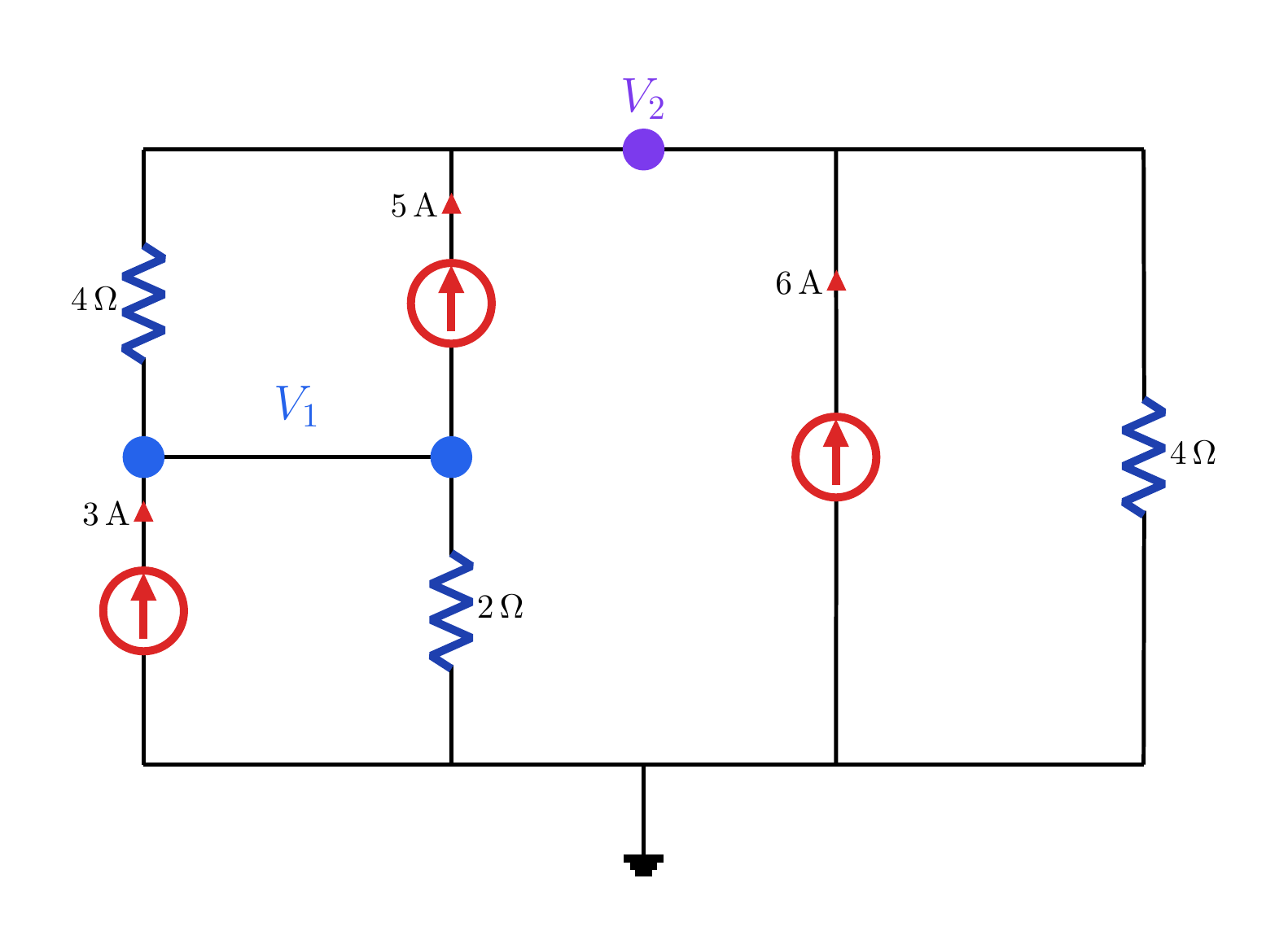
Use nodal analysis to find V_1 and V_2. Define each current-source voltage positive at the arrowhead terminal and calculate all three source voltages.
Written solution and narration transcript(shows the full solution)
Below are all the lines written in the notebook together with the full narration transcript.
1. Same method, two new twists
Source between two nodes ⇒ opposite KCL signsFirst solve V1 and V2Then calculate the source voltagesNarration transcript
Welcome back. In the previous video, we learned the four-step nodal analysis method and applied it to a simple two-node circuit. Today, we use the same method on a richer circuit with a few new twists. First, one of our current sources sits between the two non-reference nodes, not between a node and ground. Second, the question this time asks us to find the voltage across each current source, not just the node voltages. Let's see how the same four steps handle this.
2. Read the circuit and source directions
The 5 A source flows from V₁ to V₂; the other two sources inject current from ground. 3 A → V1, 5 A: V1→V2, 6 A → V2Source-voltage + terminal = arrowhead sideNarration transcript
Here is our circuit. We have two unknown nodes, V one and V two. Node V one is connected to ground through a two-ohm resistor, and to V two through a four-ohm resistor. Node V two is connected to ground through another four-ohm resistor. Now the current sources. A three-ampere source enters node V one from below. A five-ampere source flows from V one toward V two — this is the new feature, a source sitting between two non-reference nodes. And a six-ampere source enters node V two from below. Our goal: first find V one and V two, then find the voltage across each of the three current sources.
3. KCL at node V₁
The 5 A source flows from V₁ to V₂; the other two sources inject current from ground. Multiply by 4:Narration transcript
Let's write KCL at node V one. Four terms this time. First, the two-ohm resistor to ground gives V one over two. Second, the four-ohm resistor to V two gives V one minus V two, divided by four. Now the sources. The three-ampere source is entering V one, so by the entering-leaving rule we write minus three. The five-ampere source is leaving V one toward V two, so we write plus five. Putting it all together: V one over two, plus V one minus V two over four, minus three, plus five, equals zero. Multiply through by four to clear denominators. We get two V one, plus V one minus V two, plus eight, equals zero. Combining like terms: three V one minus V two equals minus eight. That is our first equation.
4. KCL at node V₂
The 5 A source flows from V₁ to V₂; the other two sources inject current from ground. Multiply by 4:Narration transcript
Now KCL at node V two — again four terms. First, the four-ohm resistor to ground gives V two over four. Second, the same four-ohm resistor we saw before — but now seen from V two — gives V two minus V one, divided by four. Now the sources. The five-ampere source is entering V two from V one, so we write minus five. The six-ampere source also enters V two, so we write minus six. Putting it together: V two over four, plus V two minus V one over four, minus five, minus six, equals zero. Multiply through by four. We get V two, plus V two minus V one, minus forty four, equals zero. Combining: minus V one plus two V two equals forty four. That is our second equation.
5. Solve and verify
The 5 A source flows from V₁ to V₂; the other two sources inject current from ground. Both KCL checks return zeroNarration transcript
Now we solve the two equations together. Equation one: three V one minus V two equals minus eight. Equation two: minus V one plus two V two equals forty four. This time we'll use substitution. From equation one, V two equals three V one plus eight. Substitute into equation two: minus V one plus two times the quantity three V one plus eight, equals forty four. Expanding: minus V one plus six V one plus sixteen equals forty four. Five V one equals twenty eight. So V one equals five point six volts. Now back-substitute: V two equals three times five point six plus eight, which is twenty four point eight volts. Quick check at node V one: five point six over two is two point eight. Five point six minus twenty four point eight, over four, is minus four point eight. Add the source terms: minus three plus five gives plus two. Total: two point eight minus four point eight plus two equals zero. Our solution is correct.
6. Voltages across the current sources
The 5 A source flows from V₁ to V₂; the other two sources inject current from ground. + terminal = arrowhead, where source current exitsReverse polarity changes only the signNarration transcript
Now the second part of the question: find the voltage across each current source. We use Kirchhoff's voltage law, which simply says the voltage across any element equals the difference of node voltages at its terminals. The three-ampere source sits between V one and ground. So its voltage is V one minus zero, which is five point six volts. The five-ampere source sits between V one and V two, with current flowing from V one toward V two. Its voltage is V two minus V one, which is twenty four point eight minus five point six, equals nineteen point two volts. And the six-ampere source sits between V two and ground. Its voltage is V two minus zero, which is twenty four point eight volts. Notice the sign convention: the plus terminal of each source is on the side where the current exits.
7. Result and sign summary
Use opposite signs for an inter-node sourceElement voltage = selected node-voltage differenceDefine polarity before calculatingBack-check the result with KCLNarration transcript
Three takeaways from this example. First, the same four-step nodal method works even when a current source sits between two non-reference nodes. Just write the source on both nodes' equations with opposite signs. Second, once you know the node voltages, the voltage across any element is simply the difference of the node voltages at its terminals. And third, the plus terminal of a current source is always on the side where the current exits the source. In the next video, we'll tackle a three-node example.
Source video: Circuit Theory #09 | Nodal Analysis Example 2 — Voltage Across Each Source (6:06)