Circuit Theory 1 · Circuit Analysis Fundamentals
#11 Nodal analysis example 4 — voltage source connected to ground
Shows why a grounded 6 V source fixes its adjacent node voltage, then verifies Vₐ=24/11≈2.182 V using KCL.
Question
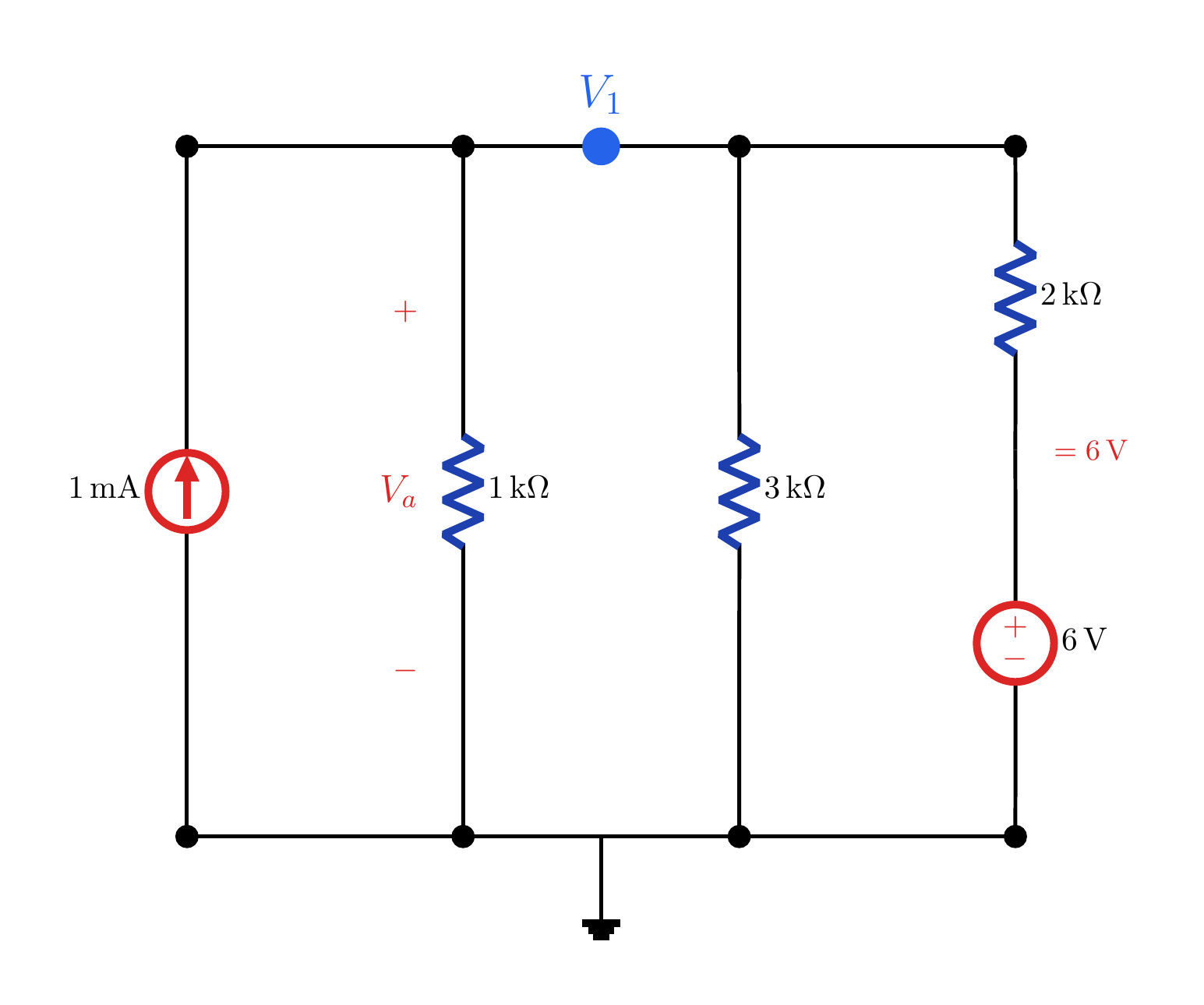
Use nodal analysis to find V_a. Explicitly use the known voltage at the far end of the 2 kΩ resistor created by the 6 V source connected to ground.
Written solution and narration transcript(shows the full solution)
Below are all the lines written in the notebook together with the full narration transcript.
1. What does a voltage source change?
The upper terminal of the 6 V source is the known +6 V node; Vₐ is measured from the top of 1 kΩ to ground. New element: a 6 V source tied to groundIts upper terminal is a known +6 V nodeIt adds no unknownNarration transcript
In our previous examples, every circuit had only resistors and current sources. That made nodal analysis straightforward — resistor currents are simply voltage over resistance, and current sources plug directly into KCL. Today, a new element appears: a voltage source. The question is, how does a voltage source affect the node method? Let's find out.
2. Read the circuit and known node
The upper terminal of the 6 V source is the known +6 V node; Vₐ is measured from the top of 1 kΩ to ground. Only unknown node: V1Right resistor lies between V1 and the known 6 V nodeNarration transcript
Here is the circuit. A one-milliamp current source on the left pushes current upward into the top node. Three resistors connect that top node to the bottom ground rail: one kilohm on the left, three kilohms in the middle, and two kilohms on the right. But notice the right branch: the two-kilohm resistor is in series with a six-volt source whose positive terminal sits at six volts above ground. This means the junction between the two-kilohm resistor and the six-volt source has a known voltage — it is simply six volts. So we still have only one unknown node at the top, which we call V one. V sub a is measured across the one-kilohm resistor, from V one to ground, so V sub a equals V one. Our task: find V sub a.
3. KCL at node V₁
The upper terminal of the 6 V source is the known +6 V node; Vₐ is measured from the top of 1 kΩ to ground. Multiply by 6k:Narration transcript
Let's write KCL at node V one. We sum all currents leaving through resistors and subtract the current entering from the source. The one-kilohm branch carries V one over one k. The three-kilohm branch carries V one over three k. The two-kilohm branch: the far end is at six volts, so the current leaving V one is V one minus six, over two k. The one-milliamp source enters V one, so we write minus one m. Setting the sum to zero: V one over one k, plus V one over three k, plus V one minus six over two k, minus one m, equals zero. To clear the denominators, multiply everything by six k. We get six V one, plus two V one, plus three times V one minus six, minus six, equals zero. Combining: eleven V one minus twenty-four equals zero. So eleven V one equals twenty-four.
4. Find and verify Vₐ
The upper terminal of the 6 V source is the known +6 V node; Vₐ is measured from the top of 1 kΩ to ground. 2.182+0.727−1.909=1 mANarration transcript
Dividing both sides by eleven: V one equals twenty-four over eleven, which is approximately two point one eight two volts. Since V sub a is measured from V one to ground, V sub a equals V one, which is also two point one eight two volts. Let's verify. V one over one k is about two point one eight milliamps. V one over three k is about zero point seven three milliamps. V one minus six over two k is about negative one point nine one milliamps. Adding: two point one eight plus zero point seven three minus one point nine one equals one milliamp, which matches the source. Correct.
5. Grounded-source rule
The upper terminal of the 6 V source is the known +6 V node; Vₐ is measured from the top of 1 kΩ to ground. One source terminal at ground ⇒ other node knownWrite KCL only at unknown nodesSource between two unknown nodes ⇒ supernodeNarration transcript
Here is the key insight from this example. When a voltage source has one terminal connected to the reference node — ground — the other terminal's voltage is immediately known. It does not add an unknown; it actually reduces the number of unknowns. But what happens when a voltage source sits between two non-reference nodes, where neither voltage is known? That creates a special structure called a supernode — and that is exactly what we will tackle in the next video.
Source video: Circuit Theory #11 | Nodal Analysis Example 4 — Voltage Source to Ground (3:44)