Communication Basics · Nyquist Sampling and a 64-kbit/s Raw PCM Calculation
#21 separate DC and 1/4-kHz components in a composite analog signal, distinguish the 8-kHz textbook Nyquist bound from a realizable sample rate, calculate 8 bits for 256 levels and a 64-kbit/s raw PCM rate, then evaluate 5/32-kHz sampling and voice/video scope
Extract the 4-kHz highest component, then separate the 8-kHz theoretical Nyquist bound, 8-bit quantization, and 64-kbit/s raw PCM result from real-system assumptions.
Question
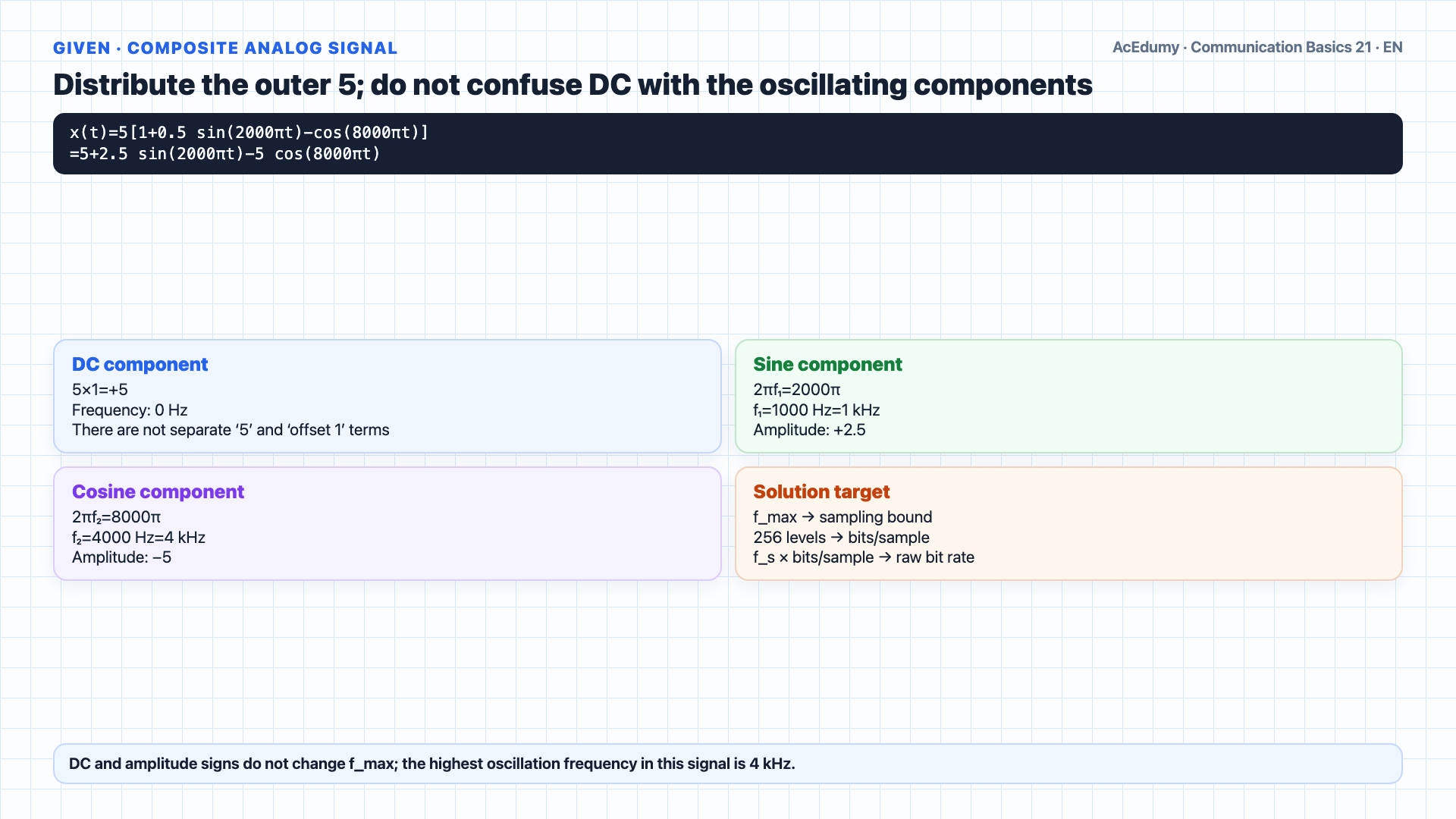
Decompose x(t)=5[1+0.5sin(2000πt)-cos(8000πt)]; derive f_max=4 kHz and the 8-ksample/s textbook Nyquist rate, identify equality as a critical endpoint and reserve a guard band for a realizable filter; calculate 8 bits/sample for 256 fixed-length levels and a 64-kbit/s raw rate; compare 5 and 32 ksample/s through aliasing, data rate, and oversampling benefits; explicitly bound the G.711 and 6-MHz video arithmetic.
Written solution and narration transcript(shows the full solution)
Below are all the lines written in the notebook together with the full narration transcript.
1. Expand the composite signal and set the solution goals
8 ksample/s is a textbook lower bound; a realizable design separately needs filter guard band, anti-aliasing, quantizer range, and format assumptions. Welcome.Today we work through the classic Nyquist and PCM calculation that turns an analog signal into a digital bit stream.Here is our analog signal: x(t) equals five times the quantity one plus zero point five sine of two thousand pi t minus cosine of eight thousand pi t.Our job is to find three things.First, the textbook sampling lower bound for an ideal bandlimited model and the margin needed by a realizable design.Second, the number of bits per sample if we use two hundred fifty six quantization levels.Third, the minimum digital bit rate.Narration transcript
Welcome. Today we work through the classic Nyquist and P C M calculation that turns an analog signal into a digital bit stream. Here is our analog signal: x of t equals five times the quantity one plus zero point five sine of two thousand pi t minus cosine of eight thousand pi t. Our job is to find three things. First, the minimum sampling rate needed to capture this signal without losing information. Second, the number of bits per sample if we use two hundred fifty six quantization levels. Third, the minimum digital bit rate.
2. Find f_max from the DC, 1-kHz, and 4-kHz components
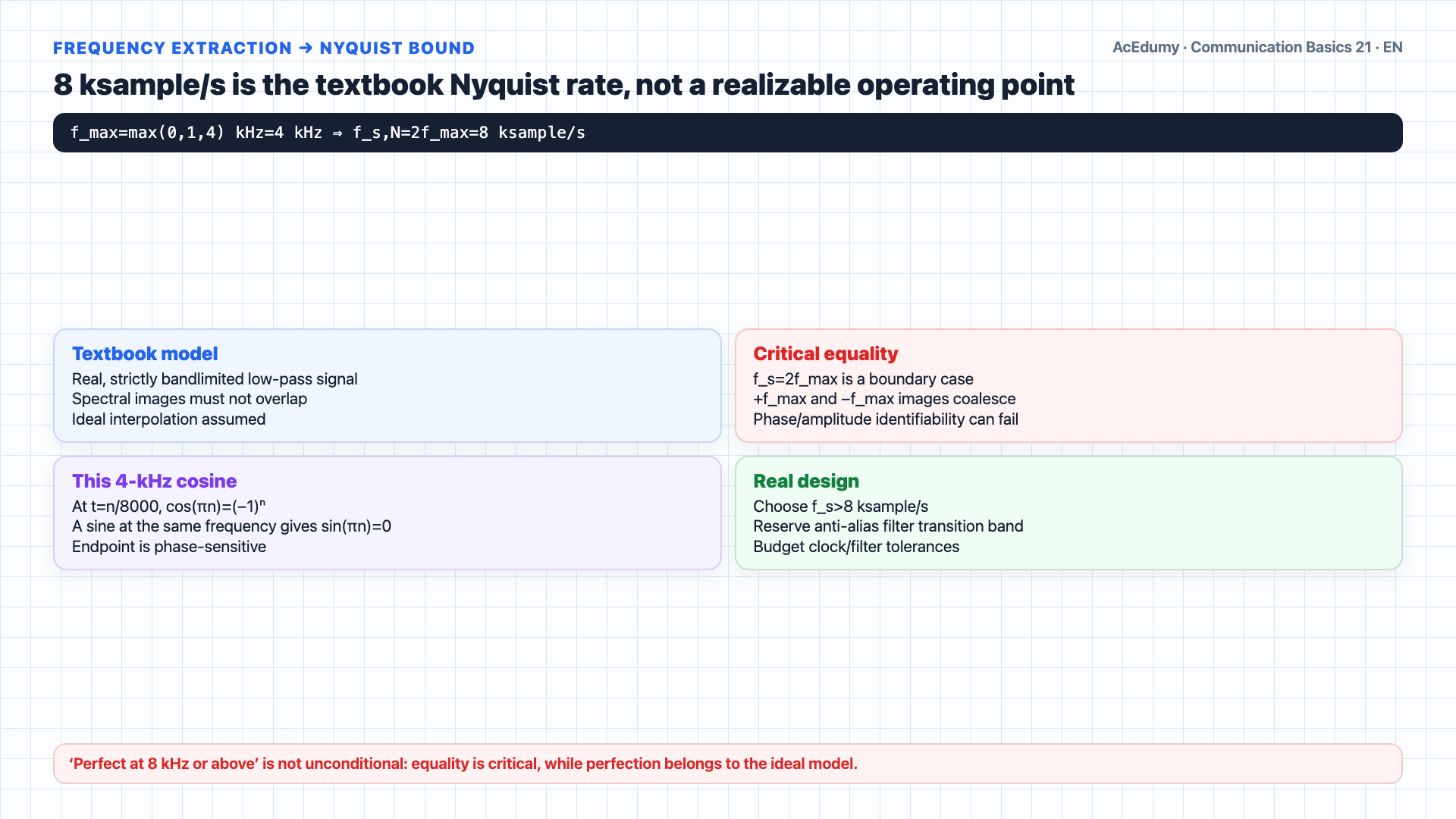
8 ksample/s is a textbook lower bound; a realizable design separately needs filter guard band, anti-aliasing, quantizer range, and format assumptions. Step one: find the maximum frequency in the signal.The signal has two oscillating components.The first is sine of two thousand pi t.We compare with the standard form sine of two pi f t.Setting two pi f equal to two thousand pi gives f equals one thousand hertz, or one kilohertz.The second is cosine of eight thousand pi t.Setting two pi f equal to eight thousand pi gives f equals four thousand hertz, or four kilohertz.After distributing the outer 5, the DC component is +5; this non-oscillating term has frequency 0 Hz.The maximum frequency in the signal is the larger of the two: fmax equals four kilohertz.Narration transcript
Step one: find the maximum frequency in the signal. The signal has two oscillating components. The first is sine of two thousand pi t. We compare with the standard form sine of two pi f t. Setting two pi f equal to two thousand pi gives f equals one thousand hertz, or one kilohertz. The second is cosine of eight thousand pi t. Setting two pi f equal to eight thousand pi gives f equals four thousand hertz, or four kilohertz. The constant term five and the D C offset one do not oscillate, so they contribute zero frequency. The maximum frequency in the signal is the larger of the two: f max equals four kilohertz.
3. Separate the 8-kHz textbook bound from a realizable sample rate
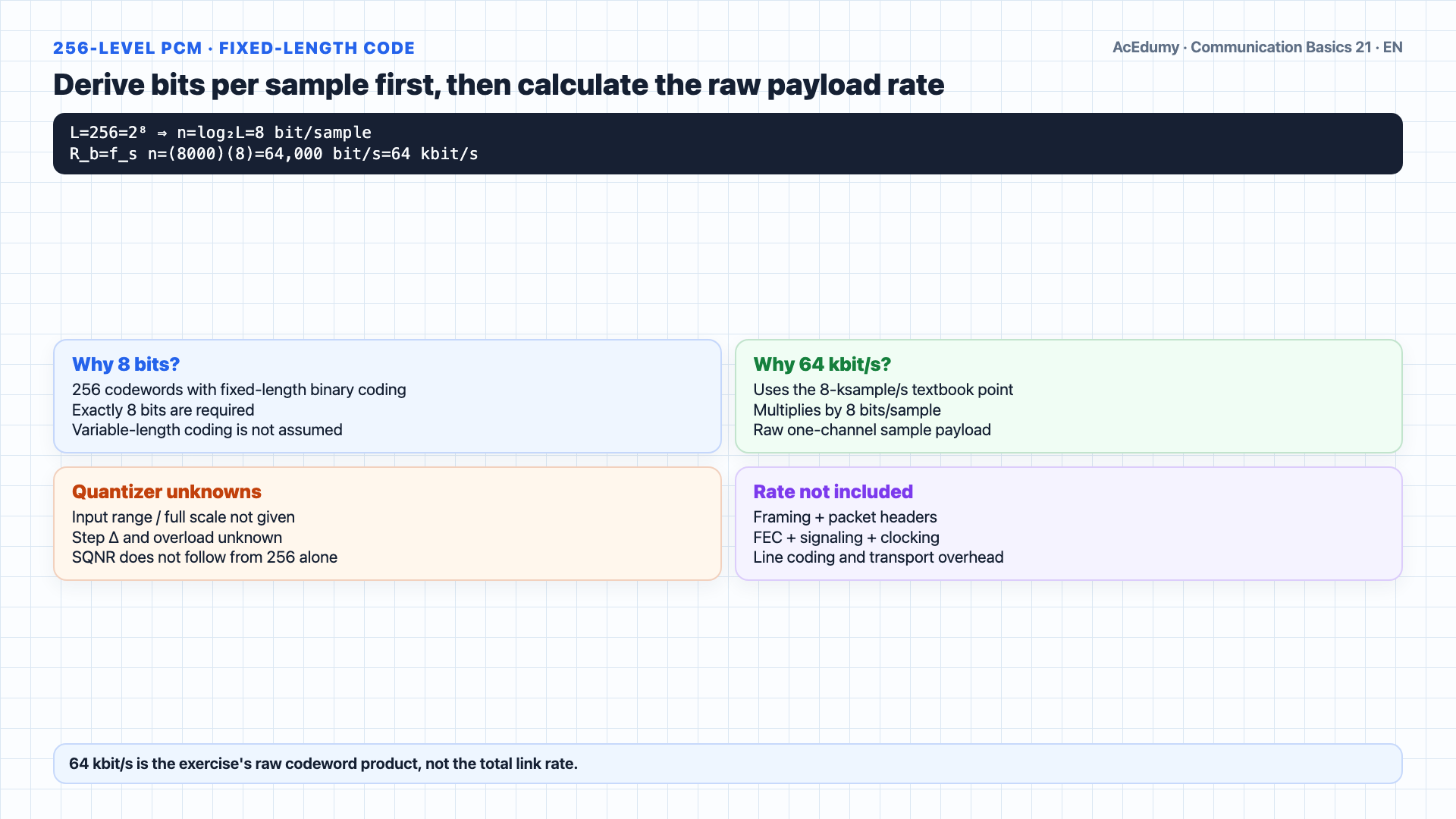
8 ksample/s is a textbook lower bound; a realizable design separately needs filter guard band, anti-aliasing, quantizer range, and format assumptions. Step two: apply the Nyquist sampling theorem.For an ideal strictly bandlimited real-signal model, the textbook Nyquist rate is 2fmax; equality is a critical endpoint case.The textbook lower bound is fs,N=2fmax; a realizable anti-alias filter normally calls for fs>2fmax and a transition guard band.That is two times four thousand, which gives eight thousand samples per second.This is written as eight kilohertz or eight K samples per second.8 ksample/s is the theoretical boundary here; a sinusoid at fs/2 can lose phase/amplitude identifiability, and perfect reconstruction also assumes ideal bandlimiting and interpolation.With this baseband model and no extra structure, sampling below 8 ksample/s creates aliasing, so the original components are not uniquely determined by the samples.Narration transcript
Step two: apply the Nyquist sampling theorem. Nyquist tells us that to capture a signal without losing information, we must sample at least twice the maximum frequency. The minimum sampling rate is f s equals two times f max. That is two times four thousand, which gives eight thousand samples per second. This is written as eight kilohertz or eight K samples per second. If we sample at this rate or higher, we can perfectly reconstruct the original analog signal. If we sample below this rate, aliasing occurs and information is permanently lost.
4. Derive 8 bits from 256 levels and calculate 64 kbit/s raw
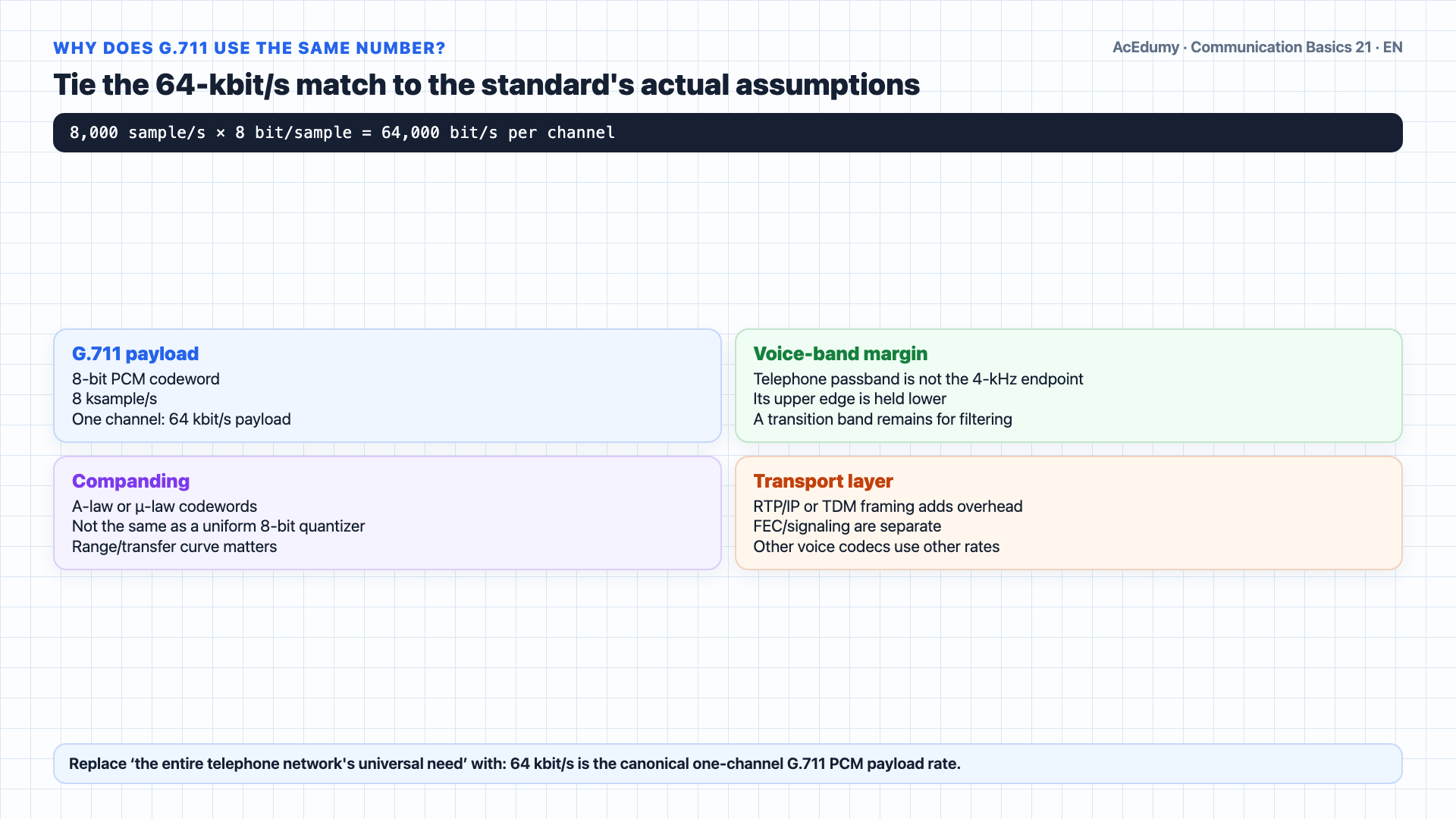
8 ksample/s is a textbook lower bound; a realizable design separately needs filter guard band, anti-aliasing, quantizer range, and format assumptions. Step three: quantization and bit rate.Each sample is a voltage value that must be represented as a binary number.The problem says we use two hundred fifty six quantization levels.How many bits do we need?L=256=28, so fixed-length binary coding needs 8 bits per sample.So each sample requires eight bits.Now the bit rate.We take eight thousand samples every second, and each sample is eight bits.Bit rate equals sampling rate times bits per sample.Eight thousand times eight equals sixty four thousand bits per second, which is sixty four kilobits per second.This number should look familiar.64 kbit/s is the one-channel G.711 PCM payload rate from 8 ksample/s and 8-bit codewords; packet/framing/FEC overhead and other codecs are separate.Narration transcript
Step three: quantization and bit rate. Each sample is a voltage value that must be represented as a binary number. The problem says we use two hundred fifty six quantization levels. How many bits do we need? Two hundred fifty six equals two to the power of eight. So each sample requires eight bits. Now the bit rate. We take eight thousand samples every second, and each sample is eight bits. Bit rate equals sampling rate times bits per sample. Eight thousand times eight equals sixty four thousand bits per second, which is sixty four kilobits per second. This number should look familiar. Sixty four kilobits per second is the standard P C M digital voice channel, the fundamental building block of the entire telephone network.
5. Evaluate 5 and 32 ksample/s via aliasing and oversampling
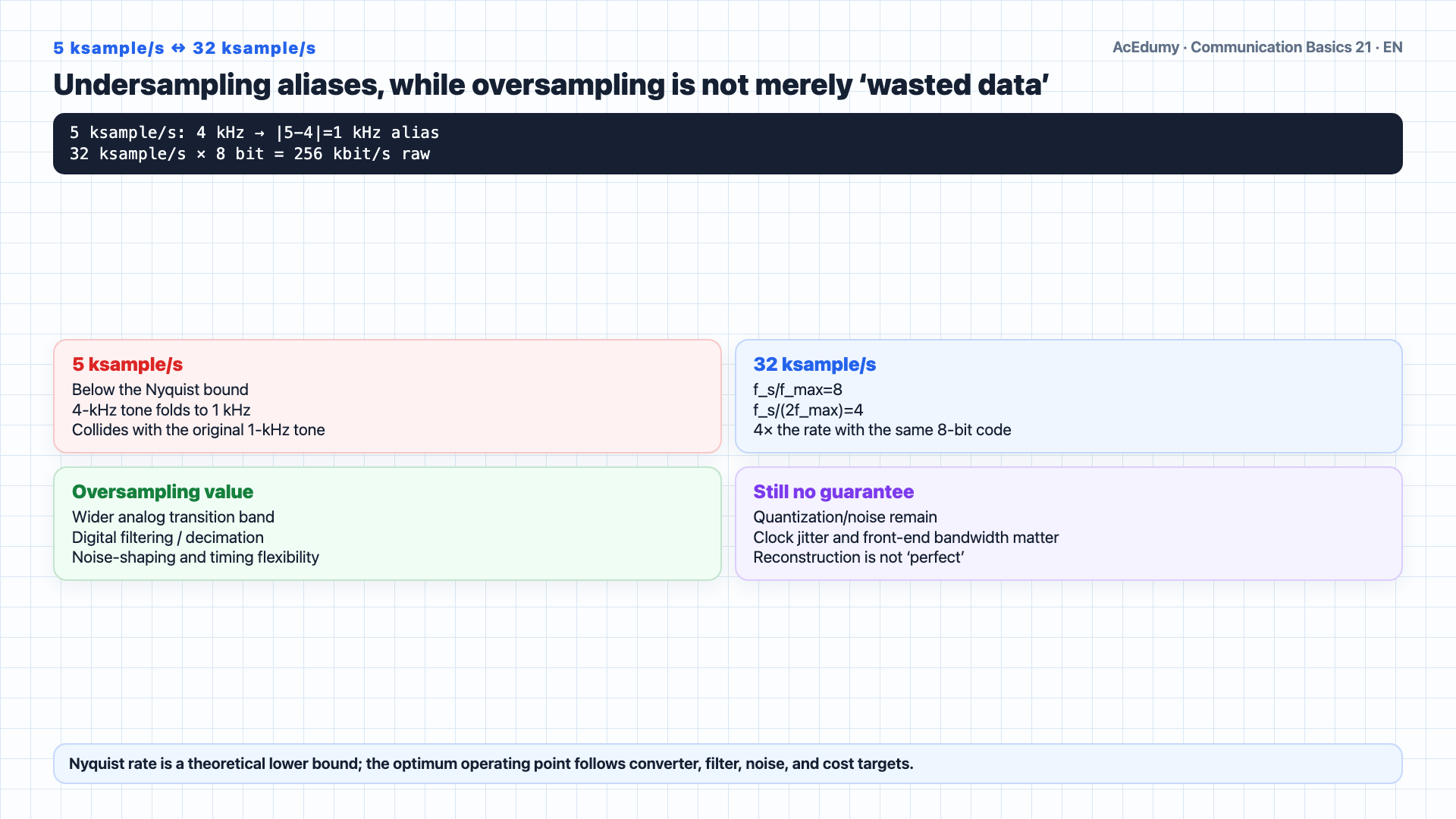
8 ksample/s is a textbook lower bound; a realizable design separately needs filter guard band, anti-aliasing, quantizer range, and format assumptions. What happens if we change the sampling rate?First choose a lower rate: fs=5 ksample/s.Wait, five kilohertz is only one point two five times fmax.That is below the Nyquist rate of eight kilohertz.At 5 ksample/s the 4-kHz component aliases to 1 kHz and collides with the original 1-kHz component, losing identifiability in this problem.Now suppose we use a much higher rate, like thirty two kilohertz.fs=32 ksample/s is 8 times fmax and 4 times the textbook Nyquist rate.Keeping the same fixed 8-bit code makes the raw rate 32,000×8=256 kbit/s; reconstruction quality still depends on filtering, quantization, and noise.The sample count rises 4×; oversampling can relax anti-alias/reconstruction filters and help timing or noise-shaping design.8 ksample/s is this exercise's textbook bound; the engineering operating point depends on filter transition band, clock tolerance, noise, and converter architecture.Narration transcript
What happens if we change the sampling rate? Suppose we use a higher rate, say five kilohertz sampling. Wait, five kilohertz is only one point two five times f max. That is below the Nyquist rate of eight kilohertz. The signal will be recovered with a loss of information, which is not acceptable. Now suppose we use a much higher rate, like thirty two kilohertz. That is four times f max. The signal will be recovered perfectly, but the bit rate jumps to thirty two thousand times eight equals two hundred fifty six kilobits per second. Four times the data for no extra information. The Nyquist rate is the sweet spot: the minimum rate that preserves everything.
6. Bound the G.711 voice and 6-MHz video arithmetic
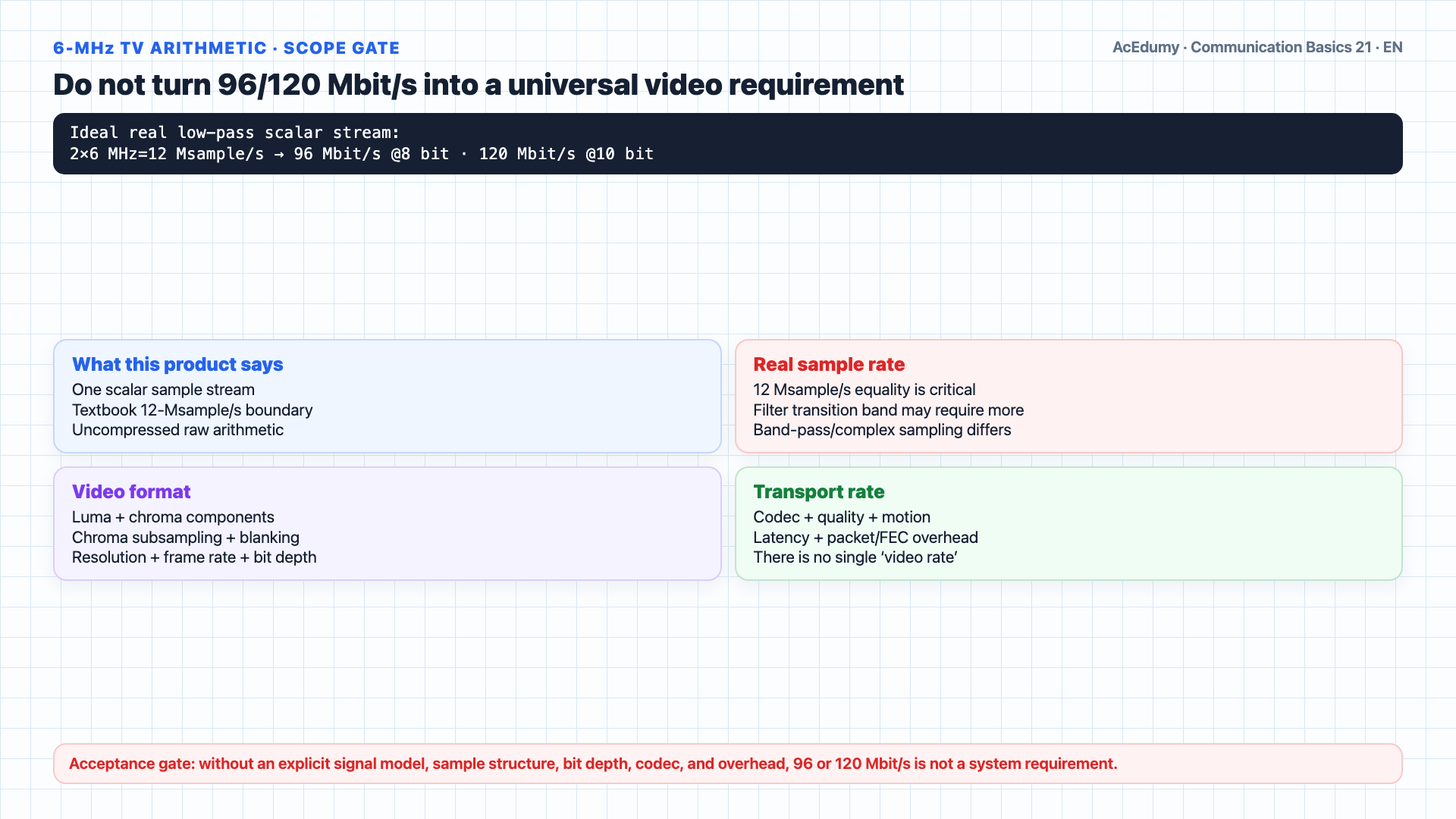
8 ksample/s is a textbook lower bound; a realizable design separately needs filter guard band, anti-aliasing, quantizer range, and format assumptions. Let us summarize the full chain.Start with an analog signal.Extract the maximum frequency: four kilohertz.Apply Nyquist: sample at two times four, eight thousand samples per second.Quantize: two hundred fifty six levels means eight bits per sample.Multiply: eight thousand times eight equals sixty four kilobits per second.This arithmetic matches one 64-kbit/s G.711 PCM payload channel; the telephony voice passband stays below the 4-kHz endpoint.The same product scales for one real low-pass sample stream with fixed bits/sample; band-pass/complex sampling and multi-component formats require separate models.For a six megahertz TV signal: two times six megahertz equals twelve million samples per second.For an ideal 6-MHz real low-pass scalar stream, 12 Msample/s × 8 bit=96 Mbit/s is textbook raw-bound arithmetic.Under the same assumptions, 12 Msample/s × 10 bit=120 Mbit/s; a realizable sample rate may be higher than 12 Msample/s.Real video rate also depends on component/chroma sampling, resolution, frame rate, blanking, codec, quality, and overhead; 96/120 Mbit/s is not a universal video requirement.Narration transcript
Let us summarize the full chain. Start with an analog signal. Extract the maximum frequency: four kilohertz. Apply Nyquist: sample at two times four, eight thousand samples per second. Quantize: two hundred fifty six levels means eight bits per sample. Multiply: eight thousand times eight equals sixty four kilobits per second. That is one standard voice channel. The same method scales to any bandwidth. For a six megahertz TV signal: two times six megahertz equals twelve million samples per second. At eight bits per sample, that is ninety six megabits per second. At ten bits, one hundred twenty megabits per second. From voice to video, the recipe never changes: frequency, sampling, quantization, bit rate.
Source video: Communication Basics #21 Worked Example: Nyquist Theorem & PCM (4:56)