Antenna Theory · Observation Point, Vector Potential, and the Far-Field Road
#04 The chain from power at an observation point through the Poynting vector and E/H fields, plus vector potential A and the r, r′, R geometry
Separate source, origin, and observer geometry to prepare the route from vector potential to far-field methods.
Question
Set up the field-and-power question at an antenna observation point; explain the roles of the Poynting vector, E/H fields, and vector potential A, then distinguish the r, r′, and R position vectors.
Written solution and narration transcript(shows the full solution)
Below are all the lines written in the notebook together with the full narration transcript.
1. Set up the field and power question at P
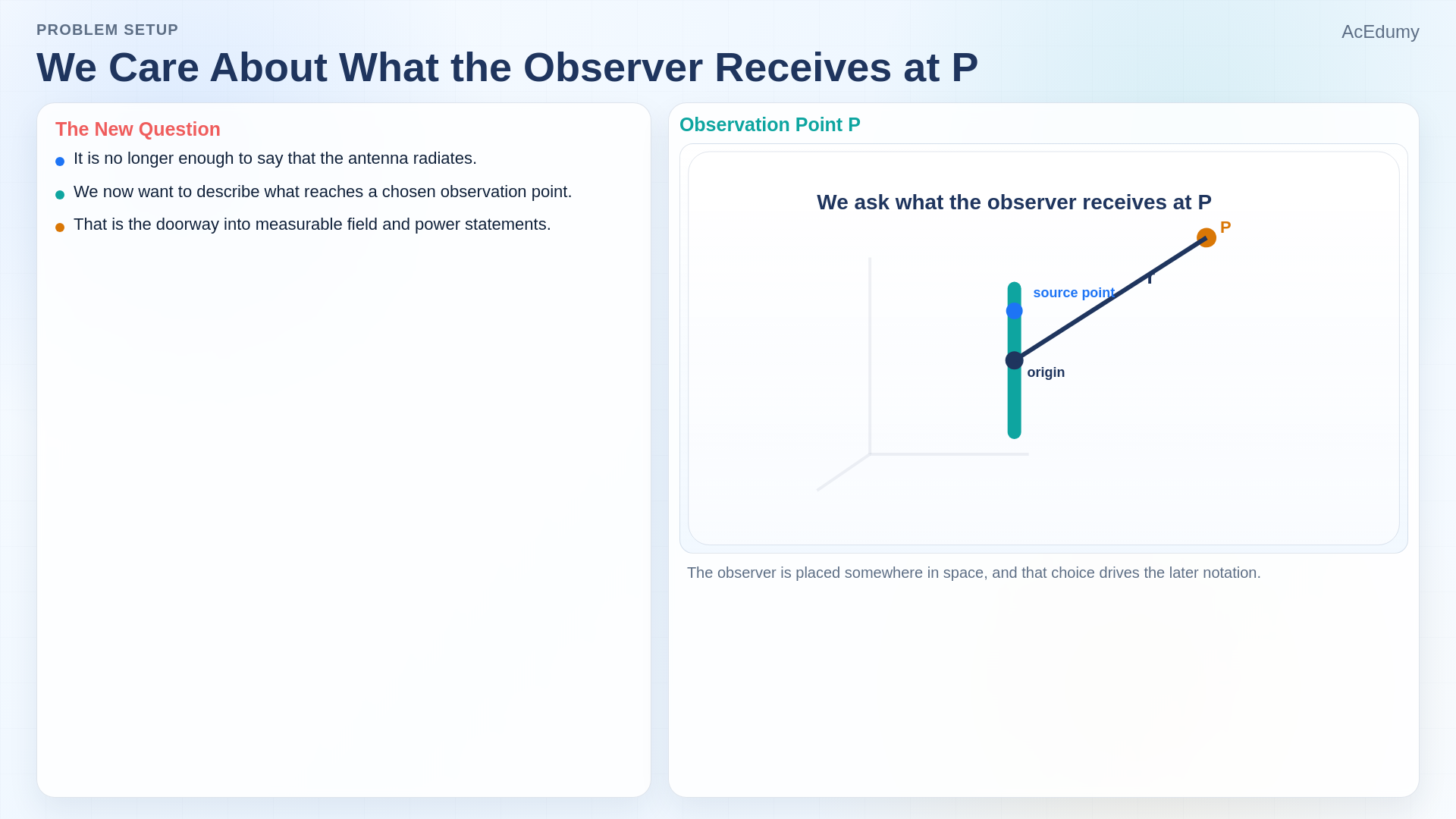
Once the geometry is separated, r, r′, and R become meaningful position records for the far-field calculation. In this lesson, we stop saying only that the antenna radiates.We now ask a more serious engineering question.At a chosen observation point, usually written as the observation point P, what field and power does an observer actually receive?That question is the doorway into the first real theory language of antenna analysis.Narration transcript
In this lesson, we stop saying only that the antenna radiates. We now ask a more serious engineering question. At a chosen observation point, usually written as the point P, what field and power does an observer actually receive? That question is the doorway into the first real theory language of antenna analysis.
2. Build the power, Poynting-vector, and E/H chain

Once the geometry is separated, r, r′, and R become meaningful position records for the far-field calculation. If we care about power at the observation point, then the Poynting vector immediately appears.And once the Poynting vector appears, we know we need both the electric field and the magnetic field.So the lesson logic becomes very clean.Power at P leads us to the Poynting vector, and the Poynting vector leads us to the pair E and H.Narration transcript
If we care about power at the observation point, then the Poynting vector immediately appears. And once the Poynting vector appears, we know we need both the electric field and the magnetic field. So the lesson logic becomes very clean. Power at P leads us to the Poynting vector, and the Poynting vector leads us to the pair E and H.
3. Place vector potential A in its helper role

Once the geometry is separated, r, r′, and R become meaningful position records for the far-field calculation. But antenna theory usually does not jump directly to E and H.Instead, it introduces the vector potential A.That does not mean A is the final goal.It means A is a helper quantity that organizes the field problem in a form engineers can work with.The real target still remains the fields, and from the fields we return to power.Narration transcript
But antenna theory usually does not jump directly to E and H. Instead, it introduces the vector potential A. That does not mean A is the final goal. It means A is a helper quantity that organizes the field problem in a form engineers can work with. The real target still remains the fields, and from the fields we return to power.
4. Separate the origin, source point, and observer
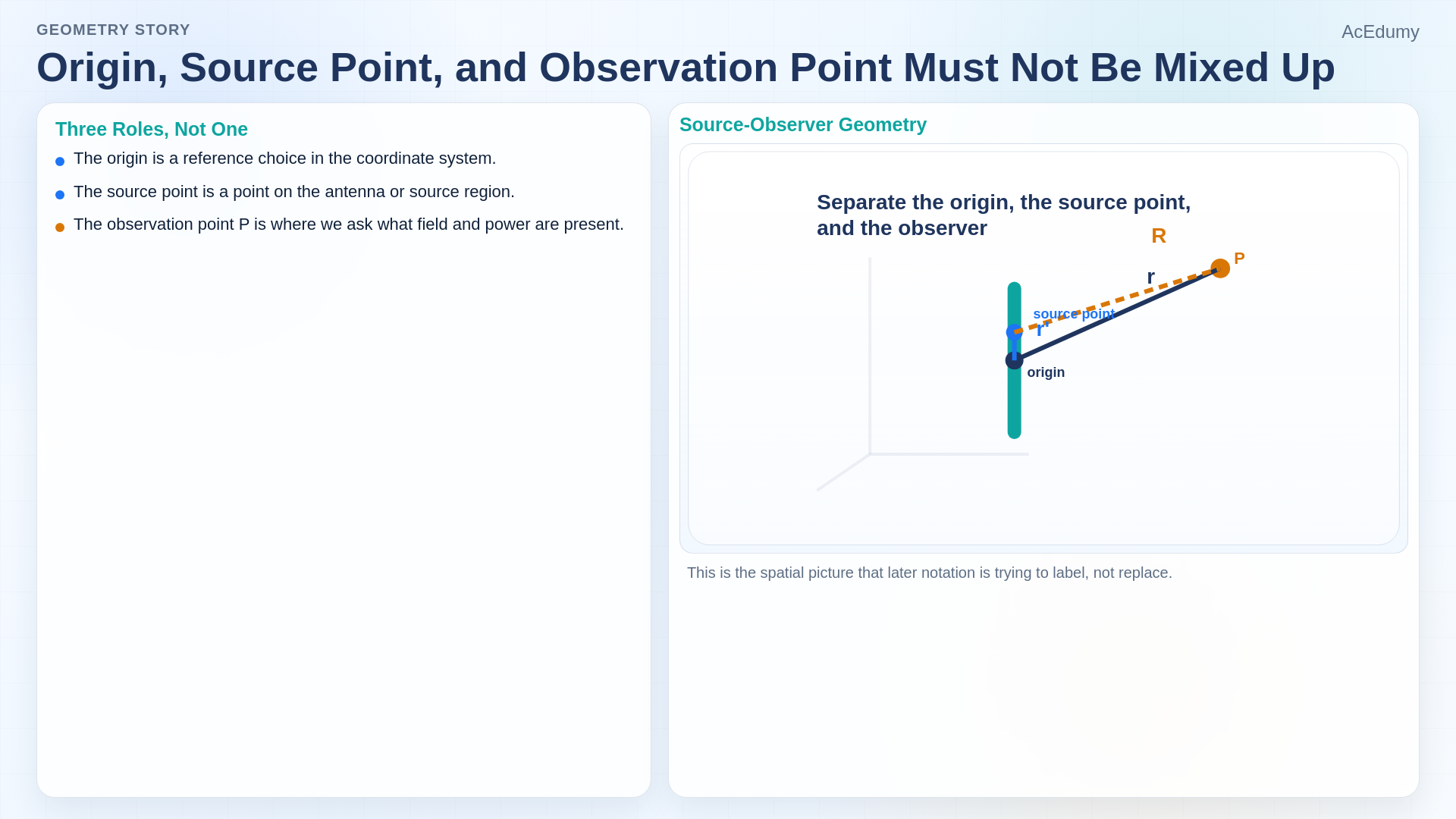
Once the geometry is separated, r, r′, and R become meaningful position records for the far-field calculation. Now the geometry must become clear.We need to separate three roles that beginners often blend together.There is the origin of the coordinate system, there is a source point on the antenna or source region, and there is the observation observation point P in space.If those roles are mixed, the notation will feel random even when the equations are correct.Narration transcript
Now the geometry must become clear. We need to separate three roles that beginners often blend together. There is the origin of the coordinate system, there is a source point on the antenna or source region, and there is the observation point P in space. If those roles are mixed, the notation will feel random even when the equations are correct.
5. Read the r, r′, and R position vectors
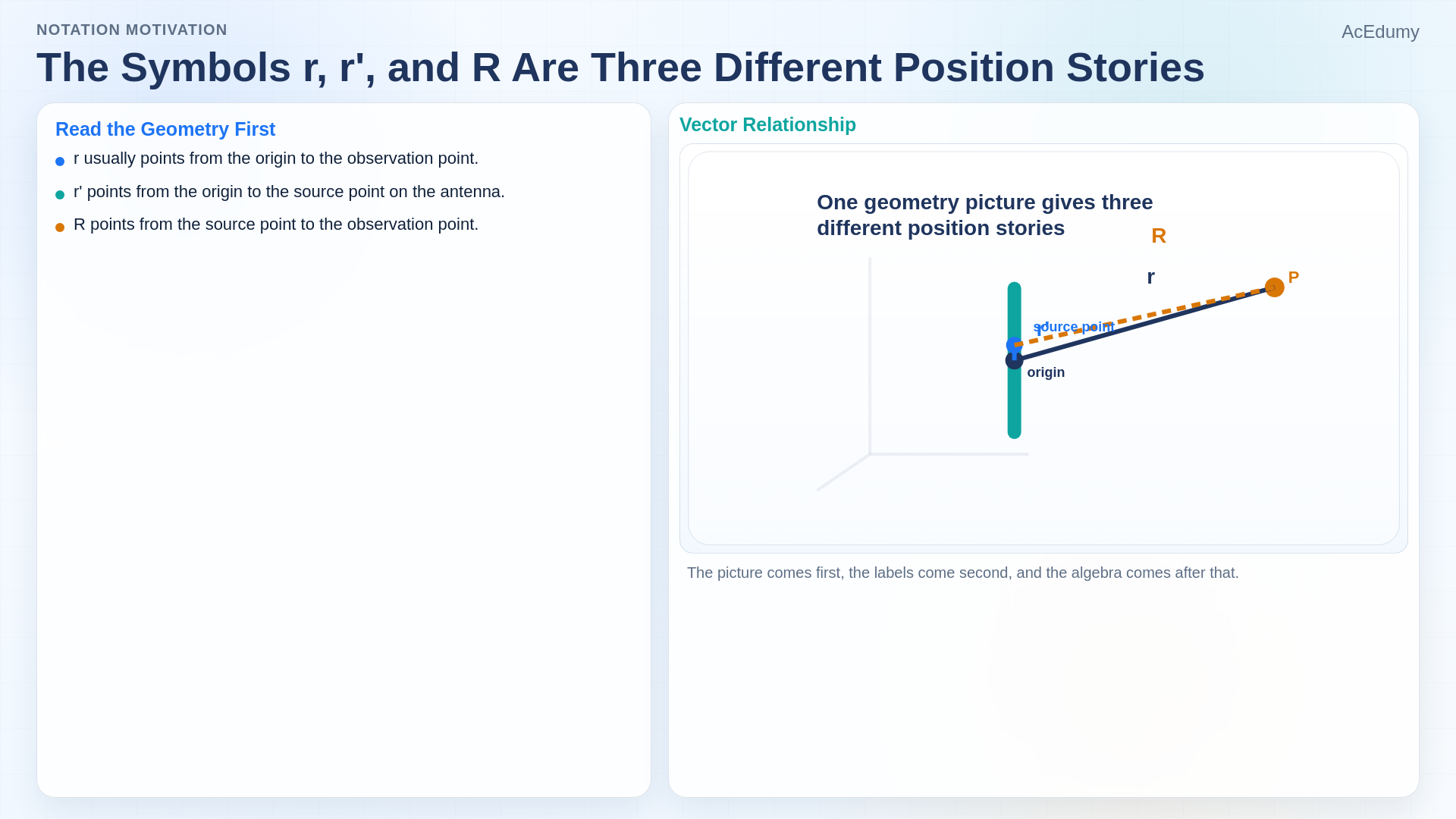
Once the geometry is separated, r, r′, and R become meaningful position records for the far-field calculation. This is why symbols such as r, r′, and R appear.They are not decoration.They label different position stories in the same picture.R usually points from the source point to the observer, r often points from the origin to the observer, and r′ points from the origin to the source point.The picture comes first, and the symbols only help us keep the geometry organized.Narration transcript
This is why symbols such as r, r prime, and capital R appear. They are not decoration. They label different position stories in the same picture. R usually points from the source point to the observer, r often points from the origin to the observer, and r prime points from the origin to the source point. The picture comes first, and the symbols only help us keep the geometry organized.
6. Connect each symbol to the two places it measures

Once the geometry is separated, r, r′, and R become meaningful position records for the far-field calculation. At this stage, the main win is not memorizing symbols mechanically.The main win is learning to ask what each symbol is measuring, and between which two places.When that habit becomes natural, later equations stop looking like a wall of unexplained letters.They begin to look like careful bookkeeping for a geometry problem.Narration transcript
At this stage, the main win is not memorizing symbols mechanically. The main win is learning to ask what each symbol is measuring, and between which two places. When that habit becomes natural, later equations stop looking like a wall of unexplained letters. They begin to look like careful bookkeeping for a geometry problem.
7. See the route to far-field approximation methods

Once the geometry is separated, r, r′, and R become meaningful position records for the far-field calculation. That is why this lesson matters before far field methods and approximation techniques.Once the observation point story, the field chain, and the geometry labels feel clear, later topics such as far field results, stationary phase, or endpoint methods feel motivated instead of mysterious.This lesson is not the end of the math.It is the moment the math finally gets a reason to exist.Narration transcript
That is why this lesson matters before far field methods and approximation techniques. Once the observation point story, the field chain, and the geometry labels feel clear, later topics such as far field results, stationary phase, or endpoint methods feel motivated instead of mysterious. This lesson is not the end of the math. It is the moment the math finally gets a reason to exist.
Source video: Antenna Theory #04 | Observation Point and Notation | Vector Potential and Far-Field Road (3:00)