Circuit Theory 1 · Circuit Fundamentals
#01 From Maxwell to Ohm's law — current, capacitors, and sources
Derive Ohm's law from Maxwell's DC limit, then connect current, the capacitor equation, and the four source types in one foundation lesson.
Question
Starting from σE = J_{es} in the DC limit, use units and lumped quantities to derive V=IR. Then define current as charge-flow rate, derive the capacitor current-voltage equation from Q=V_C C, and classify independent/dependent voltage and current sources.
Written solution and narration transcript(shows the full solution)
Below are all the lines written in the notebook together with the full narration transcript.
1. The big picture
Moving from field quantities to lumped circuit quantities produces Ohm's law. Field theory → circuit theoryDC limit:Lumped quantities → V = IRI = dq/dt and IC = C·dVC/dtSources: independent/dependent × V/INarration transcript
Circuit theory might seem like a standalone subject, but it actually originates from electromagnetic theory. Every equation we use in circuits, starting with Ohm's law, can be traced back to Maxwell's equations. Understanding this connection gives you a deeper appreciation of why these formulas work. In this first video, we'll derive Ohm's law, V equals I R, directly from Maxwell's equations. Then we'll define current and the capacitor voltage-current relationship. Finally, we'll introduce the four types of circuit sources you'll encounter throughout this course.
2. From Maxwell to Ohm's law
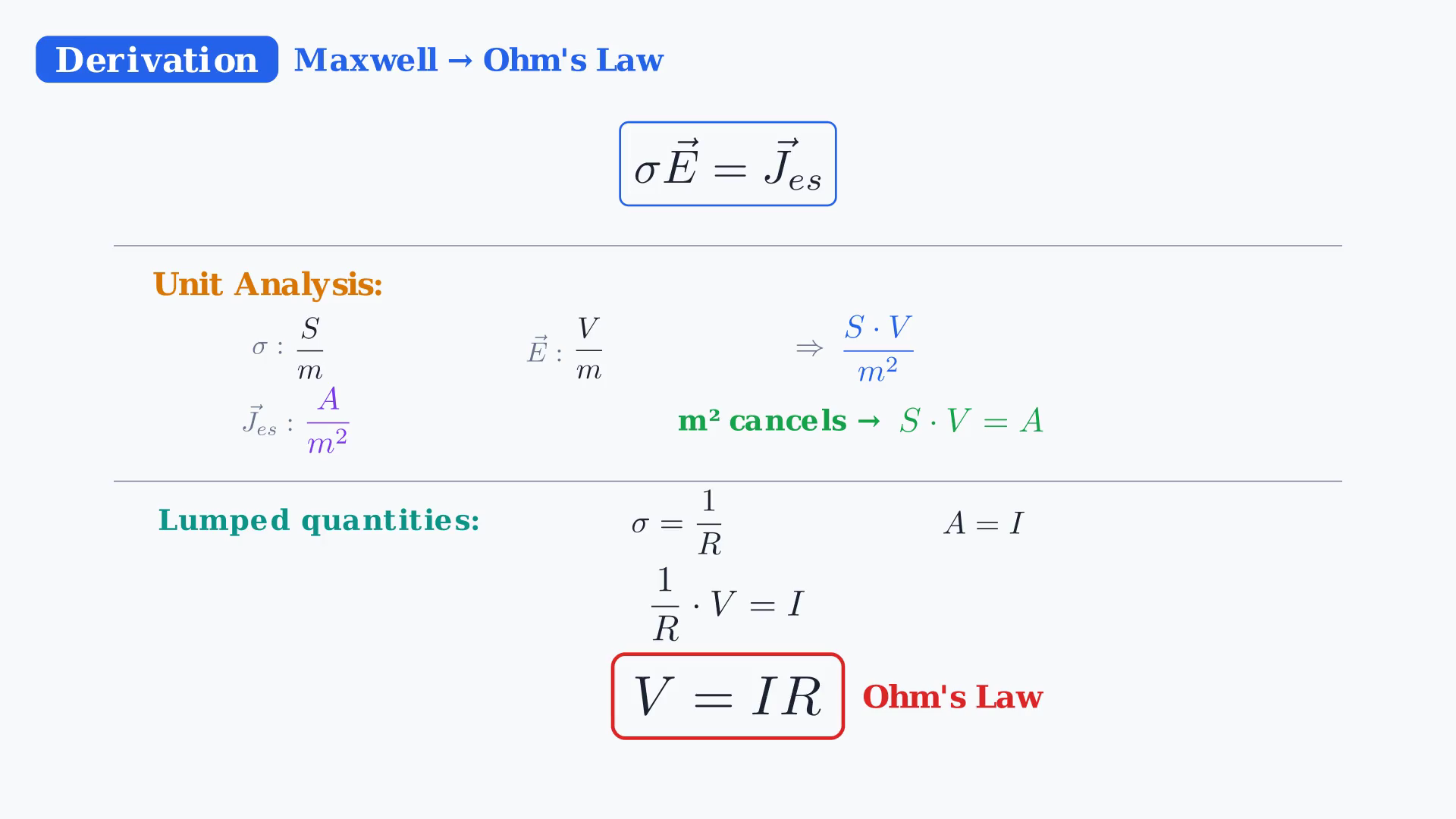
Moving from field quantities to lumped circuit quantities produces Ohm's law. At DC, dD/dt = 0σ ↔ 1/R; E ↔ V; Jes ↔ IV = IRNarration transcript
Let's begin with one of Maxwell's equations: the curl of H. In full form, it reads: curl H equals the time derivative of D, plus sigma times E, plus the external source current density, J e s. Sigma E represents the conduction current density. Sigma is the material's electrical conductivity, measured in siemens per meter. E is the electric field, in volts per meter. J e s is the current density from external sources, in amperes per meter squared. In a DC circuit, nothing changes with time, so the dD/dt term drops out. What remains is: sigma E equals J e s. Now let's examine the units on each side. On the left: siemens per meter times volts per meter gives us siemens times volts over meters squared. On the right: amperes over meters squared. The meters squared cancel from both sides. Now, conductivity sigma is the inverse of resistance: sigma equals one over R. And the current through a cross-sectional area is just I. Substituting: one over R times V equals I. Multiplying both sides by R gives us V equals I times R. And there it is: Ohm's law, derived directly from Maxwell's equations.
3. What is current?
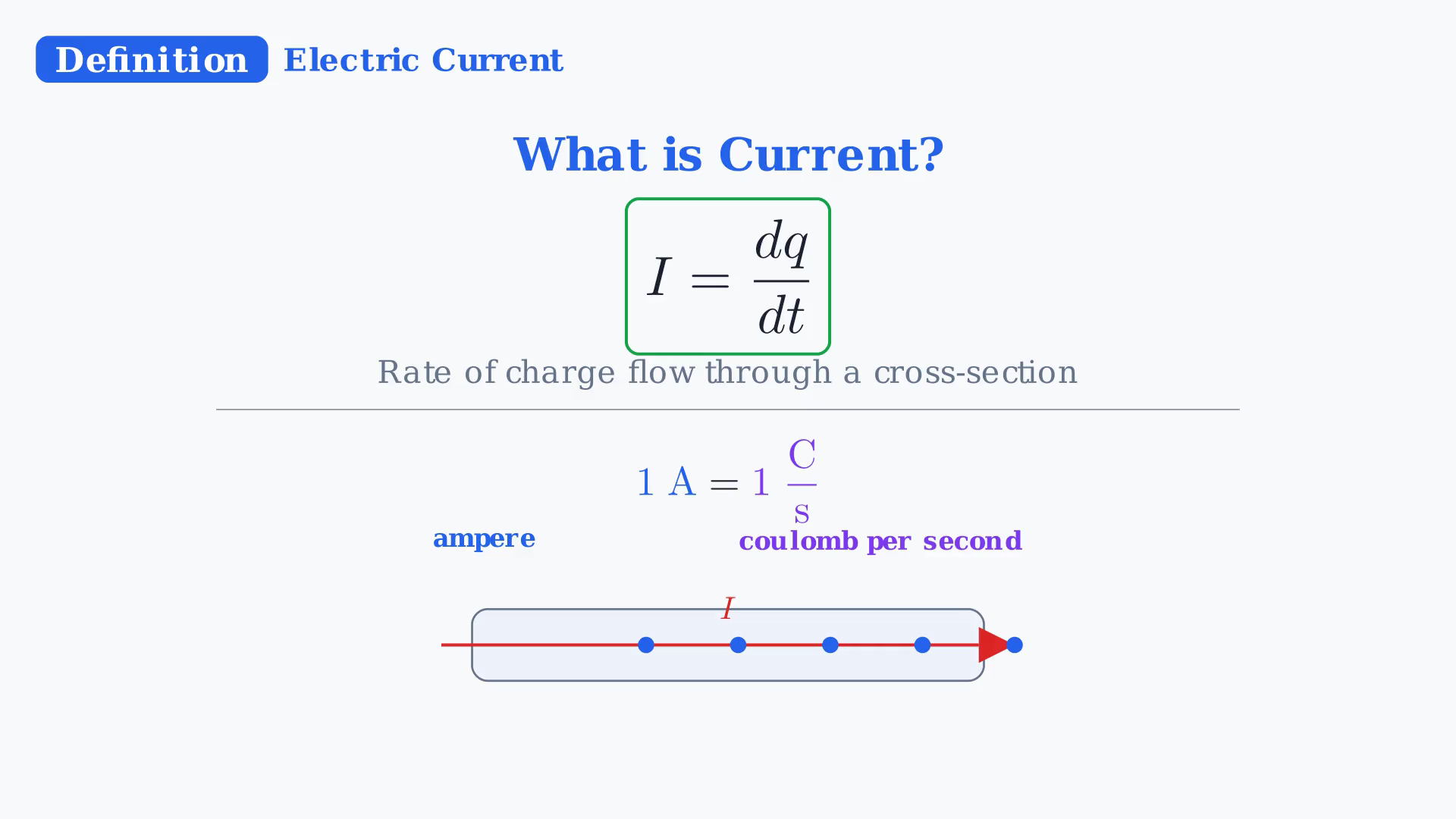
Current is the time rate of charge crossing a section. Current = rate of charge flowI = dq/dtCharge crossing a section / timeCurrent represents charge in motionNarration transcript
Now let's precisely define what current means. Current, I, equals dq over dt. It is the time rate of change of electric charge. Physically, it tells us how much charge flows through a cross-section of a conductor per unit time. If one coulomb of charge passes through in one second, that's one ampere of current. This dq over dt relationship is fundamental. Every time you see a current in a circuit, remember: it represents charge in motion.
4. The capacitor equation
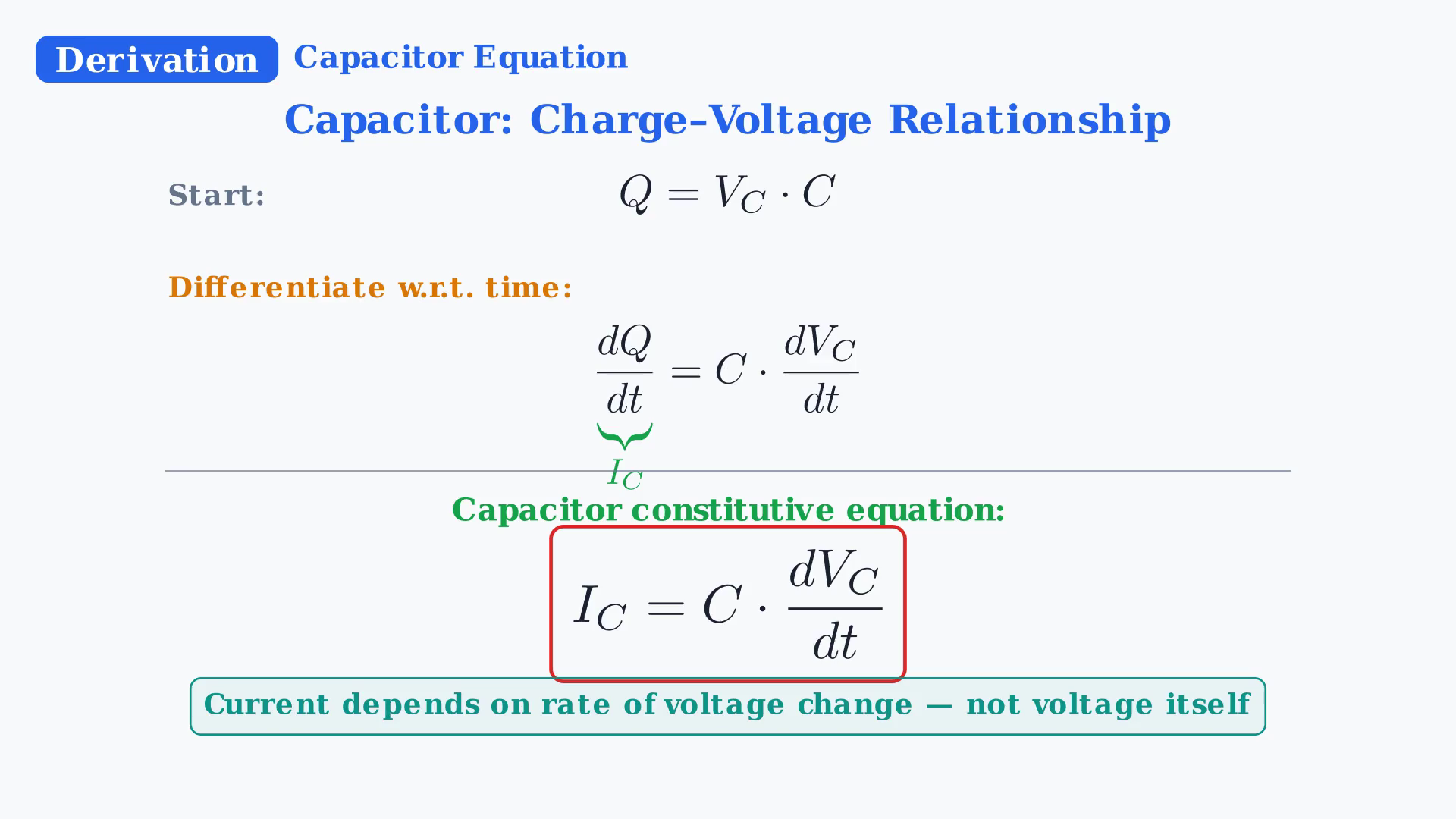
Capacitor current depends on the rate of voltage change rather than voltage alone. Start with Q = VC CDifferentiate both sides with timedQ/dt = C·dVC/dtdQ/dt = ICIC = C·dVC/dtConstant VC means IC = 0Narration transcript
A capacitor stores energy in an electric field between its plates. The charge stored relates to the voltage across it by Q equals V C, where C is the capacitance in farads. Now, what happens when the voltage changes with time? Let's differentiate both sides with respect to t. On the left side, dQ over dt is simply the current flowing into the capacitor, which we call I c. On the right side, C is a constant, so it stays outside the derivative. We get C times dVc over dt. Therefore, I c equals C times dVc over dt. This is the capacitor's constitutive equation. Notice something important: unlike a resistor where current depends directly on voltage, a capacitor's current depends on the rate of change of voltage. If the voltage is constant, no current flows through the capacitor, no matter how large that voltage is.
5. Four source types
Independent source: fixed valueDependent source: controlled by another V or IVoltage source: +/− polarityCurrent source: arrow directionCircle = independent; diamond = dependentFour basic source types in totalNarration transcript
Every circuit needs sources to drive current and establish voltages. There are two categories: independent and dependent. An independent source provides a fixed value regardless of what happens elsewhere in the circuit. We represent it with a circle. A dependent source, also called a controlled source, produces a value that depends on some other voltage or current in the circuit. We draw it as a diamond, or rhombus shape. For voltage sources, plus and minus signs indicate the polarity. For current sources, an arrow inside shows the direction of conventional current flow. This gives us four types in total: independent voltage source, dependent voltage source, independent current source, and dependent current source. You'll see independent sources in most basic circuits. Dependent sources become important when modeling transistors and operational amplifiers.
6. Foundation summary
Moving from field quantities to lumped circuit quantities produces Ohm's law. V = IRI = dq/dtIC = C·dVC/dtIndependent and dependent V/I sourcesThe building blocks for circuit analysis are readyNarration transcript
Let's wrap up with the key takeaways. Ohm's law, V equals I R, comes directly from Maxwell's equations. It's not just an empirical rule; it has a theoretical foundation. Current is defined as the rate of charge flow: I equals dq over dt. The capacitor current-voltage relationship is I c equals C times dVc over dt. And we have four source types: independent and dependent, each in voltage and current variants, drawn as circles and diamonds respectively. With these building blocks in place, we're ready to start analyzing circuits in the next video.
Source video: Circuit Theory #01 — Ohm's Law from Maxwell's Equations (5:38)