Circuit Theory 1 · Operational Amplifiers
#36 Operational Amplifiers #36 — Solved op-amp problems
Solves five inverting, summing, integrating, and cascaded op-amp problems step by step.
Question
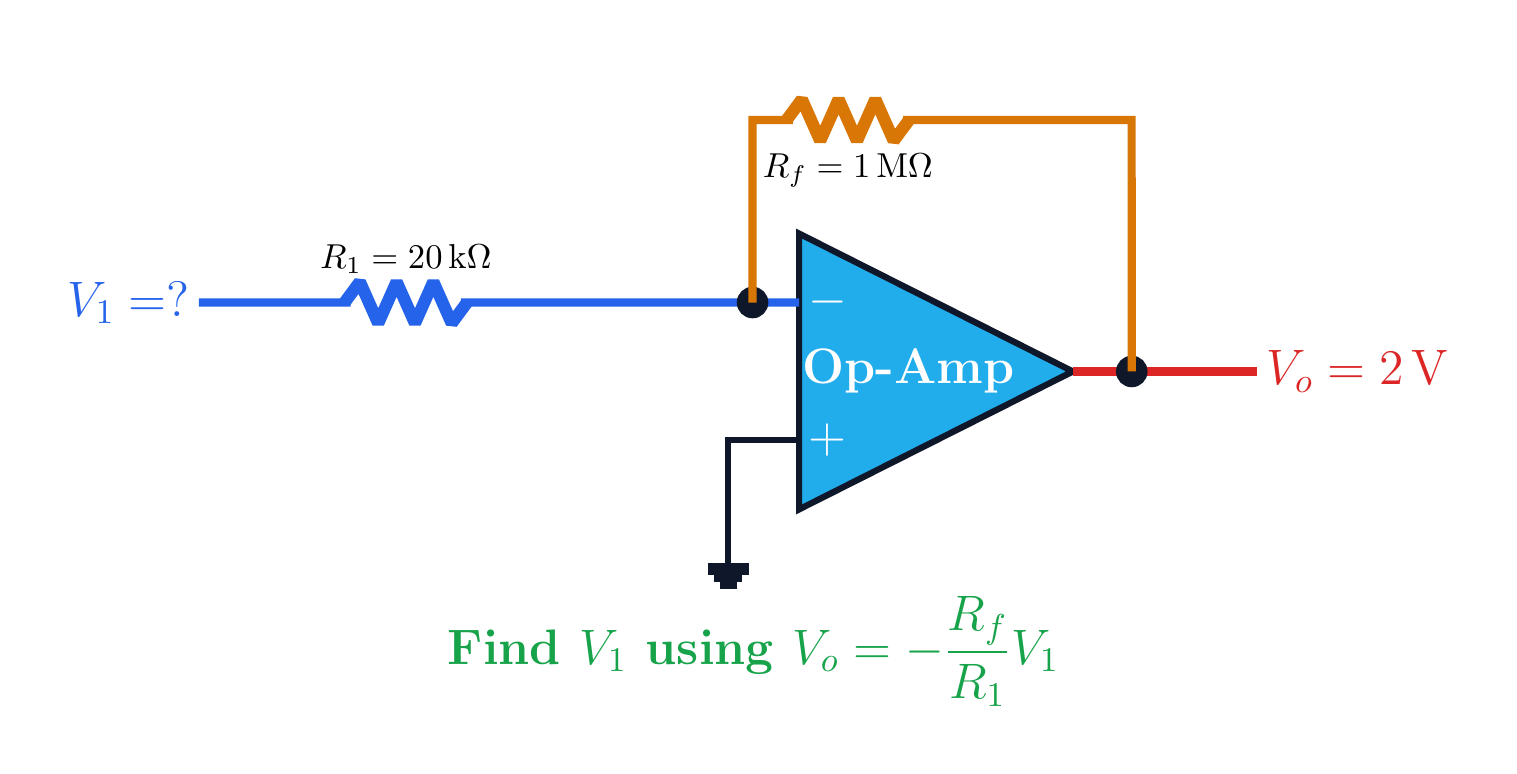
Solve five ideal op-amp problems: recover the input of an inverting amplifier from its output, find a three-input summer output, analyze a step-driven integrator, cascade a buffer and inverter, and solve a two-stage hybrid summer. State initial-condition and supply-rail assumptions.
Written solution and narration transcript(shows the full solution)
Below are all the lines written in the notebook together with the full narration transcript.
1. Q1 — inverting stage
The inverting-gain equation is solved backward for V_1. Q1 — inverting op-ampV1=−40 mVThe minus sign comes from inversionNarration transcript
Let's start with a basic inverting amplifier problem. The circuit has an input resistor of 20 kilohms and a feedback resistor of 1 megohm. The output voltage is 2 volts. We need to find the input voltage V1. Using the inverting formula, V out equals negative R f over R 1 times V 1. Plugging in, we get V 1 equals negative 2 divided by 50, which gives us negative 40 millivolts.
2. Q2 — summing stage
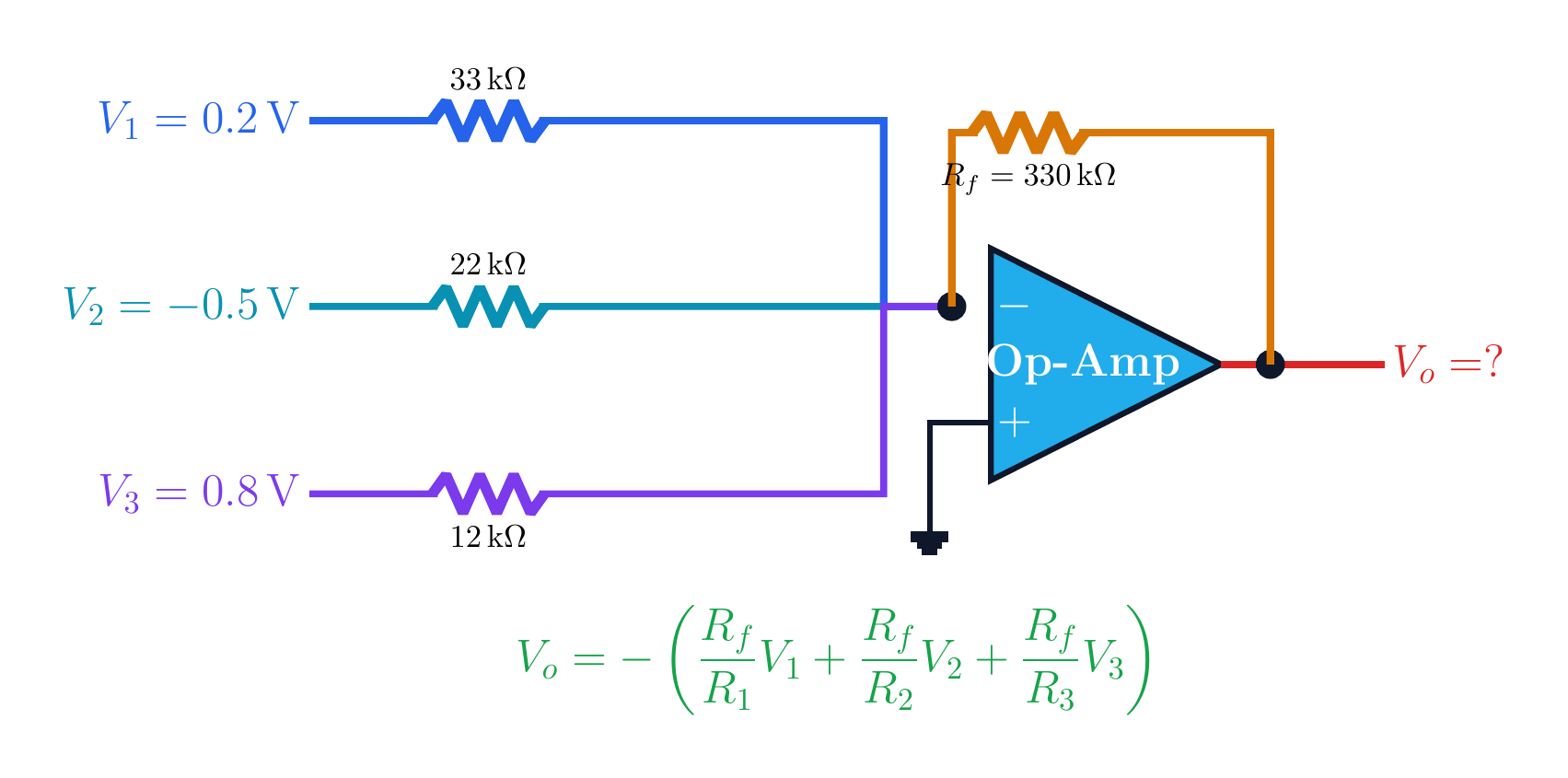
Each input contributes with its own R_f/R_i weight. Q2 — three-input summerWeights: 10, 15, 27.5Contributions: 2, −7.5, 22 VSum=16.5 VIdeal result; verify the supply railsNarration transcript
Next, a summing amplifier with three inputs. V1 is 0.2 volts through 33 kilohms, V2 is negative 0.5 volts through 22 kilohms, and V3 is 0.8 volts through 12 kilohms. The feedback resistor is 330 kilohms. Applying the summing formula, we calculate each gain ratio: 10, 15, and 27.5. The total output is negative of 2 minus 7.5 plus 22, giving us negative 16.5 volts.
3. Q3 — integrator
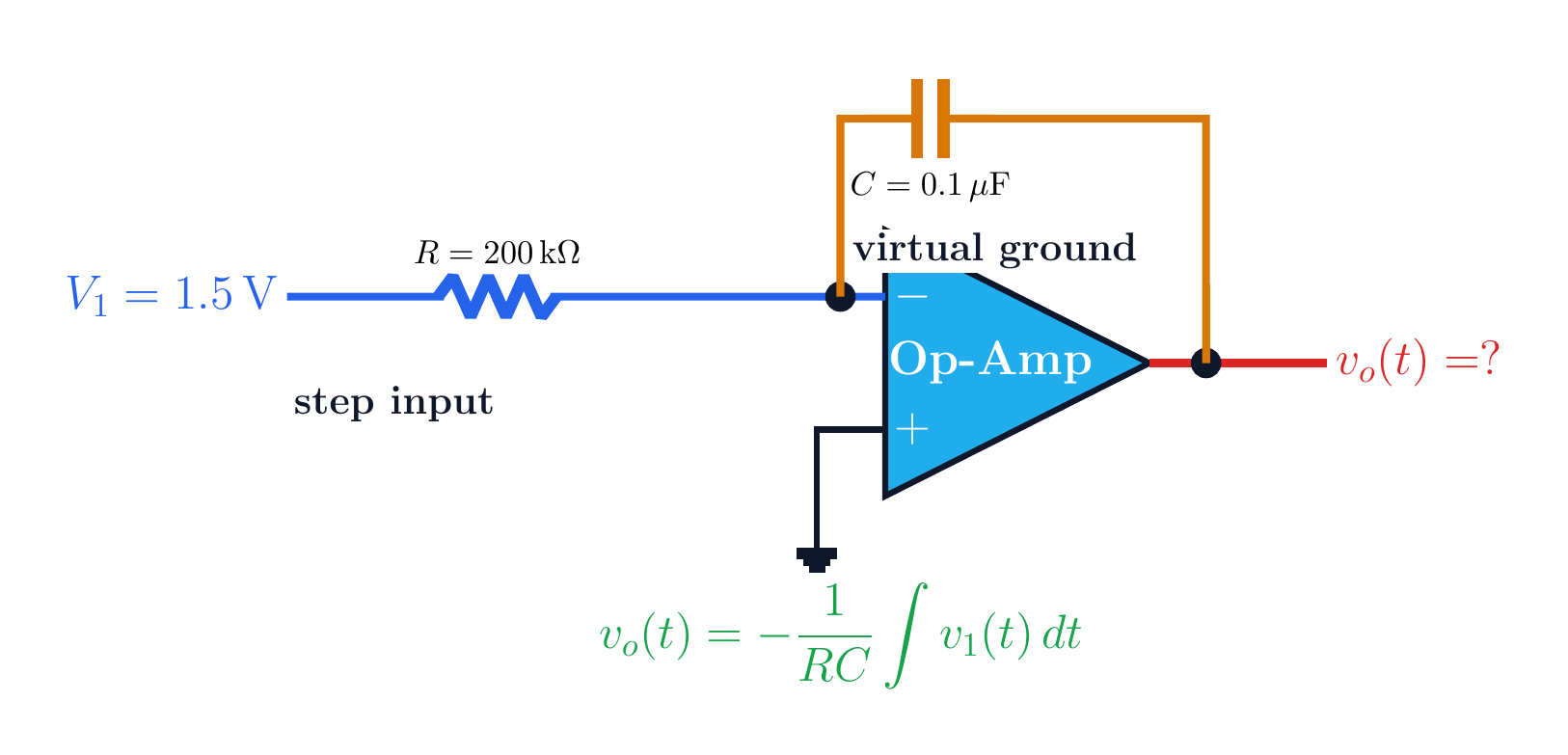
With zero initial condition, the step becomes a linear ramp. Q3 — step-driven integratorRC=0.02 s ⇒ 1/(RC)=50 s−1vo(t)=−(1/RC)∫vi(t)dtSlope=−75 V/sAssume zero initial condition and no saturationNarration transcript
Now an integrator circuit from the previous lesson. With R equals 200 kilohms, C equals 0.1 microfarads, and a step input of 1.5 volts, we first find 1 over RC equals 50. The output is negative 75 t volts — a negative ramp with a slope of 75 volts per second. The integrator converts our step input into a linearly decreasing ramp.
4. Q4 — cascaded stages
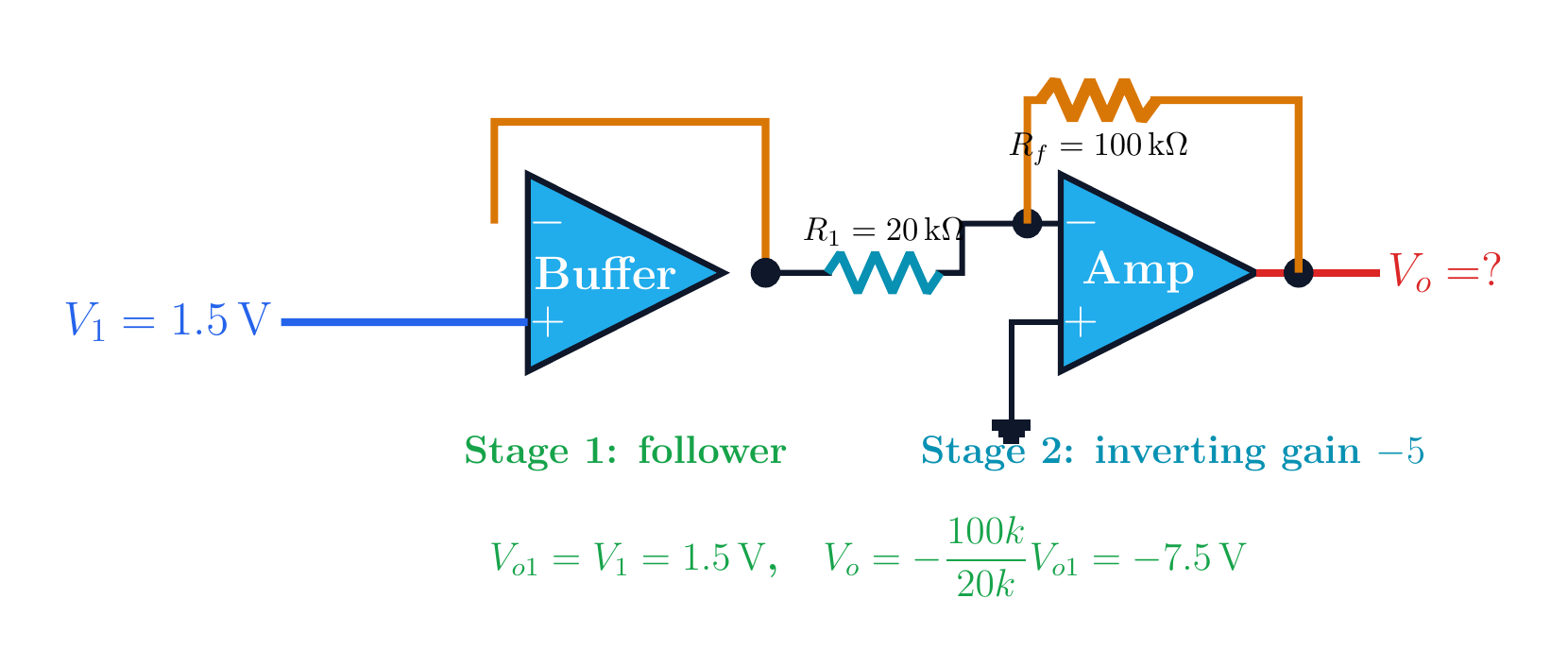
The buffer isolates the source from the gain stage. Q4 — buffer + inverterStage 1: unity followerStage 2:The buffer isolates the sourceNarration transcript
Here's something new — a two-stage cascaded circuit. The first stage is a unity follower, or buffer. It passes the 1.5 volt input straight through without any gain. The second stage is an inverting amplifier with a gain of negative 5. So the final output is negative 5 times 1.5, giving us negative 7.5 volts. The buffer isolates the source from the gain stage.
5. Q5 — hybrid circuit
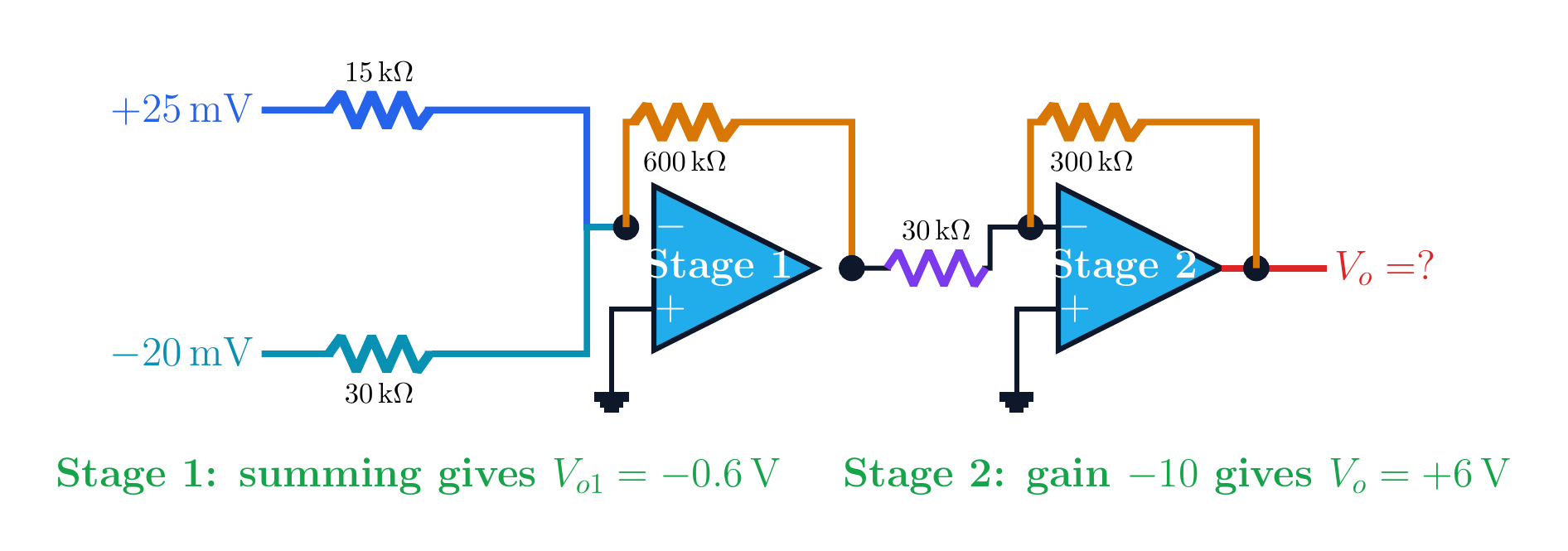
Solve each stage separately; the first output drives the second. Q5 — summer + inverterStage-1 weights:Bracket: 40(25 mV)+20(−20 mV)Stage-2 gain:Solve the stages in orderNarration transcript
Finally, our most complex problem — a two-stage circuit combining summing and cascading. Stage one sums two inputs: positive 25 millivolts through 15 kilohms and negative 20 millivolts through 30 kilohms, with a 600 kilohm feedback resistor. The gains are 40 and 20 respectively. Stage one outputs negative 0.6 volts. Stage two inverts with a gain of 10, giving a final output of positive 6 volts.
6. Results
Solve each stage separately; the first output drives the second. Five-problem summaryQ1: V1=−40 mVQ2:Q3:Q4:Q5:Rule: solve each stage and preserve signsFinal check: initial condition, rails, saturationNarration transcript
To recap our five problems: Q1, inverting amplifier, negative 40 millivolts. Q2, summing amplifier, negative 16.5 volts. Q3, integrator ramp with slope negative 75 volts per second. Q4, cascaded buffer plus inverter, negative 7.5 volts. And Q5, the hybrid two-stage summer, positive 6 volts. These problems covered everything from basic gain to multi-stage circuits.