Circuit Theory 1 · Second-Order Transients
#48 Transient Analysis #48 — Overdamped and critically damped parallel RLC
Builds the two-real-root overdamped form and repeated-root critical form, with a checked numerical example for each.
Question
Derive the overdamped and critically damped parallel-RLC natural-response forms; solve the α=5, ω₀=3 and α=ω₀=4 examples.
Written solution and narration transcript(shows the full solution)
Below are all the lines written in the notebook together with the full narration transcript.
1. Separate the two non-oscillatory cases
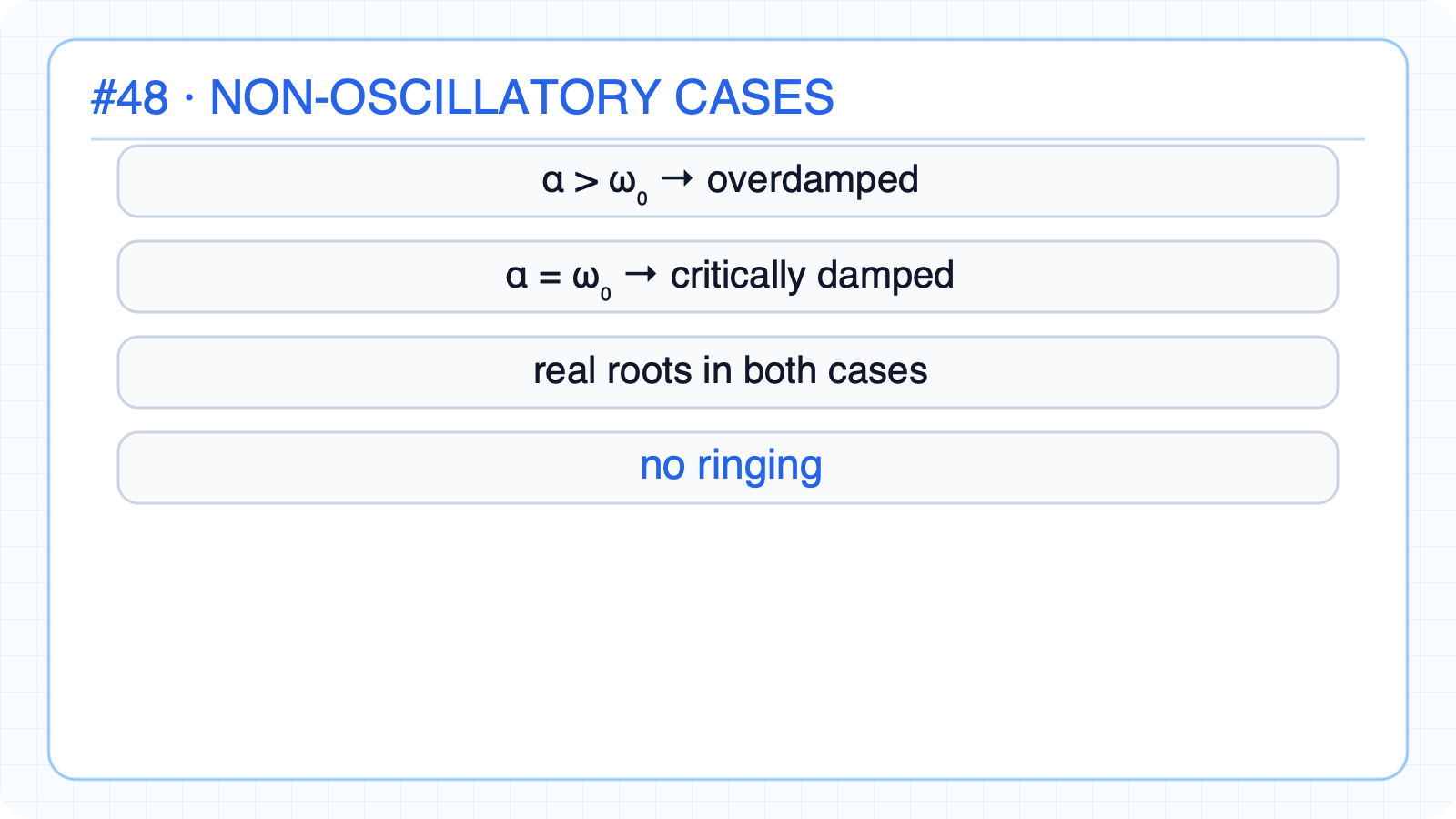
Circuit Theory 1 #48 · Separate the two non-oscillatory cases The relation between α and ω₀ selects the parallel-RLC rootsα>ω₀ → overdampedα=ω₀ → critically dampedBoth cases have real rootsBoth return to equilibrium without oscillationThey differ in root pattern and settling speedNarration transcript
From the previous lesson, we already know that the parallel R L C natural response is controlled by the relationship between alpha and omega zero. Today we focus only on the two non-oscillatory cases: overdamped and critically damped. In both cases, the response returns to equilibrium without ringing. The difference is in the root pattern and in how fast the response settles.
2. Overdamped solution form
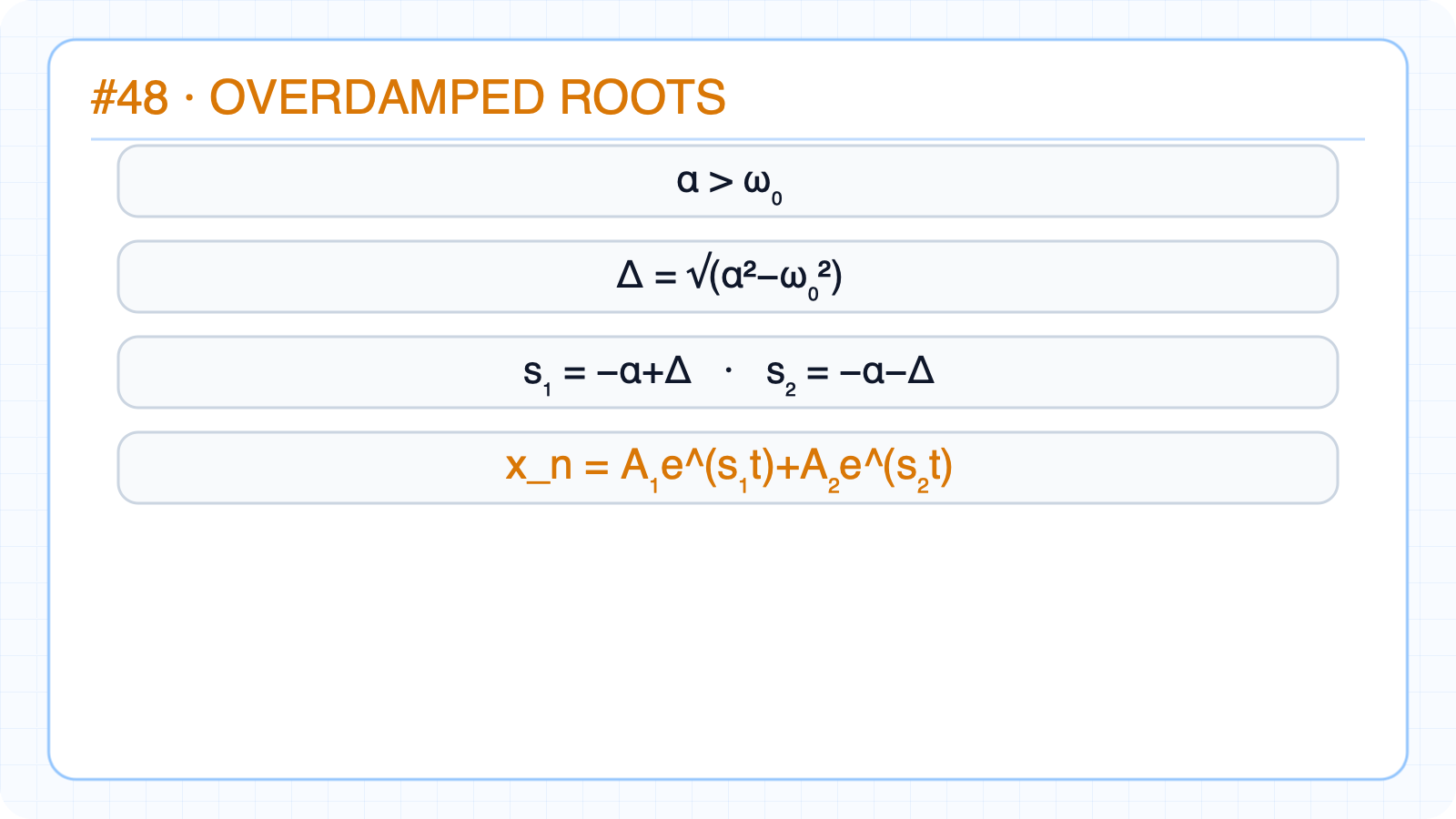
Circuit Theory 1 #48 · Overdamped solution form Condition:Δ=√(α²−ω₀²) is realThe roots are distinct, real, and negativeNo oscillation: one fast and one slow exponential modeNarration transcript
Start with the overdamped case, where alpha is greater than omega zero. The characteristic equation then gives two distinct real roots: s one equals negative alpha plus the square root of alpha squared minus omega zero squared, and s two equals negative alpha minus the same square root. Because both roots are real and negative, the natural response becomes a sum of two decaying exponentials. There is no oscillation. Instead, the waveform returns smoothly, with one fast mode and one slower dominant mode.
3. Overdamped numerical example
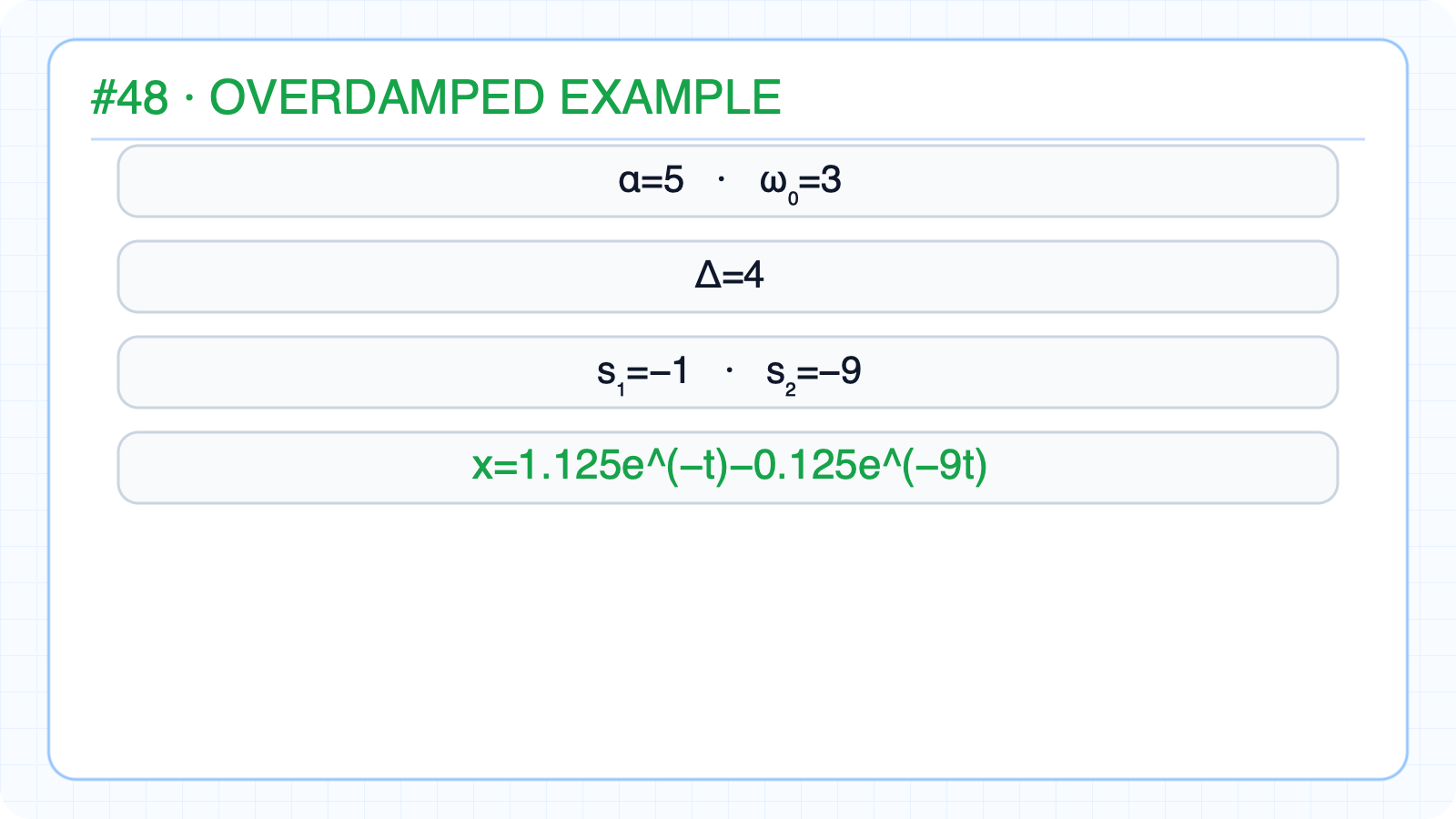
Circuit Theory 1 #48 · Overdamped numerical example α=5 s⁻¹, ω₀=3 rad/sThe checks x(0)=1 and x′(0)=0 passe−9t dies quickly; e−t becomes dominantNarration transcript
For a quick example, choose alpha equal to five and omega zero equal to three. Then the roots are negative one and negative nine. A normalized response can be written as one point one two five e to the minus t, minus zero point one two five e to the minus nine t. The e to the minus nine t term dies out very quickly. After the initial moment, the slower e to the minus t term dominates the shape. That is why overdamped responses often look sluggish even though two modes are present.
4. Critically damped solution form
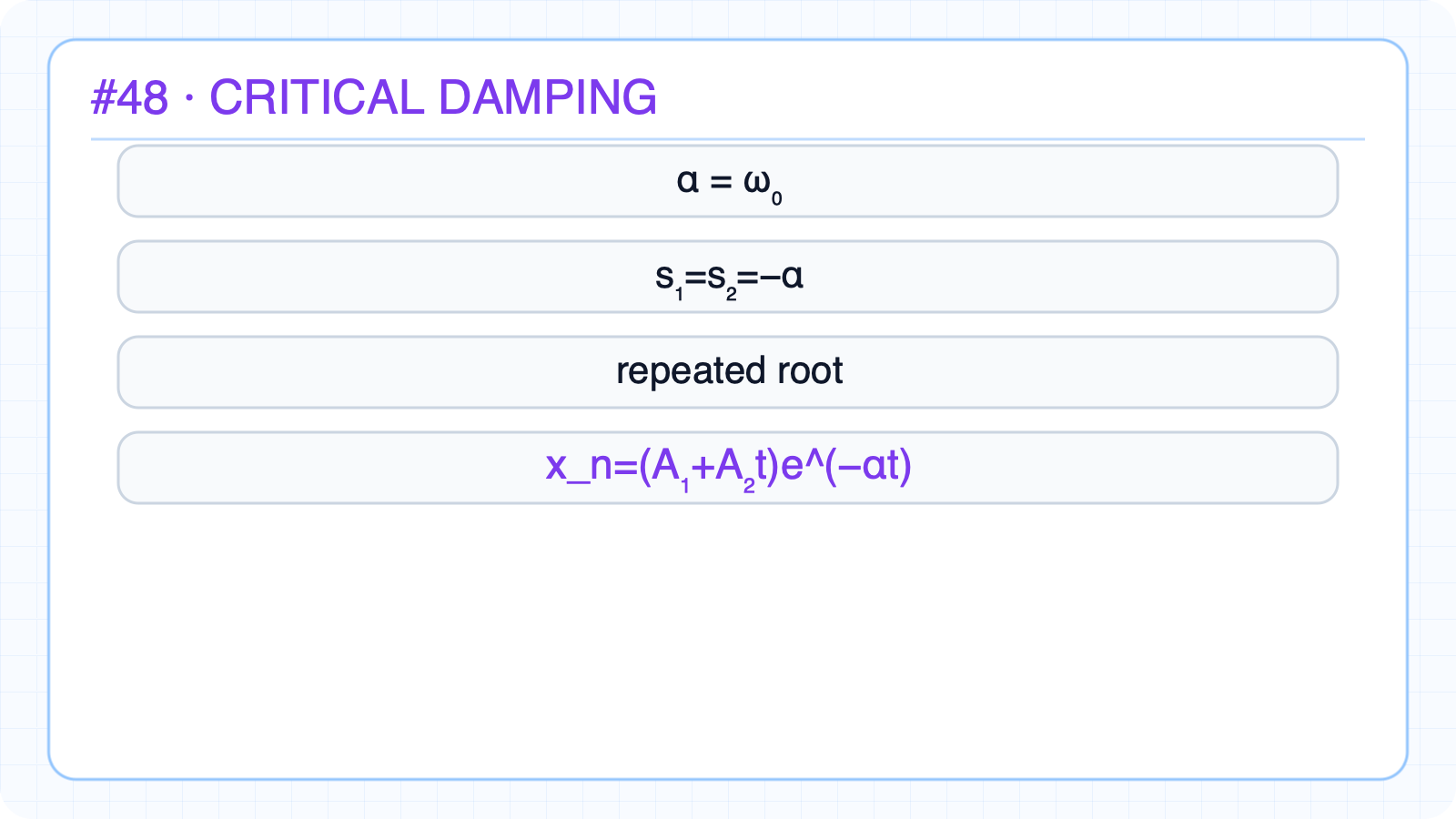
Circuit Theory 1 #48 · Critically damped solution form Condition:s₁=s₂=−α [repeated root]A second independent solution is needed for two constantsThe t factor is the signature of the repeated rootFastest ideal return without oscillationNarration transcript
Now move to the critically damped case, where alpha equals omega zero. Here the two real roots collapse into one repeated root at s equals negative alpha. A repeated root changes the structure of the solution. The response is no longer just A one e to the s t. Instead, we need the form open parenthesis A one plus A two t close parenthesis e to the minus alpha t. This extra t factor is the signature of critical damping.
5. Critically damped numerical example
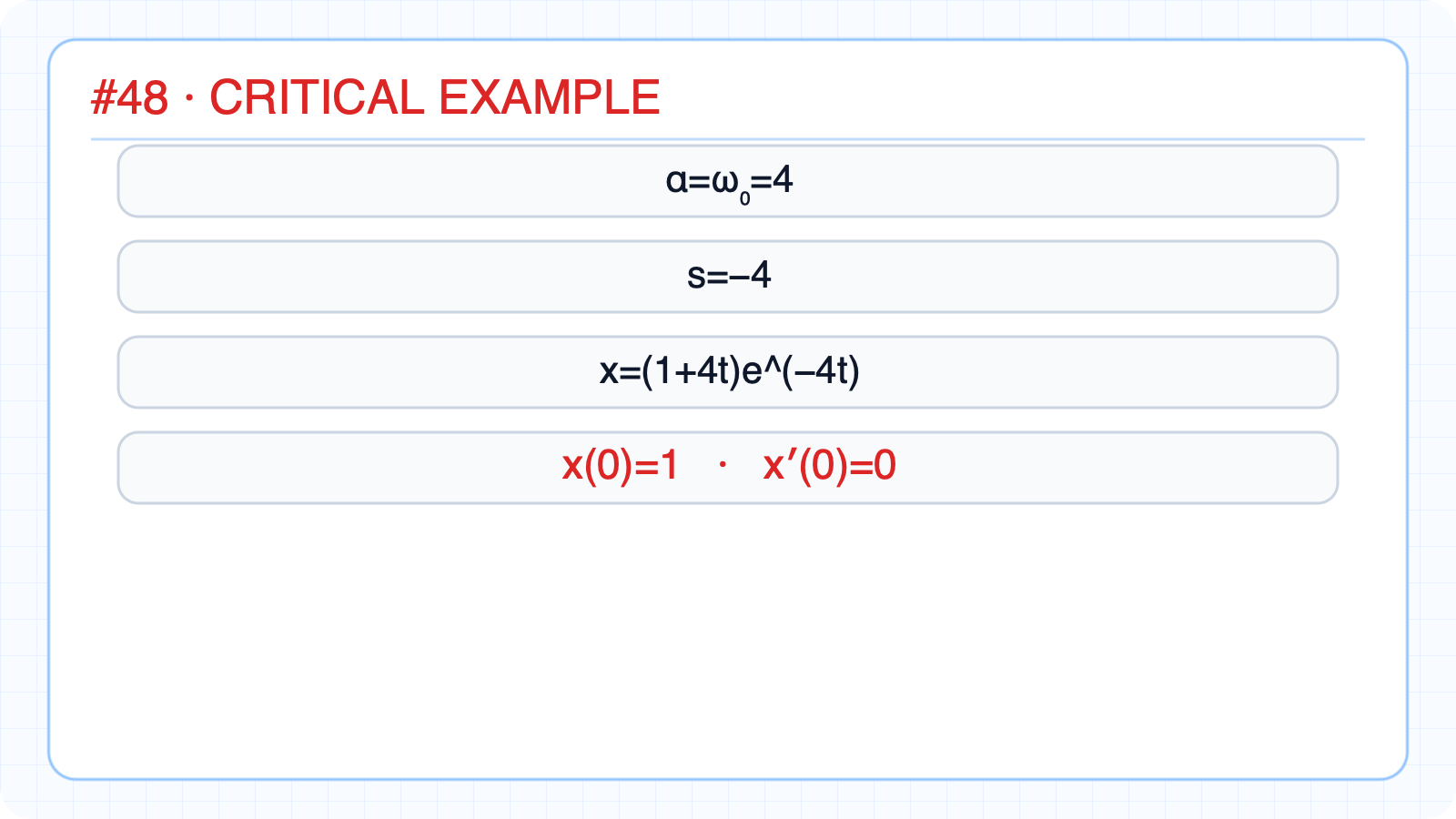
Circuit Theory 1 #48 · Critically damped numerical example Repeated root:It falls rapidly to zero without overshoot or ringingNarration transcript
As an example, let alpha equal omega zero equal four. With normalized initial conditions, one valid response is open parenthesis one plus four t close parenthesis e to the minus four t. This curve is still non-oscillatory, but it returns faster than the overdamped case. That is the main practical meaning of critical damping: it is the fastest return to equilibrium without overshoot or oscillation.
6. Compare overdamped and critical response
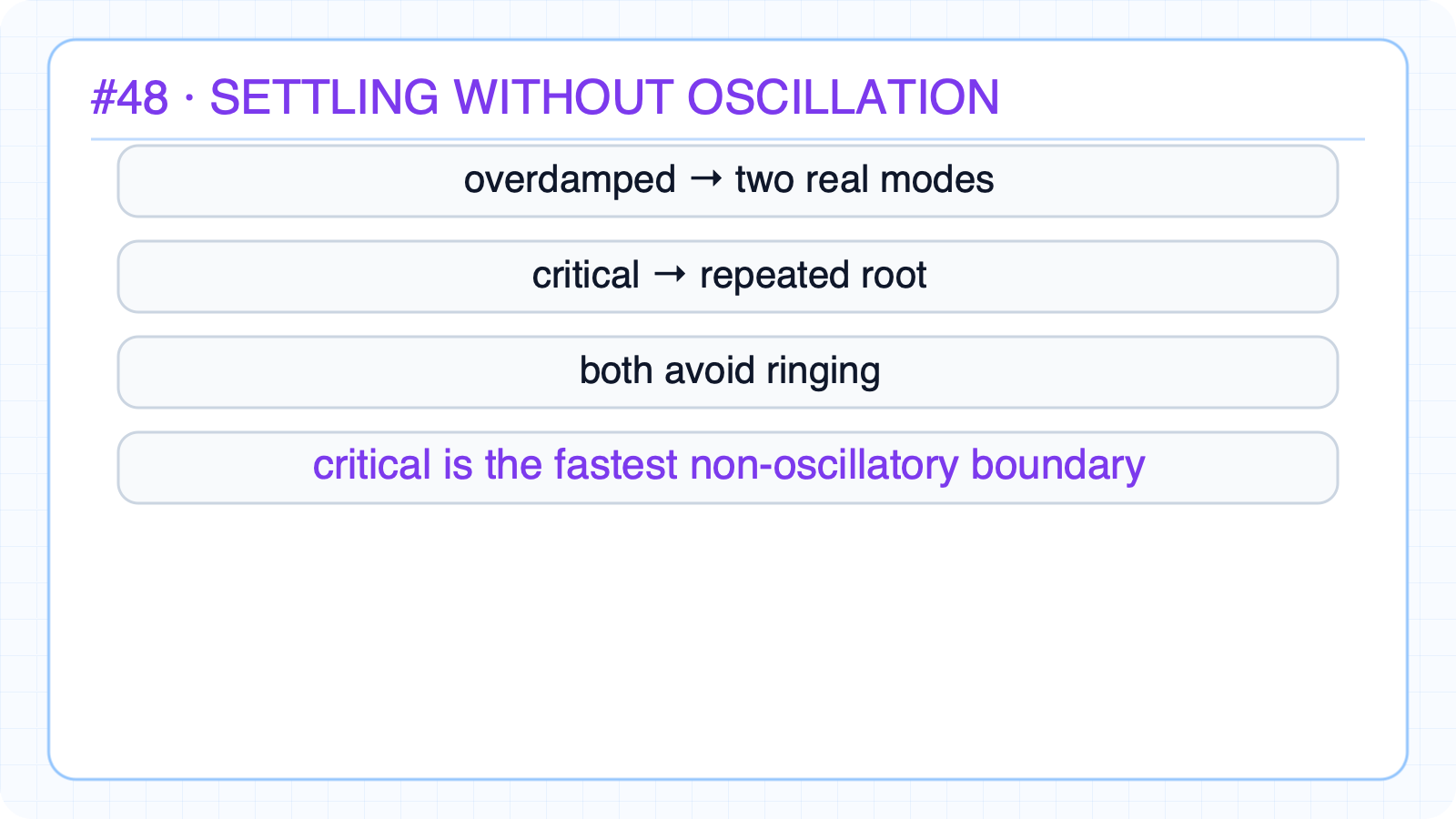
Circuit Theory 1 #48 · Compare overdamped and critical response Overdamped:Two distinct real roots and two exponential modesThe slow root can dominate for a long timeCritical:Repeated root and (A₁+A₂t)e−αtCritical damping is the fastest non-oscillatory boundaryNext: underdamped and undamped responseNarration transcript
Let us summarize. When alpha is greater than omega zero, the circuit is overdamped and the natural response is a sum of two real exponential modes. When alpha equals omega zero, the circuit is critically damped and the repeated root produces the form open parenthesis A one plus A two t close parenthesis e to the minus alpha t. Both cases are non-oscillatory, but critical damping settles faster. Next lesson, we continue with the oscillatory cases: underdamped and undamped response.