Communication Basics · PDH, the E1 Frame, and E-Carrier Dimensioning
#17 G.704 E1 timeslots, G.702/G.742 PDH rates and tributaries, plesiochronous clocks, justification, staged access, and capacity/provisioning choices
Analyze E1 and PDH through timeslot policy, justification, tributary access, and real provisioning choices—not a ladder of rounded rates.
Question
Do not equate E1's 32 64-kbit/s timeslots with voice-call capacity; bind TS0 and TS16 use to framing/signalling policy; build the 2.048-based PDH hierarchy with exact nominal rates and tributary structure; explain justification and legacy drop/insert limits; compare five E1s, E3, SDH, and packet options for the 150-call example using demand, service quality, protection, interface, and cost gates.
Written solution and narration transcript(shows the full solution)
Below are all the lines written in the notebook together with the full narration transcript.
1. Separate the E1 frame from voice/signalling timeslot policy
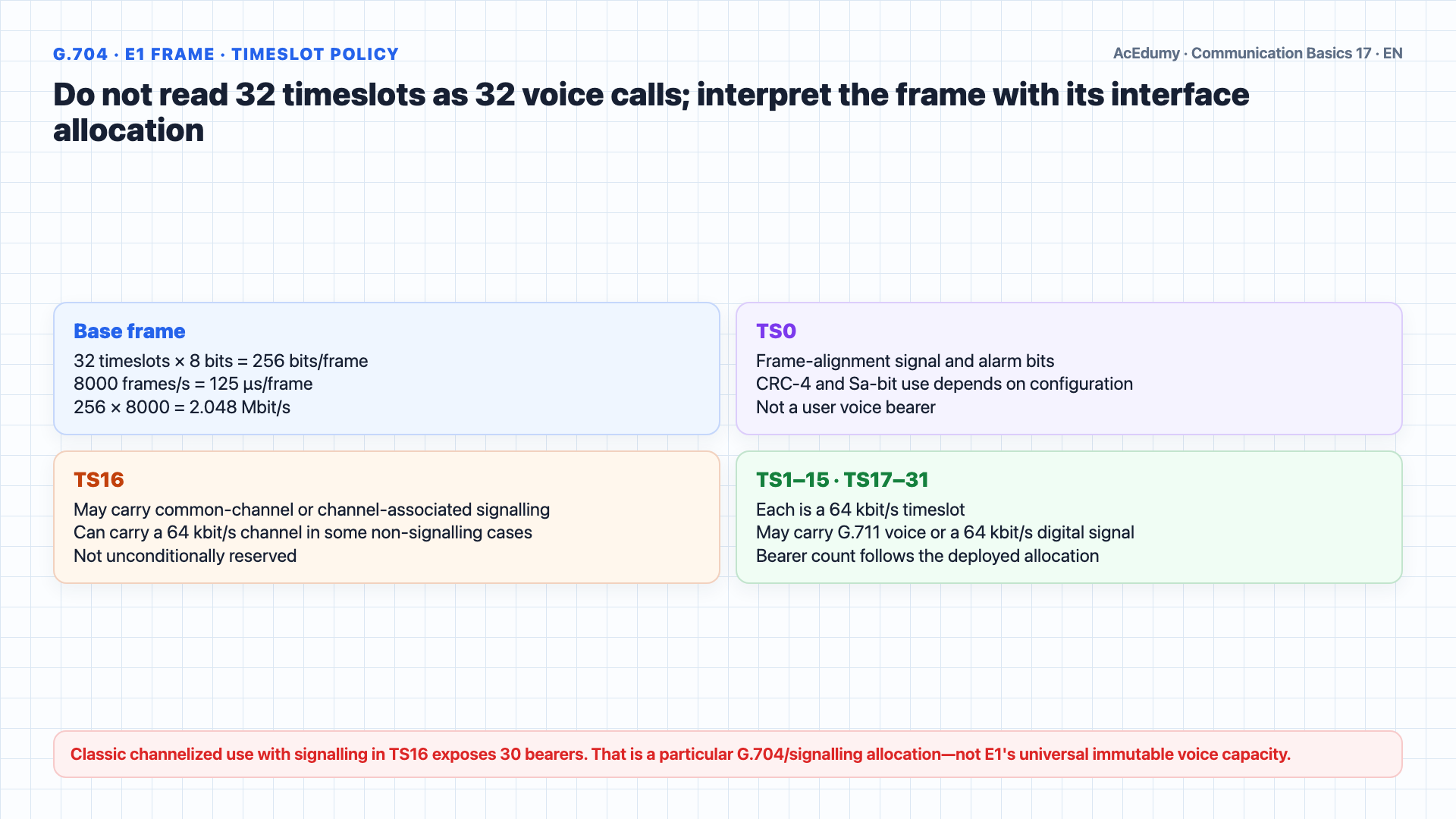
E1 timeslot count is not automatically voice capacity; validate PDH level selection against demand, signalling, protection, available interfaces, and operating cost. Welcome back.In the previous lesson we used the historical G.711/DS0 example as a 64 kbit/s PCM stream; current voice channels do not all use the same codec or rate.Today we ask the next question: how do we pack many of these channels onto a single line between two telephone exchanges?For this historical 2.048 Mbit/s transport example, the answer is the G.704 E1 frame.A G.704 E1 frame carries 32 octet-interleaved 64 kbit/s timeslots numbered 0–31; a timeslot is not automatically one voice call.32 times 8 gives us 256 bits per frame.The frame repetition rate is 8000 Hz, or 125 µs; it is compatible with 8 kHz PCM sampling, while the frame can also carry non-voice digital signals.So the total bit rate is 256 times 8000, which equals 2 point 048 megabits per second.The 2.048 Mbit/s-based hierarchy is internationally standardized; verify the deployed regional interface and framing with the operator/equipment.TS0 carries frame alignment, alarm, and related overhead bits; TS16 may carry signalling and can carry a 64 kbit/s channel in some non-signalling cases; TS1–15 and TS17–31 may carry voice or digital data.Narration transcript
Welcome back. In the previous lesson we built up the P S T N and saw that every voice channel is a 64 kilobit per second P C M stream. Today we ask the next question: how do we pack many of these channels onto a single line between two telephone exchanges? The answer is the E one frame. An E one frame carries 32 channels, time multiplexed, each 8 bits wide. 32 times 8 gives us 256 bits per frame. We send 8000 frames per second, exactly the voice sampling rate. So the total bit rate is 256 times 8000, which equals 2 point 048 megabits per second. That is the famous E one rate used across Europe and most of the world. Channel 0 is reserved for synchronization, channel 16 for signaling, and the remaining 30 channels carry actual voice traffic.
2. Build the 2.048-based PDH hierarchy with exact nominal rates and tributary counts
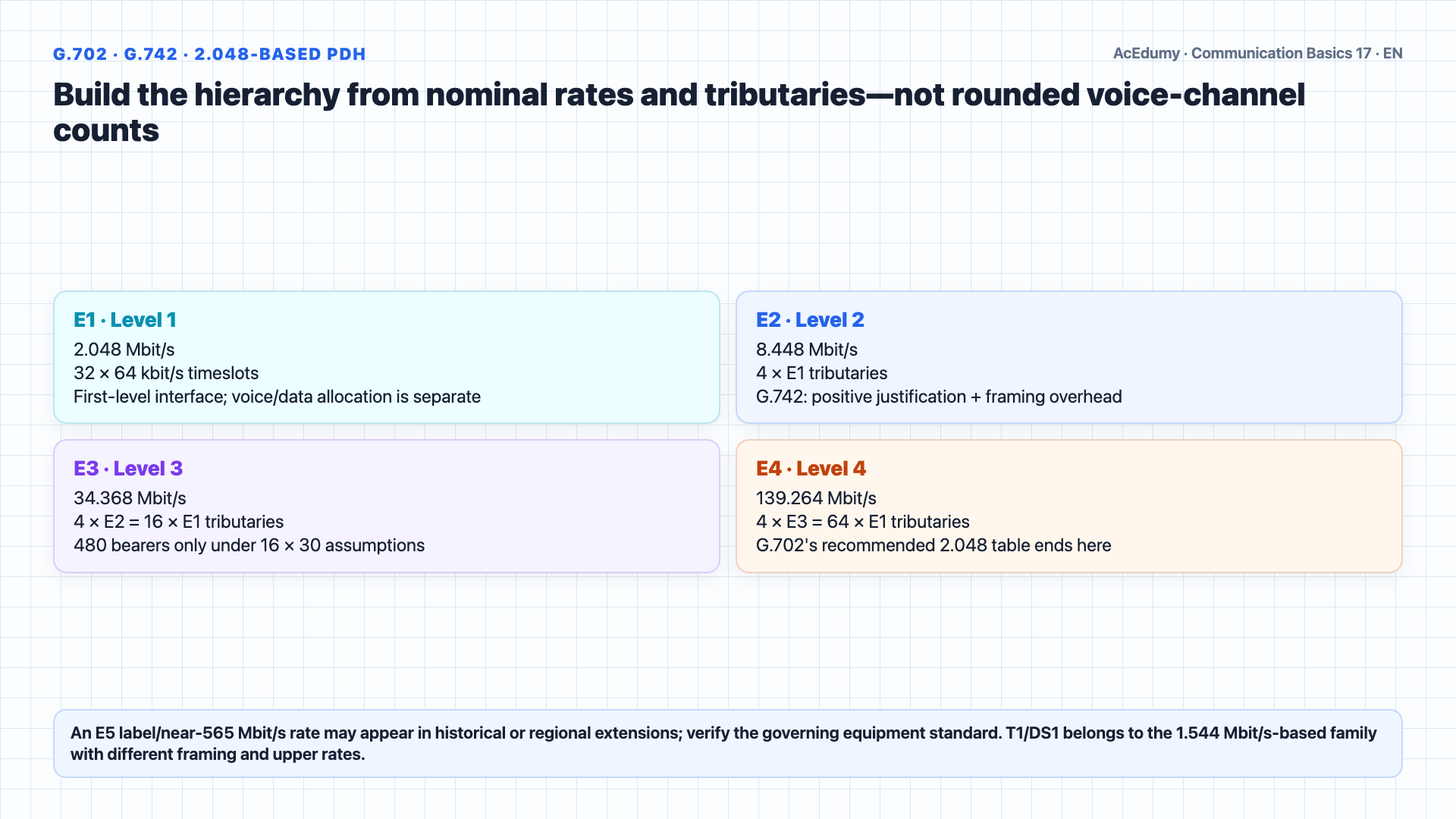
E1 timeslot count is not automatically voice capacity; validate PDH level selection against demand, signalling, protection, available interfaces, and operating cost. The E1 is just the bottom level of a much taller hierarchy called the CEPT hierarchy, or E carrier system.G.742 E2 multiplexes four 2.048 Mbit/s tributaries with positive justification and overhead into 8.448 Mbit/s; 120 bearers follows only if each E1 is assumed to expose 30 bearers.E3 has a nominal rate of 34.368 Mbit/s and carries four E2 tributaries; 480 voice bearers follows only from the 30-bearer-per-E1 assumption.E4 has a nominal rate of 139.264 Mbit/s; 1,920 voice bearers is not a native line property but 64 E1s × 30 assumed bearers.E5 labels and near-565 Mbit/s rates appear in historical/regional extensions; G.702's recommended 2.048-based table stops at E4, so verify the governing equipment standard.In the North American 1.544 Mbit/s-based hierarchy, T1/DS1 carries 24 DS0 timeslots plus framing; framing/signalling and upper rates differ from the 2.048-based family.Narration transcript
The E one is just the bottom level of a much taller hierarchy called the C E P T hierarchy, or E carrier system. Above the E one sits the E two, which bundles four E ones plus a small overhead, giving 8 point 448 megabits per second and 120 voice channels. Above that, the E three combines four E twos for 34 megabits per second and 480 channels. The E four packs four E threes into 140 megabits per second and 1920 channels. And the E five, the top of the European hierarchy, carries 565 megabits per second and almost 8000 voice channels. North America uses a different ladder called the T carrier system, where T one is 1 point 544 megabits per second with 24 channels, but the principle of stacking lower levels into higher ones is the same.
3. Explain plesiochronous clock differences, justification, and staged tributary access
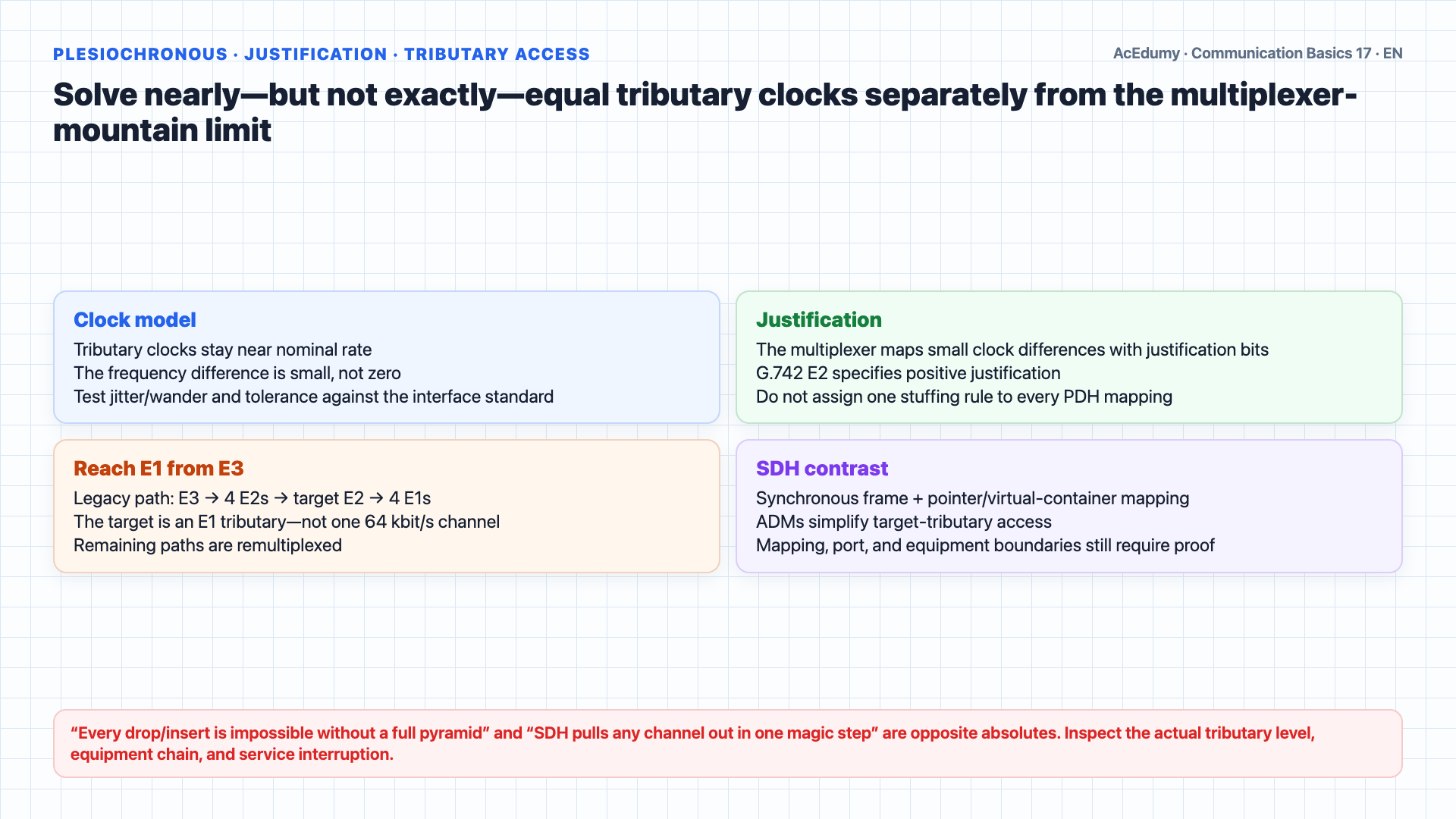
E1 timeslot count is not automatically voice capacity; validate PDH level selection against demand, signalling, protection, available interfaces, and operating cost. Now the word plesiochronous deserves attention.Plesio means almost in Greek.So plesiochronous means almost synchronous.In a plesiochronous mapping, tributary clocks may come from independent sources; their nominal frequencies are close, with small permitted differences.PDH mappings manage tributary clock differences with justification; for example, G.742 E2 specifies positive justification for four 2.048 Mbit/s tributaries.Justification works, but tributary bits do not occupy one simple fixed byte position in the higher-order PDH stream; legacy equipment commonly performs staged demultiplexing to reach the target tributary.Suppose you want one E1 out of an E3.In a legacy chain, E3 is split into four E2s and the target E2 into four E1s; after extracting the target E1 tributary, remaining paths are remultiplexed—the item is not one 64 kbit/s channel.Engineers call this the multiplexer mountain.A classic discrete PDH chain often needs staged demux/remux for drop/insert; integrated equipment may hide the steps, but the hierarchical-access limit remains.The approach can require more equipment, ports, and operational steps; cost and delay must be measured for the actual topology/equipment.SDH standardizes synchronous framing and add/drop tributary access to reduce this operational limit; resilience and management are also part of the design.Narration transcript
Now the word plesiochronous deserves attention. Plesio means almost in Greek. So plesiochronous means almost synchronous. Each multiplexer in the network has its own clock, and these clocks are very close in frequency but not exactly equal. To absorb the tiny differences, P D H inserts justification bits as small overhead. This works, but it creates a serious problem: you cannot directly read a single channel out of a high level signal. Suppose you want one E one out of an E three. You must first demultiplex the E three back into four E twos, then demultiplex one of the E twos into four E ones, extract the channel you need, and then remultiplex everything back together. Engineers call this the multiplexer mountain. Every drop and insert operation requires a full demux and remux pyramid. It is expensive, slow, and rigid. This is exactly the limitation that S D H was invented to solve, and we will see that next time.
4. Dimension the 150-simultaneous-call assumption across five E1s, E3, SDH, and packet options
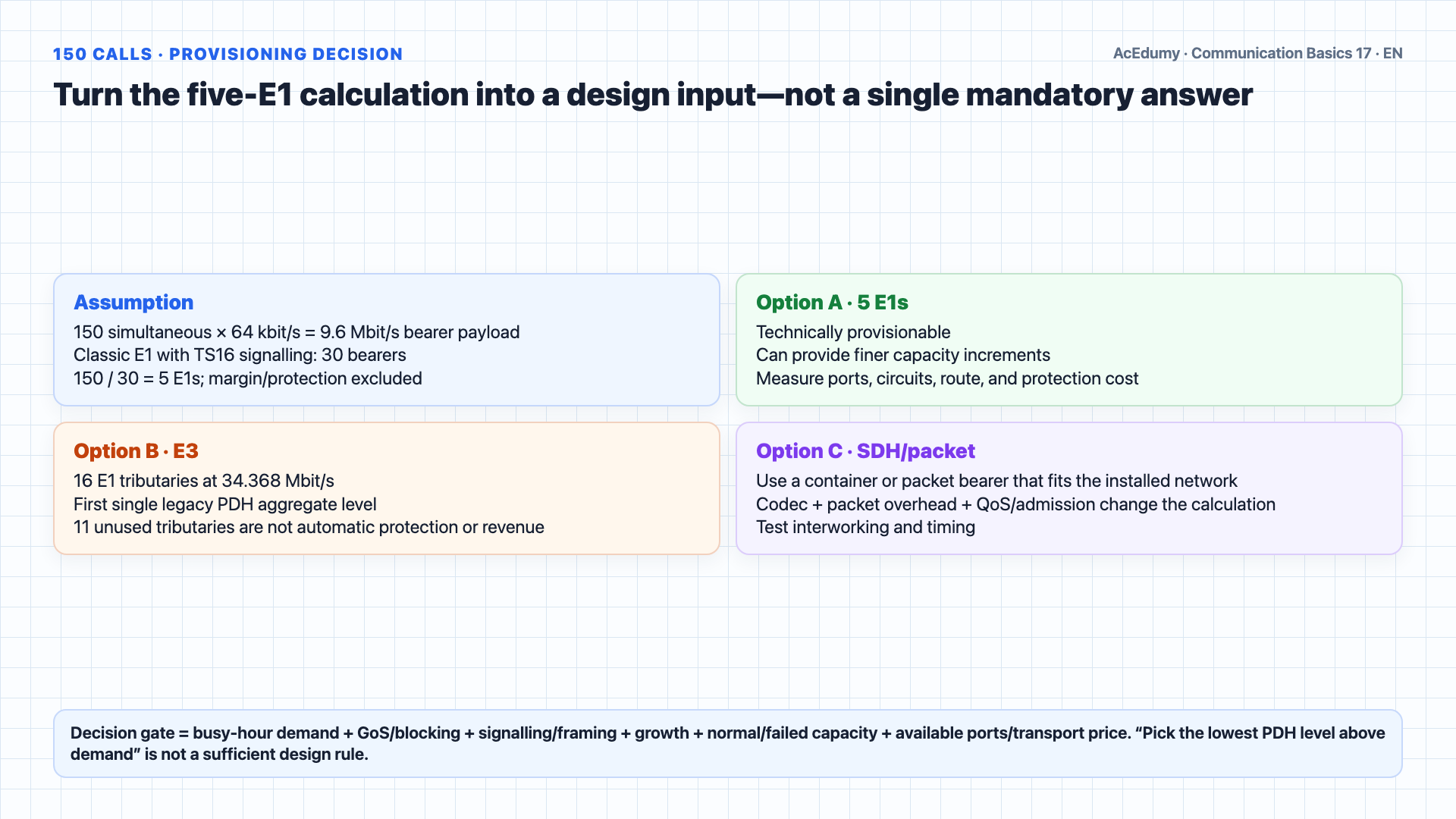
E1 timeslot count is not automatically voice capacity; validate PDH level selection against demand, signalling, protection, available interfaces, and operating cost. Let us work through a quick example.Assume 150 simultaneous 64 kbit/s circuits and a particular E1 signalling arrangement for this example; a real design starts from busy-hour demand, codec, and Grade of Service.Which E carrier level do you choose?First count bearer timeslots, signalling, protection margin, and the demand matrix for the deployed interface.Under the classic channelized assumption in which TS16 carries signalling, one E1 exposes 30 64 kbit/s bearers; other G.704 uses can allocate timeslots differently.Under that assumption, 150/30 = five E1 bearer capacities; blocking, growth, and failure margin have not yet been added.Five separate E1s can be provisioned; one E3, an SDH container, or packet transport depends on available interfaces, price, protection, delay, and operations.One E2 carries four E1 tributaries, giving 120 calls only under the 30-bearer assumption.120 is less than 150, so an E2 is not enough.E3 carries four E2s, or 16 E1 tributaries; its nominal rate is 34.368 Mbit/s and theoretical capacity is 480 calls under the 30-bearer assumption.E3 is the first single legacy PDH aggregate above five E1s, but it is not automatically the right economic or resilient provisioning choice.With static 30-bearer assignment, 150 calls fill five E1 tributaries; the other 11 are available for growth, protection, or other services only if planned and provisioned.Design gates are busy-hour call/bit demand + signalling/framing overhead + GoS/blocking + failure protection + available interface/cost; choosing only the lowest nominal level is insufficient.Narration transcript
Let us work through a quick example. Suppose you are designing an inter exchange link that must carry 150 simultaneous voice calls. Which E carrier level do you choose? First, count the channels per level. Each E one carries 30 voice channels, since channel 0 is for synchronization and channel 16 is for signaling. 150 voice calls divided by 30 gives 5 E ones worth of payload. But you cannot rent 5 individual E ones over the trunk; you have to pick the next level up. An E two bundles 4 E ones, so it carries 120 voice channels. 120 is less than 150, so an E two is not enough. An E three bundles 16 E ones, so it carries 480 voice channels and runs at 34 megabits per second. 480 is comfortably more than 150, so the E three is the right choice. The 150 active voice channels live inside 5 of the 16 E one slots, and the remaining 11 slots are reserved for growth or for other services. Notice the design rule: you always size for channels, not just for raw bit rate, and you pick the lowest level that exceeds your demand.
5. Summarize PDH-to-SDH/packet migration through measurable validation gates
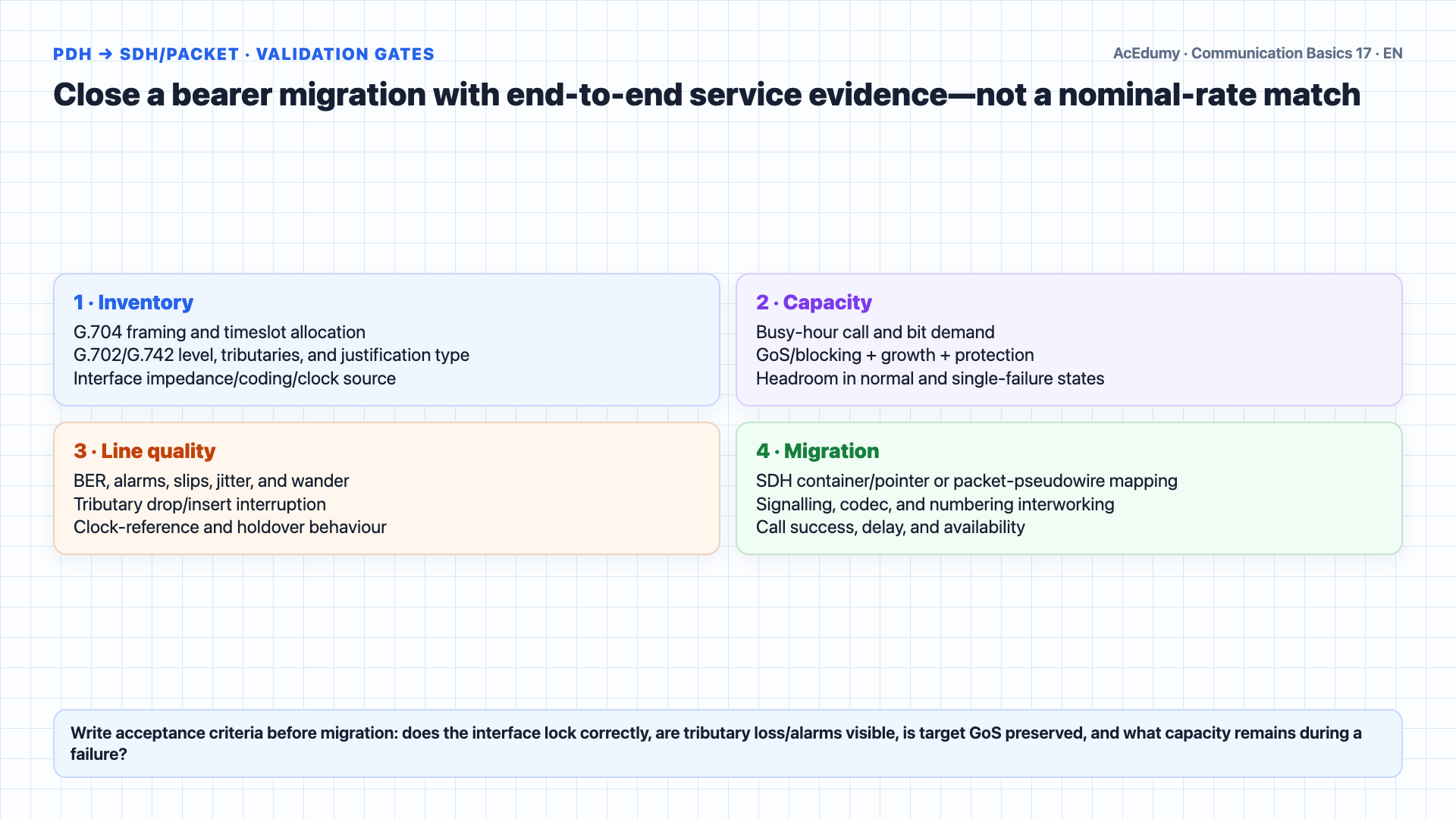
E1 timeslot count is not automatically voice capacity; validate PDH level selection against demand, signalling, protection, available interfaces, and operating cost. Let us summarize.A 2.048 Mbit/s E1 interface carries 32 64 kbit/s timeslots; TS0 serves framing functions and other timeslots can carry voice or data under the allocation policy.G.702's recommended 2.048-based rates are E1 2.048, E2 8.448, E3 34.368, and E4 139.264 Mbit/s; verify a regional standard before using an E5 label.The North American 1.544 Mbit/s-based T-carrier family applies a similar aggregation idea with different framing and upper rates.Plesiochronous refers to nominally close tributary clocks; their permitted difference is managed by the justification method defined for that PDH mapping.A key legacy PDH operational limit is staged demux/remux to reach a target tributary; one 64 kbit/s channel and one E1 tributary are not the same object.Next we will study how SDH uses synchronous frames, pointers/virtual containers, and add/drop functions to simplify tributary access while mapping and equipment boundaries still remain.Narration transcript
Let us summarize. P D H bundles 64 kilobit voice channels into the E one frame, 32 channels at 2 point 048 megabits. The C E P T hierarchy stacks E ones into E twos, E twos into E threes, all the way up to E five. T carrier in North America follows the same idea with different rates. Plesiochronous means almost synchronous, with small clock differences absorbed by justification bits. The big drawback is the multiplexer mountain: extracting a single channel requires a full demux and remux all the way down and back up. Next time we will see how S D H, the synchronous digital hierarchy, fixes this with synchronized clocks and add and drop multiplexers that pull a channel out of the stream in a single step.
Source video: Communication Basics #17 PDH: Plesiochronous Digital Hierarchy & E-Carrier (5:53)