Antenna Theory · Point-Source Radiation and e^(−jkr)/r
#06 Delta collapse of the point-source integral, source-to-observer distance, and the amplitude/phase meaning of e^(−jkr)/r
Collapse the source integral to one point and read spherical 1/r spreading and e^(−jkr) phase in the resulting field form.
Question
Insert a point source into the vector-potential integral; use the delta function to collapse it, apply R=r at the origin, and interpret the 1/r amplitude decay and e^(−jkr) phase progression.
Written solution and narration transcript(shows the full solution)
Below are all the lines written in the notebook together with the full narration transcript.
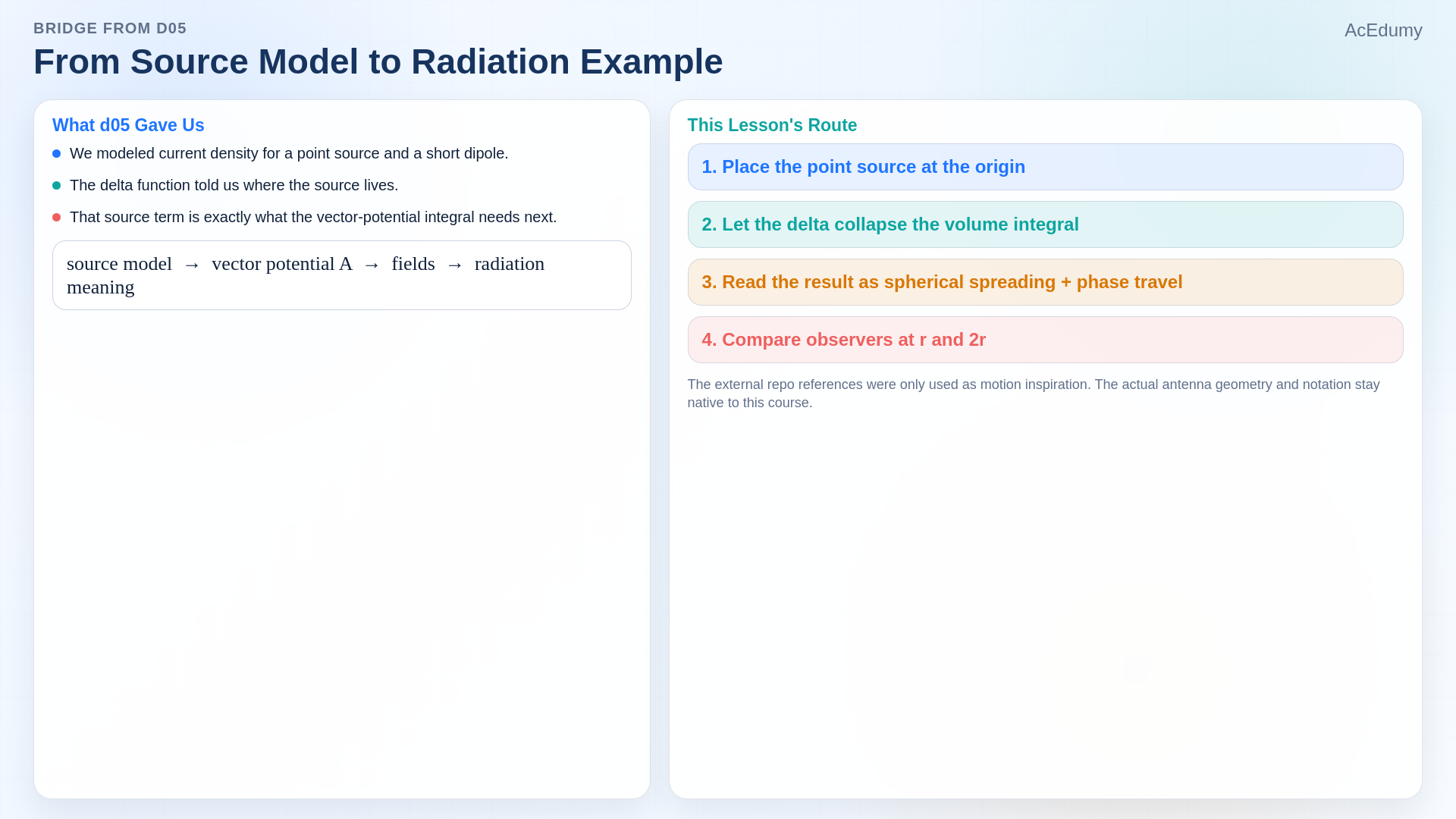
1. Move from the source model to the first radiation example
The 1/r factor carries spherical amplitude spreading, while e^(−jkr) carries accumulated propagation phase. In the last lesson, we wrote current density for a point source and a dipole.Now we finally do something useful with that source model.We place the cleanest possible source, an ideal point source, into the vector-potential integral and watch the expression simplify.This is the first full source-to-field example in the series.Narration transcript
In the last lesson, we wrote current density for a point source and a dipole. Now we finally do something useful with that source model. We place the cleanest possible source, an ideal point source, into the vector-potential integral and watch the expression simplify. This is the first full source-to-field example in the series.
2. Place the point source at the origin
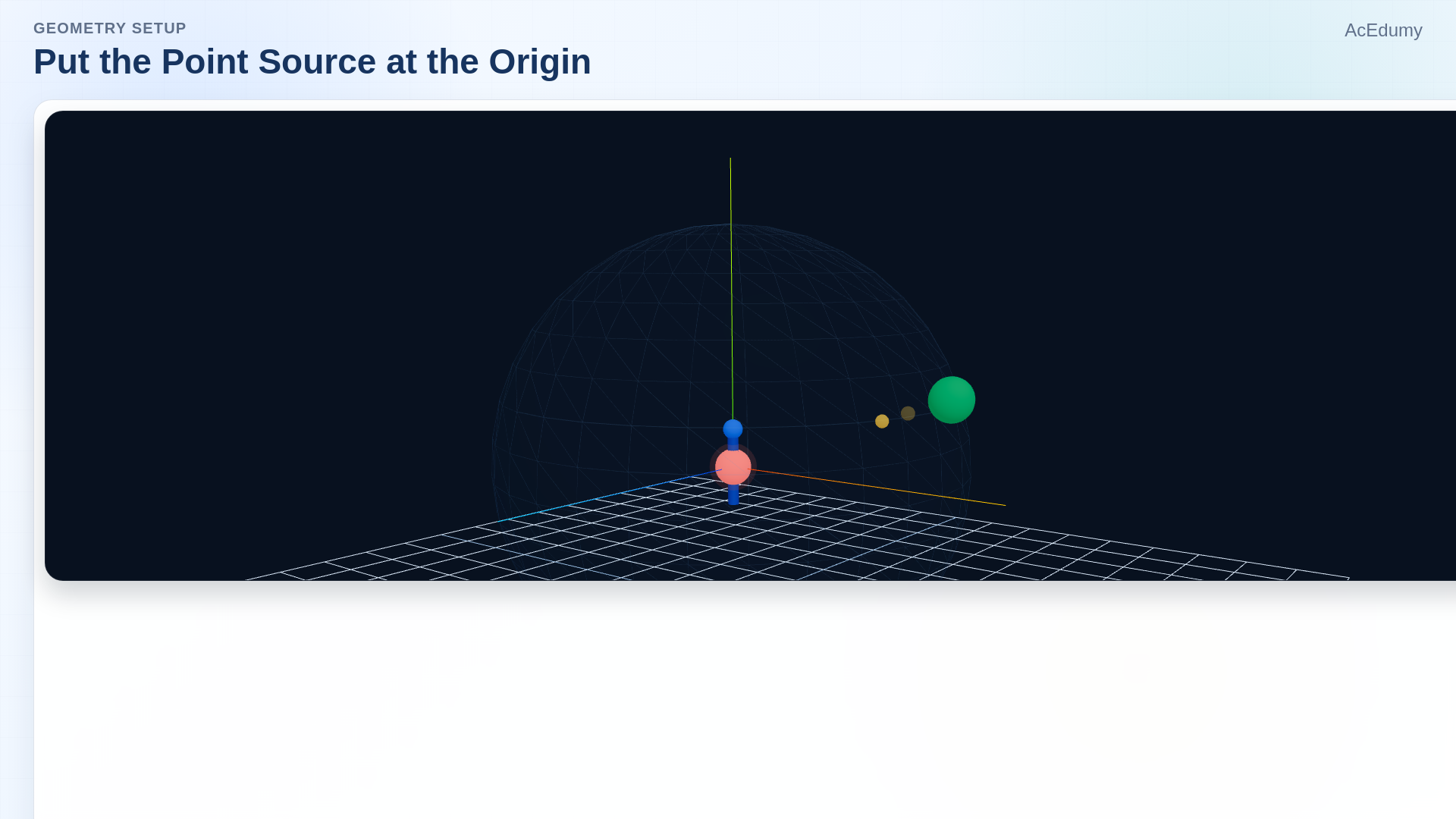
The 1/r factor carries spherical amplitude spreading, while e^(−jkr) carries accumulated propagation phase. To keep the geometry clean, put the point source at the origin.The observer sits at position vector r.Because the source is concentrated at one location, the source point and the origin become the same place in this example.That one choice removes a lot of notation immediately.Narration transcript
To keep the geometry clean, put the point source at the origin. The observer sits at position vector r. Because the source is concentrated at one location, the source point and the origin become the same place in this example. That one choice removes a lot of notation immediately.
3. Collapse the volume integral with the delta function
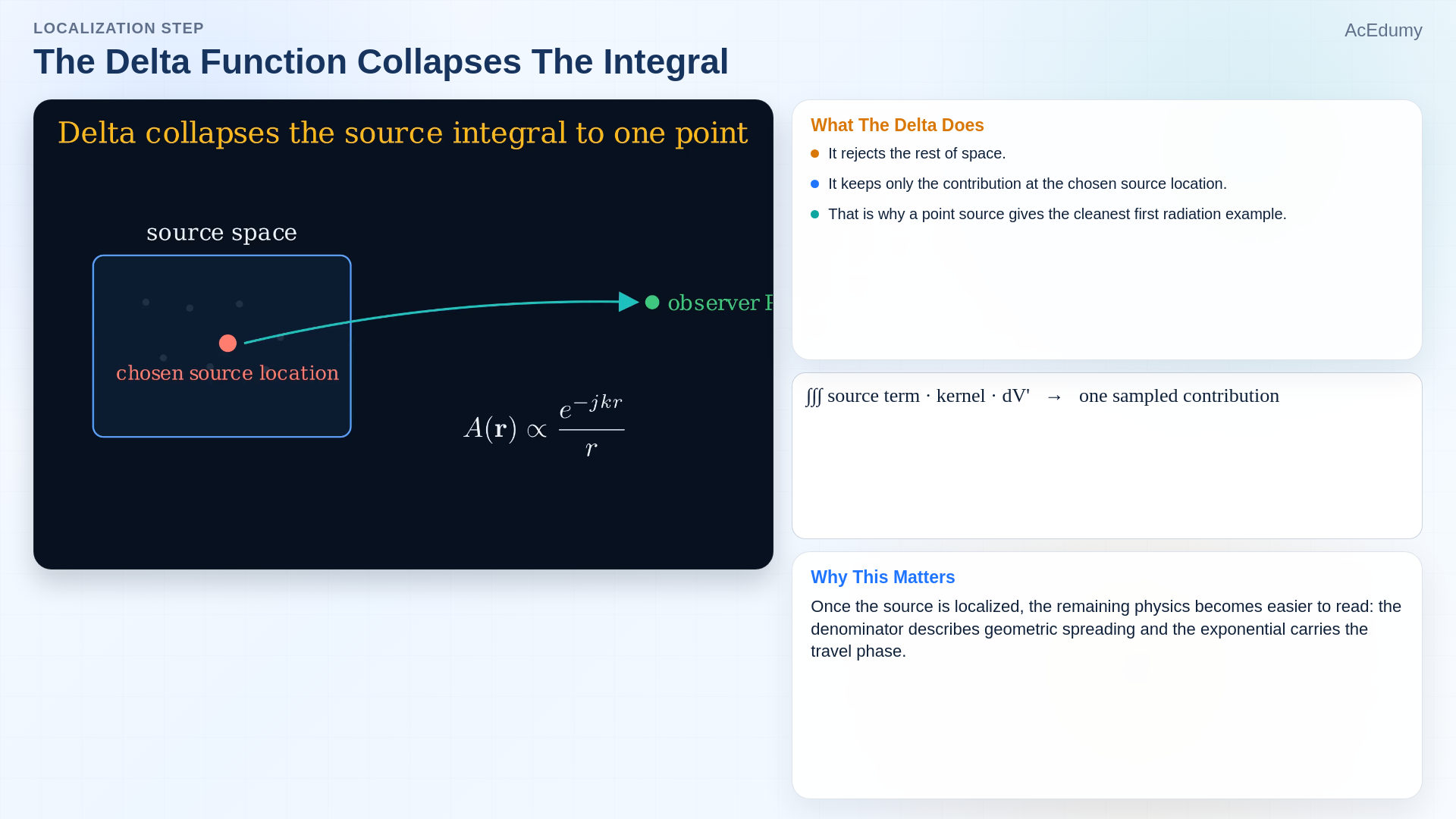
The 1/r factor carries spherical amplitude spreading, while e^(−jkr) carries accumulated propagation phase. The delta function now does the real work.Inside the integral, it says: ignore the rest of space and keep only the contribution from the chosen source location.So instead of integrating over a spread-out source region, we sample one point.That is why the point-source example is the cleanest first radiation calculation.Narration transcript
The delta function now does the real work. Inside the integral, it says: ignore the rest of space and keep only the contribution from the chosen source location. So instead of integrating over a spread-out source region, we sample one point. That is why the point-source example is the cleanest first radiation calculation.
4. Derive R=r and A(r)=C·e^(−jkr)/r at the origin
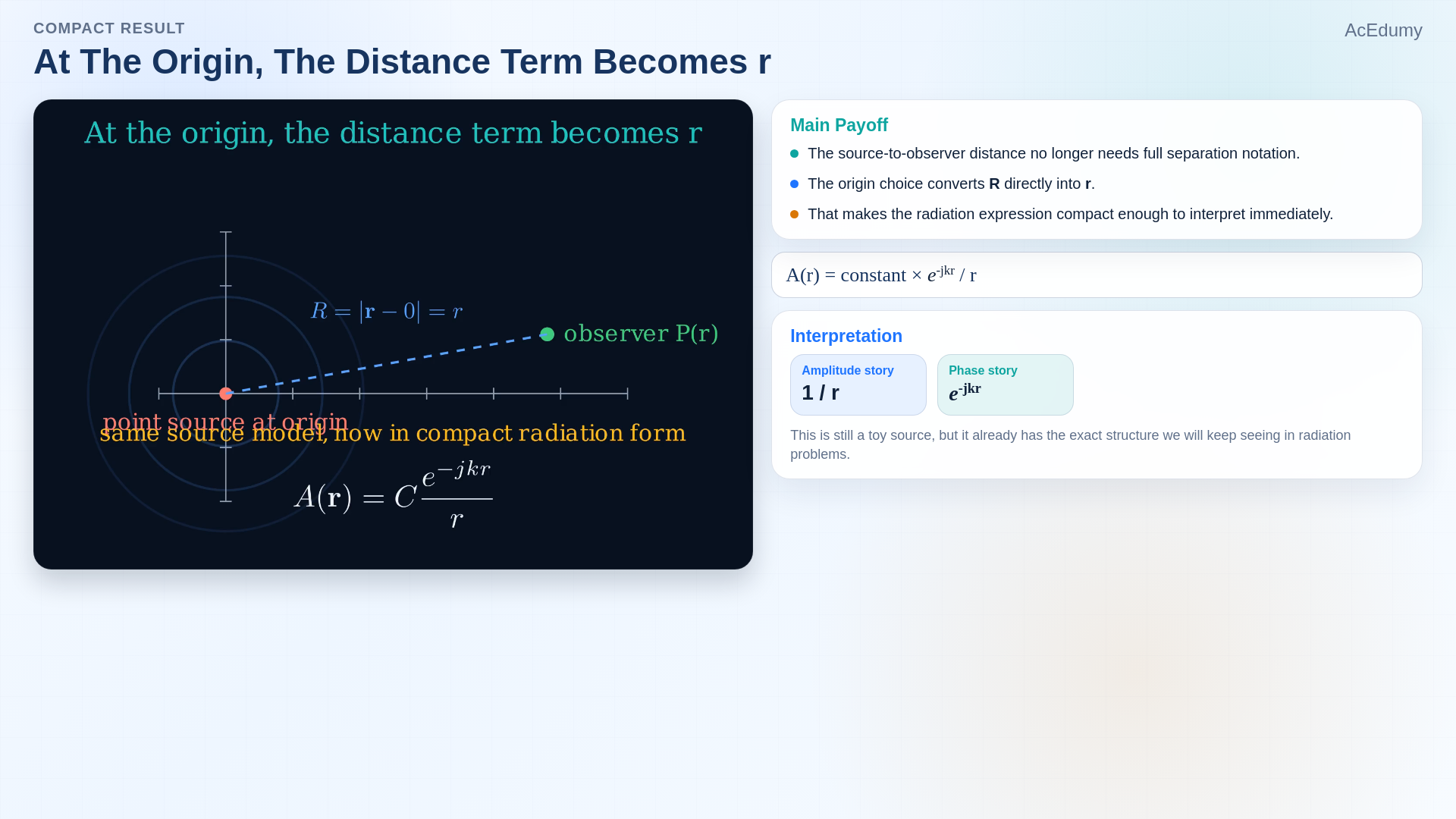
The 1/r factor carries spherical amplitude spreading, while e^(−jkr) carries accumulated propagation phase. Once the source collapses to one point at the origin, the source-to-observer distance R = r.The vector potential therefore takes the familiar form of A(r) = C·e(−jkr)/r.This is the first big payoff of the lesson.A compact source description has turned into a compact radiation expression.Narration transcript
Once the source collapses to one point at the origin, the source-to-observer distance big R becomes simply r. The vector potential therefore takes the familiar form of a constant times e to the minus j k r divided by r. This is the first big payoff of the lesson. A compact source description has turned into a compact radiation expression.
5. Update only the distance term for a shifted source
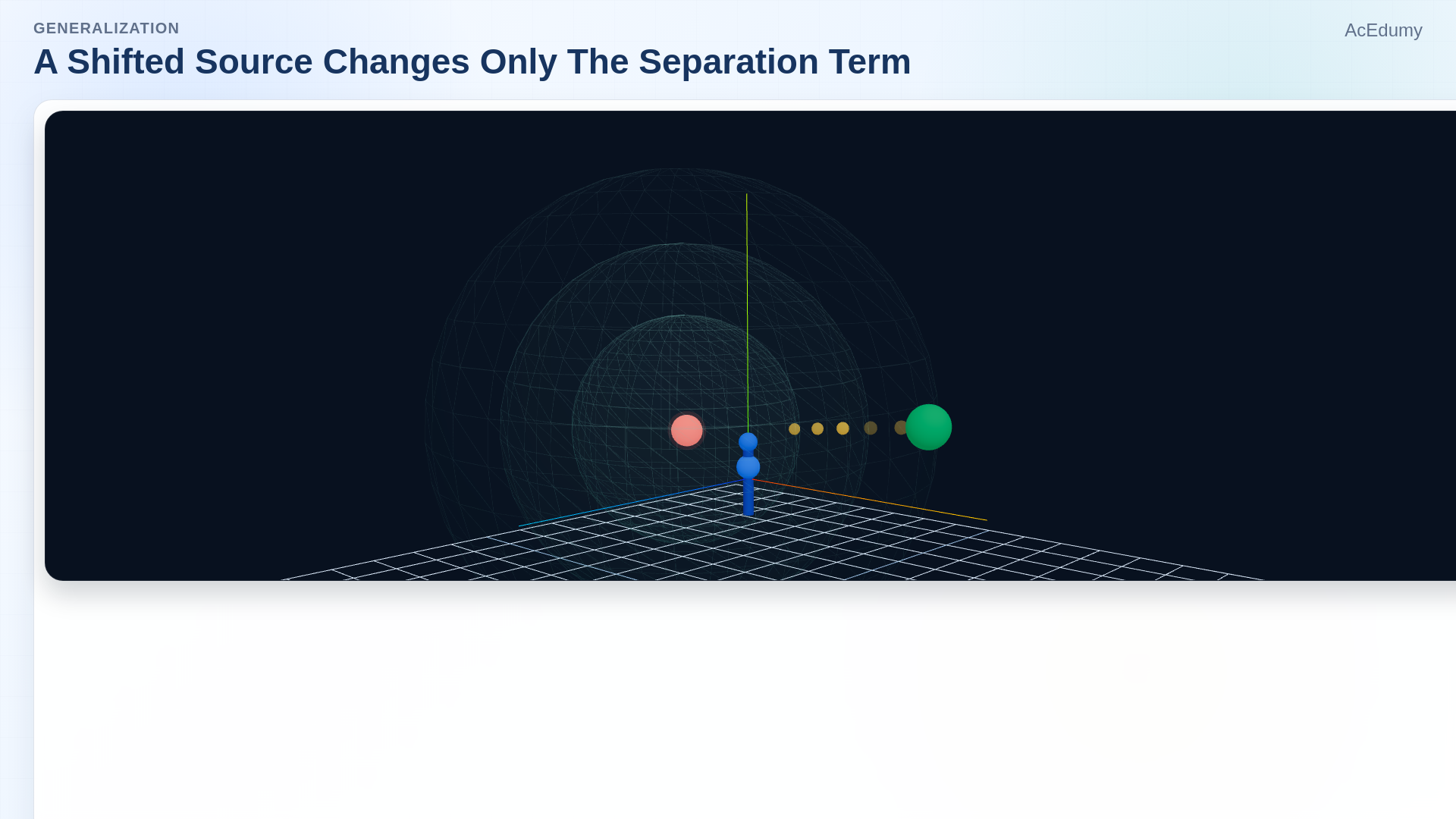
The 1/r factor carries spherical amplitude spreading, while e^(−jkr) carries accumulated propagation phase. If the point source is not at the origin, the story is still the same.The only thing that changes is the distance term.Instead of r, we keep the full source-to-observer separation magnitude.So the point-source result is not tied to the origin.The origin case is only the cleanest first version.Narration transcript
If the point source is not at the origin, the story is still the same. The only thing that changes is the distance term. Instead of r, we keep the full source-to-observer separation magnitude. So the point-source result is not tied to the origin. The origin case is only the cleanest first version.
6. Separate 1/r amplitude decay from e^(−jkr) phase

The 1/r factor carries spherical amplitude spreading, while e^(−jkr) carries accumulated propagation phase. Read the result in two parts.The 1/r factor says the amplitude weakens with distance because the wave spreads over larger spherical surfaces.The exponential phase term says the disturbance is propagating outward and accumulating phase as distance increases.One factor tells the spreading story.The other tells the travel story.Narration transcript
Read the result in two parts. The one over r factor says the amplitude weakens with distance because the wave spreads over larger spherical surfaces. The exponential phase term says the disturbance is propagating outward and accumulating phase as distance increases. One factor tells the spreading story. The other tells the travel story.
7. Compare amplitude and phase at r and 2r
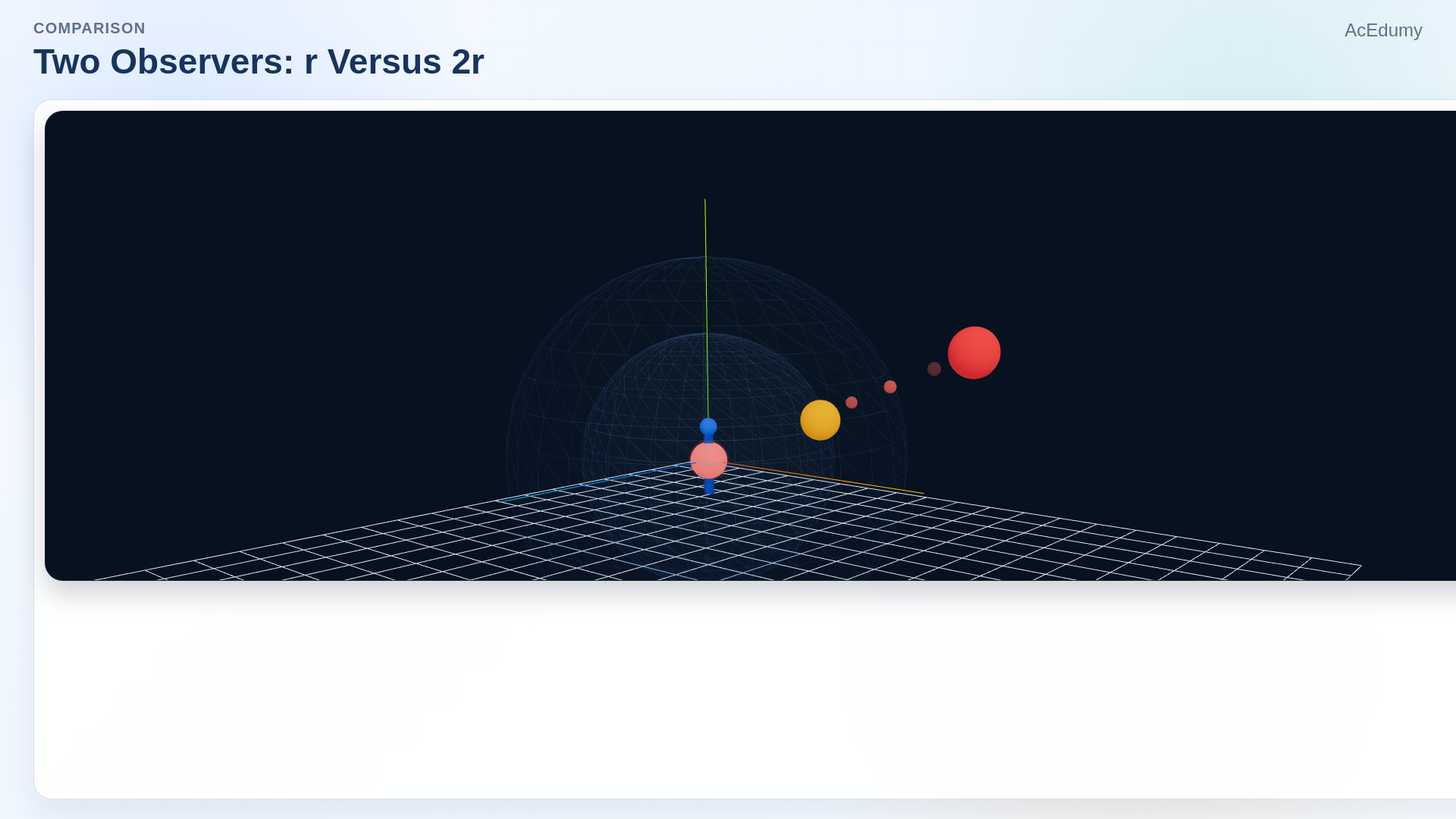
The 1/r factor carries spherical amplitude spreading, while e^(−jkr) carries accumulated propagation phase. Now compare two observers.If one observer is at distance r and another is at distance 2r, the second observer does not receive the same field.Its amplitude is cut in half by the 1/r factor, and its phase is delayed by an extra kr in the exponential term.So even this toy example already shows the two key ideas: decay and phase progression.Narration transcript
Now compare two observers. If one observer is at distance r and another is at distance two r, the second observer does not receive the same field. Its amplitude is cut in half by the one over r factor, and its phase is delayed by an extra k r in the exponential term. So even this toy example already shows the two key ideas: decay and phase progression.
8. Summarize the four point-source results

The 1/r factor carries spherical amplitude spreading, while e^(−jkr) carries accumulated propagation phase. That is why the point-source example matters.It is not the final antenna we care about, but it is the cleanest source-to-field example we can solve first.The delta localizes the source.The integral collapses.At the origin, big R becomes r.And the result reveals spherical spreading and propagation phase in one expression.Narration transcript
That is why the point-source example matters. It is not the final antenna we care about, but it is the cleanest source-to-field example we can solve first. The delta localizes the source. The integral collapses. At the origin, big R becomes r. And the result reveals spherical spreading and propagation phase in one expression.
Source video: Antenna Theory #06 | Point Source Radiation | Why e^(-jkr) / r Appears (3:28)