Electromagnetic Theory · Polarization and Dielectrics
#14 Dielectric polarization, bound charge, electric susceptibility, permittivity, dielectric strength, material classes, and a capacitor example
Derive bound charge from polarization, build permittivity, and calculate field, charge, and voltage in a dielectric-filled capacitor.
Question
Derive the polarization vector and bound charges; obtain permittivity from D = ε₀E + P, classify dielectric strength and simple materials, and solve the dielectric-filled capacitor example.
Written solution and narration transcript(shows the full solution)
Below are all the lines written in the notebook together with the full narration transcript.
1. Move from conductors to dielectrics
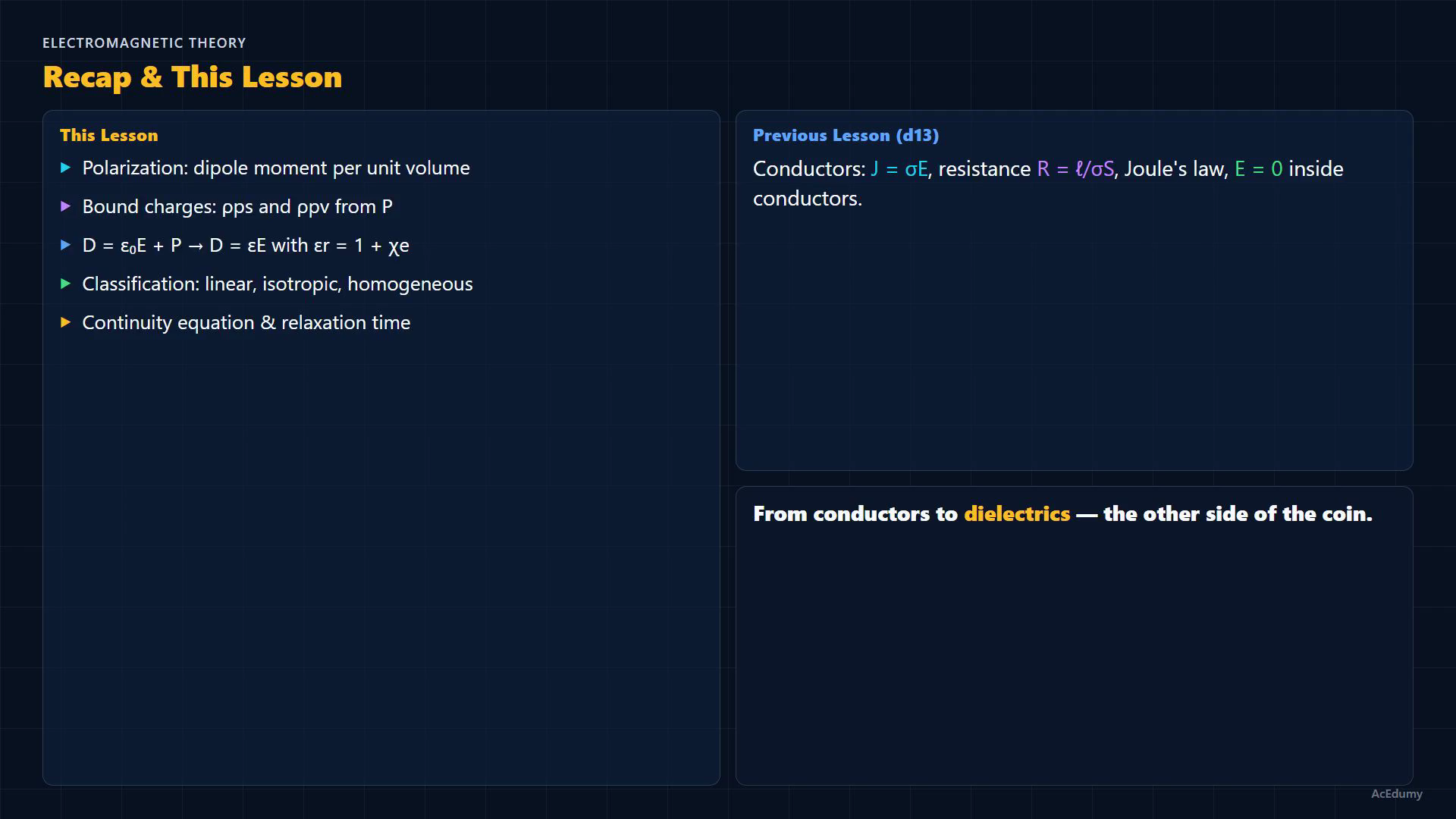
Polarization creates bound charge, and a linear dielectric obeys D = εE. In the previous lesson, we studied electric currents and conductors.The point form of Ohm's law is J = σE; for a uniform conductor R = ℓ/(σS).We also saw that inside a perfect conductor in static equilibrium, the electric field is zero.Today we move to the other side: dielectrics — insulators.We will learn how an applied electric field polarizes a dielectric, creating bound charges.We will define susceptibility, permittivity, and the dielectric constant.We will classify materials as linear, isotropic, and homogeneous.And finally, we will derive the continuity equation and the concept of relaxation time.Narration transcript
In the previous lesson, we studied electric currents and conductors. We learned that current density J equals sigma E — the point form of Ohm's law — and derived resistance as R equals length over sigma times cross-section area. We also saw that inside a perfect conductor in static equilibrium, the electric field is zero. Today we move to the other side: dielectrics — insulators. We will learn how an applied electric field polarizes a dielectric, creating bound charges. We will define susceptibility, permittivity, and the dielectric constant. We will classify materials as linear, isotropic, and homogeneous. And finally, we will derive the continuity equation and the concept of relaxation time.
2. Define polarization and bound charge
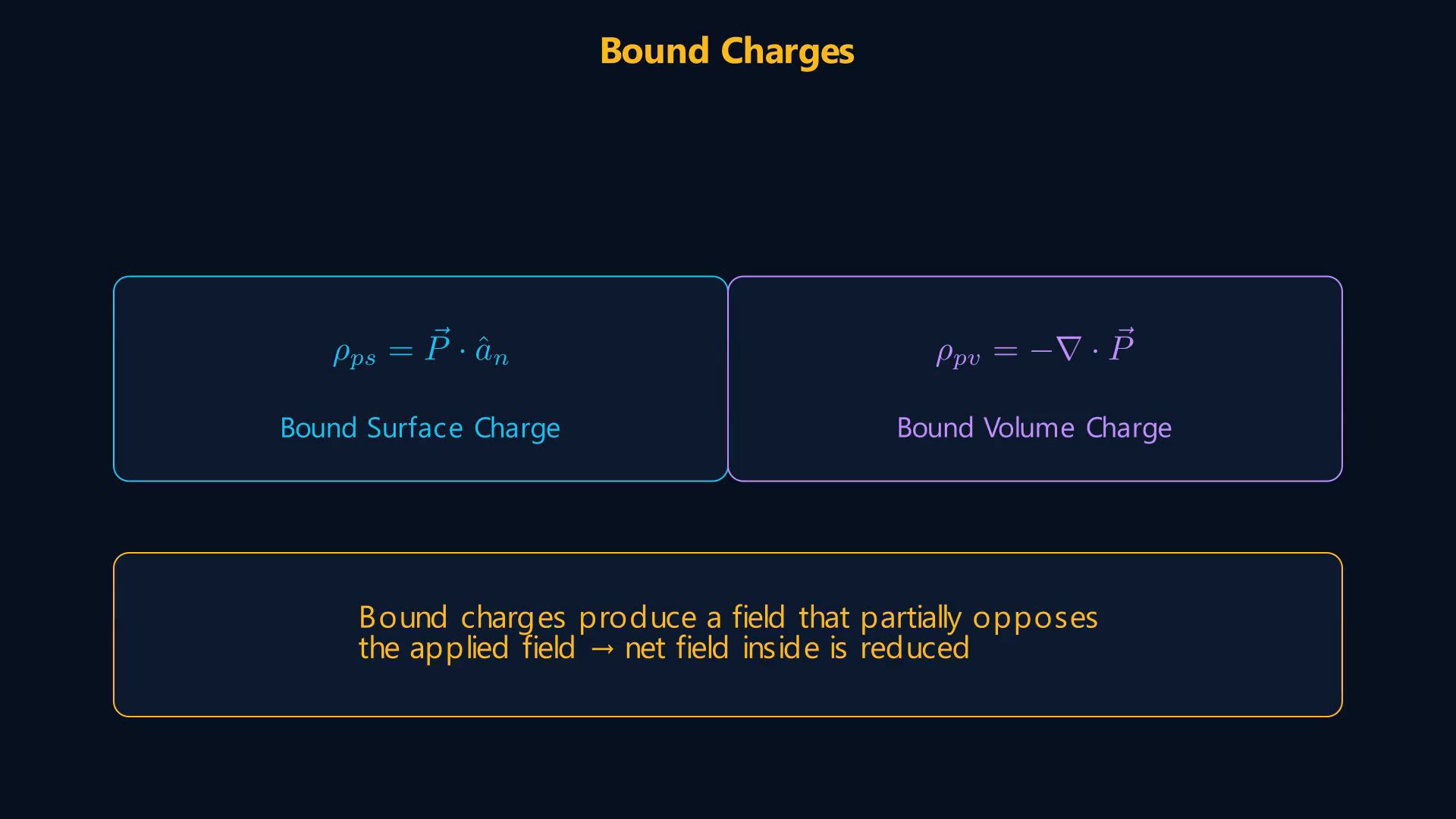
Polarization creates bound charge, and a linear dielectric obeys D = εE. What happens when you apply an electric field to an insulator?Unlike a conductor, the charges cannot flow freely.Instead, each atom or molecule distorts slightly — the positive nucleus shifts in the direction of E, and the negative electron cloud shifts against E.This creates a tiny electric dipole at every atom.An atom's dipole moment is p = Qd, with d directed from negative to positive charge.Molecules fall into two categories.Nonpolar molecules like hydrogen and nitrogen have no permanent dipole — the dipole is induced only by the field.Polar molecules like water already have a built-in dipole moment, and the applied field rotates them into partial alignment.We define the polarization vector P as the dipole moment per unit volume.P has units of coulombs per square meter.Polarization creates what we call bound charges — charges that are not free to move, but arise from the collective displacement.Bound surface charge density:Bound volume charge density:These bound charges produce their own electric field that partially opposes the applied field, reducing the total field inside the dielectric.Narration transcript
What happens when you apply an electric field to an insulator? Unlike a conductor, the charges cannot flow freely. Instead, each atom or molecule distorts slightly — the positive nucleus shifts in the direction of E, and the negative electron cloud shifts against E. This creates a tiny electric dipole at every atom. The dipole moment of one atom is p equals Q times d, where d is the displacement vector from minus to plus. Molecules fall into two categories. Nonpolar molecules like hydrogen and nitrogen have no permanent dipole — the dipole is induced only by the field. Polar molecules like water already have a built-in dipole moment, and the applied field rotates them into partial alignment. We define the polarization vector P as the dipole moment per unit volume. P has units of coulombs per square meter. Polarization creates what we call bound charges — charges that are not free to move, but arise from the collective displacement. The bound surface charge density is rho p s equals P dot a hat n. The bound volume charge density is rho p v equals minus divergence of P. These bound charges produce their own electric field that partially opposes the applied field, reducing the total field inside the dielectric.
3. Build permittivity, dielectric constant, and strength
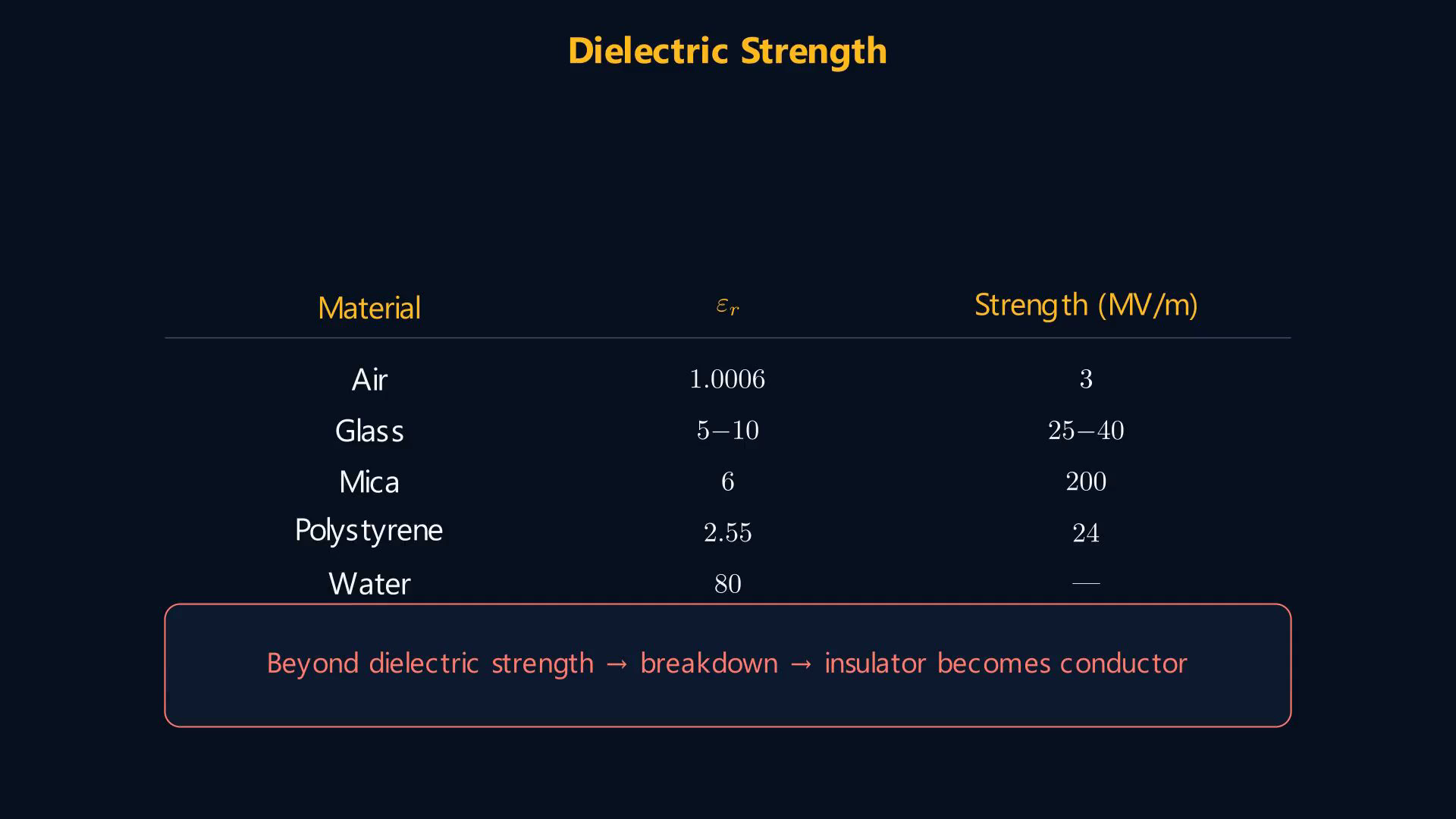
Polarization creates bound charge, and a linear dielectric obeys D = εE. Now we connect polarization to the electric field quantitatively.For a linear dielectric, P = χeε₀E; χe is the dimensionless electric susceptibility.The total electric flux density is D = ε₀E + P.Substituting P = χeε₀E gives D = ε₀(1 + χe)E.Relative permittivity (dielectric constant):D = ε₀εrE = εE, where ε = ε₀εr.The dielectric constant is always greater than or equal to one.For free space, ε r equals one.For water, ε r is about 80.For glass, it is around 5 to 10.Every dielectric has a maximum field it can withstand.Beyond this value, called the dielectric strength, the material breaks down — electrons are ripped free and the insulator becomes a conductor.For air at atmospheric pressure, the dielectric strength is about 3 megavolts per meter.This is why high-voltage equipment uses oil or special gases as insulation.Narration transcript
Now we connect polarization to the electric field quantitatively. For most materials, the polarization is proportional to the applied field: P equals chi e times epsilon zero times E, where chi e is the electric susceptibility — a dimensionless number. The total flux density D includes both the free-space contribution and the polarization: D equals epsilon zero E plus P. Substituting P equals chi e epsilon zero E, we get D equals epsilon zero times one plus chi e, times E. We define the relative permittivity, also called the dielectric constant, as epsilon r equals one plus chi e. So D equals epsilon zero epsilon r E, which we write simply as D equals epsilon E, where epsilon equals epsilon zero times epsilon r. The dielectric constant is always greater than or equal to one. For free space, epsilon r equals one. For water, epsilon r is about 80. For glass, it is around 5 to 10. Every dielectric has a maximum field it can withstand. Beyond this value, called the dielectric strength, the material breaks down — electrons are ripped free and the insulator becomes a conductor. For air at atmospheric pressure, the dielectric strength is about 3 megavolts per meter. This is why high-voltage equipment uses oil or special gases as insulation.
4. Classify dielectric materials
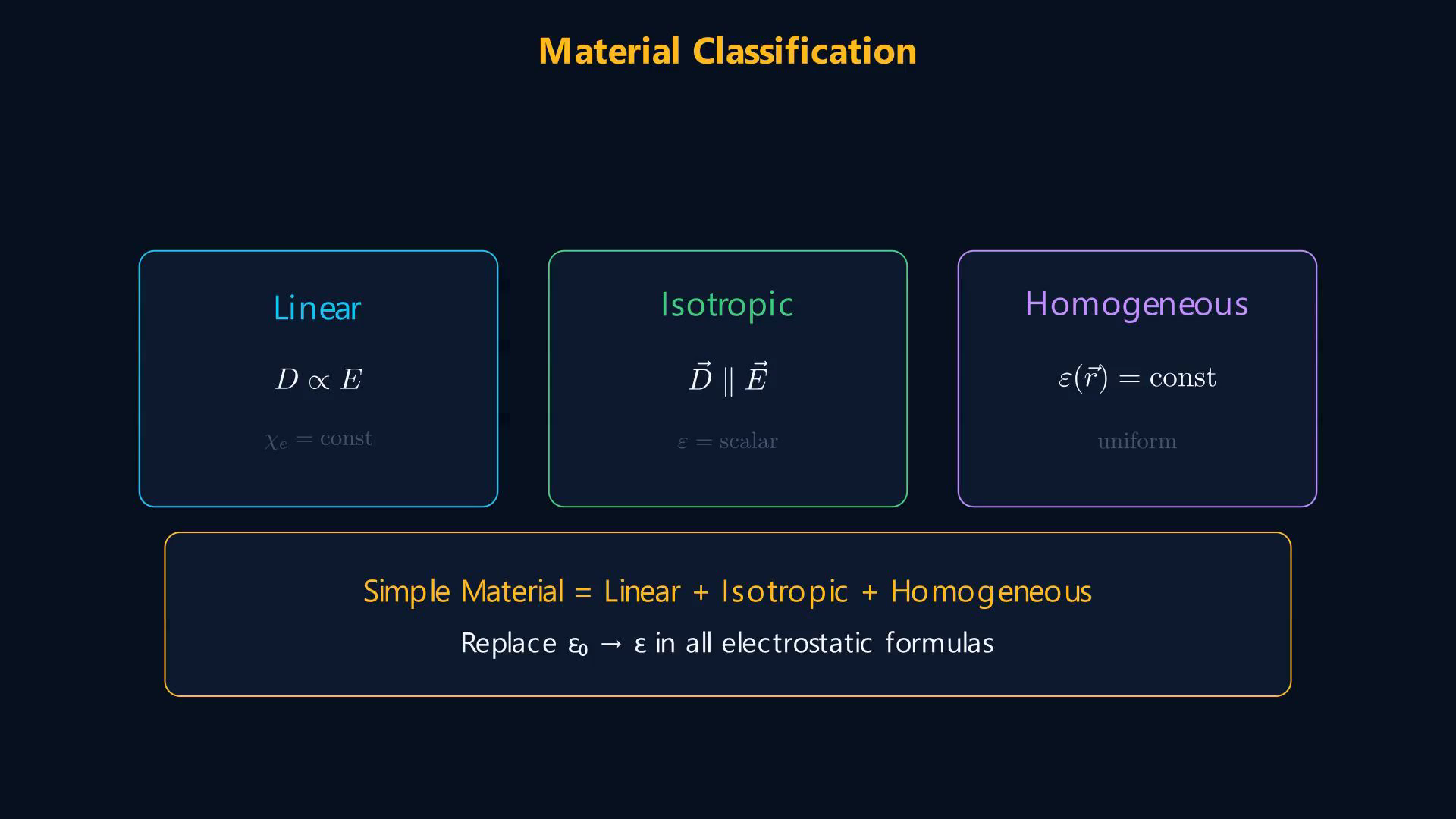
Polarization creates bound charge, and a linear dielectric obeys D = εE. We classify dielectric materials using three properties.A material is linear if D varies linearly with E — meaning chi e is constant regardless of field strength.A material is isotropic if its properties are the same in all directions — meaning D and E are always parallel, and ε is a single scalar, not a tensor.A material is homogeneous if ε does not change from point to point — the same permittivity everywhere inside the material.A material that is linear, isotropic, and homogeneous is called a simple material.For simple materials, replace ε₀ with ε in the free-space formulas.Coulomb's law:Energy density:Most engineering dielectrics behave as simple materials at moderate field strengths.The exceptions are important too.Nonlinear materials, like ferroelectrics, have chi e that depends on E.Anisotropic materials, like certain crystals, require a 3 by 3 permittivity tensor because the field in the x direction can create a flux component in the y direction.Inhomogeneous materials have spatially varying permittivity.Narration transcript
We classify dielectric materials using three properties. A material is linear if D varies linearly with E — meaning chi e is constant regardless of field strength. A material is isotropic if its properties are the same in all directions — meaning D and E are always parallel, and epsilon is a single scalar, not a tensor. A material is homogeneous if epsilon does not change from point to point — the same permittivity everywhere inside the material. A material that is linear, isotropic, and homogeneous is called a simple material. For simple materials, all the formulas from Chapter 4 still apply — we just replace epsilon zero with epsilon. Coulomb's law: F equals Q one Q two over four pi epsilon R squared. The energy density becomes one half epsilon E squared. Most engineering dielectrics behave as simple materials at moderate field strengths. The exceptions are important too. Nonlinear materials, like ferroelectrics, have chi e that depends on E. Anisotropic materials, like certain crystals, require a 3 by 3 permittivity tensor because the field in the x direction can create a flux component in the y direction. Inhomogeneous materials have spatially varying permittivity.
5. Derive continuity and relaxation time
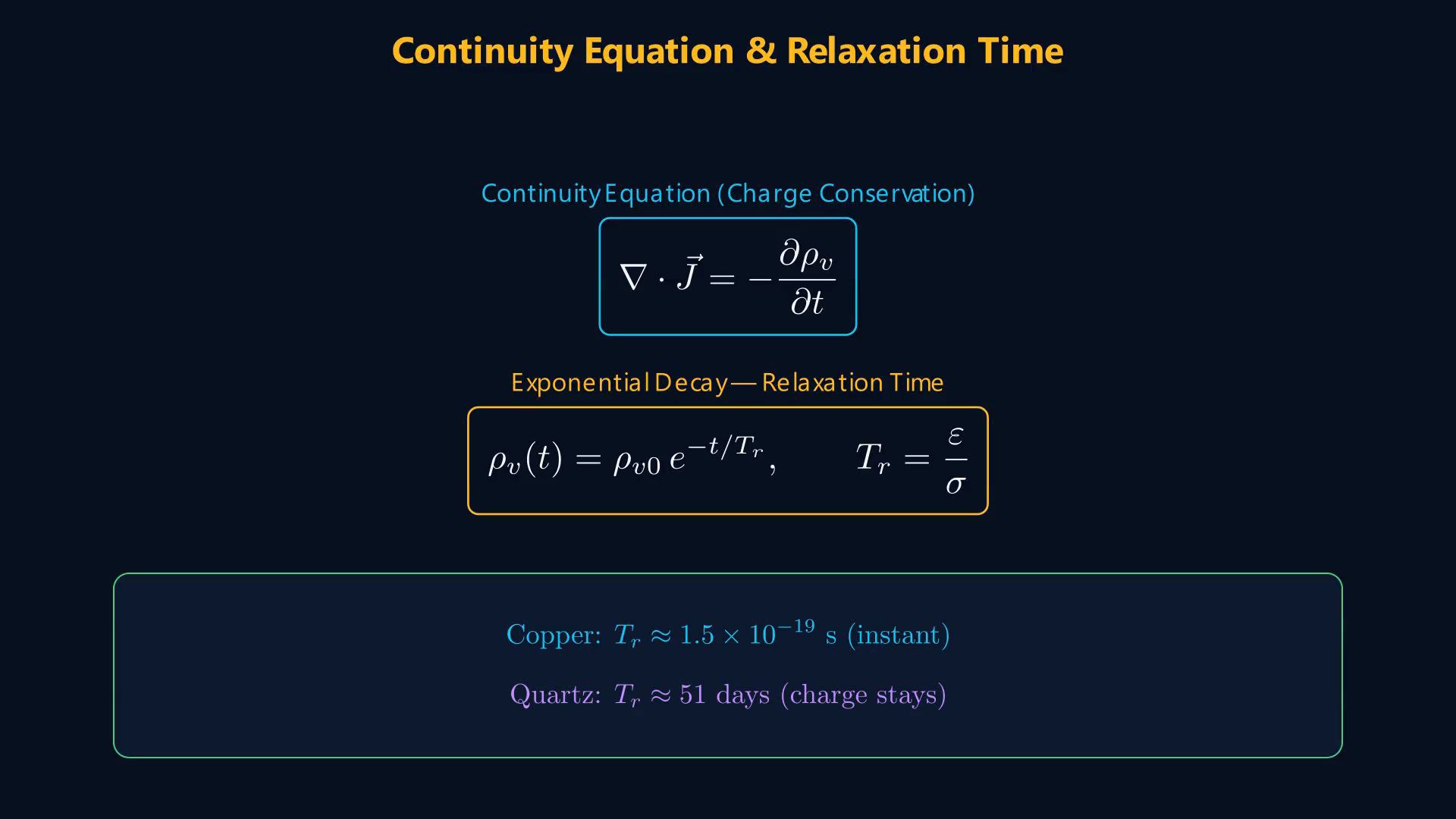
Polarization creates bound charge, and a linear dielectric obeys D = εE. Before leaving this chapter, we derive one more fundamental result: the continuity equation.The principle of charge conservation states that charge cannot be created or destroyed.If current flows out of a closed surface, the charge inside must decrease by the same amount.Continuity equation:This is the continuity equation.Now consider what happens when you place free charge inside a material with conductivity σ and permittivity ε.From J = σE and ∇·D = ρv, ρ(t) = ρ₀e(−t/Tr), with relaxation time Tr = ε/σ.For copper, σ is 5.8 times 10 to the 7 and ε r is essentially one.The relaxation time is about 1.5 times 10 to the minus 19 seconds — charge placed inside copper vanishes almost instantaneously.For fused quartz, σ is 10 to the minus 17 and ε r is 5.The relaxation time is about 51 days — charge placed inside a good insulator stays there for weeks.This enormous difference — 18 orders of magnitude — is what separates conductors from insulators.Narration transcript
Before leaving this chapter, we derive one more fundamental result: the continuity equation. The principle of charge conservation states that charge cannot be created or destroyed. If current flows out of a closed surface, the charge inside must decrease by the same amount. In mathematical form: the divergence of J equals minus the partial derivative of rho v with respect to time. This is the continuity equation. Now consider what happens when you place free charge inside a material with conductivity sigma and permittivity epsilon. From J equals sigma E and the divergence of D equals rho v, we can show that the charge decays exponentially: rho of t equals rho zero times e to the minus t over T r, where T r equals epsilon over sigma is the relaxation time. For copper, sigma is 5.8 times 10 to the 7 and epsilon r is essentially one. The relaxation time is about 1.5 times 10 to the minus 19 seconds — charge placed inside copper vanishes almost instantaneously. For fused quartz, sigma is 10 to the minus 17 and epsilon r is 5. The relaxation time is about 51 days — charge placed inside a good insulator stays there for weeks. This enormous difference — 18 orders of magnitude — is what separates conductors from insulators.
6. Solve the dielectric-filled capacitor example
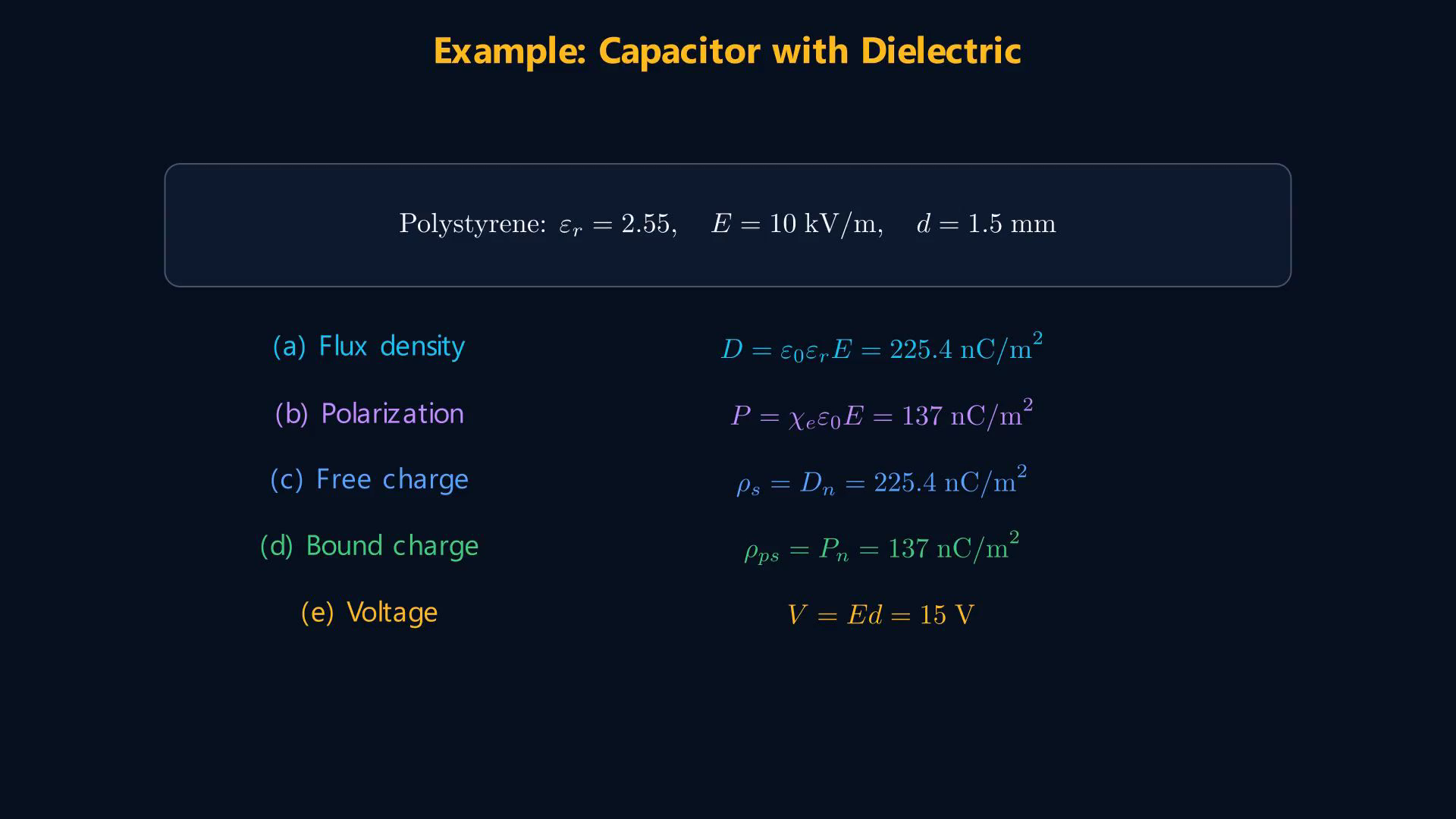
Polarization creates bound charge, and a linear dielectric obeys D = εE. Let us work through a practical example.A parallel-plate capacitor has d = 1.5 mm and polystyrene with εr = 2.55.Applied field: E = 10 kV/m.Part a: Find the electric flux density D.That is 8.854 times 10 to the minus 12, times 2.55, times 10 to the 4.D = 225.4 nC/m².Part b: Find the polarization P.P = 137 nC/m².Free surface charge on each plate: ρs = D·an = 225.4 nC/m².Bound charge on the dielectric surface: ρps = P·an = 137 nC/m².Notice: the bound charge partially cancels the free charge, reducing the field inside.Voltage across the plates: V = Ed = 10⁴×1.5×10⁻³ V.The result is V = 15 V.Narration transcript
Let us work through a practical example. A parallel-plate capacitor has plate separation d equals 1.5 millimeters and is filled with polystyrene, which has a dielectric constant epsilon r equals 2.55. The applied electric field is E equals 10 kilovolts per meter. Part a: Find the electric flux density D. D equals epsilon zero epsilon r E. That is 8.854 times 10 to the minus 12, times 2.55, times 10 to the 4. The result is D equals 225.4 nanocoulombs per square meter. Part b: Find the polarization P. P equals chi e epsilon zero E. Chi e equals epsilon r minus one equals 1.55. So P equals 1.55 times 8.854 times 10 to the minus 12 times 10 to the 4. The result is P equals 137 nanocoulombs per square meter. Part c: The surface density of free charge on each plate equals D dot a hat n, which is 225.4 nanocoulombs per square meter. Part d: The surface density of bound polarization charge on the dielectric surface equals P dot a hat n, which is 137 nanocoulombs per square meter. Notice: the bound charge partially cancels the free charge, reducing the field inside. Part e: The voltage across the plates is V equals E times d equals 10 to the 4 times 1.5 times 10 to the minus 3. The result is V equals 15 volts.
7. Review polarization and dielectric relations

Polarization creates bound charge, and a linear dielectric obeys D = εE. Let us review the key results.Polarization P is the dipole moment per unit volume, created when an external field displaces charge within a dielectric.Bound charges: ρps = P·an and ρpv = −∇·P.D = ε₀E + P leads to D = εE, where ε = ε₀εr.For simple materials — linear, isotropic, homogeneous — just replace ε zero with ε in all electrostatic formulas.Charge conservation:The relaxation time Tr = ε/σ controls the decay of free charge.In the next lesson, we study boundary conditions — what happens to E and D at the interface between two different materials.Narration transcript
Let us review the key results. Polarization P is the dipole moment per unit volume, created when an external field displaces charge within a dielectric. Bound charges arise from polarization: surface charge rho p s equals P dot a hat n, and volume charge rho p v equals minus divergence of P. The relationship D equals epsilon zero E plus P leads to D equals epsilon E, where epsilon equals epsilon zero epsilon r. For simple materials — linear, isotropic, homogeneous — just replace epsilon zero with epsilon in all electrostatic formulas. The continuity equation expresses charge conservation: divergence of J equals minus partial rho v over partial t. The relaxation time T r equals epsilon over sigma determines how quickly charge decays inside a material. In the next lesson, we study boundary conditions — what happens to E and D at the interface between two different materials.
Source video: Electromagnetic Theory (v2) #14 Polarization & Dielectrics (10:53)