Circuit Theory 1 · Power and Energy
#03 Power and energy — passive sign convention
Connects instantaneous power, the energy integral, and the passive sign convention through two consistent examples.
Question
Explain the relationship between instantaneous power and energy in a circuit element. Apply the passive sign convention to decide whether the element absorbs or delivers power for i = -5 A, v = 6 V and i = -6 A, v = 10 V.
Written solution and narration transcript(shows the full solution)
Below are all the lines written in the notebook together with the full narration transcript.
1. Instantaneous power
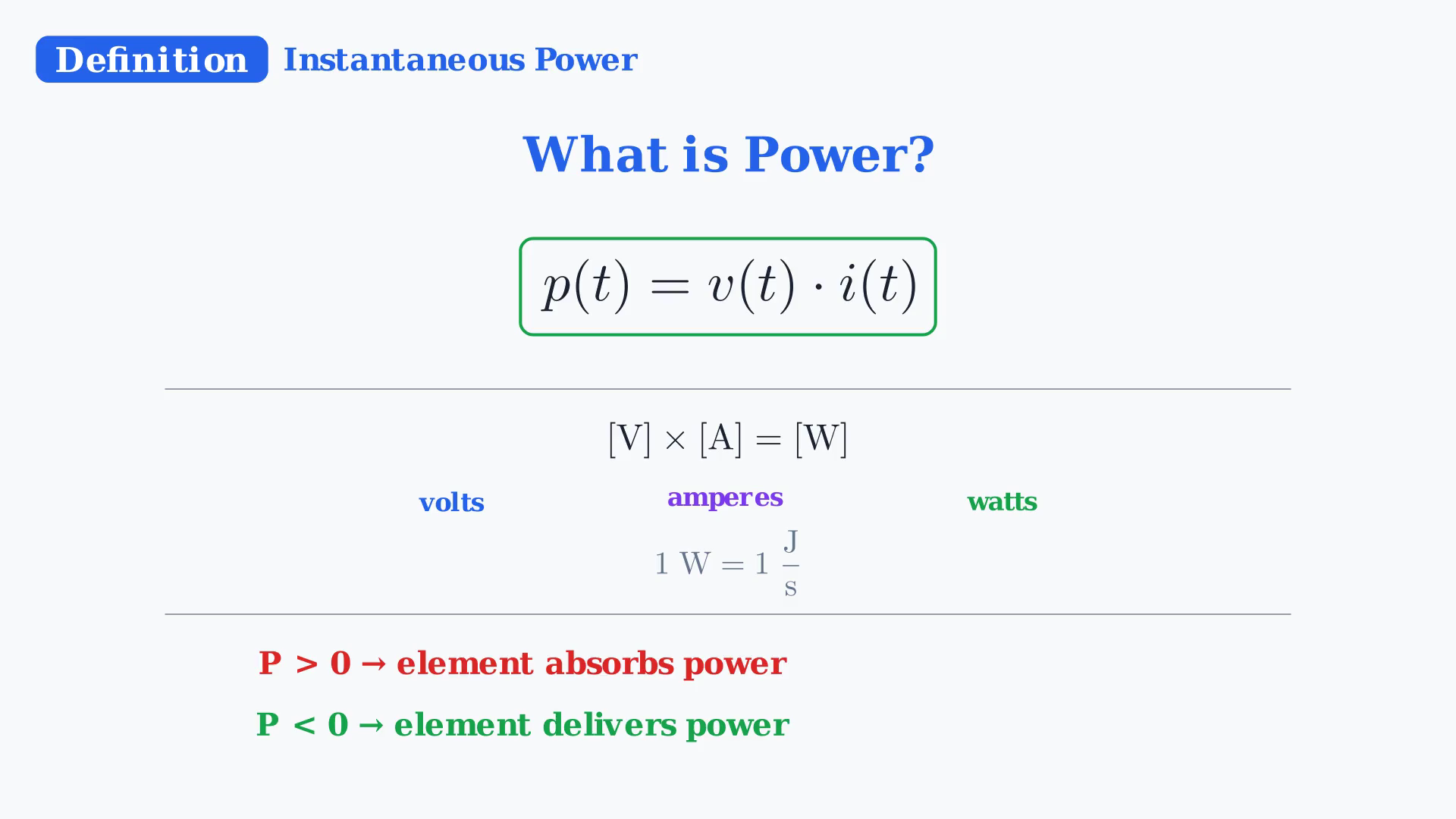
Instantaneous power and its sign. p > 0 → absorbsp < 0 → deliversNarration transcript
Power tells us how fast energy is being transferred in a circuit. The instantaneous power is p of t equals v of t times i of t. Voltage is in volts, current is in amperes, and their product gives us power in watts. One watt equals one joule per second. If the power is positive, the element is absorbing energy. If negative, the element is delivering energy to the rest of the circuit.
2. Energy
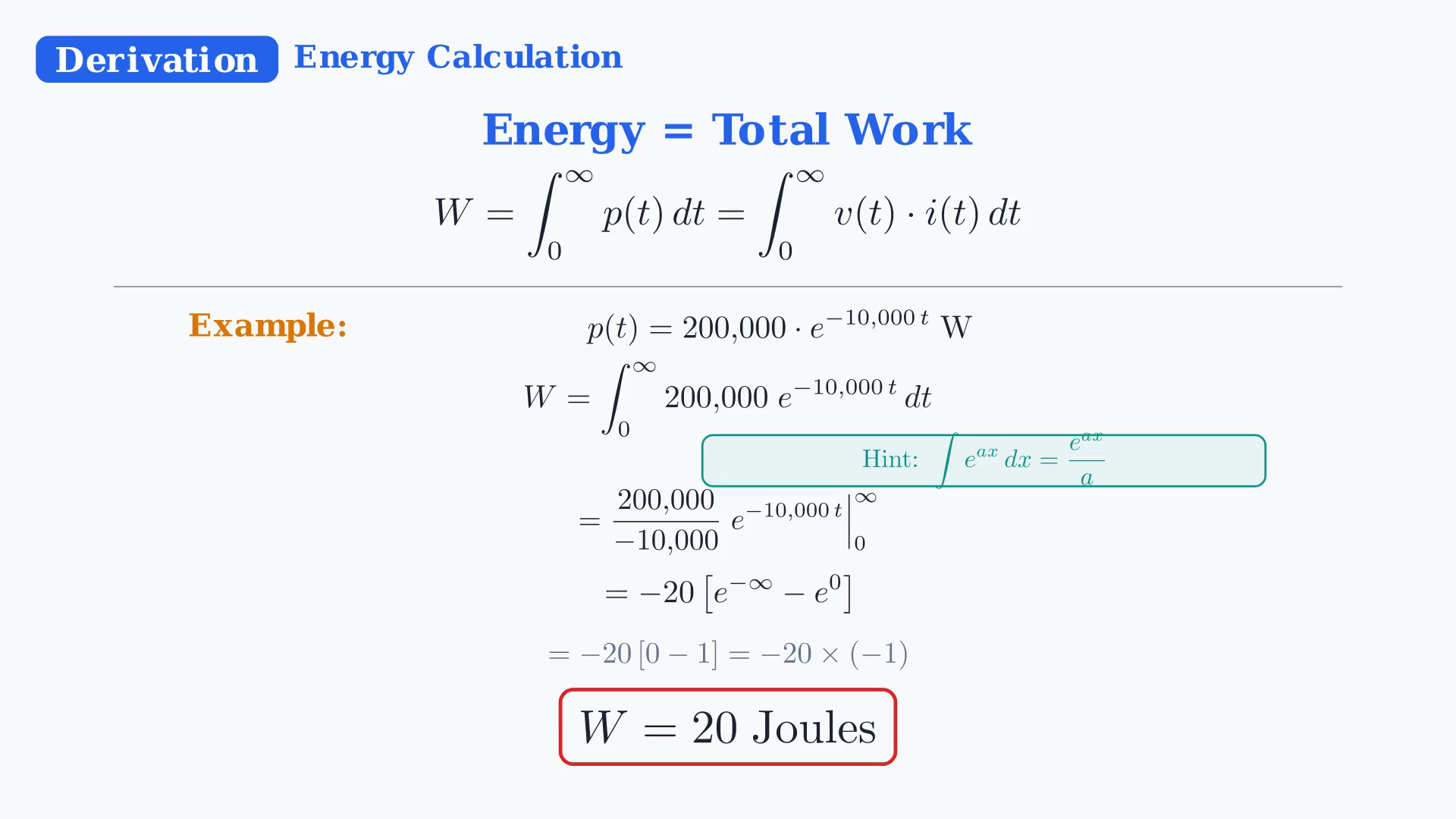
Energy integral example. Narration transcript
Energy is the total work done over time. We find it by integrating power: W equals the integral of p of t dt, from zero to infinity. Which is also the integral of v of t times i of t dt. Let's work through an example. Suppose the power is p of t equals two hundred thousand times e to the negative ten thousand t, in watts. To find the total energy, we integrate from zero to infinity. Using the hint that the integral of e to the a x dx equals e to the a x divided by a, we get two hundred thousand divided by negative ten thousand, times e to the negative ten thousand t, evaluated from zero to infinity. At infinity, the exponential goes to zero. At zero, e to the zero is one. So W equals negative twenty times the quantity zero minus one, which gives us W equals twenty joules. The element absorbed twenty joules of energy total.
3. Passive sign
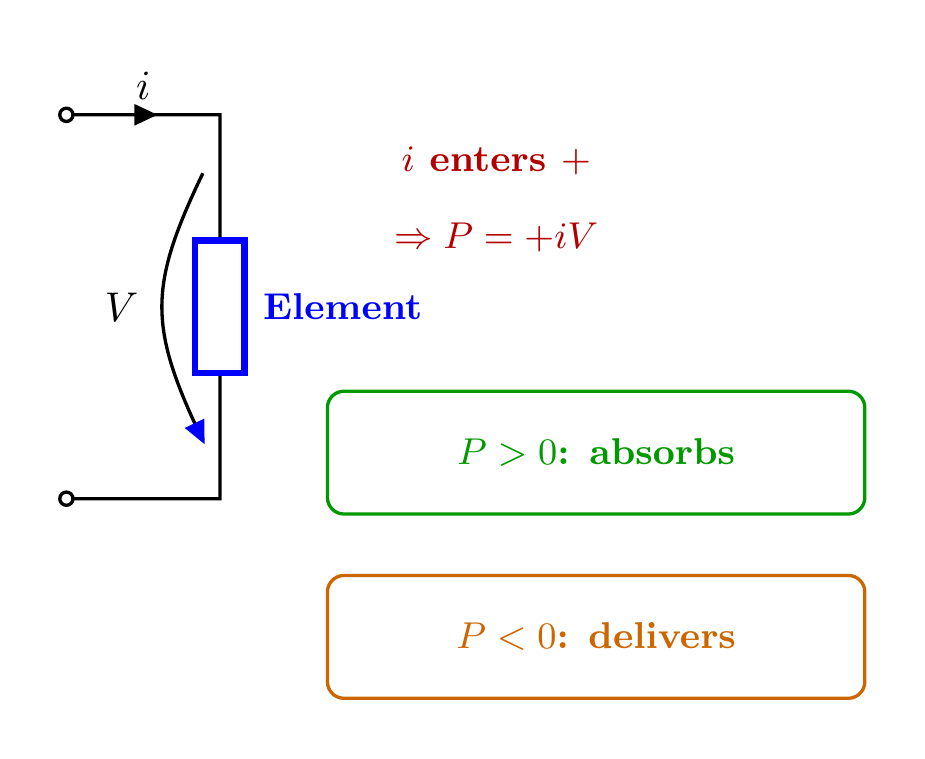
Passive sign convention. Current enters the + terminalp > 0 → absorbs powerp < 0 → delivers powerCheck reference directions firstNarration transcript
How do we know if an element absorbs or delivers power? This is where the passive sign convention comes in. Here's the rule: if current enters through the positive terminal, then P equals plus i times V, and a positive result means the element absorbs power. If current enters through the negative terminal, or equivalently, if the current direction opposes the voltage polarity, then a positive P means the element delivers power. The sign of P tells you everything: positive P with passive sign convention means absorbing, negative P means delivering.
4. Example: -30 W
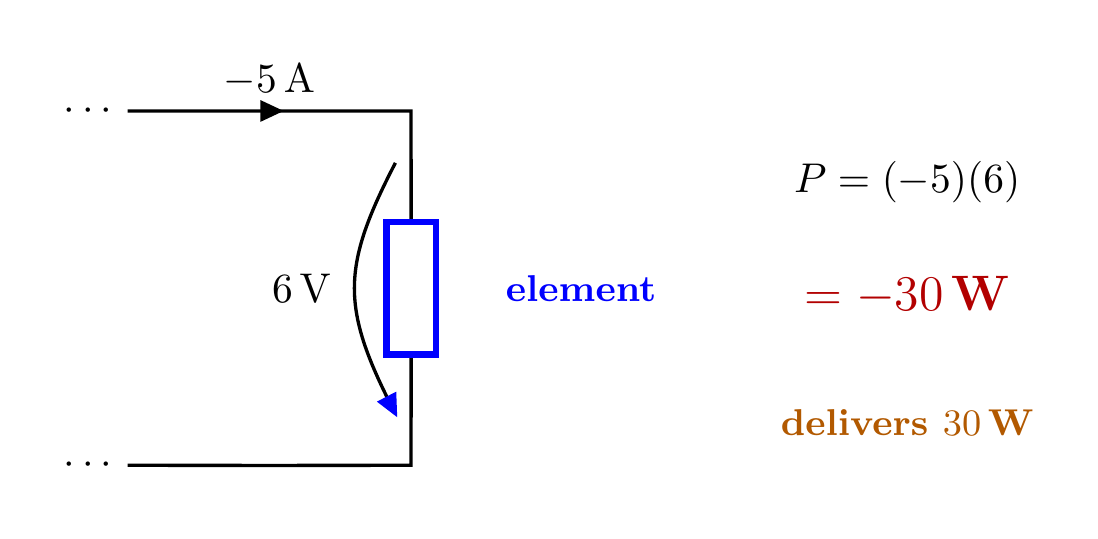
Negative thirty watts: the element delivers power. The element delivers 30 WNarration transcript
Example three. Current is negative five amperes, voltage is six volts. P equals negative five times six, which gives us negative thirty watts. The current enters the positive terminal. With passive sign convention, negative P means delivering. This element delivers thirty watts to the circuit.
5. Example: -60 W
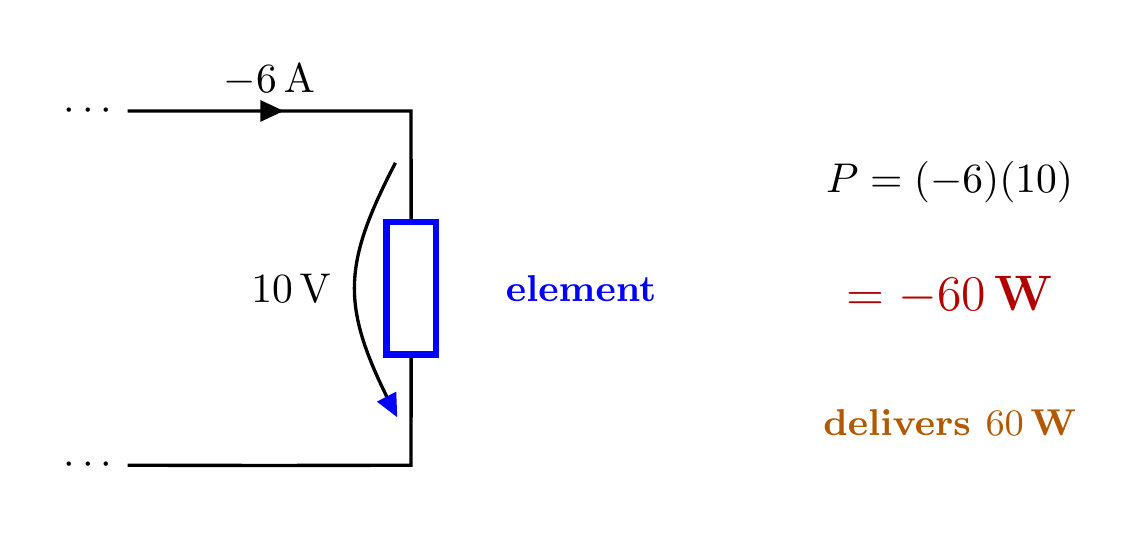
Negative sixty watts: the element delivers power. The element delivers 60 WNarration transcript
Example four. Current is negative six amperes, voltage is ten volts. P equals negative six times ten, equals negative sixty watts. The current enters the positive terminal. Negative P means delivering. This element delivers sixty watts of power. Notice the pattern: always check which terminal the current enters, then apply the sign convention consistently.
6. Method summary
Power:Energy:Passive reference: +p absorbsPassive reference: -p deliversDirections → calculation → meaningNarration transcript
Let's review. Power is p equals v times i, measured in watts. Energy is the integral of power over time, in joules. The passive sign convention tells us: if current enters the positive terminal, positive P means absorbing. Negative P means delivering. Always check the current direction relative to the voltage polarity before calculating power. In the next video, we'll start applying Kirchhoff's laws to analyze complete circuits.
Source video: Circuit Theory #03 — Power & Energy, Passive Sign Convention (4:52)