Communication Basics · PSTN Topology: Tandem Star vs Full-Mesh Edge Counting
#30 derive E_star=n independent edges/trunks for a simplified single-tandem star and E_mesh=C(n,2)=n(n−1)/2 for full mesh; verify 5/10, 10/45, and 100/4950 at n=5, 10, and 100; avoid treating edge-count scaling as capacity-, cable-length-, equipment-, or cost-equivalence; add traffic-matrix, busy-hour offered traffic, Erlang/blocking grade-of-service, tandem-fabric, routing, redundancy, protection, and lifecycle gates
Calculate n edges for a tandem star and n(n−1)/2 for full mesh, then add traffic, GoS, and resilience gates without mistaking edge ratio for capacity or cost ratio.
Question
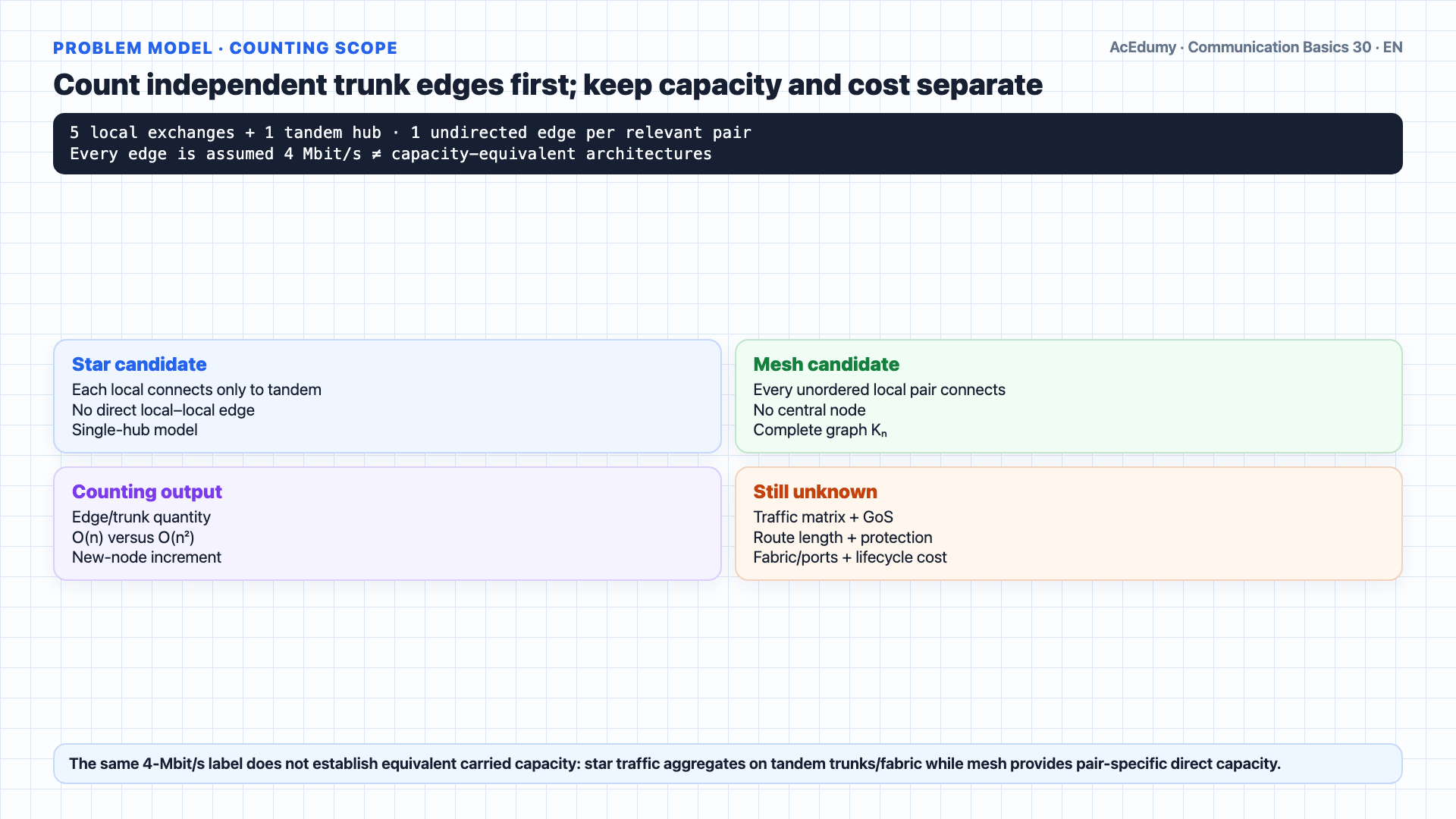
First fix this as a simplified graph-counting exercise: count at most one undirected logical/physical edge per exchange pair and do not treat the stated 4 Mbit/s per edge as making the architectures capacity-equivalent; derive E=n for a single-tandem star and E=n(n−1)/2 for full mesh; verify 5 versus 10 at n=5, 10 versus 45 at n=10, and 100 versus 4950 at n=100; give the new-node edge increment as 1 for the star and n for an existing n-node mesh; keep 4950/100=49.5 strictly as the edge-count ratio rather than cable-length, right-of-way, equipment, or cost ratio; state that an interlocal call uses two trunk hops only in the problem's star model and that traffic aggregates through tandem trunks/fabric; dimension each trunk separately from traffic matrix, busy-hour offered load, holding-time/distribution assumptions, blocking/GoS, directionality, protection, and growth; account for tandem switching fabric, ports, site, power, operations, and central failure/congestion concentration; leave redundant tandems, hierarchical/alternate routing, protection, partial mesh/ring, and packet/NGN cores open for real networks; do not conflate TDM with statistical multiplexing; remove unsupported Istanbul/country exchange counts and almost-every-PSTN, entire-reason, exact-50×-cost, and mathematically-affordable causal claims.
Written solution and narration transcript(shows the full solution)
Below are all the lines written in the notebook together with the full narration transcript.
1. Fix the problem model and limit the comparison to edge count
Preserve the edge-count mathematics; do not turn the 49.5× edge ratio into an equivalent cable, capacity, equipment, or cost ratio. Welcome back.Today a network topology question that looks easy with five nodes and only gets interesting once you push the numbers.Here is the setup.Simplified graph model: five local-exchange nodes and one tandem hub; redundancy, hierarchy, and alternate routing are omitted from the initial count.Assume one 4-Mbit/s trunk edge per local–tandem pair; equal rate per edge does not make star and mesh capacity-equivalent.Three questions.Part a: count the undirected trunk edges in the single-tandem star model.Part b: count edges in a full mesh with one direct edge for every unordered local pair.Part c: do these numbers stay close as the network grows?What happens at ten exchanges, or one hundred?Narration transcript
Welcome back. Today a network topology question that looks easy with five nodes and only gets interesting once you push the numbers. Here is the setup. Imagine a city with five local telephone exchanges and one tandem exchange. Every local exchange is connected to the tandem exchange through a four megabit per second trunk. Three questions. Part a: how many four megabit trunks do we need with the tandem in the middle? Part b: if we throw the tandem out and connect every local exchange directly to every other local exchange — a full mesh — how many trunks now? Part c: do these numbers stay close as the network grows? What happens at ten exchanges, or one hundred?
2. Bound local, trunk, and tandem definitions to the legacy model
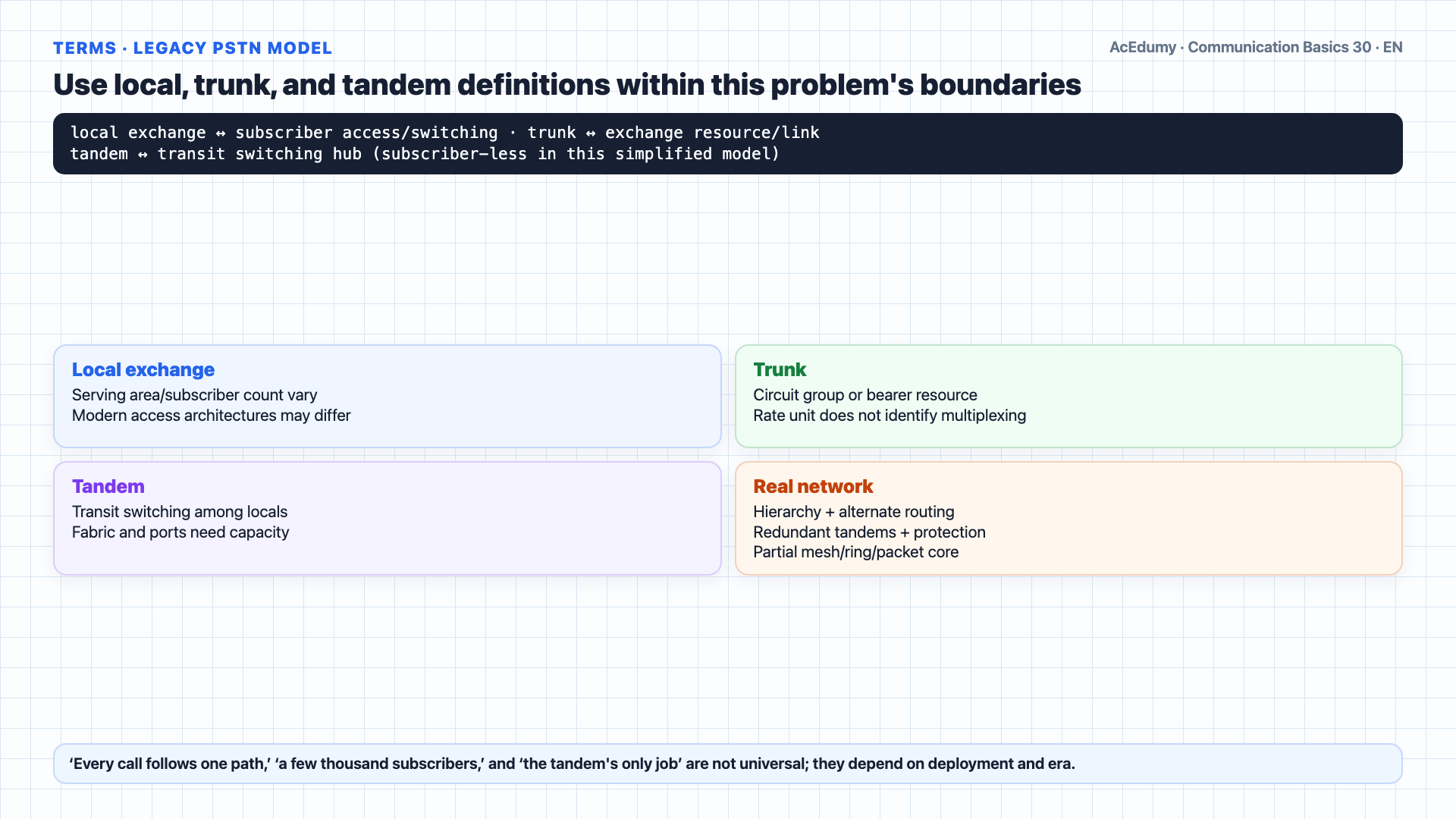
Preserve the edge-count mathematics; do not turn the 49.5× edge ratio into an equivalent cable, capacity, equipment, or cost ratio. Before we count, two pieces of vocabulary that the question takes for granted.In the legacy PSTN model, a local exchange terminates subscriber access and switches calls; modern access, softswitch, and packet architectures may differ.Serving area, subscriber count, and call path are deployment-specific; do not assume a universal few-thousand scale or one path for every call.A trunk is a high-capacity link between two exchanges, not between a phone and an exchange.A trunk is an exchange-to-exchange resource group/link; its rate may be kbit/s, Mbit/s, or higher, and the unit alone does not prove a multiplexing method.This problem models the tandem as a subscriber-less hub providing transit switching among locals; real node functions depend on deployment.So when we say 'connect every local to the tandem,' we mean run one trunk from each local exchange to that central tandem switch.When we say 'full mesh,' we mean run a separate trunk between every pair of local exchanges, no central node in the middle.Two different topologies, two very different trunk counts.Narration transcript
Before we count, two pieces of vocabulary that the question takes for granted. A local exchange is the switch your home phone is wired into. It serves a neighborhood — a few thousand subscribers — and it is where every local call ends up before being routed anywhere. A trunk is a high-capacity link between two exchanges, not between a phone and an exchange. Trunks are shared by many calls at once and that is why their rates are quoted in megabits, not kilobits. And a tandem exchange is just a switch that has no subscribers of its own — its only job is to connect other exchanges to one another. So when we say 'connect every local to the tandem,' we mean run one trunk from each local exchange to that central tandem switch. When we say 'full mesh,' we mean run a separate trunk between every pair of local exchanges, no central node in the middle. Two different topologies, two very different trunk counts.
3. Calculate E=n and five edges for the single-tandem star
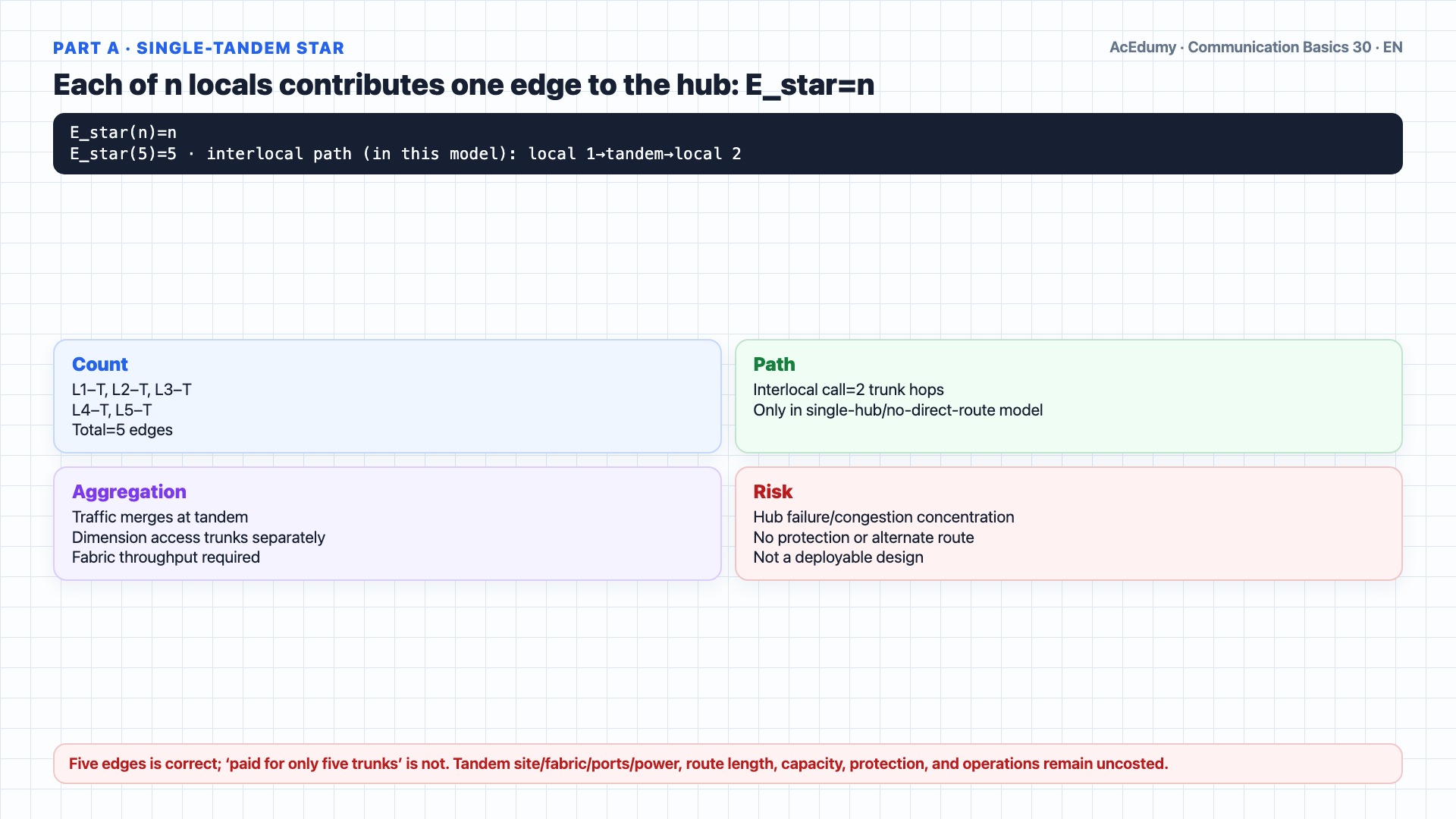
Preserve the edge-count mathematics; do not turn the 49.5× edge ratio into an equivalent cable, capacity, equipment, or cost ratio. Part a — tandem topology.We have five local exchanges.Each one runs a single trunk to the tandem in the middle.Five locals, five trunks.That is it.This is a classic star topology — the tandem is the hub, the locals are the spokes.In this unprotected single-hub model an interlocal call uses two trunk hops, local 1→tandem→local 2; alternate or direct routes change the path.The edge count is five; a cost conclusion also needs tandem fabric/ports/site/power, per-trunk capacity, route length, protection, and operations.Narration transcript
Part a — tandem topology. We have five local exchanges. Each one runs a single trunk to the tandem in the middle. Five locals, five trunks. That is it. This is a classic star topology — the tandem is the hub, the locals are the spokes. Notice that any call between two locals takes two trunk hops: local one to tandem, then tandem to local two. It is one extra switching step, but you only paid for five trunks total.
4. Derive E=n(n−1)/2 and ten edges for the five-node mesh
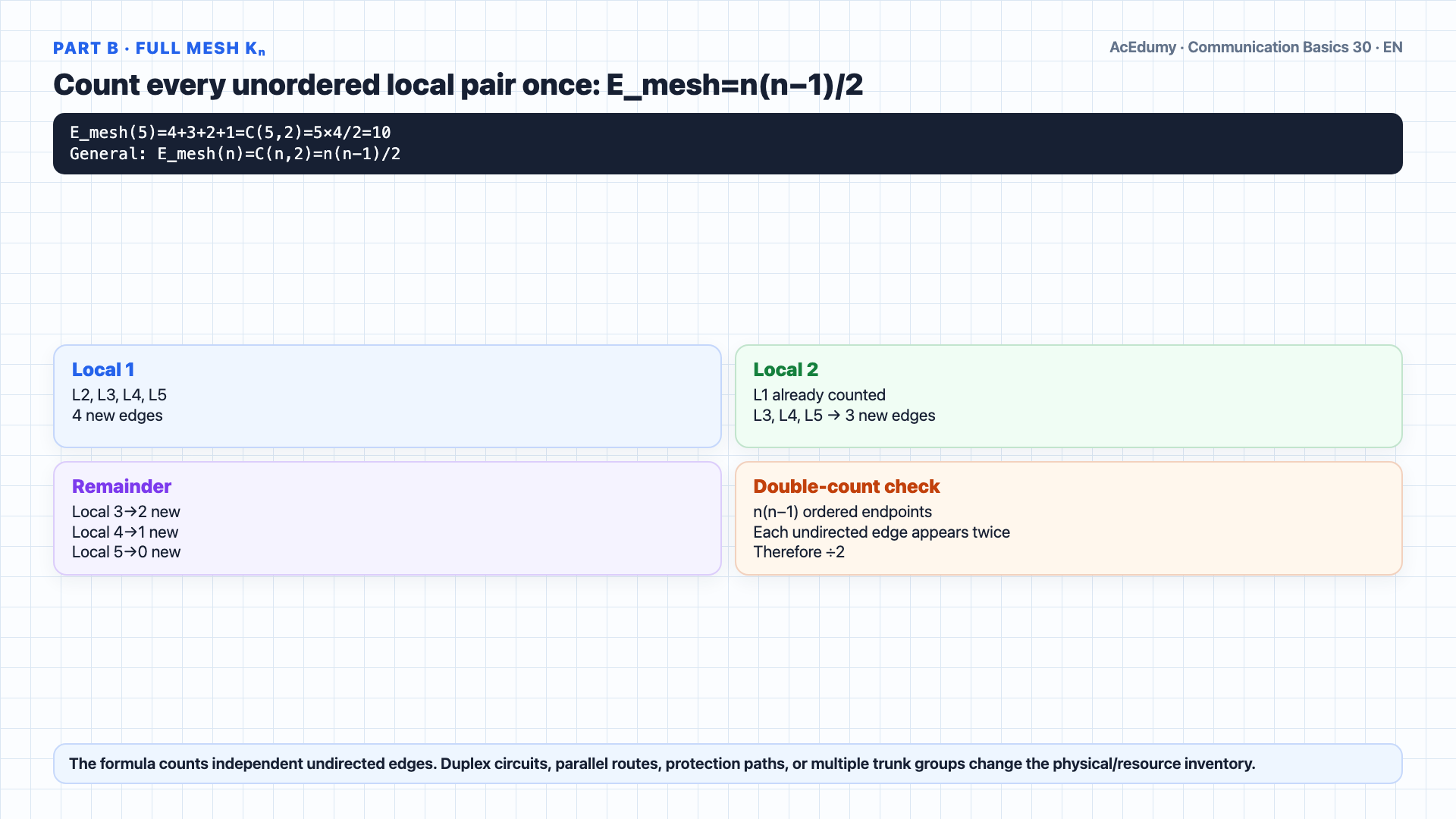
Preserve the edge-count mathematics; do not turn the 49.5× edge ratio into an equivalent cable, capacity, equipment, or cost ratio. Part b — full mesh, no tandem.Now every local exchange is connected directly to every other local exchange.Count the connections.Local one needs a trunk to locals two, three, four, and five — that is four trunks.Local two already has its trunk to local one, so it needs new trunks only to three, four, and five — three more.Local three needs new trunks to four and five — two more.Local four needs one more trunk, to local five.And local five is already connected to everyone.Add them up: four plus three plus two plus one equals ten.The pattern is the sum from one up to n minus one, which is the binomial coefficient n choose two — n times n minus one, all divided by two.For n equals five that gives five times four divided by two, equals ten.Exactly what we counted by hand.Narration transcript
Part b — full mesh, no tandem. Now every local exchange is connected directly to every other local exchange. Count the connections. Local one needs a trunk to locals two, three, four, and five — that is four trunks. Local two already has its trunk to local one, so it needs new trunks only to three, four, and five — three more. Local three needs new trunks to four and five — two more. Local four needs one more trunk, to local five. And local five is already connected to everyone. Add them up: four plus three plus two plus one equals ten. The pattern is the sum from one up to n minus one, which is the binomial coefficient n choose two — n times n minus one, all divided by two. For n equals five that gives five times four divided by two, equals ten. Exactly what we counted by hand.
5. Compare linear and quadratic edge scaling at n=5, 10, and 100
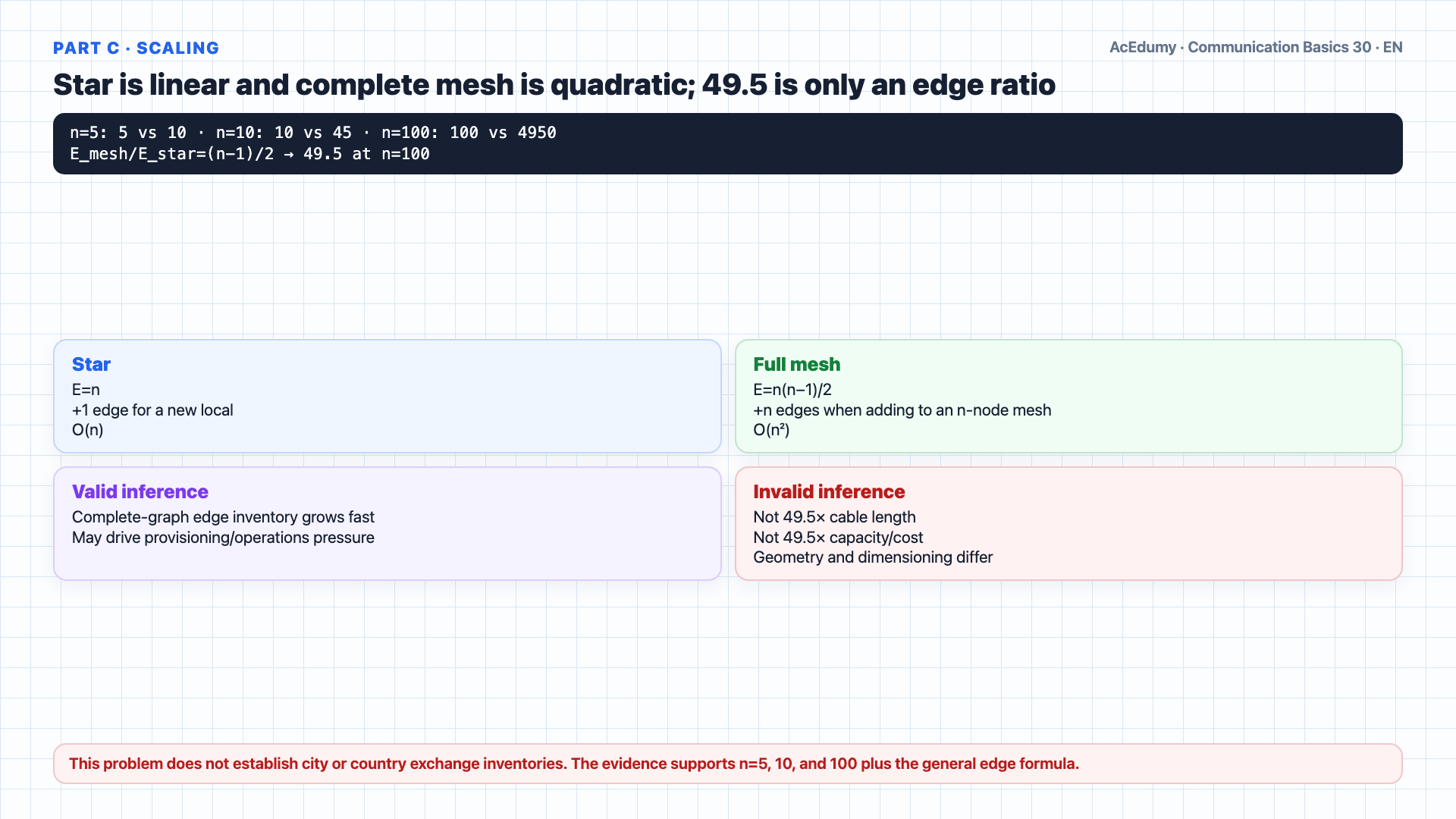
Preserve the edge-count mathematics; do not turn the 49.5× edge ratio into an equivalent cable, capacity, equipment, or cost ratio. Part c — and this is where the answer changes character.The tandem topology grows linearly with n.Five locals, five trunks.Ten locals, ten trunks.One hundred locals, one hundred trunks.The mesh grows as n times n minus one over two — roughly n squared over two for large n.Five locals, ten trunks.Ten locals — and now mesh needs forty five trunks while tandem needs ten.One hundred locals — tandem still wants one hundred trunks, but mesh now wants four thousand nine hundred and fifty.4950/100=49.5 is only the edge-count ratio; cable length, right-of-way, capacity, equipment, and lifecycle cost need not follow it because geometry and dimensioning differ.City and country exchange inventories are time- and operator-dependent external data; this numerical example is limited to n=5, 10, and 100.Quadratic complete-graph edge growth is one important scalability pressure; traffic, routing, resilience, geography, regulation, operations, and economics also shape architecture.The math punishes you fast.Narration transcript
Part c — and this is where the answer changes character. The tandem topology grows linearly with n. Five locals, five trunks. Ten locals, ten trunks. One hundred locals, one hundred trunks. The mesh grows as n times n minus one over two — roughly n squared over two for large n. Five locals, ten trunks. Ten locals — and now mesh needs forty five trunks while tandem needs ten. One hundred locals — tandem still wants one hundred trunks, but mesh now wants four thousand nine hundred and fifty. That is almost fifty times more cable, fifty times more right-of-way, fifty times more equipment to maintain. And these numbers are still small in PSTN terms — Istanbul has hundreds of local exchanges, the country has thousands. If you ever wondered why PSTNs are not built as flat meshes, this is the entire reason. The math punishes you fast.
6. Add traffic-capacity, GoS, routing, and resilience gates
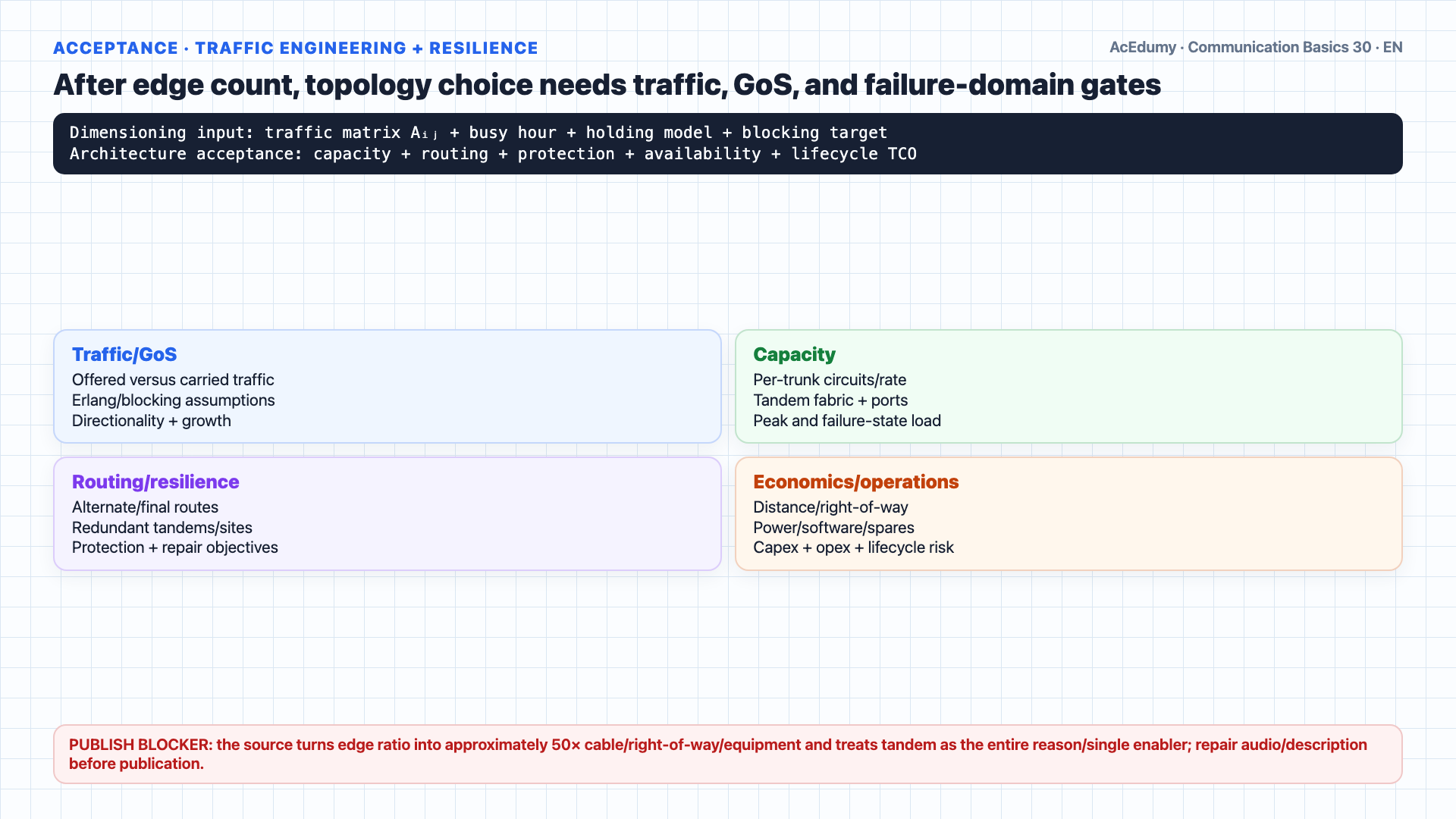
Preserve the edge-count mathematics; do not turn the 49.5× edge ratio into an equivalent cable, capacity, equipment, or cost ratio. Legacy PSTNs commonly used tandem/transit and hierarchical routing; real and modern networks may be redundant, alternate-routed, partial-mesh, or packet-core architectures.Three reasons, beyond the obvious trunk count.One: traffic aggregation can provide pooling/economy; per-call cost requires offered load, blocking target, technology, route, and lifecycle cost.Aggregation can carry many circuits/channels over shared facilities; synchronous TDM deterministic slotting and statistical multiplexing are distinct mechanisms, and bearer media are a separate layer.Two: maintenance is finite.A hundred-node mesh has nearly five thousand trunks, each of which can fail, get cut, or degrade.The unprotected counting model has 100 access trunks and one tandem; that hub concentrates failure and congestion and a deployable design needs redundancy/protection.Operational burden also includes alarms, spares, route diversity, switch fabric, power, software, repair times, and failure domains.Three: growth is graceful.Adding a new local exchange to a mesh means running new trunks to every existing exchange — ten if you already have ten, fifty if you have fifty.The counting model adds one edge for a new local; traffic growth may also require expansion of tandem fabric or existing trunk capacities.That one trunk grows the network by a useful amount.Two takeaways.One: O(n) versus O(n²) edge growth is an important topology-scaling comparison, not a complete network cost model.A quadratic edge term grows faster than a linear edge term as n increases; dominance in total cost depends on coefficients, capacity, geography, and omitted components.Two: hierarchy and transit switching can reduce edge growth; scalable PSTN design also requires multiplexing, traffic engineering, routing, redundancy, operations, and economics.Narration transcript
So why does almost every real PSTN use tandem switching? Three reasons, beyond the obvious trunk count. One: the trunks themselves get cheaper per call. When you concentrate traffic onto a few high-rate trunks instead of many low-rate point-to-point links, you exploit the multiplexing tricks we saw earlier in this course — TDM, statistical multiplexing — and pack many simultaneous calls into one fiber or microwave hop. Two: maintenance is finite. A hundred-node mesh has nearly five thousand trunks, each of which can fail, get cut, or degrade. A hundred-node tandem network has one hundred trunks plus one big switch in the middle. The operations team has a fighting chance. Three: growth is graceful. Adding a new local exchange to a mesh means running new trunks to every existing exchange — ten if you already have ten, fifty if you have fifty. Adding a new local exchange to a tandem network means running one trunk to the tandem. That one trunk grows the network by a useful amount. Two takeaways. One: linear versus quadratic is the deepest cost-engineering lesson in network design. Whenever something scales as n squared, it eventually dominates. Two: the tandem exchange is not just a convenience — it is what makes the PSTN mathematically affordable at country scale.
Source video: Communication Basics #30 Worked Example: PSTN Topology — Tandem vs Mesh, the Real Reason for Hubs (6:25)