Antenna Theory · Radiation Patterns, Directivity, and Gain
#02 Reading radiation patterns as directional maps, E/H principal planes, the directivity-gain distinction, and Poynting power flow
Translate the three-dimensional radiation picture into engineering language by connecting principal planes, directivity, gain, and outward power flow.
Question
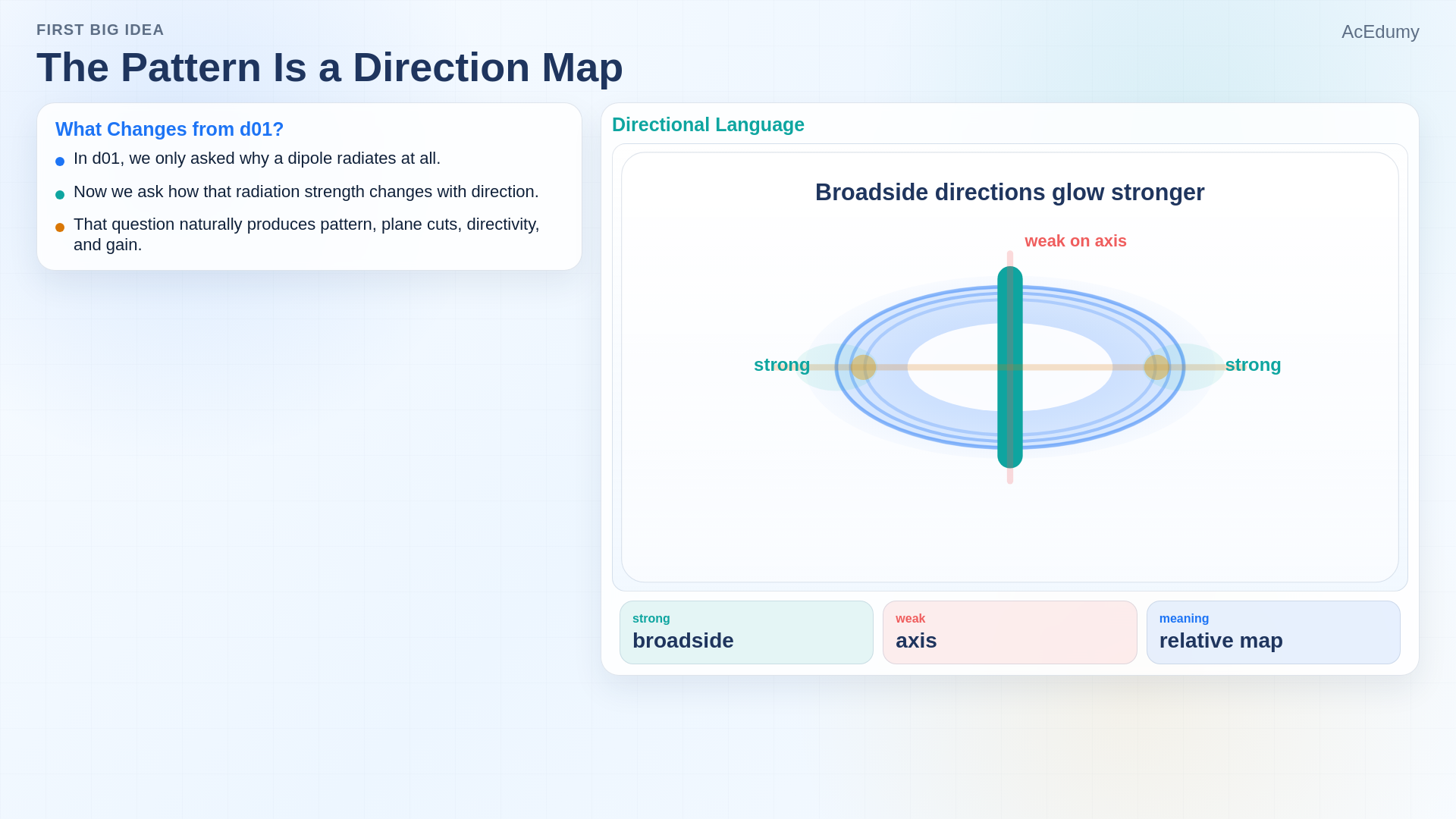
Interpret an antenna radiation pattern as a directional map; define the E and H principal planes, distinguish directivity from gain through efficiency, and connect the pattern to Poynting-vector power flow.
Written solution and narration transcript(shows the full solution)
Below are all the lines written in the notebook together with the full narration transcript.
1. Build the pattern-to-gain concept chain
The pattern describes directional power distribution, directivity measures focus, and gain combines focus with efficiency. In this lesson, we move from the basic radiation picture to the language engineers use to describe it.We will look at the radiation pattern, the E-plane, the H-plane, directivity, gain, and the intuitive meaning of power flow.The goal is still visual understanding first.We want the terms to feel connected instead of memorized.Narration transcript
In this lesson, we move from the basic radiation picture to the language engineers use to describe it. We will look at the radiation pattern, the E plane, the H plane, directivity, gain, and the intuitive meaning of power flow. The goal is still visual understanding first. We want the terms to feel connected instead of memorized.
2. Read the strong and weak directions of a dipole pattern
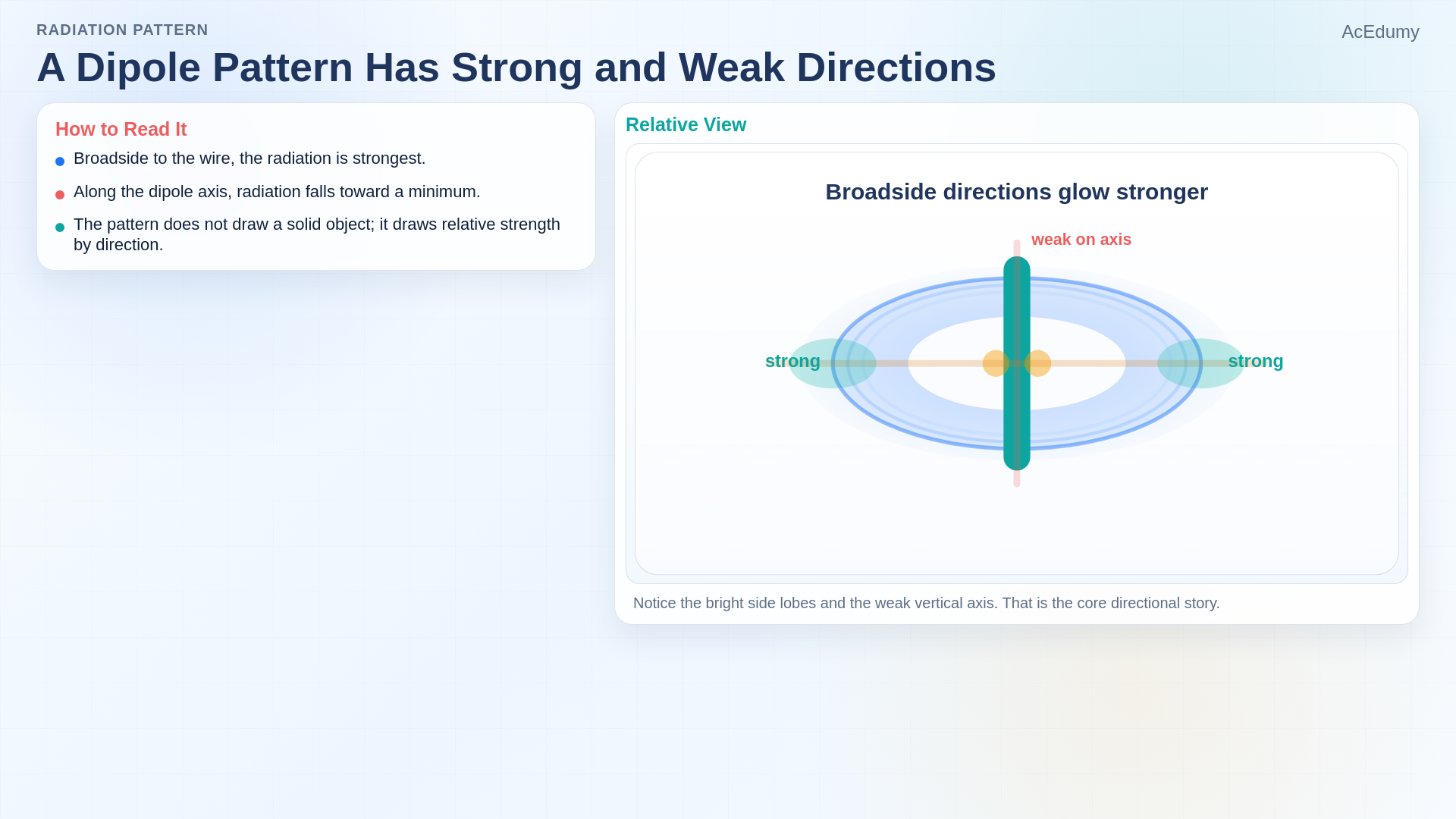
The pattern describes directional power distribution, directivity measures focus, and gain combines focus with efficiency. A radiation pattern tells us how strongly an antenna radiates in different directions.It does not mean that the antenna creates a solid object in space.It is a directional map of relative field strength or radiated power.For a dipole, the strongest radiation appears broadside to the wire, while radiation is weakest along the dipole axis.Narration transcript
A radiation pattern tells us how strongly an antenna radiates in different directions. It does not mean that the antenna creates a solid object in space. It is a directional map of relative field strength or radiated power. For a dipole, the strongest radiation appears broadside to the wire, while radiation is weakest along the dipole axis.
3. Separate the E- and H-plane cuts
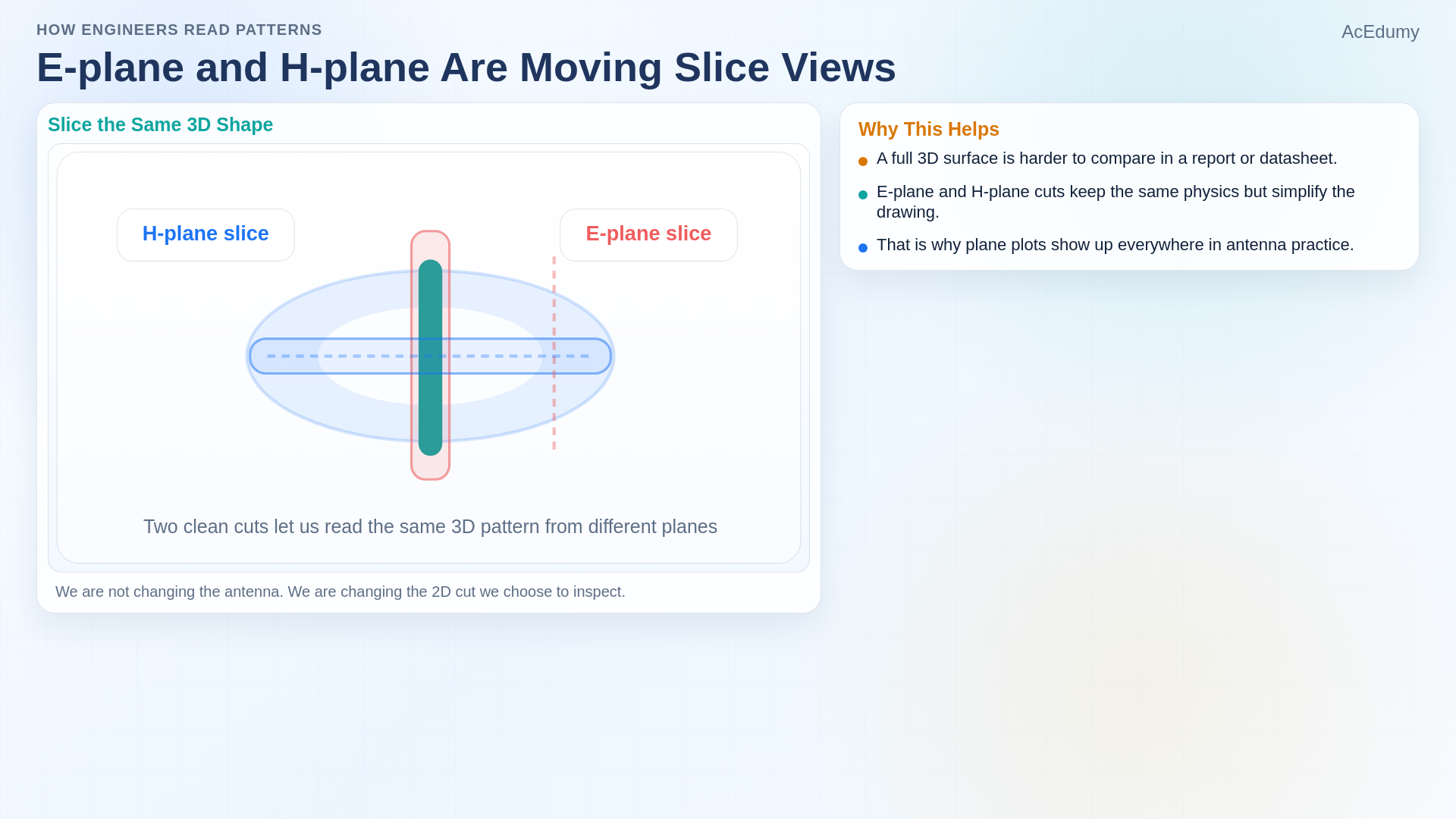
The pattern describes directional power distribution, directivity measures focus, and gain combines focus with efficiency. Because the full three-dimensional pattern is hard to draw on paper, we often inspect important two-dimensional cuts.The E-plane is the plane that contains the electric field vector and the direction of maximum radiation.The H-plane is the plane that contains the magnetic field vector and the direction of maximum radiation.These cuts let us compare antennas without always drawing the full three-dimensional shape.Narration transcript
Because the full three dimensional pattern is hard to draw on paper, we often inspect important two dimensional cuts. The E plane is the plane that contains the electric field vector and the direction of maximum radiation. The H plane is the plane that contains the magnetic field vector and the direction of maximum radiation. These cuts let us compare antennas without always drawing the full three dimensional shape.
4. Interpret directivity as pattern concentration
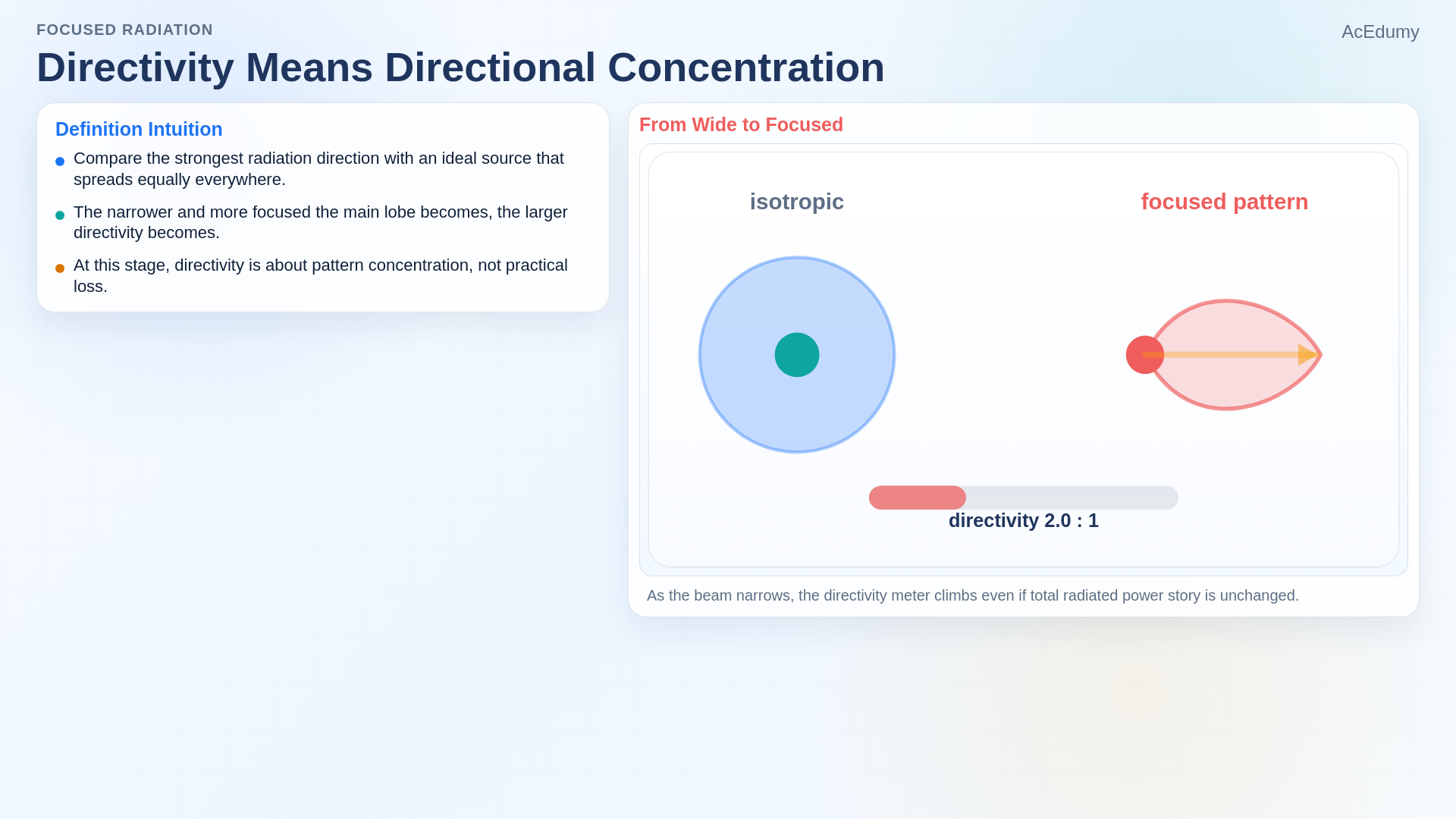
The pattern describes directional power distribution, directivity measures focus, and gain combines focus with efficiency. Directivity tells us how concentrated the radiation is in the strongest direction compared with an ideal source that spreads energy equally in all directions.So directivity is about directional concentration.A more focused pattern means higher directivity.This does not automatically tell us about practical losses yet.Narration transcript
Directivity tells us how concentrated the radiation is in the strongest direction compared with an ideal source that spreads energy equally in all directions. So directivity is about directional concentration. A more focused pattern means higher directivity. This does not automatically tell us about practical losses yet.
5. Connect gain to directivity and efficiency
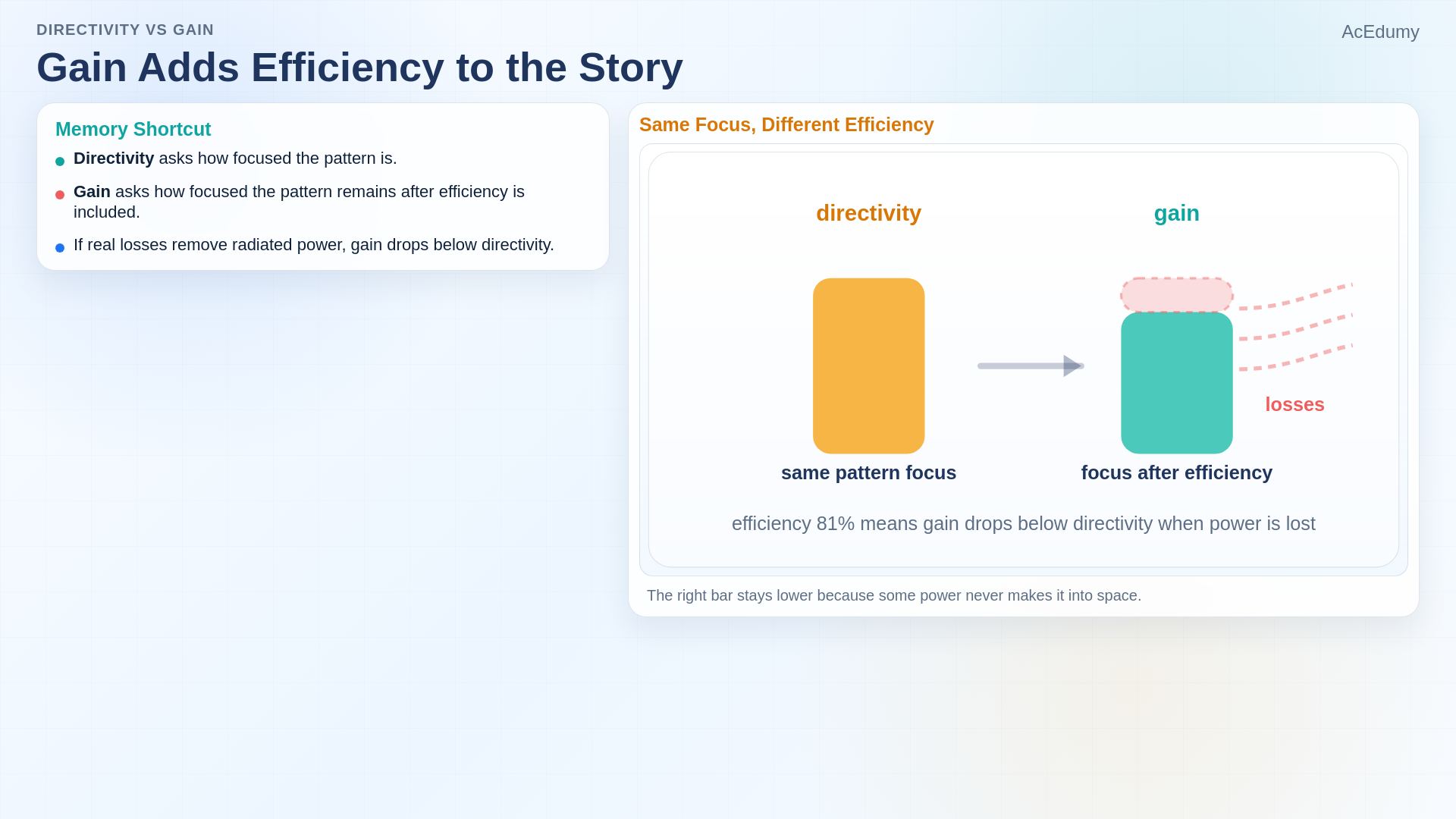
The pattern describes directional power distribution, directivity measures focus, and gain combines focus with efficiency. Gain is closely related to directivity, but it also reflects real antenna efficiency.If losses reduce the power that actually gets radiated, the gain becomes lower than the directivity.So a useful memory is this: directivity describes pattern focus, while gain describes pattern focus plus efficiency.Narration transcript
Gain is closely related to directivity, but it also reflects real antenna efficiency. If losses reduce the power that actually gets radiated, the gain becomes lower than the directivity. So a useful memory is this: directivity describes pattern focus, while gain describes pattern focus plus efficiency.
6. Use the Poynting vector to see outward power flow
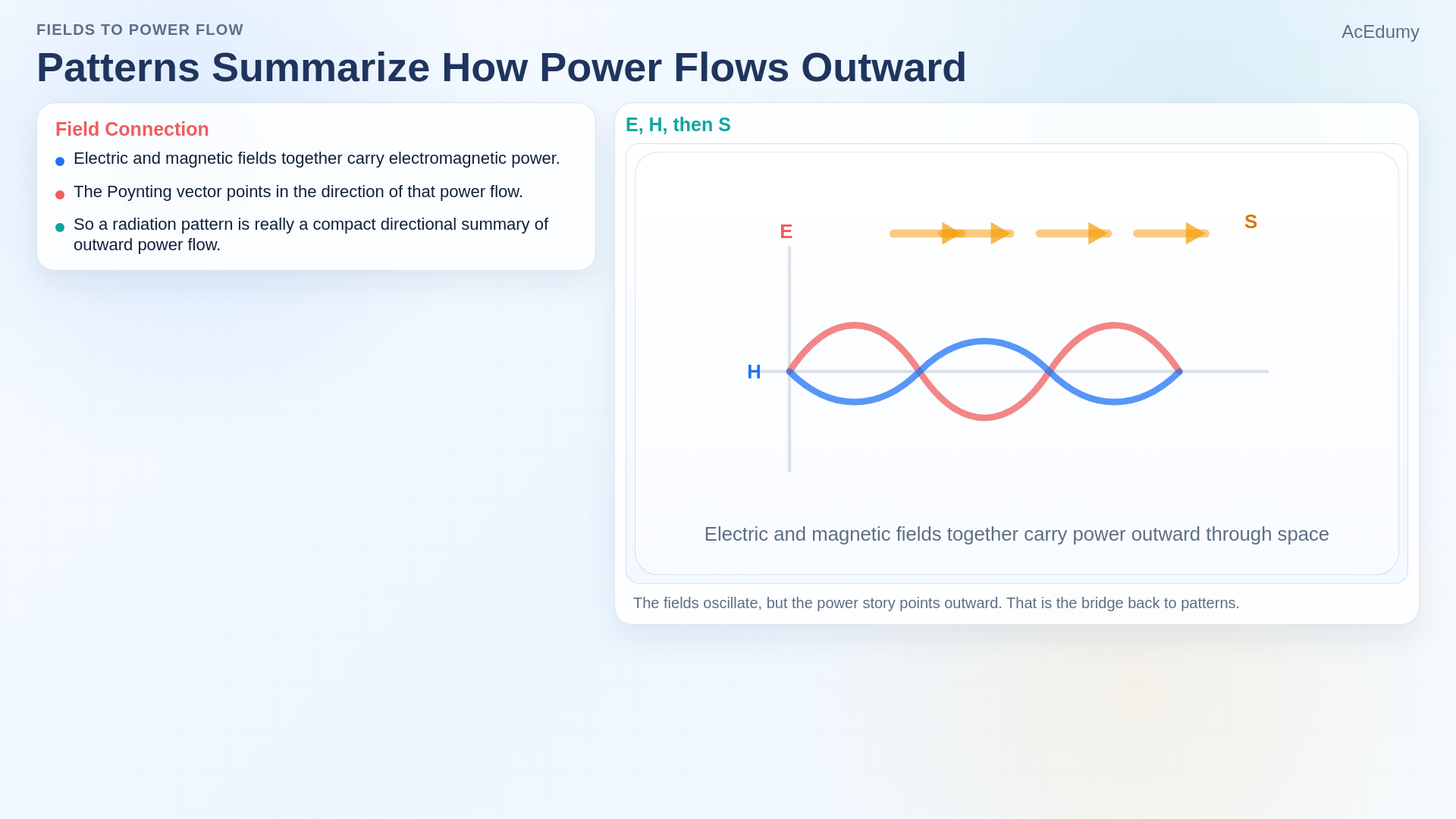
The pattern describes directional power distribution, directivity measures focus, and gain combines focus with efficiency. To connect these pattern ideas back to fields, remember that the electric and magnetic fields together carry power through space.The Poynting vector gives the direction of electromagnetic power flow.So when we draw a pattern, we are really summarizing how strongly power is carried outward in each direction.That is why field pictures and radiation-pattern pictures belong to the same story.Narration transcript
To connect these pattern ideas back to fields, remember that the electric and magnetic fields together carry power through space. The Poynting vector gives the direction of electromagnetic power flow. So when we draw a pattern, we are really summarizing how strongly power is carried outward in each direction. That is why field pictures and radiation-pattern pictures belong to the same story.
7. Summarize the four core links
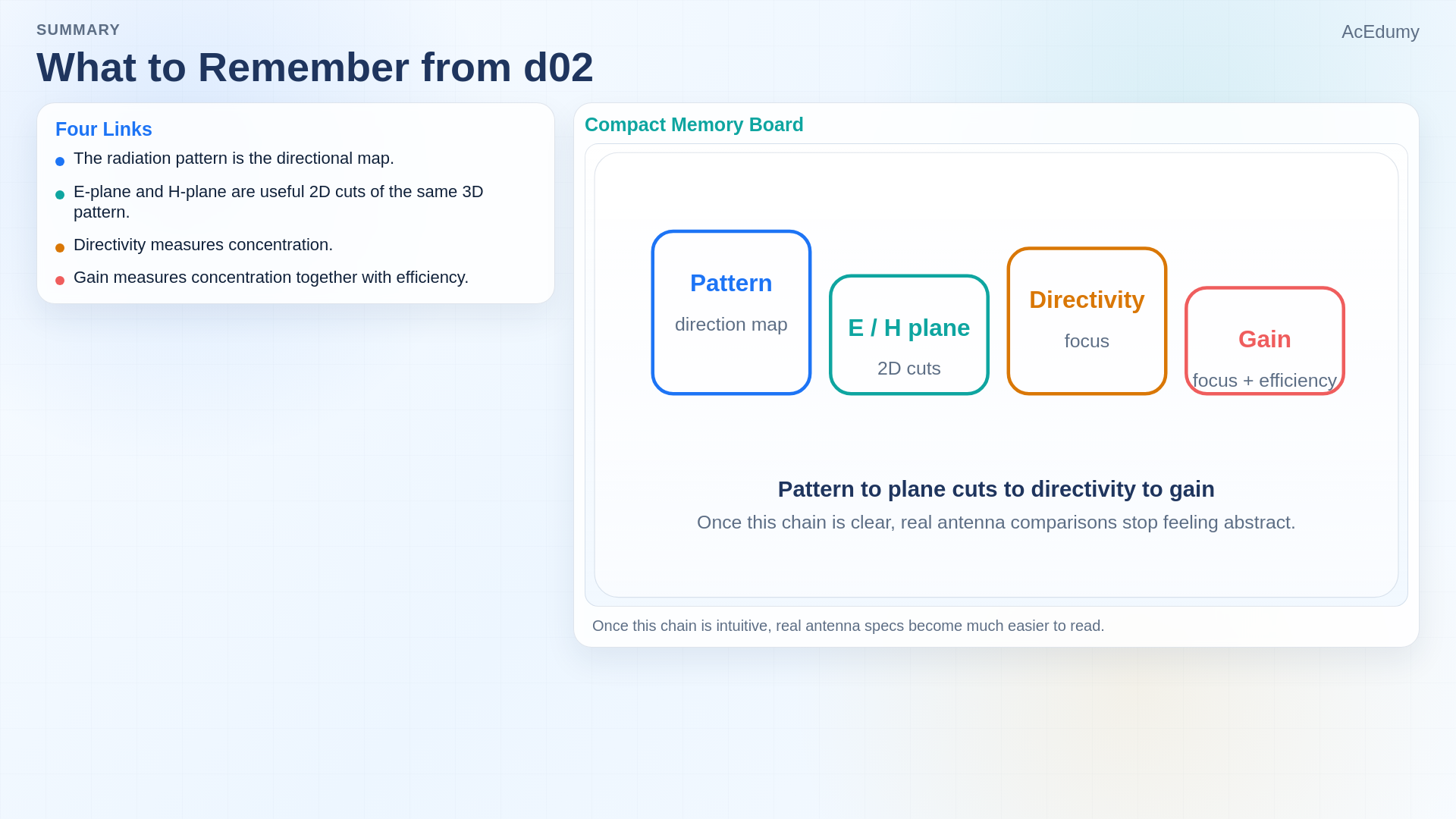
The pattern describes directional power distribution, directivity measures focus, and gain combines focus with efficiency. For this lesson, remember four links.The radiation pattern is the directional map.The E-plane and H-plane are useful two-dimensional cuts.Directivity is directional concentration.Gain is directional concentration together with efficiency.Narration transcript
For this lesson, remember four links. The radiation pattern is the directional map. The E plane and H plane are useful two dimensional cuts. Directivity is directional concentration. Gain is directional concentration together with efficiency.
Source video: Antenna Theory #02 Radiation Patterns, Directivity and Gain (2:56)