Circuit Theory 1 · First-Order Transients
#40 Transient Analysis #40 — RC natural response and capacitor discharge
Derives the source-free RC differential equation, exponential natural response, time constant, current/power/energy expressions, and five-tau rule through a numerical example.
Question
For a capacitor initially charged to V₀ and discharging through R, form the differential equation; derive v(t), i(t), p_R(t), τ, and energy results; solve the R=2 kΩ, C=100 µF, V₀=50 V example.
Written solution and narration transcript(shows the full solution)
Below are all the lines written in the notebook together with the full narration transcript.
1. Physical setup of the RC natural response
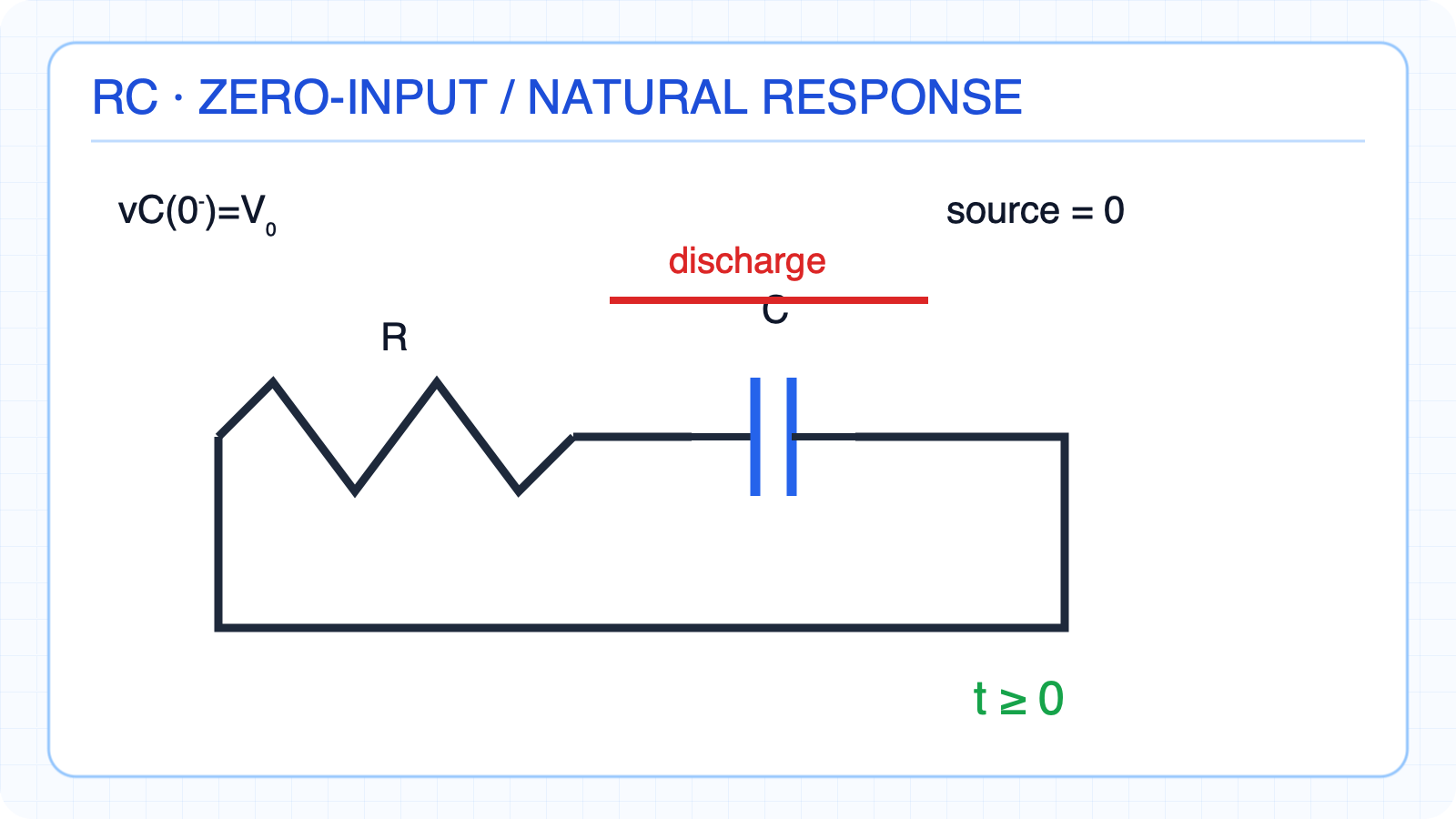
For t≥0, the capacitor's initial energy is the only energy source. Zero-input RC natural responseThe capacitor is initially charged to V₀At t=0 it begins discharging through RThere is no external source for t≥0The only energy source is wC(0)=½CV₀²We seek vC(t)The natural response is decay of initial energyNarration transcript
Consider a capacitor charged to V-zero volts, connected to a resistor through a switch. At t equals zero, the switch closes. No external source is connected — so this is a zero-input response, also called the natural response. The only energy comes from the capacitor's initial charge. The question is: how does the capacitor voltage change over time?
2. Derivation of the differential equation
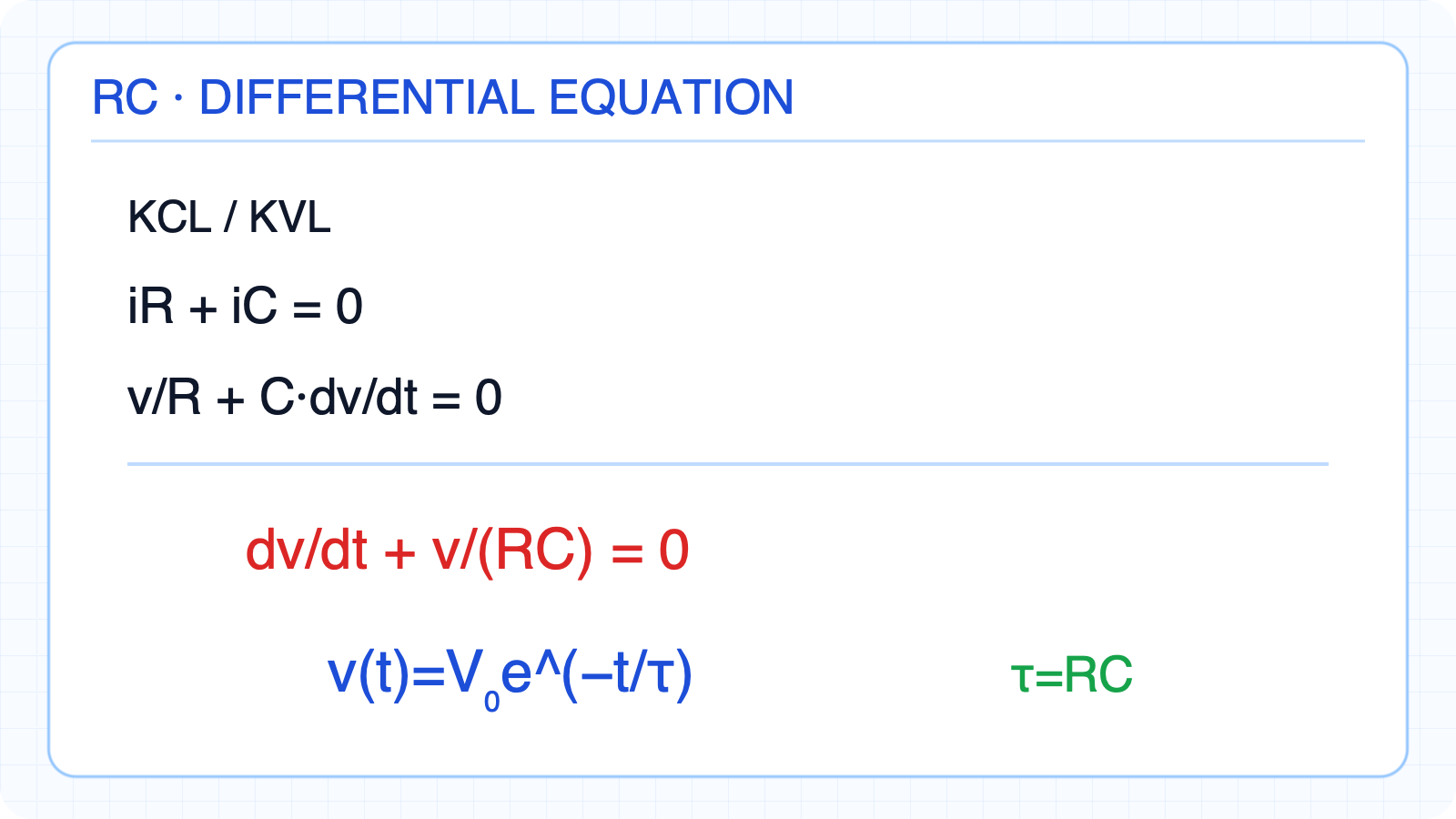
dv/dt+v/(RC)=0 and v(t)=V₀e^(−t/τ), τ=RC. Apply KVL to the loop or KCL to the nodev/R+C·dv/dt=0dv/dt+v/(RC)=0First-order homogeneous differential equationInitial condition v(0)=V₀v(t)=V₀e(−t/τ), τ=RCNarration transcript
Apply KVL around the loop. The voltage across the resistor is i times R, and the voltage across the capacitor is v. Since i equals C times d-v-d-t, we substitute: R-C times d-v-d-t plus v equals zero. Dividing both sides by R-C gives d-v-d-t plus v over R-C equals zero. This is a first-order linear ODE. The solution is an exponential: v of t equals V-zero times e to the minus t over R-C. We define the time constant tau equals R times C.
3. Time constant and graphical meaning
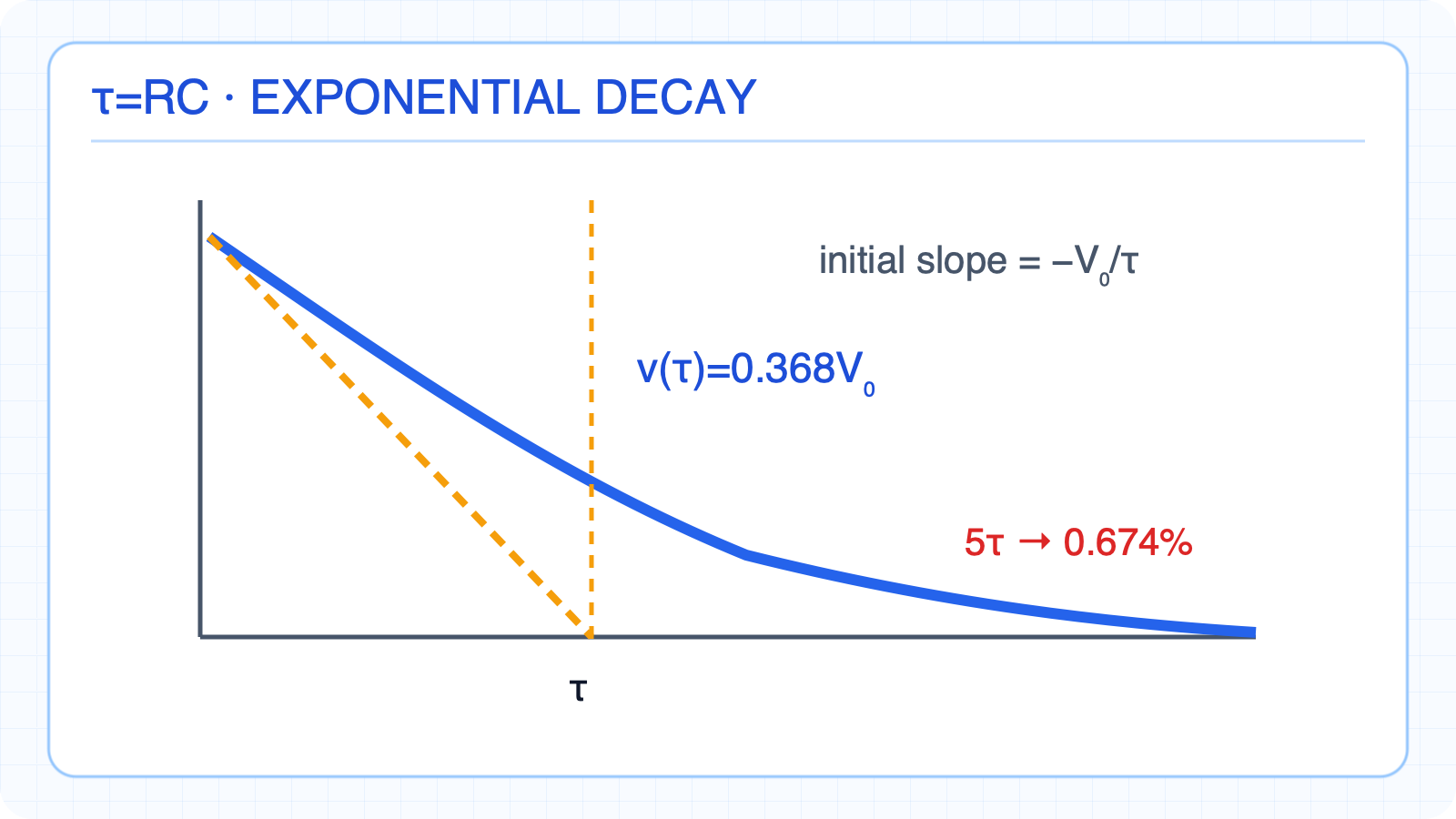
36.8% remains at t=τ and 0.674% at t=5τ. τ=RC is the circuit's speed scaleLarger R or C ⇒ slower dischargeInitial slope dv/dt(0)=−V₀/τThe t=0 tangent hits the axis at t=τOnly 0.674 percent remains at 5τNarration transcript
The time constant tau equals R-C has units of seconds — ohms times farads gives seconds. At t equals tau, the voltage drops to e to the minus one times V-zero — that's about 36.8 percent of the initial value. The time constant tells us HOW FAST the circuit responds. A larger tau means slower decay — more resistance or more capacitance slows the discharge. A smaller tau means faster decay. The tangent line at t equals zero would reach zero at exactly t equals tau.
4. Current, power, and energy expressions
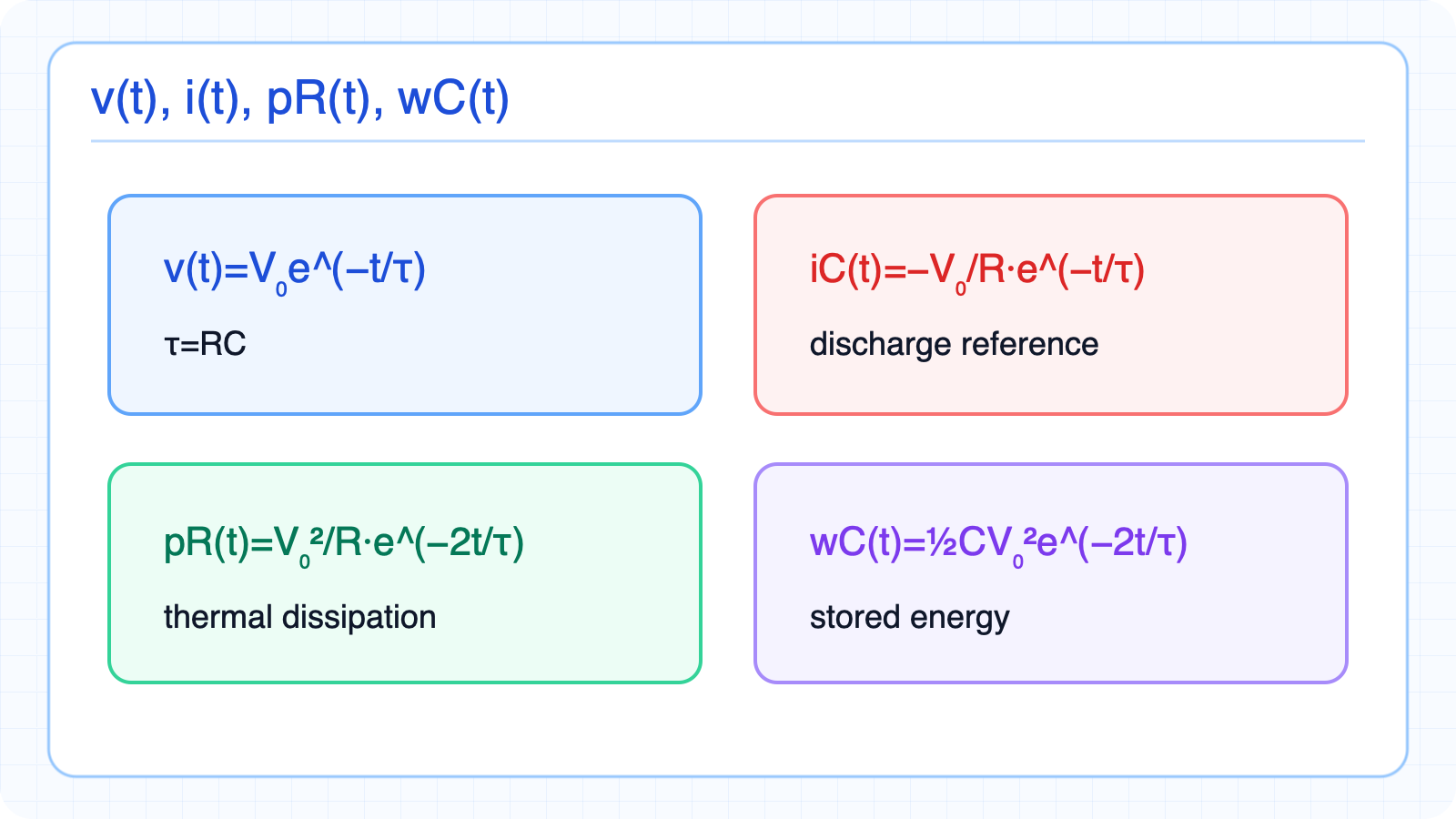
Power and energy decay as e^(−2t/τ); voltage and current as e^(−t/τ). Derive all quantities from v(t)iC=C·dv/dtThe minus sign indicates discharge in the passive referencewC(t)=½CV₀²e(−2t/τ)Power and energy decay at twice the exponent rateNarration transcript
From the voltage, we derive all other quantities. Current: i of t equals C times d-v-d-t, which gives minus V-zero over R times e to the minus t over tau. The negative sign means current flows opposite to the charging direction — the capacitor is discharging. Power dissipated in the resistor: p of t equals i-squared times R, which equals V-zero-squared over R times e to the minus two-t over tau. Notice power decays twice as fast as voltage, because it depends on i-squared.
5. Numerical RC natural-response example
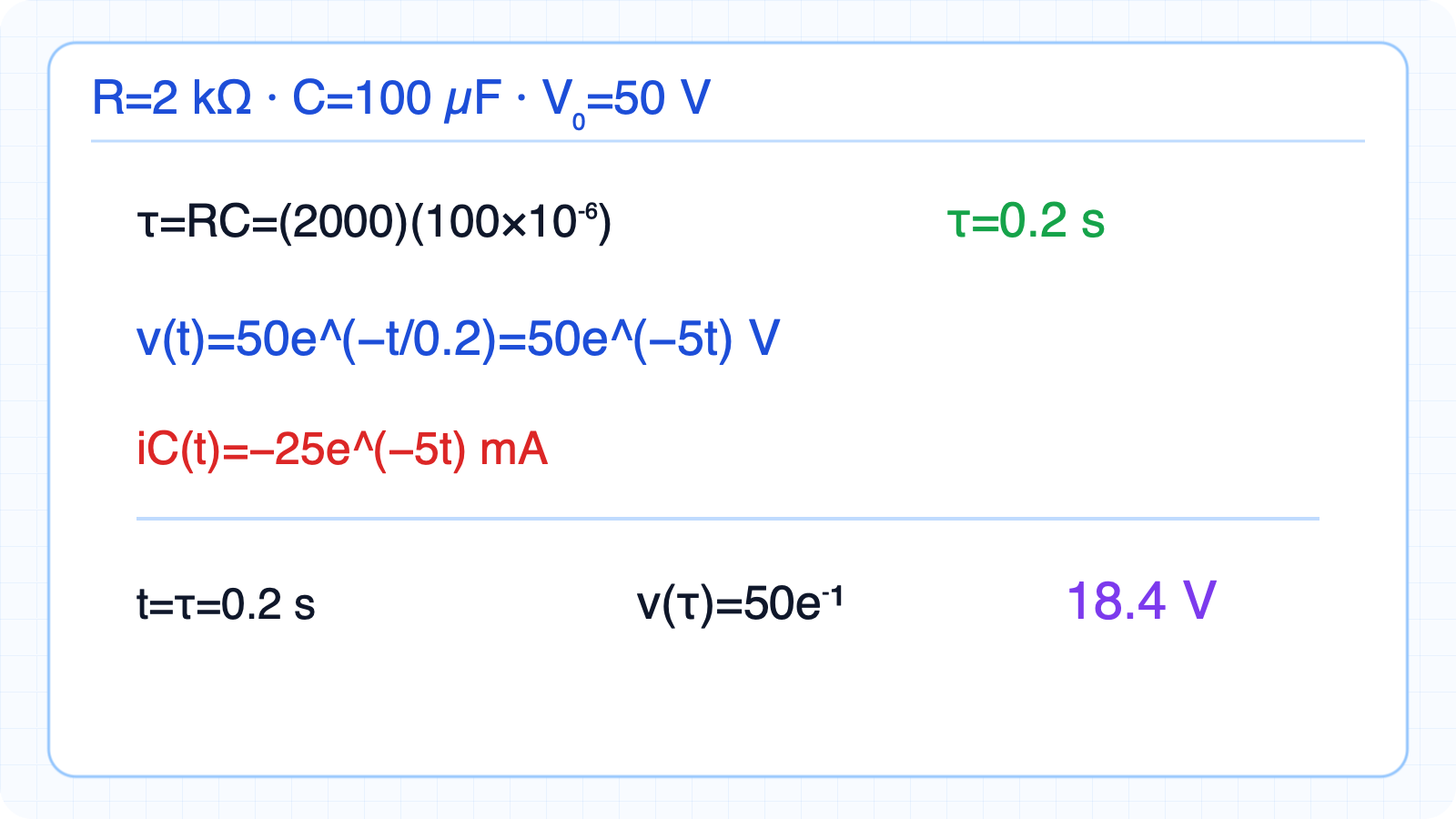
τ=0.2 s, i_C(0)=−25 mA, and v(τ)=18.4 V. iC(t)=−25e(−5t) mANarration transcript
Example: A 100 microfarad capacitor charged to 50 volts discharges through a 2 kilohm resistor. Step one: calculate tau equals R-C equals 2000 times 100 times ten to the minus six, which equals 0.2 seconds — 200 milliseconds. Step two: v of t equals 50 times e to the minus t over 0.2 volts. Step three: i of t equals minus 50 over 2000 times e to the minus t over 0.2, which equals minus 25 milliamps times e to the minus 5-t. At t equals 0.2 seconds, v equals 50 times 0.368 equals 18.4 volts.
6. Five-time-constant rule
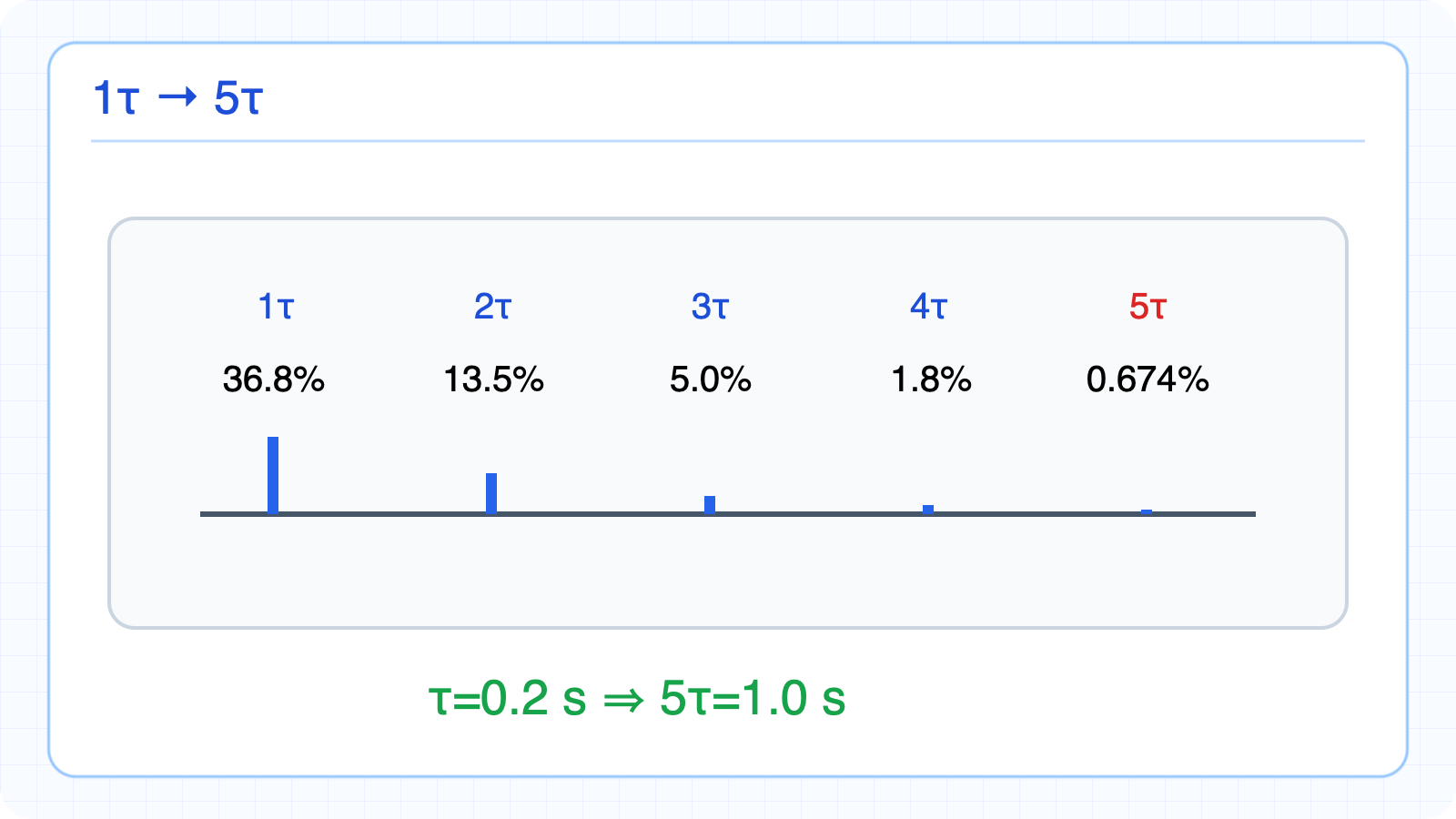
With τ=0.2 s, the transient is practically over after 1 s. Remaining voltage V/V₀=e(−t/τ)1τ: 36.8 percent2τ: 13.5 percent3τ: 5.0 percent4τ: 1.8 percent5τ: 0.674 percent; practically zeroIn the example, 5τ=1.0 sNarration transcript
The 5-tau rule is a practical guideline for engineers. At t equals one-tau, voltage is 36.8 percent of V-zero. At two-tau, 13.5 percent. At three-tau, 5.0 percent. At four-tau, 1.8 percent. And at five-tau, only 0.7 percent remains. Engineers consider the transient effectively DEAD after 5 time constants. In our example with tau equals 200 milliseconds, the capacitor is fully discharged after one second — 5 times 200 milliseconds.
7. Energy conservation and graphical method
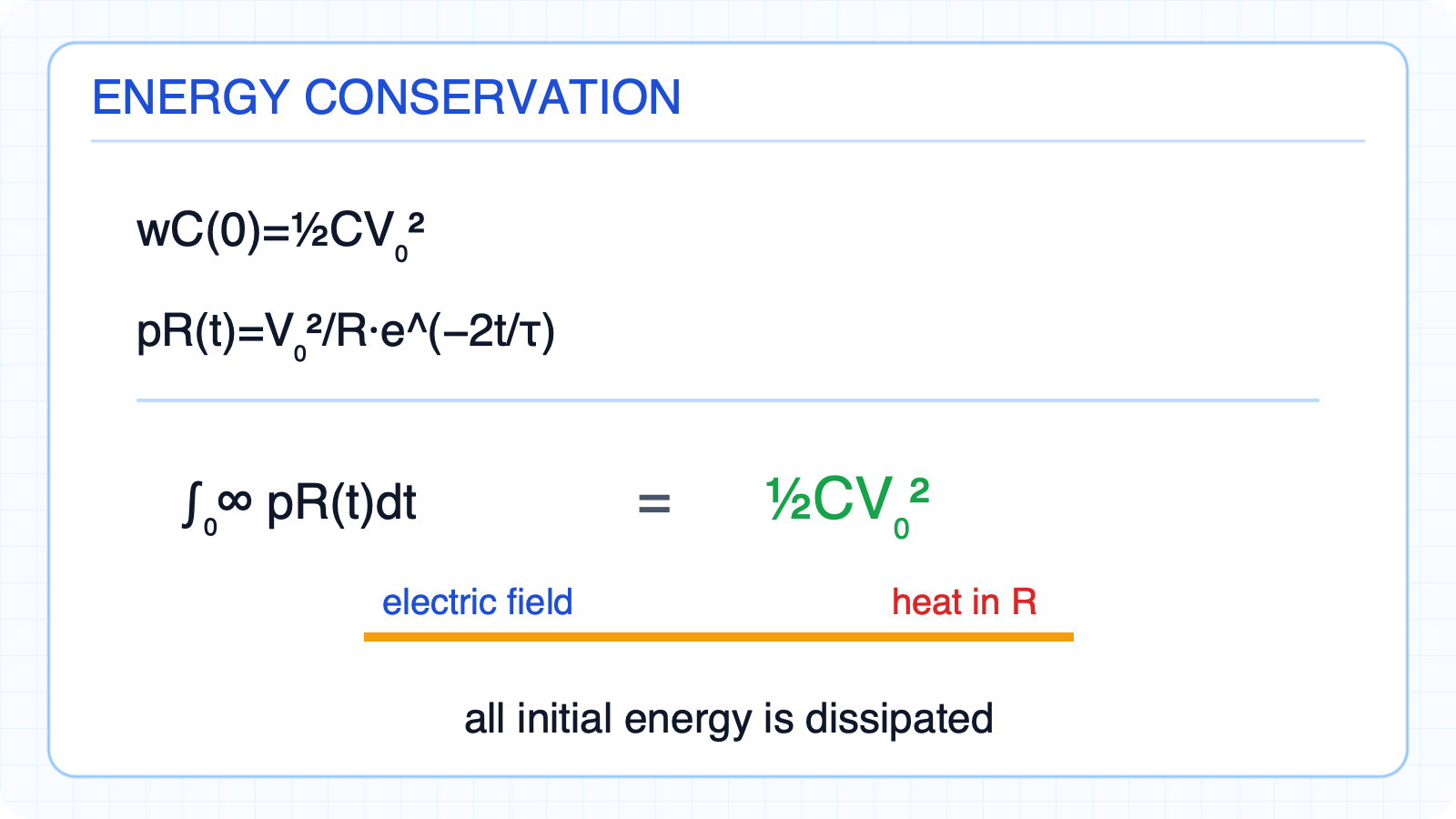
The time integral of resistor power equals ½CV₀². All initial energy is dissipated in RwC(0)=½CV₀²∫₀∞pR(t)dt=½CV₀²Electric-field energy becomes heatv(t) approaches zero asymptoticallyThe initial tangent estimates τ from measurementsNarration transcript
The energy initially stored in the capacitor is one-half C times V-zero squared. As the capacitor discharges, ALL of this energy is dissipated as heat in the resistor. We can verify: integrate p of t from zero to infinity. The integral of V-zero-squared over R times e to the minus two-t over tau gives one-half C times V-zero-squared — exactly the initial stored energy. Energy is conserved: nothing is lost, nothing is created. The capacitor's electric field energy converts entirely to thermal energy in the resistor. The voltage curve starts at V-zero and decays exponentially toward zero, never quite reaching it. The initial slope is minus V-zero over tau — draw the tangent line at t equals zero, and it crosses the time axis at exactly t equals tau. This gives us a simple graphical method to estimate the time constant from measurements. The current curve is a mirror image — it starts at its most negative value and decays toward zero with the same time constant.
8. RC natural-response summary
dv/dt+v/(RC)=0 and v(t)=V₀e^(−t/τ), τ=RC. Essential RC natural-response resultsv(t)=V₀e(−t/RC)τ=RC determines the decay speedThe transient is practically over after 5τInitial energy becomes heat in the resistorNatural response: no source, but initial energyNarration transcript
Three essential results from this lecture. First: the RC natural response is v of t equals V-zero times e to the minus t over tau, where tau equals R-C. Second: the time constant tau determines the speed of decay — the tangent at t equals zero hits the axis at t equals tau, and after 5-tau the transient is essentially zero. Third: all energy stored in the capacitor, one-half C V-zero-squared, is dissipated as heat in the resistor. In the next lecture, we'll see the RL natural response — the dual of everything we learned today.