Electromagnetic Theory · Resistance and Capacitance
#16 General resistance and capacitance from field solutions, parallel-plate, coaxial and spherical geometries, the RC relation, and a numerical capacitor example
Derive R and C from the electric field, compare basic geometries, and calculate a capacitor's charge and stored energy.
Question
Derive general resistance and capacitance expressions from the field solution; compare the three basic capacitor geometries and calculate C, Q, and W for the given parallel-plate capacitor.
Written solution and narration transcript(shows the full solution)
Below are all the lines written in the notebook together with the full narration transcript.
1. Connect the Poisson–Laplace workflow to R and C
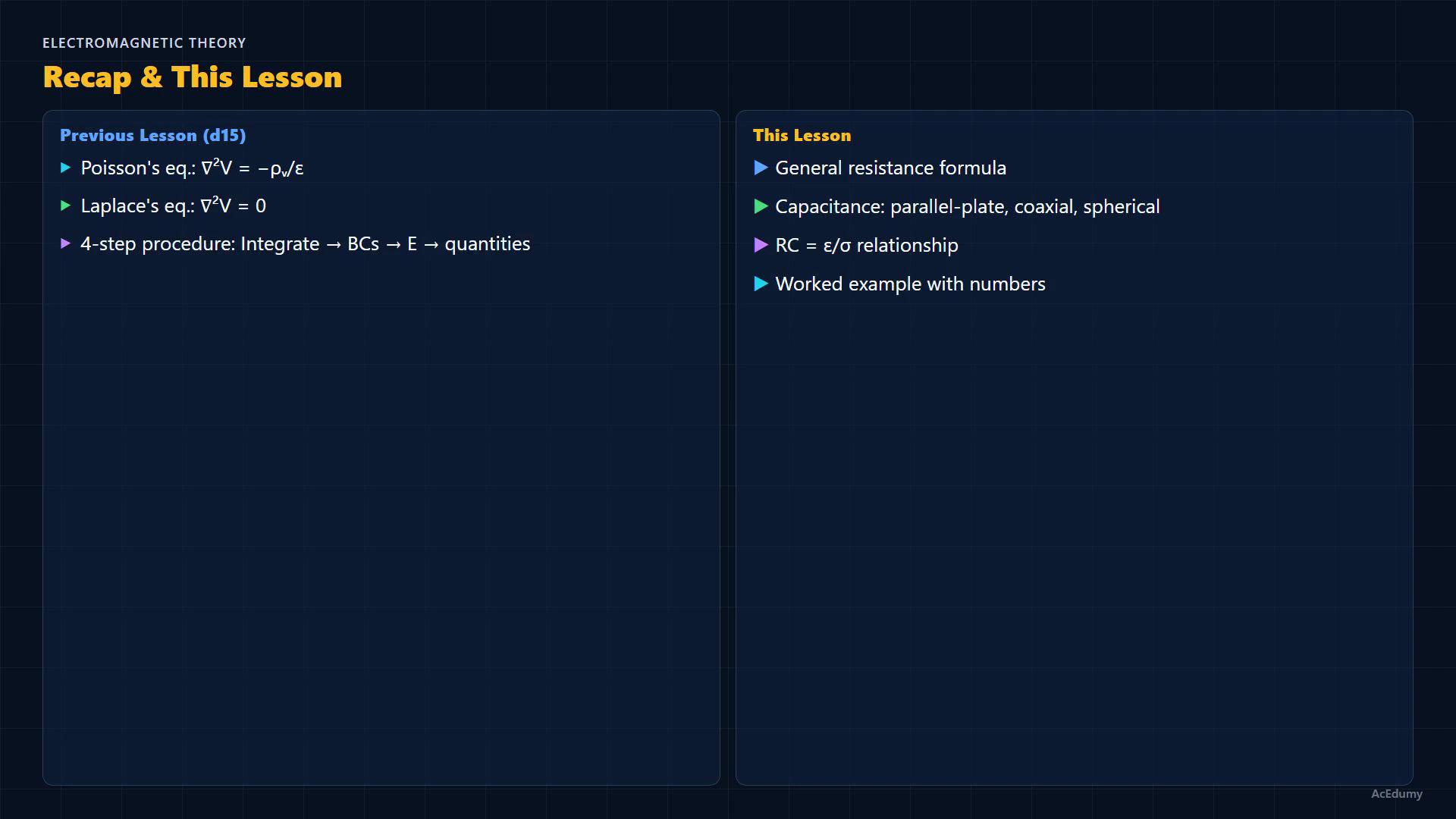
For the same geometry, one field solution yields both resistance and capacitance, with RC = ε/σ. In our last lesson, we derived Poisson's and Laplace's equations from Gauss's law.Poisson's equation relates the Laplacian of V to the charge density, while Laplace's equation applies in charge-free regions.We also introduced the 4-step solution procedure: integrate the equation, apply boundary conditions, find E, then find other quantities.Today, we apply these tools to derive general expressions for resistance and capacitance.Narration transcript
In our last lesson, we derived Poisson's and Laplace's equations from Gauss's law. Poisson's equation relates the Laplacian of V to the charge density, while Laplace's equation applies in charge-free regions. We also introduced the 4-step solution procedure: integrate the equation, apply boundary conditions, find E, then find other quantities. Today, we apply these tools to derive general expressions for resistance and capacitance.
2. Derive resistance from the field solution
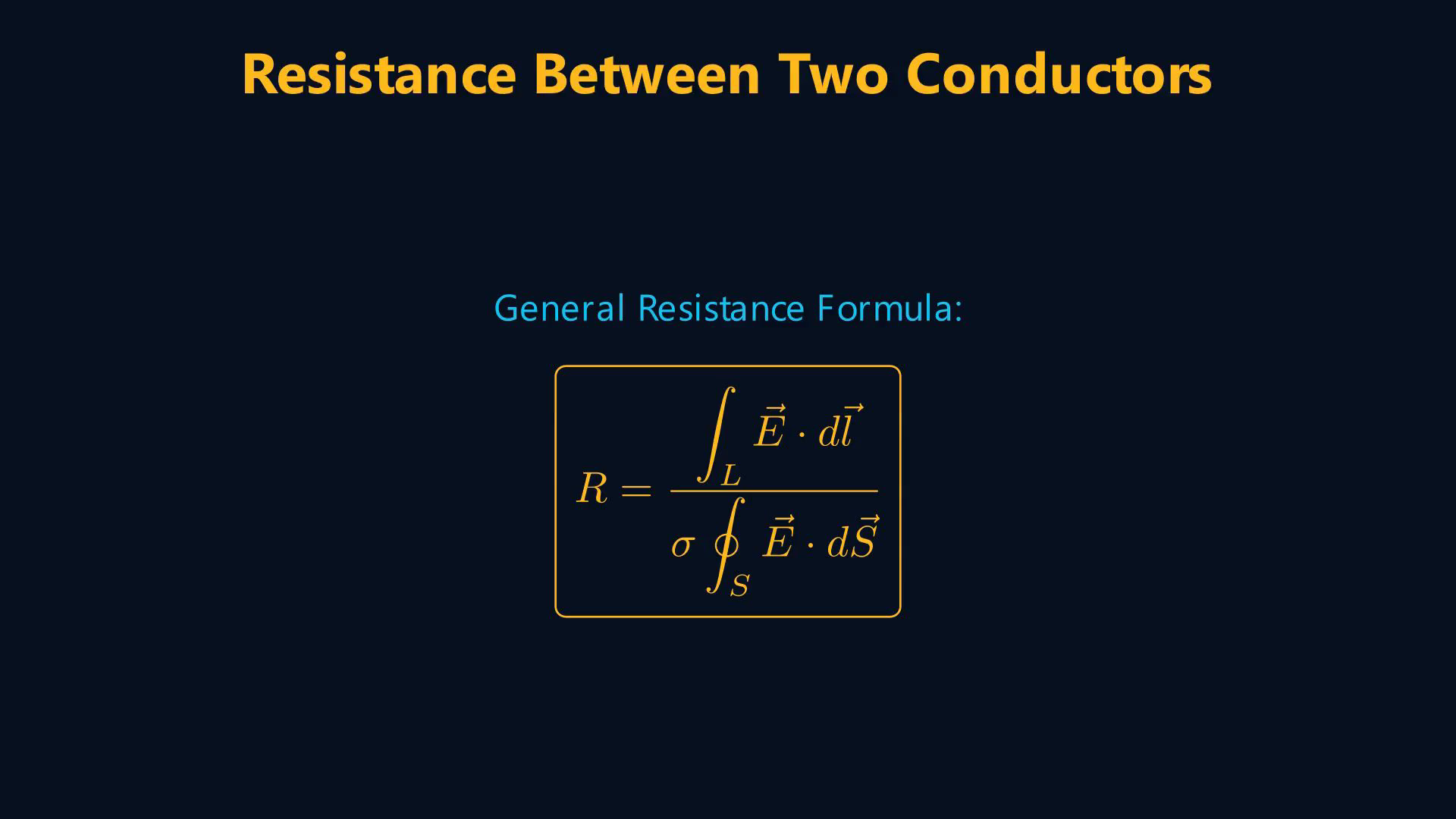
For the same geometry, one field solution yields both resistance and capacitance, with RC = ε/σ. Let's start with resistance.Consider two conductors maintained at a potential difference V zero.To find the resistance between them, we follow these steps.First, choose a suitable coordinate system and solve Laplace's equation to find V.Second, find E from E = −∇V.Third, use J = σE and I = ∫ₛσE·dS.Finally, R = V/I.General resistance: R = ∫E·dl / (σ∫ₛE·dS).Notice that we solve for the field first, then derive resistance from the field solution.We don't need to know the charge distribution.Narration transcript
Let's start with resistance. Consider two conductors maintained at a potential difference V zero. To find the resistance between them, we follow these steps. First, choose a suitable coordinate system and solve Laplace's equation to find V. Second, find E from E equals negative gradient of V. Third, find the current density J equals sigma E, and integrate over the conductor surface to get the total current: I equals the integral of sigma E dot dS. Finally, the resistance is R equals V over I. This gives the general formula: R equals the line integral of E dot d l, divided by sigma times the surface integral of E dot d S. Notice that we solve for the field first, then derive resistance from the field solution. We don't need to know the charge distribution.
3. Build capacitance for three geometries
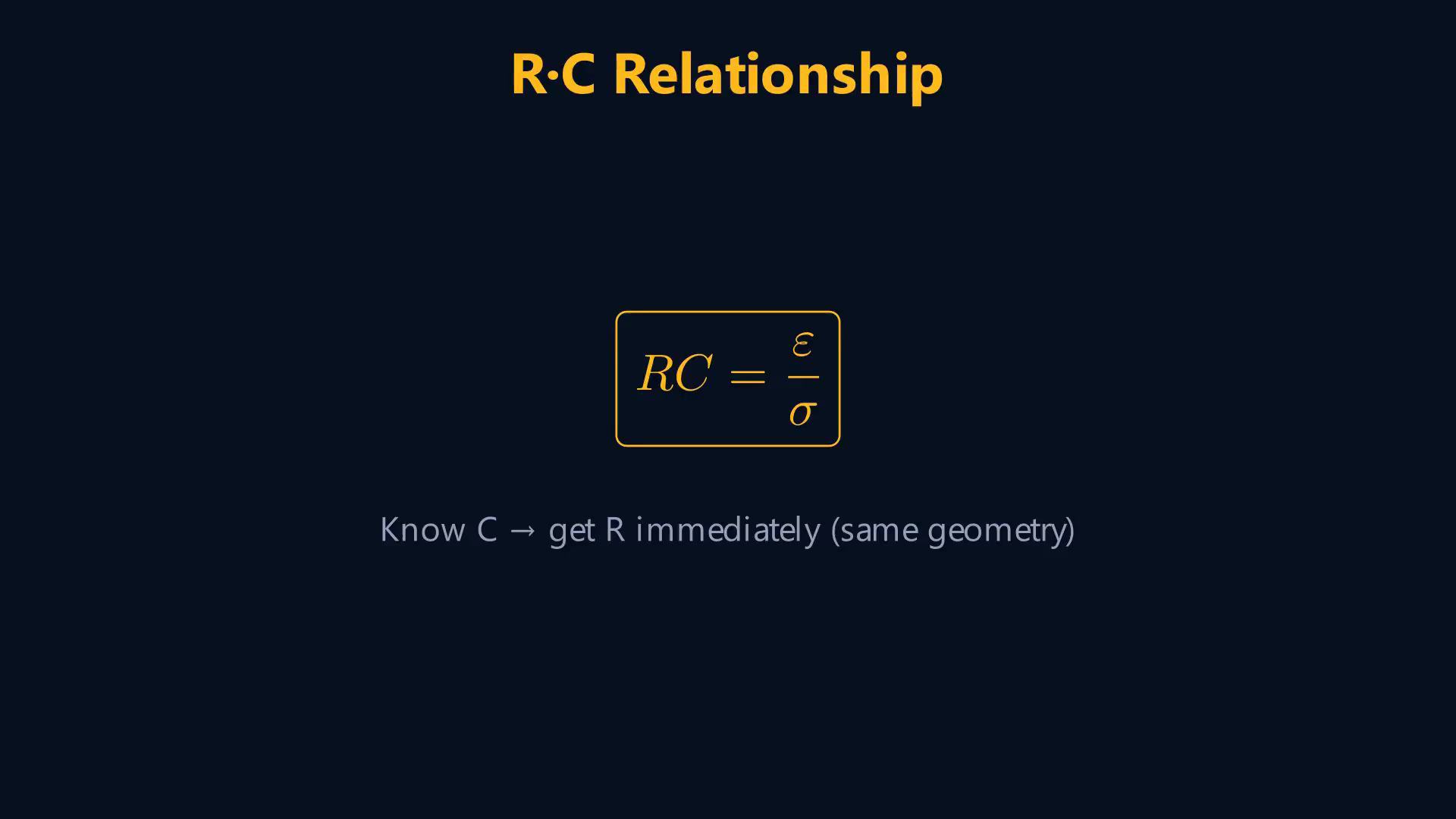
For the same geometry, one field solution yields both resistance and capacitance, with RC = ε/σ. Now let's find capacitance.A capacitor consists of two conductors separated by a dielectric.When V is applied, Q accumulates and C = Q/V.General capacitance: C = ε∮E·dS / ∫E·dl.Let's apply this to three common geometries.For parallel plates with area S and separation d, E = V/d.Integration gives C = εS/d.This is the most fundamental capacitor formula.For a coaxial cable with inner radius a and outer radius b, the field varies as 1 over ρ.For a coaxial geometry, C = 2πεL/ln(b/a).For concentric spheres with radii a and b, the field varies as 1 over r squared.For concentric spheres, C = 4πε/(1/a − 1/b).There is an elegant relationship between R and C for the same geometry: R times C equals ε over σ.If you know the capacitance, you can immediately find the resistance, and vice versa.Narration transcript
Now let's find capacitance. A capacitor consists of two conductors separated by a dielectric. When voltage V is applied, charge Q accumulates on the plates, and C equals Q over V. The general formula is: C equals epsilon times the closed surface integral of E dot d S, divided by the line integral of E dot d l. Let's apply this to three common geometries. For parallel plates with area S and separation d, the electric field is uniform: E equals V over d. Integrating gives C equals epsilon S over d. This is the most fundamental capacitor formula. For a coaxial cable with inner radius a and outer radius b, the field varies as 1 over rho. The capacitance per unit length is C equals 2 pi epsilon L, divided by the natural logarithm of b over a. For concentric spheres with radii a and b, the field varies as 1 over r squared. The result is C equals 4 pi epsilon, divided by the quantity 1 over a minus 1 over b. There is an elegant relationship between R and C for the same geometry: R times C equals epsilon over sigma. If you know the capacitance, you can immediately find the resistance, and vice versa.
4. Solve the parallel-plate capacitor example
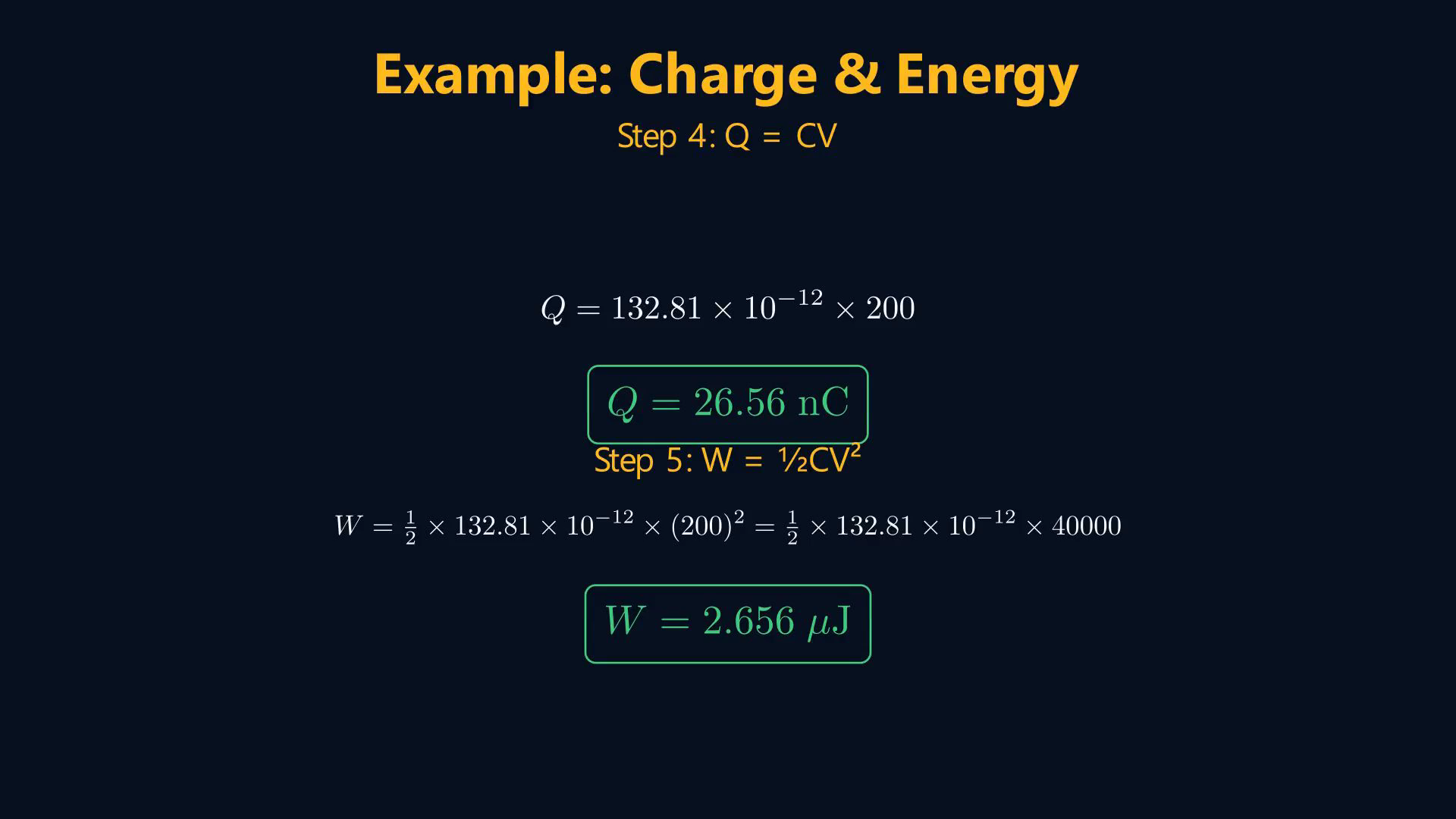
For the same geometry, one field solution yields both resistance and capacitance, with RC = ε/σ. Let's work a numerical example.A parallel-plate capacitor has square plates of side length 10 centimetres, separated by 2 millimetres.The dielectric has relative permittivity εr = 3.A voltage of 200 volts is applied.Find the capacitance, charge, and stored energy.Step one: Convert units.The plate area is S equals 10 centimetres times 10 centimetres equals 100 square centimetres.Converting to SI: S equals 100 times 10 to the negative 4, which is 0.01 square metres.The separation is d = 2 mm = 2×10⁻³ m.Step two: Find the permittivity.Step three: apply C = εS/d.Substituting: C equals 26.562 times 10 to the negative 12, times 0.01, divided by 2 times 10 to the negative 3.C = 132.81×10⁻¹² F = 132.81 pF.Step four: Q = CV.Q = 26.56 nC.Step five: W = ½CV².200 squared is 40000.Narration transcript
Let's work a numerical example. A parallel-plate capacitor has square plates of side length 10 centimetres, separated by 2 millimetres. The dielectric has relative permittivity epsilon r equals 3. A voltage of 200 volts is applied. Find the capacitance, charge, and stored energy. Step one: Convert units. The plate area is S equals 10 centimetres times 10 centimetres equals 100 square centimetres. Converting to SI: S equals 100 times 10 to the negative 4, which is 0.01 square metres. The separation is d equals 2 millimetres equals 2 times 10 to the negative 3 metres. Step two: Find the permittivity. Epsilon equals epsilon r times epsilon zero equals 3 times 8.854 times 10 to the negative 12. That gives epsilon equals 26.562 times 10 to the negative 12 farads per metre. Step three: Apply C equals epsilon S over d. Substituting: C equals 26.562 times 10 to the negative 12, times 0.01, divided by 2 times 10 to the negative 3. This gives C equals 132.81 times 10 to the negative 12, which is 132.81 picofarads. Step four: The charge is Q equals C V. Q equals 132.81 times 10 to the negative 12, times 200. That gives Q equals 26.56 nanocoulombs. Step five: The stored energy is W equals one half C V squared. W equals one half times 132.81 times 10 to the negative 12, times 200 squared. 200 squared is 40000. So W equals one half times 132.81 times 10 to the negative 12 times 40000. That gives W equals 2.656 microjoules.
5. Review resistance–capacitance relations
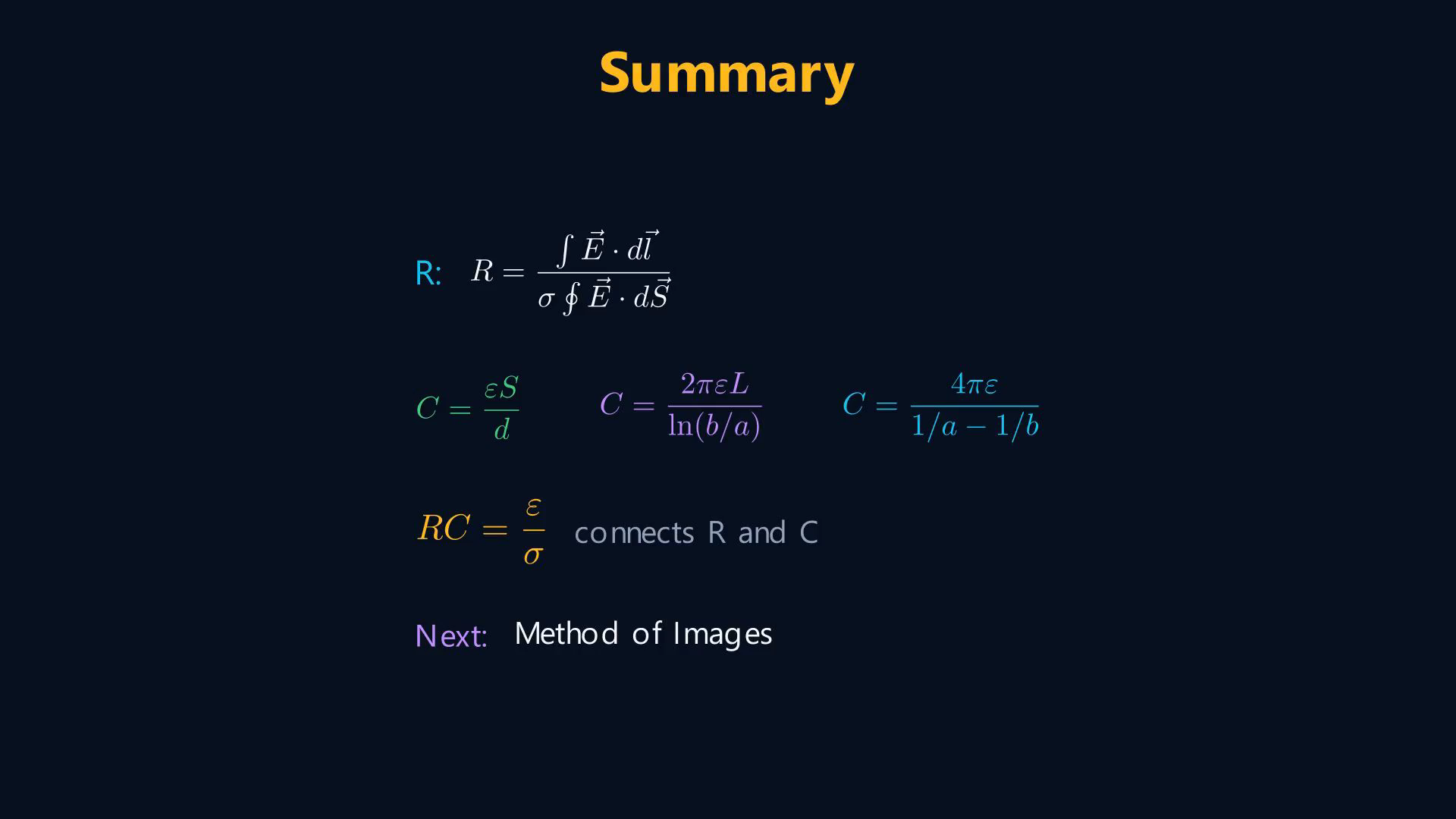
For the same geometry, one field solution yields both resistance and capacitance, with RC = ε/σ. Let's summarize.The general resistance formula uses the field solution: R equals the integral of E dot d l over σ times the integral of E dot d S.For capacitance, the three key formulas are: parallel plate, C equals ε S over d; coaxial, C equals 2 π ε L over ln b over a; and spherical, C equals 4 π ε over 1 over a minus 1 over b.For the same geometry RC = ε/σ connects resistance and capacitance.In our next lesson, we'll explore the method of images.Narration transcript
Let's summarize. The general resistance formula uses the field solution: R equals the integral of E dot d l over sigma times the integral of E dot d S. For capacitance, the three key formulas are: parallel plate, C equals epsilon S over d; coaxial, C equals 2 pi epsilon L over ln b over a; and spherical, C equals 4 pi epsilon over 1 over a minus 1 over b. The elegant result R C equals epsilon over sigma connects resistance and capacitance for any geometry. In our next lesson, we'll explore the method of images.
Source video: Electromagnetic Theory (v2) #16 Resistance & Capacitance (6:26)