Antenna Theory · Resonance, Wavelength, and Antenna Size
#03 Connecting operating frequency to wavelength and practical antenna size, using half- and quarter-wavelength rules and a 3 GHz example
See how the operating frequency fixes wavelength and turns abstract fractions into physical antenna dimensions.
Question
Connect frequency, wavelength, and resonance; interpret half- and quarter-wavelength dimensions and calculate realistic antenna sizes at 3 GHz.
Written solution and narration transcript(shows the full solution)
Below are all the lines written in the notebook together with the full narration transcript.
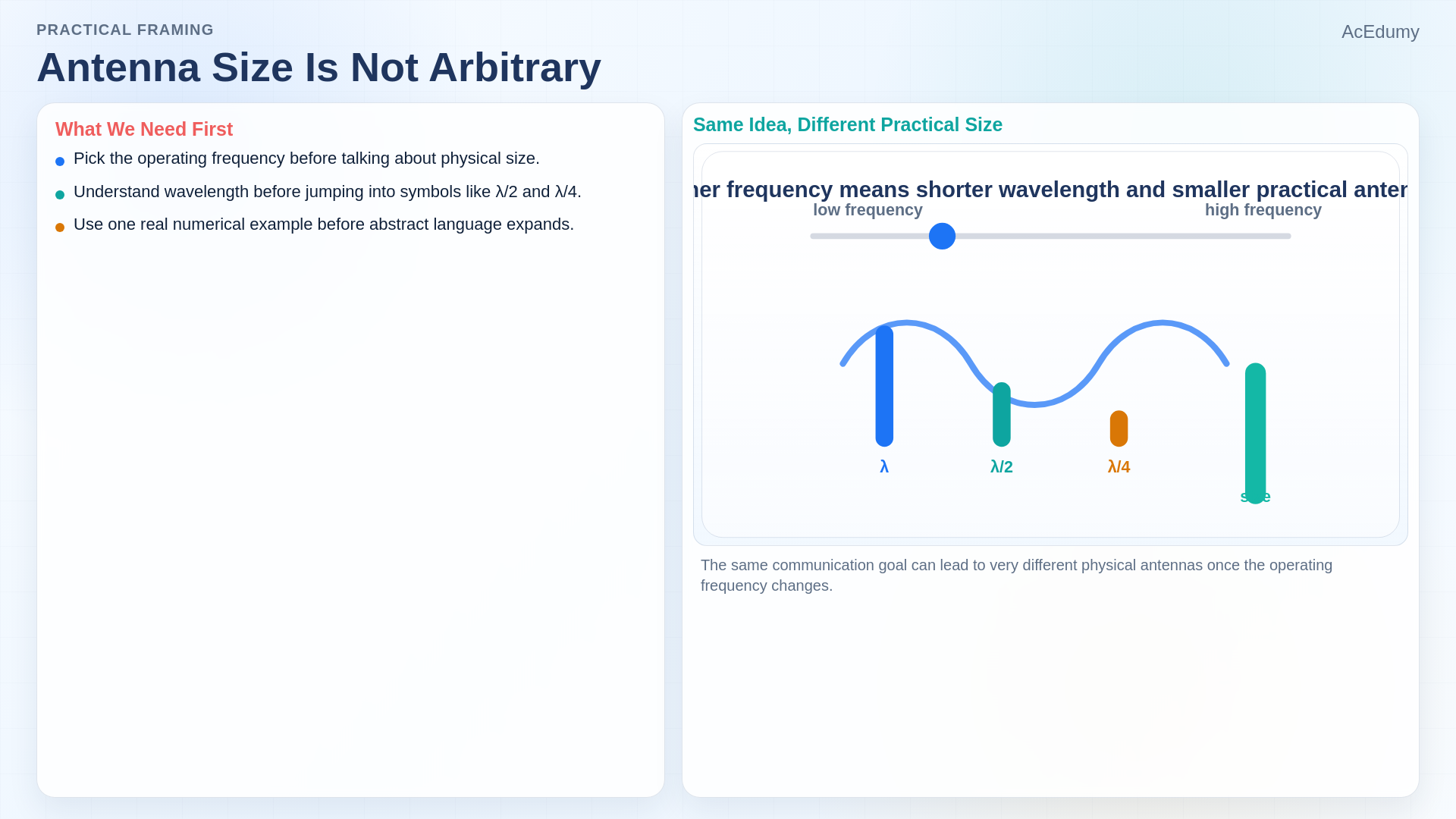
1. See why antenna size is not arbitrary
Frequency sets wavelength, and wavelength guides practical antenna dimensions. In this lesson, we answer a practical antenna question that almost every beginner asks.Why are some antennas compact and easy to build, while low frequency antennas quickly become physically huge?To answer that, we need a clean link between operating frequency, wavelength, and practical antenna size.This is where resonance and wavelength fractions start to become useful instead of mysterious.Narration transcript
In this lesson, we answer a practical antenna question that almost every beginner asks. Why are some antennas compact and easy to build, while low frequency antennas quickly become physically huge? To answer that, we need a clean link between operating frequency, wavelength, and practical antenna size. This is where resonance and wavelength fractions start to become useful instead of mysterious.
2. Recognize resonance as a strong-response region
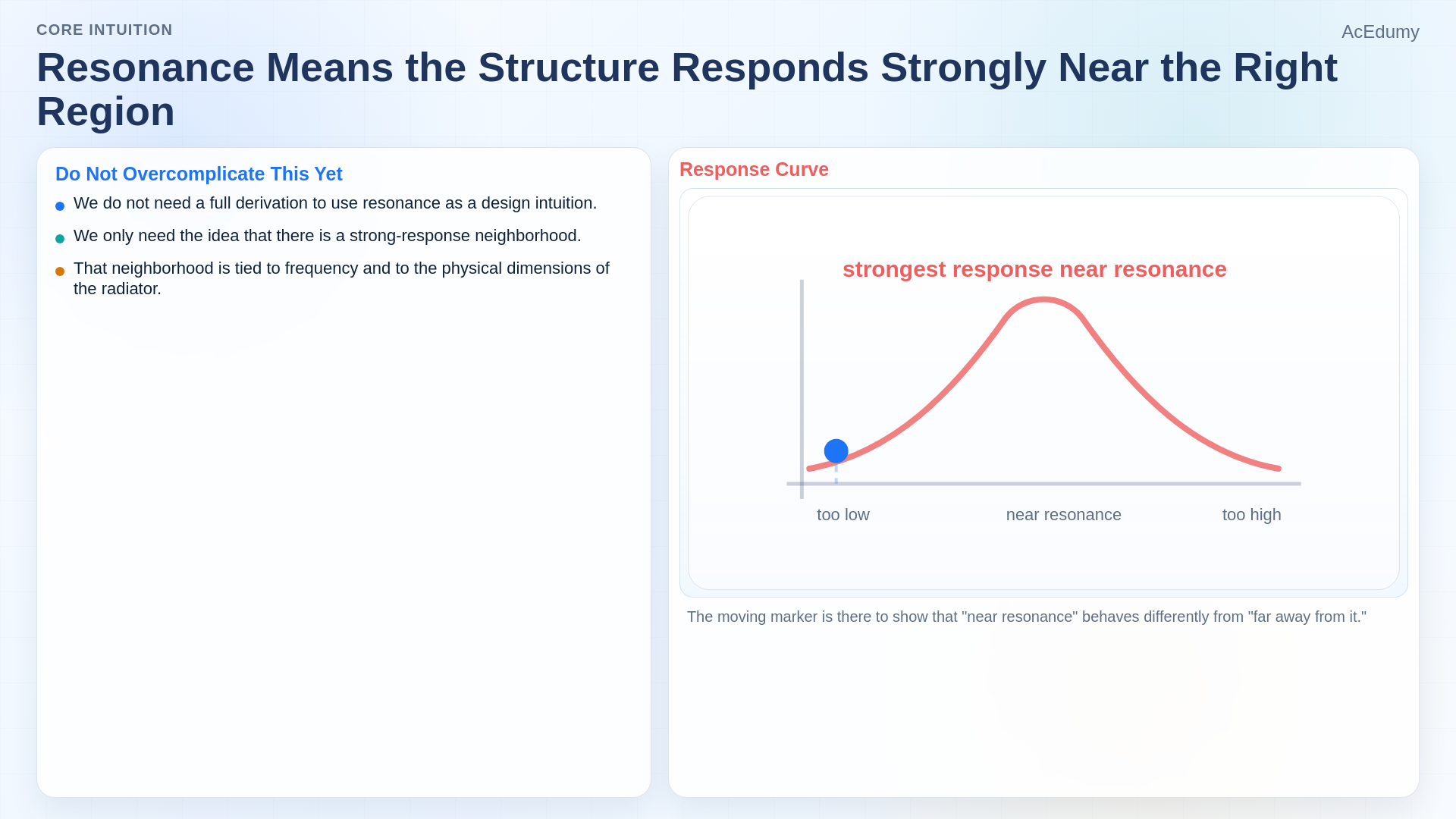
Frequency sets wavelength, and wavelength guides practical antenna dimensions. For this lesson, resonance only needs a simple meaning.It is the region where the structure responds strongly near the right operating condition.We are not doing a heavy derivation yet.We only need the idea that frequency and physical dimensions are not independent.Near the right region, the antenna behaves much more effectively than it does far away from it.Narration transcript
For this lesson, resonance only needs a simple meaning. It is the region where the structure responds strongly near the right operating condition. We are not doing a heavy derivation yet. We only need the idea that frequency and physical dimensions are not independent. Near the right region, the antenna behaves much more effectively than it does far away from it.
3. Connect higher frequency to shorter wavelength
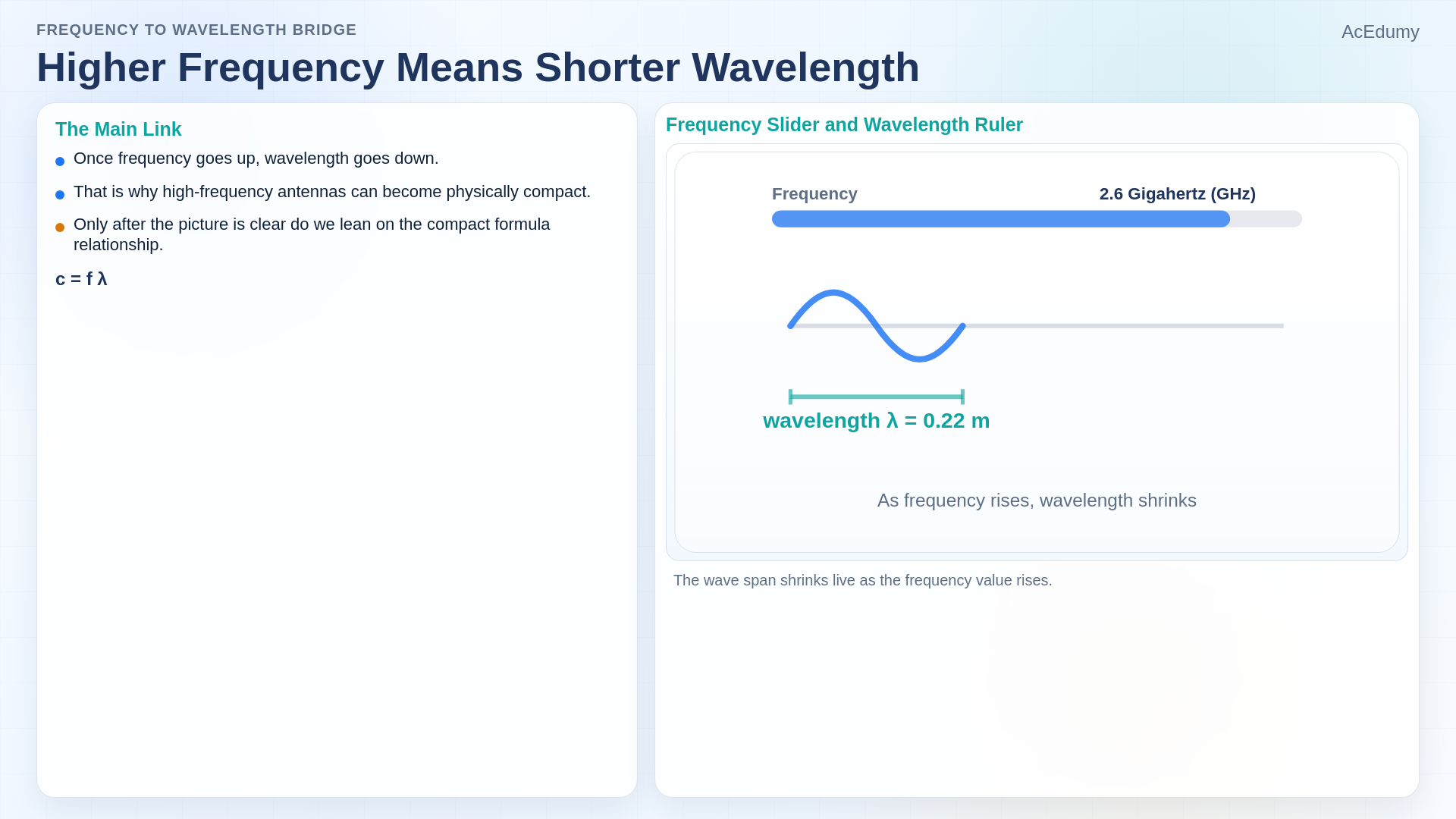
Frequency sets wavelength, and wavelength guides practical antenna dimensions. Now connect frequency to wavelength.Higher frequency means shorter wavelength, and lower frequency means longer wavelength.That is the quiet reason antenna size changes so much from one system to another.Once the operating frequency is chosen, the wavelength picture already starts telling us what sizes are practical.Narration transcript
Now connect frequency to wavelength. Higher frequency means shorter wavelength, and lower frequency means longer wavelength. That is the quiet reason antenna size changes so much from one system to another. Once the operating frequency is chosen, the wavelength picture already starts telling us what sizes are practical.
4. Read the λ, λ/2, and λ/4 size language
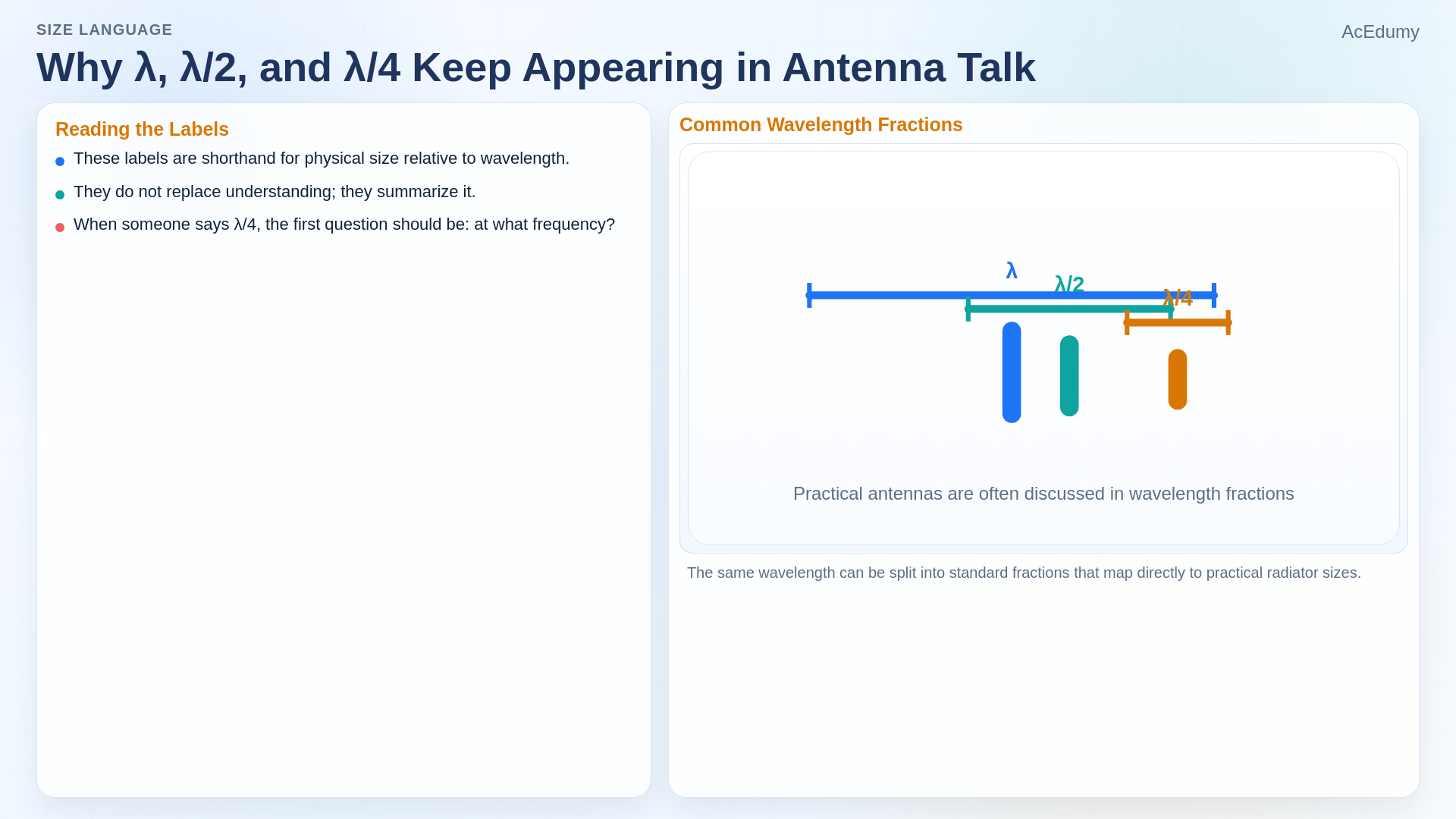
Frequency sets wavelength, and wavelength guides practical antenna dimensions. This is why antenna engineers keep using labels like wavelength, half wavelength (λ/2), and quarter wavelength (λ/4).Those labels are not just names.They are shorthand for physical size relative to the operating wavelength.And the moment someone says quarter wavelength (λ/4) or half wavelength (λ/2), the next question should be: at what frequency?Narration transcript
This is why antenna engineers keep using labels like wavelength, half wavelength, and quarter wavelength. Those labels are not just names. They are shorthand for physical size relative to the operating wavelength. And the moment someone says quarter wavelength or half wavelength, the next question should be: at what frequency?
5. Find the 10 cm, 5 cm, and 2.5 cm sizes at 3 GHz
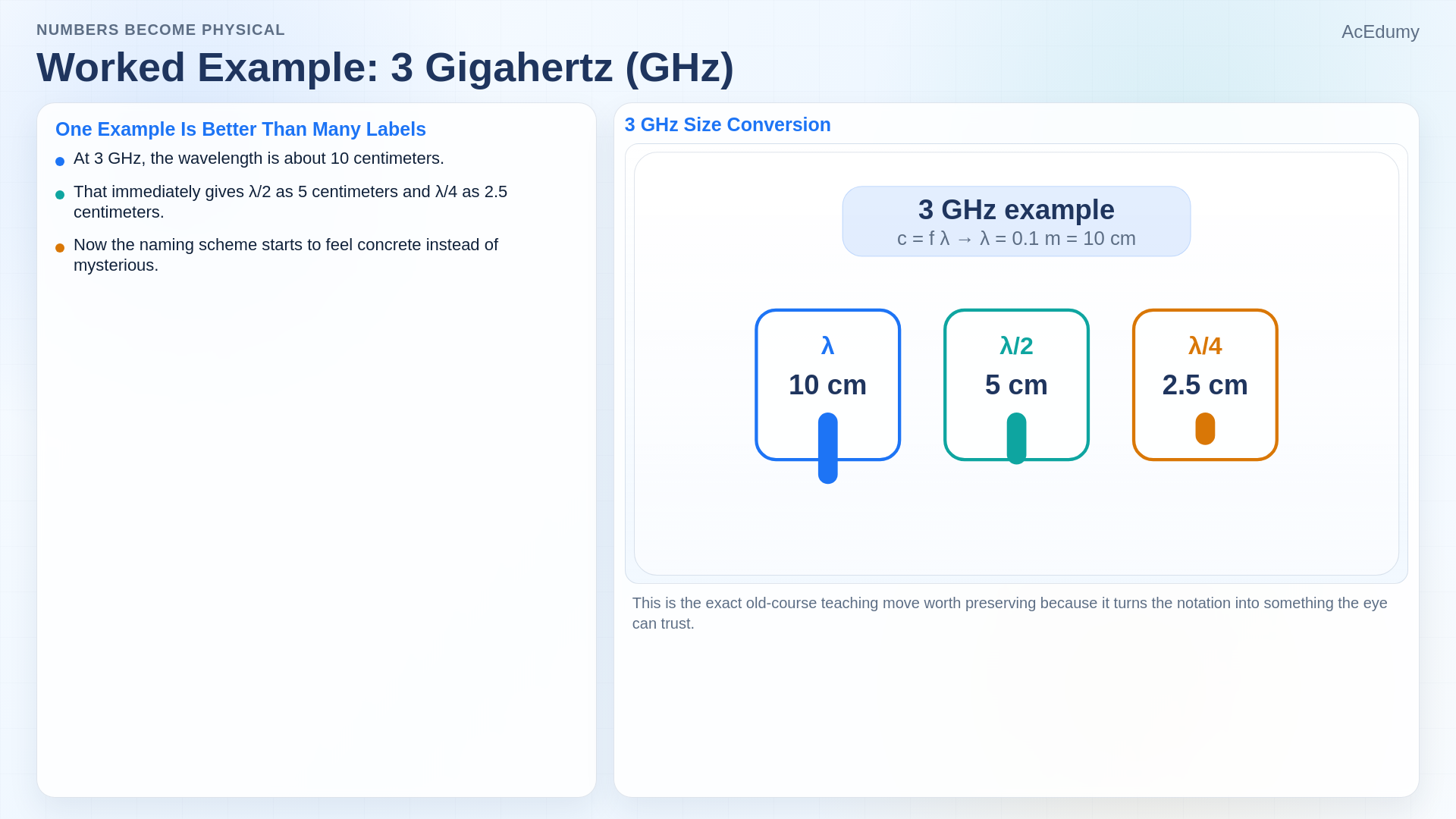
Frequency sets wavelength, and wavelength guides practical antenna dimensions. Let us anchor the idea with one concrete example.Suppose the operating frequency is 3 gigahertz (3 GHz).That gives a wavelength of about 10 cm.So half wavelength (λ/2) becomes 5 cm, and quarter wavelength (λ/4) becomes 2.5 cm.Now the size labels feel physical instead of abstract.Narration transcript
Let us anchor the idea with one concrete example. Suppose the operating frequency is three Gigahertz, written as three G H Z. That gives a wavelength of about ten centimeters. So half wavelength becomes five centimeters, and quarter wavelength becomes two point five centimeters. Now the size labels feel physical instead of abstract.
6. See the physical-size cost of low frequency
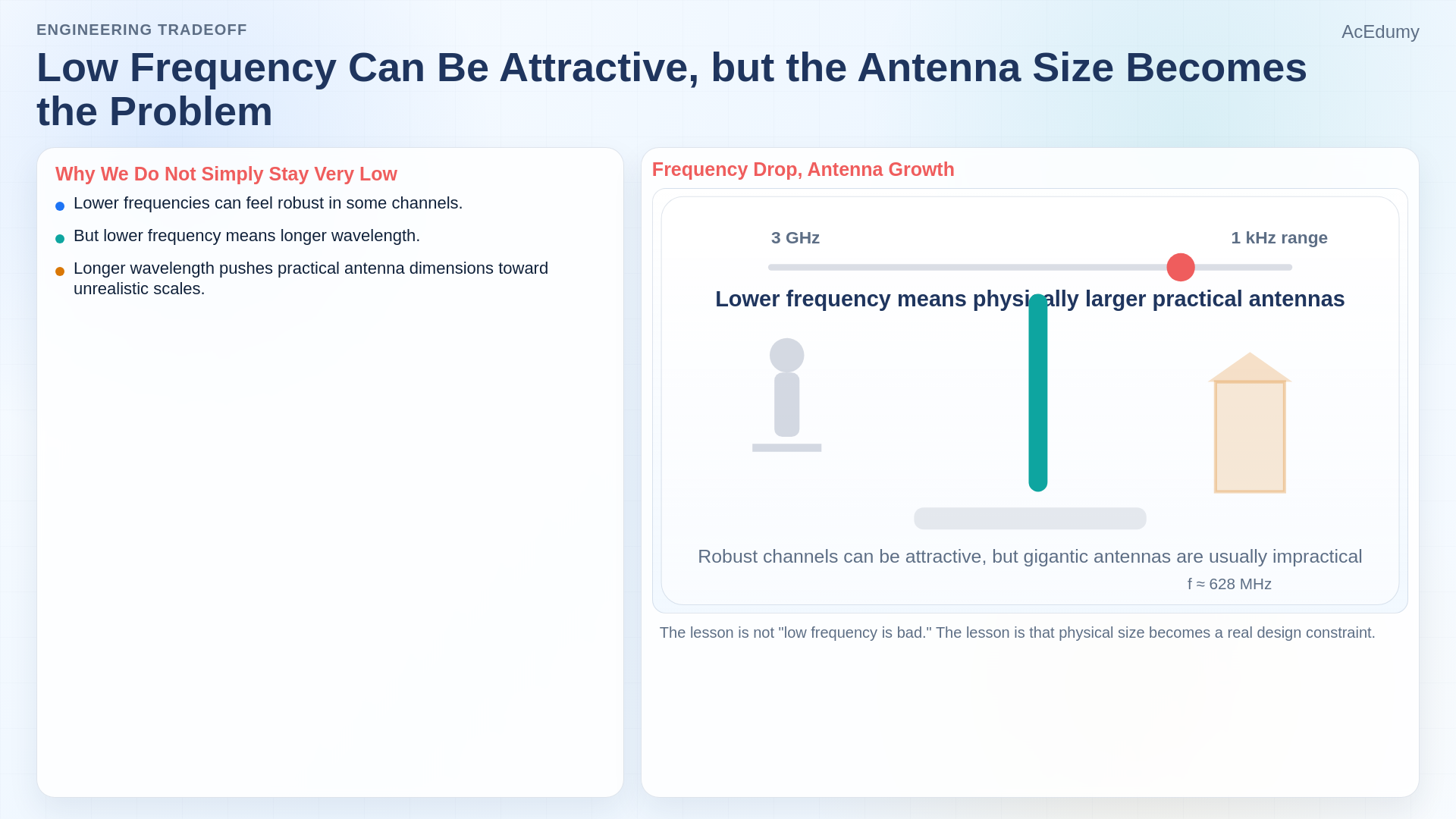
Frequency sets wavelength, and wavelength guides practical antenna dimensions. At first glance, low frequency can sound attractive because some channels feel more forgiving there.But the wavelength grows as the frequency falls.And that means the practical antenna size grows too.So the engineering tradeoff is not simply about signal behavior.It is also about whether the antenna can exist in a realistic physical size.Narration transcript
At first glance, low frequency can sound attractive because some channels feel more forgiving there. But the wavelength grows as the frequency falls. And that means the practical antenna size grows too. So the engineering tradeoff is not simply about signal behavior. It is also about whether the antenna can exist in a realistic physical size.
7. Summarize the frequency-to-size chain
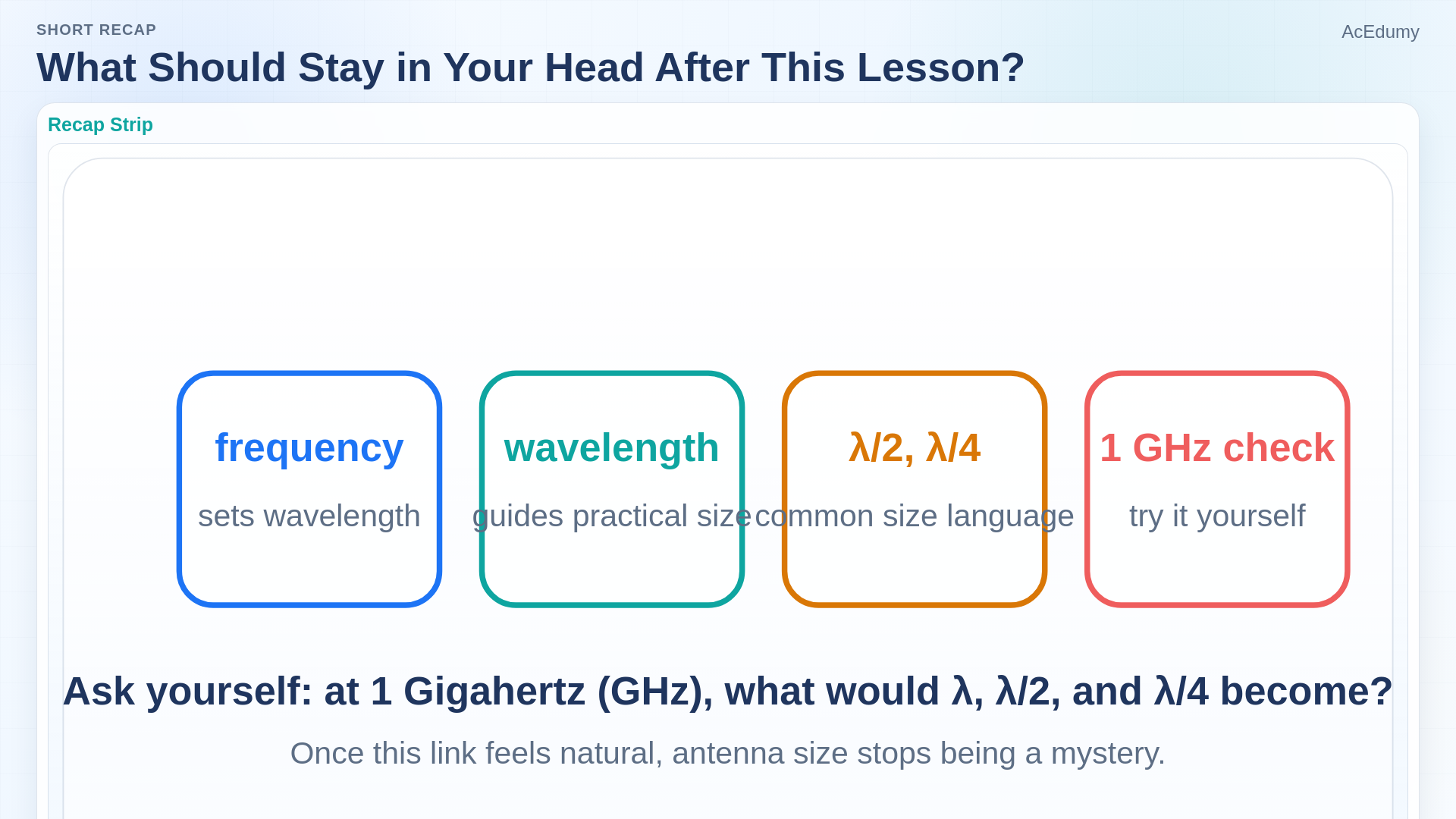
Frequency sets wavelength, and wavelength guides practical antenna dimensions. Keep four links from this lesson.Frequency sets wavelength.Wavelength guides practical antenna size.Labels like half wavelength (λ/2) and quarter wavelength (λ/4) are size shortcuts.And if someone gives you a frequency, you can begin estimating a realistic antenna size instead of guessing.Narration transcript
Keep four links from this lesson. Frequency sets wavelength. Wavelength guides practical antenna size. Labels like half wavelength and quarter wavelength are size shortcuts. And if someone gives you a frequency, you can begin estimating a realistic antenna size instead of guessing.
Source video: Antenna Theory #03 | Resonance, Wavelength, and Why Antenna Size Matters (2:58)