Circuit Theory 1 · First-Order Transients
#42 Transient Analysis #42 — RL natural-response numerical example
Solves the RL natural response for 100 mH, 50 Ω, and 2 A, including time constant, current/voltage, one- and five-tau checks, energy, and switching safety.
Question
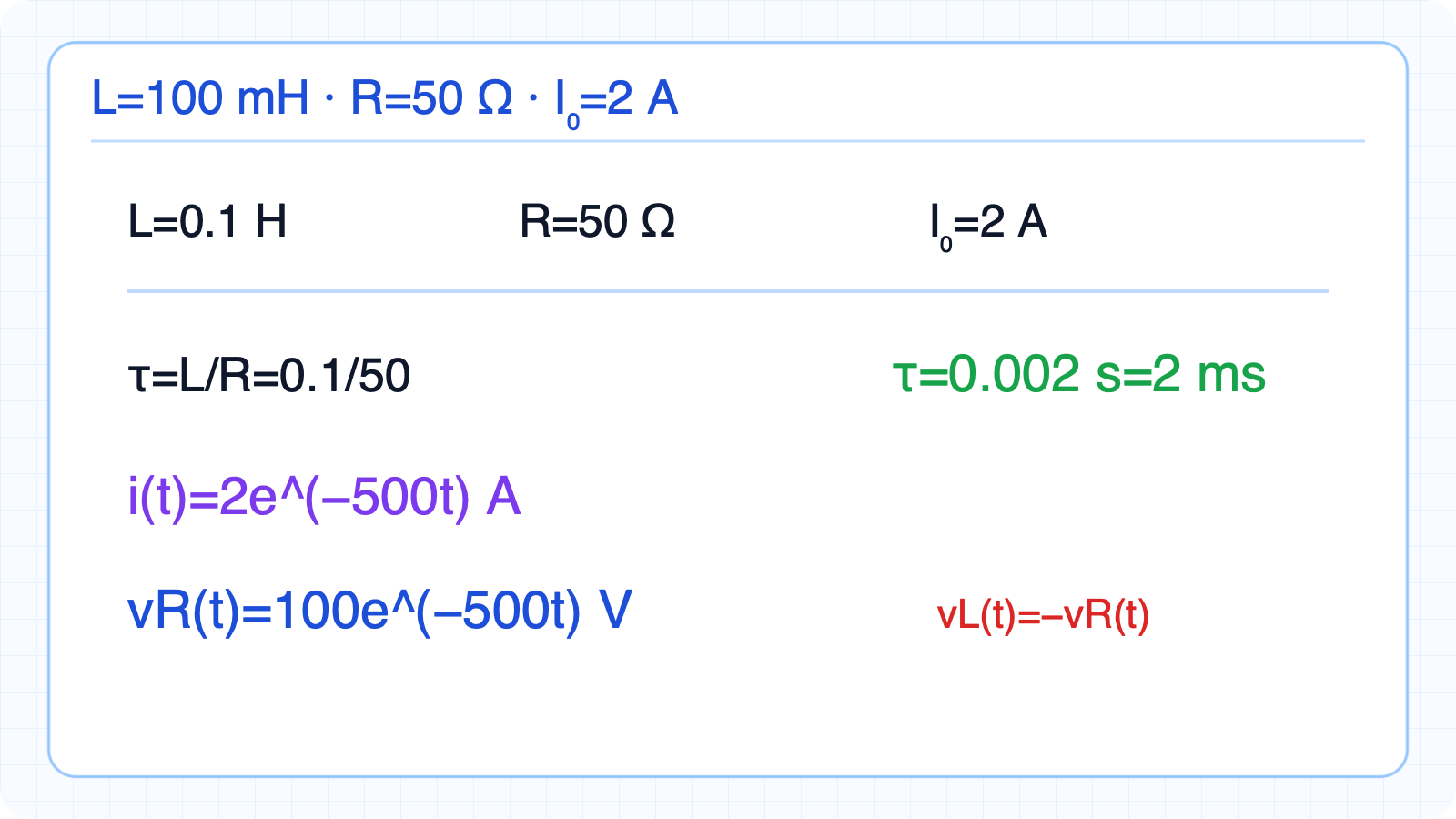
For L=100 mH, R=50 Ω, and I₀=2 A, calculate τ, i(t), v_R(t), v_L(t), i(τ), i(5τ), initial power, and energy conversion.
Written solution and narration transcript(shows the full solution)
Below are all the lines written in the notebook together with the full narration transcript.
1. Numerical RL natural-response solution
τ=2 ms, i(t)=2e^(−500t) A, and v_R(t)=100e^(−500t) V. L=100 mH, R=50 Ω, I₀=2 Aτ=0.002 s=2 msAt t=τ: i=0.736 A and vR=36.8 VNarration transcript
Let's work through a detailed numerical example. We have an inductor of 100 millihenries, a resistor of 50 ohms, and an initial current of 2 amperes. The switch opens at t equals zero. Step one: calculate the time constant. Tau equals L over R equals zero point one over 50 equals zero point zero zero two seconds, or two milliseconds. Very fast decay! Step two: write the current expression. i of t equals two times e to the negative t over zero point zero zero two, or equivalently, two times e to the negative five hundred t amperes. Step three: find the voltage across the resistor. V-R equals I-zero times R times the exponential. That's two times fifty times e to the negative five hundred t, which simplifies to one hundred times e to the negative five hundred t volts. Notice: at t equals zero, we have a 100-volt spike across the resistor. This is why switches handling inductors can produce dangerous voltage transients! Step four: check our answer at t equals tau equals two milliseconds. The current becomes two times e to the minus one equals zero point seven three six amperes. The voltage drops to thirty-six point eight volts.
2. One-tau and five-tau checks
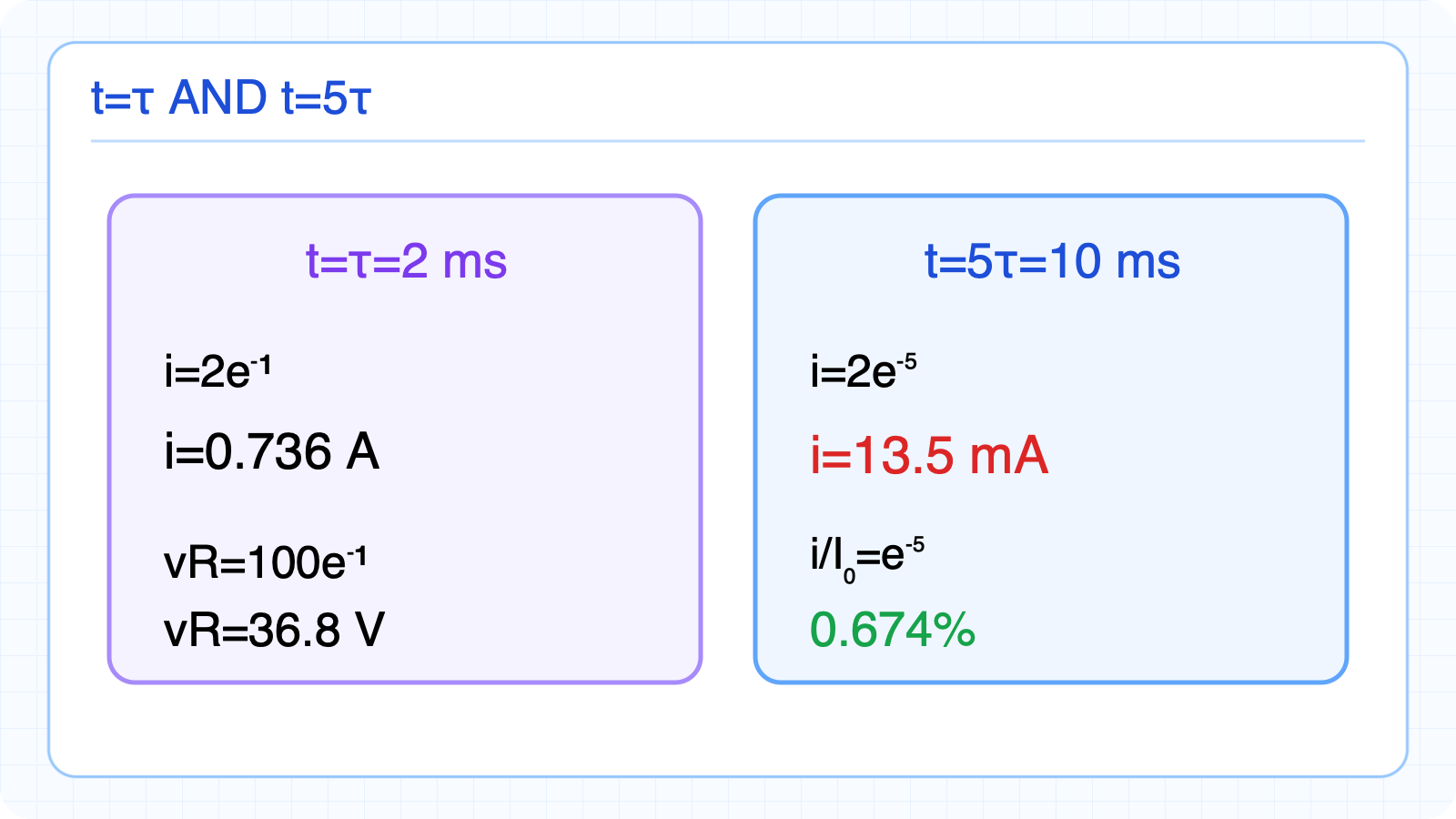
0.736 A at 2 ms and the correct value 13.5 mA at 10 ms. Check exponential decay at specific timest=τ=2 mst=5τ=10 msi(5τ)=0.0135 A=13.5 mARemaining ratio: 0.674 percentThe transient is practically overNarration transcript
The five-tau rule is a practical guideline for transient analysis. After how long can we say the transient is effectively finished? The answer: five time constants. At t equals tau, thirty-six point eight percent of the current remains. At t equals two-tau, only thirteen point five percent. At three-tau: five percent. At four-tau: one point eight percent. At five-tau: zero point seven percent. After five-tau, the current has decayed to less than one percent of its initial value — for most practical purposes, the transient is dead. In circuit design, this is critical. If you design a power supply that switches inductors, you must account for the five-tau settling time. For a two-millisecond time constant, five-tau is ten milliseconds. The inductor current doesn't vanish instantly — it takes that settling time. In digital circuits switching inductors or large transformers, this settling time can limit your switching frequency.
3. Magnetic energy and heat in the resistor
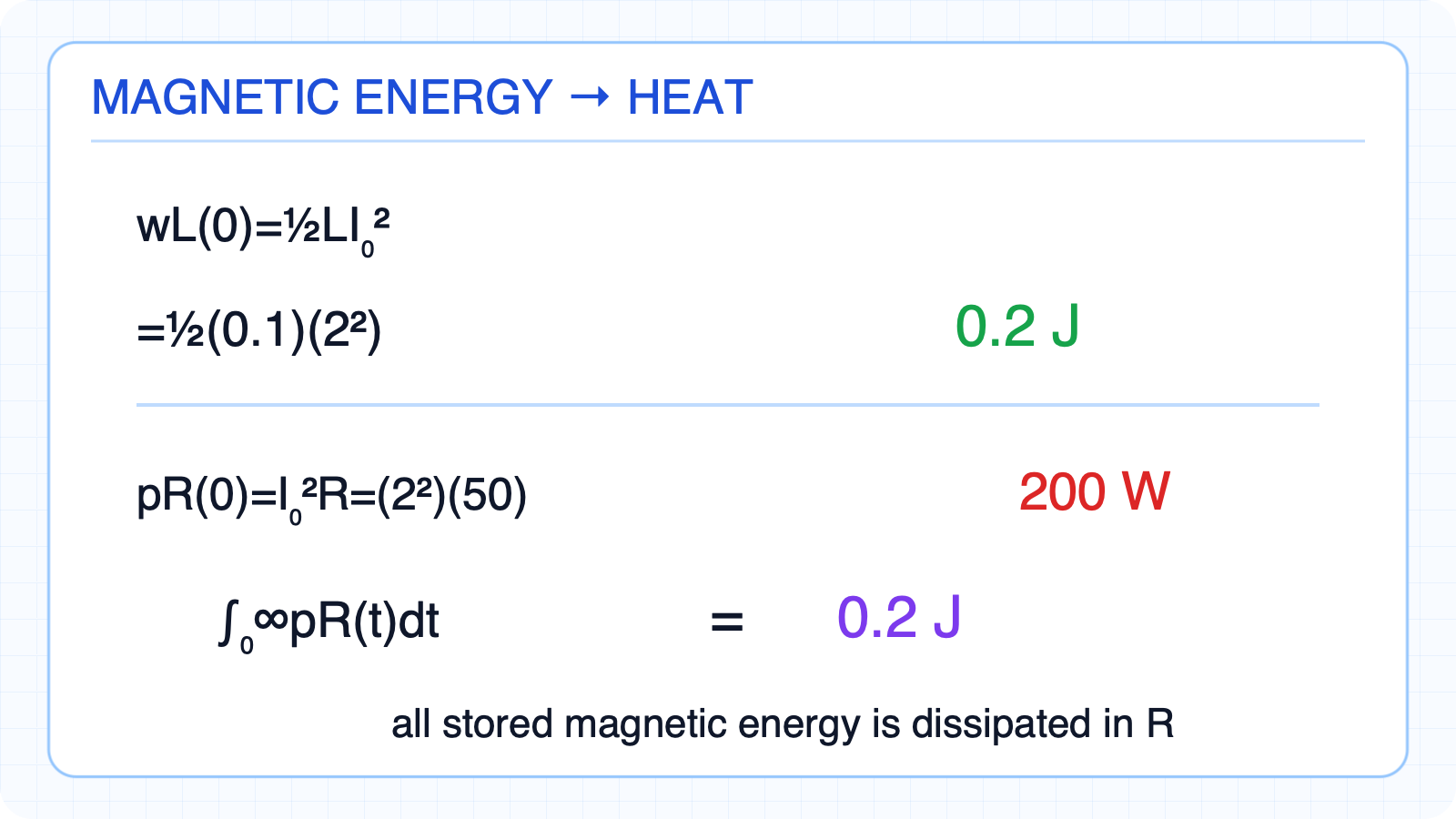
All 0.2 J becomes heat in R; initial power is 200 W. Track the inductor's initial energywL(0)=½LI₀²Initial resistor power pR(0)=I₀²RMagnetic-field energy becomes heatNarration transcript
Where does the energy go? The inductor starts with magnetic energy W-zero equals one-half L times I-zero-squared. This is the only energy in the circuit — the resistor has no initial energy. As the current decays, the magnetic field collapses. Where is the energy released? Into the resistor! The power dissipated is p equals i-squared R. Over the entire time interval from zero to infinity, we can integrate: total energy equals the integral of p-R of t d-t equals the integral of I-zero-squared R times e to the negative two-t over tau d-t. Evaluating this integral gives exactly one-half L I-zero-squared. This is a beautiful result: all the initial magnetic energy is dissipated as heat in the resistor. The integral of power from zero to infinity equals the initial stored energy. This is energy conservation in action. The electromagnetic field energy is not lost — it is converted to thermal energy. In practical terms, the resistor gets warm because it is absorbing all the inductor's stored energy.
4. RL application summary and safety
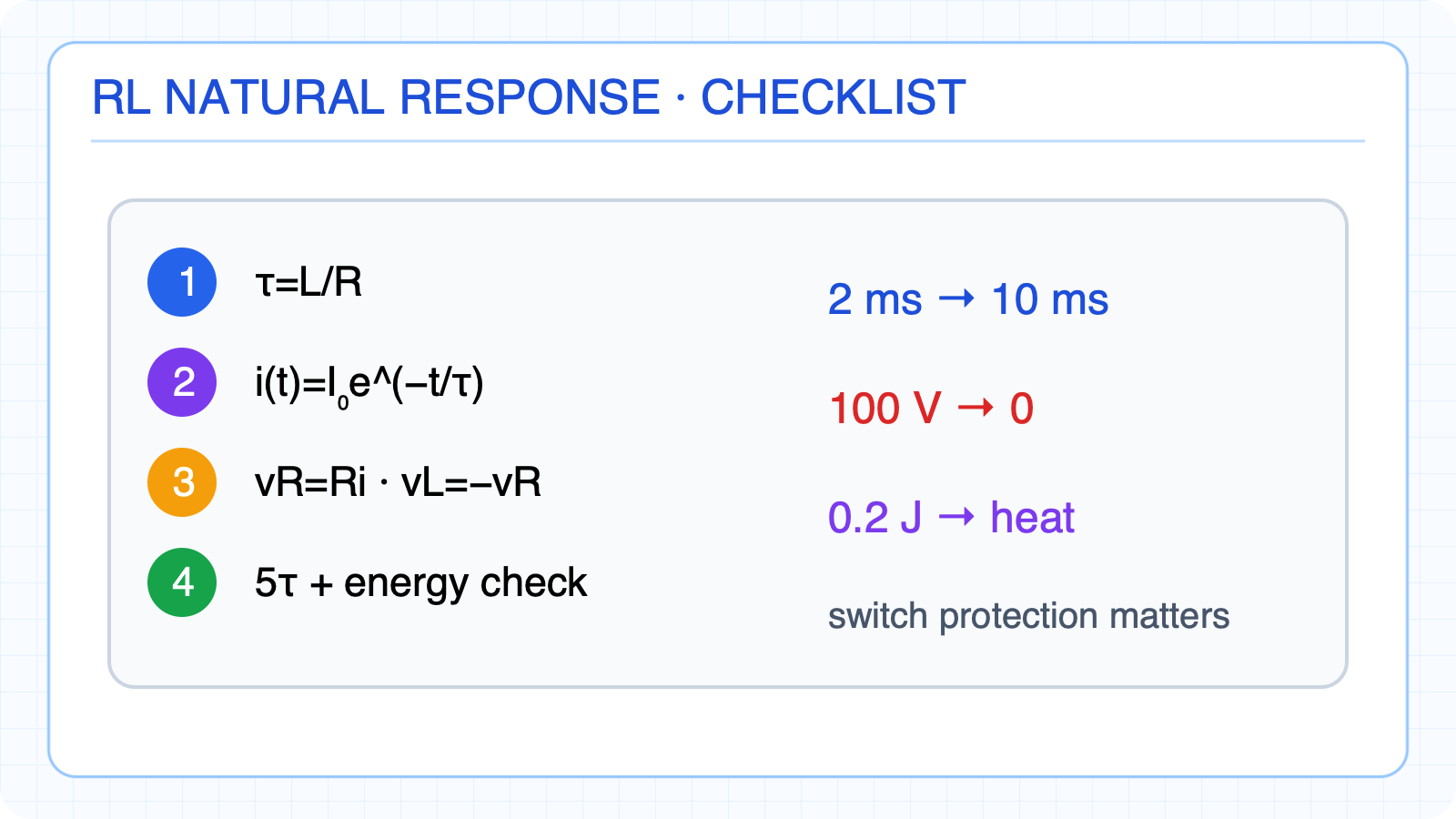
Time constant, current, voltage, five-tau, and energy checks. RL natural-response application sequence1) First calculate τ=L/R2) Write i(t)=I₀e(−t/τ)3) Find vR=Ri and vL=−vR4) Check 5τ and energyHere τ=2 ms and 5τ=10 msInitially vR=100 VSwitching inductors can create dangerous voltage transientsReal circuits may require protection componentsNarration transcript
Let's summarize the key results from this lesson. First: the RL natural response follows i of t equals I-zero times e to the negative t over tau, where tau equals L over R. This is the perfect dual of the RC natural response. We swapped voltage for current, and capacitance for inductance. Second: the time constant tau determines everything. At t equals tau, thirty-six point eight percent of the current remains. You can find tau graphically by drawing a tangent to the exponential curve at t equals zero — it hits the time axis at exactly t equals tau. After five-tau, the transient is dead. Third: energy conservation. The inductor begins with magnetic energy one-half L I-zero-squared. All of this energy is dissipated as heat in the resistor. The power dissipates twice as fast as the current because it depends on i-squared. Fourth: practical implications. When you open a switch carrying inductor current, the voltage across the switch can spike to dangerous levels because V equals L times d-i-d-t. The settling time dictated by five-tau is critical in power electronics. Next lecture we'll explore the RC and RL step response — what happens when we apply a voltage step instead of just releasing stored energy.