Circuit Theory 1 · First-Order Transients
#41 Transient Analysis #41 — RL natural-response theory
Derives the physical meaning, KVL equation, exponential current solution, τ=L/R time constant, and voltage-power-energy expressions for a source-free RL circuit.
Question
For an inductor carrying initial current I₀ and releasing energy through R, form the KVL equation and derive i(t), τ, v_R, v_L, p_R, and w_L.
Written solution and narration transcript(shows the full solution)
Below are all the lines written in the notebook together with the full narration transcript.
1. Physical setup of the RL natural response
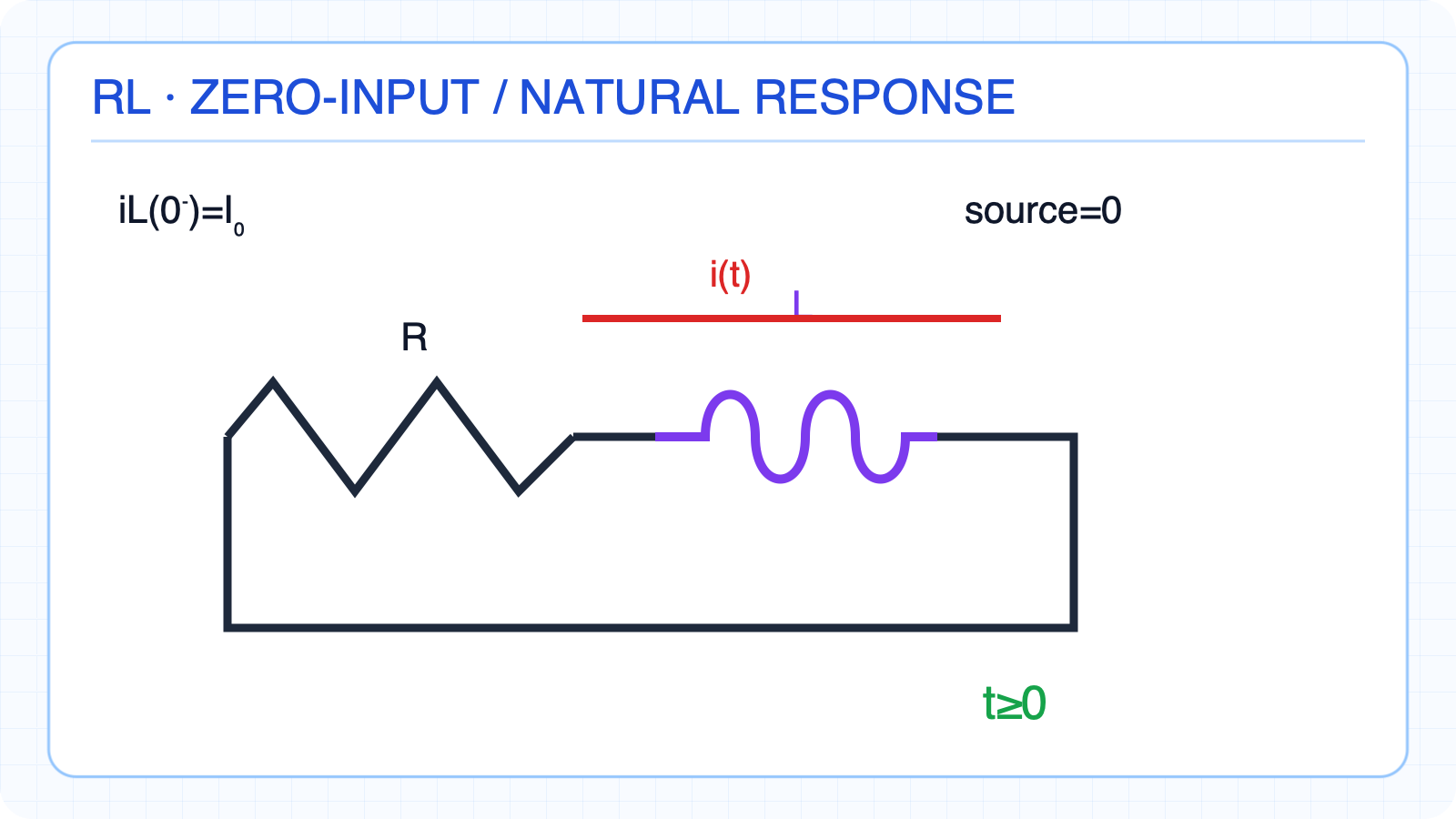
Magnetic-field energy becomes heat in the resistor. Zero-input RL natural responseInitial inductor current is I₀There is no external source for t≥0The only energy source is wL(0)=½LI₀²The inductor releases energy through RWe seek i(t)Current cannot fall to zero instantaneouslyThe natural response is decay of magnetic energyNarration transcript
Now we examine the RL natural response. We have an inductor with initial current I-zero and a resistor. The switch opens at t equals zero. Before that, the inductor current is steady at I-zero. At the moment the switch opens, no external source drives the circuit. Only the energy stored in the inductor's magnetic field exists. The inductor will discharge its energy through the resistor, and we need to find i of t for t greater than zero.
2. RL equation and exponential solution
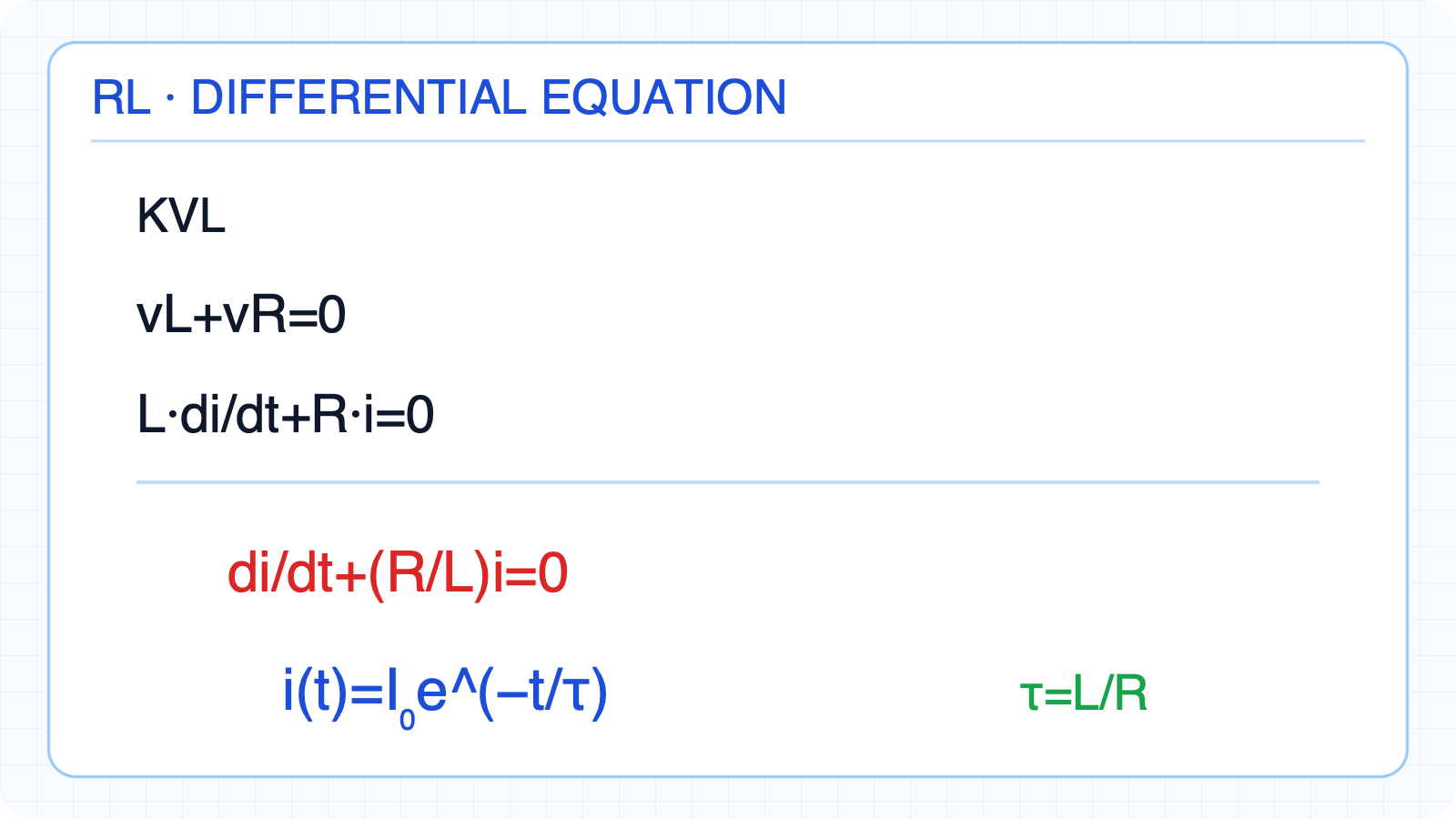
di/dt+(R/L)i=0 and i(t)=I₀e^(−t/τ), τ=L/R. Apply KVL to the RL loopL·di/dt+R·i=0di/dt+(R/L)i=0Separate: di/i=−(R/L)dtNarration transcript
Apply Kirchhoff's voltage law around the loop: V-L plus V-R equals zero. Substituting V equals L times d-i-d-t and V equals i-R, we get L times d-i-d-t plus i times R equals zero. Rearrange: d-i-d-t plus R-over-L times i equals zero. This is a first-order linear homogeneous ODE. Let's define the time constant tau equals L over R — notice it has units of seconds, just like R-C. Separate variables: d-i over i equals negative one-over-tau times d-t. Integrate both sides: natural log of i equals negative t over tau plus a constant. Solve for i: i of t equals A times e to the power negative t over tau. Apply the initial condition: at t equals zero, i equals I-zero. Therefore A equals I-zero. Our final solution: i of t equals I-zero times e to the negative t over tau.
3. RL time constant
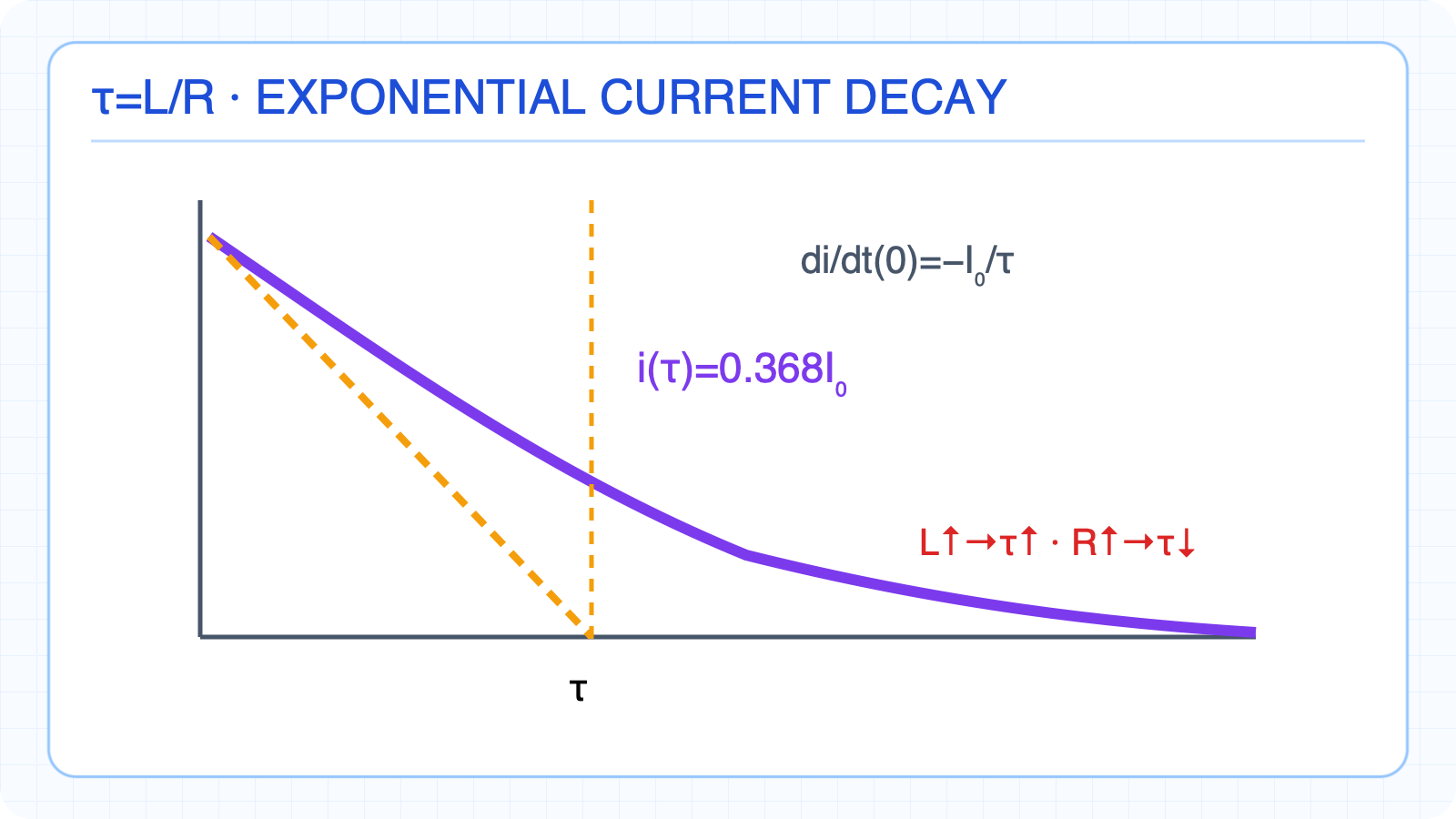
36.8% remains at t=τ; larger L slows decay and larger R speeds it up. τ=L/R is the current-decay speed scaleInitial slope di/dt(0)=−I₀/τThe initial tangent hits the axis at t=τIncreasing L increases τLarger L means slower current changeIncreasing R decreases τLarger R dissipates energy fasterNarration transcript
The time constant tau equals L over R determines the rate of decay. At t equals tau, the current falls to thirty-six point eight percent of its initial value — that's one over e. The unit check: L has units of henries, which is volt-seconds per ampere. R has units of volts per ampere. So L over R gives seconds. The initial slope of the curve is d-i-d-t at t equals zero, which equals negative I-zero over tau. We can use this graphically: draw a tangent line to the exponential curve at t equals zero. That tangent line will cross the time axis exactly at t equals tau. This is a practical way to determine tau from experimental measurements. Larger L means the inductor stores more energy and resists rapid current change, so tau is larger and decay is slower. Larger R means faster dissipation, so tau is smaller and decay is quicker.
4. RL voltage, power, and energy
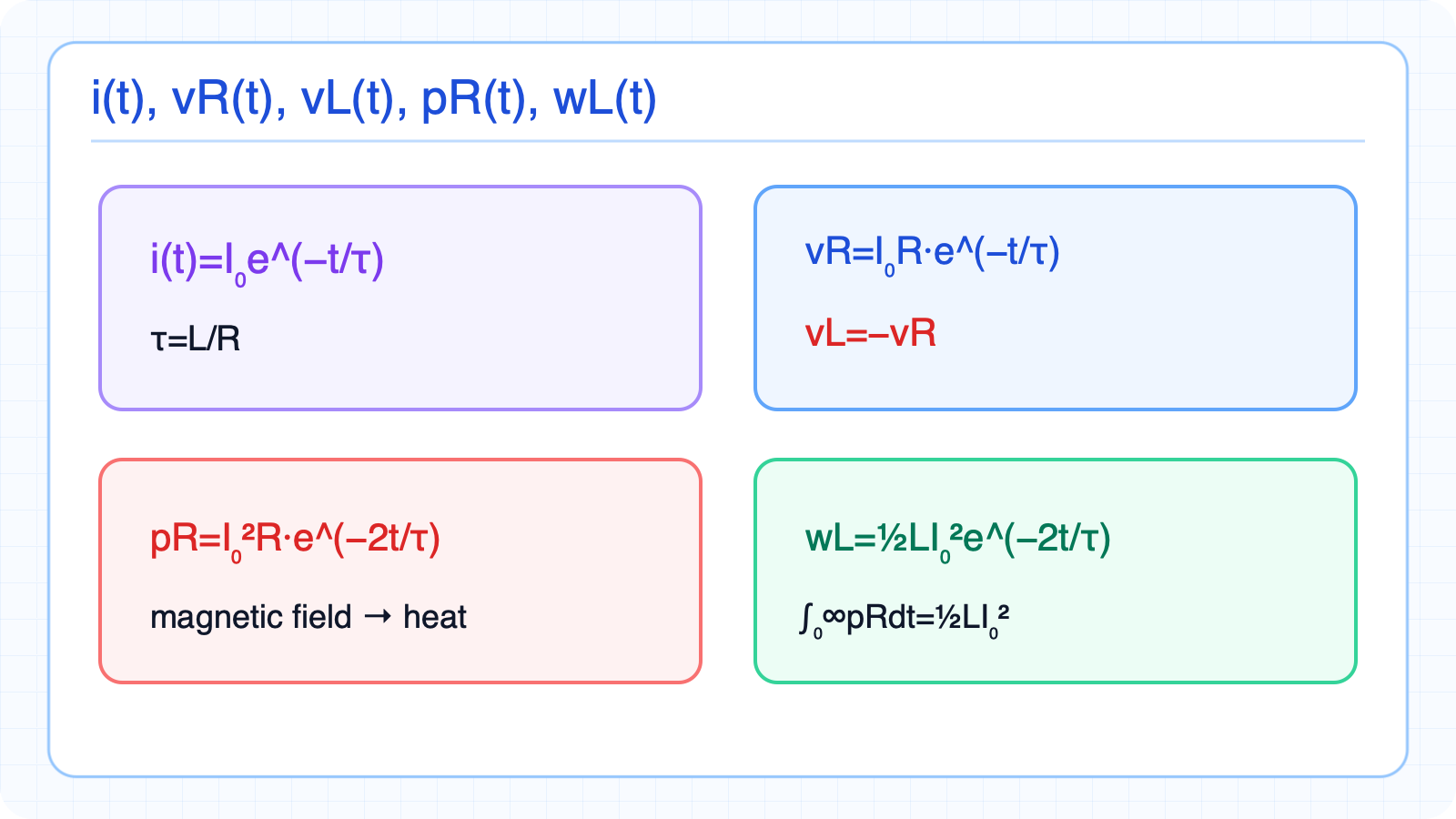
v_L=−v_R; power and energy decay as e^(−2t/τ). Derive all quantities from currentvL+vR=0 at every instantwL(t)=½LI₀²e(−2t/τ)∫₀∞pRdt=½LI₀²All magnetic-field energy becomes heat in RNarration transcript
Here are all the response quantities for the RL natural response. The inductor current decays as i of t equals I-zero times e to the negative t over tau. The voltage across the resistor is V-R equals i times R equals I-zero times R times e to the negative t over tau. We can write this as V-zero times e to the negative t over tau, where V-zero equals I-zero times R is the initial voltage. The voltage across the inductor is V-L equals negative V-zero times e to the negative t over tau. Notice the negative sign — the inductor opposes the decrease in current by creating a reverse voltage. Kirchhoff's voltage law holds: V-L plus V-R equals zero at all times. The power dissipated in the resistor is p equals i-squared times R equals I-zero-squared times R times e to the negative two-t over tau. Power decays twice as fast as current because it depends on i-squared. Finally, the magnetic energy stored in the inductor is w equals one-half L times i-squared equals one-half L times I-zero-squared times e to the negative two-t over tau. Over time, all this magnetic energy is converted to thermal energy — heat dissipated in the resistor.