Communication Basics · Satellite GEO Propagation Delay: 120 ms, 240 ms, and 480 ms
#26 calculate 120-ms one-leg, 240-ms one-way ground-to-ground propagation, and 480-ms symmetric network RTT in an ideal model with each ground–satellite leg set to 36,000 km; distinguish geosynchronous from geostationary, apply ITU-T G.114 one-way guidance accurately, and bound LEO/MEO/GEO comparisons
Calculate 120/240/480-ms propagation values in the ideal 36,000-km GEO problem with correct semantics, nuance the G.114 voice conclusion, and separate orbit-leg estimates from real network latency.
Question
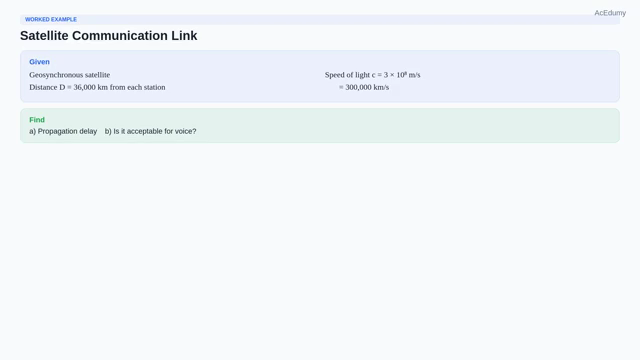
Treat 36,000 km as the problem's per-leg path rather than a generic GEO slant range; calculate 36,000/300,000=0.120 s=120 ms, 240-ms one-way propagation over two legs, and 480-ms network RTT over a symmetric return; correct geosynchronous period to the 23 h 56 min 4 s sidereal day, geostationary orbit to the circular/equatorial/prograde special case, and altitude to about 35,786 km; state G.114 as 0–150 ms acceptable for most applications, 150–400 ms acceptable with impact considered, and above 400 ms an upper bound not to exceed for general network planning; do not automatically reject voice at 240 ms; bound 3/67/120-ms orbit numbers as example radial one-leg propagation values and add slant-path, processing, routing, capacity, coverage, and QoE gates.
Written solution and narration transcript(shows the full solution)
Below are all the lines written in the notebook together with the full narration transcript.
1. Fix the 36,000-km problem model and three delay definitions
Verify the propagation arithmetic without treating 240 ms as total mouth-to-ear latency or automatic voice rejection, and do not make orbit altitude the sole network-latency determinant. Welcome to the first final prep video.Today a classic satellite problem that sounds simple but hides a real design constraint.Here is the setup.The problem assumes each ground-station–satellite path is 36,000 km; this is not a generic GEO slant range or the altitude for every ground station.The speed of light is three times ten to the eight meters per second, or three hundred thousand kilometers per second.We have two questions.Part a: find the propagation delay in this link.Part b: is this delay acceptable for voice communication?The arithmetic exposes a propagation floor; conversational QoE and NGSO-constellation rationale also include processing, routing, coverage, capacity, and cost.Narration transcript
Welcome to the first final prep video. Today a classic satellite problem that sounds simple but hides a real design constraint. Here is the setup. A satellite communication link uses a geosynchronous satellite located thirty six thousand kilometers from the earth stations. The speed of light is three times ten to the eight meters per second, or three hundred thousand kilometers per second. We have two questions. Part a: find the propagation delay in this link. Part b: is this delay acceptable for voice communication? Simple arithmetic, but the answer explains a lot about why your long distance satellite call feels awkward, and why Starlink exists.
2. Separate geosynchronous period from geostationary geometry
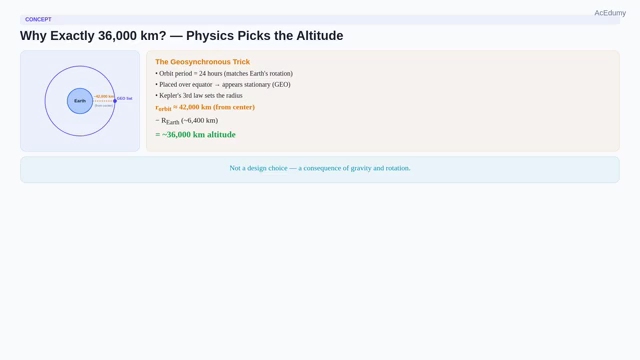
Verify the propagation arithmetic without treating 240 ms as total mouth-to-ear latency or automatic voice rejection, and do not make orbit altitude the sole network-latency determinant. First, why exactly thirty six thousand kilometers?A geosynchronous satellite's mean orbital period is one sidereal day—about 23 h 56 min 4 s—and its orbit may be inclined or elliptical.Geostationary orbit is geosynchronous plus circular, equatorial, prograde, and nearly zero inclination/eccentricity, so the satellite appears fixed at one longitude.Given the sidereal period and circular-equatorial orbit, Kepler dynamics sets orbital radius; choosing the orbit regime remains an architecture decision.From Kepler's third law, the orbit radius works out to about forty two thousand kilometers from the center of the earth.Subtract the earth's radius, about six thousand four hundred kilometers, and the altitude above the surface is close to thirty six thousand kilometers.The roughly 35,786-km altitude follows from the chosen geostationary geometry/period; selecting GEO versus NGSO is a design choice.Operational GEO spacecraft are maintained near the nominal 35,786-km altitude within a stationkeeping box; actual range varies with ground geometry and drift.Narration transcript
First, why exactly thirty six thousand kilometers? A geosynchronous satellite orbits the earth once every twenty four hours, matching the earth's rotation. If we place it over the equator, it appears stationary in the sky — that is called geostationary orbit, or G E O. To orbit in twenty four hours, physics picks the distance for us. From Kepler's third law, the orbit radius works out to about forty two thousand kilometers from the center of the earth. Subtract the earth's radius, about six thousand four hundred kilometers, and the altitude above the surface is close to thirty six thousand kilometers. This is not a design choice — it is a consequence of gravity and rotation. Every G E O satellite, from your T V dish to weather satellites, sits at this altitude.
3. Calculate 120-ms propagation for one ground–satellite leg
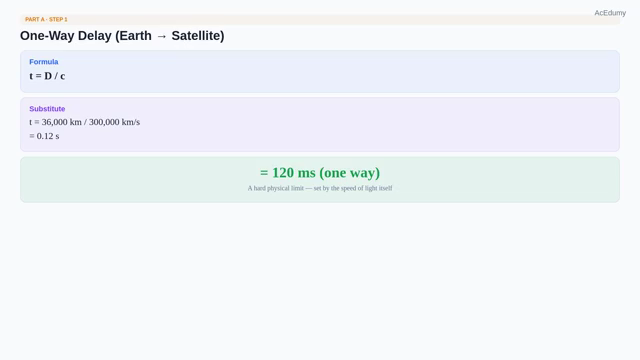
Verify the propagation arithmetic without treating 240 ms as total mouth-to-ear latency or automatic voice rejection, and do not make orbit altitude the sole network-latency determinant. Part a, step one: compute the one way delay from earth to the satellite.The formula is simple: time equals distance over speed.Distance is thirty six thousand kilometers.Speed is three hundred thousand kilometers per second.One way delay equals thirty six thousand divided by three hundred thousand.That is zero point one two seconds — or one hundred twenty milliseconds.This is the time for a radio wave to travel from a ground station up to the satellite.120 ms is an ideal vacuum-propagation estimate from rounded 36,000-km path and c≈300,000 km/s; it is not an exact universal delay.Information cannot exceed c in vacuum, while engineering can shorten path length, hop count, processing, and routing delay.Narration transcript
Part a, step one: compute the one way delay from earth to the satellite. The formula is simple: time equals distance over speed. Distance is thirty six thousand kilometers. Speed is three hundred thousand kilometers per second. One way delay equals thirty six thousand divided by three hundred thousand. That is zero point one two seconds — or one hundred twenty milliseconds. This is the time for a radio wave to travel from a ground station up to the satellite. And it is a hard limit, set by the speed of light. Nothing we build can beat it.
4. Separate 240-ms one-way propagation from 480-ms network RTT
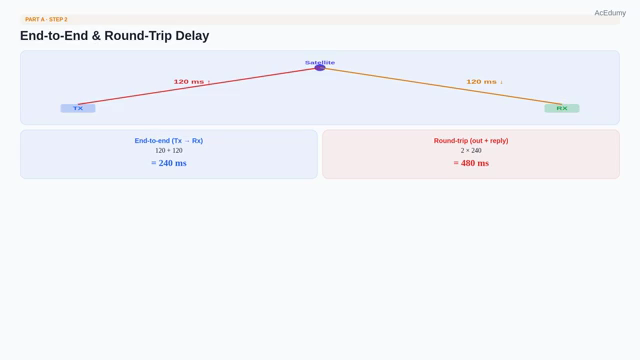
Verify the propagation arithmetic without treating 240 ms as total mouth-to-ear latency or automatic voice rejection, and do not make orbit altitude the sole network-latency determinant. Step two: end to end delay.To get a signal from one earth station to another, the wave goes up to the satellite, then back down.Up plus down equals one hundred twenty plus one hundred twenty equals two hundred forty milliseconds.This is the transmitter to receiver delay.For network RTT, add the return traversal of the same path; conversational response time also includes human reaction and application processing.For the symmetric ideal path, propagation RTT=2×240=480 ms; ‘reply’ here means packet/signal return, not human reply.Almost half a second just for a signal to go up, come down, and return.Narration transcript
Step two: end to end delay. To get a signal from one earth station to another, the wave goes up to the satellite, then back down. Up plus down equals one hundred twenty plus one hundred twenty equals two hundred forty milliseconds. This is the transmitter to receiver delay. But for a two way conversation, we also need the reply. The round trip — out and back to the originating station — is two times two hundred forty, which is four hundred eighty milliseconds. Almost half a second just for a signal to go up, come down, and return.
5. Apply ITU-T G.114 one-way-delay guidance accurately
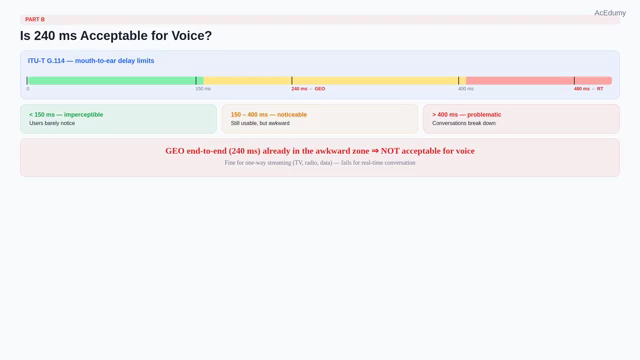
Verify the propagation arithmetic without treating 240 ms as total mouth-to-ear latency or automatic voice rejection, and do not make orbit altitude the sole network-latency determinant. Part b: is this delay acceptable for voice?The answer is not categorical: 240-ms propagation affects conversational voice, but acceptance depends on G.114 conditions, total mouth-to-ear delay, echo control, task, and QoE objective.ITU-T G.114 gives one-way transmission-time guidance: 0–150 ms is acceptable for most user applications, not an imperceptibility guarantee; some highly interactive tasks may degrade below 150 ms.150–400 ms remains acceptable provided the administration recognizes the transmission-time impact on user-application quality.One-way delay above 400 ms should not be exceeded for general network planning, while the Recommendation recognizes exceptional cases.The ideal 240-ms one-way propagation lies in G.114's 150–400-ms impact-aware acceptable band; total mouth-to-ear delay will be higher.Codec, packetization, jitter buffer, transponder, routing, and queueing add delay; whether total latency exceeds 300 ms depends on implementation and measured path.The ideal 480-ms propagation RTT contributes to observed conversational pauses; production routing/processing, codecs, and human turn-taking also matter, and this is not true of every satellite link.Broadcast and buffered streaming may tolerate delay; interactive text/control and live media have different requirements and are not automatically one-directional.For real-time voice, 240-ms propagation is a material impairment but not a categorical deal breaker; evaluate echo control and the QoE objective.Narration transcript
Part b: is this delay acceptable for voice? The short answer is no. The I T U standard G point one one four sets the limits for mouth to ear delay: under one hundred fifty milliseconds, users barely notice. One hundred fifty to four hundred milliseconds, noticeable but still usable. Above four hundred, conversations become awkward. Our G E O one way end to end delay is two hundred forty milliseconds — already well into the awkward zone. Add processing and coding delays, and real systems push past three hundred. The round trip is four hundred eighty — half a second — which is why news reporters on satellite links always seem to stare into space for a moment before answering. For text, video streaming, T V broadcast, this delay is fine — one direction only, no conversation. For real time voice, it is a deal breaker.
6. Bound LEO/MEO/GEO values as radial one-leg examples
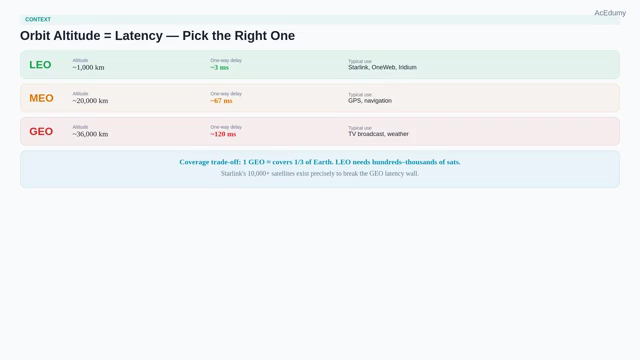
Verify the propagation arithmetic without treating 240 ms as total mouth-to-ear latency or automatic voice rejection, and do not make orbit altitude the sole network-latency determinant. So what do engineers do when they need low latency and satellite coverage?A lower orbit can shorten propagation path; gateway placement, inter-satellite routing, processing, and terrestrial route are also architecture levers.For comparable geometry, lower altitude reduces the propagation floor; end-to-end latency also depends on slant distance, hops, routing, processing, and queueing.LEO commonly denotes Earth orbits below roughly 2,000 km; 500–2,000 km is only a representative operating band in this lesson.A 1,000-km radial ground-to-satellite leg is about 3.34 ms in vacuum; a user-to-user service path has at least two slant legs plus other network segments.That is the regime of Starlink, OneWeb, and the Iridium phone system.MEO boundaries vary by source; GPS spacecraft near 20,200-km altitude provide a representative MEO example.A 20,200-km radial satellite-to-ground leg is about 67.38 ms; this is not end-to-end network delay.GPS satellites sit here.A 35,786-km GEO altitude leg is about 119.37 ms using exact c; actual slant legs are longer for non-nadir ground geometry.GEO offers a wide footprint and three suitably spaced satellites can provide near-global coverage; actual footprint/elevation mask and NGSO constellation size depend on coverage, capacity, availability, inclination, and redundancy.Starlink fleet count is time-dependent; constellation rationale spans coverage, capacity, availability, spectrum, gateways, cost, and latency—not only a GEO latency wall.Narration transcript
So what do engineers do when they need low latency and satellite coverage? Change the orbit. Lower orbit means shorter distance means lower delay. Low earth orbit, or L E O, sits around five hundred to two thousand kilometers up. At one thousand kilometers, one way delay is about three milliseconds. That is the regime of Starlink, OneWeb, and the Iridium phone system. Medium earth orbit, or M E O, runs around ten thousand to twenty thousand kilometers. At twenty thousand kilometers, one way is about sixty seven milliseconds. G P S satellites sit here. G E O, at thirty six thousand, gives us our one hundred twenty milliseconds each way. The trade off is coverage and cost: one G E O sat covers a third of the planet, but L E O needs hundreds or thousands of satellites to give the same coverage. Starlink's ten thousand plus satellites exist precisely to break the G E O latency wall.
7. Add coverage, QoE, and network gates for orbit architecture
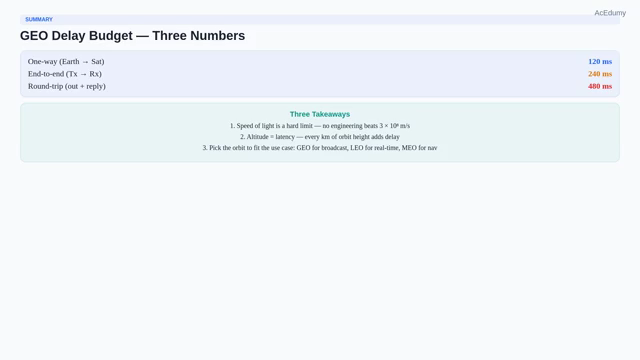
Verify the propagation arithmetic without treating 240 ms as total mouth-to-ear latency or automatic voice rejection, and do not make orbit altitude the sole network-latency determinant. Big picture.For a GEO satellite at thirty six thousand kilometers: one way up, one hundred twenty milliseconds.End to end across two ground stations, two hundred forty milliseconds.Round trip including the reply, four hundred eighty milliseconds.Three takeaways.One: the vacuum information-speed limit is c=299,792,458 m/s; 3×10⁸ m/s is rounded for calculation, while architecture can reduce avoidable path and processing.Two: altitude is a strong component of propagation path, not the entirety of end-to-end latency.Each extra radial kilometre adds about 3.34 µs per leg; the end-to-end multiplier depends on geometry and the number of satellite legs.Three: choose orbit architecture using coverage, latency, capacity, terminals, spectrum, availability, and cost; GEO/LEO/MEO application examples are not exclusive rules.Good luck on your final.Narration transcript
Big picture. For a G E O satellite at thirty six thousand kilometers: one way up, one hundred twenty milliseconds. End to end across two ground stations, two hundred forty milliseconds. Round trip including the reply, four hundred eighty milliseconds. Three takeaways. One: the speed of light is a hard physical limit — no amount of engineering can beat three times ten to the eight meters per second. Two: altitude equals latency. Every kilometer of orbit height adds delay. Three: pick the orbit to fit the use case — G E O for broadcast and coverage, L E O for real time voice and low latency data, M E O for navigation where long orbital life matters. Good luck on your final.
Source video: Communication Basics #26 Worked Example: Satellite GEO Delay (6:18)