Communication Basics · SDH/SONET, the STM-1 Frame, ADM, and ATM Mapping
#18 G.707 STM-1 framing, AU-4 pointer and VC-4 payload area, provisioned tributary access through ADMs, exact SDH/SONET line rates, continuous ATM cell mapping, and SDH/OTN migration validation
Analyze SDH/SONET through timing, pointers, virtual containers, and real ADM boundaries; calculate the continuous ATM stream inside STM-1 without cutting cells at frame edges.
Question
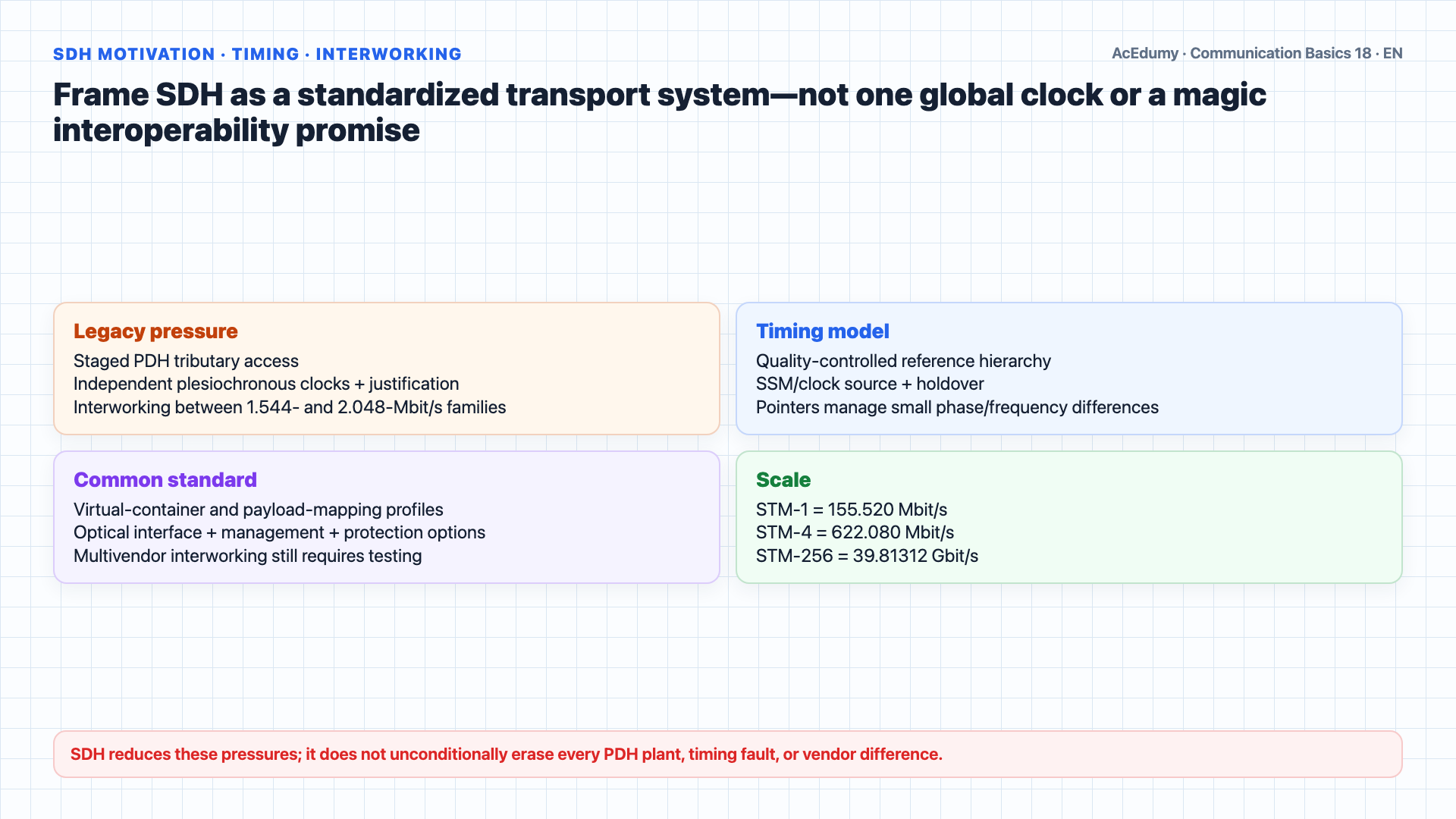
Do not present SDH as one global clock or unconditional multivendor interoperability; derive STM-1 from 9 × 270 octets at 8000 Hz; separate the AU-4 pointer to the VC-4 start from user payload and do not label all 261 columns as user data; bound ADM access to mapped and provisioned virtual containers/tributaries; use exact STM line rates; calculate continuous ATM mapping with cells allowed to cross a VC-4 frame boundary; validate migration through timing, alarm/BER, mapping, protection, and interworking gates.
Written solution and narration transcript(shows the full solution)
Below are all the lines written in the notebook together with the full narration transcript.
1. Frame SDH motivations with standards, interworking, and timing limits
STM-1 transport capacity is not direct user capacity; validate pointers, path overhead, mapping, ATM headers, and operating conditions separately. Welcome back.In the previous lesson we built up PDH and met the multiplexer mountain: extracting one channel required a full demux and remux pyramid.Legacy PDH operation faced four common pressures; their severity depended on topology, equipment, and service.First, drop and insert was expensive because of that mountain.Plesiochronous tributary clocks could be independent while remaining near nominal rate, so the applicable PDH mapping managed small frequency differences with justification.The 2.048- and 1.544-Mbit/s PDH families differed in rates and framing and required interworking; that fact alone does not prove vendor lock-in.G.702's recommended 2.048-based table reaches E4 at 139.264 Mbit/s; other PDH families and regional extensions existed, so this was not a universal highest rate.SDH was designed to reduce these operational pressures through synchronous framing, standard virtual containers, pointers, management, and protection functions.An SDH network uses a timing hierarchy and quality-controlled references; its nodes are not all phase-locked to one global atomic clock.An ADM can add/drop provisioned virtual containers or tributaries without the full legacy PDH demultiplexing chain; the accessible level depends on mapping and device capability.ITU-T standards define common interworking profiles, but actual interoperability still depends on optical interfaces, payload mappings, options, management, and protection profiles.Recommended SDH levels run from STM-1 at 155.520 Mbit/s through STM-256 at 39.81312 Gbit/s; deployed equipment support must be checked.Narration transcript
Welcome back. In the previous lesson we built up P D H and met the multiplexer mountain: extracting one channel required a full demux and remux pyramid. P D H had four real problems. First, drop and insert was expensive because of that mountain. Second, every multiplexer had its own clock, so engineers had to add justification bits to absorb the differences. Third, the European E carrier and North American T carrier hierarchies were incompatible, creating vendor lock in. Fourth, the highest standard rate, E four, capped out at around 140 megabits per second, which was already too slow for fiber backbones. S D H, the Synchronous Digital Hierarchy, solves all four. It uses a globally synchronized clock from atomic references. It introduces the add and drop multiplexer, which extracts one channel in a single step. It is an I T U world standard, so equipment from any vendor interoperates. And it scales cleanly from 155 megabits all the way to tens of gigabits per second.
2. Build the STM-1 frame and AU-4/VC-4 pointer-payload relationship correctly
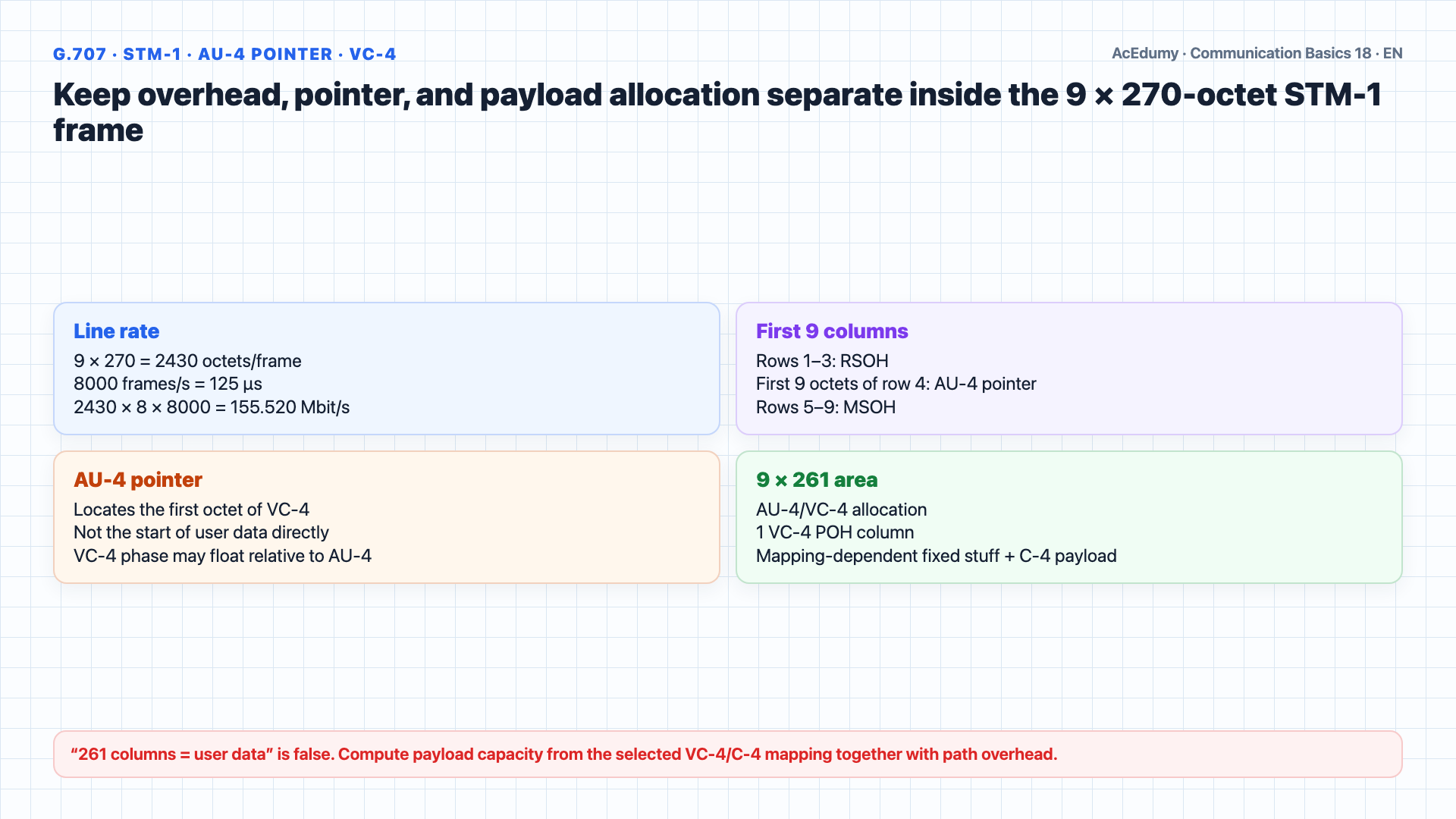
STM-1 transport capacity is not direct user capacity; validate pointers, path overhead, mapping, ATM headers, and operating conditions separately. The fundamental SDH frame is called the STM-1, Synchronous Transport Module level one.It is organized as a matrix: 9 rows by 270 bytes per row, for a total of 2430 bytes per frame.The STM-N frame repeats at 8000 Hz, or every 125 µs; this aligns with historical 8-kHz telephony timing but the transport is not voice-only.STM-1's first 9 columns form the section-overhead region, with the AU-4 pointer bytes interposed in the first 9 octets of row 4; the whole region is not SOH.Inside the SOH, rows 1 to 3 hold the Regenerator Section Overhead, the RSOH, which is used by signal regenerators along the link.The first 9 octets of row 4 carry AU-4 pointer bytes; the pointer locates the first octet of the VC-4—not the start of user data directly.Rows 5 to 9 hold the Multiplex Section Overhead, the MSOH, used by add and drop multiplexers.The 9 × 261 area after the first 9 columns is allocated to the AU-4/VC-4 structure; 'SPE' is SONET terminology and the whole area is not user data.VC-4 contains path overhead, mapping-dependent fixed stuff, and container payload together.VC-4 contains one path-overhead column plus mapping-dependent payload structure; lower-order tributary structure also includes two fixed-stuff columns.Now the bit rate.2430 bytes times 8 bits per byte times 8000 frames per second gives us 155 point 52 megabits per second.This is the famous STM-1 rate.Narration transcript
The fundamental S D H frame is called the S T M one, Synchronous Transport Module level one. It is organized as a matrix: 9 rows by 270 bytes per row, for a total of 2430 bytes per frame. Like P D H, the frame is sent 8000 times per second, matching the voice sampling rate. The first 9 columns of the frame are the Section Overhead, or S O H. Inside the S O H, rows 1 to 3 hold the Regenerator Section Overhead, the R S O H, which is used by signal regenerators along the link. Row 4 holds the A U pointer, which tells the receiver where the user payload starts. Rows 5 to 9 hold the Multiplex Section Overhead, the M S O H, used by add and drop multiplexers. The remaining 261 columns are the Synchronous Payload Envelope, or S P E. This is where user data lives. One column inside the S P E is the Path Overhead, the P O H, which travels with the payload from end to end. Now the bit rate. 2430 bytes times 8 bits per byte times 8000 frames per second gives us 155 point 52 megabits per second. This is the famous S T M one rate.
3. Bound ADM access to provisioned tributaries, mappings, and device capability
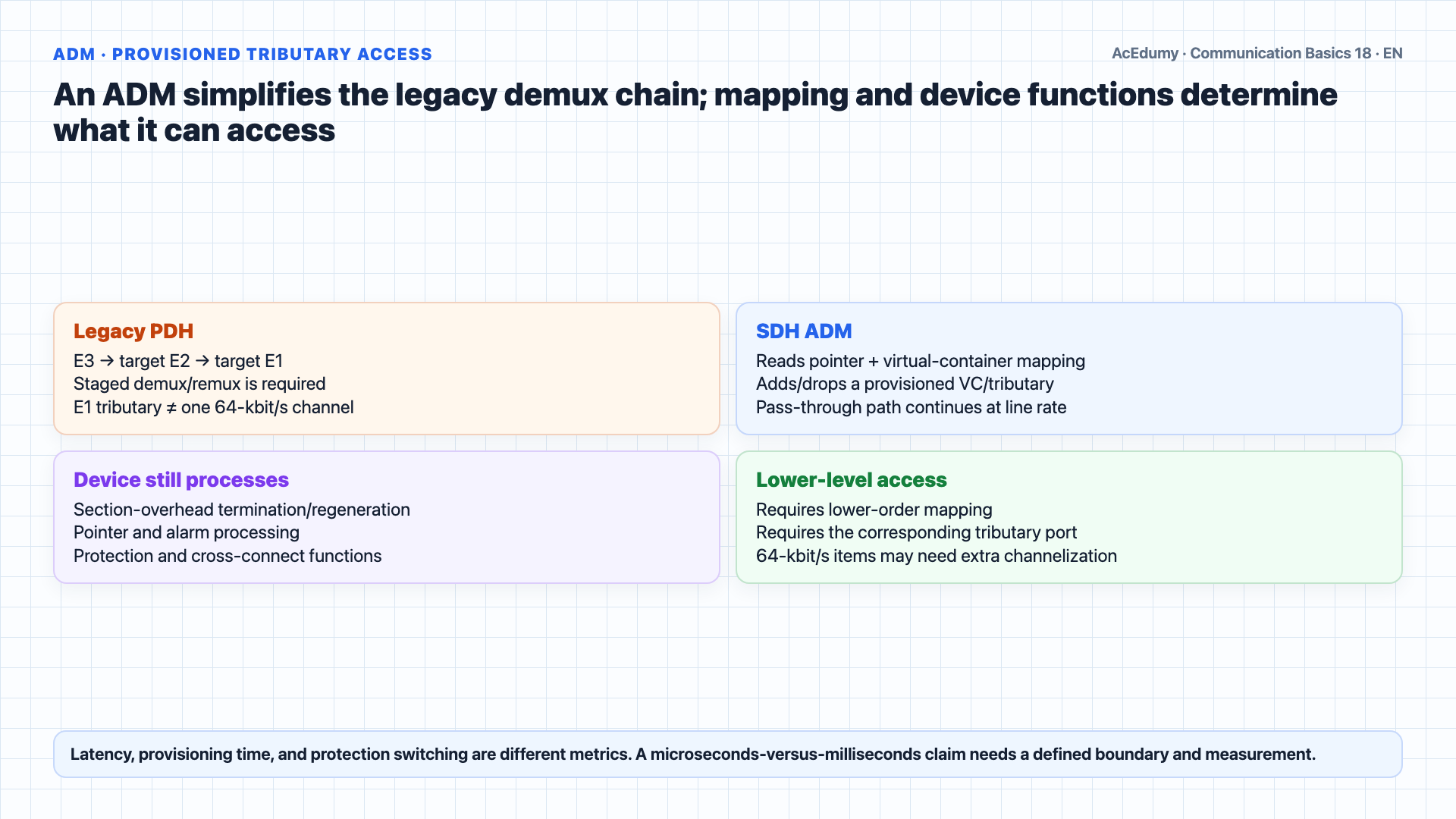
STM-1 transport capacity is not direct user capacity; validate pointers, path overhead, mapping, ATM headers, and operating conditions separately. Now bound what the ADM actually changes operationally.Remember the PDH multiplexer mountain?In a classic discrete PDH chain, access to a target E1 tributary inside E3 required staged demux/remux; an E1 tributary is not the same as one 64-kbit/s channel.An SDH ADM simplifies the legacy PDH chain by adding/dropping appropriately mapped and provisioned virtual containers in one network element.An ADM is a box that sits on the STM-1 stream.Pass-through traffic is forwarded at line rate, while the network element may still terminate/regenerate section overhead and process pointers and alarms.The ADM uses pointer and mapping information to drop a provisioned VC/tributary; a lower-order item such as a 64-kbit/s channel needs the corresponding mapping and port functions.Adding a channel works the same way in reverse.The full legacy PDH demultiplexing pyramid may disappear, but mapping, pointer processing, and add/drop operations remain inside the equipment.Latency, provisioning time, and protection switching are different metrics; a microseconds-versus-milliseconds claim needs measurement and a defined boundary.Simpler tributary access was one important migration driver; carriers did not replace every PDH plant over one universal period or scope.Payback depends on topology, port density, operations, spares, and service-migration cost and must be demonstrated in the business case.Narration transcript
Now the magic. Remember the P D H multiplexer mountain? To extract one channel from an E three, you had to demultiplex everything down to E one, grab the channel, and rebuild the entire pyramid. S D H replaces that whole pyramid with a single device called the Add and Drop Multiplexer, or A D M. An A D M is a box that sits on the S T M one stream. Traffic flows through it from one side to the other, untouched, at full line rate. When you want to extract a channel, the A D M reads the pointers in the overhead, pulls just that channel out the side, and lets the rest of the stream pass through. Adding a channel works the same way in reverse. No demux, no remux, no pyramid. It is a single step that takes microseconds instead of milliseconds. This is the operational reason carriers replaced their entire P D H plant with S D H in the 1990s and 2000s. The capital cost of new equipment was huge, but the savings on every drop and insert operation paid it back many times over.
4. Map exact SDH/SONET line rates and bound today's deployment claims
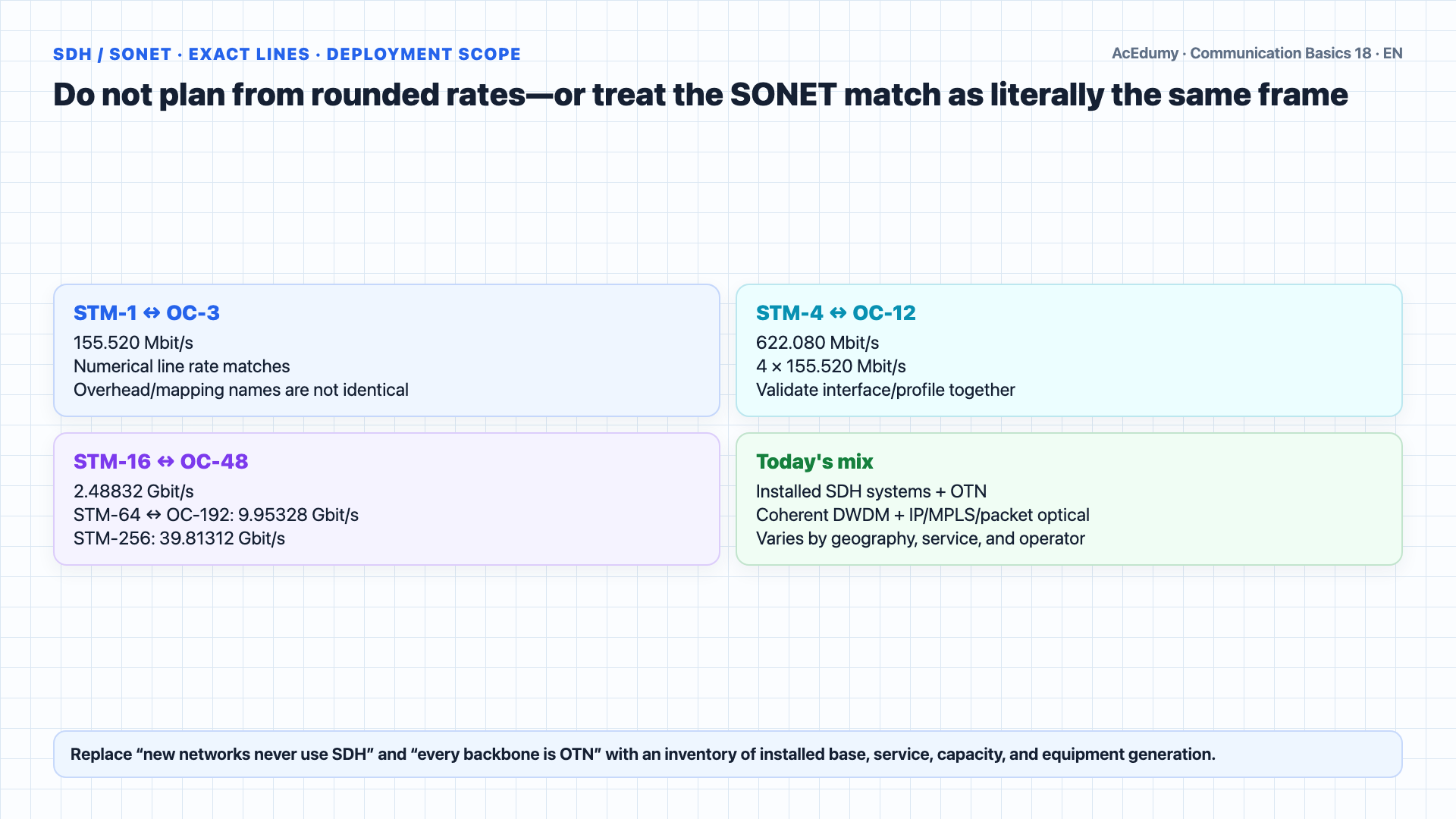
STM-1 transport capacity is not direct user capacity; validate pointers, path overhead, mapping, ATM headers, and operating conditions separately. Once you have STM-1, you can stack it just like PDH stacked E1.STM-4 has an exact nominal line rate of 622.080 Mbit/s and carries four STM-1 equivalents in the synchronous structure.STM-16 has an exact nominal line rate of 2.48832 Gbit/s.Exact nominal rates are STM-64 at 9.95328 and STM-256 at 39.81312 Gbit/s.North America uses an equivalent ladder called SONET.OC-3 matches STM-1, OC-12 matches STM-4, OC-48 matches STM-16, and OC-192 matches STM-64.Those OC levels numerically match the corresponding STM line rates; SONET and SDH framing/overhead names and payload-mapping profiles are not literally identical.One important note for today.SDH and SONET were the dominant carrier transport from the 1990s into the 2010s, but they are no longer the leading edge.Many modern long-haul backbones use OTN, coherent DWDM optics, and IP/MPLS layers; exact layering and rates vary by operator, route, and generation.SDH remains in some legacy access and enterprise circuits; the mix of new SDH, OTN, and packet-optical deployment must be verified by geography, service, and operator.Learn SDH both to operate installed systems and to understand OTN/packet-optical roots; it is unsafe to claim that no new network uses it.Narration transcript
Once you have S T M one, you can stack it just like P D H stacked E one. S T M four is four S T M ones byte interleaved, at 622 megabits per second. S T M sixteen is sixteen S T M ones, at 2 point 5 gigabits per second. S T M sixty four reaches 10 gigabits, and S T M two hundred fifty six almost 40 gigabits per second. North America uses an equivalent ladder called S O N E T. O C three matches S T M one, O C twelve matches S T M four, O C forty eight matches S T M sixteen, and O C one ninety two matches S T M sixty four. Same rates, same frame structure. One important note for today. S D H and S O N E T were the dominant carrier transport from the 1990s into the 2010s, but they are no longer the leading edge. Modern long haul backbones run over the Optical Transport Network, O T N, with 100, 200, and 400 gigabit coherent optics on D W D M, often layered with I P and M P L S directly. S D H still runs in legacy access and corporate circuits worldwide, but new builds are mostly packet optical. You learn S D H to understand the foundation, not because new networks use it.
5. Calculate continuous ATM cell mapping across the VC-4 frame boundary
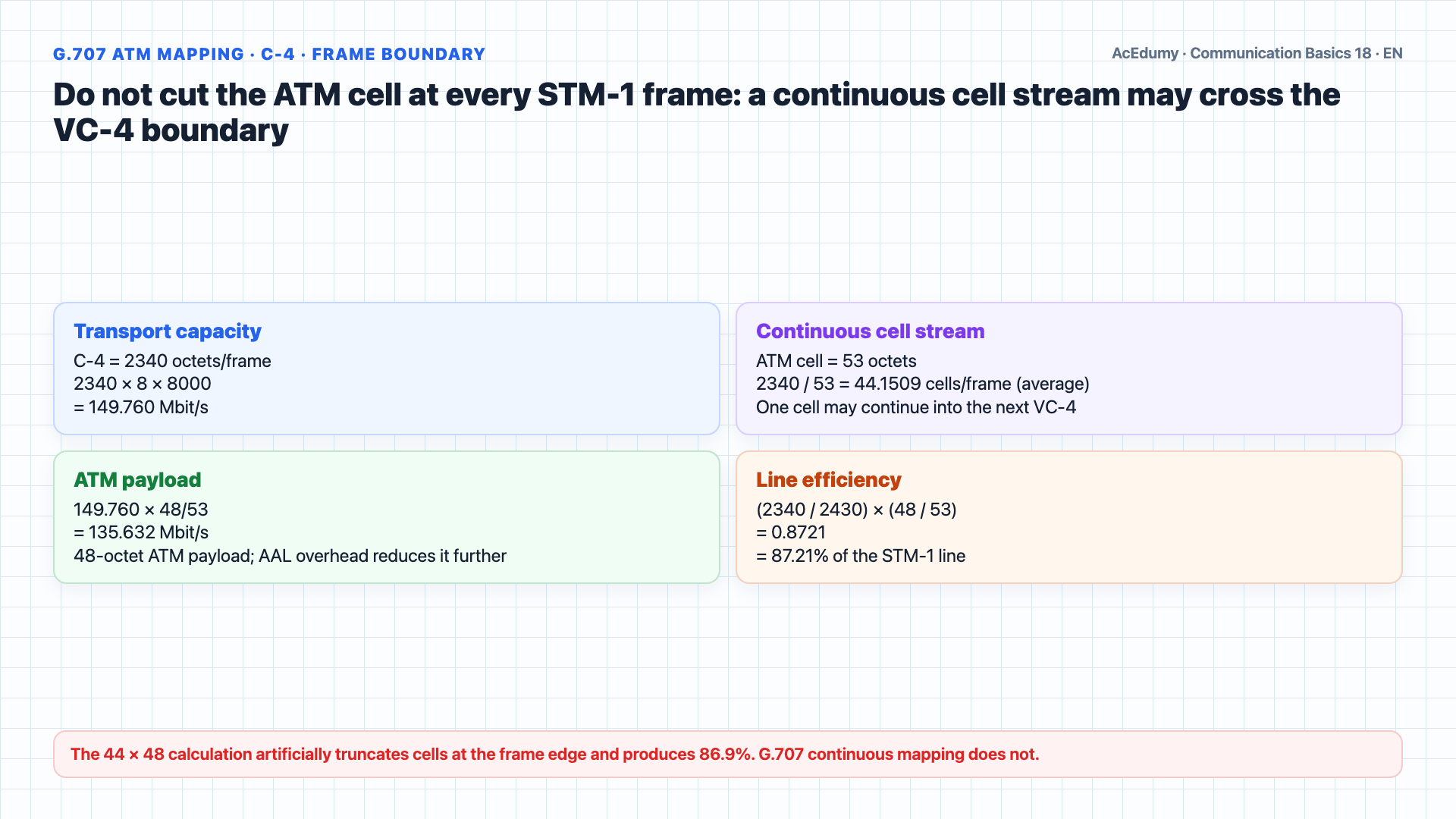
STM-1 transport capacity is not direct user capacity; validate pointers, path overhead, mapping, ATM headers, and operating conditions separately. Let us work through a classic example.How many ATM cells fit inside one STM-1 frame, and what is the efficiency?Each ATM cell is 53 bytes: a 5 byte header plus a 48 byte payload.The SPE inside an STM-1 frame is 2349 bytes.Subtract the 9 byte path overhead, and we have 2340 bytes of usable payload.G.707 maps the ATM cell stream continuously and byte-aligned into C-4; because 2340 is not an integer multiple of 53, a cell may cross the VC-4 frame boundary. The long-run average is 2340/53 = 44.1509 cells per frame.Do not round down to a fixed 44 cells: continuous mapping preserves C-4's 2340-octet-per-frame capacity and the ATM payload ratio is 48/53.ATM cell-payload rate = 2340 × 8 × 8000 × 48/53 = 135.632 Mbit/s; AAL and application overhead reduce useful data further.Relative to the STM-1 line rate, ATM payload efficiency = (2340/2430) × (48/53) = 87.21%.The remainder is consumed by the STM-1/AU-4/VC-4 structure and ATM cell headers; the 48-octet ATM payload is not necessarily all end-user data.Narration transcript
Let us work through a classic example. How many A T M cells fit inside one S T M one frame, and what is the efficiency? Each A T M cell is 53 bytes: a 5 byte header plus a 48 byte payload. The S P E inside an S T M one frame is 2349 bytes. Subtract the 9 byte path overhead, and we have 2340 bytes of usable payload. 2340 divided by 53 equals 44 point 15, so 44 complete A T M cells fit in one frame, with a few leftover bytes. Each frame carries 44 cells times 48 user payload bytes, equal to 2112 user bytes. Multiply by 8 bits and 8000 frames per second, and the user data rate is 135 point 17 megabits per second. Compare to the line rate of 155 point 52 megabits, and the efficiency is 86 point 9 percent. The remaining 13 percent goes to overhead, both S T M and A T M, which is the price you pay for synchronous carrier service.
6. Close SDH-to-OTN/packet-optical migration with measurable validation gates
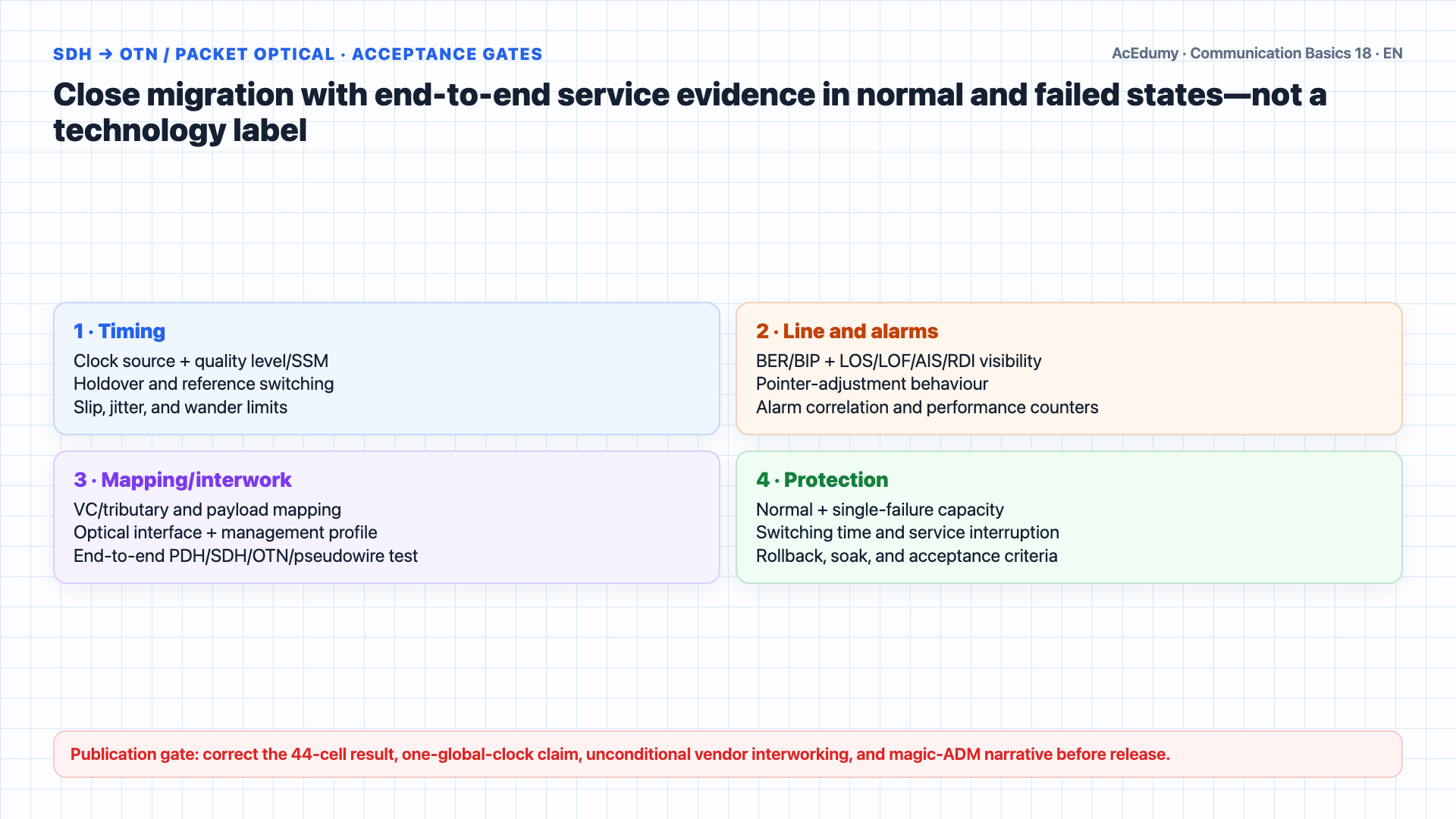
STM-1 transport capacity is not direct user capacity; validate pointers, path overhead, mapping, ATM headers, and operating conditions separately. Let us summarize.SDH is a transport hierarchy that reduces legacy tributary-access, timing, standard-interface/mapping, and scaling pressures; it does not solve every case unconditionally.The STM-1 frame is 9 rows by 270 bytes, sent 8000 times per second, for a line rate of 155 point 52 megabits per second.The 9 × 270 STM-1 structure separates RSOH/MSOH, AU-4 pointer bytes, and the AU-4/VC-4 payload area; read terminology together with the mapping.An ADM simplifies provisioned VC/tributary add/drop; accessible level, mapping, and device capability still set the boundary.Recommended SDH line rates run from STM-1 at 155.520 Mbit/s to STM-256 at 39.81312 Gbit/s.Continuous C-4 ATM mapping can carry a cell across a frame boundary: the average is 44.1509 cells/frame, ATM payload is 135.632 Mbit/s, and line efficiency is 87.21%.SDH was historically important in many carrier backbones; today's SDH, OTN, and packet-optical mix depends on operator, service, geography, and installed base.SDH is mature technology and remains operational knowledge for installed networks, interworking, and newer transport layers.This concludes the Communication Basics topic series.Coming next: dedicated midterm and final exam problem solving videos in light mode, where we work through the classic exam questions step by step.Narration transcript
Let us summarize. S D H replaced P D H to fix four problems: drop and insert cost, clock drift, vendor incompatibility, and a low bit rate ceiling. The S T M one frame is 9 rows by 270 bytes, sent 8000 times per second, for a line rate of 155 point 52 megabits per second. The frame is divided into Section Overhead, A U pointer, and Synchronous Payload Envelope. The Add and Drop Multiplexer is the magic device that extracts a channel in a single step, no pyramid required. The S D H ladder scales from S T M one all the way to S T M two hundred fifty six at almost 40 gigabits per second. And our worked example showed that an S T M one carries 44 A T M cells per frame at 86 point 9 percent efficiency. Remember: S D H built the carrier backbone of the 1990s and 2000s, but today's high speed networks have moved on to O T N and packet optical transport. S D H is foundation knowledge, not state of the art. This concludes the Communication Basics topic series. Coming next: dedicated midterm and final exam problem solving videos in light mode, where we work through the classic exam questions step by step.
Source video: Communication Basics #18 SDH/SONET: STM-1 Frame, ADM & The End of the Mux Mountain (8:30)