Circuit Theory 1 · Second-Order Transients
#52 Transient Analysis #52 — Second-order RLC problem solving
Solves a source-free parallel RLC and a step-driven series RLC through one verifiable second-order workflow.
Question
Solve the given source-free parallel-RLC natural response and the capacitor response of the series RLC driven by an 8 V step from their initial conditions.
Written solution and narration transcript(shows the full solution)
Below are all the lines written in the notebook together with the full narration transcript.
1. Build the second-order problem workflow
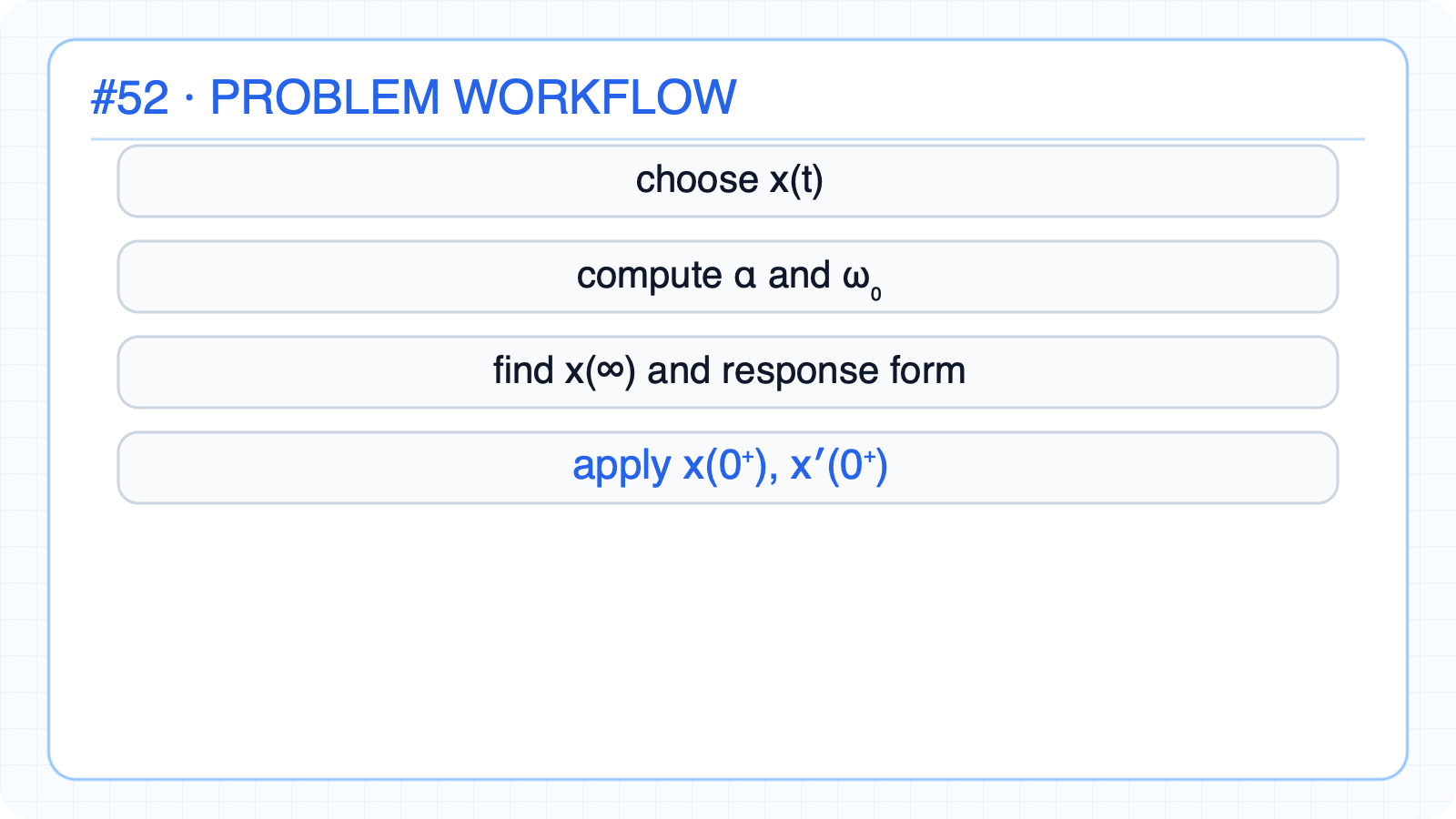
Circuit Theory 1 #52 · Build the second-order problem workflow 1) Choose the response variable and circuit form2) Compute α and ω₀; classify the poles3) If a source is present, find x(∞) first4) Write the correct natural or full-response form5) Use continuity to obtain x(0⁺)6) Use KCL or KVL to obtain x′(0⁺)7) Solve two constants; verify initial and final valuesNarration transcript
For second-order problems, the workflow is short and reliable. First, identify the response variable and the circuit form. Second, compute alpha and omega zero to classify the case. Third, use two initial conditions to determine the constants. If a source is present, first find the final value, then add the transient shape around it.
2. Problem 1: source-free parallel RLC
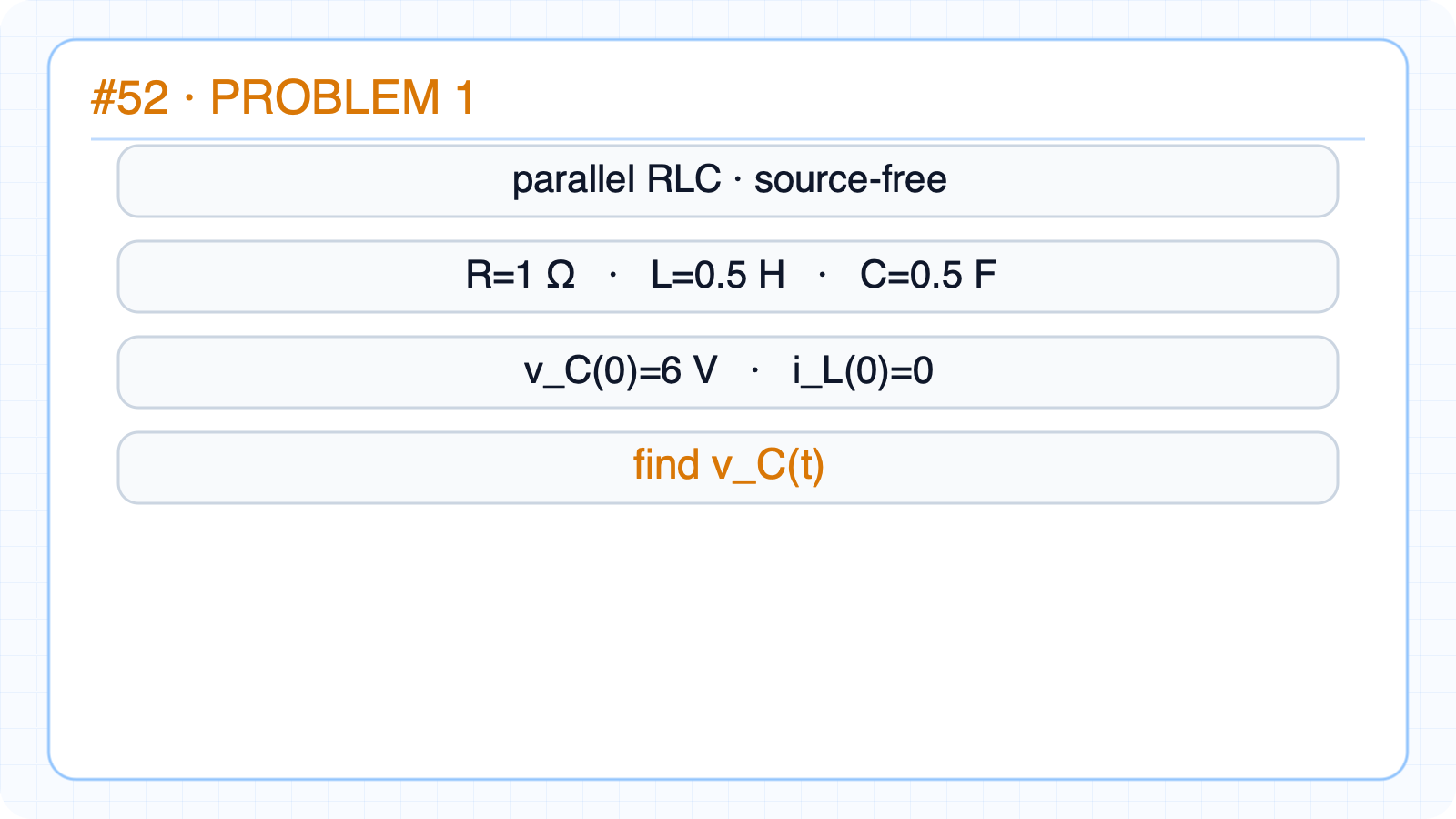
Circuit Theory 1 #52 · Problem 1: source-free parallel RLC Given:Find:No source → the response is entirely transientThe natural variable in the parallel form is vC(t)Narration transcript
Problem one is a source-free parallel R L C circuit. We are given R equals one ohm, L equals zero point five henry, and C equals zero point five farad. The initial capacitor voltage is six volts, and the initial inductor current is zero. We want the capacitor voltage for t greater than or equal to zero.
3. Solve Problem 1
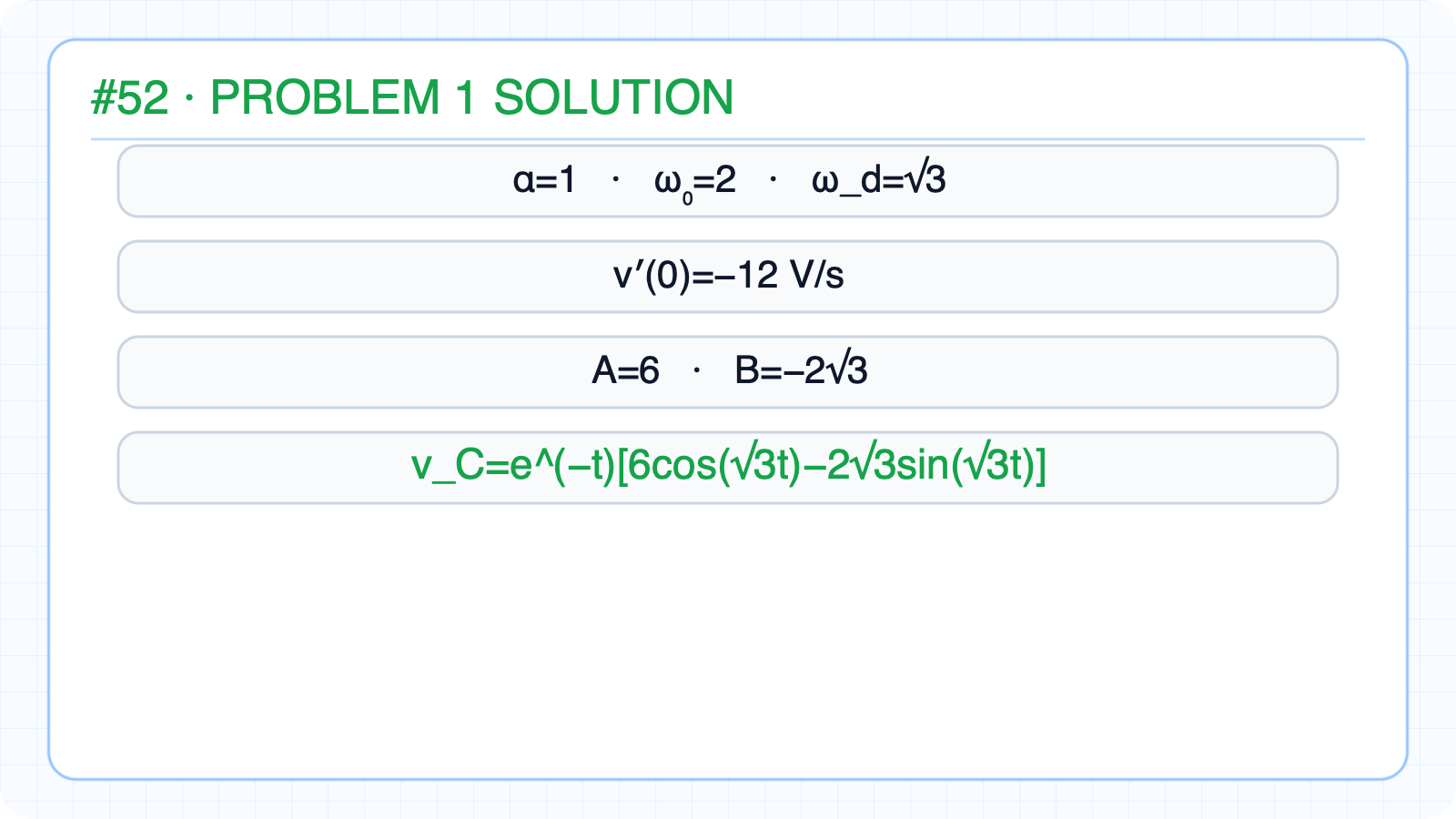
Circuit Theory 1 #52 · Solve Problem 1 α=1/(2RC)=1 s⁻¹ω₀=1/√(LC)=2 rad/sα<ω₀ → underdamped; ωd=√3KCL:Narration transcript
This is a natural response problem, so the final value is zero. For the parallel form, alpha equals one over two R C, which gives one. Omega zero equals one over square root of L C, which gives two. Since alpha is smaller than omega zero, the response is underdamped. So we write v of t as e to the minus t times a cosine sine combination with omega d equal to square root of three. The first condition gives A equals six. For the derivative, use K C L at t equals zero plus: C d v over d t plus v over R plus i sub L equals zero. Substituting the initial values gives d v over d t at zero plus equals minus twelve. That leads to B equals minus two root three. So the capacitor voltage is e to the minus t times open bracket six cosine root three t minus two root three sine root three t close bracket.
4. Problem 2: step-driven series RLC
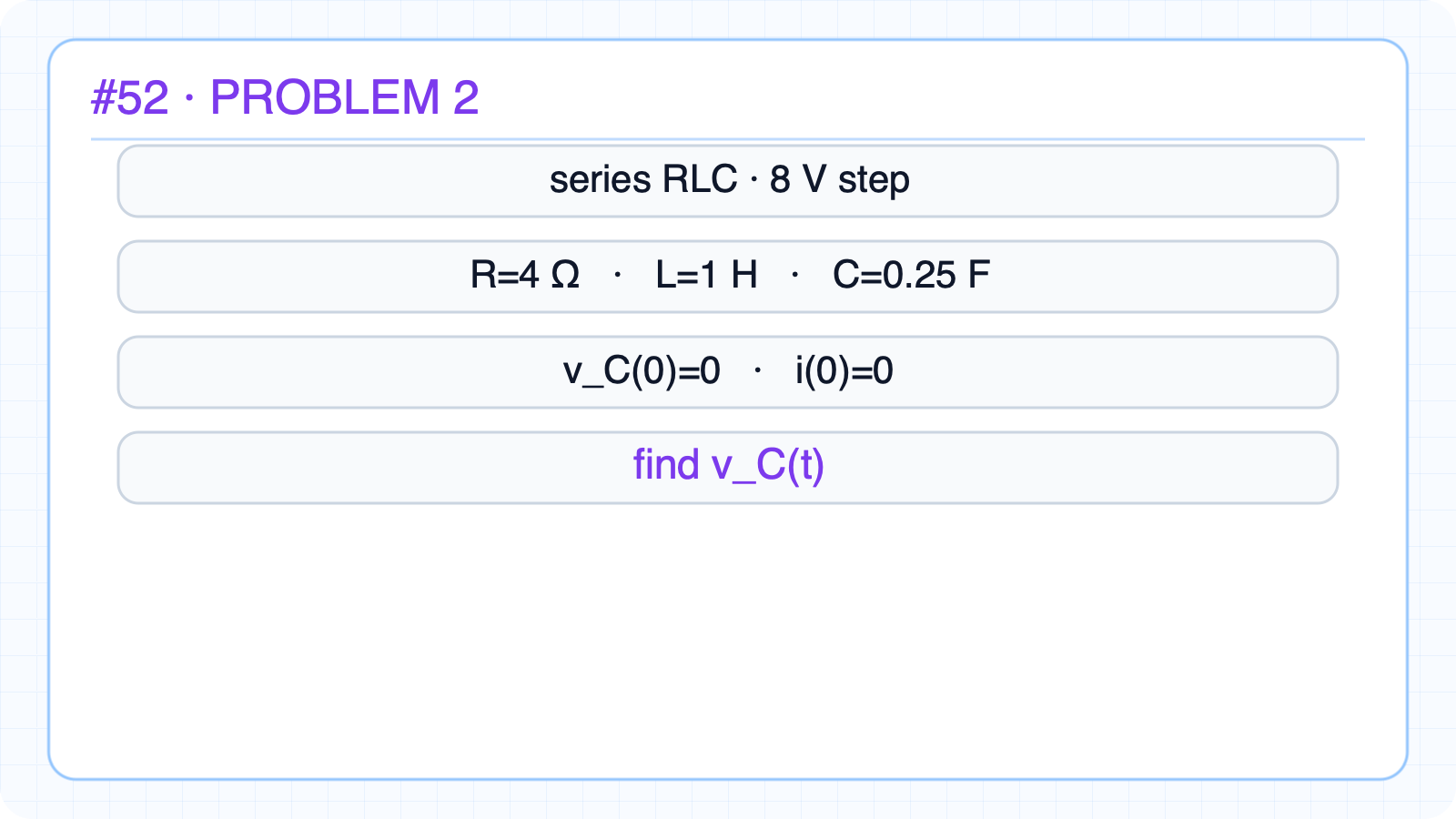
Circuit Theory 1 #52 · Problem 2: step-driven series RLC An 8 V source is connected at t=0vC(0)=0 V and i(0)=0 AFind:A source is present → use the full responseAt DC steady state, C is openNarration transcript
Problem two is a switched series R L C step response. At t equals zero, the switch closes and an eight volt source drives a series circuit with R equals four ohms, L equals one henry, and C equals zero point two five farad. Initially, the capacitor voltage and loop current are both zero. We want v sub C of t.
5. Solve Problem 2
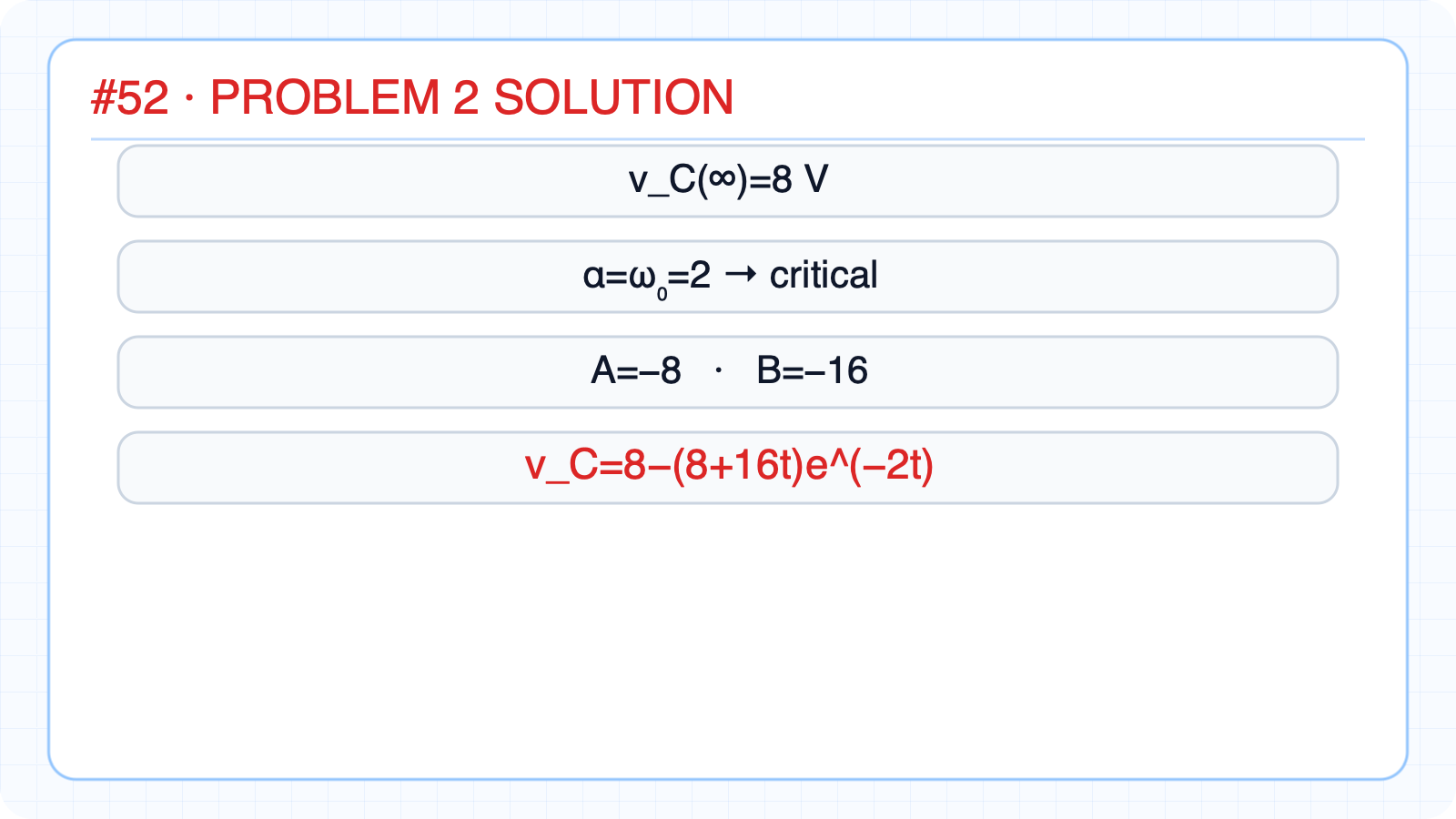
Circuit Theory 1 #52 · Solve Problem 2 ω₀=1/√(LC)=2 rad/sα=ω₀ → critically dampedNarration transcript
Now the source is present, so we first find the final value. At steady state, the capacitor is open, the current becomes zero, and the capacitor voltage reaches the source voltage. So v sub C of infinity is eight volts. For the series circuit, alpha equals R over two L, which gives two. Omega zero also equals two, so the case is critically damped. The correct form is eight plus open bracket A plus B t close bracket e to the minus two t. Using v sub C of zero equals zero gives A equals minus eight. Since i equals C d v over d t and the initial current is zero, the initial slope of the capacitor voltage is also zero. That gives B minus two A equals zero, so B equals minus sixteen. Therefore v sub C of t equals eight minus open bracket eight plus sixteen t close bracket e to the minus two t.
6. Unify both problems with one method
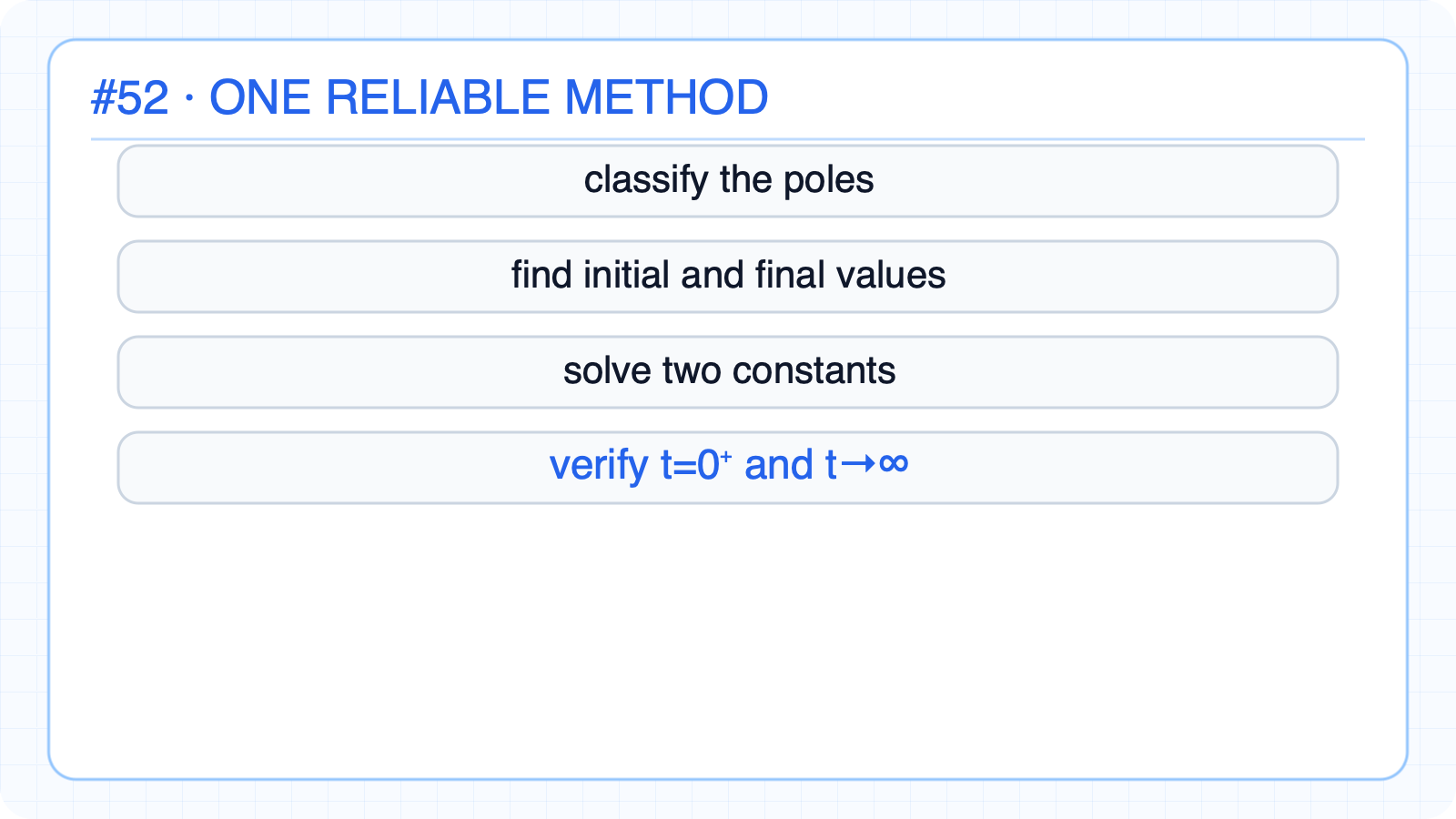
Circuit Theory 1 #52 · Unify both problems with one method Source-free: x(∞)=0 and the response is entirely transientDriven: find x(∞), then attach the transient around itα and ω₀ select the pole typeContinuity preserves the first conditionKCL/KVL supplies the second condition or derivativeTwo conditions → two unknown constantsFinal check: t=0⁺ and t→∞The same workflow works for parallel and series RLCNarration transcript
These two examples show the whole pattern. In a source-free problem, the response is entirely transient. In a driven problem, find the final value first, then attach the correct transient form. In both cases, alpha and omega zero classify the poles, and two initial conditions determine the constants.