Circuit Theory 1 · Resistive Circuits
#02 Series and parallel resistors — voltage and current dividers
Build equivalent-resistance, voltage-divider, and current-divider rules, then simplify a mixed resistor network from the inside out.
Question
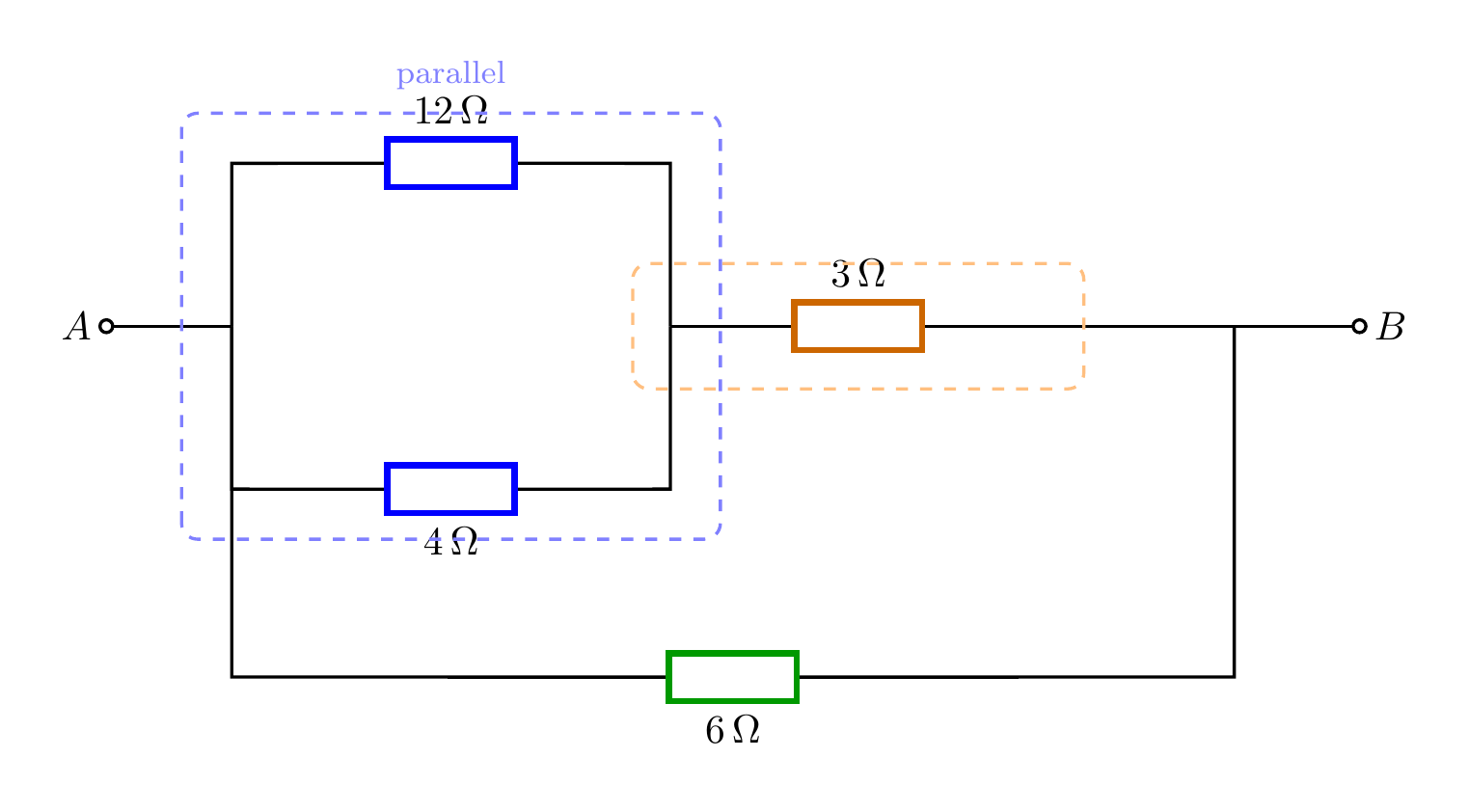
Derive the equivalent resistance formulas for series and parallel connections and explain the voltage- and current-divider rules. Then simplify the mixed network (12 ohms in parallel with 4 ohms, plus 3 ohms) in parallel with 6 ohms to find the A-B equivalent resistance.
Written solution and narration transcript(shows the full solution)
Below are all the lines written in the notebook together with the full narration transcript.
1. Series resistors
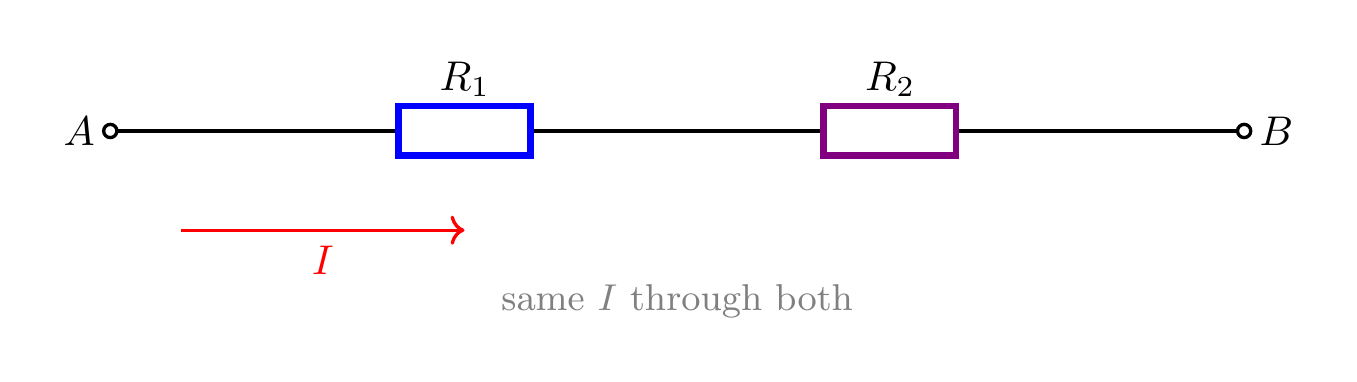
Series resistors carry the same current and their resistances add. Series connection: same currentLarger R → larger voltage shareNarration transcript
When resistors are connected in series, the same current flows through each one. To find the equivalent resistance, we simply add them up: R equivalent equals R1 plus R2 plus R3, and so on. This makes sense because each resistor adds more opposition to the current. Now, since the current is the same through every resistor, the voltage divides proportionally. The voltage across R1 is I times R1. The voltage across R2 is I times R2. And the total voltage equals V1 plus V2, which is I times the quantity R1 plus R2. This leads us to the voltage divider rule: V1 equals V times R1 over R1 plus R2. The larger the resistor, the larger its share of the total voltage.
2. Parallel resistors
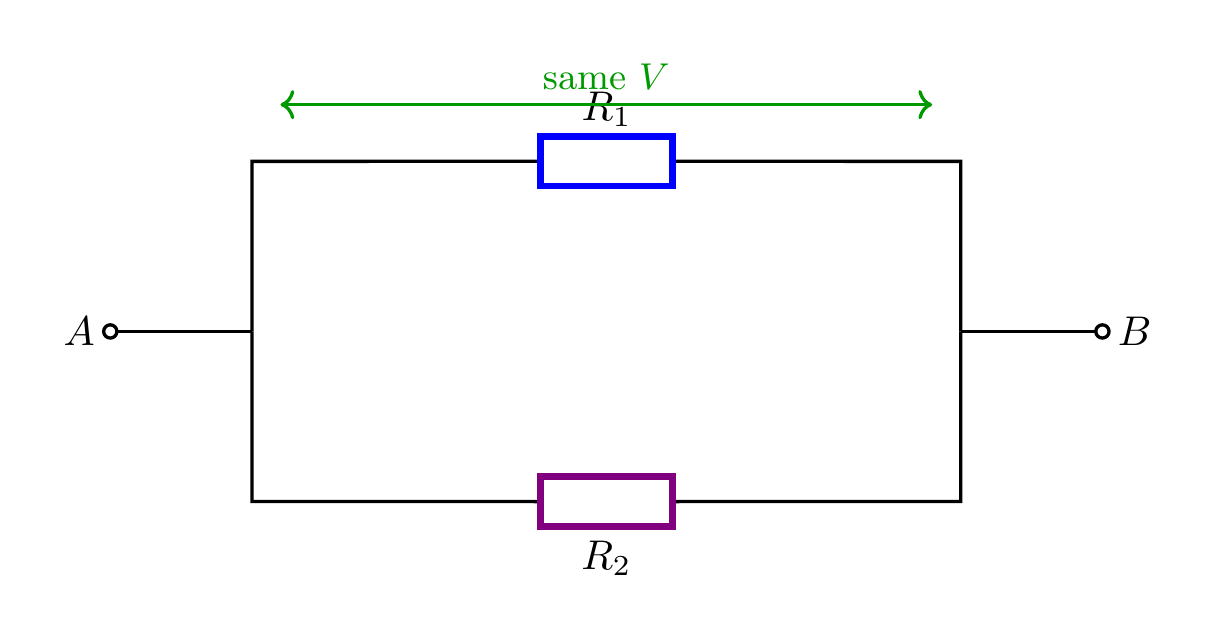
Parallel resistors share the same voltage and their conductances add. Parallel connection: same voltageThe opposite resistance is in the numeratorNarration transcript
When resistors are connected in parallel, they share the same voltage across them. The equivalent resistance follows from: one over R equivalent equals one over R1 plus one over R2. For two resistors, there's a handy shortcut: R equivalent equals R1 times R2, divided by R1 plus R2. This is sometimes called the product over sum rule. Notice that parallel resistance is always less than the smallest individual resistor. Since the voltage is the same, the current divides inversely to the resistance. The current through R1 is V over R1. The current through R2 is V over R2. And the total current is I1 plus I2. This gives us the current divider rule: I1 equals I total times R2 over R1 plus R2. Notice the opposite resistor appears in the numerator, not the same one.
3. Quick checks
Parallel Req < smallest resistorR parallel R = R/2If R2 >> R1, then Req ≈ R1Estimate first, calculate secondNarration transcript
Here are some practical shortcuts for parallel resistors. First, R equivalent is always smaller than the smallest resistor in the group. If you get a larger value, double check your work. Second, if both resistors are equal, say R and R, then R equivalent is simply R over two. Third, if one resistor is much larger than the other, say R2 is a hundred times R1, then R equivalent is approximately equal to R1. The large resistor barely affects the result. Keep these rules in mind; they're great for quick sanity checks before you even pick up a calculator.
4. Mixed example
Simplify the mixed network from the inside out. Find the A-B equivalentInner pair: 12 ohms parallel 4 ohmsThen in series with 3 ohmsWhole branch parallel with 6 ohmsStrategy: inside outNarration transcript
Let's work through a mixed series-parallel example. Here's our circuit between terminals A and B. We have twelve ohms and four ohms in parallel. Their combination is in series with three ohms. And that entire branch is in parallel with six ohms. Our goal is to find the total equivalent resistance. The strategy is to simplify from the inside out, one pair at a time.
5. 12 parallel 4
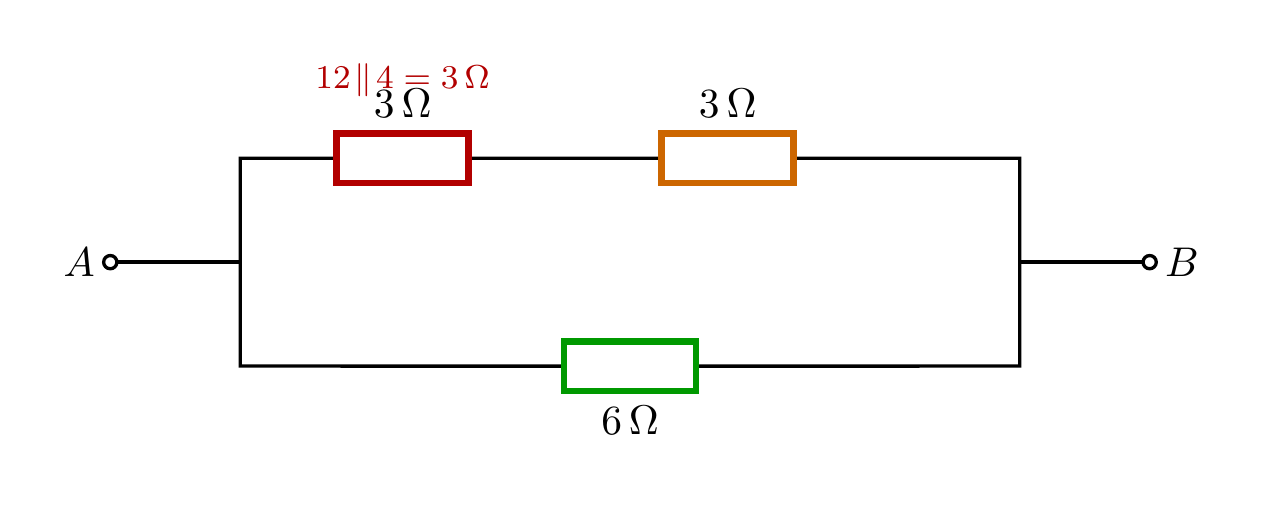
The inner parallel pair becomes 3 ohms. Rp = 3 ohms12 ohms parallel 4 ohms → 3 ohmsNarration transcript
Step one: start with the inner parallel pair. Twelve ohms in parallel with four ohms. Using the product over sum formula: twelve times four over twelve plus four equals forty eight over sixteen, which gives us three ohms. So we replace the twelve and four ohm parallel pair with a single three ohm resistor. The circuit now has three ohms in series with three ohms, and that combination is still in parallel with six ohms.
6. Series branch
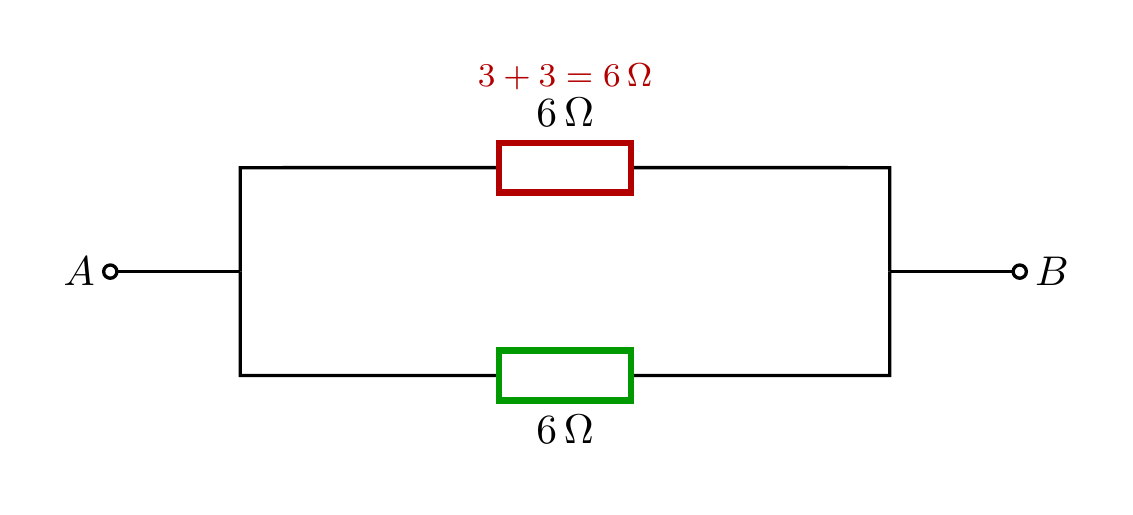
The series branch becomes 6 ohms. Rs = 6 ohmsNow 6 ohms parallel 6 ohmsNarration transcript
Step two: the three ohm resistor from step one is in series with the other three ohms. For series resistors, we simply add: three plus three equals six ohms. Now our circuit has simplified to just two resistors: six ohms in parallel with six ohms.
7. Final parallel
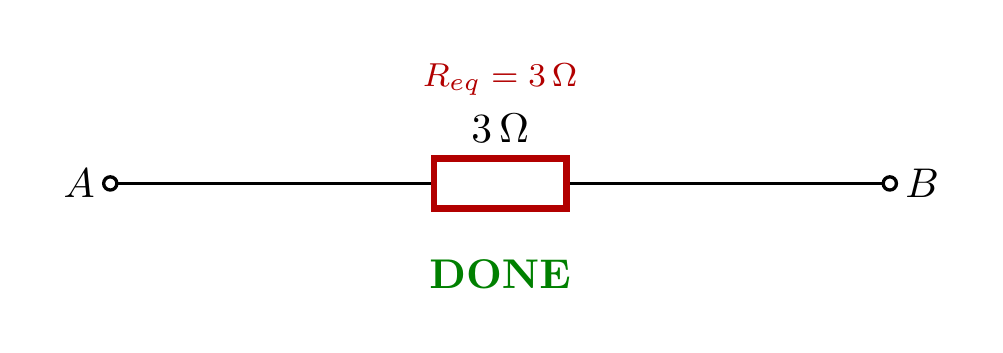
The total equivalent resistance is 3 ohms. Req = 3 ohmsCheck: equal parallel resistors halveNarration transcript
Step three: six ohms in parallel with six ohms. Since both resistors are equal, we can use our shortcut: R parallel R equals R over two. Six over two equals three ohms. Or using the full formula: six times six over six plus six equals thirty six over twelve, which confirms three ohms. So the total equivalent resistance between A and B is three ohms.
8. Method summary
Series: add resistancesParallel: product over sumCurrent is common in series; voltage in parallelReduce mixed circuits from the inside outResult: RAB = 3 ohmsNarration transcript
Let's recap. For series resistors, R equivalent is the sum: R1 plus R2. Current is the same, voltage divides proportionally. For parallel resistors, use product over sum: R1 R2 over R1 plus R2. Voltage is the same, current divides inversely. Remember: parallel R equivalent is always less than the smallest resistor. Equal resistors in parallel give half. And for mixed circuits, simplify from the inside out. In the next video, we'll use these tools to study power and energy in circuits.
Source video: Circuit Theory #02 — Series & Parallel Resistors, Voltage & Current Dividers (5:17)