Signals and Systems · Fourier-series properties
#26 Signals & Systems #26 | FS Properties Part 2 - Convolution, Parseval's & Summary
Corrected solution notes. The audio is the original recording and may contain errors or incomplete phrases. Where they differ, use the corrected written solution.
Question
Corrected solution notes. The audio is the original recording and may contain errors or incomplete phrases. Where they differ, use the corrected written solution. Signals & Systems #26 | FS Properties Part 2 - Convolution, Parseval's & Summary
Written solution and narration transcript(shows the full solution)
Below are all the lines written in the notebook together with the full narration transcript.
1. Fourier-series properties
Corrected solution notes. The audio is the original recording and may contain errors or incomplete phrases. Where they differ, use the corrected written solution.Use a common period T and the analysis factor 1/T.Apply the following identities under convergence or distributional assumptions that make the products and derivatives meaningful.Narration transcript
In the previous lesson, we covered the first five properties of Fourier series coefficients: linearity, time shifting, frequency shifting, conjugation, and time reversal. We also discussed conjugate symmetry for real signals. In this lesson, we complete the property set with properties six through eleven: time scaling, periodic convolution, multiplication, differentiation, integration, and Parseval's theorem. We will also prove the periodic convolution property and Parseval's theorem using orthogonality.
2. Scaling, convolution and product
For a>0, x(at) has period T/a and frequency spacing aω0 with the same indexed coefficients. Compression requires a>1; 0<a<1 expands time.Unnormalized periodic convolution over one period gives Z[k]=T X[k]Y[k].Multiplication in time gives the discrete convolution of the coefficient sequences when the relevant sums/products are defined.Narration transcript
Property 6 is time scaling. If we compress the signal by replacing t with a t, where a is greater than zero, the Fourier series coefficients remain the same, X of k. However, the fundamental period changes from T to T over a, and the fundamental frequency changes from omega zero to a times omega zero. So the coefficients stay the same, but the harmonics are spaced further apart. Property 7 is periodic convolution. The periodic convolution of x of t and y of t, defined as the integral over one period of x of beta times y of t minus beta d beta, has Fourier series coefficients T times X of k times Y of k. Notice the factor of T. Periodic convolution in time corresponds to multiplication of coefficients, scaled by the period. Property 8 is multiplication. If we multiply x of t and y of t in time, the Fourier series coefficients are the discrete convolution of X of k and Y of k, written as the sum from l equals negative infinity to infinity of X of l times Y of k minus l. This is the dual of Property 7: multiplication in time corresponds to convolution in frequency.
3. Periodic convolution proof
Substitute both exponential series into the one-period convolution integral.Orthogonality makes the integral of exp(j(k−m)ω0t) equal T for k=m and zero otherwise.Only matched harmonics remain, yielding the factor T in Z[k]. Interchanging limits is justified under sufficient regularity, or first proved for finite sums and extended appropriately.Narration transcript
Let us prove Property 7. Define z of t as the periodic convolution of x of t and y of t. That is, z of t equals the integral over one period of x of beta times y of t minus beta d beta. Both x and y are periodic with period T. We substitute the Fourier series expansions. x of beta equals the sum over k of X of k times e to the j k two pi over T beta. And y of t minus beta equals the sum over m of Y of m times e to the j m two pi over T times the quantity t minus beta. Substituting into the integral, z of t equals the double sum over k and m of X of k times Y of m, times the integral over one period of e to the j times k minus m times two pi over T times beta d beta, times e to the j m two pi over T times t. Now we use the orthogonality result: the integral of e to the j times k minus m times two pi over T times beta, over one period, equals T when k equals m, and zero otherwise. This eliminates the inner sum. Only the terms where m equals k survive. So z of t equals the sum over k of X of k times Y of k times T times e to the j k two pi over T times t. Comparing with the synthesis equation, we identify Z of k equals T times X of k times Y of k. This completes the proof.
4. Correct integration statement
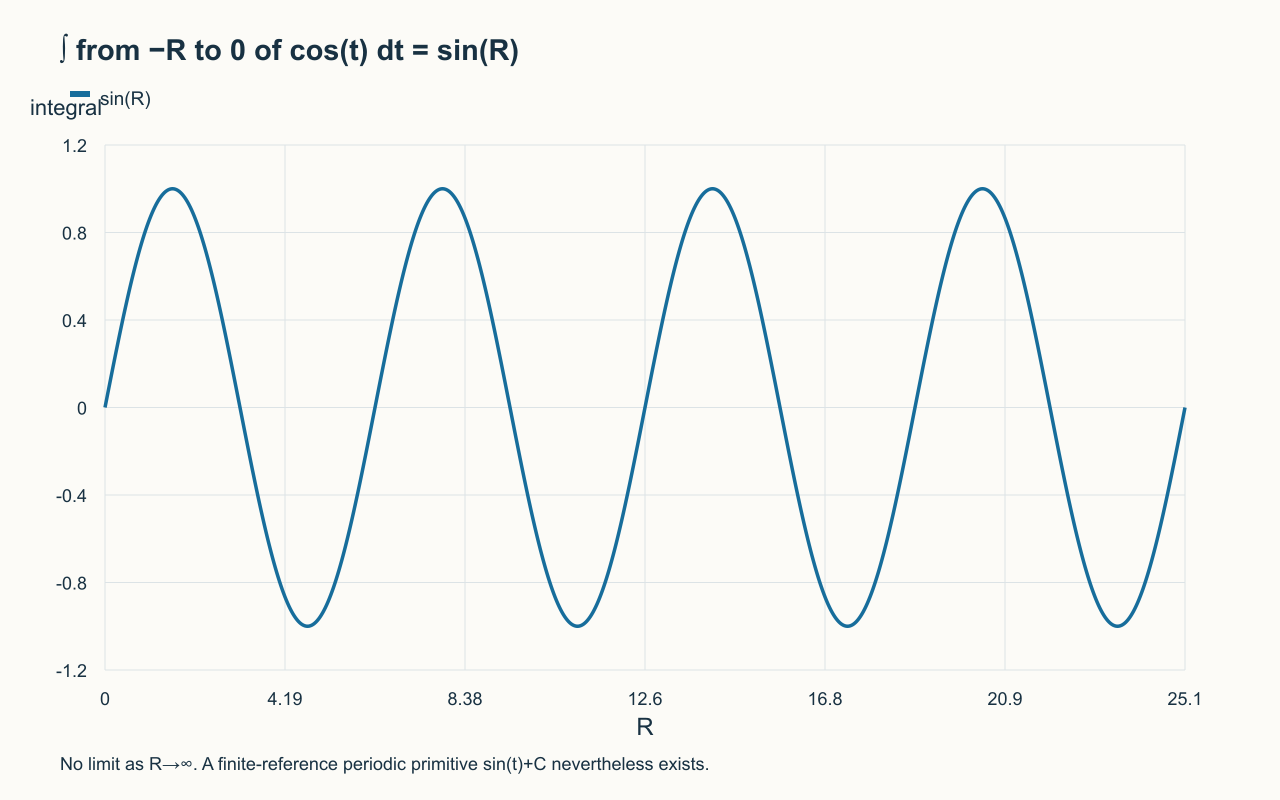
The nth derivative has coefficients (jkω0)n X[k].A zero-mean integrable periodic input has a periodic primitive defined from a finite reference time, plus an arbitrary constant. Nonzero coefficients of that primitive are X[k]/(jkω0); its DC is separately chosen.Zero mean alone does not make the ordinary integral from negative infinity converge: integrating cos(t) from −R to zero gives sin(R), which has no limit as R grows.Narration transcript
Property 9 is differentiation. The n-th derivative of x of t has Fourier series coefficients equal to j k omega zero raised to the n-th power, times X of k, where omega zero equals two pi over T. Each differentiation multiplies the k-th coefficient by j k omega zero. This amplifies high-frequency components and suppresses the DC term, since the coefficient is zero when k equals zero. Property 10 is integration. The integral of x of t from negative infinity to t has Fourier series coefficients X of k divided by j k omega zero, valid for k not equal to zero. For this to be finite valued and periodic, we need the DC component X of zero to equal zero. If X of zero is nonzero, the integral grows without bound and is not periodic. Notice that differentiation and integration are inverse operations in the frequency domain: one multiplies by j k omega zero, the other divides by it.
5. Parseval
For a square-integrable periodic signal, mean-square value equals the sum of squared coefficient magnitudes.Equivalently, the integral of abs(x(t))² over one period equals T times that sum.Orthogonality eliminates unequal harmonics; extension from finite sums uses the mean-square convergence theorem.Narration transcript
Property 11 is Parseval's theorem. It states that the integral of the squared magnitude of x of t over one period equals T times the sum of the squared magnitudes of all coefficients. That is, the integral over T of the absolute value of x of t squared d t equals T times the sum from k equals negative infinity to infinity of the absolute value of X of k squared. This relates total signal energy per period to the energy distribution across harmonics. Let us prove it. We write the absolute value of x of t squared as x of t times x star of t. The Fourier expansion of x of t is the sum over k of X of k times e to the j k two pi over T times t. For the conjugate, we use the fact that e to the j theta conjugate equals e to the negative j theta. So x star of t equals the sum over m of X star of m times e to the negative j m two pi over T times t. Integrating the product over one period, we get the double sum over k and m of X of k times X star of m, times the integral of e to the j times k minus m times two pi over T times t d t. By orthogonality, the integral equals T when k equals m, and zero otherwise. This leaves the sum over k of X of k times X star of k times T, which equals T times the sum of the absolute value of X of k squared. This proves Parseval's theorem.
6. Review
Corrected mathematical reference; use with the written derivation. Keep the period factor in convolution and the stated scaling range.Differentiation loses DC; periodic primitive recovery needs a finite reference and a separately selected constant.Do not replace an undefined improper integral by a valid periodic primitive without stating the change.Narration transcript
Let us summarize all the properties covered in this lesson. Time scaling preserves coefficients but changes the period. Periodic convolution in time gives coefficient multiplication scaled by T. Multiplication in time gives discrete convolution of coefficients. Differentiation multiplies coefficients by j k omega zero to the n-th power. Integration divides coefficients by j k omega zero, requiring zero DC. And Parseval's theorem connects time-domain energy to spectral energy. Together with the five properties from the previous lesson, these eleven properties form a complete toolkit for analyzing Fourier series without computing integrals directly. In the next lesson, we begin deriving the continuous-time Fourier Transform from the Fourier Series.
Source video: Signals & Systems #26 | FS Properties Part 2 - Convolution, Parseval's & Summary (8:11)