Signals and Systems · Inverse transform and derivative method
#30 Signals & Systems #30 | IFT Verification & Ramp FS via Derivative Trick
Corrected solution notes. The audio is the original recording and may contain errors or incomplete phrases. Where they differ, use the corrected written solution.
Question
Corrected solution notes. The audio is the original recording and may contain errors or incomplete phrases. Where they differ, use the corrected written solution. Signals & Systems #30 | IFT Verification & Ramp FS via Derivative Trick
Written solution and narration transcript(shows the full solution)
Below are all the lines written in the notebook together with the full narration transcript.
1. Inverse transform and derivative method
Corrected solution notes. The audio is the original recording and may contain errors or incomplete phrases. Where they differ, use the corrected written solution.Use Fourier analysis exp(−jωt) and inverse factor 1/(2π) with exp(+jωt).Then derive the coefficients of a period-two ramp by differentiating its jumps correctly.Narration transcript
In the previous lecture series, we derived the Fourier Transform from the Fourier Series, computed basic transform pairs, and established the relationship between FS coefficients and the Fourier Transform. Now we begin Lecture Twelve, where we put these tools to work. First, we'll verify that the Inverse Fourier Transform actually recovers the original signal — a fundamental consistency check. Then we'll tackle a powerful worked example: computing Fourier Series coefficients for a ramp signal using the derivative trick, where taking derivatives converts a difficult integral into simple impulse evaluations.
2. Inverse-transform interpretation
Substitution gives a formal kernel integral equal to 2πδ(t−τ). Sifting recovers x under the applicable inversion conditions.Exchanging infinite integrals requires regularization or a distributional argument. At a jump, the usual pointwise inversion gives the midpoint of the one-sided limits, not an arbitrarily assigned endpoint value.Narration transcript
Let's verify that applying the Inverse Fourier Transform to X of omega gives back x of t. Start with the IFT formula: x hat of t equals one over two pi, times the integral of X of omega, e to the j omega t, d omega. Now substitute the definition of X of omega, which is the integral of x of tau, e to the minus j omega tau, d tau. We get a double integral. The key step is swapping the order of integration. The inner integral over omega becomes the integral of e to the j omega times t minus tau, d omega. This equals two pi times delta of t minus tau. This is a fundamental identity: two pi times delta of t minus t one equals the integral from minus infinity to infinity of e to the j omega times t minus t one, d omega. Now applying the sifting property of the delta function to the outer integral, we get x hat of t equals x of t. This confirms that the Inverse Fourier Transform perfectly recovers the original signal.
3. Periodic ramp
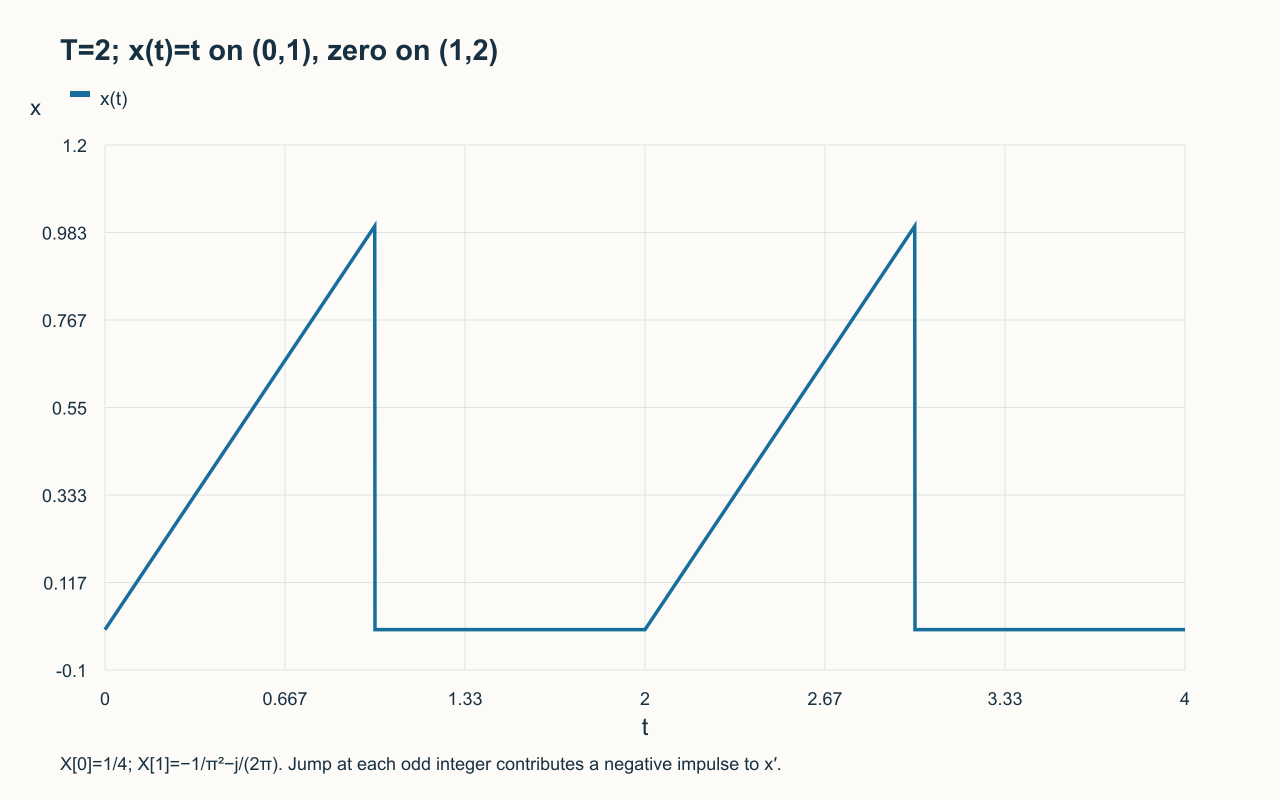
One period is t on (0,1) and zero on (1,2), repeated every two units. Thus ω0=π.A single pulse is r(t)−r(t−1)−u(t−1); isolated endpoint choices do not alter the coefficients.Narration transcript
Let's compute the Fourier Series coefficients for a periodic ramp signal. Consider x tilde of t with period T equals two. One period is defined as: x sub o p of t equals t, for zero less than or equal to t less than or equal to one, and zero for one less than t less than or equal to two. This is a ramp that rises linearly from zero to one, then drops to zero. Computing X of k directly through integration would be tedious. Instead, we use the derivative trick. First, decompose x sub o p of t using elementary signals: x sub o p of t equals r of t, minus r of t minus one, minus u of t minus one. The ramp r of t starts at the origin, r of t minus one cancels the ramp after t equals one, and subtracting u of t minus one removes the constant offset.
4. Correct the derivative sign
The first derivative is u(t)−u(t−1)−δ(t−1); the second is δ(t)−δ(t−1)−δ′(t−1), periodically repeated.Pairing −δ′(t−1) with exp(−jkπt) gives −jkπ exp(−jkπ), because the two derivative signs must both be retained.Therefore Y[k]=(1/2)(1−(1+jkπ)(−1)k), and Y[k]=(jkπ)²X[k].Narration transcript
Now we apply the derivative trick. Take the first derivative: x dot of t equals u of t, minus u of t minus one, minus delta of t minus one. The step functions form a rectangular pulse, and the discontinuity at t equals one produces a negative impulse. Take the second derivative: x double dot of t equals delta of t, minus delta of t minus one, minus delta prime of t minus one. Let y of t equal x double dot of t. Since differentiation in the FS domain corresponds to multiplication by j k omega zero, we have Y of k equals j k omega zero, squared, times X of k, where omega zero equals two pi over T equals pi. Now Y of k is easy to compute using the sifting property. Y of k equals one over T, times the integral of y of t, e to the minus j k omega zero t, d t. The delta of t term gives one half. The delta of t minus one term gives minus one half times e to the minus j k pi, which is minus one half times minus one to the k. For the delta prime term, we use the identity: the integral of f of t times delta prime of t minus t zero, d t, equals minus f prime of t zero. This gives one half times j k pi times e to the minus j k pi. Combining everything: Y of k equals one half times the quantity one minus, minus one to the k, times the quantity one minus j k pi.
5. Corrected coefficients
Corrected mathematical reference; use with the written derivation. For k≠0: X[k]=−(1−(1+jkπ)(−1)k)/(2(kπ)²).The entire quantity kπ is squared. The mean is X[0]=1/4.Direct integration gives X[1]=−1/π²−j/(2π), checking the corrected imaginary sign. Synthesis uses X[k]exp(+jkπt).Narration transcript
Now we solve for X of k. Since Y of k equals j k pi, squared, times X of k, we get X of k equals Y of k divided by j k pi squared. This simplifies to minus one over two k pi squared, times the quantity one minus, one minus j k pi, times minus one to the k. This formula is valid for k not equal to zero. For k equals zero, the denominator vanishes, so we compute X of zero separately. X of zero equals one over T, times the integral of x of t d t over one period, the average value. Geometrically, this is the area of the triangle with base one and height one, divided by the period. The area is one half, and dividing by T equals two gives X of zero equals one quarter. The complete Fourier Series representation is: x of t equals one quarter, plus the sum over k not equal to zero, of minus one over two k pi squared, times one minus, one minus j k pi, times minus one to the k, times e to the j k pi t. The derivative trick transformed what would have been a challenging integration into straightforward impulse evaluations.
Source video: Signals & Systems #30 | IFT Verification & Ramp FS via Derivative Trick (6:31)