Signals and Systems · Combined time and amplitude transformations
#02 Affine time-coordinate mapping and trapezoid, ramp and triangle examples
Map waveform breakpoints through two equivalent affine-time recipes, and keep vertical amplitude scaling separate from horizontal time scaling.
Question
For y(t)=x(a t+b), use real a≠0. An old feature time u maps to t=(u−b)/a; reorder support endpoints when a<0. The signed displacement of x(t+b) is −b; its argument offset is +b. Method one forms y_1(t)=x(t+b), then y(t)=y_1(a t). Method two forms w(t)=x(a t), then y(t)=w(t+b/a), a signed displacement −b/a. Both give the same result but naive shift and scale do not commute. The source's 'always shift first' is limited to method one, since its own alternative explicitly scales first. Its later 'shift by b/a' is ambiguous shorthand for the argument parameter, not a claim of displacement +b/a; the preceding narration and alternative-method final card explicitly say negative b/a. The notebook exposes this distinction in its matching lines rather than silently changing audio. A human pedagogical review of this source wording is still recommended. The unit-height trapezoid has linear vertices(0,0),(1,1),(2,1),(3,0), zero outside. x(t+3) has vertices(−3,0),(−2,1),(−1,1),(0,0); x(2t+3) has(−3/2,0),(−1,1),(−1/2,1),(0,0). The first reference figure intentionally shows original x(t), not the compressed answer. The second source is one on[−1,1], linearly2−t on(1,2], zero outside. The jump's isolated endpoint convention does not change its breakpoint locations; the vertical drawn segment is a jump marker, not multiple values of a function. x(t−2) breakpoints1,3,4 become1/3,1,4/3 in x(3t−2). For amplitude, the source changes notation to a x(b t+c): a is now vertical gain, b≠0 is time scale, c is argument offset. An old vertex(u,v) maps to((u−c)/b,a v). a<0 flips vertically, b<0 reverses time, and a=0 yields zero. b=0 gives a x(c) when defined, not invertible scaling. The final asymmetric triangle is linear from(−1,0) through(0,1) to(2,0), zero outside. Intermediate z(t)=x(t+2) vertices are(−3,0),(−2,1),(0,0); v(t)=z(2t)=x(2t+2) vertices are(−3/2,0),(−1,1),(0,0); y(t)=−2v(t) vertices are(−3/2,0),(−1,−2),(0,0). Amplitude multiplication commutes with the time-coordinate transformation, so the three-step recipe is convenient, not the only valid ordering. Existing authenticated Bunny final only, no generator or embedded credentials executed. Eight MP3s are extracted from the actual final and correlated back to it; this is same-source integrity, not independent original-TTS provenance. Full large-model alignment failed example-three confidence .588 below unchanged .62. Cached small model faithfully recovers all53 source sentences and exact example-three coordinates at .9328–1; it supplies accepted cue timings. The large whole-final output and the first three short coordinate checks omit numeric phrases; the fourth short check confirms final negative coordinates but does not independently confirm every coordinate. These model-specific omissions are recorded, not called proof of wrong source audio. No token substitutions, guessed signs, forced anchors, threshold reductions, new TTS, paid generation or model downloads. All eight actual final frames and the additional76.500s source-trapezoid frame were visually inspected; image pixels remain original. This is an unpublished technical draft, not full human listening, motion, pedagogical or publication approval.
Written solution and narration transcript(shows the full solution)
Below are all the lines written in the notebook together with the full narration transcript.
1. Compose time transformations with a nonzero scale
Original-video reference. The first trapezoid figure shows the untransformed source waveform, not the final answer; its later overlapping labels are avoided. The method overview and summary use the source's explicit alternative method with signed shift −b/a. Amplitude scaling uses the same video's four-stage triangle. Plus b or b/a inside an argument is not the signed physical displacement; nonzero time scale is assumed. Combine shifting, scaling and reversal.Use separate coordinate steps to avoid sign errors.First target:Time shifting and time scaling both affect the horizontal coordinate.For nonzero slope, an old feature at u appears at:Narration transcript
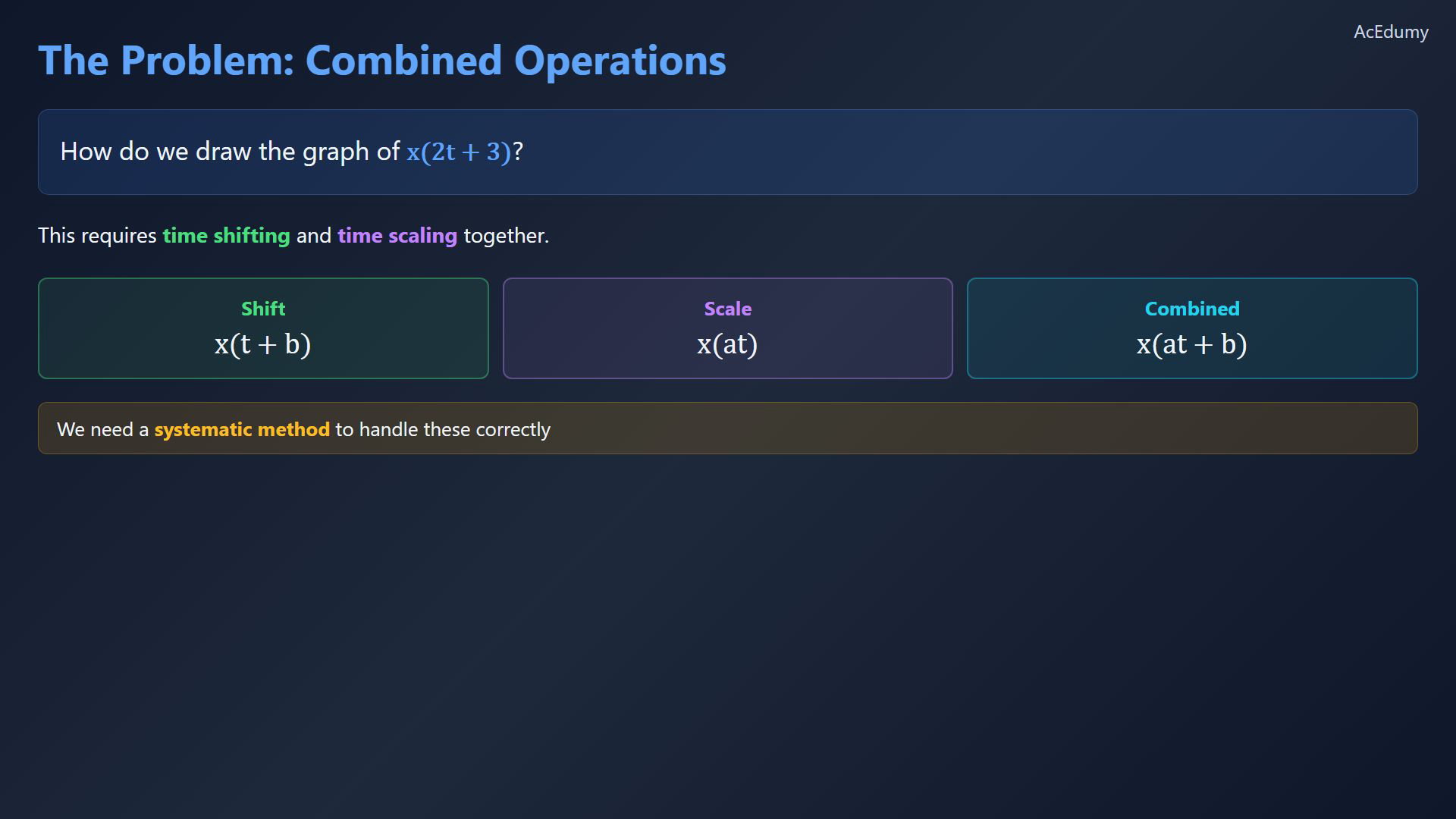
In the previous lesson, we learned three basic signal operations: shifting, scaling, and reversal. But what happens when we need to apply more than one operation at the same time? For example, how do we draw the graph of x of two t plus three? This requires both time shifting and time scaling together. We need a systematic method to handle these combined transformations correctly.
2. Shift by the argument offset, then rescale coordinates

Original-video reference. The first trapezoid figure shows the untransformed source waveform, not the final answer; its later overlapping labels are avoided. The method overview and summary use the source's explicit alternative method with signed shift −b/a. Amplitude scaling uses the same video's four-stage triangle. Plus b or b/a inside an argument is not the signed physical displacement; nonzero time scale is assumed. Method one assumes a nonzero time-scale factor:First form the shifted signal:Clarification: the signed displacement is minus b, not plus b.Then rescale the shifted signal:Divide feature times by a; a negative divisor also reverses their order.Here 'always shift first' refers to method one; the alternative below is equally valid.Write the intermediate function before substituting again.Narration transcript
Here is the two-step method for drawing x of a t plus b. First, perform the shift: draw y one of t equals x of t plus b. This shifts the original signal by b units. Second, perform the scaling: replace t with a t to get y of t equals y one of a t. This compresses or stretches the shifted signal by dividing the time axis by a. The key insight is: always shift first, then scale. If you try to do both at once, you will likely make errors.
3. Map trapezoid vertices under the first example
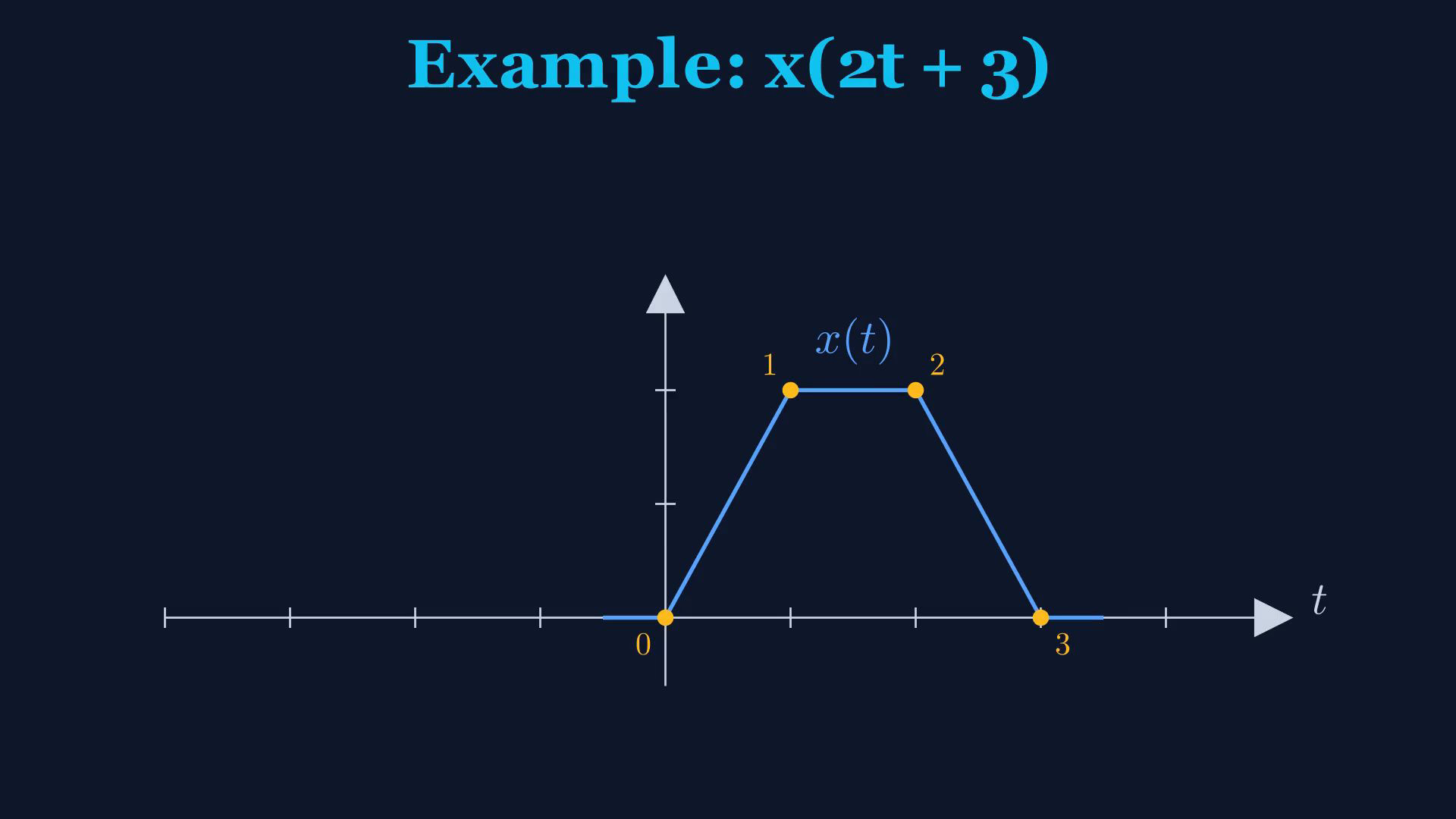
Original-video reference. The first trapezoid figure shows the untransformed source waveform, not the final answer; its later overlapping labels are avoided. The method overview and summary use the source's explicit alternative method with signed shift −b/a. Amplitude scaling uses the same video's four-stage triangle. Plus b or b/a inside an argument is not the signed physical displacement; nonzero time scale is assumed. Example one uses a unit-height trapezoid.Original vertices, joined linearly and zero outside:Transform the trapezoid:First isolate the shift.Advance the original waveform by three:Its intermediate support runs from minus three to zero.Next rescale the intermediate waveform.Divide the shifted feature times by two:Final vertices:Narration transcript
Let us apply the method to our first example. Given x of t, a trapezoidal signal that rises from zero to one between t equals zero and one, stays flat at one until t equals two, then falls back to zero at t equals three. We want to draw y of t equals x of two t plus three. Step one: shift. We draw x of t plus three, which shifts the entire signal three units to the left. The trapezoid now spans from negative three to zero. Step two: scale. We replace t with two t, dividing the time axis by two. The signal is compressed, now spanning from negative one point five to zero.
4. Map the ramp and jump under the second example
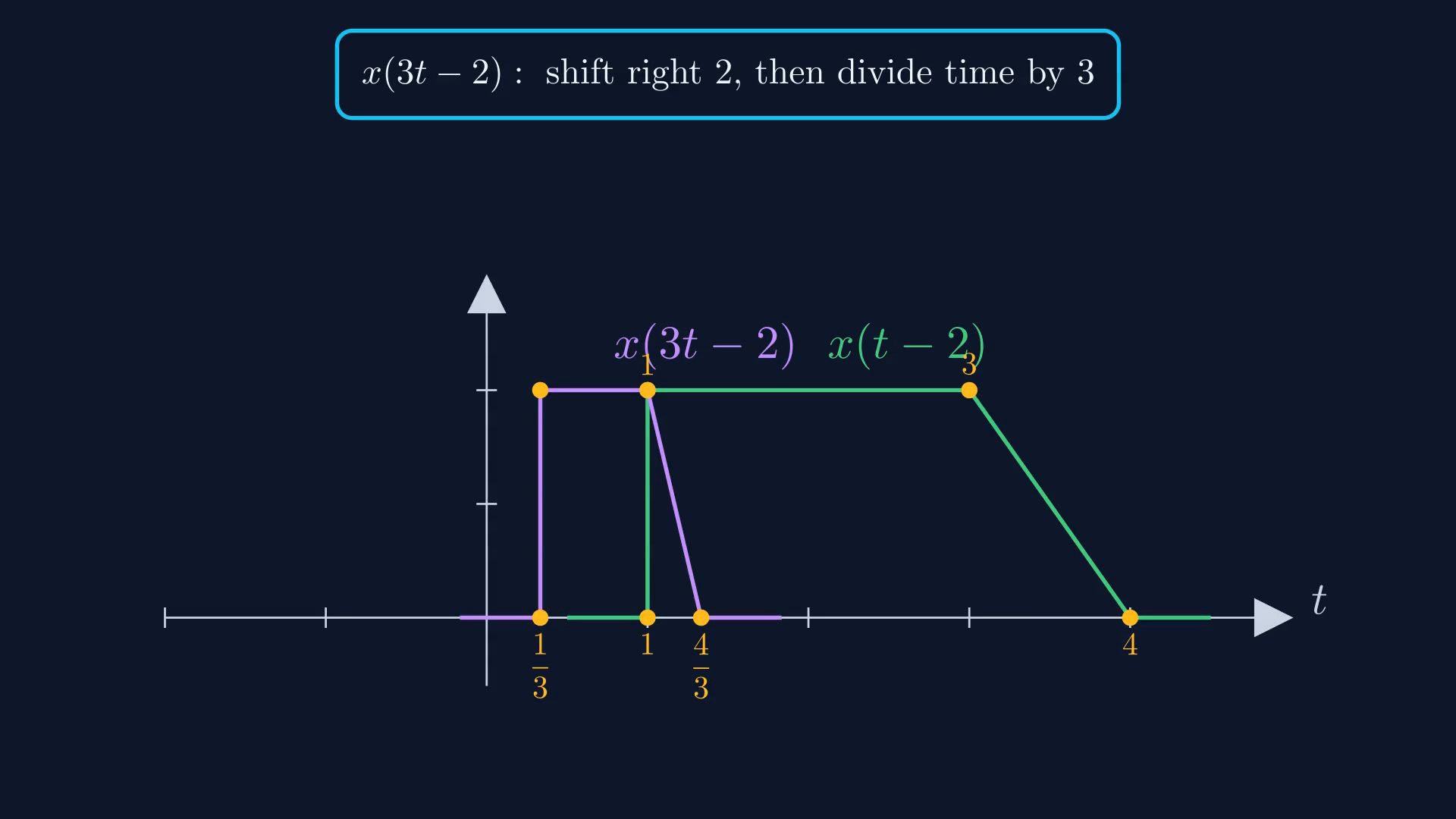
Original-video reference. The first trapezoid figure shows the untransformed source waveform, not the final answer; its later overlapping labels are avoided. The method overview and summary use the source's explicit alternative method with signed shift −b/a. Amplitude scaling uses the same video's four-stage triangle. Plus b or b/a inside an argument is not the signed physical displacement; nonzero time scale is assumed. Example two includes a jump followed by a flat section and a ramp.The source is one from minus one to one, then falls linearly to zero at two; zero outside.Target:Delay the original waveform by two:Intermediate breakpoints are one, three and four.Rescale the delayed waveform:Final breakpoints:Narration transcript
Here is another example with a different signal shape. Given x of t, a rectangular pulse with a ramp: flat at one from t equals negative one to one, then linearly decreasing to zero at t equals two. We want to draw x of three t minus two. Step one: draw x of t minus two, shifting the signal two units to the right. The key points move to one, three, and four. Step two: replace t with three t, dividing the time axis by three. The key points become one-third, one, and four-thirds.
5. Distinguish shift parameter from signed displacement

Original-video reference. The first trapezoid figure shows the untransformed source waveform, not the final answer; its later overlapping labels are avoided. The method overview and summary use the source's explicit alternative method with signed shift −b/a. Amplitude scaling uses the same video's four-stage triangle. Plus b or b/a inside an argument is not the signed physical displacement; nonzero time scale is assumed. Method two changes both the order and the shift parameter.Factor the argument for nonzero a:First scale the original waveform:Then translate the scaled waveform by the signed displacement minus b over a.Clarification; plus b over a is the argument parameter, not the signed displacement:Both methods give the same coordinate mapping:Either method is valid when its own shift amount is used.Narration transcript
There is an alternative approach. We can rewrite x of a t plus b as x of a times the quantity t plus b over a. Using this factored form: first multiply the time axis of x of t by one over a to perform the scaling. Then shift the result by negative b over a. This means: scale first, then shift by b over a. Both methods produce the same result. Choose whichever feels more natural for the given problem.
6. Keep amplitude scale separate from time scale
Original-video reference. The first trapezoid figure shows the untransformed source waveform, not the final answer; its later overlapping labels are avoided. The method overview and summary use the source's explicit alternative method with signed shift −b/a. Amplitude scaling uses the same video's four-stage triangle. Plus b or b/a inside an argument is not the signed physical displacement; nonzero time scale is assumed. Amplitude scaling affects the vertical coordinate.Here the source reuses its letters; a is amplitude and b is time scale:First shift the waveform, with signed displacement minus c:For nonzero b, rescale time:Then scale every amplitude:A negative amplitude factor flips vertically; it is different from reversing time.The next triangle shows the three separate operations.Narration transcript
What if we also need to scale the amplitude? For a transformation like a times x of b t plus c, we follow three steps. First, shift: draw x of t plus c. Second, scale time: draw x of b t plus c by dividing the time axis by b. Third, scale amplitude: multiply the entire result by a. If a is negative, the signal also flips vertically. Let us see this with a concrete example.
7. Map the asymmetric triangle and negative amplitude
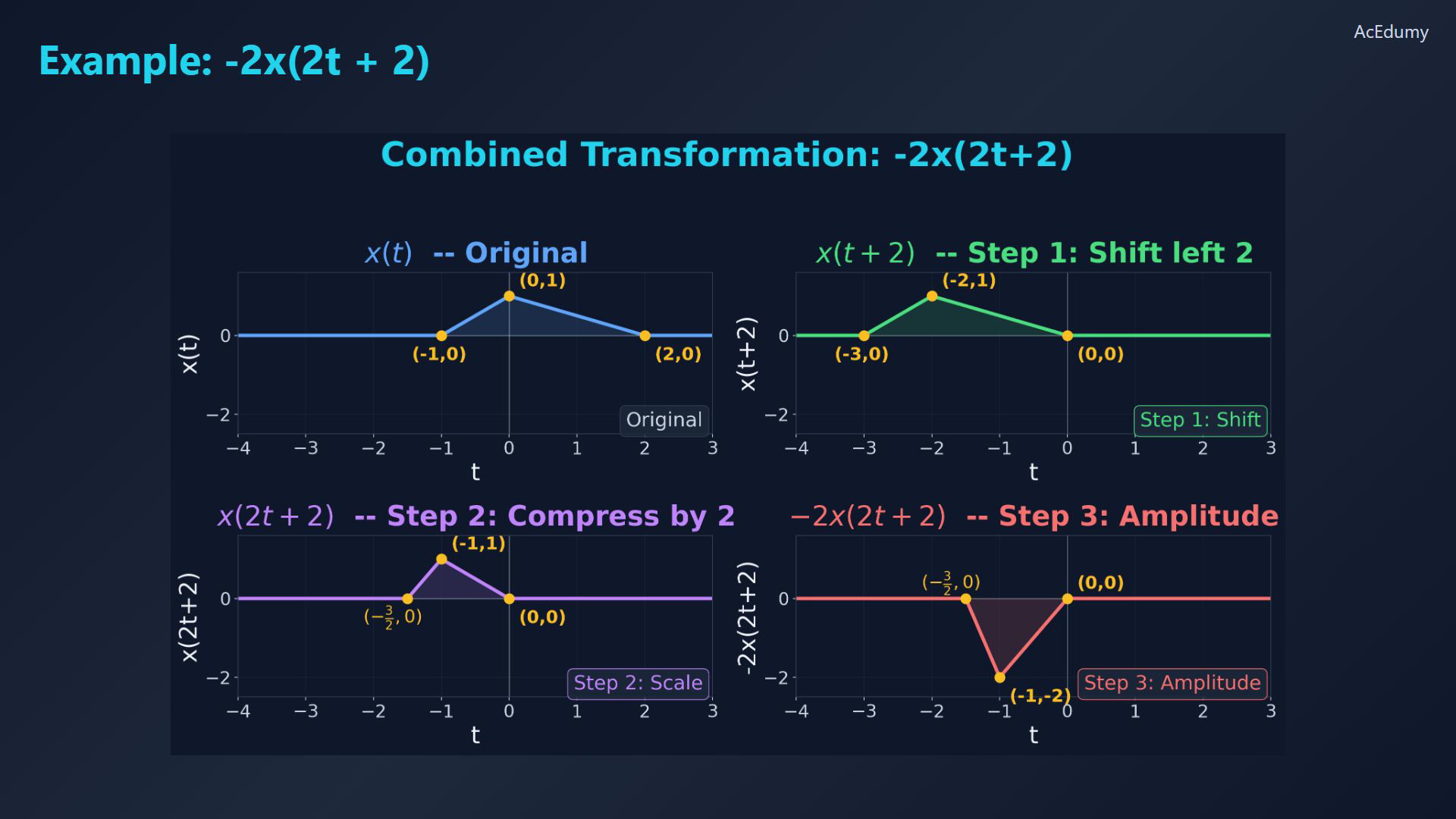
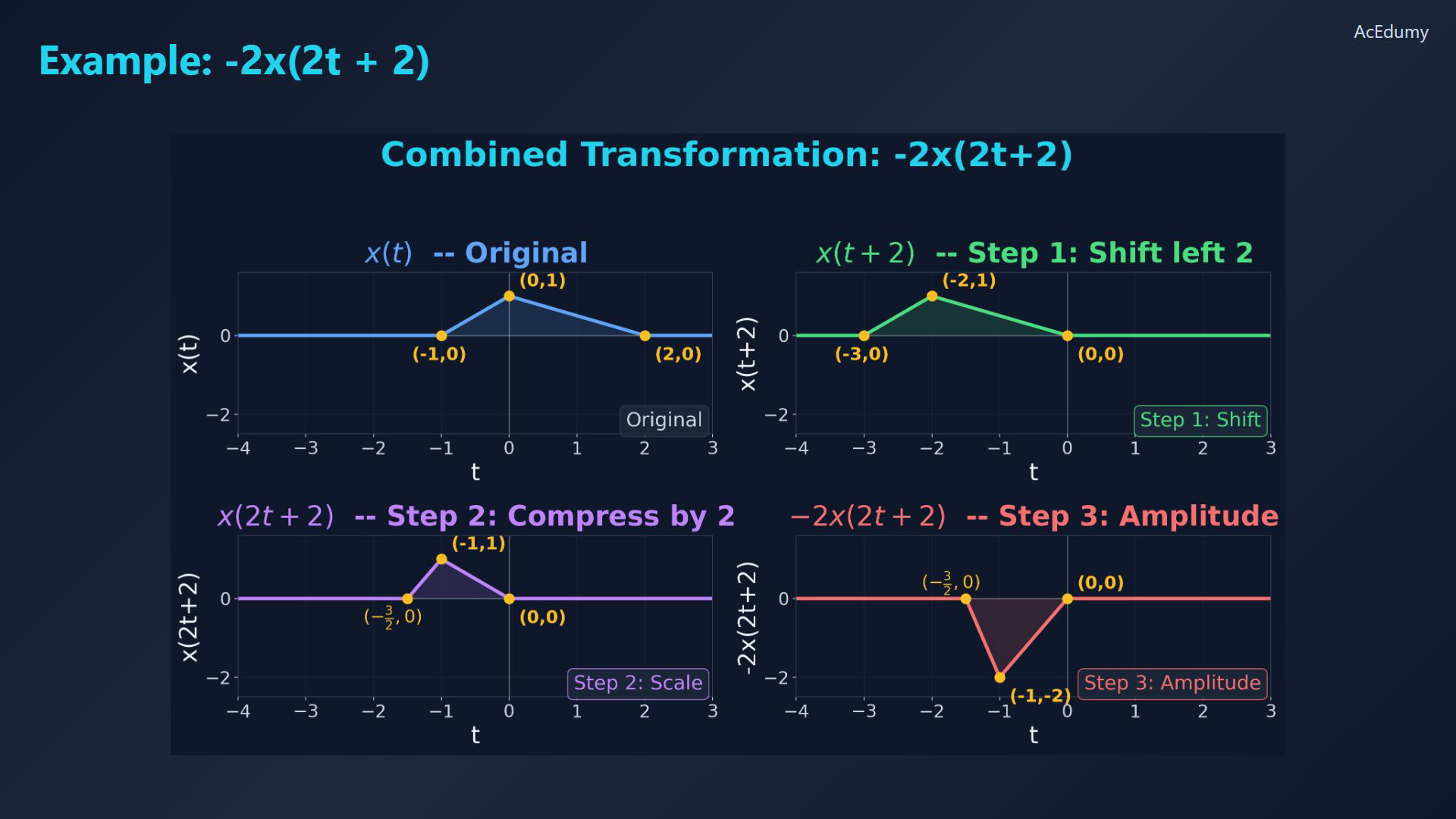
Original-video reference. The first trapezoid figure shows the untransformed source waveform, not the final answer; its later overlapping labels are avoided. The method overview and summary use the source's explicit alternative method with signed shift −b/a. Amplitude scaling uses the same video's four-stage triangle. Plus b or b/a inside an argument is not the signed physical displacement; nonzero time scale is assumed. Original asymmetric triangle, linear between these vertices and zero outside:Target:Shift left by two:After time compression by two:Multiply every height by minus two:Final triangle:Narration transcript
Consider x of t, an asymmetric triangle with vertices at negative one comma zero, zero comma one, and two comma zero. We want to draw negative two times x of two t plus two. Step one: shift left by two to get x of t plus two, with vertices at negative three comma zero, negative two comma one, and zero comma zero. Step two: compress by two to get x of two t plus two, with vertices at negative three halves comma zero, negative one comma one, and zero comma zero. Step three: multiply by negative two. The triangle flips and doubles, giving vertices at negative three halves comma zero, negative one comma negative two, and zero comma zero.
8. Check both methods against the affine coordinate rule

Original-video reference. The first trapezoid figure shows the untransformed source waveform, not the final answer; its later overlapping labels are avoided. The method overview and summary use the source's explicit alternative method with signed shift −b/a. Amplitude scaling uses the same video's four-stage triangle. Plus b or b/a inside an argument is not the signed physical displacement; nonzero time scale is assumed. Check the final feature coordinates after composing transformations.Method one: shift by the signed displacement minus b, then divide times by a.Method two: divide times by a, then shift by the signed displacement minus b over a.Keep the amplitude factor separate from the nonzero time-scale factor:Next: build a periodic signal from shifted copies of a basic waveform.Narration transcript
Let us summarize the combined transformation rules. For x of a t plus b: shift first by b, then scale by a. Alternatively, factor as x of a times t plus b over a and scale first, shift second. For amplitude scaling, a times x of b t plus c: shift, scale time, then scale amplitude. In the next lesson, we will explore how to construct periodic signals from basic building blocks.
Source video: Signals & Systems #02 | Combined Transformations x(at+b) (4:56)