Signals and Systems · Continuous-time graphical convolution
#16 Shifted steps, rectangular pulses and a trapezoid
Add step shifts, compute the overlap of unequal rectangular pulses, and verify the resulting trapezoid with four shifted ramps.
Question
The star denotes convolution; adjacent factors denote ordinary multiplication. Apply graphical convolution where the integral exists. Here x and y name two input pulses and z names their output. Keep output time t fixed while integrating over tau. The shifted-step identity subtracts the entire sum of shifts: the ramp argument is t minus (a plus b). The narration first states the identity for positive delays; the same overlap derivation also holds for any real shifts, including the zero and negative shifts used later. The overlap is empty before output time reaches the sum of shifts, and its width is zero at equality. For the rectangular example, the overlap interval runs from the larger of negative one and t minus one to the smaller of one and t; its length is zero if those endpoints are reversed. The five output regions include their boundary values: zero at negative one and two, and one at zero and one. Rectangular-pulse endpoint conventions do not change a continuous-time convolution integral. The graph uses closed endpoints, while the unit-step differences may choose different single-point values. The two input widths are two and one, so the result has a flat plateau of width one; equal widths would give a triangle. Flipping reverses time and preserves amplitude signs. In the graphical reference, the upper horizontal coordinate is tau and the yellow three is the fixed output time; the lower horizontal coordinate is t.
Written solution and narration transcript(shows the full solution)
Below are all the lines written in the notebook together with the full narration transcript.
1. Shifted unit steps
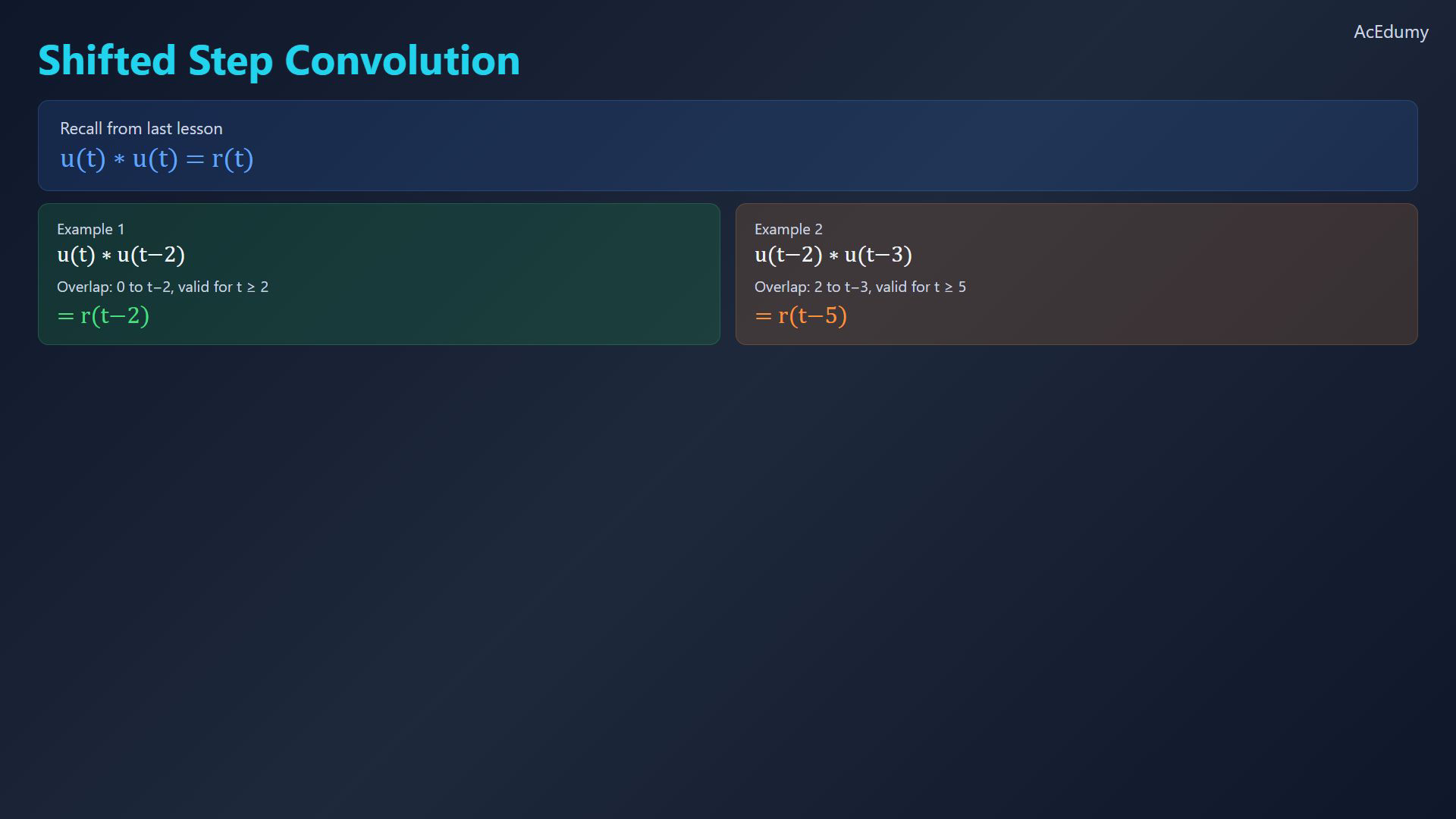
Original-video reference. The graphical frame fixes output time at three: the upper blue pulse spans integration-variable values negative one through one, and the green shifted pulse spans two through three. They do not overlap. The lower graph shows the completed trapezoid with corners at (-1,0), (0,1), (1,1), and (2,0); tick spacing is one unit. Recall two unit steps:Extend the result to shifted unit steps.First example:The integrand is one when the integration variable is at least zero and no greater than output time minus two.For output time at least two:For all output times:Second example, for output time at least five:For all output times:Narration transcript
In the last lesson we proved that u of t convolved with u of t equals r of t. Now let's extend this to shifted steps. Consider u of t convolved with u of t minus two. Setting up the integral, u of tau is one for tau greater than or equal to zero, and u of t minus tau minus two is one when tau is less than or equal to t minus two. The overlap is from zero to t minus two, so the integral equals t minus two, valid for t greater than or equal to two. Therefore u of t convolved with u of t minus two equals t minus two times u of t minus two, which is r of t minus two. Similarly, u of t minus two convolved with u of t minus three: the overlap is from two to t minus three, giving t minus five for t greater than or equal to five. So u of t minus two convolved with u of t minus three equals r of t minus five.
2. Add the shifts
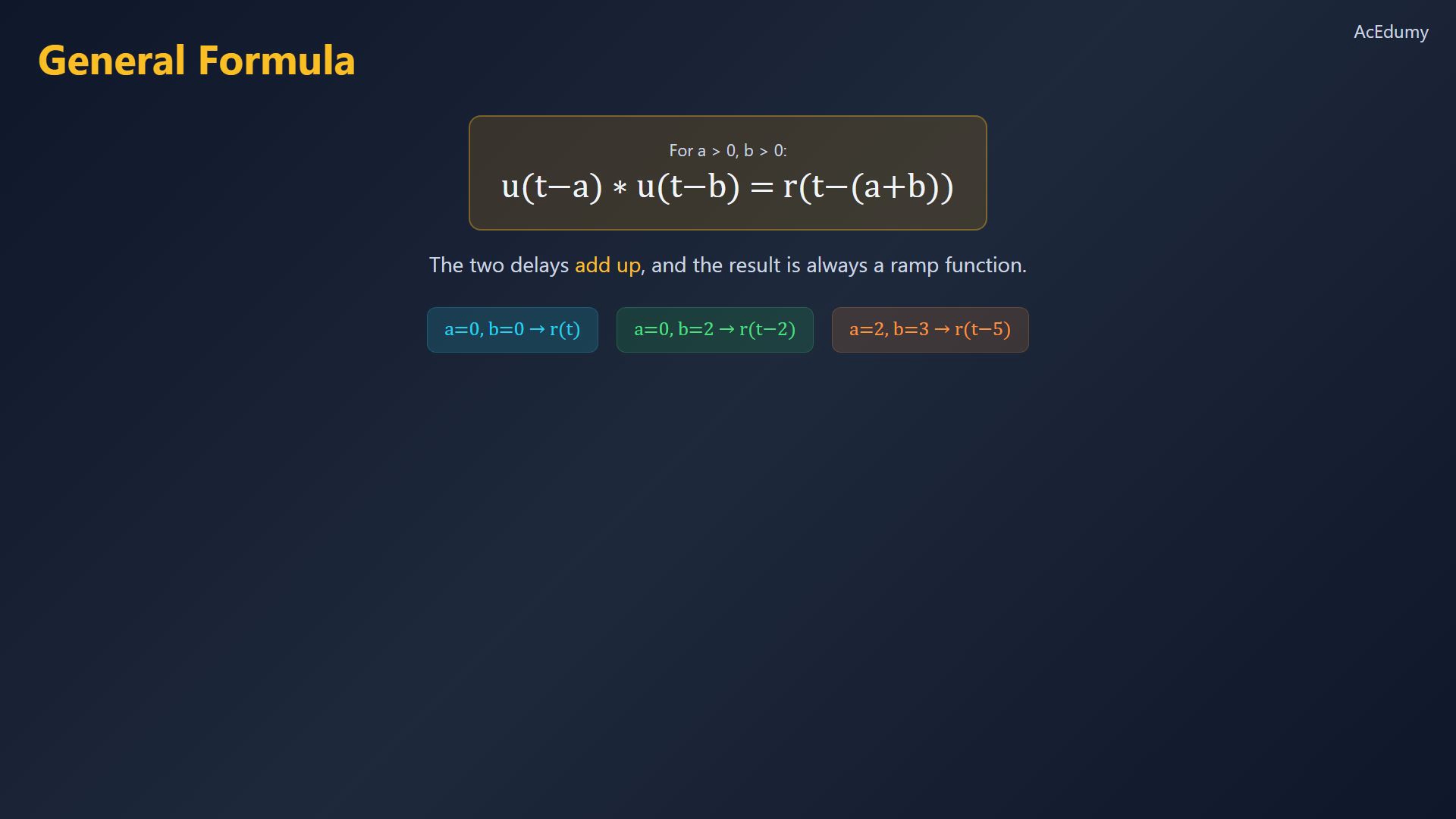
Original-video reference. The graphical frame fixes output time at three: the upper blue pulse spans integration-variable values negative one through one, and the green shifted pulse spans two through three. They do not overlap. The lower graph shows the completed trapezoid with corners at (-1,0), (0,1), (1,1), and (2,0); tick spacing is one unit. Notice the pattern.The two step shifts add.For the positive delays stated here:The resulting ramp starts at the sum of the delays.The shortcut follows directly from the overlap integral.Narration transcript
Notice the pattern. When we convolve two shifted unit steps, the shift values simply add up. In general, for a greater than zero and b greater than zero: u of t minus a convolved with u of t minus b equals r of t minus the quantity a plus b. The two delays add, and the result is always a ramp function. This powerful shortcut lets us compute step convolutions instantly without setting up any integrals.
3. Flip and shift
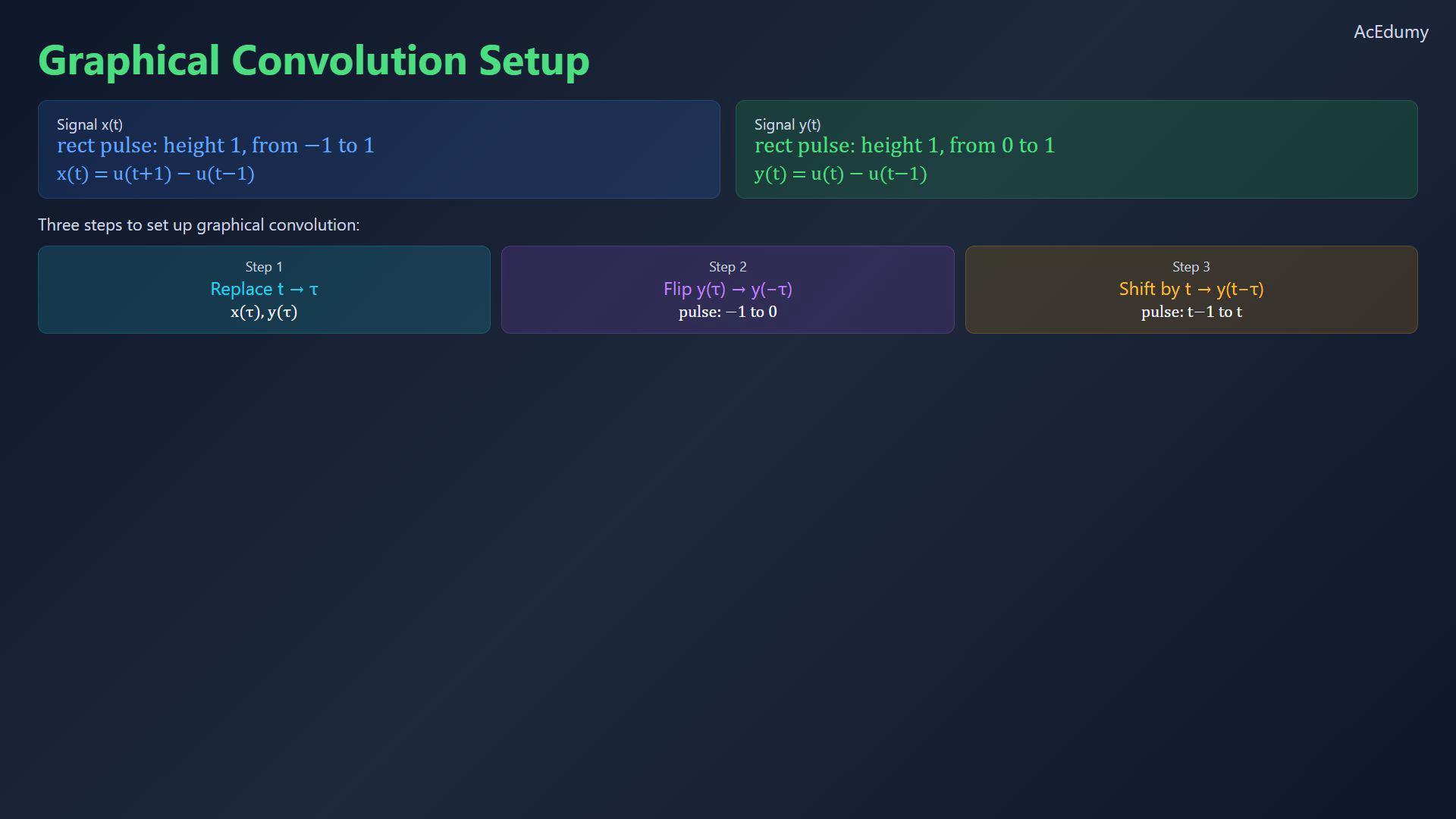
Original-video reference. The graphical frame fixes output time at three: the upper blue pulse spans integration-variable values negative one through one, and the green shifted pulse spans two through three. They do not overlap. The lower graph shows the completed trapezoid with corners at (-1,0), (0,1), (1,1), and (2,0); tick spacing is one unit. Set up graphical convolution.A unit-height pulse from negative one to one:A unit-height pulse from zero to one:Use the integration variable for both inputs and keep output time fixed.Flip about the origin:Shift the flipped pulse:Narration transcript
Now let's learn graphical convolution, a visual method for convolving any C T signals. Consider x of t, a rectangular pulse of height one from t equals negative one to t equals one. And y of t, a rectangular pulse of height one from t equals zero to t equals one. To compute the convolution integral, we first replace t with tau in both signals. Then we flip y of tau about the origin to get y of negative tau, which is a pulse from negative one to zero. Finally, we shift this flipped copy by t to get y of t minus tau, a pulse from t minus one to t.
4. Integrate overlap
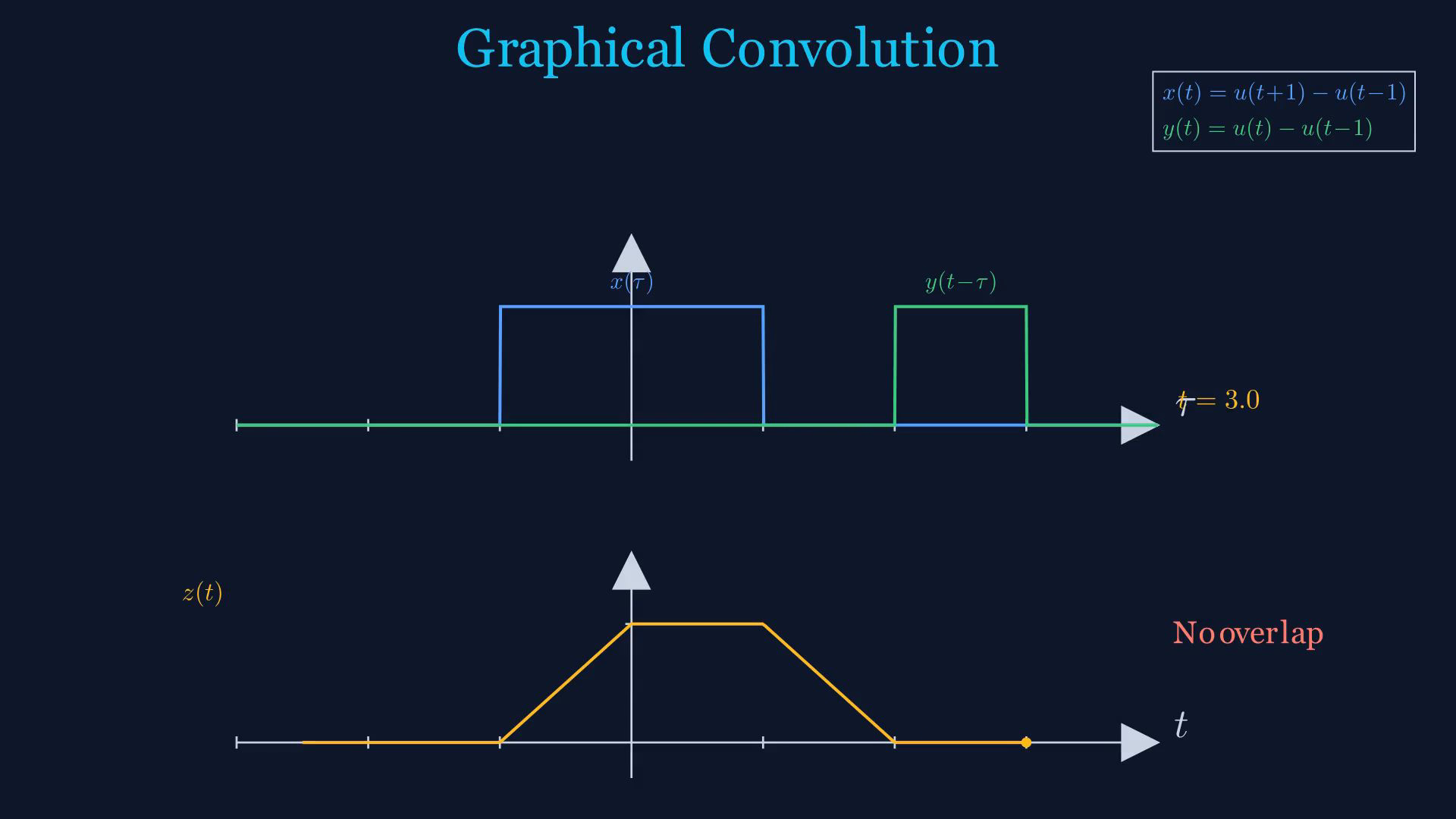
Original-video reference. The graphical frame fixes output time at three: the upper blue pulse spans integration-variable values negative one through one, and the green shifted pulse spans two through three. They do not overlap. The lower graph shows the completed trapezoid with corners at (-1,0), (0,1), (1,1), and (2,0); tick spacing is one unit. Slide and integrate the product:Before output time negative one:From negative one to zero, the shifted pulse enters from the left.Partial entry:From zero to one, the narrow pulse lies fully inside the wide pulse.Full overlap:From one to two, the shifted pulse leaves through the right edge.Partial exit:At and after output time two:Narration transcript
Now we slide y of t minus tau across x of tau and compute the overlap area at each position. When t is less than negative one, there is no overlap, so z of t equals zero. When t is between negative one and zero, the sliding pulse partially overlaps x of tau. The overlap width is t plus one, so z of t equals t plus one. When t is between zero and one, the pulse fits entirely inside x of tau, giving full overlap of width one. So z of t equals one. When t is between one and two, the pulse starts sliding out from the right. The overlap width is two minus t, so z of t equals two minus t. Finally when t is greater than or equal to two, there is no overlap again, and z of t equals zero.
5. Piecewise trapezoid
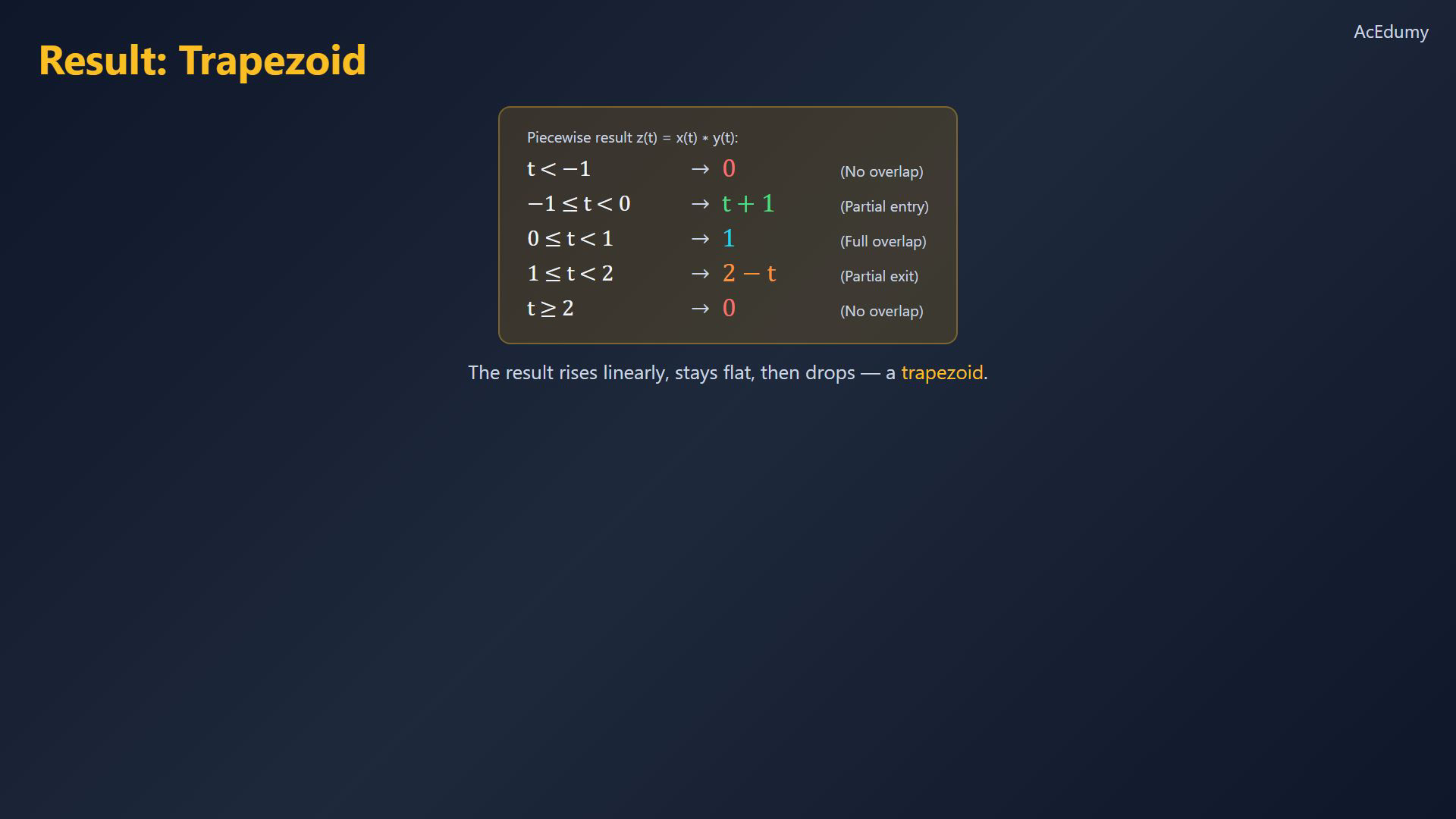
Original-video reference. The graphical frame fixes output time at three: the upper blue pulse spans integration-variable values negative one through one, and the green shifted pulse spans two through three. They do not overlap. The lower graph shows the completed trapezoid with corners at (-1,0), (0,1), (1,1), and (2,0); tick spacing is one unit. The result is a trapezoid.It joins the corners (-1,0), (0,1), (1,1), and (2,0), with zero output outside.Five regions: zero before negative one; rise by output time plus one until zero; plateau at one until one; fall by two minus output time until two; zero thereafter.Narration transcript
The result z of t is a trapezoid. It rises linearly from zero to one between t equals negative one and zero, stays flat at one between zero and one, then drops linearly back to zero between one and two. This is the piecewise formula: zero for t less than negative one, t plus one for negative one to zero, one for zero to one, two minus t for one to two, and zero for t greater than two.
6. Algebraic verification
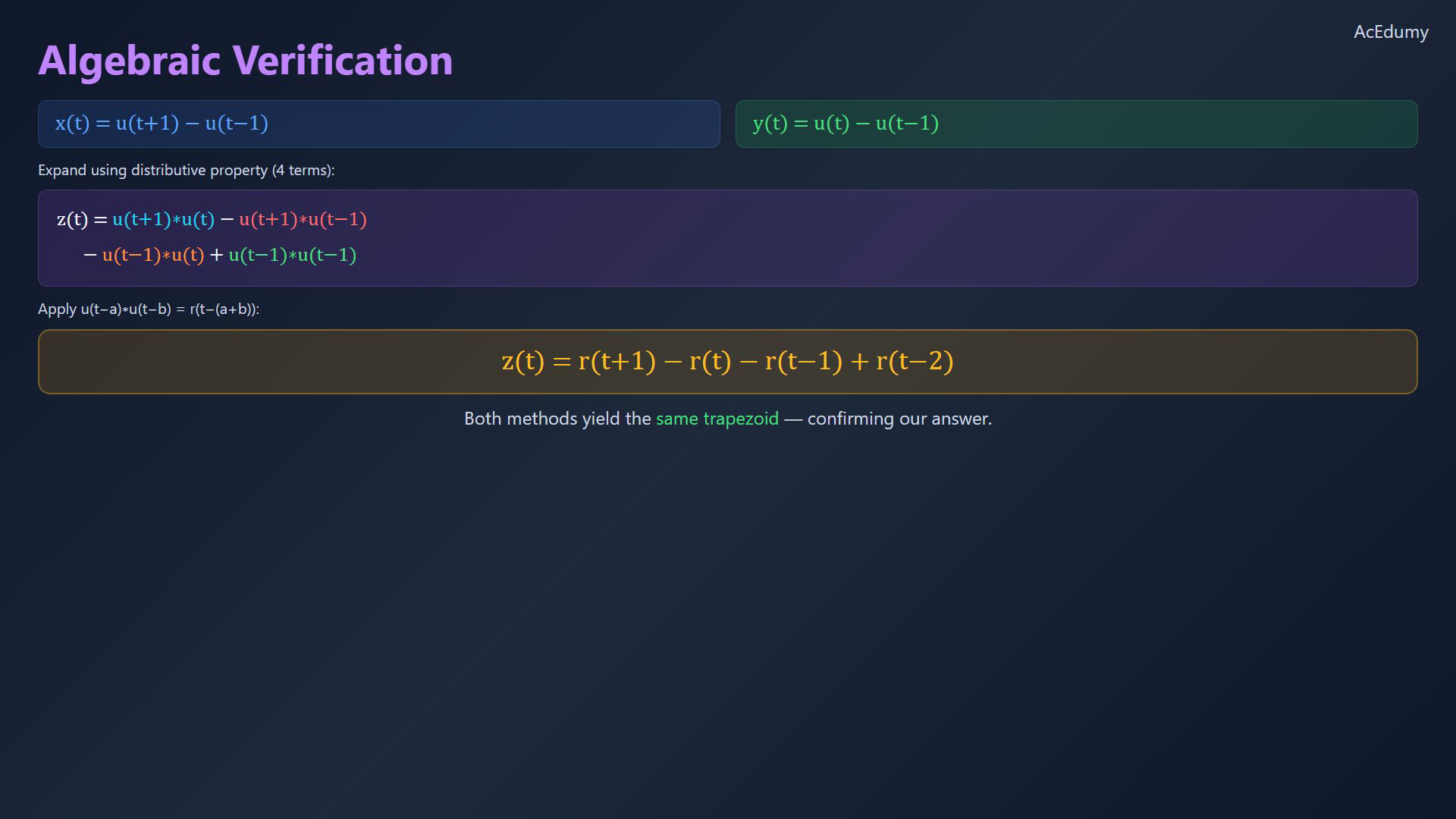
Original-video reference. The graphical frame fixes output time at three: the upper blue pulse spans integration-variable values negative one through one, and the green shifted pulse spans two through three. They do not overlap. The lower graph shows the completed trapezoid with corners at (-1,0), (0,1), (1,1), and (2,0); tick spacing is one unit. Verify the result algebraically.Write the inputs as step differences:Distribute into four terms:Add the signed ramp terms:The four ramps give the same trapezoid as the graphical method.Narration transcript
There's also an algebraic approach. We write both signals in terms of unit steps: x of t equals u of t plus one minus u of t minus one, and y of t equals u of t minus u of t minus one. Using the distributive property, we expand the convolution into four terms. Applying our general formula u of t minus a convolved with u of t minus b equals r of t minus a plus b to each term, we get z of t equals r of t plus one minus r of t minus r of t minus one plus r of t minus two. Both methods give identical results, confirming our graphical answer.
7. Summary
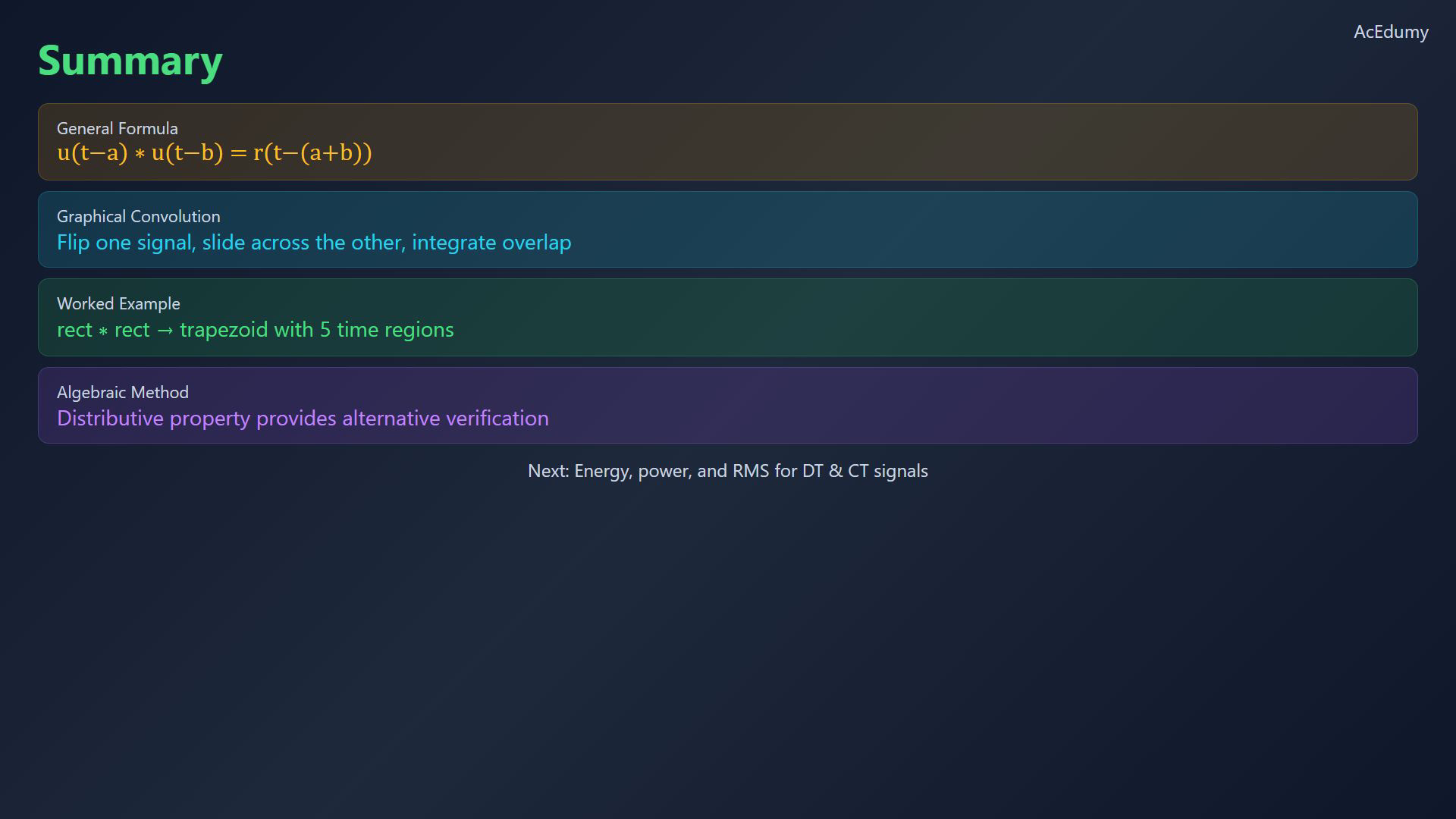
Original-video reference. The graphical frame fixes output time at three: the upper blue pulse spans integration-variable values negative one through one, and the green shifted pulse spans two through three. They do not overlap. The lower graph shows the completed trapezoid with corners at (-1,0), (0,1), (1,1), and (2,0); tick spacing is one unit. Add the shifts inside one group:Graphical convolution: flip, slide, and integrate the product over the overlap.The two unequal rectangular pulses produce five output-time regions.Distributivity gives an algebraic verification.Next: energy, power, and RMS for discrete and continuous time signals.Narration transcript
Today we learned the general formula for shifted step convolution: u of t minus a convolved with u of t minus b equals r of t minus a plus b. We mastered graphical convolution: flip one signal, slide it across the other, and integrate the overlap at each position. We worked through a complete example with rectangular pulses, identifying five distinct time regions. The algebraic method using distributive property provides an alternative verification approach. In the next lesson, we'll explore energy, power, and R M S for both discrete and continuous time signals.
Source video: Signals & Systems #16 | CT Graphical Convolution (5:22)