Signals and Systems · Distributional derivatives of signals
#11 Ordinary slopes and signed impulse weights
Differentiate a pulse, a staircase and a signal with both a ramp and a jump by combining interval slopes with signed impulse weights.
Question

Interpret derivatives containing delta as distributions. At a jump the ordinary point derivative is undefined; the impulse is one component of the distributional derivative. Its weight is the right-hand limit minus the left-hand limit. In the pulse and staircase drawings choose u(0)=1; isolated endpoint values do not change a distributional derivative. A continuous corner changes the regular slope without adding an impulse to the first derivative. Retain any initial affine baseline when representing a general piecewise-linear signal. Use the displayed examples to calculate the interval slopes and jumps separately, then add both contributions.
Written solution and narration transcript(shows the full solution)
Below are all the lines written in the notebook together with the full narration transcript.
1. Differentiate shifted elementary signals
Original-video reference. The jump rule uses the final summary card; the mixed example uses the method card. Impulse labels denote signed weights, not finite heights. The staircase graph is captured before the formula box overlaps its negative impulse label; its equation is developed below. Distributional derivative chain:Shifts and constant scaling preserve these derivative rules.Shifted and scaled rules:Narration transcript
Recall from our previous lectures that the derivative of the unit ramp r of t is the unit step u of t, and the derivative of the unit step is the impulse delta of t. When we shift and scale these functions, the same rules apply. The derivative of r of t minus t zero is u of t minus t zero, and the derivative of A times u of t minus t zero is A times delta of t minus t zero.
2. Measure signed jumps

Original-video reference. The jump rule uses the final summary card; the mixed example uses the method card. Impulse labels denote signed weights, not finite heights. The staircase graph is captured before the formula box overlaps its negative impulse label; its equation is developed below. Use the signed jump to determine the impulse weight.A jump contributes an impulse to the distributional derivative; it does not define an ordinary derivative at that point.Signed jump:A positive jump contributes a positive impulse.A negative jump contributes a negative impulse.Larger jump magnitude means larger absolute impulse weight.Narration transcript
Here's the key insight for today's lesson. When a signal f of t has a discontinuity — a sudden jump — at time t zero, the derivative f dot of t contains an impulse at that point. The amplitude of this impulse equals the size of the jump: f of t zero plus minus f of t zero minus. A positive jump creates a positive impulse. A negative jump creates a negative impulse. The bigger the jump, the stronger the impulse.
3. Differentiate a unit rectangular pulse
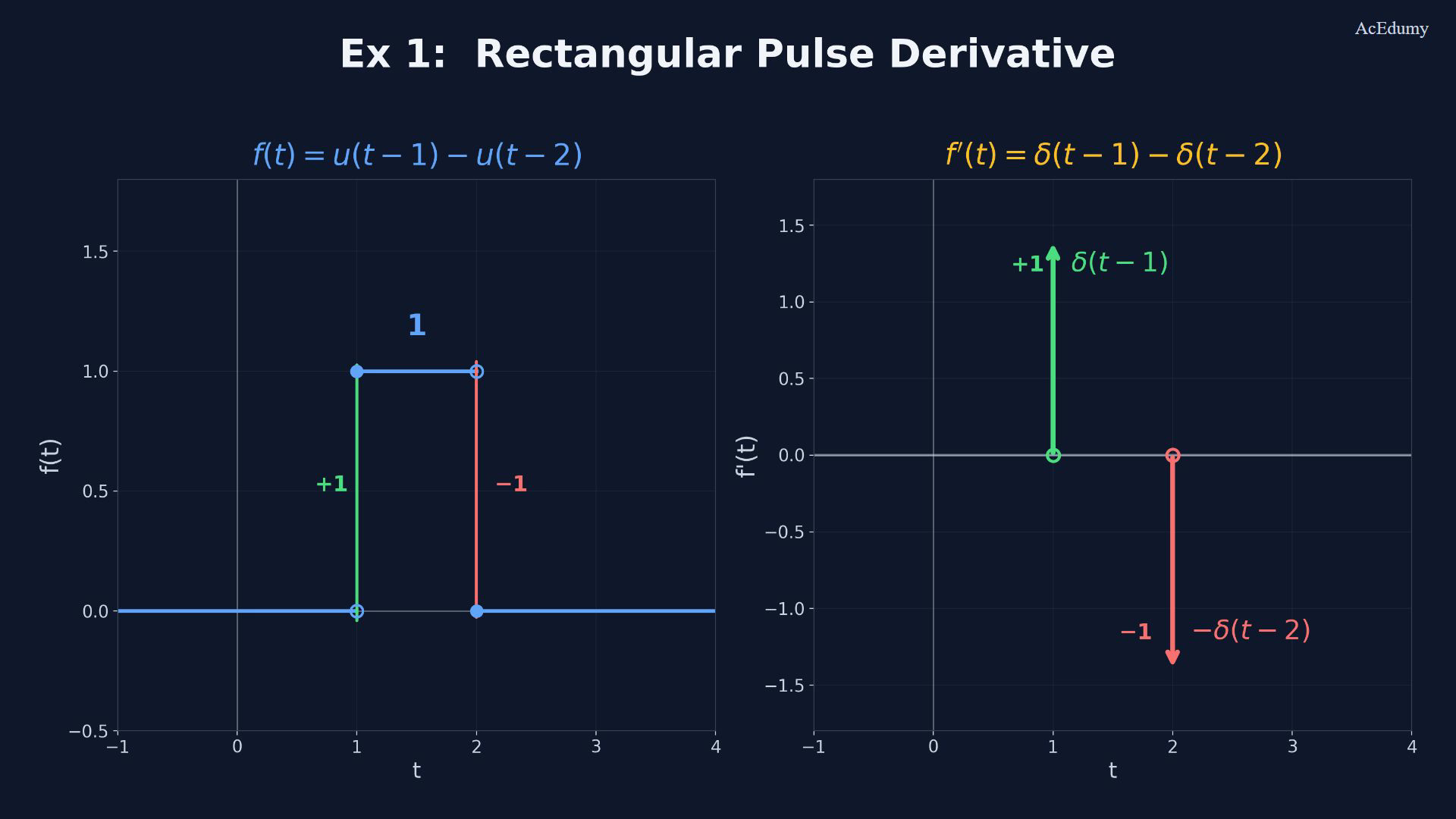
Original-video reference. The jump rule uses the final summary card; the mixed example uses the method card. Impulse labels denote signed weights, not finite heights. The staircase graph is captured before the formula box overlaps its negative impulse label; its equation is developed below. Differentiate a rectangular pulse.Pulse:The pulse jumps up by one at one and down by one at two.The first jump contributes a positive unit impulse; the second contributes a negative unit impulse.Distributional derivative:Narration transcript
Let's see this in action with a simple example. f of t equals u of t minus one minus u of t minus two. This is a rectangular pulse: it jumps up by one at t equals one, and jumps down by one at t equals two. Taking the derivative: the jump of plus one at t equals one produces delta of t minus one, and the jump of minus one at t equals two produces negative delta of t minus two. So f dot of t equals delta of t minus one minus delta of t minus two.
4. Convert three jumps to impulses
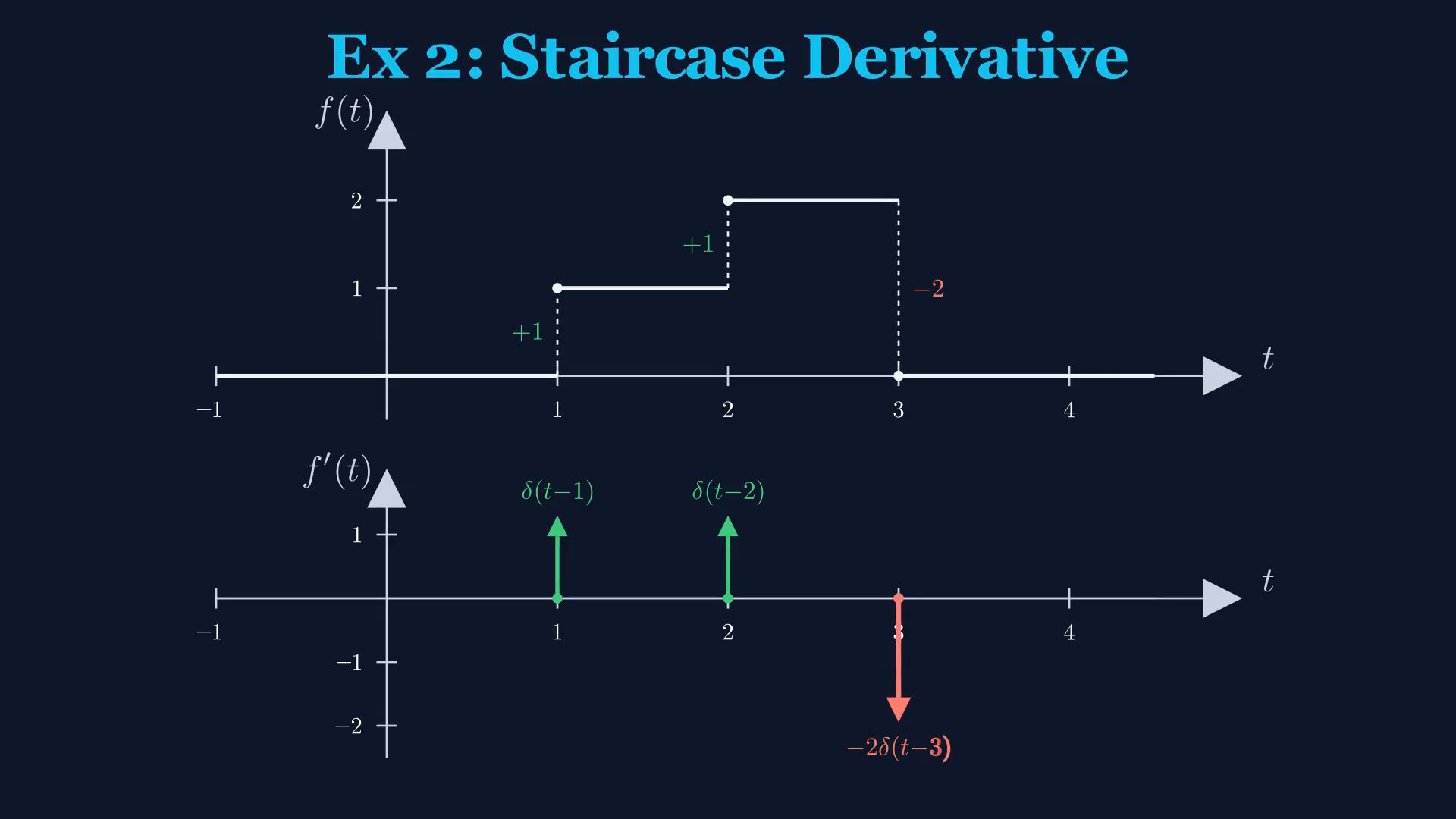
Original-video reference. The jump rule uses the final summary card; the mixed example uses the method card. Impulse labels denote signed weights, not finite heights. The staircase graph is captured before the formula box overlaps its negative impulse label; its equation is developed below. Differentiate a staircase with three jumps.Staircase:Jump at one:Jump at two:Jump at three:Each signed jump becomes the weight of an impulse at the same time.Distributional derivative:Narration transcript
Now a staircase with multiple jumps. f of t equals u of t minus one plus u of t minus two minus two u of t minus three. At t equals one, the signal jumps from zero to one — that's a jump of plus one. At t equals two, it jumps from one to two — another plus one. At t equals three, it drops from two to zero — a jump of minus two. Each discontinuity produces an impulse of the same size. The derivative is delta of t minus one plus delta of t minus two minus two delta of t minus three.
5. Combine ordinary slopes and impulse weights

Original-video reference. The jump rule uses the final summary card; the mixed example uses the method card. Impulse labels denote signed weights, not finite heights. The staircase graph is captured before the formula box overlaps its negative impulse label; its equation is developed below. Mixed example:Between zero and one, the signal has slope one.Between one and two, the signal is constant at one.Jump at two:Regular derivative component:Impulse component:Complete distributional derivative:Narration transcript
Our final example combines ramps and steps: f of t equals r of t minus r of t minus one plus two u of t minus two. Between t equals zero and one, the signal ramps up with slope one — a smooth section. Between one and two, it's flat at one. Then at t equals two, it jumps up by two to reach three. The derivative has two parts: the continuous section gives a constant one for zero less than t less than one. And the jump produces the impulse two delta of t minus two. This is the key pattern: slopes become constants, and jumps become impulses in the derivative.
6. Apply the slope and jump procedure

Original-video reference. The jump rule uses the final summary card; the mixed example uses the method card. Impulse labels denote signed weights, not finite heights. The staircase graph is captured before the formula box overlaps its negative impulse label; its equation is developed below. Find interval slopes and signed jumps separately.Express the signal with shifted steps and ramps, retaining any initial affine baseline.Locate each jump and subtract its left-hand limit from its right-hand limit.Add the regular slope component and the impulse component.On each open linear segment, the ordinary derivative equals the slope.At every jump, include an impulse weighted by the signed jump size.This construction applies to piecewise-linear signals; an initial affine term contributes its constant slope.Narration transcript
Let's summarize the procedure for finding signal derivatives. Step one: write f of t as a combination of shifted steps and ramps. Step two: identify all discontinuity points and measure each jump size. Step three: write the derivative. For each smooth ramp segment, the derivative is a constant equal to the slope. For each discontinuity, include an impulse whose amplitude equals the jump size. This method works for any piecewise-linear signal.
7. Review distributional derivatives

Original-video reference. The jump rule uses the final summary card; the mixed example uses the method card. Impulse labels denote signed weights, not finite heights. The staircase graph is captured before the formula box overlaps its negative impulse label; its equation is developed below. Jumps produce impulses in the distributional derivative.Positive and negative jumps give impulse weights with the same respective signs.Combine interval slopes with signed impulses; a continuous corner alone adds no impulse to the first derivative.Next: continuous-time sinusoidal and exponential signals.Narration transcript
Today we learned that signal derivatives at discontinuities produce impulses. The impulse amplitude equals the jump size: positive jumps give positive impulses, negative jumps give negative impulses. For signals with both slopes and jumps, the derivative combines constant segments with impulse functions. In the next lesson, we'll explore continuous-time sinusoidal and exponential signals.
Source video: Signals & Systems #11 | Signal Derivatives & Impulses at Discontinuities (4:26)