Signals and Systems · Signal energy, average power and RMS
#17 Discrete and continuous time: finite sequences, unit step and sinusoid
Compute energy and average power, distinguish energy and power signals, and derive sinusoidal RMS with finite-sequence, unit-step and exponential examples.
Question

Use real-valued signals, so the squared values in this lesson are nonnegative; complex signals require squared magnitudes. The total-energy formula applies whether or not the signal is periodic. Read the periodic-power statement with the preceding definition: one period must have finite, strictly positive energy. The zero signal is periodic but has zero energy and zero power, so it is not a power signal. For continuous time, nonzero means nonzero on a set of positive measure; period energy must exist. The lesson includes zero energy in its finite-energy convention. Neither includes all signals outside these definitions, including infinite energy with zero average power or a missing power limit; the ramp is one example. Use symmetric averaging windows. P_M denotes the DT mean over indices negative M through M; P_x is its limit as M grows without bound. In CT, E_B is energy in the interval from negative B over two to B over two, and P_B is E_B divided by B. Their limits as B grows are total energy E_x and average power P_x. The DT unit step is one at index zero and above, giving M plus one nonzero samples and average power one half. A is a positive peak amplitude and f is positive, with no DC offset, in the sinusoidal RMS result. The original symbol P_rms denotes RMS amplitude, with the same units as x, while P_x denotes mean square. Treat 220 V and 50 Hz as the specified waveform parameters. For the exponential, alpha is positive and the unit step makes it zero at negative time.
Written solution and narration transcript(shows the full solution)
Below are all the lines written in the notebook together with the full narration transcript.
1. DT definitions
Use the stated real-signal conventions and finite, nonzero period-energy condition. The RMS symbol on the original cards denotes signal amplitude. The 220 V sinusoid is the specified numerical example. Characterize a real signal by its energy and average power.DT total energy:Symmetric-window mean; take its limit as M grows:For a nonzero finite-valued periodic sequence:Narration transcript
Today we introduce two fundamental quantities that characterize signals: energy and power. For a discrete-time signal x of n, the total energy is defined as E x equals the sum from n equals negative infinity to positive infinity of x squared of n. The average power is P x equals the limit as M approaches infinity of one over two M plus one times the sum from n equals negative M to M of x squared of n. For periodic signals with period N, the energy is always infinite, and the power simplifies to one over N times the sum from n equals zero to N minus one of x squared of n.
2. Finite sequence and unit step
Use the stated real-signal conventions and finite, nonzero period-energy condition. The RMS symbol on the original cards denotes signal amplitude. The 220 V sinusoid is the specified numerical example. Compare a finite sequence and a unit step.Five samples at indices zero through four:Square and add:After the window contains all five samples, this tends to zero:Second example:Unit-step energy:Since the unit step equals its square, the symmetric window contains M plus one nonzero samples.This symmetric-window mean tends to one half:Narration transcript
Let's see two contrasting examples. First, consider the finite signal x of n equals negative one, one, zero, two, negative one. Its energy is one squared plus one squared plus zero squared plus two squared plus one squared, which equals seven. Since the signal has finite duration, its power is the limit of seven over two M plus one as M goes to infinity, which equals zero. Now consider x of n equals the unit step u of n. The energy is one squared summed infinitely, so E x equals infinity. For the power, note that u squared of n equals u of n, so we sum M plus one ones from n equals zero to M. This gives the limit of M plus one over two M plus one, which equals one half.
3. Energy and power classes
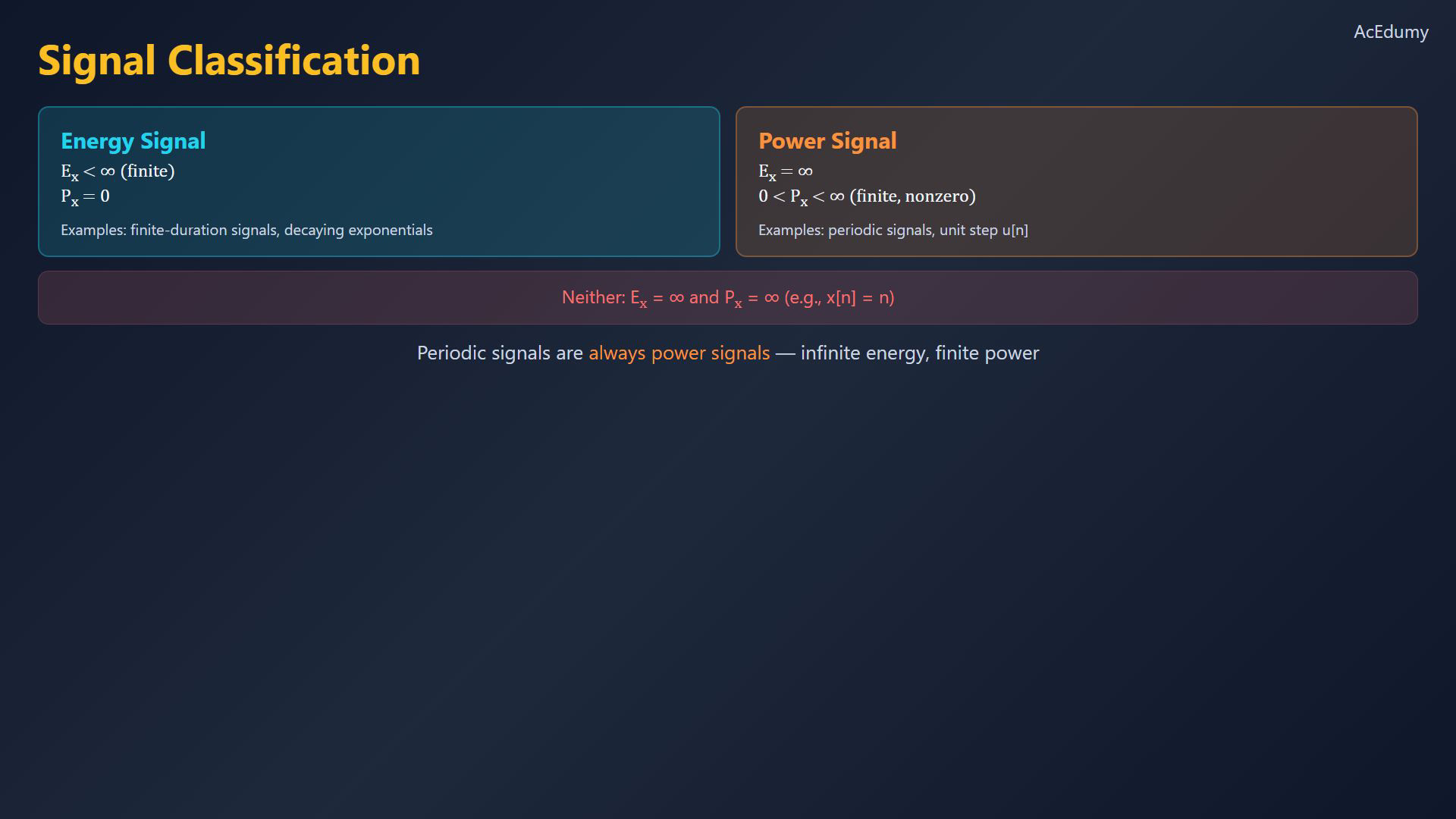
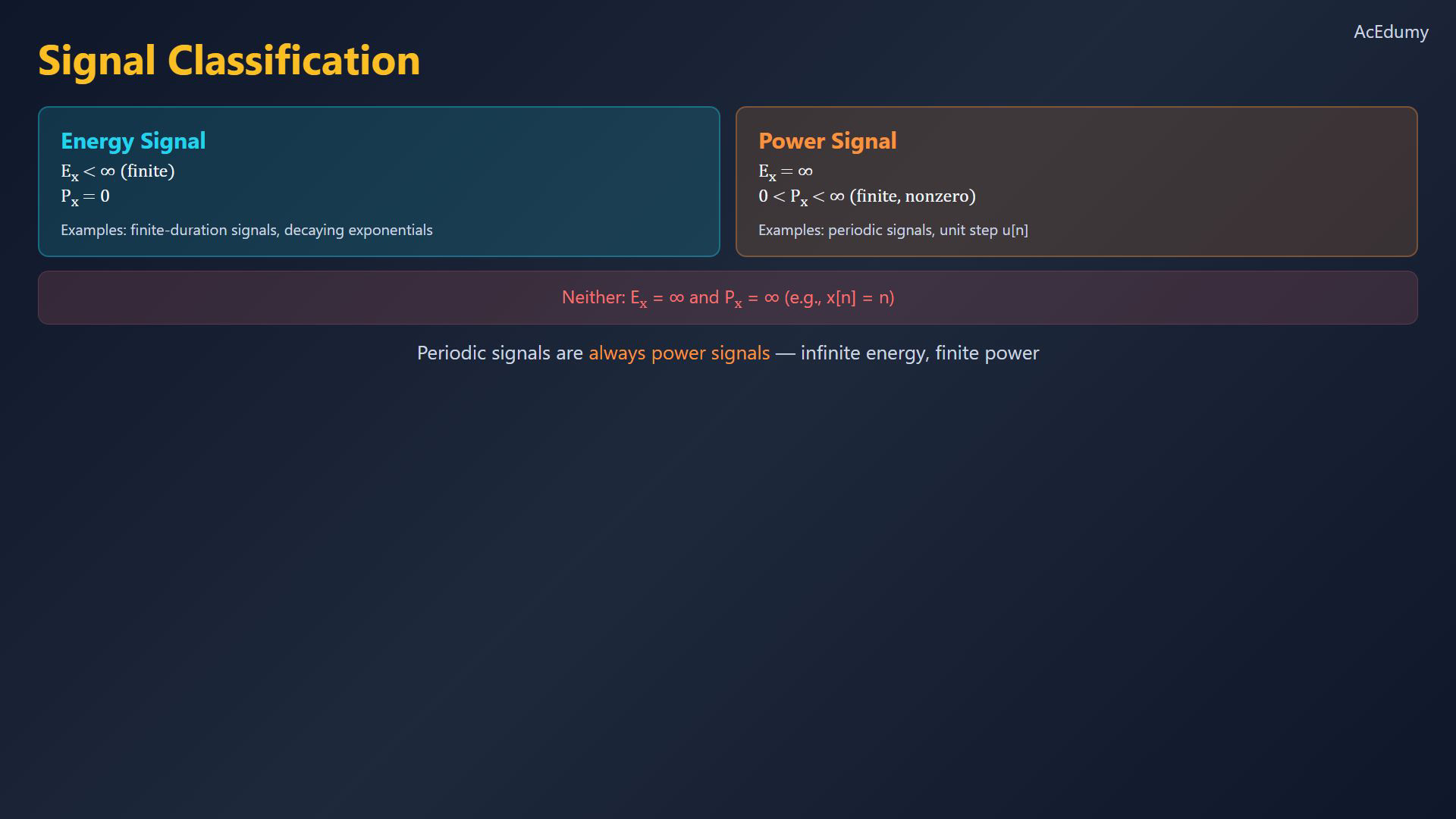
Use the stated real-signal conventions and finite, nonzero period-energy condition. The RMS symbol on the original cards denotes signal amplitude. The 220 V sinusoid is the specified numerical example. Classify the two examples using their energy and average power.The five-sample energy signal has finite energy seven and zero average power.The unit-step power signal has infinite energy and finite nonzero average power one half.Signals outside the stated energy and power classes belong to neither class.A periodic signal with finite, strictly positive energy per period is a power signal; repetition gives infinite total energy.Narration transcript
These examples illustrate two categories. An energy signal has finite energy and zero average power, like our five-sample signal with E x equals seven and P x equals zero. A power signal has infinite energy but finite nonzero average power, like the unit step with E x equals infinity and P x equals one half. Every signal falls into one of three classes: energy signal, power signal, or neither. Periodic signals are always power signals because they repeat forever, accumulating infinite energy but maintaining finite average power.
4. CT definitions

Use the stated real-signal conventions and finite, nonzero period-energy condition. The RMS symbol on the original cards denotes signal amplitude. The 220 V sinusoid is the specified numerical example. For continuous time, integrate instead of summing.Window energy; take its limit as B grows:Window mean; take its limit as B grows:One-period average:Root mean square amplitude:Narration transcript
For continuous-time signals, the definitions use integrals instead of sums. The energy is E x equals the limit as B goes to infinity of the integral from negative B over two to B over two of x squared of t d t. The power is P x equals the limit as B goes to infinity of one over B times the same integral. For periodic signals with period T, the power is P x equals one over T times the integral from negative T over two to T over two of x squared of t d t. The root mean square value, or R M S, is simply the square root of the average power: P R M S equals the square root of P x.
5. Sinusoidal RMS
Use the stated real-signal conventions and finite, nonzero period-energy condition. The RMS symbol on the original cards denotes signal amplitude. The 220 V sinusoid is the specified numerical example. Take positive peak amplitude and frequency:Period:Average the squared sinusoid:Half-angle identity:The oscillatory term integrates to zero over one complete signal period.Remaining constant term:Sinusoidal RMS amplitude:Narration transcript
Let's derive the RMS value of a sinusoidal signal x of t equals A sine of two pi f t. This signal is periodic with period T equals one over f. The power is one over T times the integral of A squared sine squared of two pi f t d t over one period. Using the half-angle identity, sine squared theta equals one minus cosine two theta divided by two, we separate the integral into two parts. The integral of cosine over a full period equals zero. So we are left with A squared over two T times T, which equals A squared over two. Therefore, the RMS value is A divided by the square root of two.
6. Practical examples
Use the stated real-signal conventions and finite, nonzero period-energy condition. The RMS symbol on the original cards denotes signal amplitude. The 220 V sinusoid is the specified numerical example. Apply the definitions to two specified waveforms.The lesson’s 220 V, 50 Hz example:RMS voltage from the positive peak:The 220-volt value describes RMS voltage in this example.For positive decay rate:Exponential energy:Finite energy implies zero average power.This decaying exponential is a continuous-time energy signal.Narration transcript
Here are two practical applications. First, the European mains voltage is described by v of t equals two hundred twenty times the square root of two times sine of two pi times fifty t volts. The peak amplitude is two hundred twenty root two, so the RMS voltage is two hundred twenty root two divided by root two, which equals two hundred twenty volts. That's why we call it two hundred twenty volt power. Second, consider a decaying exponential x of t equals e to the negative alpha t times u of t with alpha greater than zero. Its energy is the integral from zero to infinity of e to the negative two alpha t d t, which evaluates to one over two alpha. Since energy is finite, the power is zero. This is a CT energy signal.
7. Summary
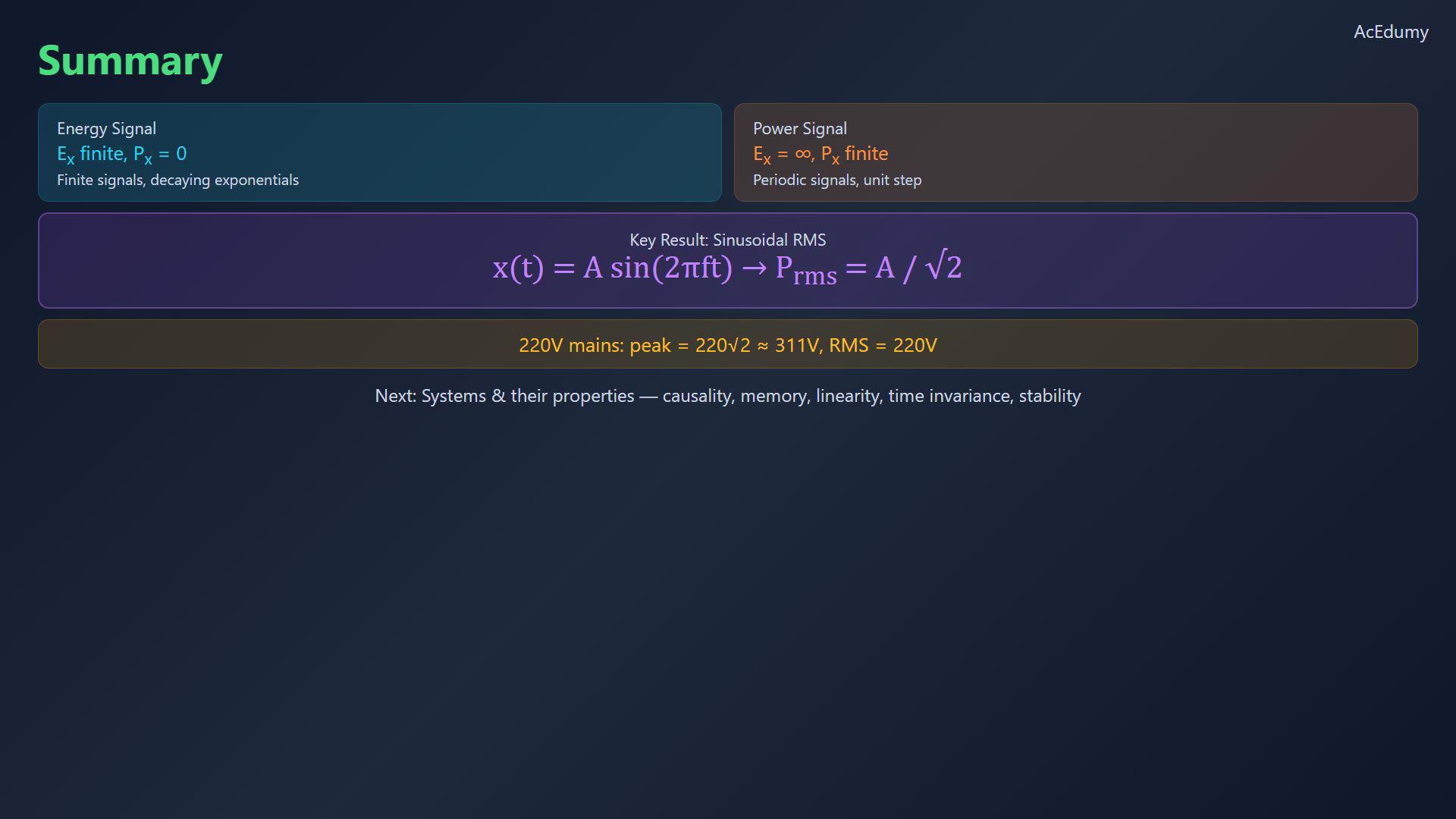
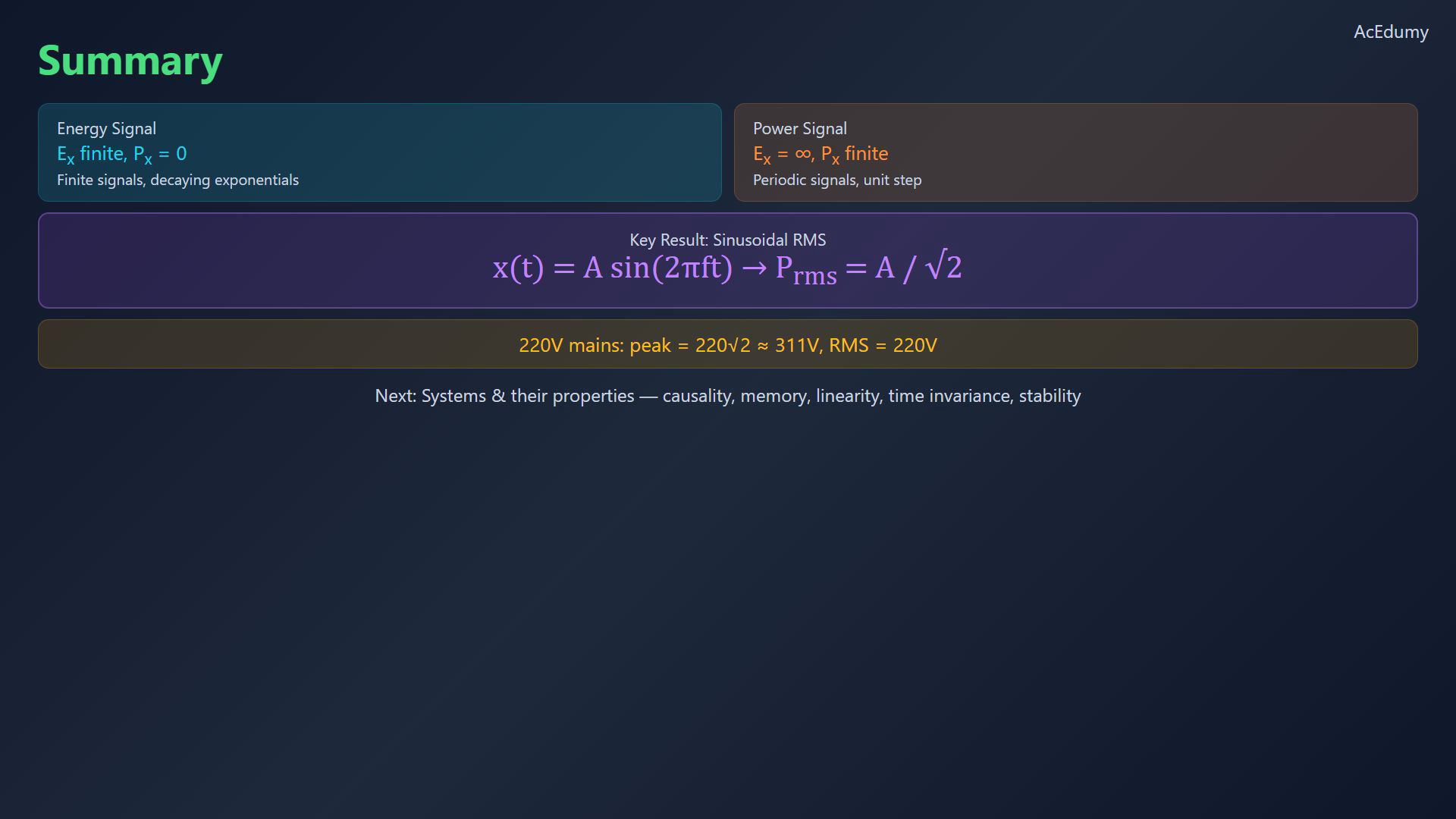
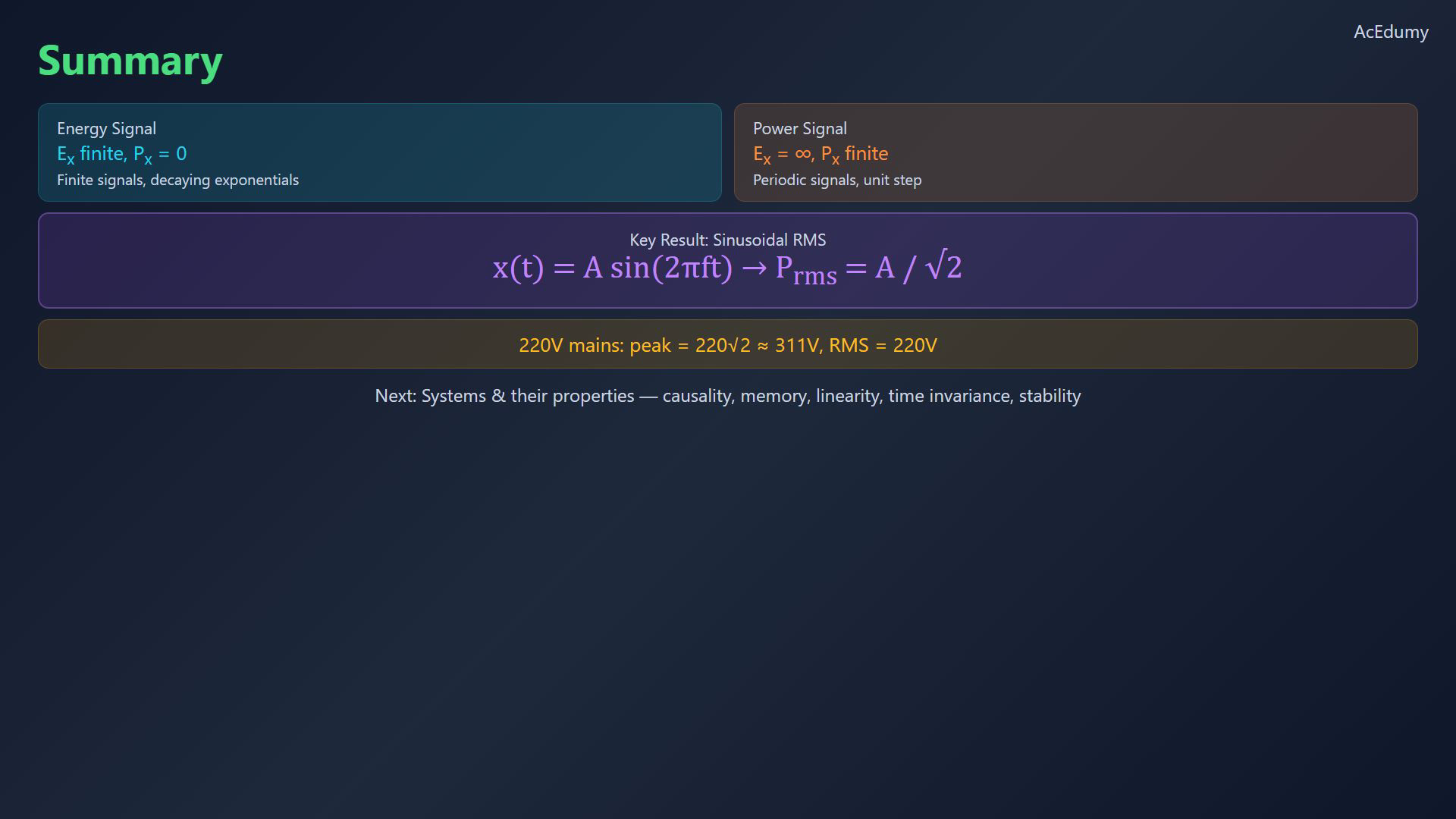
Use the stated real-signal conventions and finite, nonzero period-energy condition. The RMS symbol on the original cards denotes signal amplitude. The 220 V sinusoid is the specified numerical example. Review energy, average power and RMS in discrete and continuous time.An energy signal has finite energy and zero average power under the convention used here.The finite five-sample sequence and the decaying exponential are examples.A power signal has infinite energy and finite nonzero average power.The stated nonzero periodic waveforms and the unit step are power examples.For the positive-amplitude, positive-frequency sinusoid:Next: causality, memory, linearity, time invariance, stability and invertibility.Narration transcript
Today we covered signal energy and power for both discrete and continuous time. Energy signals have finite energy and zero power. Examples include finite-duration DT signals and decaying exponentials. Power signals have infinite energy but finite nonzero power. Examples include periodic signals and the unit step. The RMS value of a sinusoidal signal is always A over root two. In the next lesson, we'll explore systems and their key properties: causality, memory, linearity, time invariance, stability, and invertibility.
Source video: Signals & Systems #17 | Energy & Power of Signals - RMS Value (5:50)