Signals and Systems · Fourier coefficient examples
#24 Euler inspection for sine, cosine and three commensurate cosines
Read complex Fourier coefficients directly from Euler expansions and find the fundamental period of a sum of cosines.
Question

Use a positive period T, omega0 equal to two pi divided by T, and the synthesis convention with no prefactor and an analysis prefactor one divided by T. In every exponential, the time variable multiplies the complete angular frequency two pi divided by T. The imaginary unit j satisfies j squared equal to minus one. One over two j means one divided by the product two j, equal to minus j divided by two; it is not j divided by two. In the sine Euler expansion, this factor multiplies the entire difference of the positive and negative exponentials. In the cosine expansion, one half multiplies the entire sum. The preceding Euler identity and the matched coefficients fix this grouping when the spoken shorthand omits a repeated factor. Delta indexed by integer k is the Kronecker impulse, equal to one at zero and zero elsewhere, not a Dirac distribution in continuous time. A minus one inside delta selects k equal to plus one; a plus one selects k equal to minus one. The sine coefficients at plus one and minus one are minus j over two and plus j over two respectively; the cosine coefficients are one half at both indices. Every other coefficient, including DC, is zero. The real-even and real-odd symmetry statements apply to the real signals in these examples. In the three-cosine example, frequencies one, two and three share the fundamental frequency one; the least common positive multiple of periods one, one half and one third is one. This means the smallest positive duration whose ratios to all three periods are integers. There is no cancellation of the distinct nonzero harmonics. The final magnitude spectrum has equal height one half only at indices plus and minus one, two and three; its DC and all other harmonics vanish. It is not flat across every integer harmonic. The analysis integral is a valid independent check; the source strikethrough indicates a method choice, not an invalid equation.
Written solution and narration transcript(shows the full solution)
Below are all the lines written in the notebook together with the full narration transcript.
1. Overview
Original-video reference. The crossed-out analysis integral remains mathematically valid; the card recommends the shorter Euler inspection method for these examples. Every one-over-two-j factor means one divided by the entire product two j, and multiplies the complete indicated difference. In the last card, flat describes the equal heights of the six nonzero stems only; DC and every other harmonic are zero. Recall Fourier synthesis, analysis equations and earlier properties.Now compute coefficients in worked examples.Inspect three example signals.Use Euler identity to avoid unnecessary integration.Expand into complex exponentials and read off the coefficients.Narration transcript
In the last three lessons, we introduced Fourier series, derived the analysis equations, and explored some key properties like the derivative trick and Gibbs phenomenon. Now it's time to get practical. In this lesson, we'll compute the Fourier series coefficients for three example signals. Instead of using the integral formula directly, we'll use a much faster technique: Euler's identity. By writing sine and cosine in terms of complex exponentials, we can read off the coefficients by inspection.
2. Inspect sine using Euler
Original-video reference. The crossed-out analysis integral remains mathematically valid; the card recommends the shorter Euler inspection method for these examples. Every one-over-two-j factor means one divided by the entire product two j, and multiplies the complete indicated difference. In the last card, flat describes the equal heights of the six nonzero stems only; DC and every other harmonic are zero. Begin with the sine example.Given a positive period:Find the complex Fourier coefficients.The valid analysis integral over a full period:Euler inspection is shorter for this pure sinusoid.Group the complete numerator difference:Narration transcript
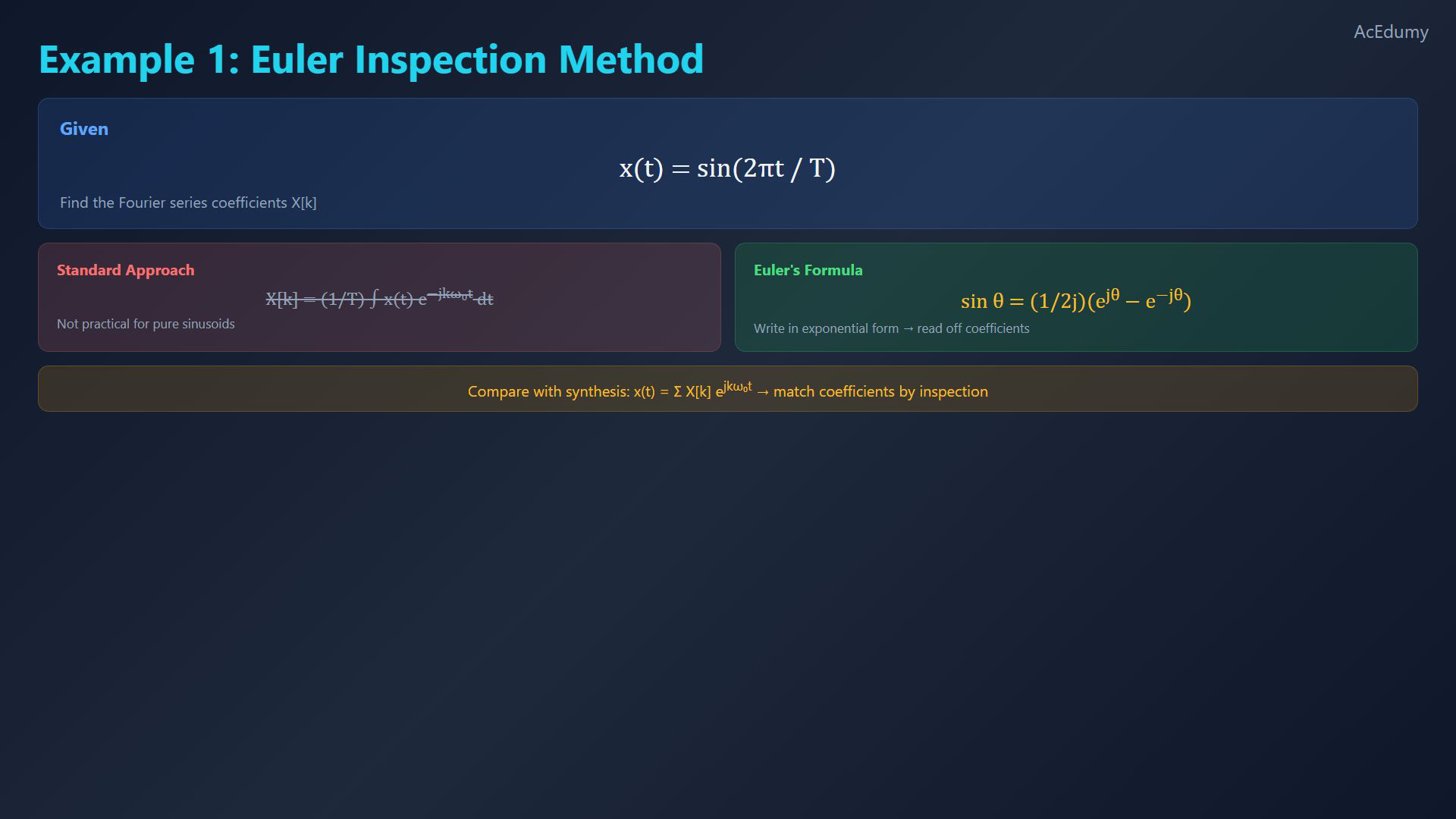
Let's start with Example 1. Given x of t equals sine of two pi t over T. We want to find the Fourier series coefficients X of k. The standard approach would be to evaluate the analysis integral: X of k equals one over T times the integral over one period of x of t times e to the negative j k two pi over T t, d t. But for a pure sinusoid, there's a much easier way. We use Euler's formula: sine theta equals one over two j times the quantity e to the j theta minus e to the negative j theta.
3. Sine coefficients
Original-video reference. The crossed-out analysis integral remains mathematically valid; the card recommends the shorter Euler inspection method for these examples. Every one-over-two-j factor means one divided by the entire product two j, and multiplies the complete indicated difference. In the last card, flat describes the equal heights of the six nonzero stems only; DC and every other harmonic are zero. Apply the common factor to both terms:Compare with the synthesis convention:The neighboring synthesis terms:Only these two coefficients are nonzero:Kronecker impulse notation:Narration transcript
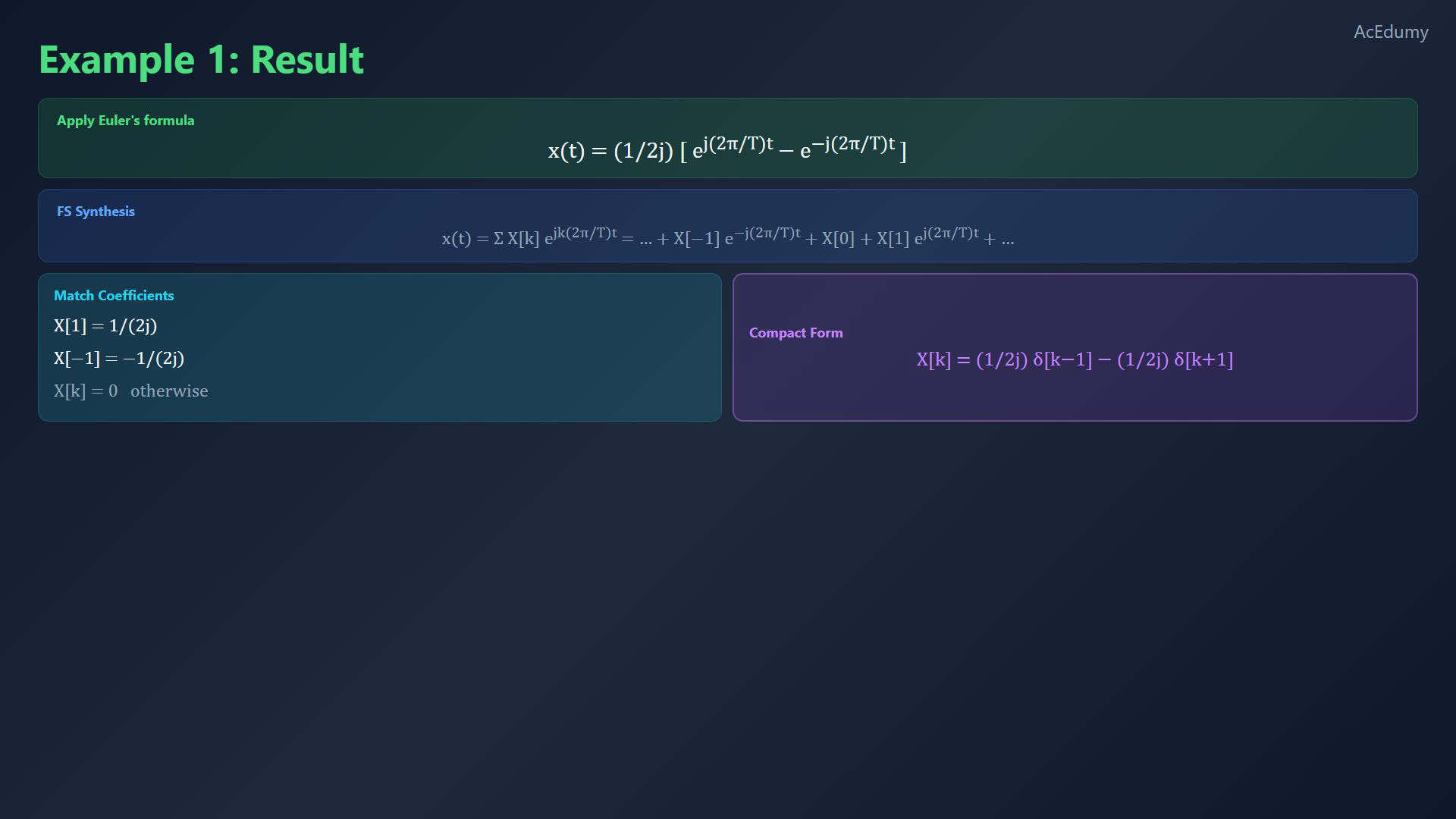
Applying Euler's formula, we write: x of t equals one over two j times e to the j two pi over T t, minus e to the negative j two pi over T t. Now compare this with the Fourier series synthesis equation: x of t equals the sum over all k of X of k times e to the j k two pi over T t. Expanding the synthesis: we have dot dot dot plus X of negative one times e to the negative j two pi over T t, plus X of zero, plus X of one times e to the j two pi over T t, plus dot dot dot. By matching coefficients, we see that X of one equals one over two j, X of negative one equals negative one over two j, and X of k equals zero for all other values of k. In compact form: X of k equals one over two j times delta of k minus one, minus one over two j times delta of k plus one.
4. Cosine coefficients
Original-video reference. The crossed-out analysis integral remains mathematically valid; the card recommends the shorter Euler inspection method for these examples. Every one-over-two-j factor means one divided by the entire product two j, and multiplies the complete indicated difference. In the last card, flat describes the equal heights of the six nonzero stems only; DC and every other harmonic are zero. Apply the same method to cosine.Given:Group the complete numerator sum:Apply one half to both exponentials:Only these two coefficients are nonzero:Kronecker impulse notation:The sine coefficients are purely imaginary.The two nonzero cosine coefficients are real and each equals one half.These real signals have odd sine symmetry and even cosine symmetry.Narration transcript
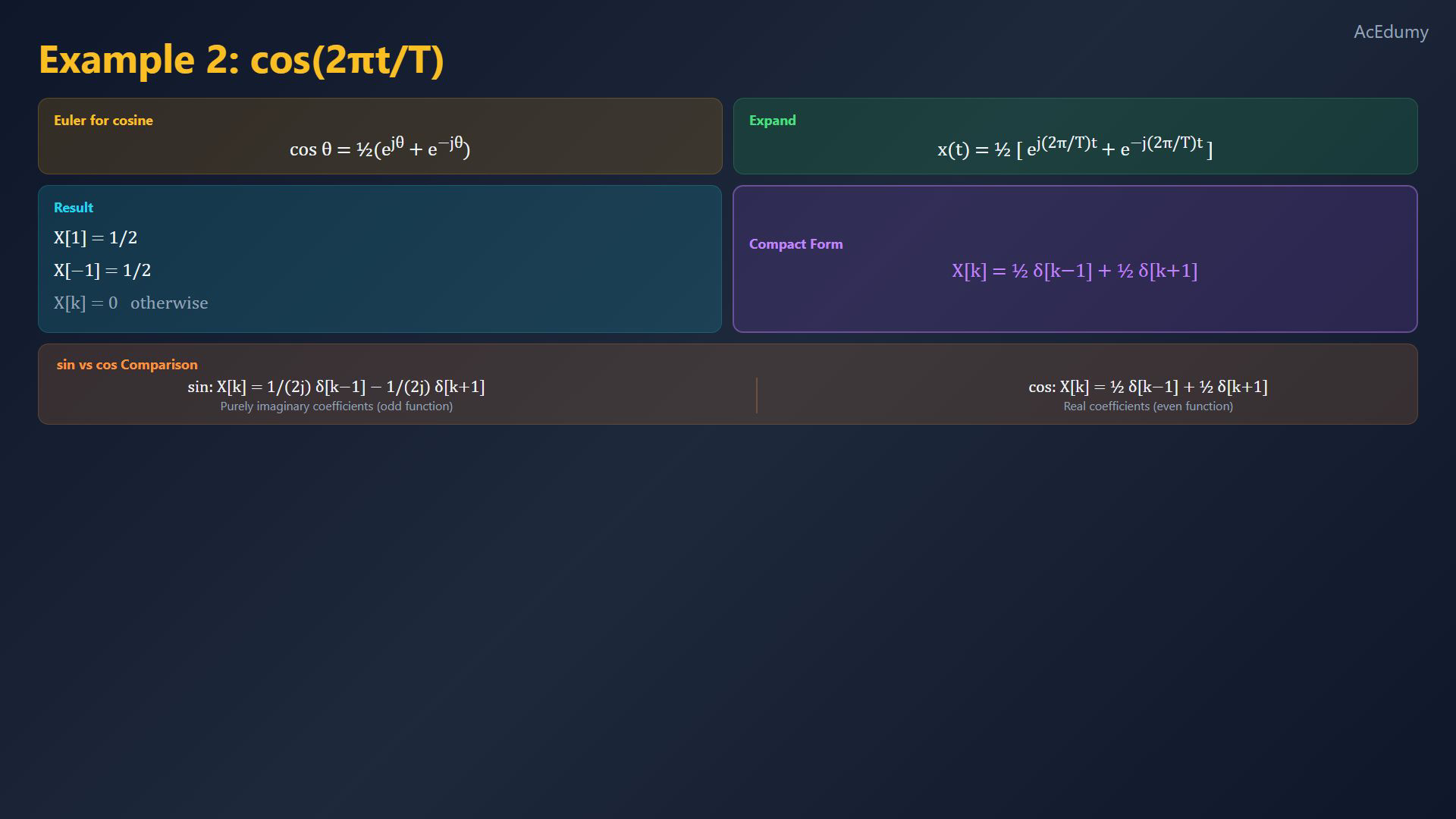
Example 2 follows the same method. Given x of t equals cosine of two pi t over T. Using Euler's formula for cosine: cosine theta equals one half times e to the j theta plus e to the negative j theta. So x of t equals one half times e to the j two pi over T t, plus e to the negative j two pi over T t. Comparing with the synthesis equation, we immediately see that X of one equals one half, X of negative one equals one half, and all other coefficients are zero. In delta notation: X of k equals one half delta of k minus one, plus one half delta of k plus one. Notice a key difference: for sine, the coefficients were purely imaginary, involving one over two j. For cosine, the coefficients are real, both equal to one half. This is because cosine is an even function and sine is an odd function.
5. Find the common period
Original-video reference. The crossed-out analysis integral remains mathematically valid; the card recommends the shorter Euler inspection method for these examples. Every one-over-two-j factor means one divided by the entire product two j, and multiplies the complete indicated difference. In the last card, flat describes the equal heights of the six nonzero stems only; DC and every other harmonic are zero. Consider three distinct cosine harmonics.Given:Find the fundamental period of the sum.A cosine with frequency f:First term:Second term:Third term:Use the least common positive multiple of the three periods.The smallest shared period and angular frequency:Narration transcript
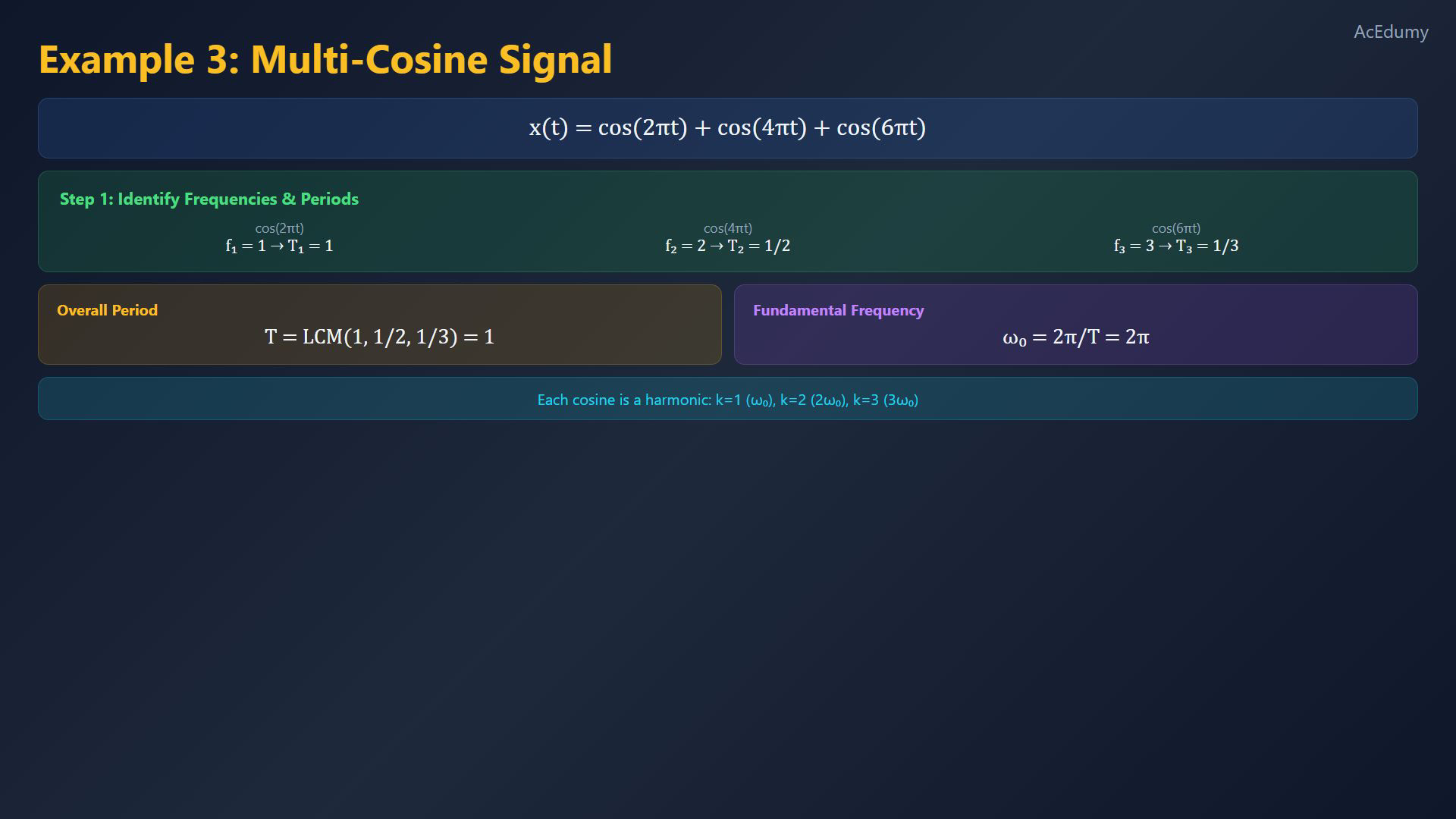
Example 3 is more interesting. Given x of t equals cosine two pi t plus cosine four pi t plus cosine six pi t. First, we need to find the overall period. Each cosine has the form cosine of two pi f t. The first term has frequency f one equals one and period T one equals one. The second has f two equals two and period T two equals one half. The third has f three equals three and period T three equals one third. The overall period T is the least common multiple of T one, T two, and T three. Since LCM of 1, one half, and one third equals 1, we have T equals 1 and omega zero equals two pi.
6. Six nonzero coefficients

Original-video reference. The crossed-out analysis integral remains mathematically valid; the card recommends the shorter Euler inspection method for these examples. Every one-over-two-j factor means one divided by the entire product two j, and multiplies the complete indicated difference. In the last card, flat describes the equal heights of the six nonzero stems only; DC and every other harmonic are zero. Expand each cosine using Euler identity.Six exponential terms:With the stated fundamental, the harmonic indices are:Each of these six coefficients equals one half.At plus and minus one, two and three, respectively:The six nonzero stems have equal height; DC and all other harmonics are zero.This finite pattern will be used when studying Fourier transform pairs.Next: a systematic list of Fourier series properties.Narration transcript
Now we expand each cosine using Euler's formula. x of t equals one half times the sum of six complex exponentials: e to the j two pi t, e to the negative j two pi t, e to the j four pi t, e to the negative j four pi t, e to the j six pi t, and e to the negative j six pi t. Since omega zero equals two pi, these correspond to k equals one, negative one, two, negative two, three, and negative three respectively. Each has coefficient one half. So: X of k equals one half for k equals plus or minus 1, plus or minus 2, and plus or minus 3, and zero otherwise. The magnitude spectrum has six equal stems at the six harmonic frequencies, forming a flat spectrum. This pattern will become important when we later study Fourier transform pairs. In the next lesson, we'll formalize the full list of Fourier series properties.
Source video: Signals & Systems #24 | Fourier Series Coefficient Computation Examples (5:49)