Signals and Systems · Fourier series
#21 Periodicity, integer harmonics, synthesis and the DC average
Describe a periodic signal through its fundamental period, harmonic sinusoids and average value.
Question
Use real, piecewise smooth periodic signals with a fundamental period when one exists. Choose T as the smallest positive period; the identity x(t+T)=x(t) alone also holds for nonfundamental periods. A constant signal has every positive period and no smallest positive period. An integer multiple kT is an invariant shift for every integer k; positive period durations use positive integers k. The zero shift is an identity, not a positive period. Here f0 is the fundamental frequency in cycles per unit time and omega0 is its angular frequency in radians per unit time. The first harmonic is a basis component and can have zero coefficient in a particular signal. The Fourier series converges to the signal at continuity points and to the midpoint of its one-sided limits at a jump under the stated piecewise smooth assumptions. It also gives mean-square convergence over one period. Do not infer pointwise equality at arbitrarily assigned jump values or uniform convergence across jumps; Gibbs overshoot remains near square-wave jumps as more terms are included. The convention in this lesson puts the mean itself in a0, not a0 divided by two. The square wave is the zero-mean symmetric, fifty-percent-duty wave with levels plus one and minus one; only its odd harmonics occur. Its displayed construction uses sin(n pi t), so its fundamental period is two. The separate cosine harmonic diagram uses omega0 equal to two pi, so its fundamental period is one; these are different illustrative scales. The even and odd symmetry labels on the synthesis card describe cosine and sine basis functions, not a restriction that every periodic input be even or odd.
Written solution and narration transcript(shows the full solution)
Below are all the lines written in the notebook together with the full narration transcript.
1. Why Fourier series
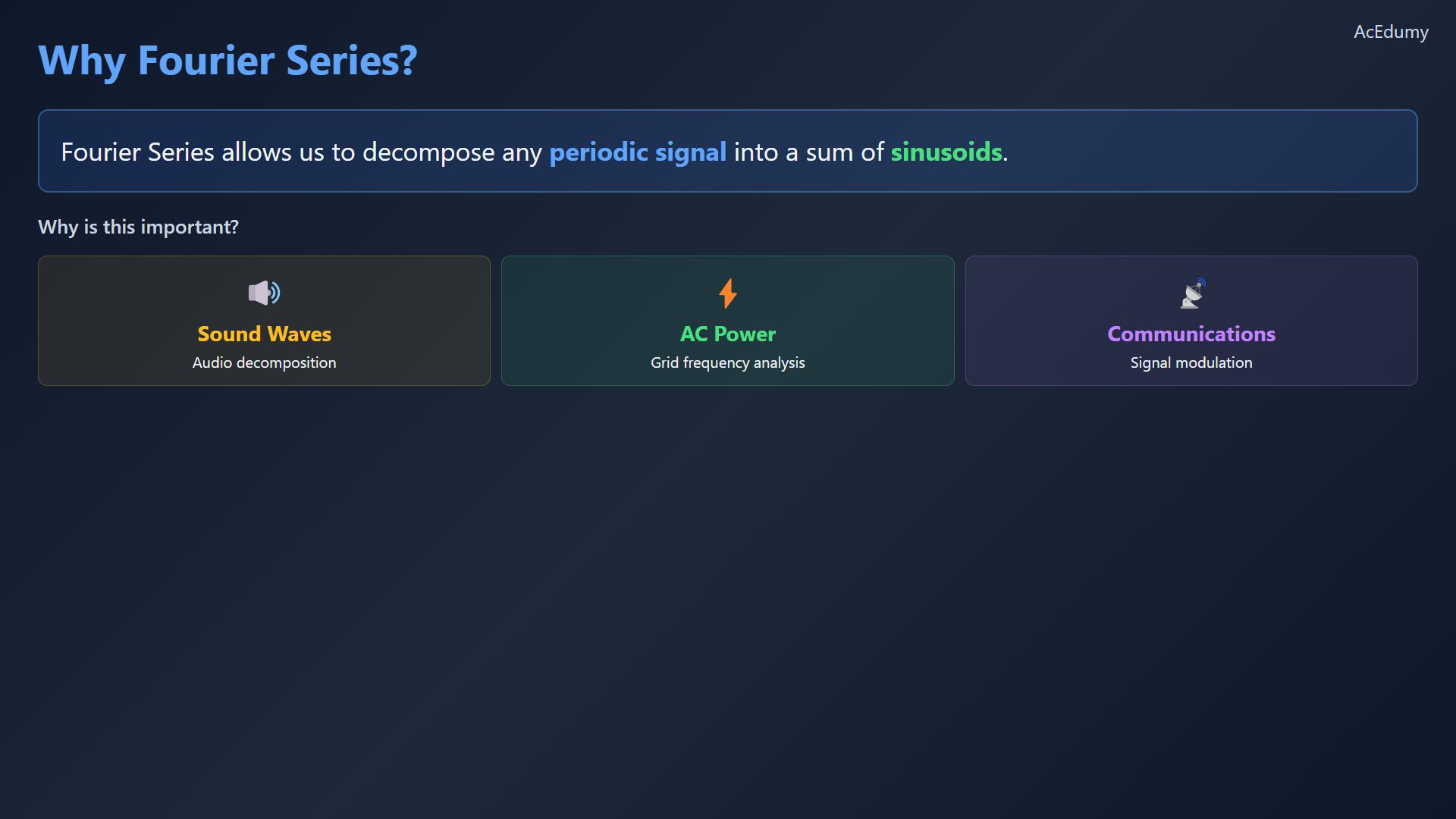
Original-video reference. The harmonic plot uses three separate time axes with equal scales and angular frequencies in the ratio one to two to three. For the square-wave decomposition step, the Fourier synthesis card is a formula reference, not a picture of a partial sum. The cosine and sine labels on that card describe the even and odd basis functions. Why use Fourier series?Elementary building blocks include step, impulse and ramp signals.Periodic signals arise in sound, alternating current and radio applications.For the stated signal class, Fourier series decomposes a periodic signal into sinusoids.This decomposition supports signal processing and communications.Narration transcript
Why do we need Fourier Series? Previously, we studied elementary signals like step, impulse, and ramp. But real-world signals are often periodic, like sound waves, alternating current, and radio signals. Fourier Series allows us to decompose any periodic signal into a sum of sinusoids. This is fundamental to signal processing, communications, and many engineering applications.
2. Period and fundamental frequency
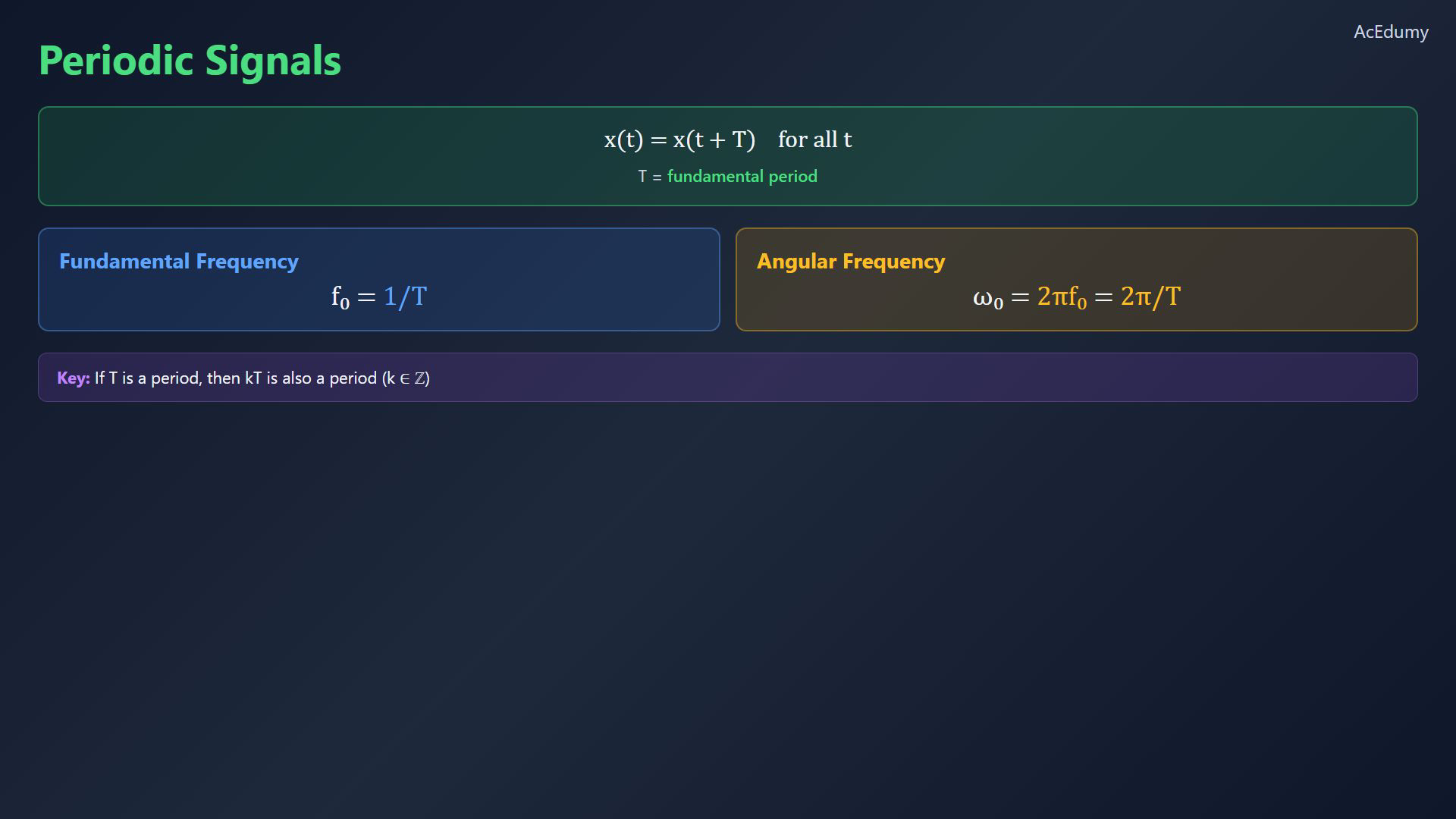
Original-video reference. The harmonic plot uses three separate time axes with equal scales and angular frequencies in the ratio one to two to three. For the square-wave decomposition step, the Fourier synthesis card is a formula reference, not a picture of a partial sum. The cosine and sine labels on that card describe the even and odd basis functions. A periodic signal repeats after a positive time interval.Choose a fundamental period when it exists:Fundamental and angular frequency:For every integer k, an invariant shift:The fundamental period is the smallest positive period; positive multiples are also periods.Narration transcript
A periodic signal repeats itself at regular intervals. Formally, x of t equals x of t plus T for all t, where T is the fundamental period. The fundamental frequency is f equals one over T, and the angular frequency is omega equals two pi f. If a signal has period T, it also has period k T for any integer k. The smallest positive T is the fundamental period.
3. Integer harmonics
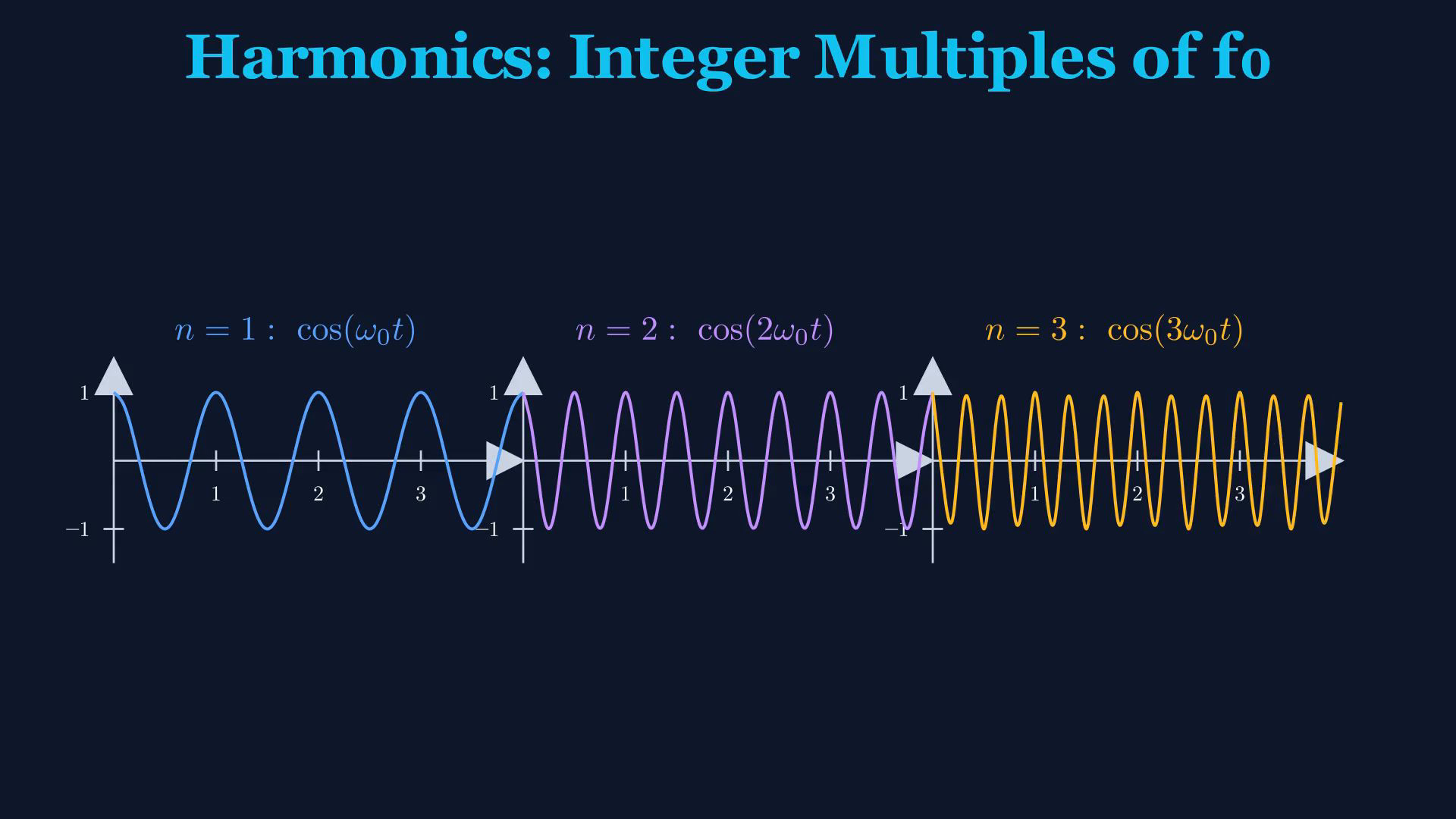
Original-video reference. The harmonic plot uses three separate time axes with equal scales and angular frequencies in the ratio one to two to three. For the square-wave decomposition step, the Fourier synthesis card is a formula reference, not a picture of a partial sum. The cosine and sine labels on that card describe the even and odd basis functions. Fourier basis sinusoids are harmonically related.First harmonic frequency:Second and third harmonic frequencies:These components are called harmonics.For positive integer n:Octave-related musical frequencies share harmonic relationships.Narration transcript
When we decompose a periodic signal, we get harmonically related sinusoids. The fundamental frequency is the first harmonic, with frequency f zero. The second harmonic has frequency two f zero, the third has three f zero, and so on. These are called harmonics. Each harmonic is an integer multiple of the fundamental frequency. This is why musical notes at octave intervals sound similar: they share harmonic relationships.
4. Synthesis equation
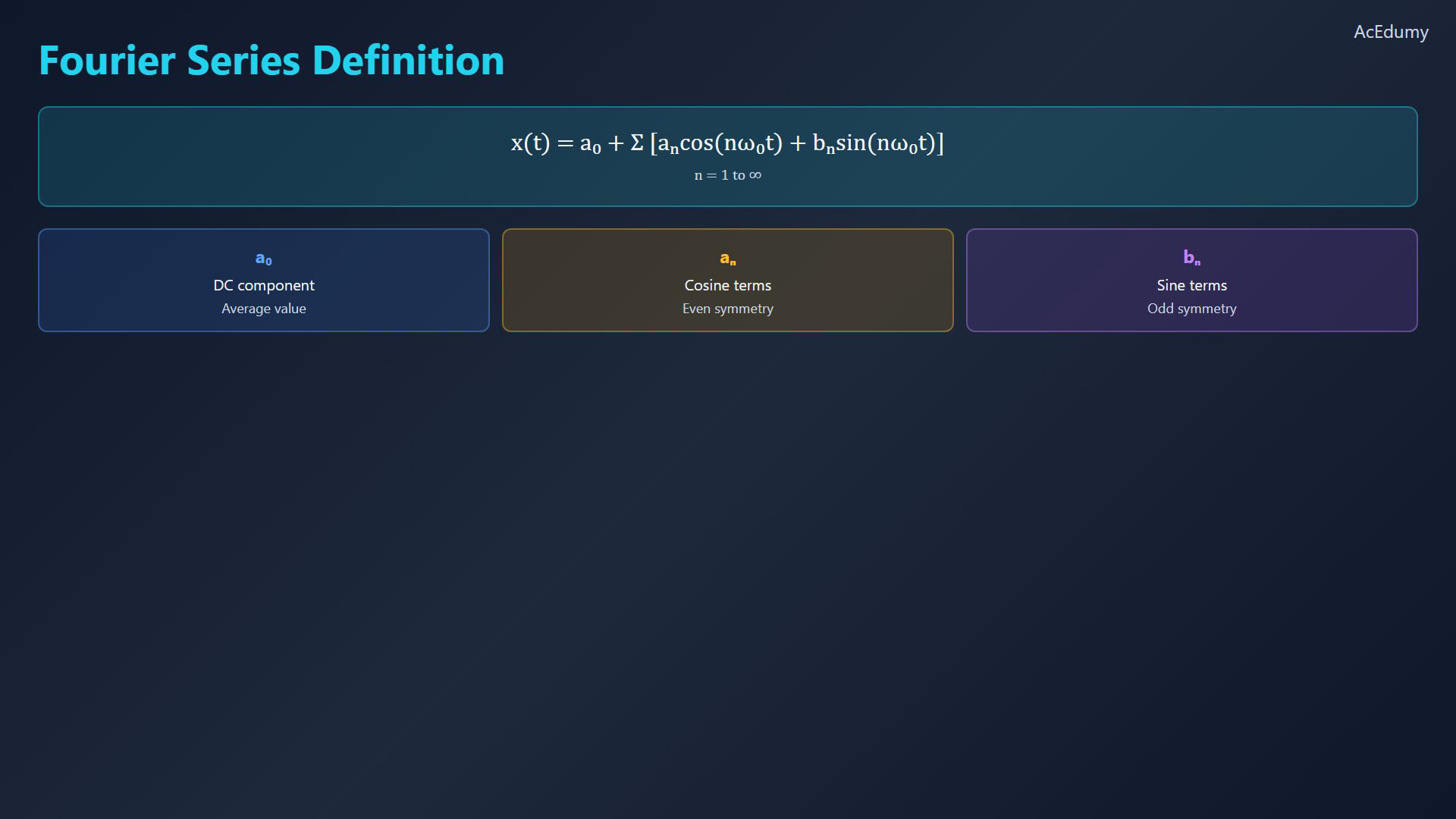
Original-video reference. The harmonic plot uses three separate time axes with equal scales and angular frequencies in the ratio one to two to three. For the square-wave decomposition step, the Fourier synthesis card is a formula reference, not a picture of a partial sum. The cosine and sine labels on that card describe the even and odd basis functions. Use an infinite harmonic sum, with the stated convergence convention.Synthesis at continuity points:Cosine and sine coefficients specify the contribution of each harmonic.Euler identity gives an equivalent complex-exponential representation.Narration transcript
The Fourier Series represents a periodic signal as an infinite sum of harmonically related sinusoids. The synthesis equation is x of t equals a zero plus the sum from n equals one to infinity of a n cosine of n omega zero t plus b n sine of n omega zero t. The coefficients a n and b n tell us how much of each harmonic is present. Alternatively, we can write it in terms of complex exponentials using Euler's formula.
5. DC average
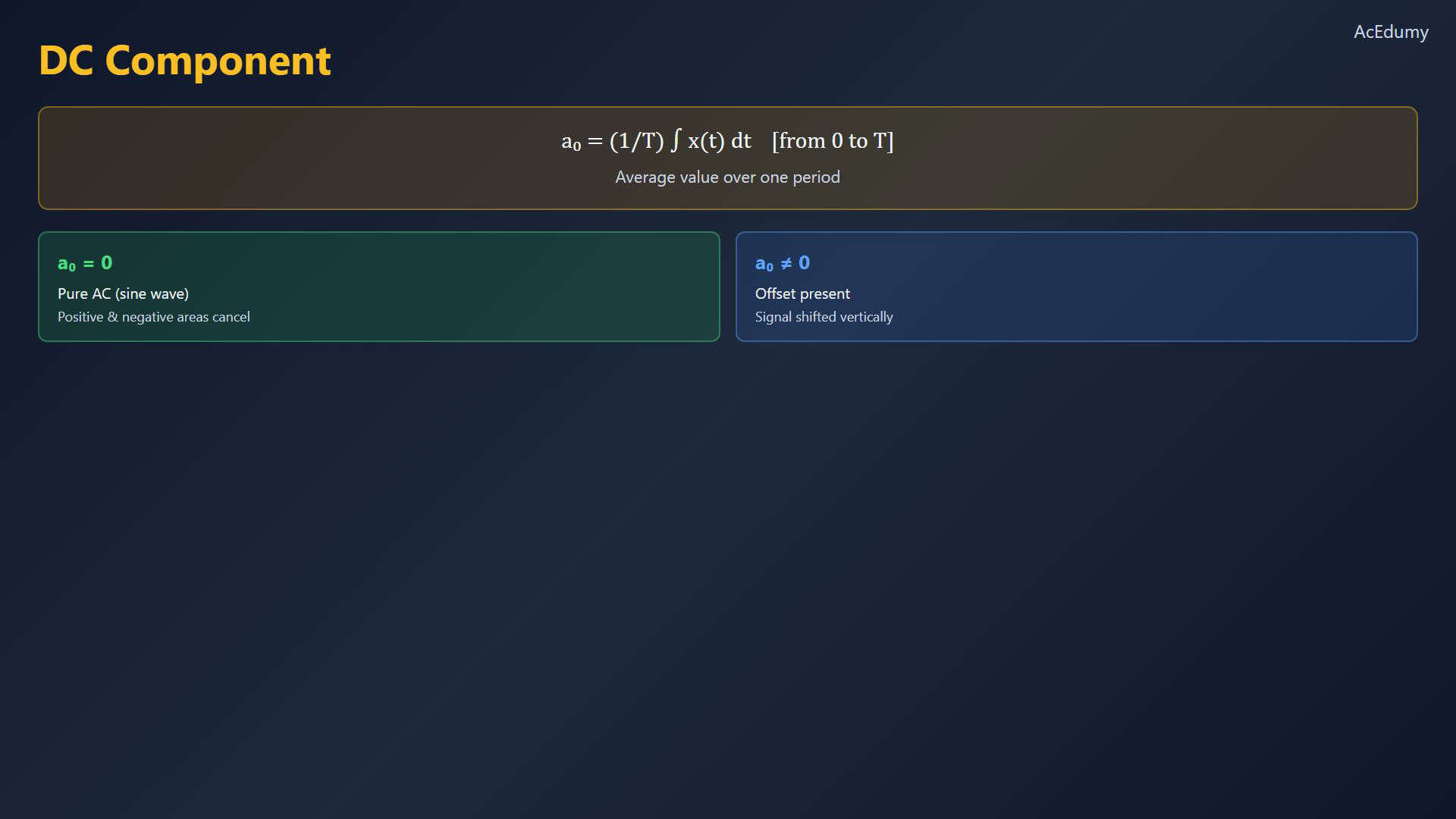
Original-video reference. The harmonic plot uses three separate time axes with equal scales and angular frequencies in the ratio one to two to three. For the square-wave decomposition step, the Fourier synthesis card is a formula reference, not a picture of a partial sum. The cosine and sine labels on that card describe the even and odd basis functions. The DC component is the mean value, denoted by a0.It is the mean over one full period.Use the mean convention:Equal positive and negative signed areas:A pure sine wave with no offset has zero mean:Narration transcript
The a zero term is the DC component, also called the average value or offset. It represents the mean level of the signal over one period. To find the DC component, we integrate x of t from zero to T and divide by T. If the positive and negative areas cancel, the DC component is zero. For a pure sine wave with no offset, a zero equals zero.
6. Build a square wave
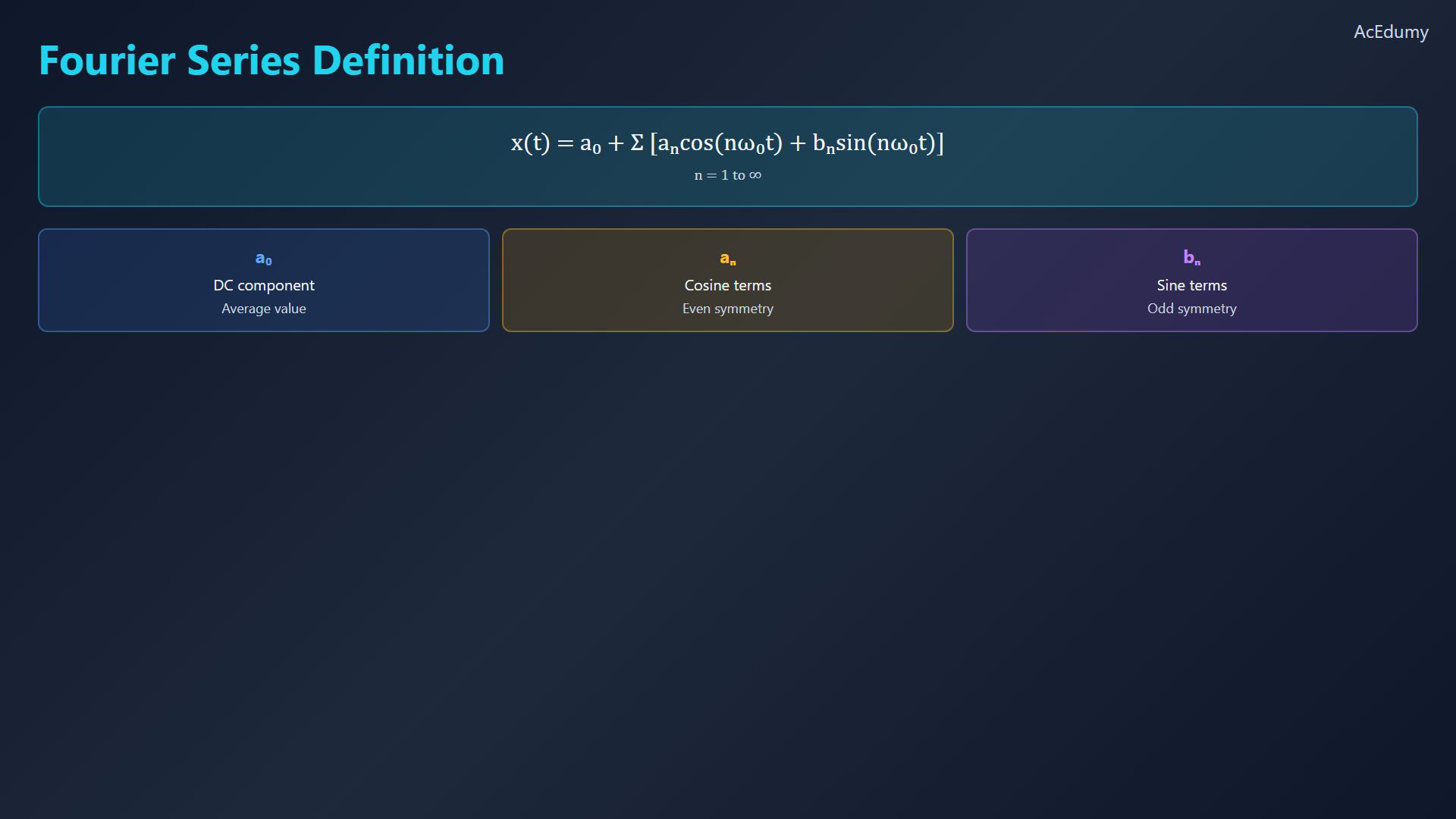
Original-video reference. The harmonic plot uses three separate time axes with equal scales and angular frequencies in the ratio one to two to three. For the square-wave decomposition step, the Fourier synthesis card is a formula reference, not a picture of a partial sum. The cosine and sine labels on that card describe the even and odd basis functions. Build a periodic waveform by adding sinusoids.Consider the symmetric square wave with zero mean and equal positive and negative half-periods.Its nonzero harmonic indices are odd:The fundamental gives the initial approximation.Add the third harmonic to sharpen the transition.Add the fifth harmonic to refine the transition further.More terms converge away from jumps; at jumps the limit is the midpoint, with Gibbs overshoot nearby.Fourier series provides a systematic sinusoidal decomposition.Narration transcript
Let us visualize how a periodic signal builds from sinusoids. Consider a square wave. Its Fourier Series contains only odd harmonics: one, three, five, seven, and so on. The fundamental gives the basic shape. Adding the third harmonic makes the corners sharper. Adding the fifth sharpens them further. As we add more harmonics, the approximation approaches the original square wave. This is the power of Fourier Series.
7. Summary

Original-video reference. The harmonic plot uses three separate time axes with equal scales and angular frequencies in the ratio one to two to three. For the square-wave decomposition step, the Fourier synthesis card is a formula reference, not a picture of a partial sum. The cosine and sine labels on that card describe the even and odd basis functions. Fourier series describes the stated periodic signal class.Fundamental period and angular frequency:Harmonic frequencies are integer multiples of the fundamental.Cosine and sine coefficients specify the harmonic sum.Next: derive the coefficient formulas from the signal.Narration transcript
In this lesson, we introduced Fourier Series for decomposing periodic signals. We defined periodicity with period T and fundamental frequency omega zero. We learned that harmonics are integer multiples of the fundamental. The Fourier Series expresses any periodic signal as a sum of sinusoids with coefficients a n and b n. In the next lesson, we will derive the formulas for calculating these coefficients from the signal itself.
Source video: Signals & Systems #21 | Fourier Series - Periodic Signals & Harmonics (3:43)