Signals and Systems · Fourier series properties
#25 Linearity, shifting, conjugation, reversal and real-signal symmetry
Transform Fourier coefficients using five basic properties and derive conjugate symmetry for real periodic signals.
Question

Use a common positive period T and the same Fourier basis for both signals, with omega zero equal to two pi divided by T. A common period need not be fundamental; retain the chosen basis after any transformation. The synthesis convention has no prefactor, and analysis has one divided by T. The coefficients and the constants A and B may be complex. A delay uses x of t minus t zero and the negative phase factor; an advance has the opposite sign. Time shift preserves magnitudes, with phase understood only at nonzero coefficients. In the substitution t prime equal to t minus t zero, the interval from zero to T becomes minus t zero to T minus t zero; the integrand remains T periodic for integer k, so its integral over any complete period is the same. The complete sum t prime plus t zero belongs inside the exponential. Frequency-shift index M must be an integer to stay on this same Fourier-series grid; for noninteger M, the stated index-shift rule on this grid does not apply. Superscript star denotes complex conjugation, not convolution or multiplication. In x equal to a plus j b, a and b are real-valued. Conjugation reverses and conjugates the coefficients, while time reversal reverses their indices without conjugation. For a real signal, X at k equals the conjugate of X at minus k; DC is real and may be negative. Magnitude is even, while opposite-index phases are negatives modulo two pi at nonzero coefficients. Principal phases of negative-real coefficients can both be pi, so do not assert literal oddness for every principal-phase convention; phases at zero coefficients are undefined. In the trigonometric synthesis, A_k denotes the real part of X[k] and B_k the imaginary part; the sine term has a minus sign and the factor two multiplies the complete positive-index sum. Use a Fourier-series convergence interpretation appropriate to the signal: equality at continuous points under piecewise smooth conditions, the midpoint at jumps, or equality in square-integrable mean. The real-symmetry card contains a raw angle entity for the phase operator. The summary card with the malformed exponent is excluded and replaced by the original overview reference; written equations preserve the full superscript.
Written solution and narration transcript(shows the full solution)
Below are all the lines written in the notebook together with the full narration transcript.
1. Overview
Original-video reference. The summary uses the overview card at 36.09 seconds because the original summary loses the superscript in the time-shift exponential. The literal angle entity visible on the time-shift and real-symmetry cards denotes the phase operator; it is explained here and in the written lines. Phase is defined only for nonzero coefficients, and the odd-phase relation is modulo two pi with consistent phase choices. The integral subscript T on the proof card means any complete period, including the shifted integration interval after substitution. No pixels were edited. Recall Euler inspection of three example signals.Begin the properties of Fourier series coefficients.Find coefficients of transformed signals without repeating integration.Cover linearity, time shift, frequency shift, conjugation and time reversal.Prove time shifting and examine real-signal symmetry.Narration transcript
In the previous lesson, we computed Fourier series coefficients for three example signals using Euler's identity. Now we begin exploring the properties of Fourier series coefficients. These properties are powerful tools that let us find coefficients of transformed signals without recomputing integrals. In this lesson, we cover the first five properties: linearity, time shifting, frequency shifting, conjugation, and time reversal. We'll also prove the time shifting property, and discuss what happens when the signal is real.
2. Linearity and time shift

Original-video reference. The summary uses the overview card at 36.09 seconds because the original summary loses the superscript in the time-shift exponential. The literal angle entity visible on the time-shift and real-symmetry cards denotes the phase operator; it is explained here and in the written lines. Phase is defined only for nonzero coefficients, and the odd-phase relation is modulo two pi with consistent phase choices. The integral subscript T on the proof card means any complete period, including the shifted integration interval after substitution. No pixels were edited. Set a common positive period and Fourier basis.For the chosen period:Use the same period and harmonic indices for both signals.Property one is linearity.For A times x plus B times y, the coefficients are:This follows from linearity of integration.Property two is time shifting.For a delay by t zero:The multiplier is a complex phase factor.Magnitudes are unchanged; phases change where the coefficients are nonzero.Narration transcript
Let's set up the notation. Given x of t, periodic with period T, its Fourier series coefficients are X of k. Similarly, y of t, periodic with the same period T, has coefficients Y of k. Property 1 is linearity. If we form A times x of t plus B times y of t, the coefficients are simply A times X of k plus B times Y of k. This follows directly from the linearity of integration. Property 2 is time shifting. If we shift x of t by t zero to get x of t minus t zero, the coefficients become X of k times e to the minus j k times two pi over T times t zero. Notice that time shifting multiplies the coefficients by a complex exponential phase factor. The magnitudes remain the same, only the phases change.
3. Prove time shifting
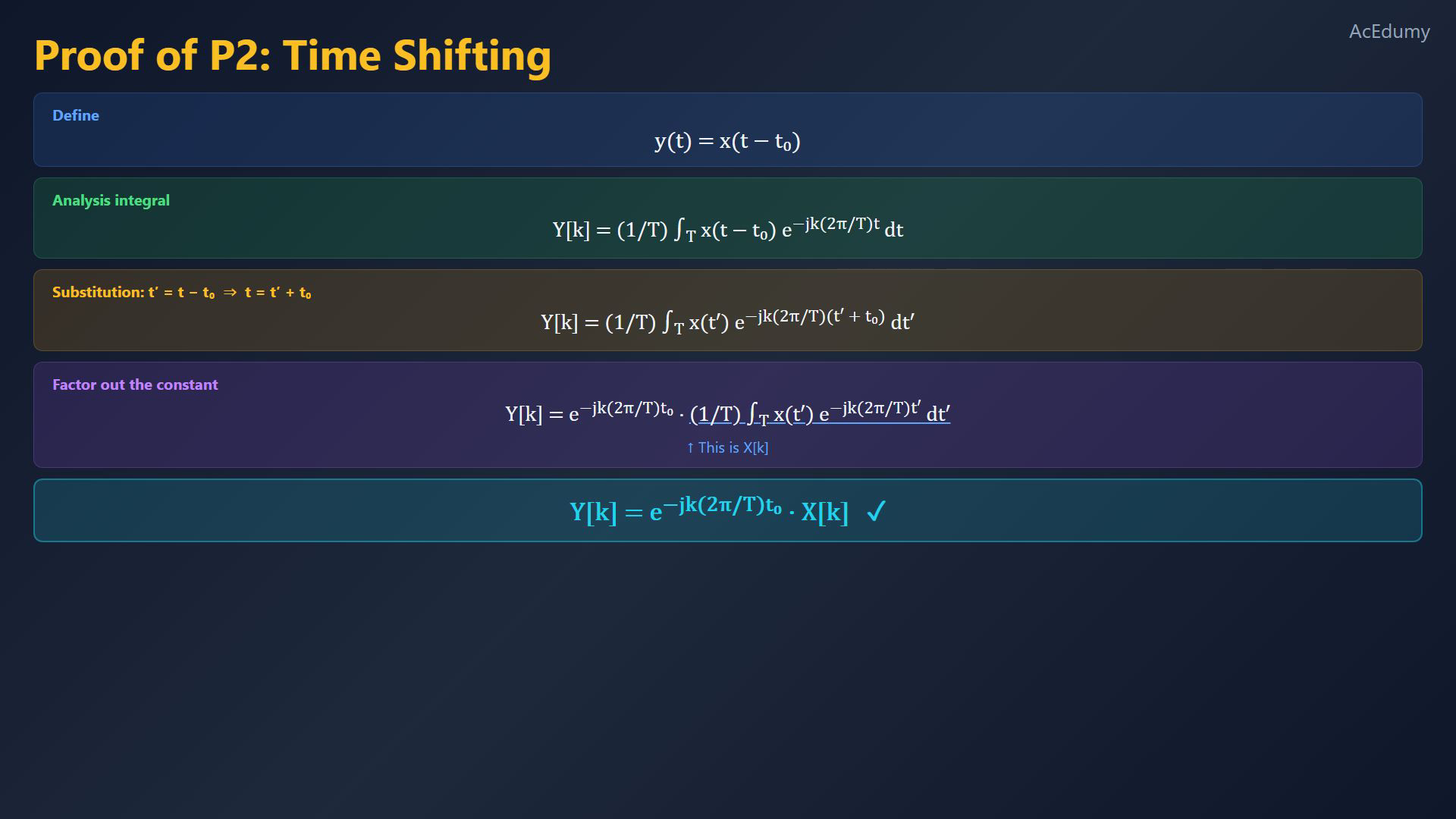
Original-video reference. The summary uses the overview card at 36.09 seconds because the original summary loses the superscript in the time-shift exponential. The literal angle entity visible on the time-shift and real-symmetry cards denotes the phase operator; it is explained here and in the written lines. Phase is defined only for nonzero coefficients, and the odd-phase relation is modulo two pi with consistent phase choices. The integral subscript T on the proof card means any complete period, including the shifted integration interval after substitution. No pixels were edited. Prove property two using the analysis integral.Define the delayed signal:Integrate over one complete period:Substitute the delayed input:Change variable and shift the interval:The shifted interval and complete exponent:Factor out the constant:The remaining integral is the same coefficient over a complete shifted period.The time-shift rule follows:Narration transcript
Let's prove Property 2. Define y of t equals x of t minus t zero. The coefficient Y of k equals one over T, times the integral over one period of y of t, times e to the minus j k two pi over T t, d t. Substituting, we get one over T integral of x of t minus t zero, times e to the minus j k two pi over T t, d t. Let t prime equal t minus t zero, so t equals t prime plus t zero and d t equals d t prime. The integral becomes one over T integral of x of t prime, times e to the minus j k two pi over T, times the quantity t prime plus t zero, d t prime. We factor out the constant e to the minus j k two pi over T times t zero. The remaining integral is one over T integral of x of t prime, e to the minus j k two pi over T t prime, d t prime, which is exactly X of k. Therefore, Y of k equals e to the minus j k two pi over T times t zero, multiplied by X of k.
4. Frequency shift, conjugation and reversal
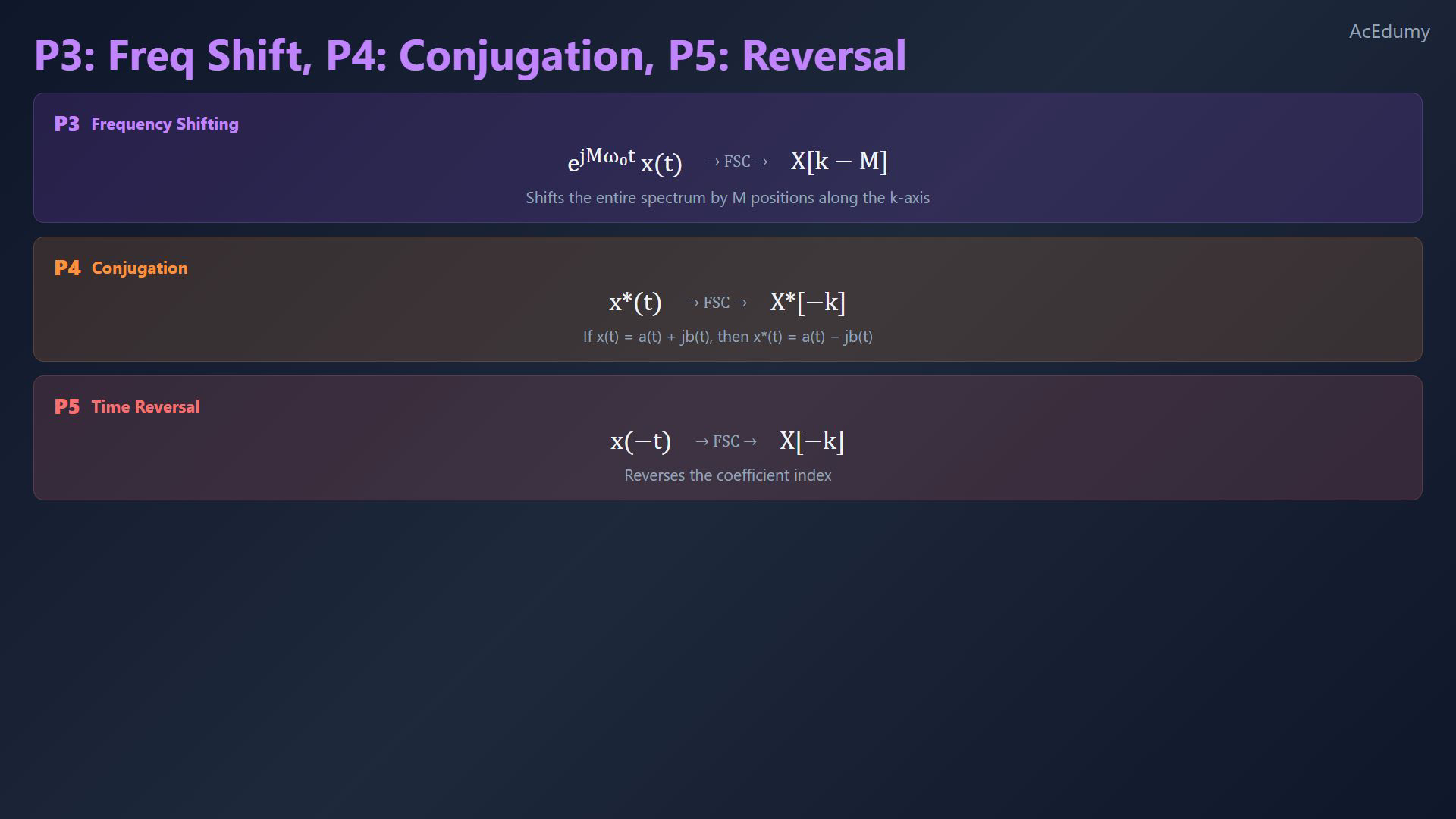
Original-video reference. The summary uses the overview card at 36.09 seconds because the original summary loses the superscript in the time-shift exponential. The literal angle entity visible on the time-shift and real-symmetry cards denotes the phase operator; it is explained here and in the written lines. Phase is defined only for nonzero coefficients, and the odd-phase relation is modulo two pi with consistent phase choices. The integral subscript T on the proof card means any complete period, including the shifted integration interval after substitution. No pixels were edited. Property three is frequency shifting on the same integer harmonic grid.After multiplying by the exponential at integer harmonic M:The spectrum shifts by M integer positions.Property four is complex conjugation.For the conjugated time signal:For real-valued a and b, conjugation changes the imaginary sign:Property five is time reversal.For x of minus t, the coefficients are:Reverse the coefficient index without conjugating.Narration transcript
Property 3 is frequency shifting. Multiplying x of t by a complex exponential e to the j M omega zero t shifts the coefficients in frequency: the result has coefficients X of k minus M. This shifts the entire spectrum by M positions along the k axis. Property 4 is conjugation. Taking the complex conjugate x star of t gives coefficients X star of minus k. Remember, if x of t equals a of t plus j b of t, then x star of t equals a of t minus j b of t. Property 5 is time reversal. Replacing t with minus t gives coefficients X of minus k. This reverses the index of the coefficient sequence.
5. Real-signal symmetry
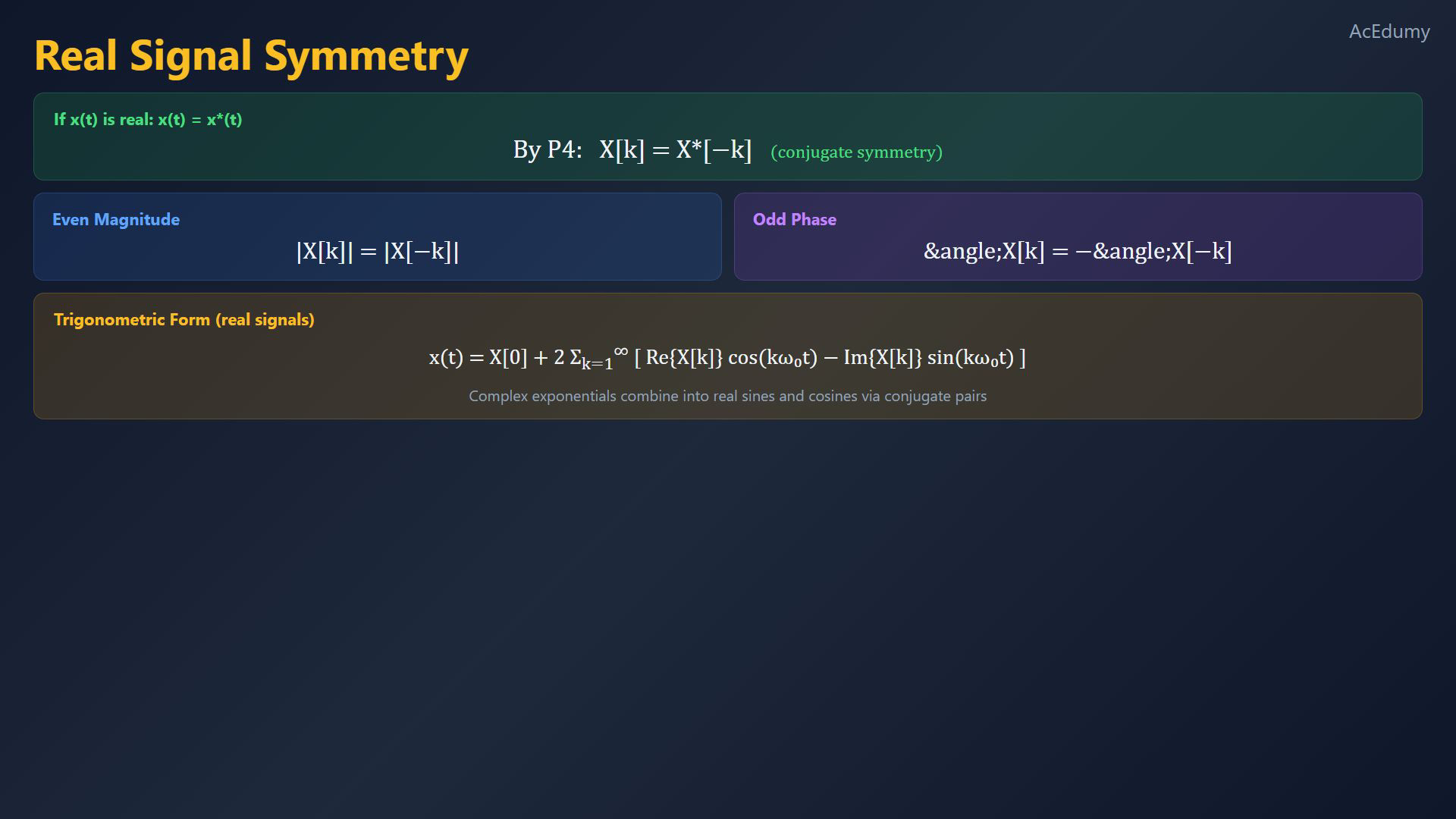
Original-video reference. The summary uses the overview card at 36.09 seconds because the original summary loses the superscript in the time-shift exponential. The literal angle entity visible on the time-shift and real-symmetry cards denotes the phase operator; it is explained here and in the written lines. Phase is defined only for nonzero coefficients, and the odd-phase relation is modulo two pi with consistent phase choices. The integral subscript T on the proof card means any complete period, including the shifted integration interval after substitution. No pixels were edited. Now assume the time signal is real.A real signal equals its complex conjugate:Property four yields:This is conjugate symmetry.It constrains both magnitude and phase.Magnitude is even:At nonzero coefficients, opposite-index phases are negatives modulo two pi.For real signals, use Ak and Bk for the real and imaginary coefficient parts.Pair positive and negative harmonics:Narration transcript
These properties have an important consequence for real signals. If x of t is real, then x of t equals x star of t. Applying Property 4, we get X of k equals X star of minus k. This is called conjugate symmetry. It has two consequences. First, the magnitude spectrum is even: the magnitude of X of k equals the magnitude of X of minus k. Second, the phase spectrum is odd: the angle of X of k equals minus the angle of X of minus k. For real signals, we can also write the Fourier series in trigonometric form. Since X of k and X of minus k are conjugate pairs, the complex exponentials combine into real sines and cosines: x of t equals X of zero, plus 2 times the sum from k equals 1 to infinity of, the real part of X of k times cosine k omega zero t, minus the imaginary part of X of k times sine k omega zero t.
6. Summary

Original-video reference. The summary uses the overview card at 36.09 seconds because the original summary loses the superscript in the time-shift exponential. The literal angle entity visible on the time-shift and real-symmetry cards denotes the phase operator; it is explained here and in the written lines. Phase is defined only for nonzero coefficients, and the odd-phase relation is modulo two pi with consistent phase choices. The integral subscript T on the proof card means any complete period, including the shifted integration interval after substitution. No pixels were edited. Summarize the five properties.Linearity combines coefficients with the same constants and common period.Time shift adds a phase factor and preserves magnitudes.An integer harmonic modulation shifts the spectrum by M positions.Conjugation both reverses and conjugates the coefficients.Time reversal reverses the coefficient index.Real signals have even magnitude and odd phase modulo two pi where nonzero.Next: periodic convolution, multiplication, differentiation, integration and Parseval.Narration transcript
Let's summarize the five fundamental properties we covered. Linearity preserves the coefficient structure. Time shifting adds a phase factor but keeps magnitudes unchanged. Frequency shifting translates the spectrum by M positions. Conjugation reverses and conjugates the coefficients. And time reversal reverses the coefficient index. For real signals, conjugate symmetry gives us even magnitude and odd phase spectra. In the next lesson, we continue with properties 6 through 11, including periodic convolution, multiplication, differentiation, integration, and Parseval's theorem.
Source video: Signals & Systems #25 | FS Properties Part 1 - Shifting, Reversal & Symmetry (5:58)