Signals and Systems · Fourier series and continuous-time Fourier transform
#29 One-period transform samples, rectangular coefficients and periodic distributions
Sample a one-period Fourier transform to obtain series coefficients, then express periodic spectra as weighted impulses.
Question
Let p(t) be a locally integrable periodic signal with a positive period T and finite integral of its absolute value over one period. It is called x-tilde in the source; C[k] denotes its Fourier-series coefficients called capital X-tilde. Choose any full period [a,a+T), define x(t) to equal p(t) there and zero elsewhere, and take X(omega) as its ordinary angular-frequency Fourier transform. Finite support alone would not ensure integrability for an arbitrary singular function; the assumed integrable period ensures X exists. Aperiodicity alone is not the existence reason. The source writes both endpoints inclusively; use a half-open interval for exact periodization without counting endpoints twice. Changing ordinary-function values at isolated endpoints does not change these integrals or coefficients. The generic source interval is [0,T); the rectangular example instead uses [-2,2), which is another valid full period. Different full-period windows need not have the same transform between harmonic samples; their samples at k omega0 agree. The standard convention has a negative exponential in the forward integral and a positive exponential divided by two pi in the inverse. Here omega0 is two pi divided by T and k is an integer. C[k]=X(k omega0)/T relates a single-period transform to Fourier coefficients. It does not equate that ordinary X to the transform of the periodic p. Write the latter as P(omega); it is the tempered-distribution impulse sum with complex weights two pi C[k], not a convergent ordinary integral or finite-height graph. Weights called areas can be complex. Fourier synthesis holds in a suitable function or distribution sense; at jumps of piecewise smooth signals the symmetric series converges to the midpoint of the one-sided limits. In the example T=4, the unit pulse occupies [-1,1] inside a centered full period [-2,2). X(omega)=2 sin(omega)/omega extends to X(0)=2, and C[k]=one half times normalized sinc(k/2), with C[0]=one half. Normalized sinc(u) is sin(pi*u)/(pi*u), continuously extended to one at zero. Nonzero even k coefficients vanish and signed odd coefficients alternate; these are coefficients, not magnitudes. The original example graph has half-width neighboring replicas, so it is excluded and an overview card is used only as a reference. In the summary, the rectangular pulse has general positive half-width T; this reuses the letter independently of the period-four example. Its zero-frequency transform is 2T. The shifted impulse is A delta(t-t0), with transform A exp(-j omega t0); impulses and the cosine transform are distributional pairs. For the cosine example omega0>0, the coefficients at plus and minus one are each one half and the two spectral weights are pi. If omega0=0 both impulses coincide and their weights add to two pi. All integer sums are over positive, zero and negative k. The original raw-text summary exponential is excluded, and the periodic-transform card is a labeled reference. Literal narration is preserved; this notebook does not claim human listening or publication approval.
Written solution and narration transcript(shows the full solution)
Below are all the lines written in the notebook together with the full narration transcript.
1. Connect Fourier series and transform
Original-video reference. Written steps use p(t) for the periodic x-tilde and C[k] for its capital-X-tilde series coefficients. X(omega) denotes the ordinary transform of one integrable period; P(omega) denotes the distributional transform of the periodic signal. The example uses the overview reference because the original example graph draws neighboring pulses too narrow. The summary uses the periodic-transform reference because its original shifted-impulse exponential appears as raw caret/braces text. These are reference cards, not replacement example graphs. Recall impulse and rectangular-pulse transform pairs.Connect Fourier-series coefficients with the one-period transform.Use transform samples to compute series coefficients.Derive the relation, apply the rectangular example, then transform periodic signals.Collect the transform pairs.Narration transcript
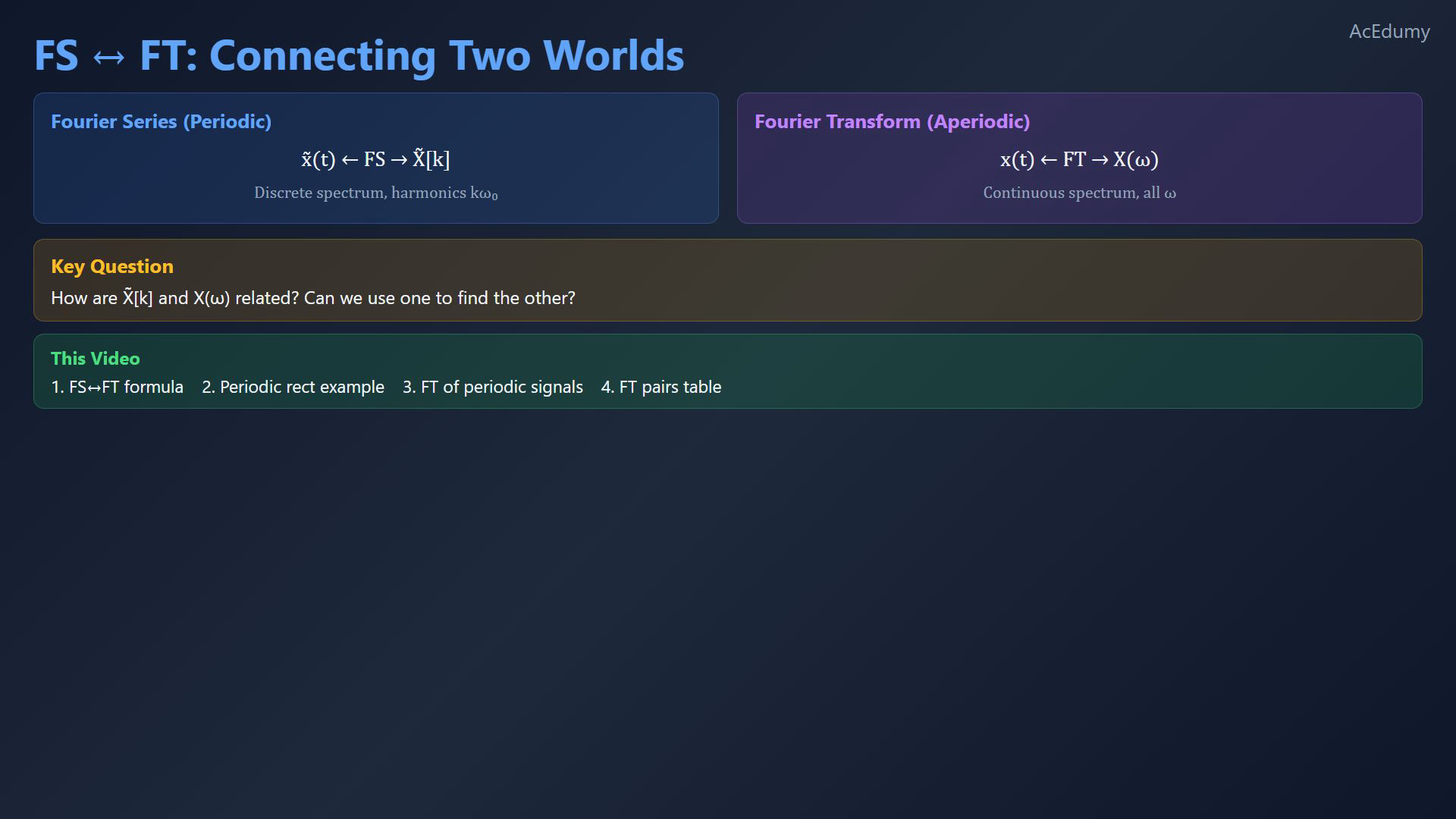
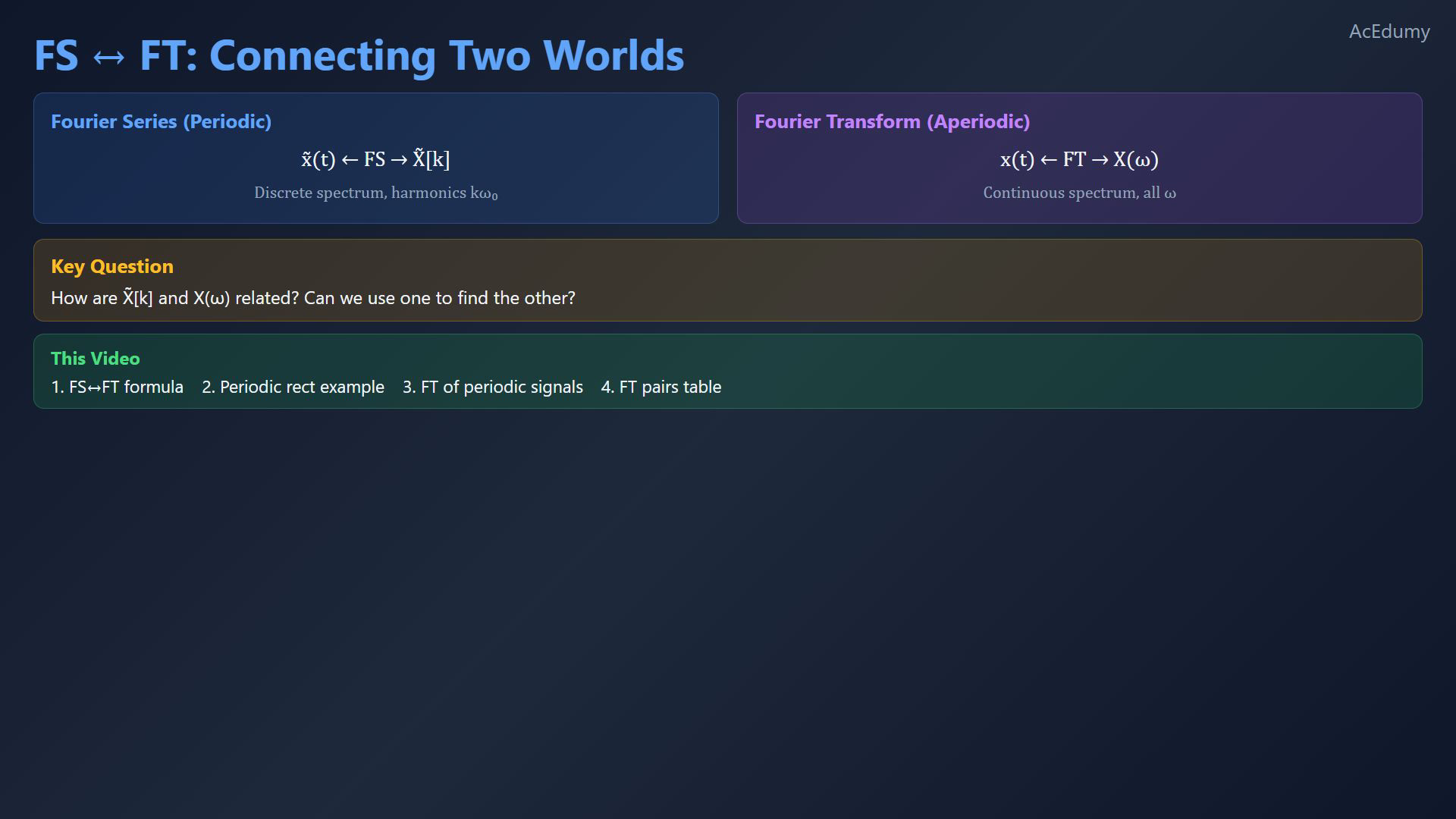
In the previous video, we computed our first Fourier Transform pairs: impulse functions, symmetric and anti-symmetric impulse pairs, and the rectangular pulse to sinc relationship. Now we'll take the next step and answer a fundamental question: what is the connection between Fourier Series coefficients and the Fourier Transform? This relationship is powerful because it lets us use FT results to quickly find FS coefficients, and vice versa. We'll derive the key formula, work through an example with a periodic rectangular pulse, then explore how to find the Fourier Transform of periodic signals using impulse functions. Finally, we'll compile a comprehensive table of Fourier Transform pairs.
2. Sample the one-period transform
Original-video reference. Written steps use p(t) for the periodic x-tilde and C[k] for its capital-X-tilde series coefficients. X(omega) denotes the ordinary transform of one integrable period; P(omega) denotes the distributional transform of the periodic signal. The example uses the overview reference because the original example graph draws neighboring pulses too narrow. The summary uses the periodic-transform reference because its original shifted-impulse exponential appears as raw caret/braces text. These are reference cards, not replacement example graphs. Connect the one-period transform to Fourier coefficients.Assume an integrable full period of the periodic signal.Write the periodization as p:The original x contains one full period of p.Use one half-open full period and set x to zero outside; endpoint values do not change the integral.The integrable one-period window has transform:Denote the Fourier-series coefficients of p by C[k].At harmonic frequencies, divide by the period:The sample spacing is:Narration transcript
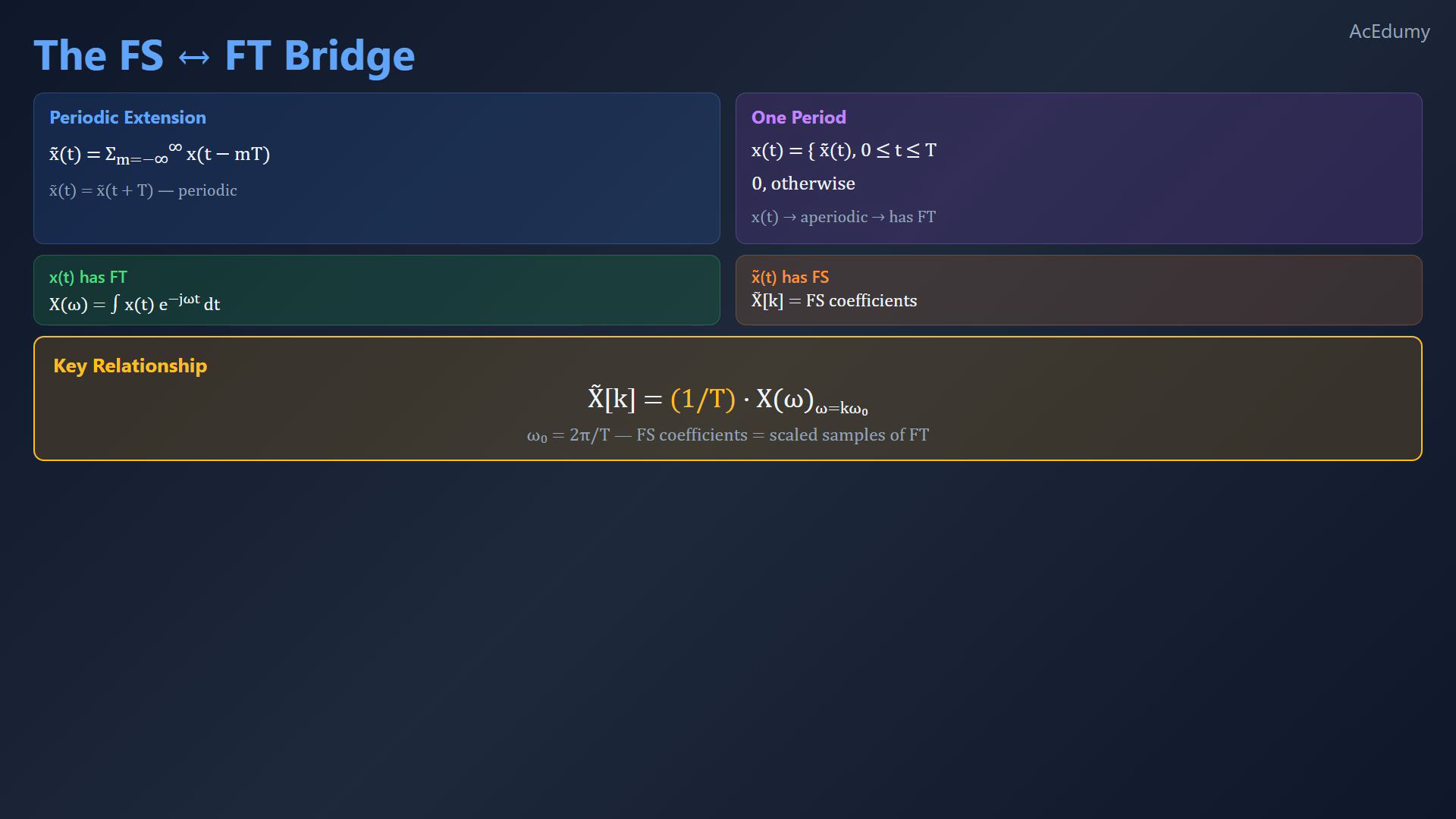
Let's build the bridge between Fourier Series and the Fourier Transform. Consider a periodic signal x-tilde of t with period capital T. We can construct it by periodically extending one period: x-tilde of t equals the sum from m equals negative infinity to infinity of x of t minus m T. Here, x of t is one period of x-tilde of t. It equals x-tilde of t for zero less than or equal to t less than or equal to T, and zero otherwise. Now, x of t is aperiodic, so it has a Fourier Transform: X of omega equals the integral of x of t times e to the minus j omega t, dt. Meanwhile, x-tilde of t is periodic, so it has Fourier Series coefficients X-tilde of k. The key relationship connecting them is: X-tilde of k equals one over T, times X of omega, evaluated at omega equals k omega-zero, where omega-zero equals two pi over T. In other words, the FS coefficients are samples of the Fourier Transform, scaled by one over T, taken at integer multiples of the fundamental frequency.
3. Rectangular pulse-train coefficients
Original-video reference. Written steps use p(t) for the periodic x-tilde and C[k] for its capital-X-tilde series coefficients. X(omega) denotes the ordinary transform of one integrable period; P(omega) denotes the distributional transform of the periodic signal. The example uses the overview reference because the original example graph draws neighboring pulses too narrow. The summary uses the periodic-transform reference because its original shifted-impulse exponential appears as raw caret/braces text. These are reference cards, not replacement example graphs. Apply the one-period sampling relation.The rectangular pulse train has period:The central unit pulse runs from minus one to plus one.Choose the centered full period from minus two to two.The single pulse has transform, continuously extended at zero:Sample and divide by the period:Here ω0 is pi over two; for nonzero k:Expand normalized sinc for nonzero k; the DC value is one half:The sampled transform yields the same coefficients as the direct series integral.Narration transcript
Let's apply this to an example. Consider x-tilde of t, a periodic rectangular pulse train with period T equals four. Each period has amplitude one from t equals minus one to t equals plus one. To find the FS coefficients, we first identify one period: x of t is a rectangular pulse from minus one to plus one. We already know its Fourier Transform from the previous video: X of omega equals two over omega, times sine of omega. Applying the key formula: X-tilde of k equals one over T, times X of omega, at omega equals k omega-zero. With T equals four and omega-zero equals two pi over four, which is pi over two: X-tilde of k equals one over four, times two sine of k pi over two, divided by k pi over two. This simplifies to one-half times sinc of k over two. Notice how efficiently we found the FS coefficients: instead of evaluating the integral directly, we just sampled the Fourier Transform that we already computed.
4. Distributional transform of periodic signals
Original-video reference. Written steps use p(t) for the periodic x-tilde and C[k] for its capital-X-tilde series coefficients. X(omega) denotes the ordinary transform of one integrable period; P(omega) denotes the distributional transform of the periodic signal. The example uses the overview reference because the original example graph draws neighboring pulses too narrow. The summary uses the periodic-transform reference because its original shifted-impulse exponential appears as raw caret/braces text. These are reference cards, not replacement example graphs. Now take the distributional transform of the periodic signal.Fourier synthesis is:Transform each exponential to obtain:These impulses lie at harmonics and have complex weights two pi times C[k].For cosine with positive fundamental frequency:Its distributional transform is:There are two impulses, at plus and minus the fundamental frequency.Narration transcript
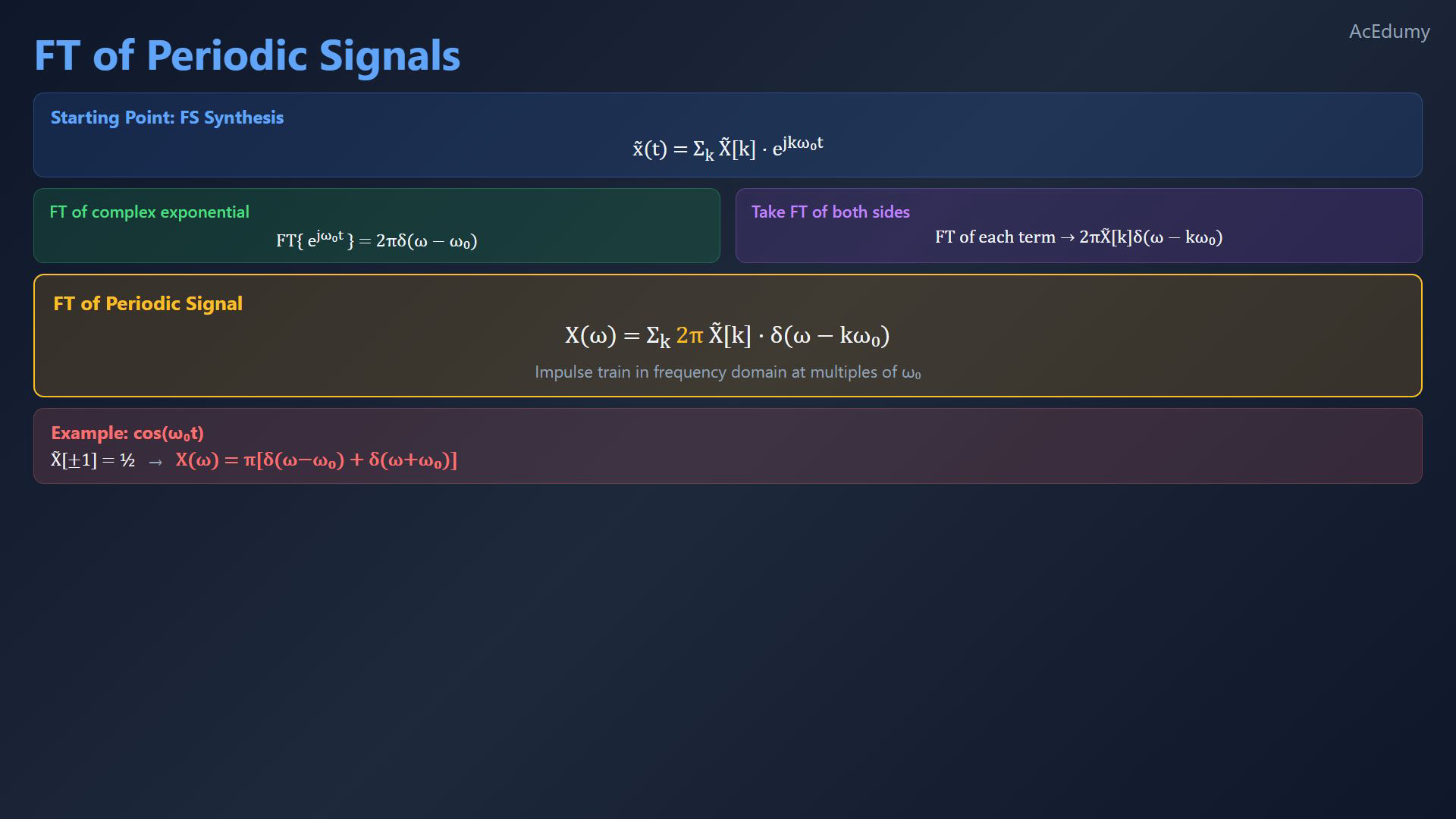
Now let's consider the reverse direction: what is the Fourier Transform of a periodic signal? A periodic signal x-tilde of t can be written as its Fourier Series: x-tilde of t equals the sum over k of X-tilde of k, times e to the j k omega-zero t. Taking the Fourier Transform of both sides, and using the fact that the FT of e to the j omega-zero t is two pi, delta of omega minus omega-zero, we get: X of omega equals the sum over k of two pi, X-tilde of k, times delta of omega minus k omega-zero. This is a powerful result: the Fourier Transform of a periodic signal is a train of impulses in the frequency domain, located at multiples of the fundamental frequency, with areas equal to two pi times the FS coefficients. For example, cosine of omega-zero t has FS coefficients one-half at k equals plus one and minus one. Therefore: the FT of cosine omega-zero t equals pi times delta of omega minus omega-zero, plus pi times delta of omega plus omega-zero. Two impulses in the frequency domain, at plus and minus omega-zero.
5. Transform-pair summary
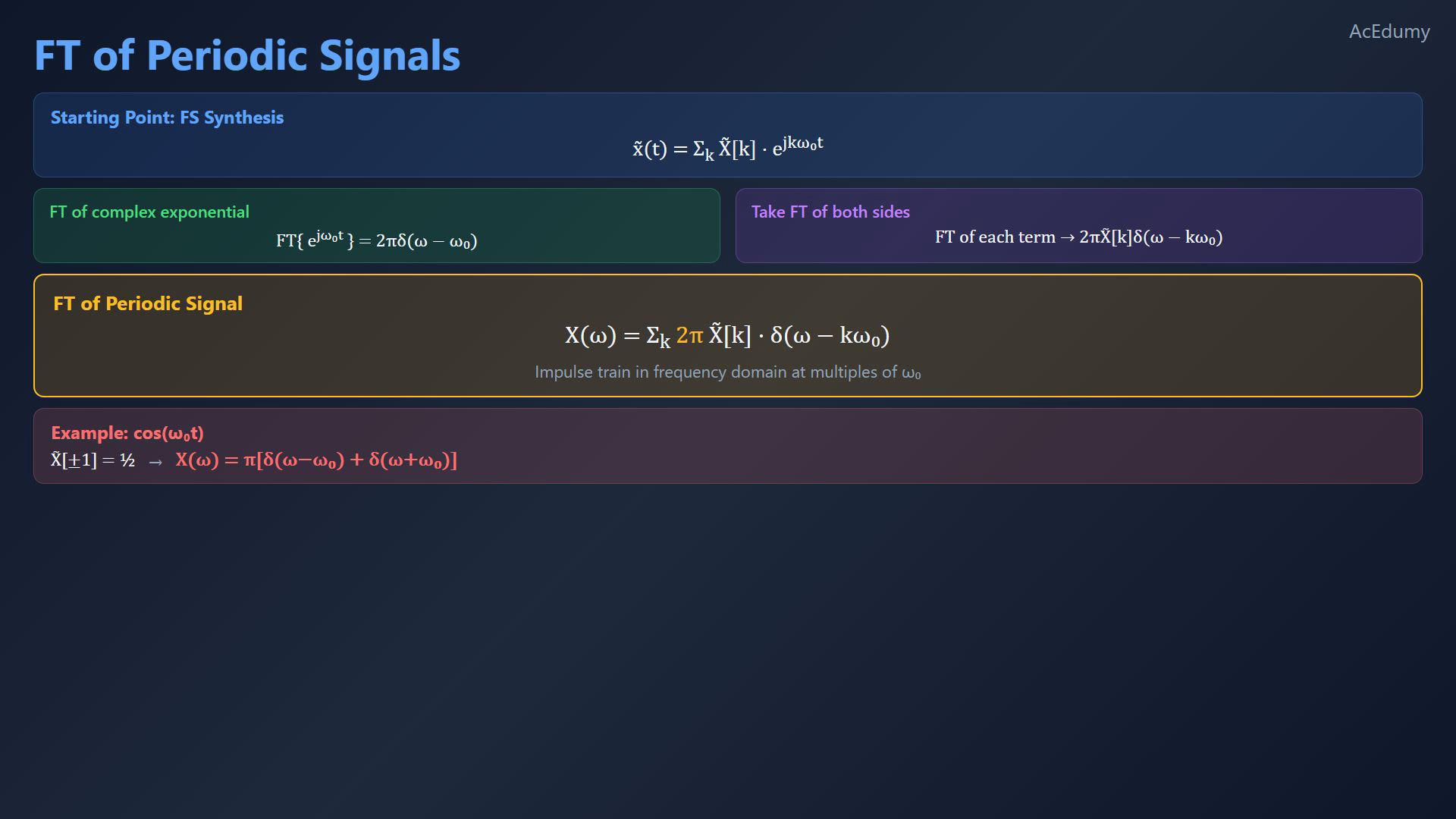
Original-video reference. Written steps use p(t) for the periodic x-tilde and C[k] for its capital-X-tilde series coefficients. X(omega) denotes the ordinary transform of one integrable period; P(omega) denotes the distributional transform of the periodic signal. The example uses the overview reference because the original example graph draws neighboring pulses too narrow. The summary uses the periodic-transform reference because its original shifted-impulse exponential appears as raw caret/braces text. These are reference cards, not replacement example graphs. Collect the series and transform relationships.One-period transform samples determine the coefficients:Sample at harmonics and include the factor one divided by the period.The periodic distribution has spectrum:This is a train of weighted frequency-domain impulses.Recall the transform pairs from the lecture.For the unit impulse:For the shifted impulse of weight A:For the symmetric unit-impulse pair:For a unit pulse of half-width T, continuously extended at zero:For cosine at positive fundamental frequency:These pairs support later signal and system analysis.Narration transcript
Let's summarize everything from this video and the entire Lecture Eleven series. The key FS-to-FT relationship is: X-tilde of k equals one over T, times X of k omega-zero. Sampling the FT at harmonic frequencies gives the FS coefficients. In the reverse direction, the FT of a periodic signal is: X of omega equals the sum of two pi, X-tilde of k, times delta of omega minus k omega-zero. A train of frequency-domain impulses. We also derived key FT pairs across this lecture series. Delta of t transforms to one. A shifted impulse transforms to A, e to the minus j omega t-zero. A symmetric impulse pair gives two cosine omega t-zero. A rectangular pulse from minus T to T gives two over omega, sine omega T. And cosine omega-zero t transforms to pi delta of omega minus omega-zero, plus pi delta of omega plus omega-zero. These building blocks form the foundation for everything we'll study next in signal processing and system analysis.
Source video: Signals & Systems #29 | FS-FT Relationship & Transform Pairs (6:12)