Signals and Systems · Impulse and step responses
#20 CT integration and differentiation; DT running sum and first difference
Recover the step response by accumulating the impulse response, and recover the impulse response by differentiation or a first difference.
Question
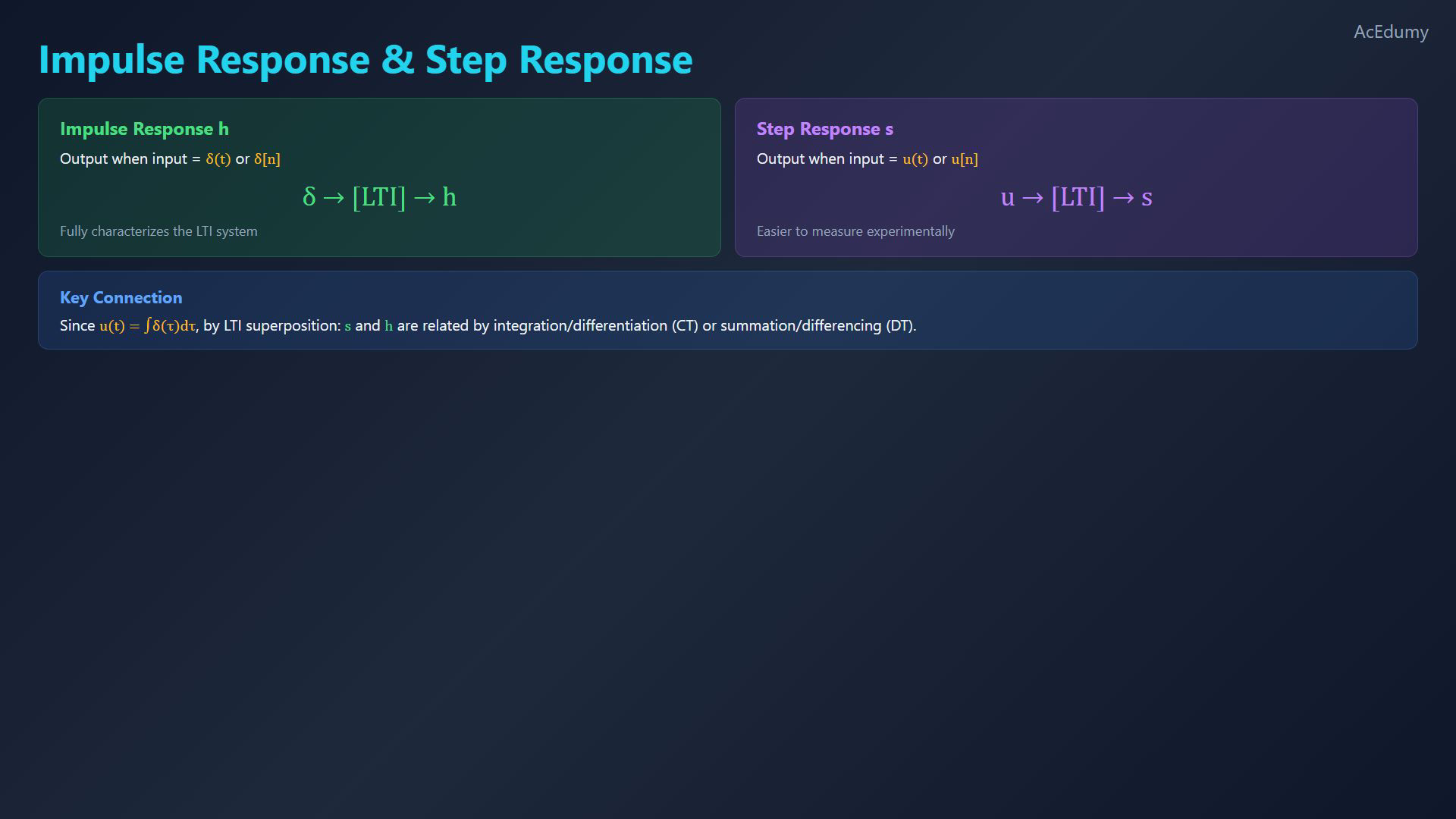
Use zero-state LTI systems for which the stated convolution, cumulative integral or running sum exists. The CT unit impulse is a distribution with unit mass. Integration starts at negative infinity with the zero-past convention; an arbitrary integration constant would not be the specified step response. For the causal formulas with lower limit zero, the displayed ordinary integral assumes a locally integrable impulse response with no impulse at the origin, as in the exponential example. If a system has an impulse at the origin, include its full mass using the distributional integral from negative infinity, or the causal convention zero minus. The CT summary carries forward the causal scope from the derivation. Differentiate in the distributional sense at jumps and corners; ordinary derivatives agree away from these points. In the exponential example, the step response is zero for negative time and equals one half times the entire group one minus exp(-2t) for nonnegative time. It is continuous at zero, so its derivative has no impulse there. The assigned value of the CT unit step at its single jump does not alter a distributional identity. In DT, the unit step equals one at and above zero and zero below zero; the running sum includes its upper index n, and the inverse uses the previous sample n minus one. For the example, the nonzero impulse samples are plus one at zero and minus one at two, with zero at all other indices including one. The cumulative response equals one only at indices zero and one. The first difference recovers both impulses and is zero elsewhere.
Written solution and narration transcript(shows the full solution)
Below are all the lines written in the notebook together with the full narration transcript.
1. Impulse and step responses
Original-video reference. The CT example is causal, with zero step response before time zero. The DT table gives impulse-response values and their cumulative sums; only indices zero and two have nonzero impulse-response values. Its two nonzero step-response samples are at indices zero and one. Connect the previous differential and difference equations to system responses.Study impulse response and step response.The impulse response is the zero-state output for a unit-impulse input.The step response is the zero-state output for a unit-step input.The impulse response determines the LTI convolution operator on admissible inputs.Impulse and step responses are connected.Use integration and differentiation in CT; running sums and first differences in DT.Narration transcript
In the last lesson, we learned how to solve LTI differential and difference equations. Now we connect those solutions to two fundamental signals: the impulse response and the step response. The impulse response, h, is the output of an LTI system when the input is the unit impulse: delta of t for continuous time, or delta of n for discrete time. The step response, s, is the output when the input is the unit step: u of t or u of n. Because any input can be built from shifted impulses, knowing h completely characterizes the system. But h and s are not independent. They are related by integration and differentiation in continuous time, and by summation and differencing in discrete time.
2. Integrate or differentiate
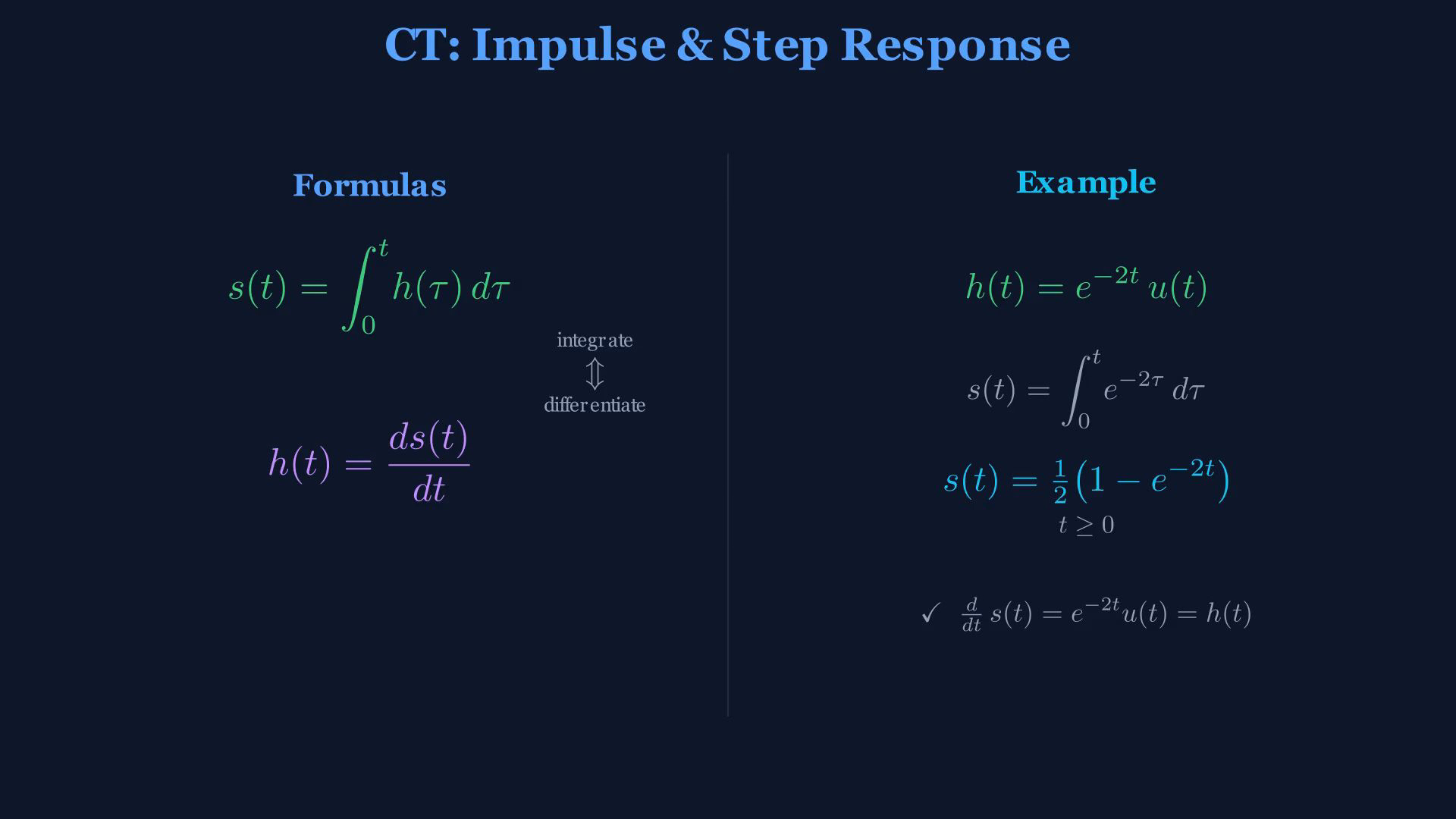
Original-video reference. The CT example is causal, with zero step response before time zero. The DT table gives impulse-response values and their cumulative sums; only indices zero and two have nonzero impulse-response values. Its two nonzero step-response samples are at indices zero and one. Derive the CT relationship.Unit step from unit impulse:LTI superposition carries the cumulative integral to the output.Accumulate the impulse response:For the stated causal ordinary-integral case and nonnegative time:Recover the impulse response:Causal example, for nonnegative time:Differentiate the complete causal step response to recover the impulse response.Narration transcript
Let's derive the continuous time relationship. The unit step is the integral of the unit impulse: u of t equals the integral from negative infinity to t of delta of tau, d tau. Because the system is linear and time invariant, we can apply the same integral to the output. If delta of t produces h of t, then integrating the input gives u of t, and integrating the output gives: s of t equals the integral from negative infinity to t of h of tau, d tau. For causal systems where h of t equals zero for t less than zero, this simplifies to the integral from zero to t. Going the other direction, we differentiate: h of t equals the derivative of s of t with respect to t. As a quick example, if the impulse response is h of t equals e to the negative 2 t times u of t, then the step response is s of t equals one half times one minus e to the negative 2 t, for t greater than or equal to zero. You can verify: the derivative of s gives back h.
3. Running sum and first difference
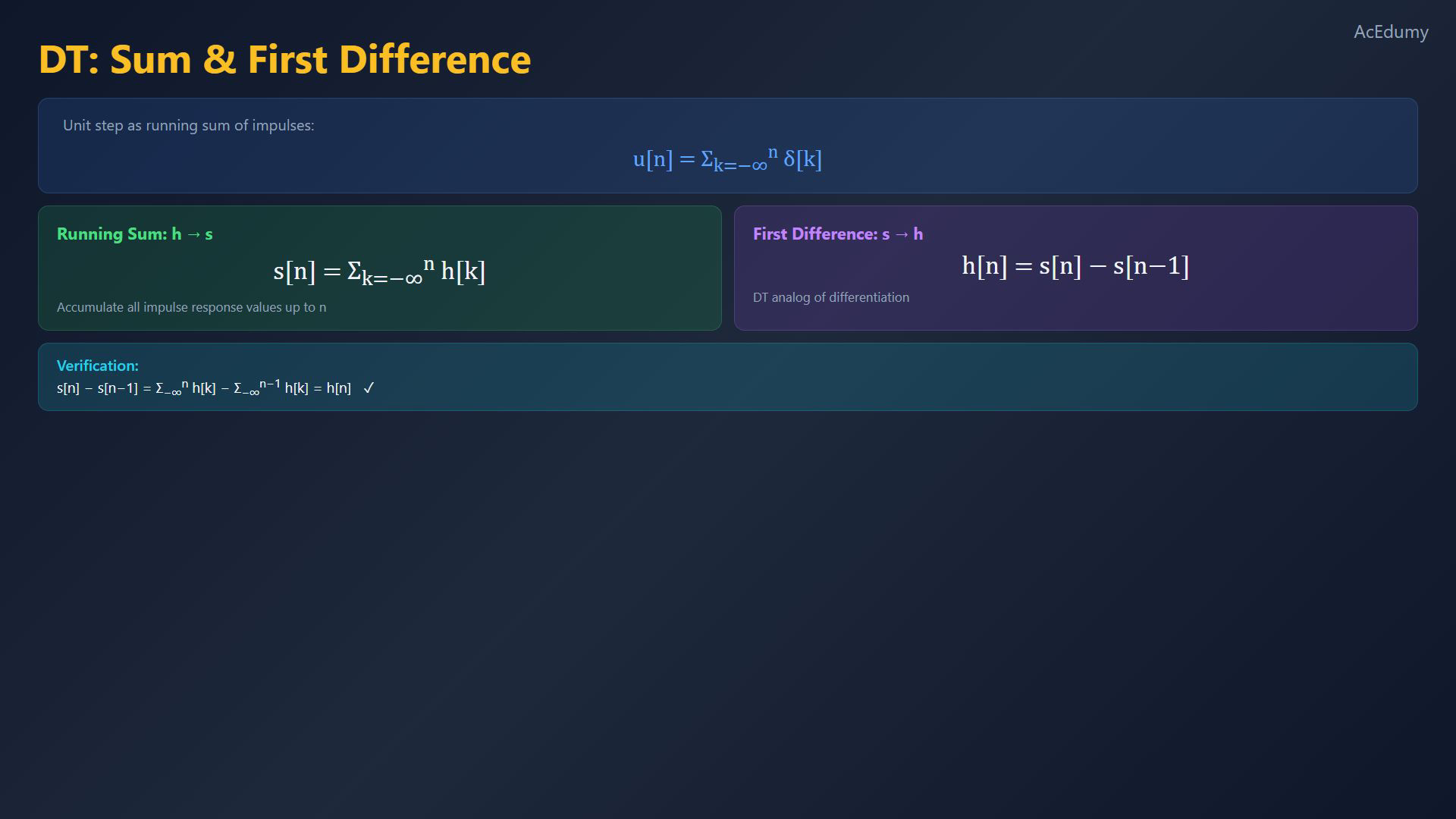
Original-video reference. The CT example is causal, with zero step response before time zero. The DT table gives impulse-response values and their cumulative sums; only indices zero and two have nonzero impulse-response values. Its two nonzero step-response samples are at indices zero and one. Use sums and first differences for discrete time.The running sum includes its upper index:Accumulate the output impulses:This is the running sum of the impulse response.Recover the current impulse sample:The first difference is the DT counterpart of differentiation.With the stated zero-past convention, accumulation and differencing recover the two responses.Narration transcript
The discrete time version follows the same logic but with sums and differences instead of integrals and derivatives. The unit step is the running sum of the unit impulse: u of n equals the sum from k equals negative infinity to n of delta of k. Applying superposition to the output: s of n equals the sum from k equals negative infinity to n of h of k. This is the running sum of the impulse response. To go in the other direction, we take the first difference: h of n equals s of n minus s of n minus one. This is the DT analog of differentiation. So in both CT and DT, we have a pair of inverse operations connecting h and s.
4. Compute a step response
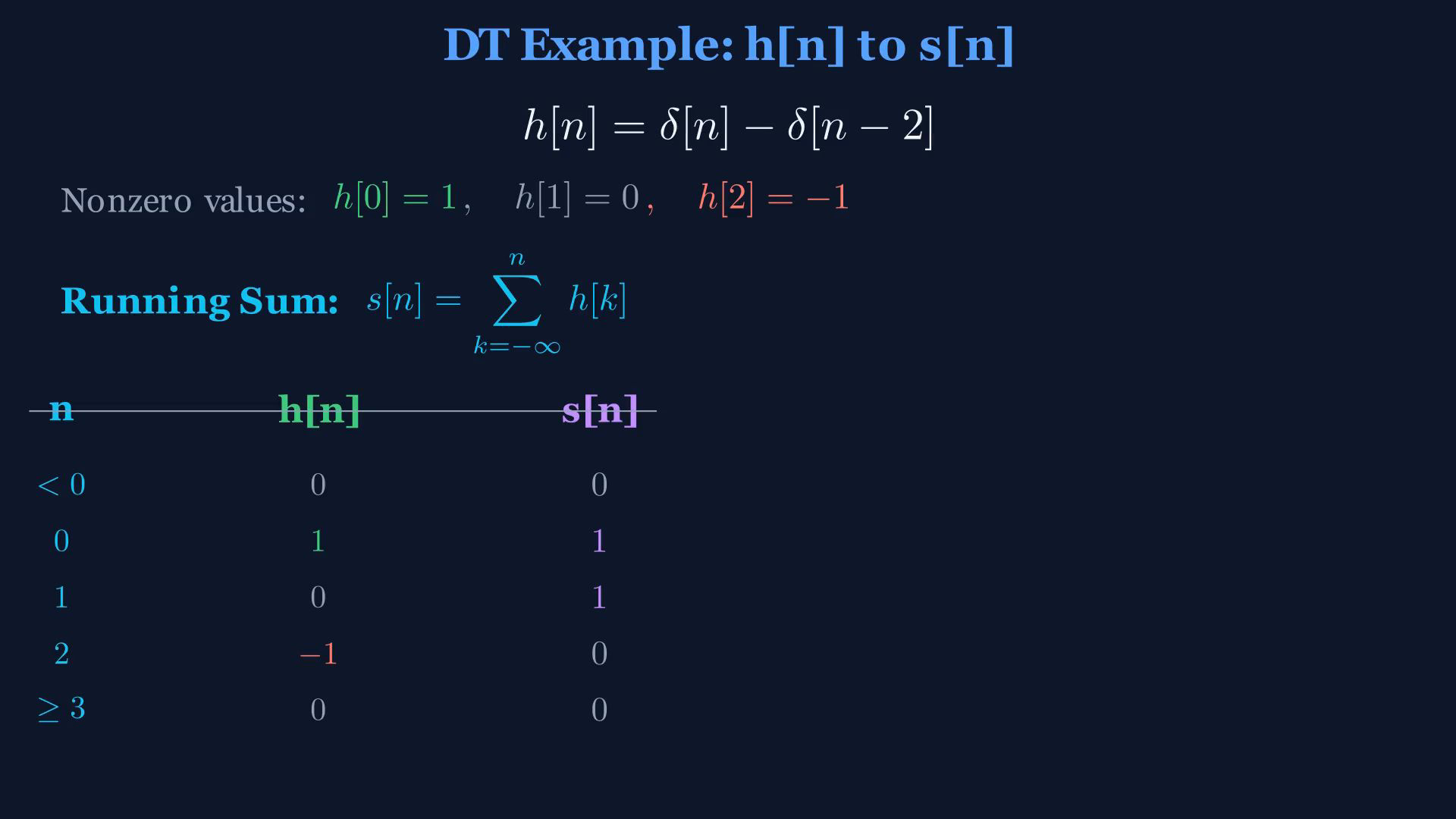
Original-video reference. The CT example is causal, with zero step response before time zero. The DT table gives impulse-response values and their cumulative sums; only indices zero and two have nonzero impulse-response values. Its two nonzero step-response samples are at indices zero and one. Work through a DT example.Given impulse response:Inspect the three indices; all other samples vanish:Compute the inclusive running sum:Before index zero:At index zero:At index one:At index two:At and beyond index two, the step response remains zero.The result for all integer indices:Verify by taking the first difference:At index zero:The negative impulse is recovered.At index two:The negative impulse is recovered.The running sum and first difference are consistent.Narration transcript
Let's work through a discrete time example. Suppose the impulse response is h of n equals delta of n minus delta of n minus two. First, let's identify the nonzero values: h of zero equals one, h of one equals zero, h of two equals negative one, and h of n is zero everywhere else. To find the step response, we take the running sum: s of n equals the sum from k equals negative infinity to n of h of k. For n less than zero, no terms contribute, so s of n equals zero. At n equals zero: s of zero equals h of zero equals one. At n equals one: s of one equals h of zero plus h of one, that's one plus zero, equals one. At n equals two: s of two equals one plus zero plus negative one, equals zero. For n greater than or equal to two, s stays at zero. So the step response is s of n equals u of n minus u of n minus two. Let's verify: h of n equals s of n minus s of n minus one. At n equals zero: one minus zero, equals one. Check. At n equals two: zero minus one, equals negative one. Check. The two formulas are consistent.
5. Summary
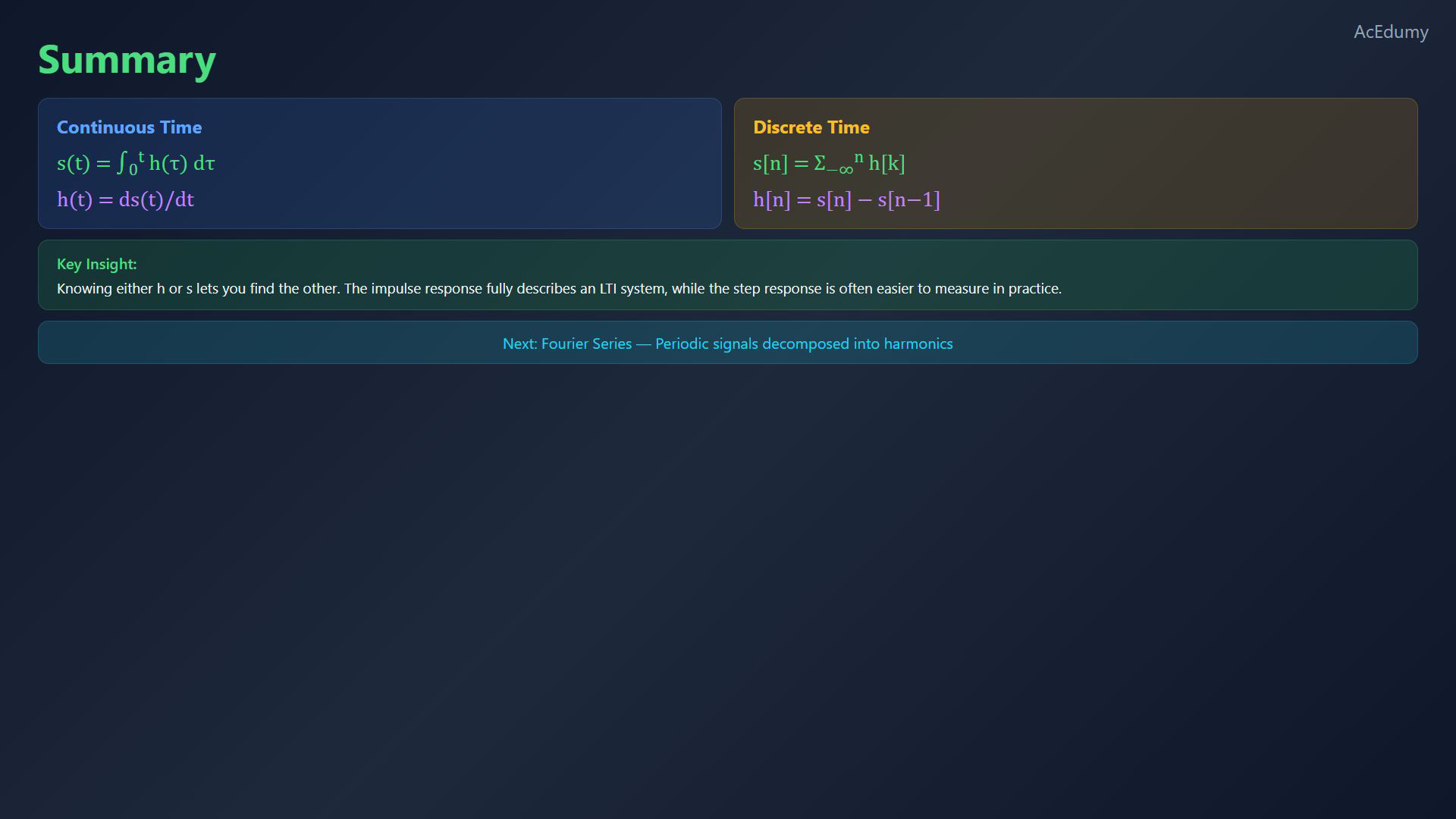
Original-video reference. The CT example is causal, with zero step response before time zero. The DT table gives impulse-response values and their cumulative sums; only indices zero and two have nonzero impulse-response values. Its two nonzero step-response samples are at indices zero and one. Four formulas connect impulse and step responses.For the stated causal CT case:In DT:Use either response to obtain the other under the stated initial convention.The impulse response characterizes the LTI system; step response is often easier to measure.Next: Fourier series and harmonics of periodic signals.Narration transcript
To summarize, the impulse response h and the step response s are related by four key formulas. In continuous time: s of t equals the integral of h from zero to t, and h of t equals the derivative of s. In discrete time: s of n equals the running sum of h from negative infinity to n, and h of n equals the first difference, s of n minus s of n minus one. Knowing any one of h or s lets you find the other. These relationships are fundamental because the impulse response fully describes an LTI system, and the step response is often easier to measure in practice. In the next lesson, we will explore Fourier series and how periodic signals can be decomposed into harmonics.
Source video: Signals & Systems #20 | Impulse & Step Response Relationship (5:30)