Signals and Systems · Periodic construction from shifted copies
#03 Nonoverlapping periodization, scaled copies and finite versus infinite triangle sums
Construct triangle pulse trains by integer shifts, then explain why infinitely many overlapping unit triangles sum to one while three copies form a finite trapezoid.
Question
Use real time t and a positive copy spacing T. Periodic means y(t+T)=y(t) for every t. T is a period, not automatically the fundamental period: a nonzero constant has every positive period and no smallest positive one. Treat voltage, clocks and carriers as ideal periodic examples; actual modulation, jitter and transients can break exact periodicity. For a finite-valued, compactly supported function x with support width W and T>0, the sum over all integers of x(t−kT) is locally finite and T-periodic by index shift. Do not claim arbitrary infinite-support functions always yield a convergent periodic sum. T>W is sufficient for separated copies, not necessary for periodicity. Equality may allow touching endpoints; whether nonzero values coincide at an endpoint depends on the source, while this triangle is zero at its support endpoints. Use the unit triangle x(t)=max(1−|t|,0), linear through(−1,0),(0,1),(1,0). At spacing3 its isolated peaks are3 apart and width2 leaves gaps1; its fundamental period is3. The scaled example reuses T as a dimensionless width factor and T_0>0 as the physical copy spacing: z(t)=x(t/T) and y(t)=sum over integer k of z(t−kT_0)=sum x((t−kT_0)/T). The full difference is divided by T; this is not x(t/T−kT_0). For positive T, width becomes T W and amplitude stays one; T>1 stretches,0<T<1 compresses. The source's 'wider' wording belongs to its stretching example T=2, not to every positive T. Negative scales also reverse time and are outside this positive-stretch example; zero scale cannot be divided into the argument. For T=2,T_0=5, support of the k-th copy is[5k−2,5k+2], width4,gap1, fundamental period5. The scaling reference deliberately shows only the original unscaled triangle because source annotations obscure vertices in the static panel. For spacing1, put t=m+r,m integer,0≤r<1. Only copies centered at m and m+1 can be nonzero, contributing1−r andr; hence the infinite sum is1 everywhere, including integer boundaries by the triangle endpoint convention. The phrase three copies 'all overlap' means neighboring copies overlap on separate intervals; the outer copies x(t−1) andx(t+1) only touch at t=0 with zero value, not a common nonzero triple overlap. The source's next interval calculation explicitly uses only two terms. This distinction is visible in the notebook and remains a wording-review note, not a silent change of narration. The three-copy finite sum x(t)+x(t−1)+x(t+1) is zero outside[−2,2],t+2 on[−2,−1],one on[−1,1],and2−t on[1,2],with consistent values at shared endpoints. Its vertices are(−2,0),(−1,1),(1,1),(2,0). It is not the infinite constant signal and, being nonzero with compact support, cannot be periodic over all real time. The finite-sum figure intentionally shows the three ingredients rather than a misleading constant-line answer; exact sum values are typeset separately. Keep all original narration literal. Existing final only, no source generator or embedded credentials executed. Eight final-derived MP3s and their final correlation provide same-source integrity, not independent original-TTS provenance. All46 whole-final ASR segments/word times,53 recovered-large source/cue lines and8 cached-small outputs were read. Large .82–1 passes unchanged .62 but drops some function arguments and initial triangle coordinates; small recovers those coordinates and shifted arguments. Small .92–1 has a phonetic 'flat stop' for 'flat top'; source, large and the numerical one-valued interval remain consistent. Do not call model-specific omissions proof of wrong audio or claim all phrases are independently confirmed by both models. All8 actual final frames and extra80.000s original-triangle and200.500s three-copy frames inspected; selected pixels are unchanged originals. This is an unpublished technical draft, not complete human listening, motion, pedagogy or publication approval. No new TTS, paid generation, model download, video render/upload/publication, access/deploy/Play/port/security/egress changes or legacy single-JSON import.
Written solution and narration transcript(shows the full solution)
Below are all the lines written in the notebook together with the full narration transcript.
1. Define a positive period without assuming it is fundamental
Original-video reference. Scaling sections use a clean view of the original unit triangle before stretching, not the period-five answer. The finite-sum reference shows its three component triangles, not the total trapezoid. These replace source panels whose annotations overlap. The constant-line figure belongs only to the infinite sum. Positive spacing and a scale greater than one for stretching are assumed. A periodic signal repeats after a fixed positive time interval.For every real time, with a positive period:Power, clock and unmodulated carrier waveforms provide idealized periodic examples.Build a periodic waveform from a finite-duration building block.Place copies at every integer multiple of a positive spacing.Narration transcript
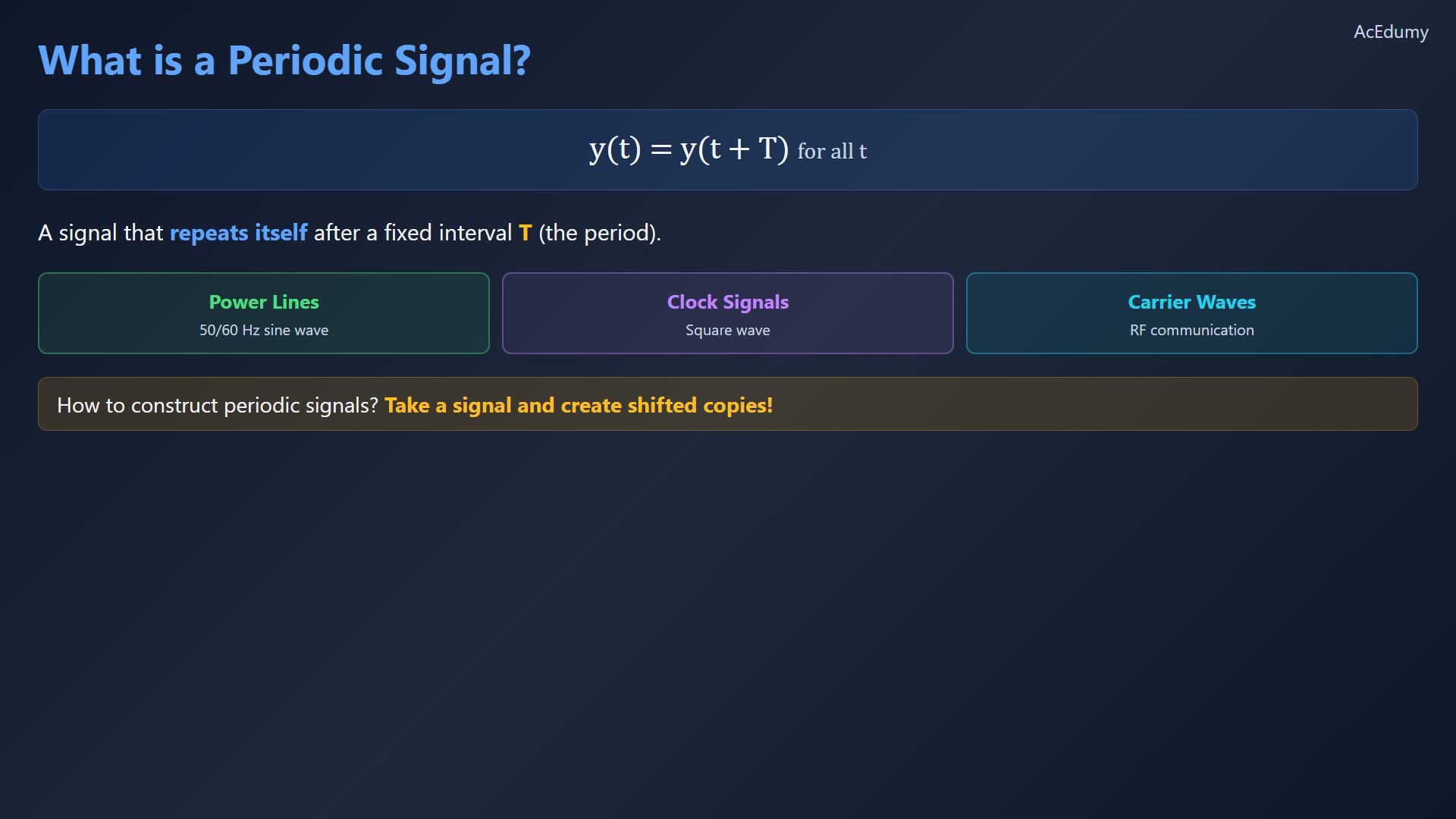
A signal is periodic if it repeats itself after a fixed interval. Mathematically, y of t equals y of t plus T for all t, where T is the period. Periodic signals are everywhere in engineering: power line voltages, clock signals, and carrier waves in communication systems. But how can we construct a periodic signal from a basic building block? The answer is simple: take a signal and create shifted copies of it.
2. Periodize a compactly supported signal by integer shifts
Original-video reference. Scaling sections use a clean view of the original unit triangle before stretching, not the period-five answer. The finite-sum reference shows its three component triangles, not the total trapezoid. These replace source panels whose annotations overlap. The constant-line figure belongs only to the infinite sum. Positive spacing and a scale greater than one for stretching are assumed. Use the sum over all integer shifts.Periodize a finite-duration building block with positive spacing:The copy indexed by k is centered relative to the original by a signed shift k times T.If the spacing exceeds the support width, the copies do not overlap.Periodicity follows by reindexing the sum; the stated spacing need not always be the smallest period.Narration transcript
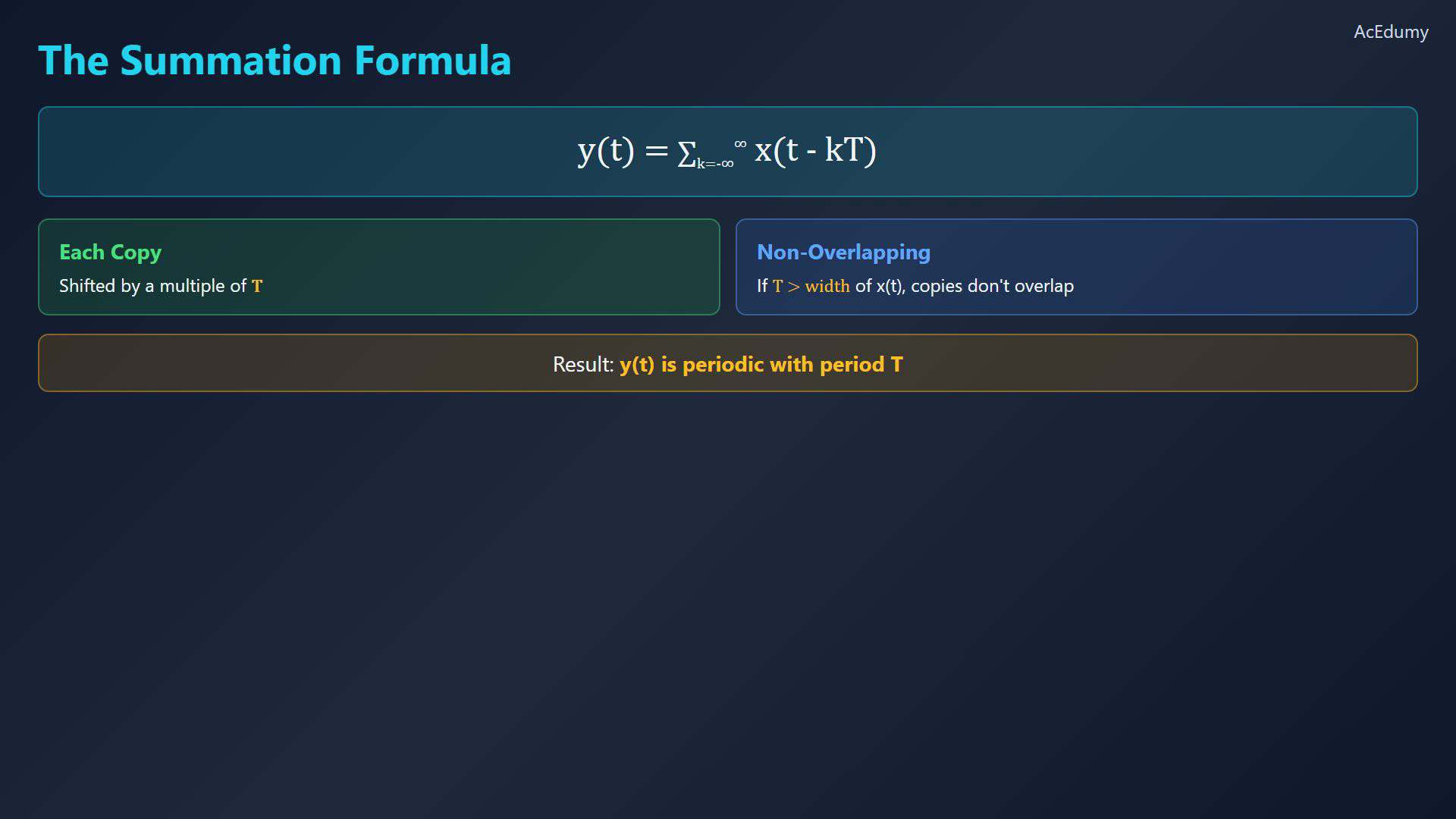
Here is the key formula. Given any signal x of t with finite duration, we can create a periodic signal by summing shifted copies: y of t equals the sum from k equals negative infinity to infinity of x of t minus k T. Each copy is shifted by a multiple of T. If T is greater than the width of x of t, the copies do not overlap, and y of t is simply a repeating pattern of x of t with period T. This is the most basic way to construct periodic signals.
3. Place nonoverlapping unit triangles three units apart
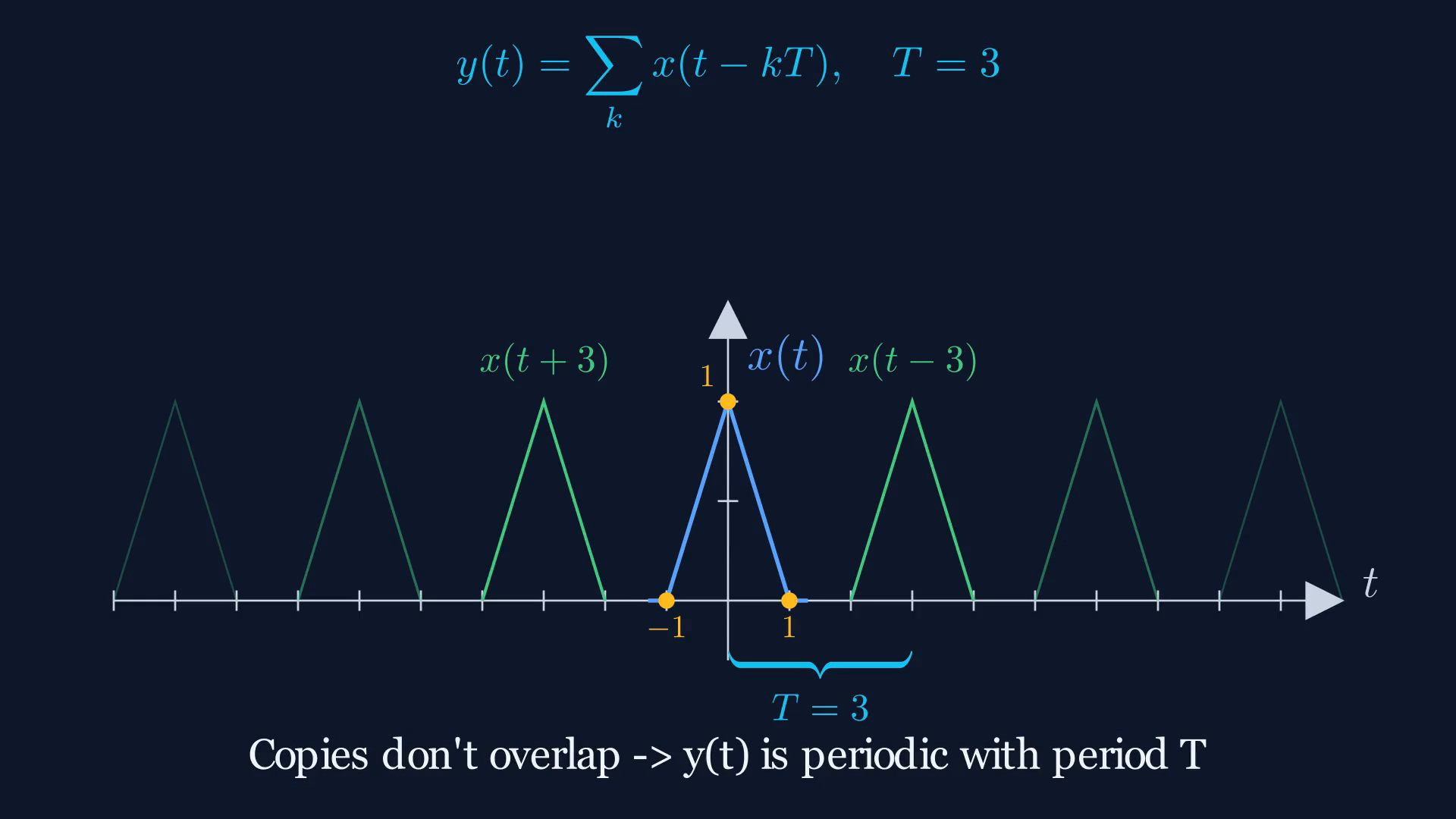
Original-video reference. Scaling sections use a clean view of the original unit triangle before stretching, not the period-five answer. The finite-sum reference shows its three component triangles, not the total trapezoid. These replace source panels whose annotations overlap. The constant-line figure belongs only to the infinite sum. Positive spacing and a scale greater than one for stretching are assumed. Example one uses a unit symmetric triangle.Triangle vertices, linear between them and zero outside:Its support width is two.The copy spacing is three, leaving gaps:Place centers at all integer multiples of three:Each width-two triangle has a one-unit gap to the next.For this nonconstant example, the smallest positive period is three:Narration transcript
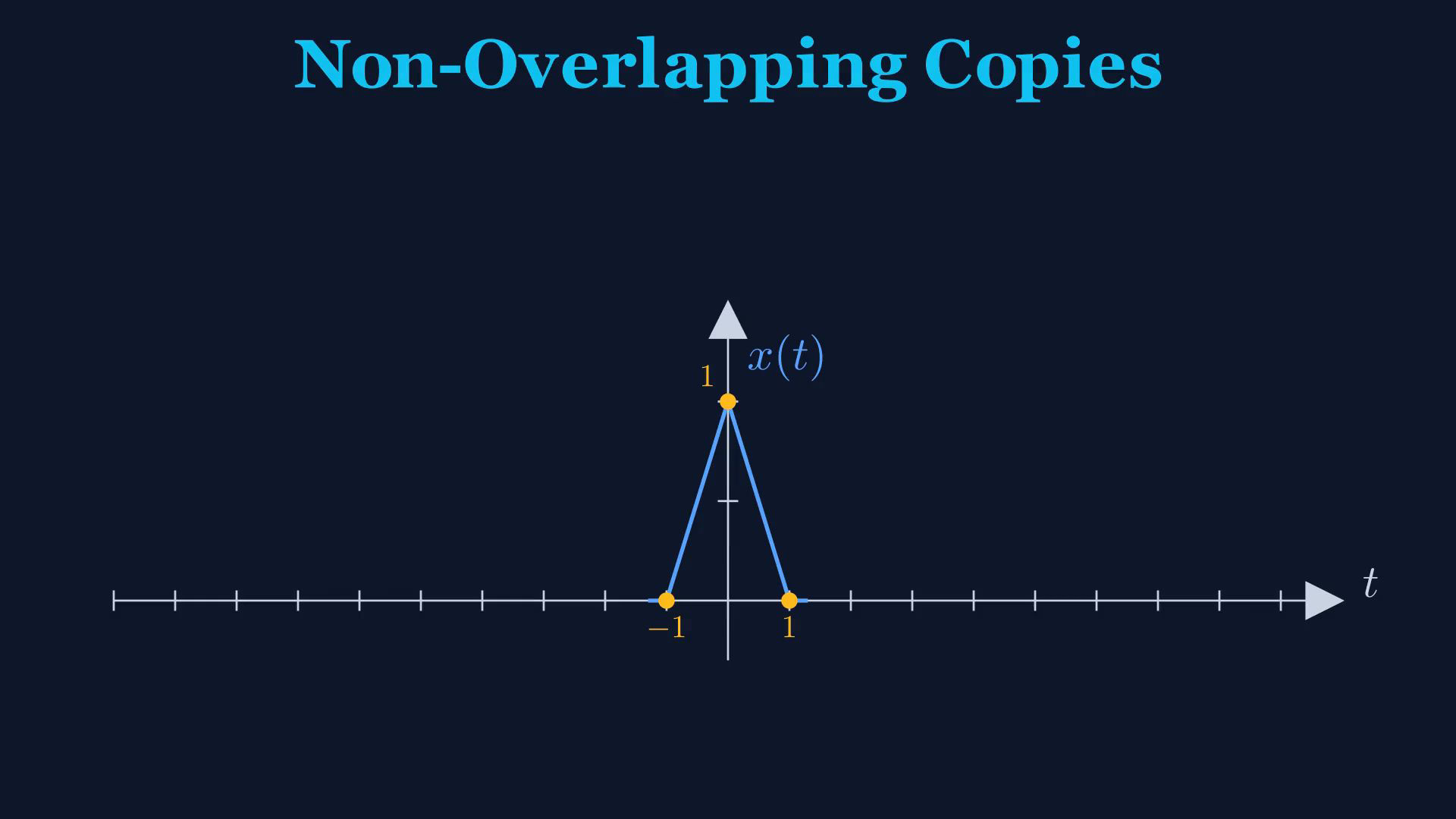
Let us see this in action. Consider x of t, a symmetric triangle signal with vertices at negative one comma zero, zero comma one, and one comma zero. Its width is two. If we choose T equals three, which is greater than two, the shifted copies will not overlap. We place copies at t equals zero, three, negative three, six, negative six, and so on. Each triangle sits alone, separated by gaps. The result y of t is periodic with period T equals three.
4. Separate a positive width scale from the copy spacing
Original-video reference. Scaling sections use a clean view of the original unit triangle before stretching, not the period-five answer. The finite-sum reference shows its three component triangles, not the total trapezoid. These replace source panels whose annotations overlap. The constant-line figure belongs only to the infinite sum. Positive spacing and a scale greater than one for stretching are assumed. Separate width scaling from the spacing between copies.With positive width scale and spacing, sum all integer copies:In the stretching case, the dimensionless scale is greater than one:The waveform is wider only when T exceeds one; its amplitude is unchanged.Shift the already-scaled waveform, keeping the whole difference inside the numerator:If the scaled width is below the spacing, the copies do not overlap; periodicity itself does not require nonoverlap.Narration transcript
We can also combine scaling with shifting. Consider y of t equals the sum of x of the quantity t minus k T zero divided by capital T. Here we first stretch x of t by replacing t with t over capital T. This gives x of t over T, a wider version of the original signal. Then we create copies shifted by multiples of T zero. As long as the stretched signal fits within one period, meaning its width is less than T zero, the copies do not overlap and y of t is periodic with period T zero.
5. Stretch the triangle by two and repeat every five
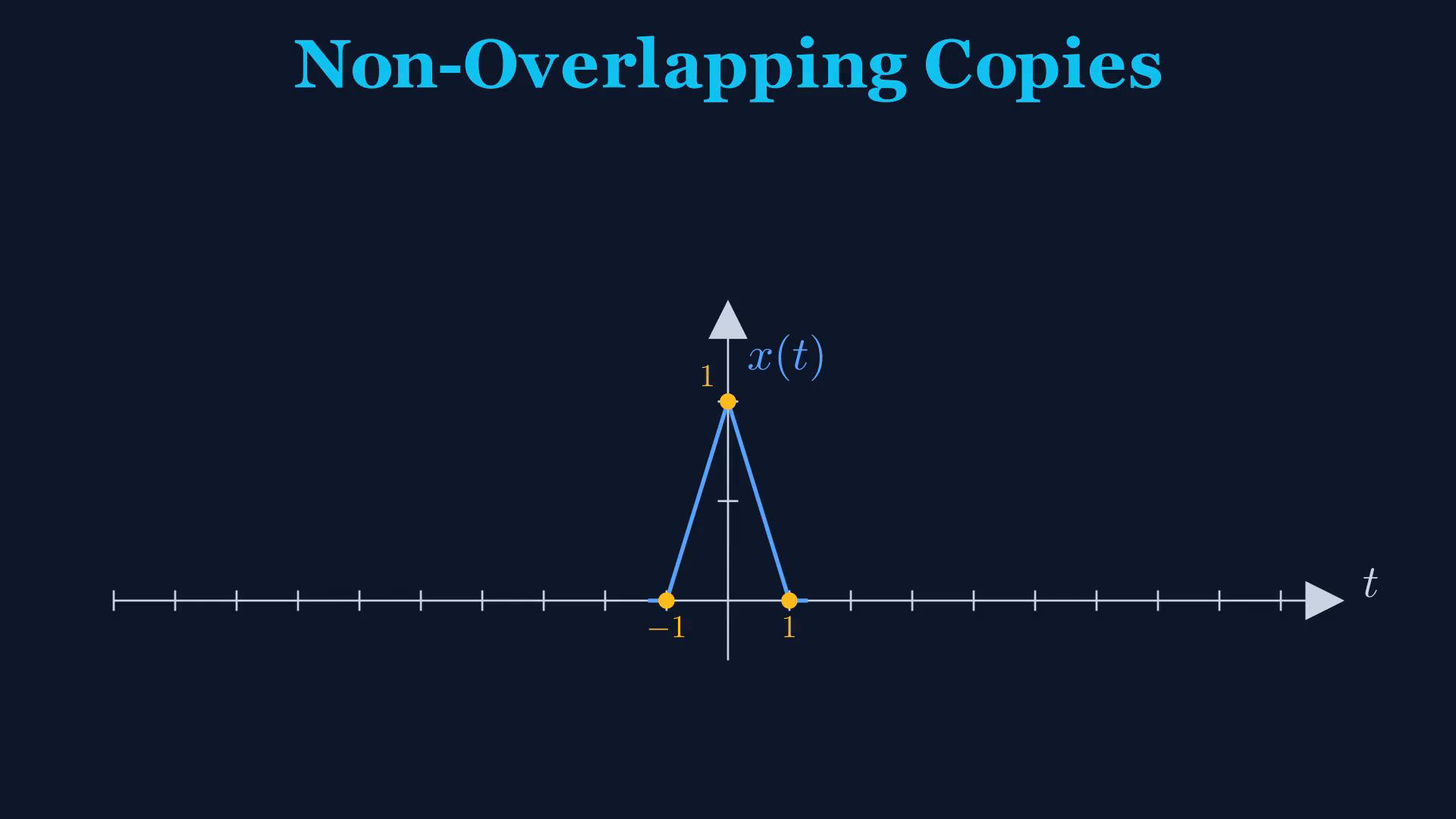
Original-video reference. Scaling sections use a clean view of the original unit triangle before stretching, not the period-five answer. The finite-sum reference shows its three component triangles, not the total trapezoid. These replace source panels whose annotations overlap. The constant-line figure belongs only to the infinite sum. Positive spacing and a scale greater than one for stretching are assumed. Use the same symmetric triangle.The reference shows the original width-two building block, before stretching.Scale time by replacing the argument with time divided by the scale.At scale two, the support is minus two to two:Use copy spacing five:Width four is less than spacing five, leaving one-unit gaps.The resulting nonconstant train has smallest positive period five:Narration transcript
Let us visualize this. Starting with x of t, our triangle signal spanning from negative one to one. First, we stretch it by replacing t with t over T. With T equals two, the signal x of t over two now spans from negative two to positive two. Next, we create copies at intervals of T zero equals five. Since the stretched width of four is less than T zero equals five, the copies fit without overlapping. The resulting y of t is periodic with period T zero.
6. Explain the partition of unity from overlapping triangles
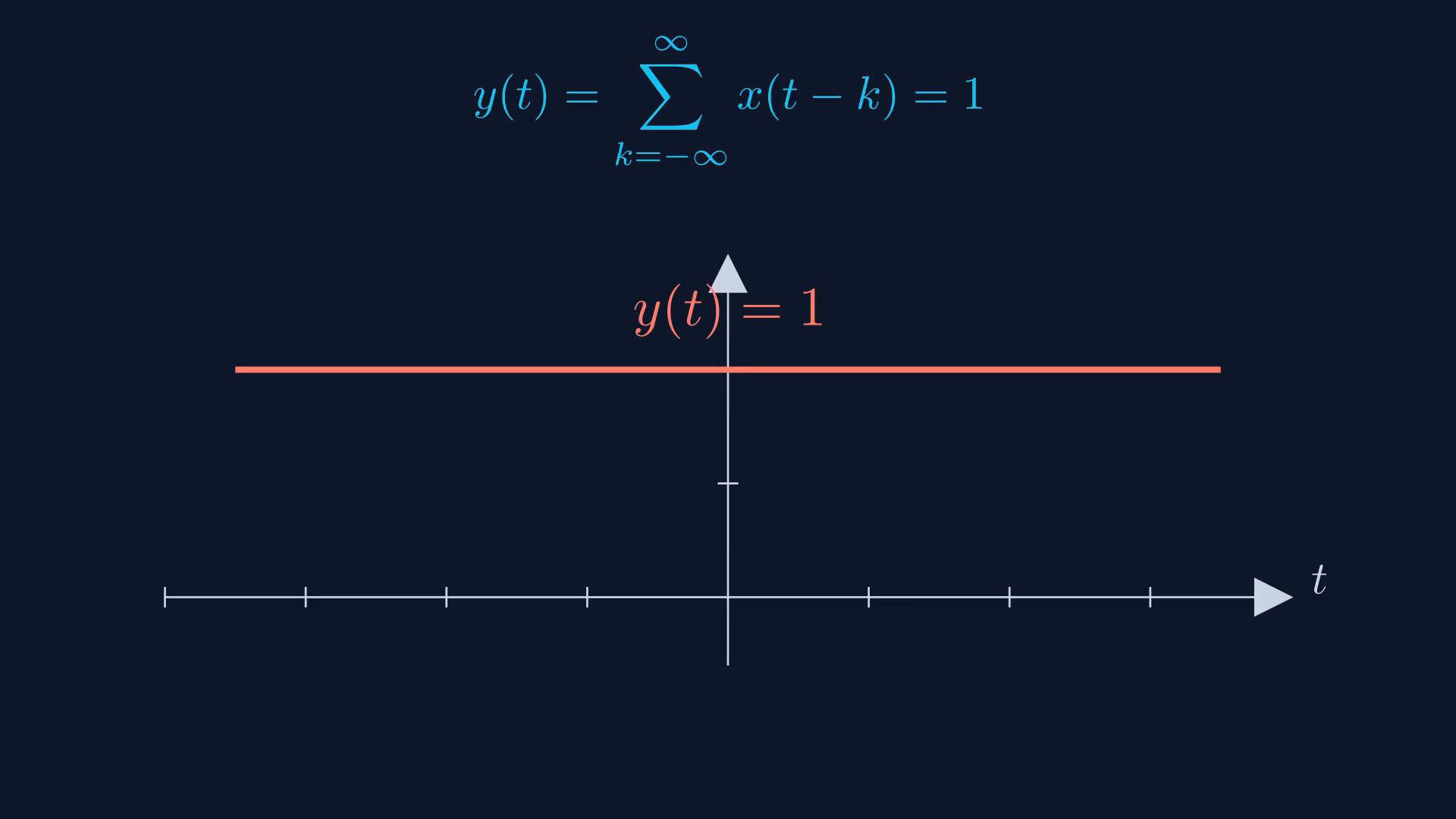
Original-video reference. Scaling sections use a clean view of the original unit triangle before stretching, not the period-five answer. The finite-sum reference shows its three component triangles, not the total trapezoid. These replace source panels whose annotations overlap. The constant-line figure belongs only to the infinite sum. Positive spacing and a scale greater than one for stretching are assumed. Overlapping copies can add to a simpler signal.The sum includes copies centered at every integer, not only the three drawn nearby.For the unit symmetric triangle, set the spacing to one:Adjacent copies overlap; the two outer copies only touch each other at a zero endpoint.On the interval from zero to one, the active terms are:Their sum is constant on that interval:Reindexing gives the same local identity between every pair of adjacent integer centers.The full infinite sum is constant for all time:A constant repeats for every positive interval; it has no smallest positive fundamental period.Narration transcript
Now here is the interesting case. What happens when the copies do overlap? Consider our triangle x of t on the interval negative one to one, and set T equals one. The copies x of t, x of t minus one, and x of t plus one all overlap. In the region from zero to one, x of t equals one minus t and x of t minus one equals t. Their sum is one minus t plus t, which equals one. The same cancellation happens everywhere. The infinite sum y of t equals one, a constant! The overlapping triangles perfectly fill in each other's gaps.
7. Distinguish a finite trapezoid from an infinite constant sum
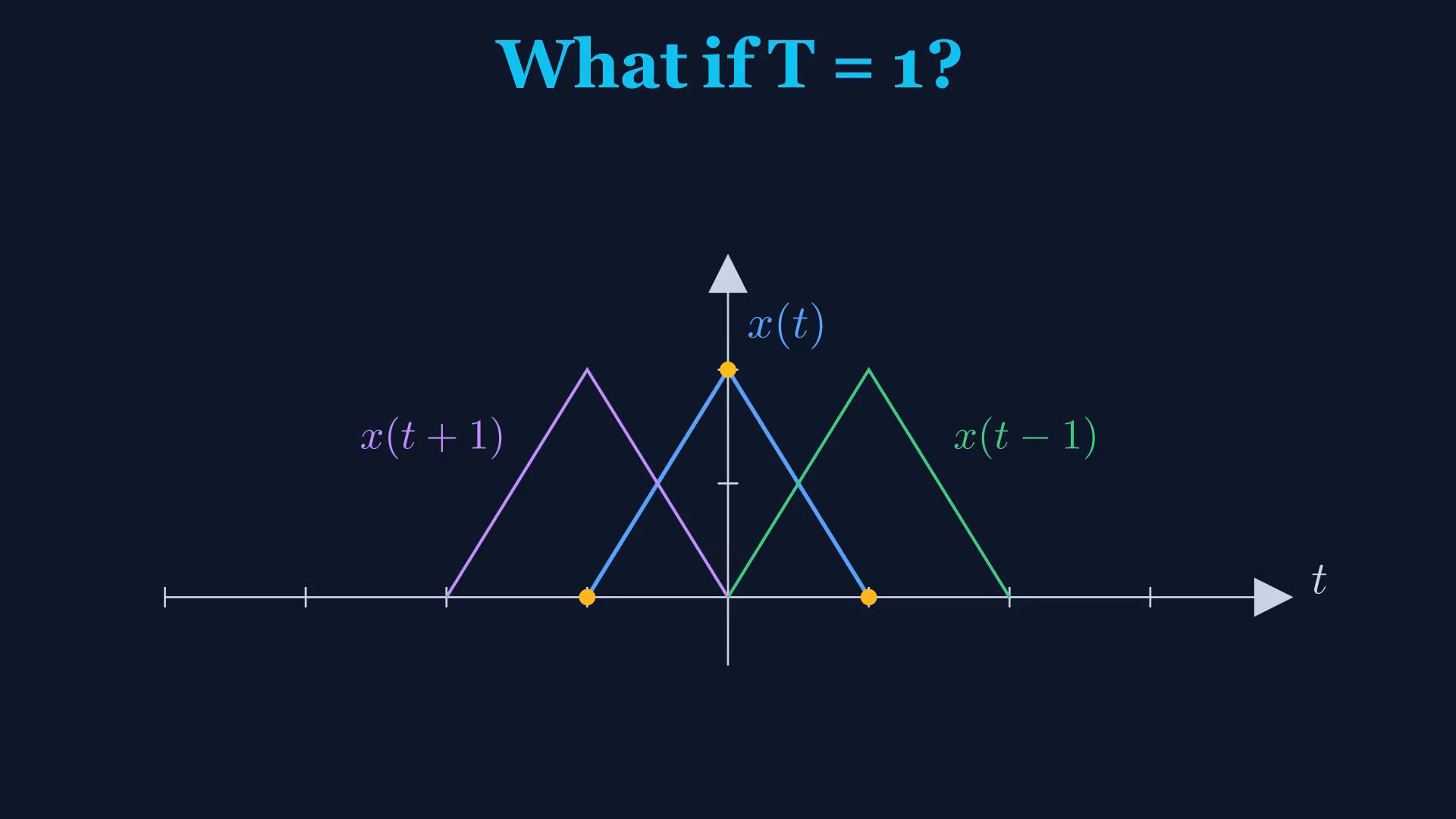
Original-video reference. Scaling sections use a clean view of the original unit triangle before stretching, not the period-five answer. The finite-sum reference shows its three component triangles, not the total trapezoid. These replace source panels whose annotations overlap. The constant-line figure belongs only to the infinite sum. Positive spacing and a scale greater than one for stretching are assumed. Now keep exactly three copies; do not extend the sum to all integers.The finite sum is:From minus two to minus one, the left copy alone gives:From minus one to one, the overlapping copies give:From one to two, the right copy alone gives:Zero outside minus two to two; trapezoid vertices are:Narration transcript
What if we only sum three copies instead of infinitely many? Let y of t equal x of t plus x of t minus one plus x of t plus one. From t equals negative two to negative one, only x of t plus one contributes, rising from zero to one. From negative one to one, the overlapping copies sum to exactly one, forming a flat top. From one to two, only x of t minus one contributes, falling from one to zero. The result is a trapezoid with vertices at negative two comma zero, negative one comma one, one comma one, and two comma zero.
8. Review the three lessons without conflating the two sums

Original-video reference. Scaling sections use a clean view of the original unit triangle before stretching, not the period-five answer. The finite-sum reference shows its three component triangles, not the total trapezoid. These replace source panels whose annotations overlap. The constant-line figure belongs only to the infinite sum. Positive spacing and a scale greater than one for stretching are assumed. Review the three introductory lessons.First, distinguish shifting, time scaling and time reversal.The earlier shift-then-scale recipe is one valid method for nonzero slope:This lesson repeats a finite-duration building block at every integer-spaced center.Nonoverlapping copies preserve separate pulses and their gaps.For the unit triangle at spacing one, overlapping infinite copies add to one; a finite sum is different.Finite three-copy trapezoids are not nonzero periodic signals over the whole real time axis.Next: examine system properties and classifications.Narration transcript
Let us wrap up Lecture one. In lesson one, we learned individual signal operations: shifting, scaling, and reversal. In lesson two, we combined these operations using the two-step method for x of a t plus b. And in this lesson, we learned to construct periodic signals by summing shifted copies. When copies do not overlap, the result simply repeats x of t. When they do overlap, the sum can produce surprising results like a constant. This completes our introduction to signal manipulations. In the next lecture, we will explore system properties and classifications.
Source video: Signals & Systems #03 | Periodic Signal Construction from Shifted Copies (5:12)