Signals and Systems · Signals, systems and time transformations
#01 Continuous/discrete time and triangle shifting, scaling and reversal
Read time-domain signals and map each triangle's support and peak through shifting, scaling and reversal, with explicit signs and conditions.
Question
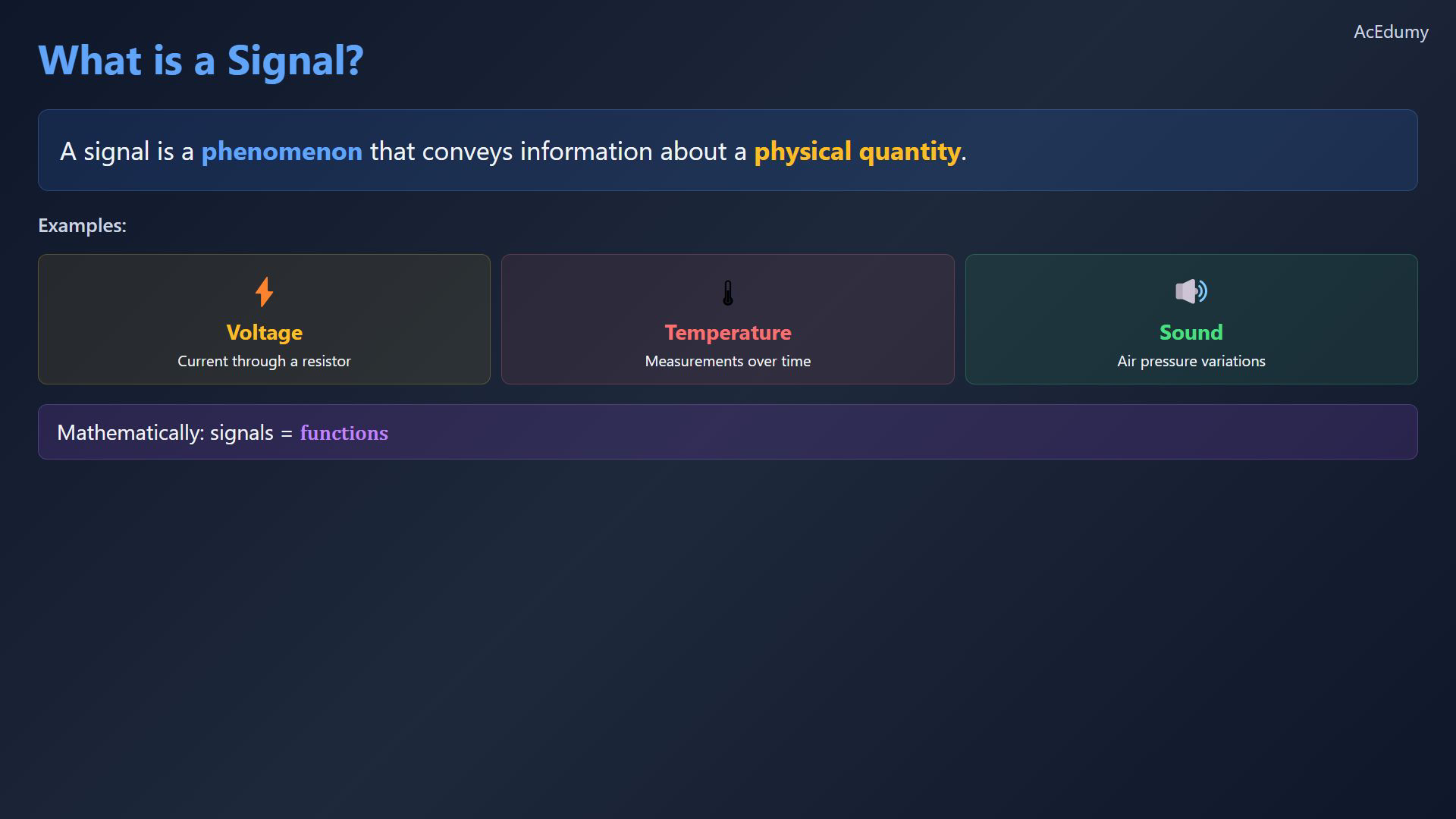
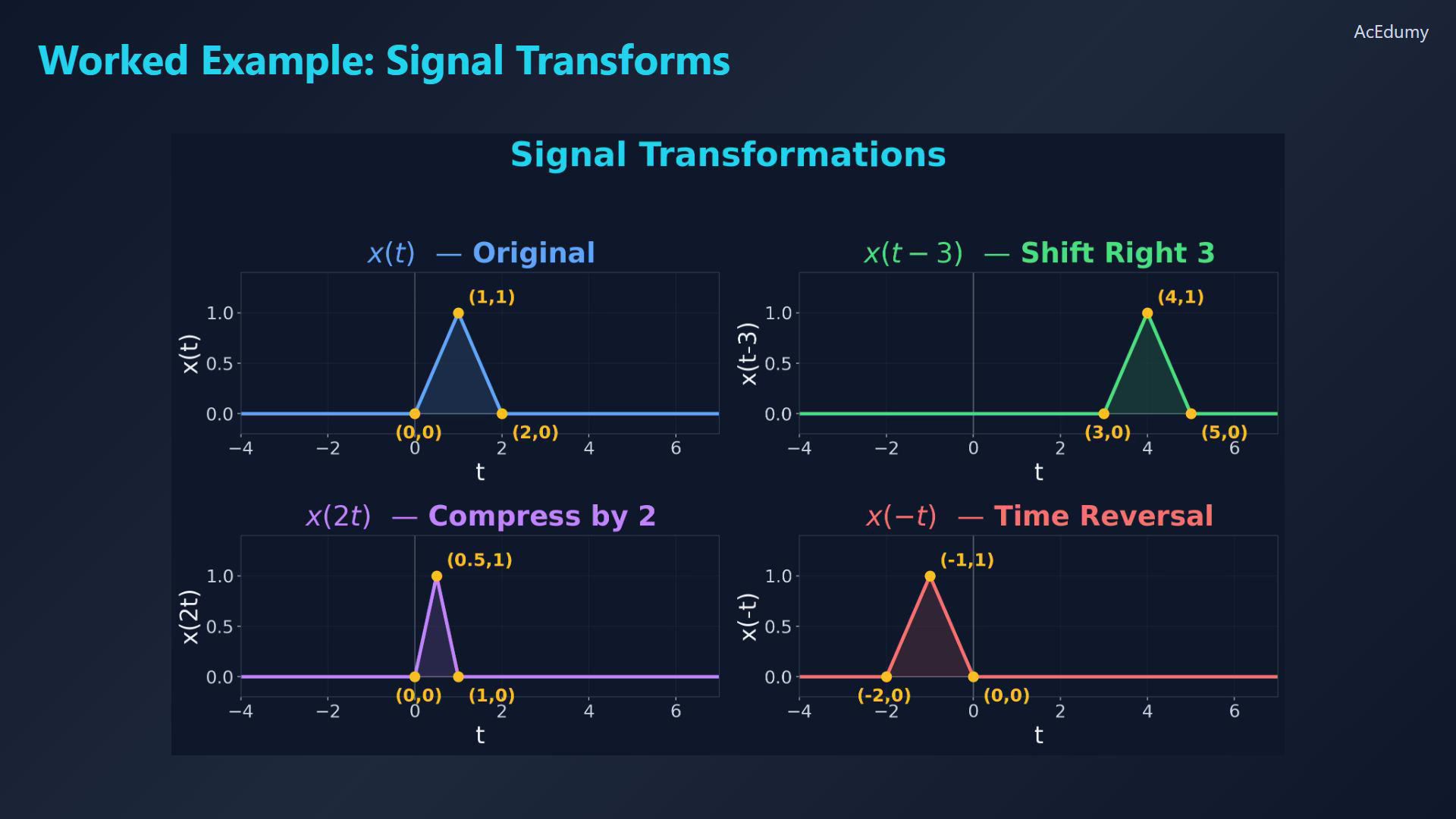
Represent a physical signal by a function of its independent variable, and a system by a mapping from an input function to an output function. The resistor example assumes a known ideal ohmic R>0 with passive-sign convention v(t)=R i(t), not an arbitrary reactive or time-varying component. A loudspeaker is an input-output example, not proof that every physical system is linear, memoryless or time invariant. Continuous-time means a real-valued time domain, not that the function is continuous: jumps are allowed. Discrete-time uses integer indices; amplitudes need not be quantized. Uniform samples x_d[n]=x_c(nT_s), T_s>0, are one example, not a definition requiring all discrete sequences to arise from uniform physical sampling. Digital encoding additionally quantizes and represents amplitudes; connecting stems is not implied. For continuous-time transformations, let t_0>0 and k be real and nonzero. A delay y(t)=x(t−t_0) moves an old feature time t_1 to t_2=t_1+t_0; advance x(t+t_0) moves it left. If t_0 is instead allowed signed, the direction follows its sign. For y(t)=x(kt), a feature at t_1 appears at t_1/k and temporal width becomes original width/|k|. Positive k>1 compresses; 0<k<1 stretches; k<0 also reverses time. k=0 gives the constant x(0) when defined, not an invertible rescaling and not a divide-by-zero formula. Reversal x(−t) reflects the time coordinate about t=0 (the vertical axis in a waveform plot); it is not point reflection (t,x)→(−t,−x) and does not negate amplitudes. Scaling and reversal commute; shifts and scaling generally do not. The unit triangle is linear from (0,0) to (1,1) to (2,0), zero outside [0,2]. Shift by three gives support [3,5],peak(4,1); compression by two gives [0,1],peak(.5,1); reversal gives [−2,0],peak(−1,1); x(−2t) gives [−1,0],peak(−.5,1). The final shifting frame illustrates x(t+2), a left shift, not the separate right-shift-by-three example. A compact piecewise definition is x=t for0≤t≤1, x=2−t for1<t≤2 and0 otherwise. The next lesson's x(at+b) assumes a≠0; this lesson does not claim shifts and scales commute. Source wording 'does not change the shape' is explicitly qualified in the notebook: amplitudes and the triangle profile are preserved under a coordinate transformation, but width and slopes in physical time can change. The source itself subsequently says compressed, stretched and twice as narrow; this is contextual disambiguation, not an assertion of geometric shape invariance or a silent audio rewrite. Likewise the source's summary 'about the origin' is the time origin, as stated by its earlier 'vertical axis' narration and Manim t=0 rule. The source remains unchanged and this wording remains a human pedagogical-review note. All138 EN source lines were read with credential-related lines redacted; literal scenes were parsed without executing imports, TTS, filesystem creation or embedded credentials. All316 TSX,337 Manim and156 graph-source lines were reviewed. Existing authenticated Bunny final5e01cf03-a9a0-4b3d-8a3d-961d2c88901f has256.682667s/15,220,491bytes/SHAa3e38daf4e932d6a01530c018982494c535388b0ecd81aae49c68cf26fc7ad62. Separate MP3/timings were not found in checked local paths or a bounded Hetzner lessons/public/output maxdepth5 search; do not claim globally absent or independent original-TTS provenance. TSX round-to30fps starts3/32.433333/61.6/99.366667/124.466667/157.966667/192.033333/225.033333 all lie in actual final silence; eight actual final frames plus185.500s scaling frame and all50 whole-final ASR segments/word times were reviewed. Real final clips preserve the half-second visual interscene gaps rather than appending a neighbor's speech. Eight same-source correlations.99853–.99995/0ms prove extraction integrity only. All45 source/cue/large lines and eight cached-small full-scene outputs were read. Large .7303–1 passes unchanged .62; in shifting/scaling large omits spoken argument tokens, while whole-final and small explicitly recover the correct t-minus/t-plus and negative-two arguments. Small .8652–1; no substitution, synthetic cue, forced anchor or threshold change. Whole-final CT notation dropped 'of t', but recovered-large and small both recover it. Colon punctuation and kt/At/t0 spacing are ASR variation, not proof of a changed variable; all original say strings remain literal. The overview/summary are remapped to the source's explicit four-triangle example; scaling uses185.500s concrete negative-two frame instead of the later generic -kt compress label that needs k>1. All other figures retain original final pixels. This is an unpublished technical draft, not full human audio, motion, pedagogy or publication approval. No new TTS, paid generation, model download, video render/upload/publication, web/security/egress/access changes or legacy single-JSON importer.
Written solution and narration transcript(shows the full solution)
Below are all the lines written in the notebook together with the full narration transcript.
1. Identify a signal and its independent variable
Original-video reference. The time-transformation overview and summary use the same video's explicit four-triangle example. The scaling frame shows the concrete negative-two example. Source wording about 'shape' means amplitude profile, not unchanged duration; reversal is about the vertical time-origin axis. Positive shift magnitudes and nonzero scale are assumed. Represent a physical quantity as a signal.For a known ideal ohmic resistor:Temperature measurements describe variation with time.Speech carries information through air-pressure variation.A function is a mathematical model of the measured signal.Use one clear signal name and one independent variable.Narration transcript
A signal is a phenomenon that conveys information about a physical quantity. For example, the voltage across a resistor tells us about the current flowing through it. Temperature measurements over time form a signal. Even your voice is a signal, carrying information through air pressure variations. Mathematically, signals are described by functions. The name of the mathematical function and the signal can be used interchangeably.
2. Distinguish a system from its input and output
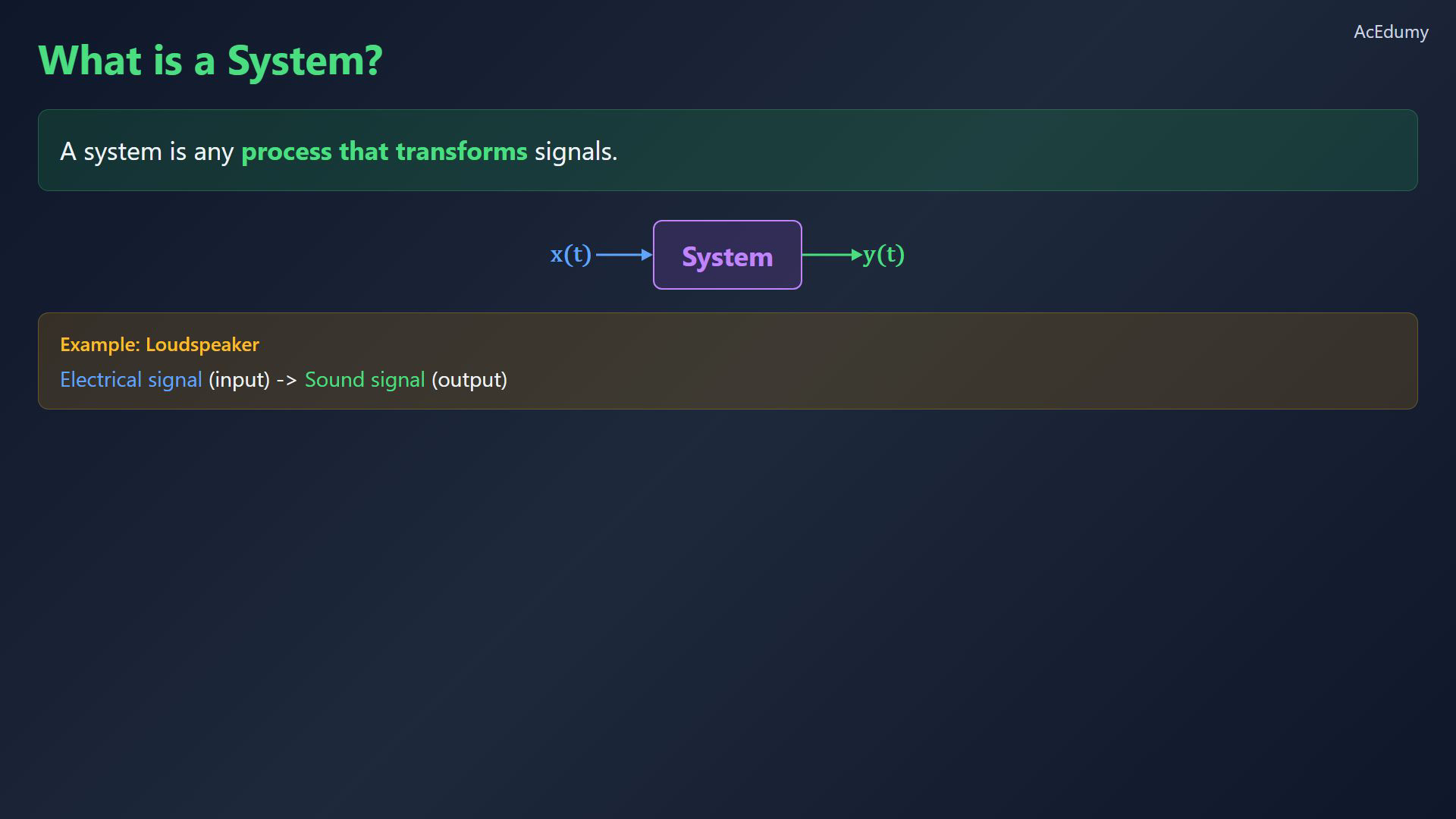
Original-video reference. The time-transformation overview and summary use the same video's explicit four-triangle example. The scaling frame shows the concrete negative-two example. Source wording about 'shape' means amplitude profile, not unchanged duration; reversal is about the vertical time-origin axis. Positive shift magnitudes and nonzero scale are assumed. A system transforms input signals into output signals.Input-output notation:The transformation can depend on more than the present input value.A loudspeaker maps an electrical input into sound; this is a physical system.Arrows show signal flow, not an assumption of linearity or time invariance.Narration transcript
A system can be viewed as any process that transforms signals. It takes an input signal and produces an output signal. The relationship between input and output is defined by the system's transformation. For example, a loudspeaker is a system: it takes an electrical signal as input and produces a sound signal as output. We will draw systems as blocks with arrows showing the signal flow direction.
3. Separate time domain from amplitude quantization
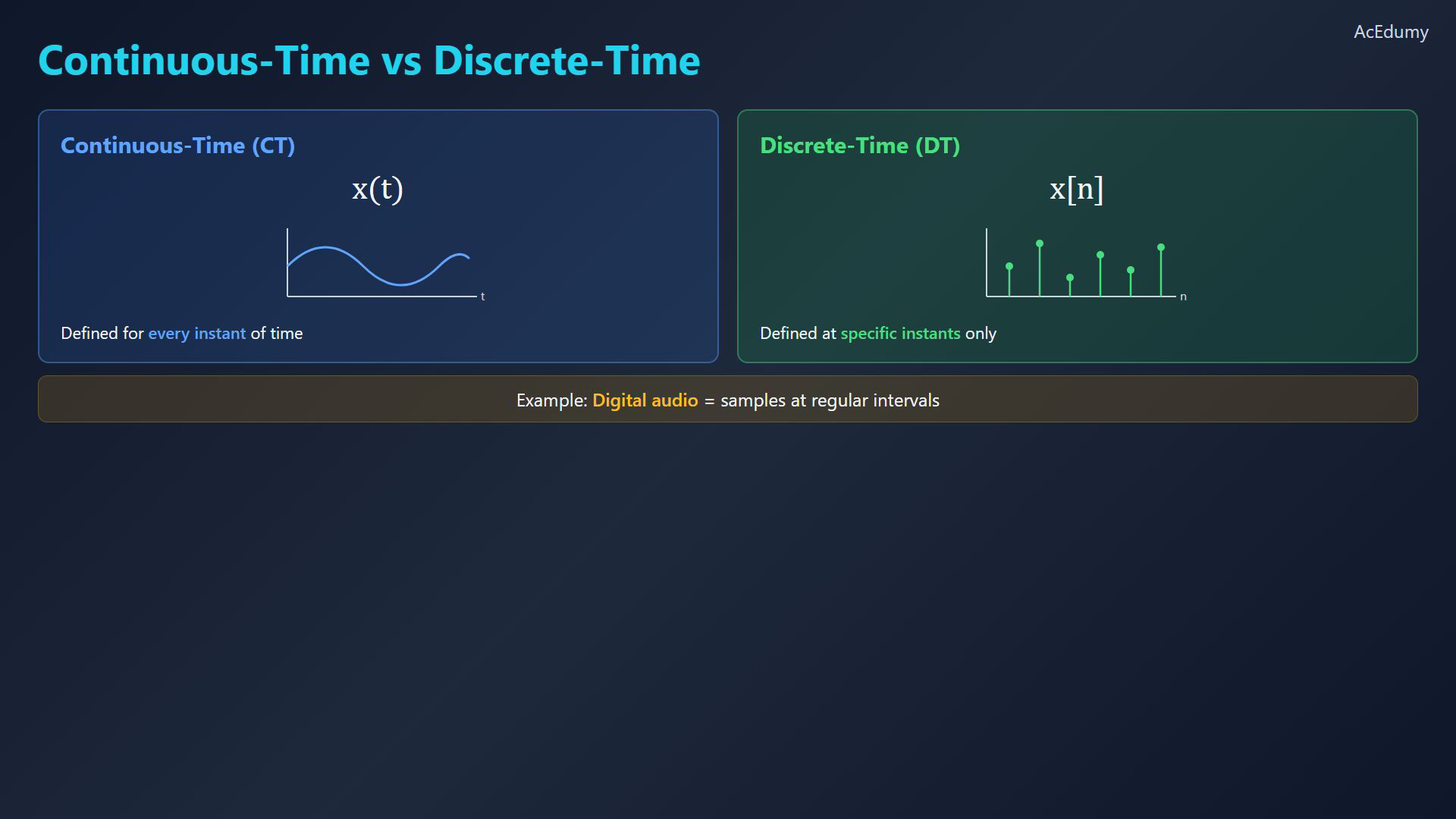
Original-video reference. The time-transformation overview and summary use the same video's explicit four-triangle example. The scaling frame shows the concrete negative-two example. Source wording about 'shape' means amplitude profile, not unchanged duration; reversal is about the vertical time-origin axis. Positive shift magnitudes and nonzero scale are assumed. Continuous time and discrete time describe the independent variable.A continuous-time signal is defined at every time in its domain.Continuous time does not require a continuous waveform; a square wave can jump.Continuous-time notation uses parentheses and a real-valued time variable.A discrete-time signal is a sequence, not an interpolated curve between samples.Its integer index labels the sequence; the amplitudes need not be quantized.Uniform sampling example, with positive sampling period:Narration transcript
Signals come in two basic forms: continuous-time signals and discrete-time signals. A continuous-time signal is defined for every instant of time. The signal itself may have discontinuities, like a square wave, but the time variable is continuous. We denote continuous-time signals as x of t. A discrete-time signal, on the other hand, is defined only at specific time instants. We write it as x of n, where n is an integer index. Think of digital audio: it consists of samples taken at regular intervals.
4. State the conditions of each time transformation
Original-video reference. The time-transformation overview and summary use the same video's explicit four-triangle example. The scaling frame shows the concrete negative-two example. Source wording about 'shape' means amplitude profile, not unchanged duration; reversal is about the vertical time-origin axis. Positive shift magnitudes and nonzero scale are assumed. Transform the time variable of a continuous-time signal.Distinguish shifting, scaling and reversal.Clarification of the source's word 'shape': amplitudes are preserved, but time scaling changes width.The triangle examples below make the transformed support and peak explicit.Narration transcript
Now let us learn how to manipulate continuous-time signals. There are three fundamental operations: time shifting, time scaling, and time reversal. These operations change when or how a signal appears along the time axis, but they do not change the shape of the signal itself. Understanding these operations is essential for analyzing signals and systems.
5. Shift the triangle along the time axis
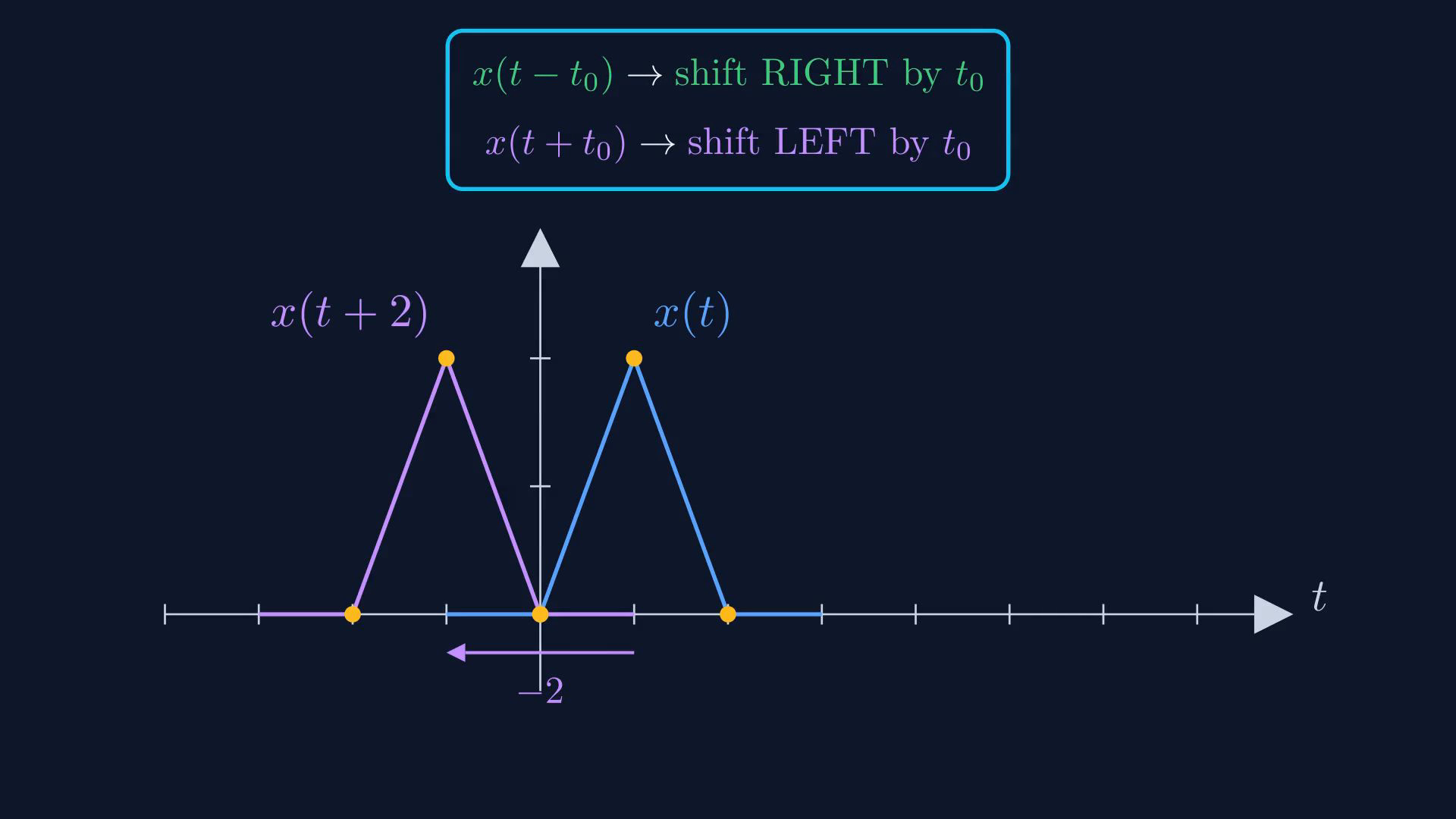
Original-video reference. The time-transformation overview and summary use the same video's explicit four-triangle example. The scaling frame shows the concrete negative-two example. Source wording about 'shape' means amplitude profile, not unchanged duration; reversal is about the vertical time-origin axis. Positive shift magnitudes and nonzero scale are assumed. Time shifting translates a waveform along the time axis.For a positive delay:For a positive advance:A delayed feature moves from its old to new time:In the shown left-shift-by-two example, the triangle spans minus two to zero.Narration transcript
Time shifting moves a signal left or right along the time axis. Given a signal x of t, the shifted signal x of t minus t-zero is obtained by shifting the graph to the right by t-zero units. Similarly, x of t plus t-zero shifts the graph to the left by t-zero units. The key rule is: replace t with t minus t-zero to shift right, or t plus t-zero to shift left. Watch as this triangle signal slides along the time axis.
6. Scale and reverse time without changing amplitudes
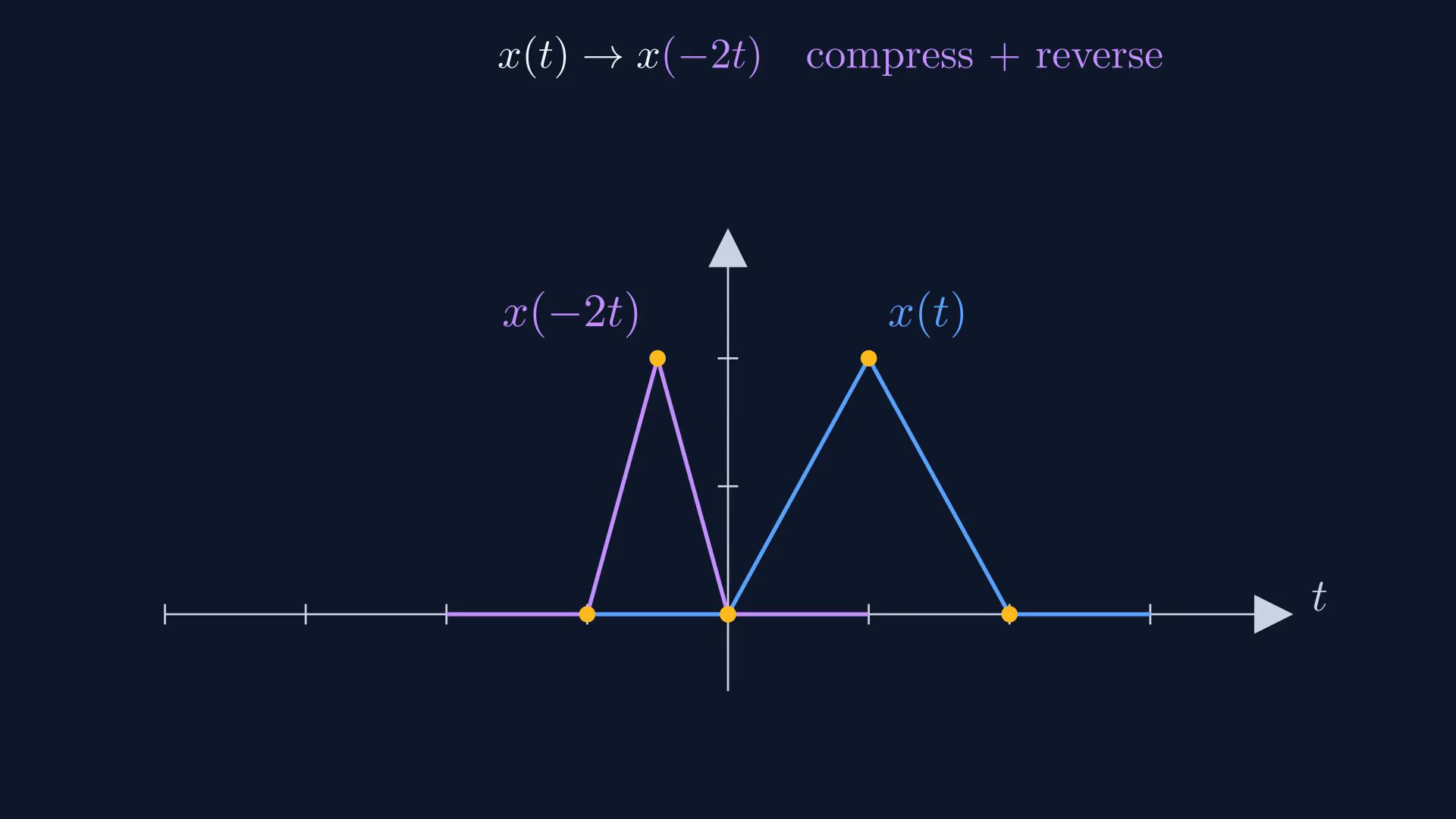
Original-video reference. The time-transformation overview and summary use the same video's explicit four-triangle example. The scaling frame shows the concrete negative-two example. Source wording about 'shape' means amplitude profile, not unchanged duration; reversal is about the vertical time-origin axis. Positive shift magnitudes and nonzero scale are assumed. Time scaling changes the duration of features, not their amplitudes.For nonzero scale k, each feature moves to:For a scale greater than one, the time width is compressed:For a positive scale below one, the time width is stretched:Reflect about the vertical time-origin axis:Time reversal preserves each amplitude's sign:Compress by two and reverse time:Reversal and scaling commute here; do not generalize that to shifting and scaling.Narration transcript
Time scaling compresses or stretches a signal. Given x of t, the signal x of k t is obtained by dividing the time axis by k. If k is greater than one, the signal is compressed. If k is between zero and one, it is stretched. Time reversal flips the signal about the vertical axis. The signal x of negative t is a mirror image of x of t. We can combine these: x of negative two t means first compress by two, then reverse. Or equivalently, reverse first, then compress.
7. Map the exact triangle support and peak
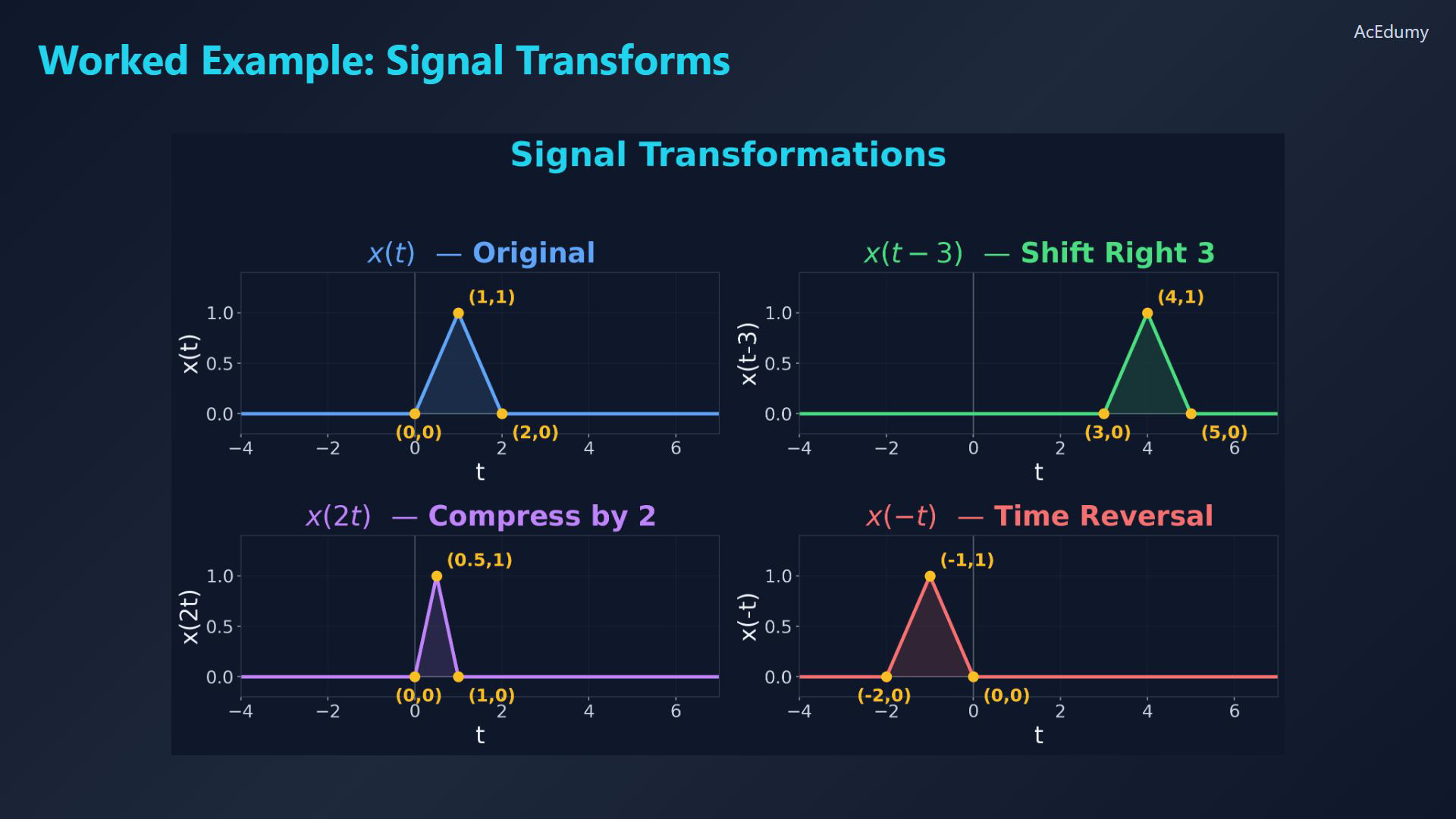
Original-video reference. The time-transformation overview and summary use the same video's explicit four-triangle example. The scaling frame shows the concrete negative-two example. Source wording about 'shape' means amplitude profile, not unchanged duration; reversal is about the vertical time-origin axis. Positive shift magnitudes and nonzero scale are assumed. Use the same unit triangle for all comparisons.Linear unit-triangle vertices, zero outside their span:Right-shifted triangle spans three to five, peaking at four:Compressed triangle spans zero to one, peaking at one half:Reversed triangle spans minus two to zero, peaking at minus one:Narration transcript
Let us work through an example. Consider a triangle signal x of t that rises from zero to one between t equals zero and t equals one, then falls back to zero at t equals two. Shifting right by three gives x of t minus three: the same triangle now spans from three to five. Compressing by two gives x of two t: the triangle spans from zero to one, twice as narrow. Reversing gives x of negative t: the triangle is mirrored to span from negative two to zero.
8. Summarize nonzero time scaling and time-origin reversal
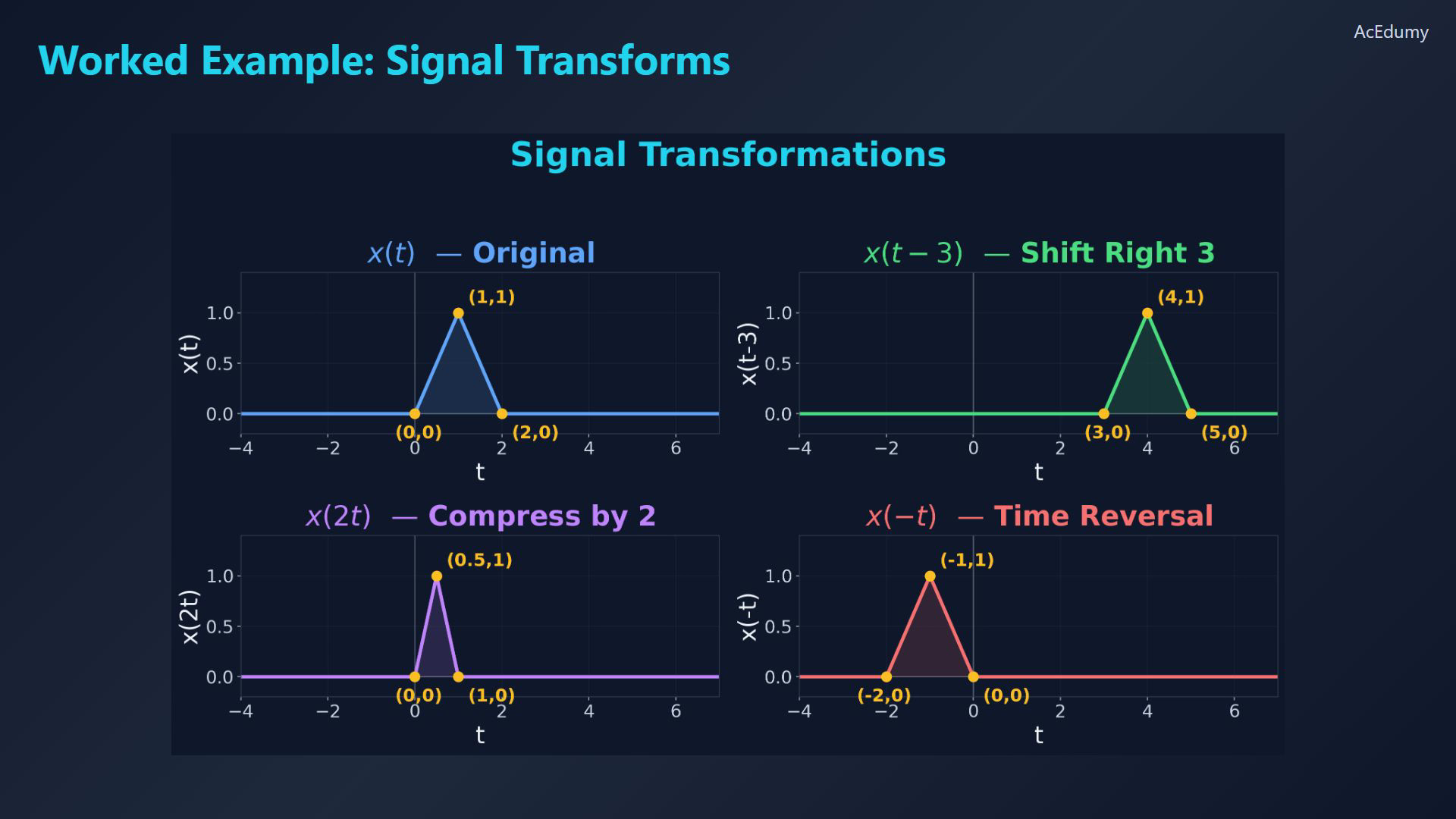
Original-video reference. The time-transformation overview and summary use the same video's explicit four-triangle example. The scaling frame shows the concrete negative-two example. Source wording about 'shape' means amplitude profile, not unchanged duration; reversal is about the vertical time-origin axis. Positive shift magnitudes and nonzero scale are assumed. Keep the conditions and the time-origin convention explicit.For a positive delay:For a nonzero time-scale factor:Reflect the time coordinate, not the amplitude:Next, with a nonzero slope, combine the transformations:Narration transcript
Let us review the key signal manipulation rules. Time shifting: x of t minus t-zero shifts right by t-zero. Time scaling: x of k t divides the time axis by k. Time reversal: x of negative t mirrors about the origin. In the next lesson, we will combine these operations to handle transformations like x of a t plus b, which involve both shifting and scaling together.
Source video: Signals & Systems #01 | What is a Signal? Time Shifting, Scaling & Reversal (4:16)