Circuit Theory 1 · Source Transformation
#23 Source transformation #23 — examples for i_a and V_0
Reduces one dependent-source circuit and one multi-stage network by source transformation to obtain i_a=6 A and V_0=28 V.
Question
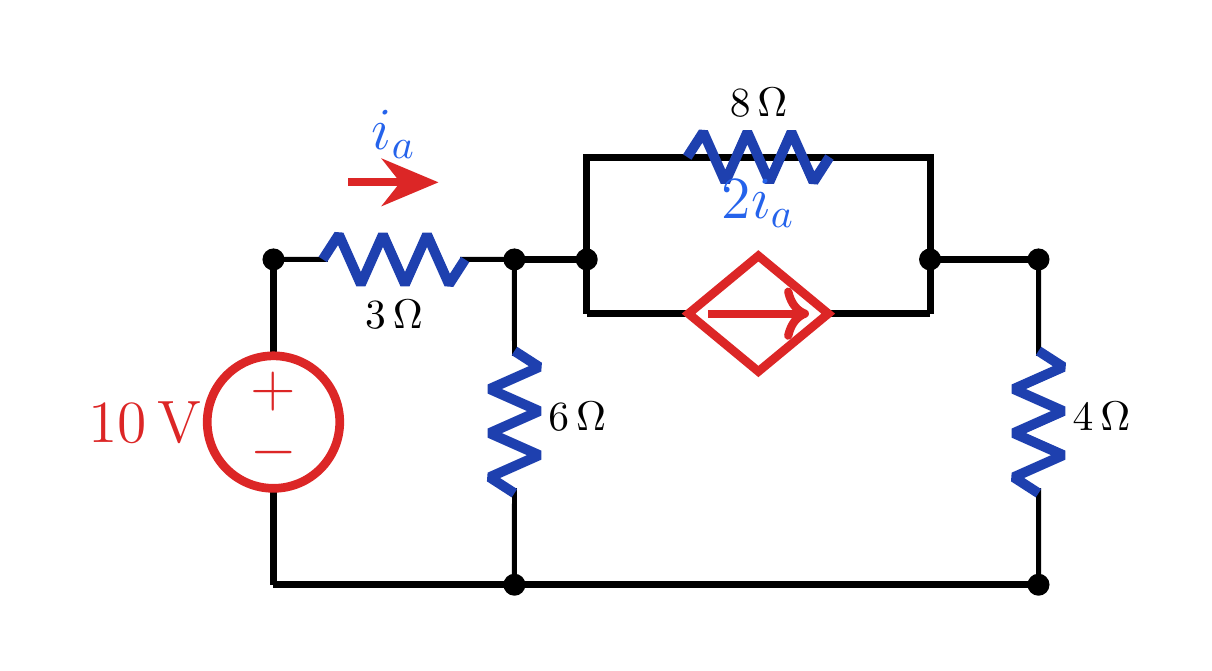
Use source transformation to find current i_a in Example 3 and voltage V_0 in Example 4.
Written solution and narration transcript(shows the full solution)
Below are all the lines written in the notebook together with the full narration transcript.
1. Terminal equivalence
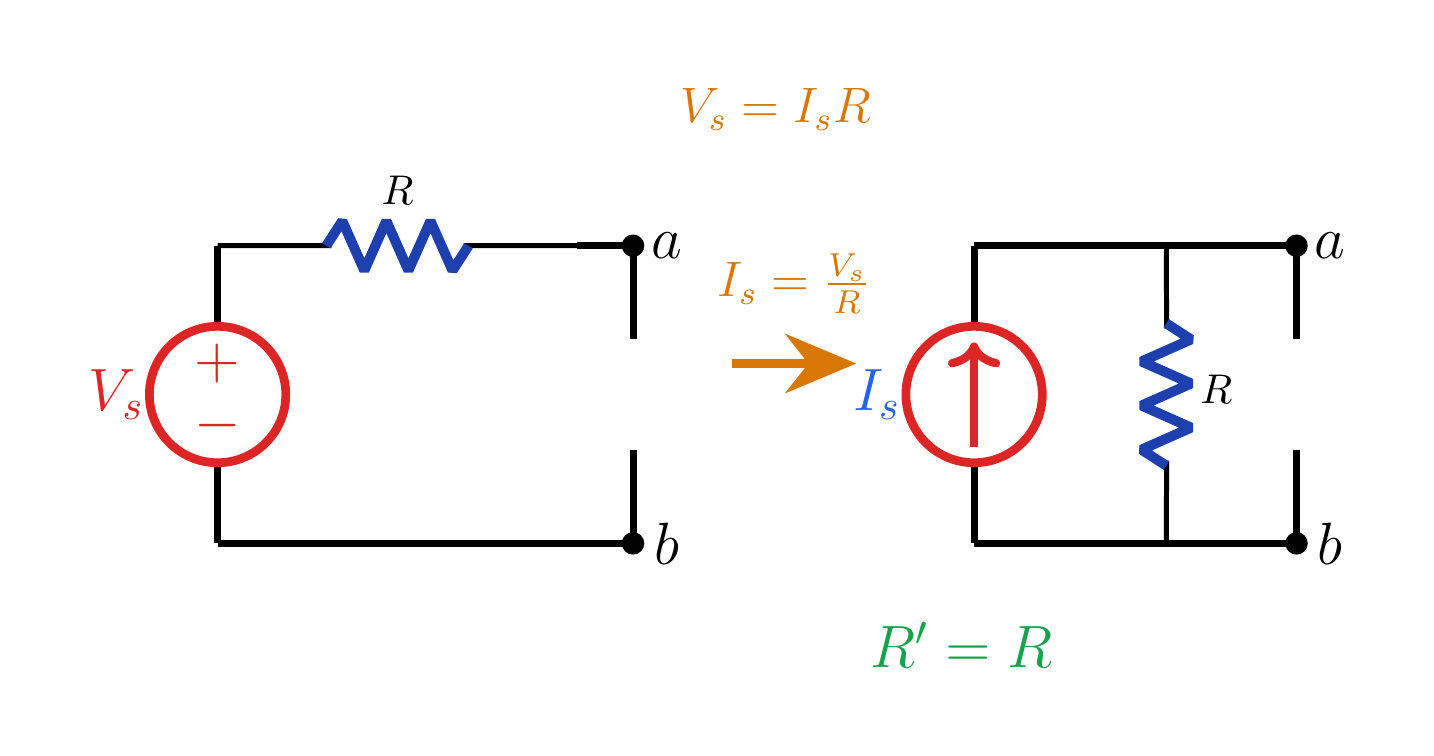
V_s=I_sR, I_s=V_s/R, and R′=R. Terminal equivalenceVs in series with R ⇔ Is in parallel with RThe resistance is unchanged:A dependent source may remain symbolicNarration transcript
In this lesson we finish the source transformation sequence with two compact examples. The key idea is still terminal equivalence. A voltage source in series with a resistor and a current source in parallel with the same resistor can describe the same behavior at the two outside terminals. That is why we can replace a complicated block by a cleaner equivalent block, as long as we preserve the correct voltage, current direction, resistance, and polarity. In the first example, the source is dependent, so its value contains i a. That is allowed; we transform it symbolically and solve for i a at the end.
2. Example 3 circuit
Current i_a points right; the dependent source is parallel with 8 Ω and followed by 4 Ω to ground. Example 3: find iaia flows right through 3 ΩMiddle branch: 6 ΩRight pair: 2ia → in parallel with 8 ΩFinal branch: 4 ΩA dependent source can still be transformedNarration transcript
Example three asks for the current i a. The current i a is the current through the 3 ohm resistor, moving from the 10 volt source toward the right. The middle branch has 6 ohms to ground. On the right, an 8 ohm resistor is in parallel with a dependent current source of value 2 i a. This dependent current source points from left to right, and it is followed by a 4 ohm branch to ground. The important note is that a dependent source does not prevent source transformation; its value just remains symbolic.
3. Example 3 solution
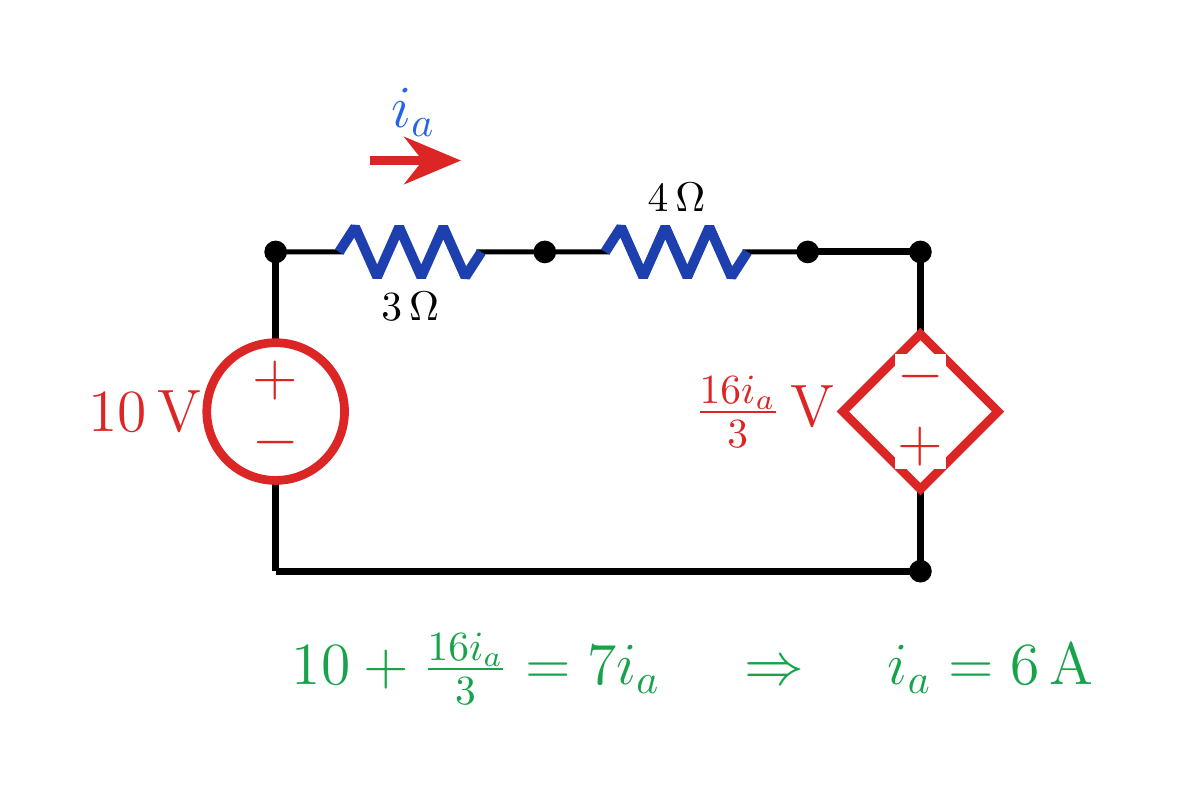
The dependent source is negative at the top and positive at the bottom; 10+16i_a/3=7i_a gives i_a=6 A. Transform the dependent pairAnswer:Narration transcript
Transform the dependent current source in parallel with 8 ohms into a dependent voltage source. The value is 2 i a times 8 ohms, equal to 16 i a volts. The 8 ohm resistor is then in series with the 4 ohm resistor, so that side is 12 ohms. Converting that series pair back to Norton gives a current source of 16 i a divided by 12 in parallel with 12 ohms. Now 6 ohms in parallel with 12 ohms gives 4 ohms. After one more transformation, the circuit is a single loop with 3 ohms plus 4 ohms, so 7 ohms total, and a dependent source of 16 i a over 3 volts. KVL gives 10 volts plus 16 i a over 3 equals 7 i a. Multiplying by 3 gives 30 plus 16 i a equals 21 i a. Therefore 5 i a equals 30, and i a equals 6 amperes.
4. Example 4 circuit
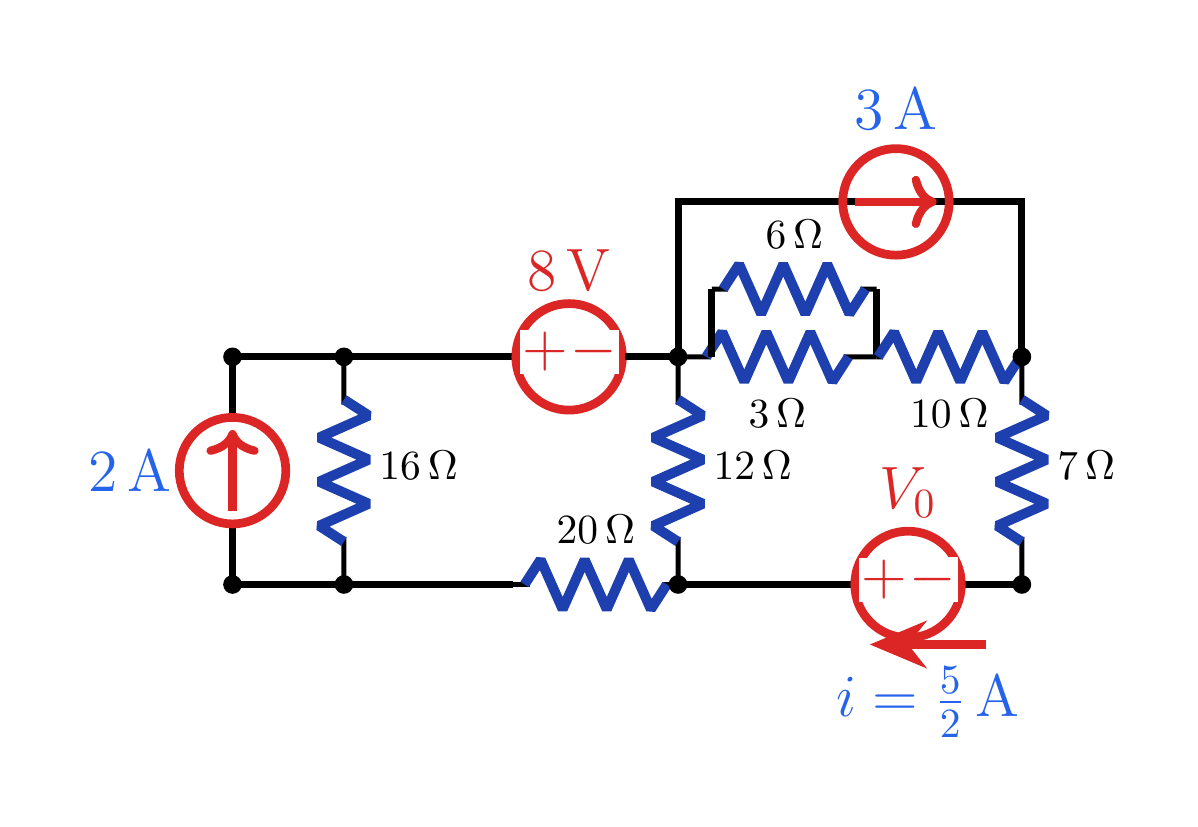
The bottom-branch current is 5/2 A from right to left; V_0 is positive on the left. Example 4: find V0Given: i=5/2 A to the left2 A ∥ 16 Ω ⇒ 32 V in series with 16 Ω32−8=24 V and 16+20=36 ΩPreserve the V0 polarity and current directionNarration transcript
Example four asks for V zero in a longer circuit. We are also given that the current through the bottom output branch is 5 over 2 amperes to the left. The reduction is a chain of small transformations. The left 2 amp current source in parallel with 16 ohms becomes a 32 volt source in series with 16 ohms. That source combines with the 8 volt source, leaving a net 24 volt source and 36 ohms on the left side. On the right side, the 6 ohm and 3 ohm resistors are in parallel, giving 2 ohms; with the 10 ohm resistor, that becomes 12 ohms.
5. Example 4 solution
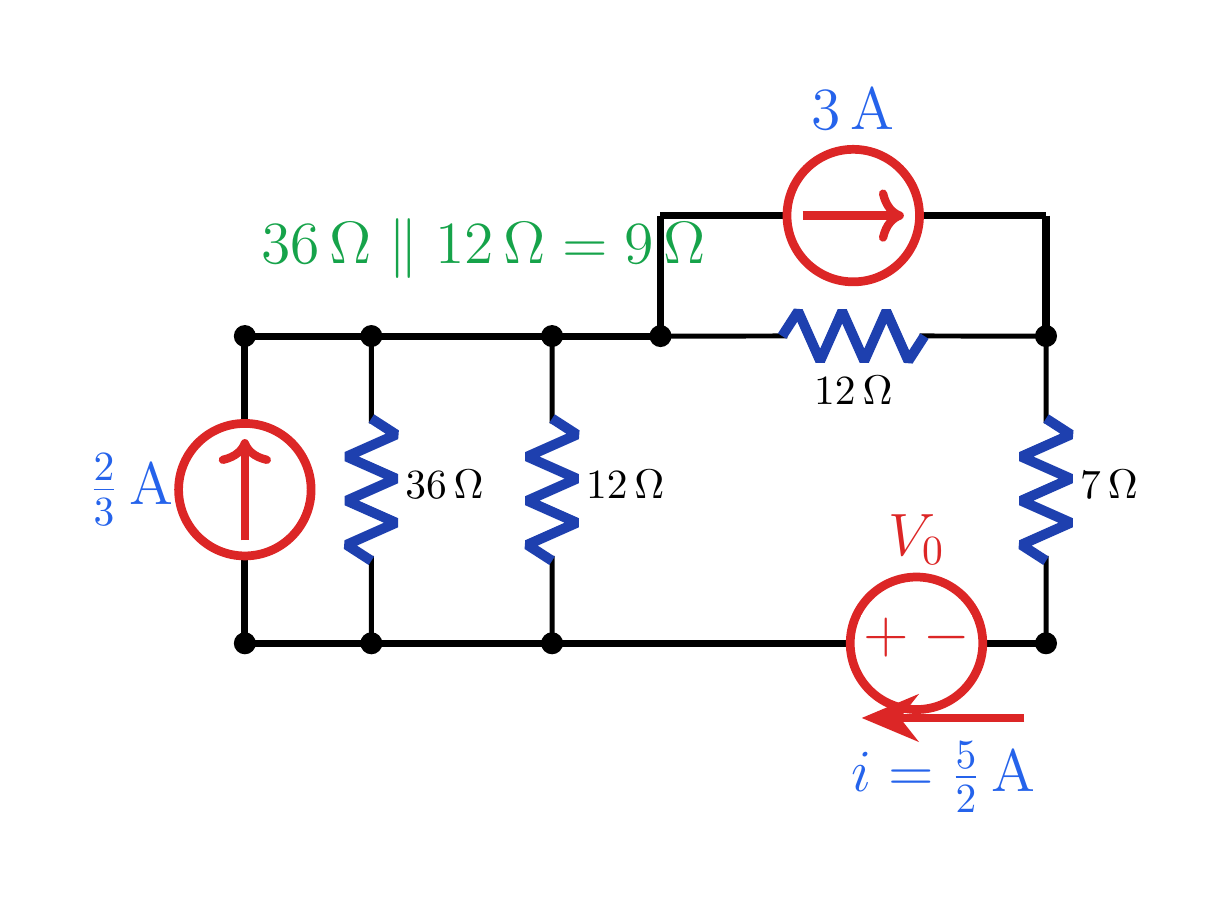
The left pair contains 2/3 A with 36 Ω and the vertical 12 Ω; the right pair contains 3 A in parallel with the horizontal 12 Ω. Reduce both sides24/36=2/3 A in parallel with 36 Ω3 A ∥ 12 Ω ⇒ 36 V, positive on the rightNarration transcript
Continue reducing example four. The 24 volt source in series with 36 ohms becomes a current source of 24 over 36, or 2 over 3 amperes, in parallel with 36 ohms. That 36 ohm resistor is in parallel with 12 ohms, so the result is 9 ohms. Transform the 2 over 3 amp source in parallel with 9 ohms into a 6 volt source in series with 9 ohms. The 3 amp source and the 12 ohm equivalent give a 36 volt source in the same series path. At the end, the loop resistance is 9 plus 12 plus 7, which is 28 ohms. The given current is 5 over 2 amperes, so the total resistor drop is 28 times 5 over 2, equal to 70 volts. The sources contribute 6 volts plus 36 volts plus V zero, so 42 plus V zero equals 70. Therefore V zero equals 28 volts.
6. Method summary
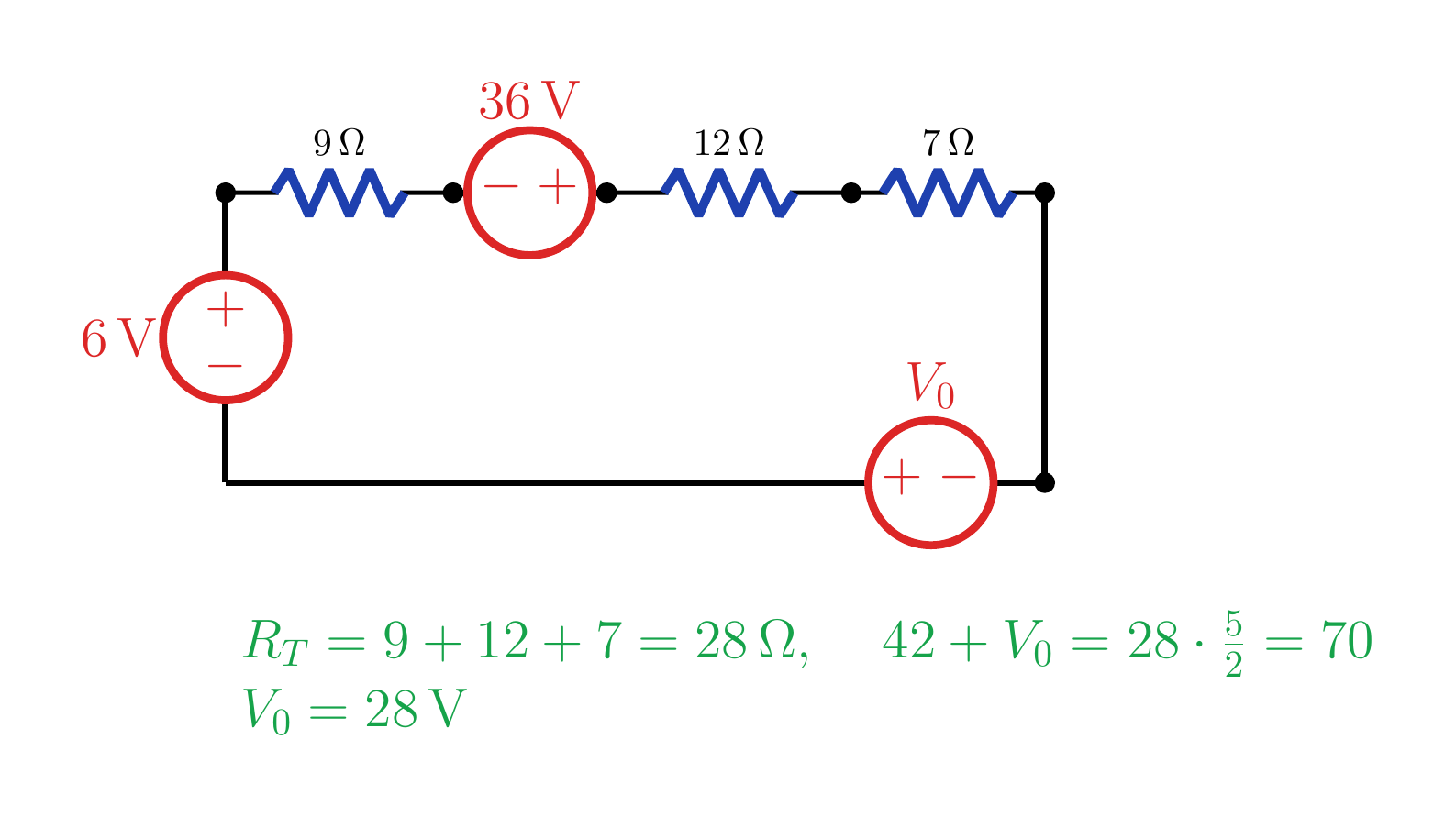
The 6 V source is positive at the top, the 36 V source on the right, and V_0 on the left; V_0=28 V. Source-transformation checklistTransform only strict series/parallel pairsCombine resistors before the next stepKeep dependent values symbolicCarry arrows and polarities into the last equationia=6 A and V0=28 VNarration transcript
The two examples show the same discipline. First, transform only pairs that are truly series or truly parallel. Second, combine resistors before doing another transformation. Third, keep dependent source values as algebraic symbols instead of replacing them by numbers too early. Finally, do the last equation carefully. For example three, the final equation is 10 plus 16 i a over 3 equals 7 i a, giving i a equals 6 amperes. For example four, the final equation is 42 plus V zero equals 70, giving V zero equals 28 volts.
Source video: Circuit Theory #23 | Source Transformation Examples - Find ia and V0 (5:12)