Analog Communication · Single sideband and vestigial sideband
#03 Real-message redundancy, Hilbert convention, VSB recovery and AM-family tradeoffs
Use real-message symmetry to compare SSB, VSB and AM; keep sideband selection, practical receiver conditions and power normalization explicit.
Question
Assume a real zero-DC message m(t), Fourier transform M(f) with exp(−j2πft) convention, band edge W>0 and f_c>W. Real-message symmetry is M(−f)=M*(f): equal magnitudes, conjugate phases, not identical arbitrary complex spectra. It does not make independent I/Q channels redundant. Positive occupied RF interval of DSB is [f_c−W,f_c+W]; the negative-frequency conjugate is necessary for a real waveform, not an additional positive RF sideband or extra physical bandwidth. Assume useful support reaches W and near DC for the interval examples; an isolated tone has spectral lines, not a filled band. Hilbert partner h(t) has response −j sgn(f); for m=cos(ω_m t), h=sin(ω_m t), ω_m>0,ω_c=2πf_c. Unit DSB waveform d=m cos(ω_c t). Define s_U=[m cos(ω_c t)−h sin(ω_c t)]/2 and s_L=[m cos(ω_c t)+h sin(ω_c t)]/2 so that each retained sideband has exactly its original DSB amplitude. For one tone they equal cos((ω_c+ω_m)t)/2 and cos((ω_c−ω_m)t)/2. No carrier is added; SSB with residual carrier is a separate allowed variant. The factor one half is essential: using an unhalved Hilbert construction and claiming equal retained-sideband power would be inconsistent. Under this same-amplitude comparison of a nonzero zero-DC real message, P_SSB=P_DSB/2; this is not a universal equal-SNR or power-amplifier-efficiency result. SSB and DSB-SC both put all ideal transmitted waveform power into message-bearing sidebands; chart scores cannot measure their DC-to-RF efficiency. Normalize an SSB product detector by multiplying s_U by4cos(ω_c t+θ), then low-pass away2ω_c products: y_U=m cosθ+h sinθ. For LSB the Hilbert term changes sign. A ninety-degree SSB phase error gives h, not the DSB zero output; source waveform phase can matter even if speech remains intelligible. A frequency error makes phase time-varying and shifts recovered tones. For VSB use real LTI RF filter H, so H(f−f_c)=H*(f_c−f). Filtering d=m cosω_ct then multiplying by2cosω_ct yields Y(f)=M(f)[H(f_c+f)+H(f−f_c)]/2 in the baseband. A sufficient distortionless condition is bracket=K exp(−j2πfτ) for |f|≤W with real nonzero K and constant delayτ; y=(K/2)m(t−τ). It is not generally enough for two magnitudes to add to a constant: relative phase/delay matters. The simplified H(f_c+f)+H(f_c−f)=constant assumes the appropriate real zero-phase response; do not silently drop complex conjugation for a general RF filter. Vestige width0<B_v<W yields B_VSB=W+B_v betweenW and2W. The textbook amplitude-complementary idealization is not a guarantee of a physically realizable zero-delay brick-wall response; real rolloff/guard/equalization apply. Near-DC content makes filtering sharply between sidebands difficult; phasing/IQ alternatives exist and SSB is not impossible. VSB does not automatically allow exact envelope recovery: suitable residual carrier, quadrature distortion and equalization conditions remain, and carrier-suppressed VSB can use coherent detection. Historical analog TV is an example, not a claim about current broadcasting standards. Conventional AM comparison uses A_c[1+μcosω_mt]cosω_ct across resistance R>0, A_c>0,0≤μ≤1. The two-sideband fractionη_AM=μ²/(2+μ²)≤1/3 is a single-tone conventional waveform result, not arbitrary-message or amplifier efficiency. Practical diode/RC margin remains necessary. Example W3kHz/B_v.5kHz gives conventionalAM/DSB6kHz,SSB3kHz,VSB3.5kHz before guards. No source narration overrides. Source129 EN SCENES/757 ACD03/77 ACRoot/164 existing TR canonical fully reviewed, generator not executed. Existing authenticated Bunny original e9ff7df1-8caf-4c00-ba6f-f217476330be is214.592s/19,270,359bytes/SHA822afe31487a5c81f60e6357fd08f32e71f199ed68aee9f1a68d67d67a7d8371; site duration215 is metadata rounding. Five current MP3+timings have six matching Hetzner/local hashes, but old timing end218.536 and normal correlations.0424–.1055 fail against final. Do not claim source MP3s match final. Original files remain unchanged. Actual scene/silence boundaries3,40.633333,86.2,130.233333,174.066667 to214.592 recover five audio clips from final. At174.033333 the source has one blank transition frame;174.066667 is new summary background and inside measured silence. At130.233333 a38ms silence found with a5ms detector threshold supports the boundary; this is not alignment-threshold weakening. Whole final36ASR segments and all word intervals, all33recovered cue/source/ASR lines and five cached-small outputs reviewed. Same-source recovered/final correlation.99128–.99997 with0ms offset proves extraction integrity, not independent original TTS provenance. All33large cues.9826–1 pass unchanged. Small.9838–1: whole-final/small write 'Bestigial', recovered-large correctly 'Vestigial'; this phonetic transcription is not proof of wrong narration and no arbitrary B/V substitution or cue fabrication is introduced. Source 'used'/ASR'use' and hyphen variants do not alter the engineering claim; fluency remains human QA. All five actual final frames seen: duplicate and SSB diagrams retained as qualitative positive-RF illustrations; centre red/grey marks must not imply a residual carrier in suppressed variants. VSB red V-shaped curve lacks axes/complementary-gain calibration and vestige relation near carrier is ambiguous; replace with clean same-final summary. Tradeoff mini spectra overflow their small chart boxes (remain visible on final canvas) and four-level efficiency scores have no numerical normalization; replace with summary, not measured performance. Five roles/three unique references. No image editing/source render changes. Shared builder/math/row-store only; no legacy singleJSON, new TTS, paid generation, model download, video rendering/upload, publication, access, security or egress changes. Unpublished technical draft, not full human audio, pedagogy, motion or publication approval.
Written solution and narration transcript(shows the full solution)
Below are all the lines written in the notebook together with the full narration transcript.
1. Use real-message conjugate symmetry correctly
Original-video conceptual reference, not a calibrated filter or efficiency chart. The ambiguous VSB curve and uncalibrated four-level comparison are replaced with the same video's clean summary; the notebook states the mathematical conditions. For a real baseband message extending to W and carrier above W, double sideband occupies:Assume a real message with zero DC and no content beyond the band edge W; state the receiver conditions before discarding a sideband.One sideband can represent this real message; two independent complex message channels need not be redundant.Real-message Fourier symmetry uses complex conjugation, not identical phases:The two baseband magnitude spectra are mirrored:The positive-frequency upper-sideband band edges are:Keeping one positive-RF sideband still requires its negative-frequency conjugate image for a real transmitted waveform.Narration transcript
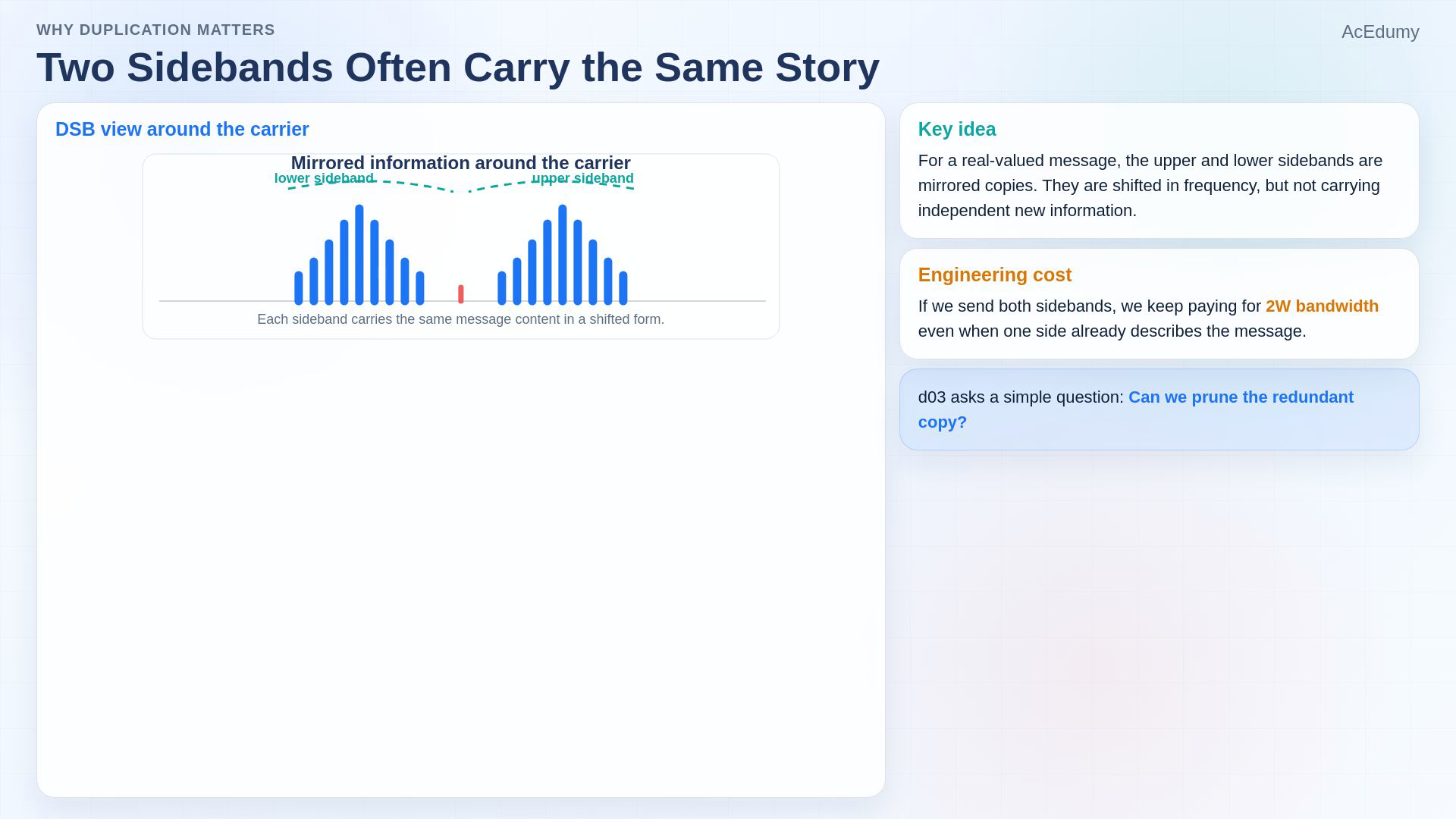
In the previous lesson, both conventional AM and DSB-SC still used two sidebands around the carrier. That raises an important engineering question. Do we truly need both of them? For a real valued message, the upper and lower sidebands are mirrored copies in frequency. They are shifted to opposite sides of the carrier, but they do not carry independent new information. So if bandwidth is precious, transmitting both sidebands can feel wasteful. That observation is the starting point for single sideband and vestigial sideband modulation.
2. Retain one recoverable sideband with a stated convention
Original-video conceptual reference, not a calibrated filter or efficiency chart. The ambiguous VSB curve and uncalibrated four-level comparison are replaced with the same video's clean summary; the notebook states the mathematical conditions. Let h be the Hilbert transform of m; keep the upper sideband at the original DSB sideband amplitude:The lower-sideband alternative uses the opposite sign:For a positive-frequency test tone, the stated Hilbert convention gives:The ideal occupied width of one sideband is:With equal retained-sideband amplitudes and no carrier, removing one equal-power copy gives:SSB can fit more narrow voice channels in a given RF allocation; practical transition bands and guard spacing still matter.For the upper-sideband model, matched frequency and normalized product detection with phase error give:Narration transcript
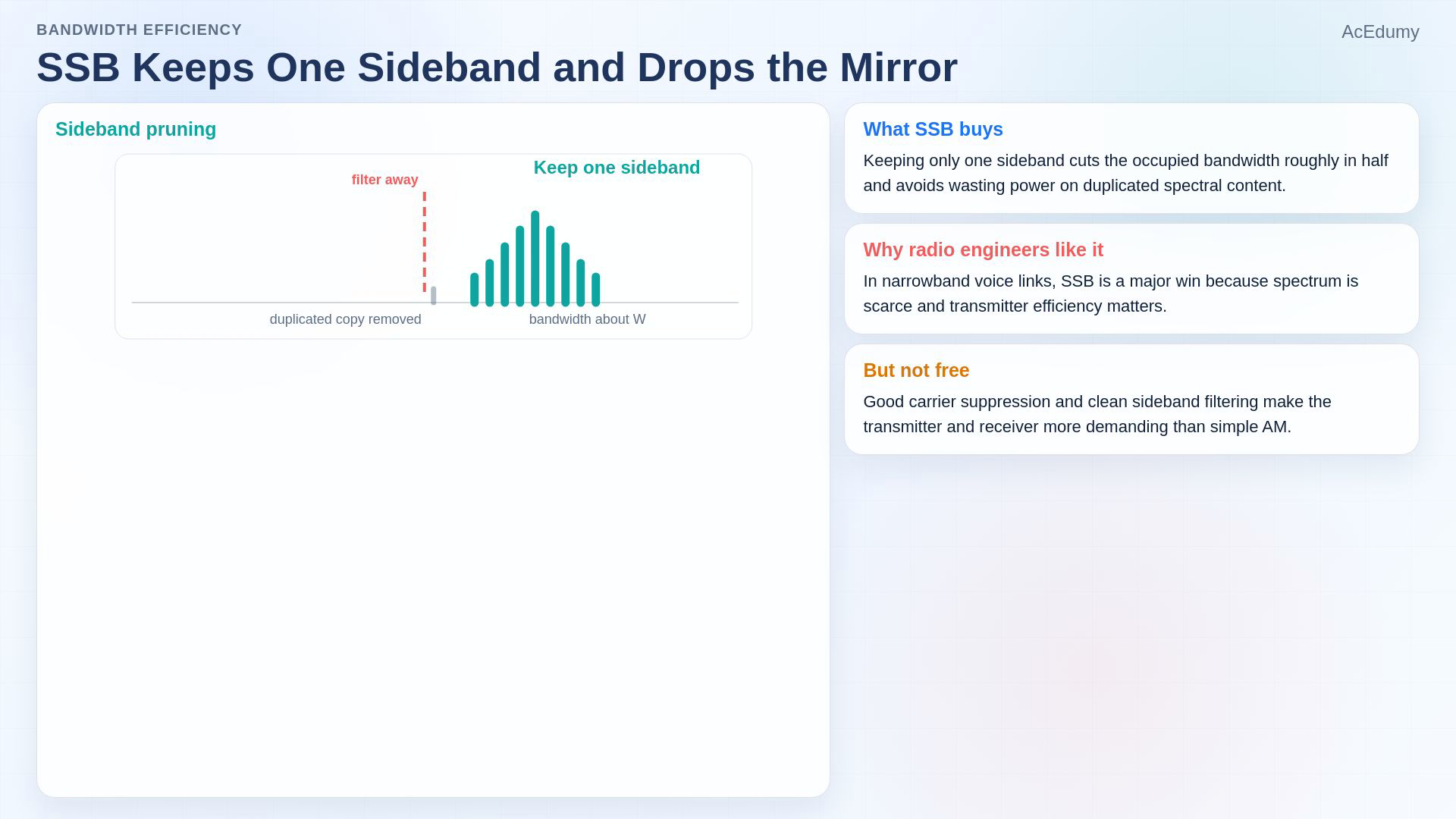
Single sideband, or SSB, keeps only one of those mirrored sidebands and discards the other. In practice, the carrier is usually suppressed as well. The result is powerful. The occupied bandwidth drops from about two times the message bandwidth to about one times the message bandwidth. At the same time, power is no longer spent on a duplicated spectral copy. That is why SSB became so important in narrowband voice radio and long distance communication. Its price is higher implementation difficulty, because generating and receiving a clean single sideband is more demanding than simple AM.
3. Trade a finite vestige for realizable filter transition
Original-video conceptual reference, not a calibrated filter or efficiency chart. The ambiguous VSB curve and uncalibrated four-level comparison are replaced with the same video's clean summary; the notebook states the mathematical conditions. Let the residual opposite-sideband width be B_v, between zero and W:Filtering one sideband sharply becomes difficult when useful message components approach the carrier arbitrarily closely.The retained vestige provides a finite transition region; correct gain and phase response are still required.For real RF filter response H, a distortionless coherent baseband condition across the message band is:With input m times the carrier and product detector using twice the matched carrier, this condition gives:Historical analog television is a VSB example; envelope detection additionally needs suitable residual carrier and controlled quadrature distortion.Narration transcript
Vestigial sideband, or VSB, is the practical compromise. Pure SSB is efficient, but near the carrier frequency it can be difficult to realize the ideal sharp filter that removes exactly one sideband and nothing else. This becomes especially awkward when very low message frequencies matter. VSB solves that problem by keeping one sideband almost fully while leaving a small vestige of the other. That means the bandwidth is slightly larger than SSB, but filtering and demodulation become much more practical. This is why VSB became attractive in wideband broadcast systems such as television video transmission.
4. Compare bandwidth, transmitted power and receiver conditions
Original-video conceptual reference, not a calibrated filter or efficiency chart. The ambiguous VSB curve and uncalibrated four-level comparison are replaced with the same video's clean summary; the notebook states the mathematical conditions. Compare occupied bandwidth, transmitted spectral power and receiver complexity as separate quantities.For non-overmodulated single-tone conventional AM, the fraction of signal power in both sidebands is:DSB-SC removes a separate carrier term only for a zero-DC message; both sidebands still occupy the same band.SSB uses the least bandwidth among these four methods, but frequency error shifts recovered tones and phase error mixes the Hilbert pair.For an intermediate vestige the ideal band ordering is:VSB trades some bandwidth saving for practical filtering; its carrier level, equalization and detector determine the power and reception tradeoffs.Narration transcript
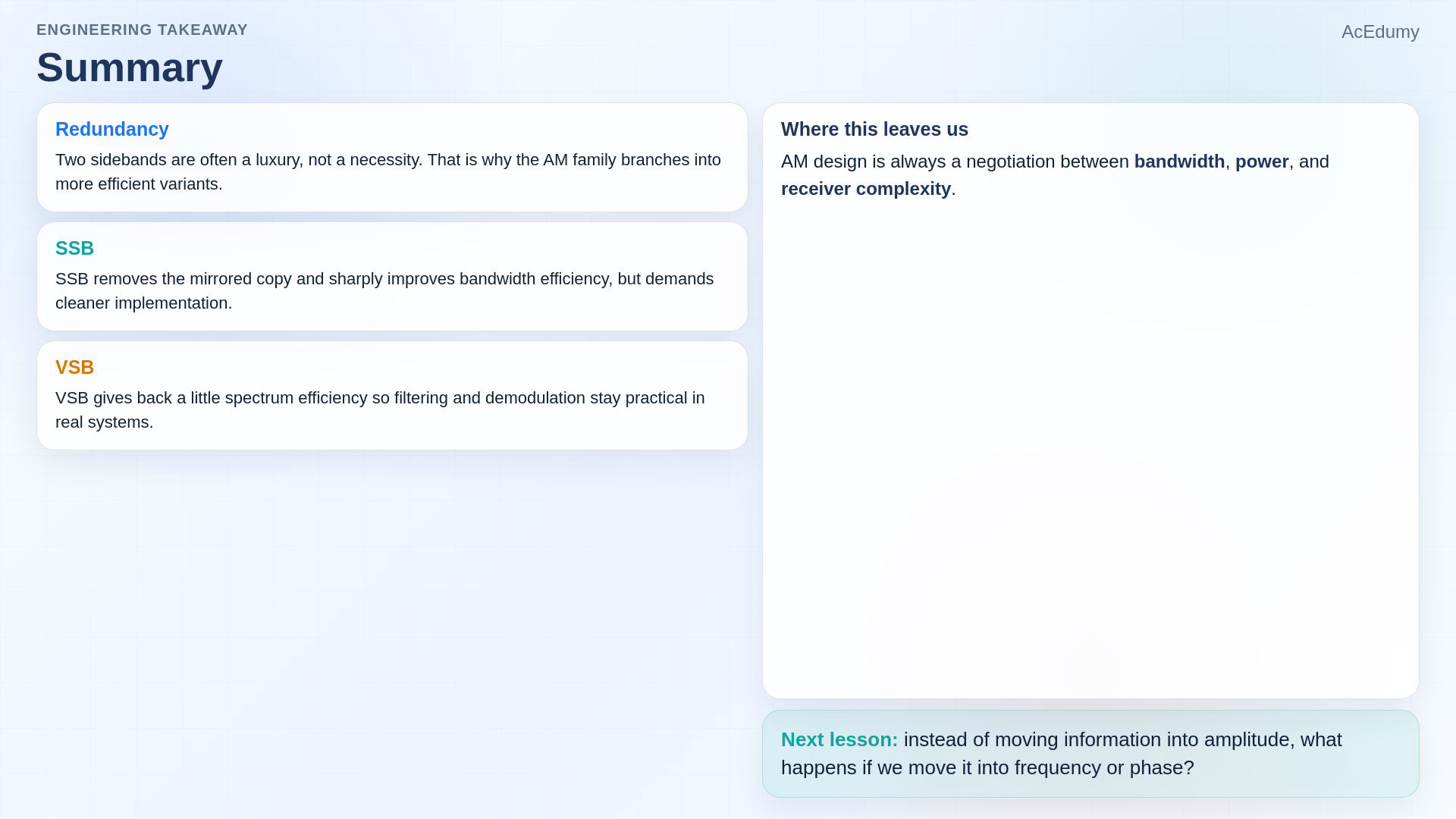
Now we can compare the AM family with a clearer engineering lens. Conventional AM is easiest to receive because the carrier supports simple envelope detection, but it is poor in power efficiency. DSB-SC removes the wasted carrier power, yet still pays for two sidebands. SSB is the most bandwidth efficient member of this family and also avoids duplicated sideband power, but it demands better oscillators, filtering, and tuning. VSB sits between SSB and DSB styles. It gives back a little efficiency so that practical filters and receivers become easier to build.
5. Choose a method under explicit application constraints
Original-video conceptual reference, not a calibrated filter or efficiency chart. The ambiguous VSB curve and uncalibrated four-level comparison are replaced with the same video's clean summary; the notebook states the mathematical conditions. Choose a method from explicit bandwidth, carrier-power and receiver requirements; there is no universal winner.Example assumption: the real message extends from near DC to a 3 kHz band edge, with a 0.5 kHz vestige allowed.Conventional AM with a well-behaved envelope uses this width in kHz:DSB-SC saves carrier power but keeps the same width in kHz:Keeping one sideband gives this ideal width in kHz:One sideband plus the chosen vestige gives this width in kHz:Next: put information into frequency or phase; the linear AM-family bandwidth formulas do not automatically carry over.Narration transcript
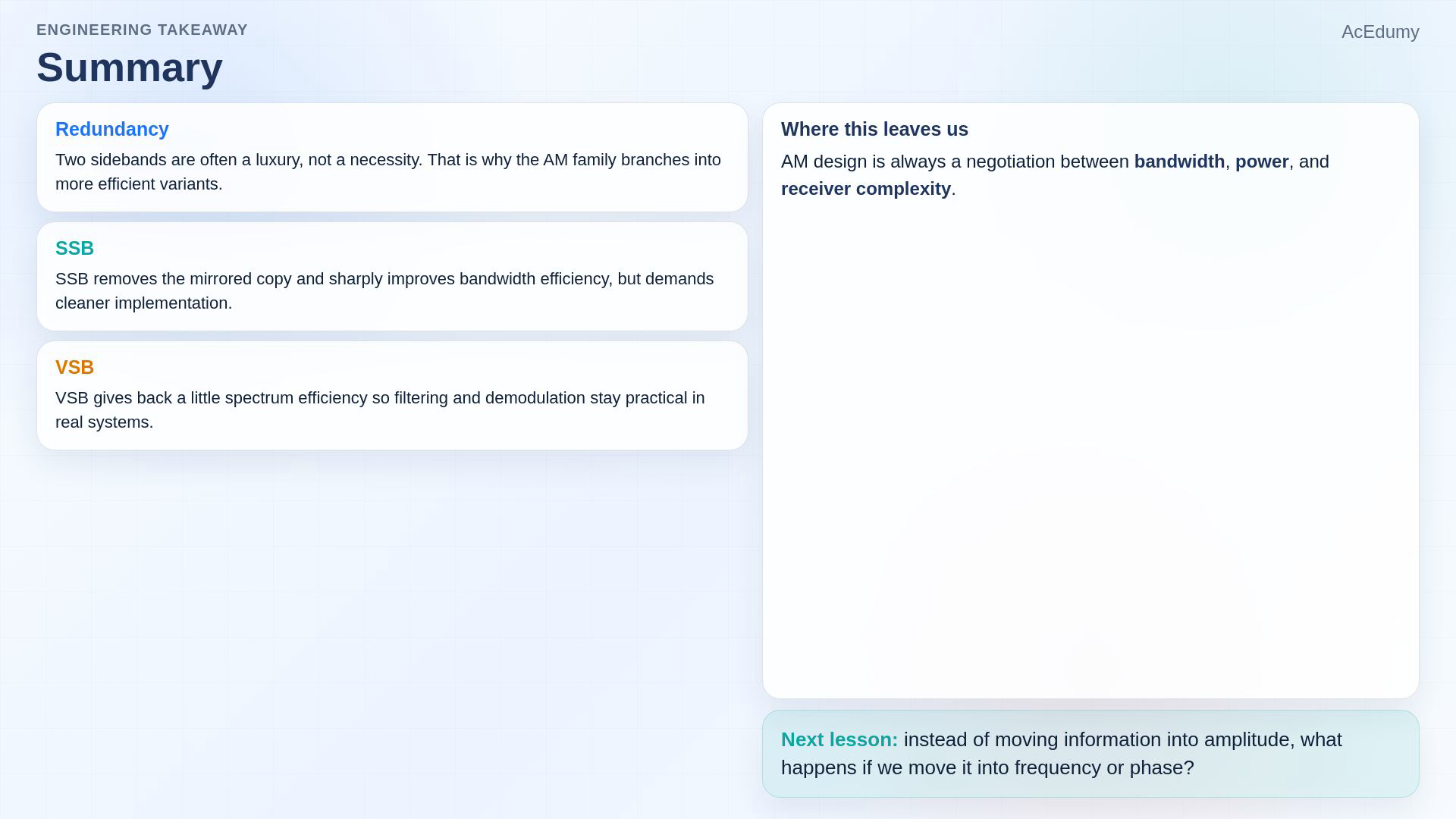
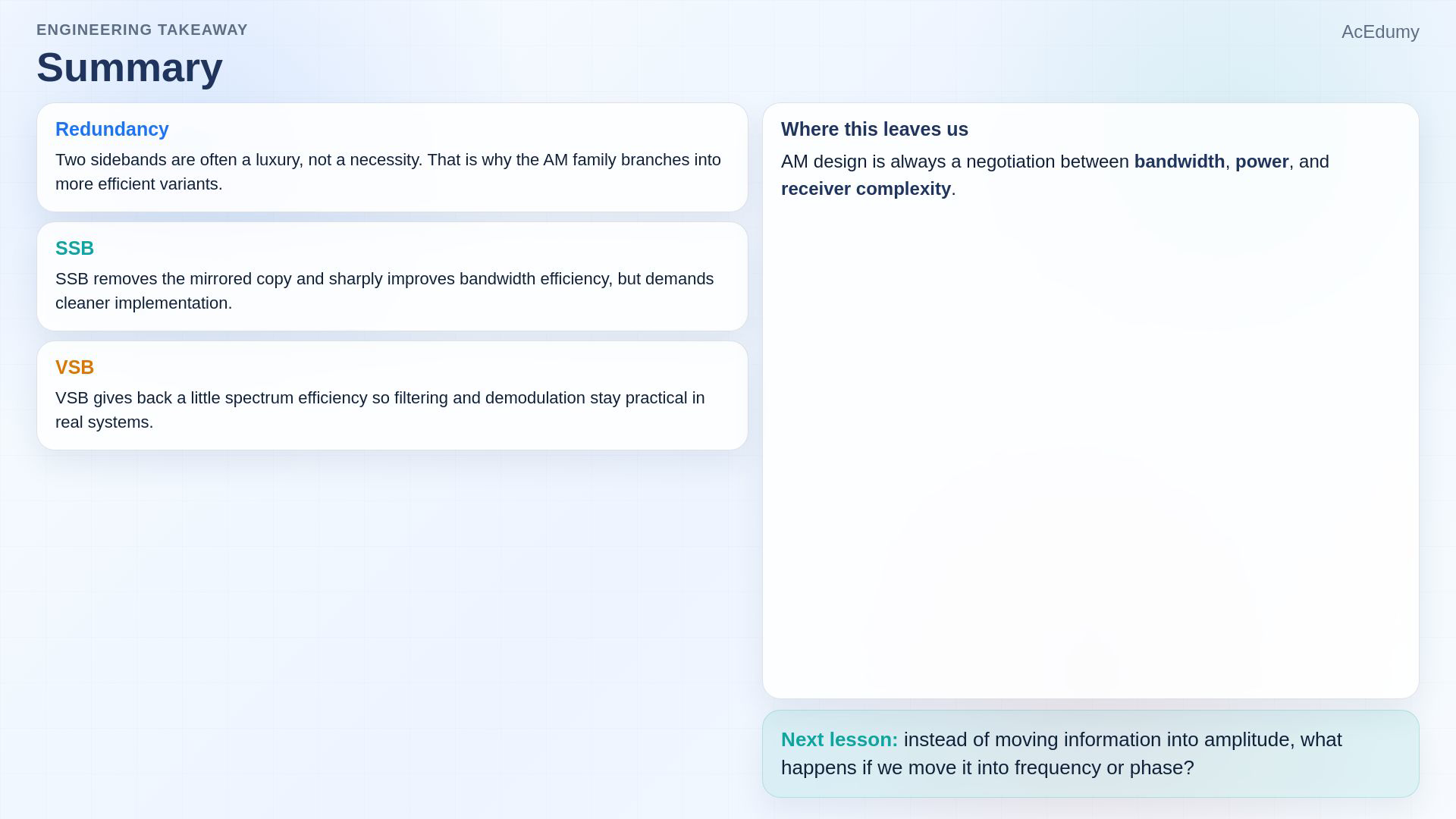
So the big idea is this. AM design is a tradeoff between bandwidth, power, and receiver simplicity. If simplicity matters most, conventional AM is attractive. If carrier power should be removed but bandwidth can stay the same, DSB-SC is useful. If spectrum is scarce, SSB becomes very attractive. If a pure SSB filter is too difficult, VSB offers a practical compromise. In the next lesson, we leave amplitude based modulation and ask what changes when the information is placed into frequency or phase instead.
Source video: Analog Communication #03 | Single Sideband (SSB), Vestigial Sideband (VSB) and AM Tradeoffs (3:35)