Statics · Statics
#01 Force and Its Components
Vectors · Resultant · Resolving into Components
Question
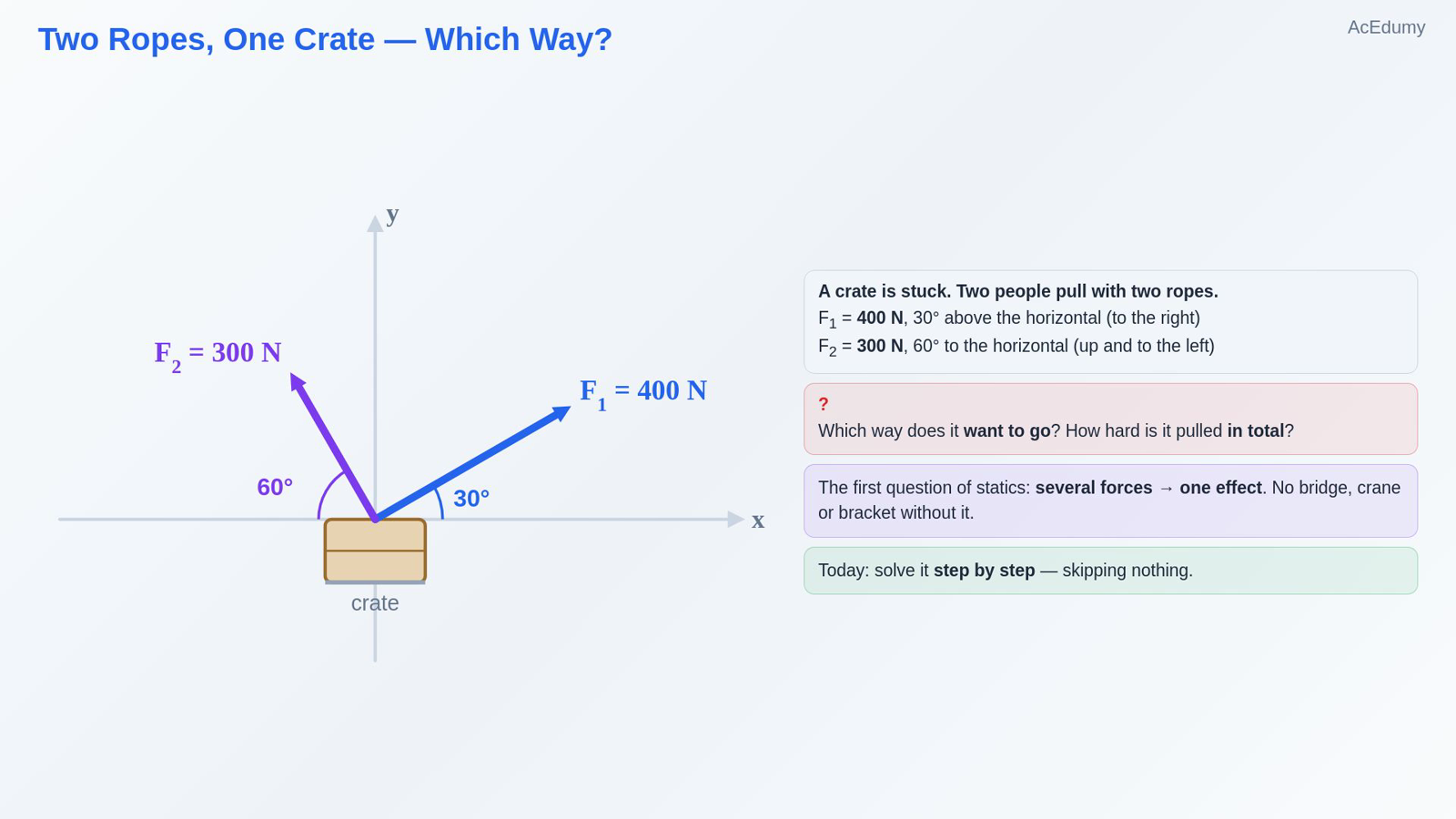
A crate is stuck on the ground, and two people are pulling it with two ropes. One pulls with 400 newtons, holding the rope 30 degrees above the horizontal. The other pulls with 300 newtons, up and to the left, with the rope at 60 degrees to the horizontal. Here is the question: which way does the crate want to go, and how hard is it being pulled in total? This is the very first question of statics: taking several forces and reducing them to a single effect. Until you can do this, you cannot analyze a bridge, a crane, or even a simple shelf bracket. By the end of this lesson we will solve this exact problem step by step, skipping nothing. But first, let us be honest about what a force really is.
Written solution and narration transcript(shows the full solution)
Below are all the lines written in the notebook together with the full narration transcript.
1. Two Ropes, One Crate — Which Way?
Final view of this section in the source lesson. F₁ = 400 N, 30° above the horizontal (to the right)F₂ = 300 N, 60° to the horizontal (up and to the left)The first question of statics: several forces → one effect. No bridge, crane or bracket without it.Today: solve it step by step — skipping nothing.Narration transcript
A crate is stuck on the ground, and two people are pulling it with two ropes. One pulls with 400 newtons, holding the rope 30 degrees above the horizontal. The other pulls with 300 newtons, up and to the left, with the rope at 60 degrees to the horizontal. Here is the question: which way does the crate want to go, and how hard is it being pulled in total? This is the very first question of statics: taking several forces and reducing them to a single effect. Until you can do this, you cannot analyze a bridge, a crane, or even a simple shelf bracket. By the end of this lesson we will solve this exact problem step by step, skipping nothing. But first, let us be honest about what a force really is.
2. What Is a Force? A Vector
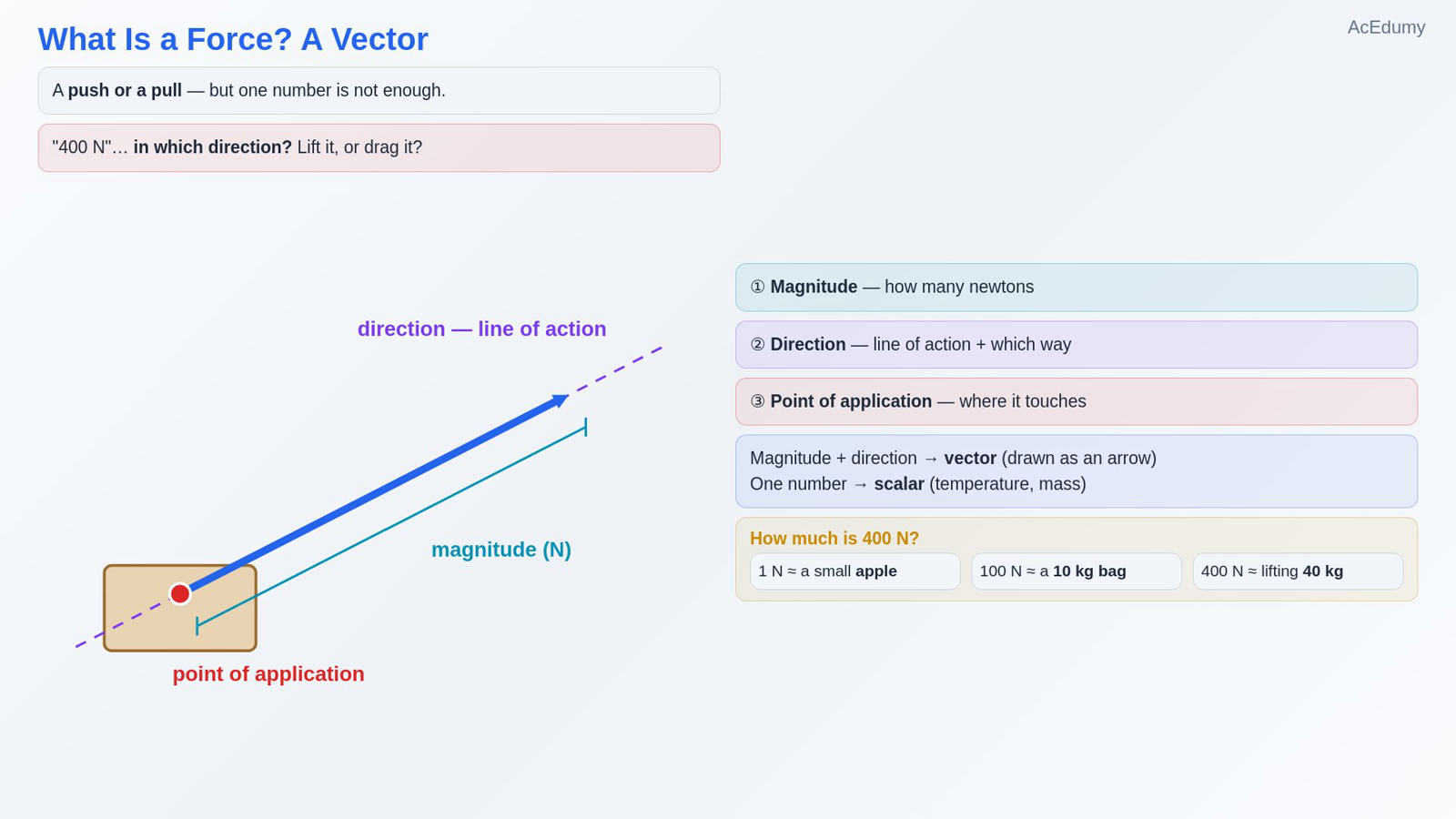
Final view of this section in the source lesson. ① Magnitude — how many newtons② Direction — line of action + which way③ Point of application — where it touchesHow much is 400 N?1 N ≈ a small apple100 N ≈ a 10 kg bag400 N ≈ lifting 40 kgNarration transcript
A force is a push or a pull. But a single number is not enough to describe it. If you tell me 'I am pulling the rope with 400 newtons', my very next question is: in which direction? Are you pulling upward, or sideways? The same 400 newtons either lifts the crate or drags it, depending on the direction. So a force has three pieces of identity. One: its magnitude, how many newtons. Two: its direction, which line it acts along, and which way along that line. Three: its point of application, where it touches the body. A quantity with both magnitude and direction is called a vector, and we draw it as an arrow. A quantity described by a single number, like temperature or mass, is called a scalar. Now, how much is 400 newtons? Here is a feel for it. One newton is about the weight of a small apple in your hand. One hundred newtons is roughly carrying a 10 kilogram bag. So 400 newtons is a pull strong enough to lift a 40 kilogram load. Serious, but well within what two people can do.
3. Adding Forces — Tip to Tail
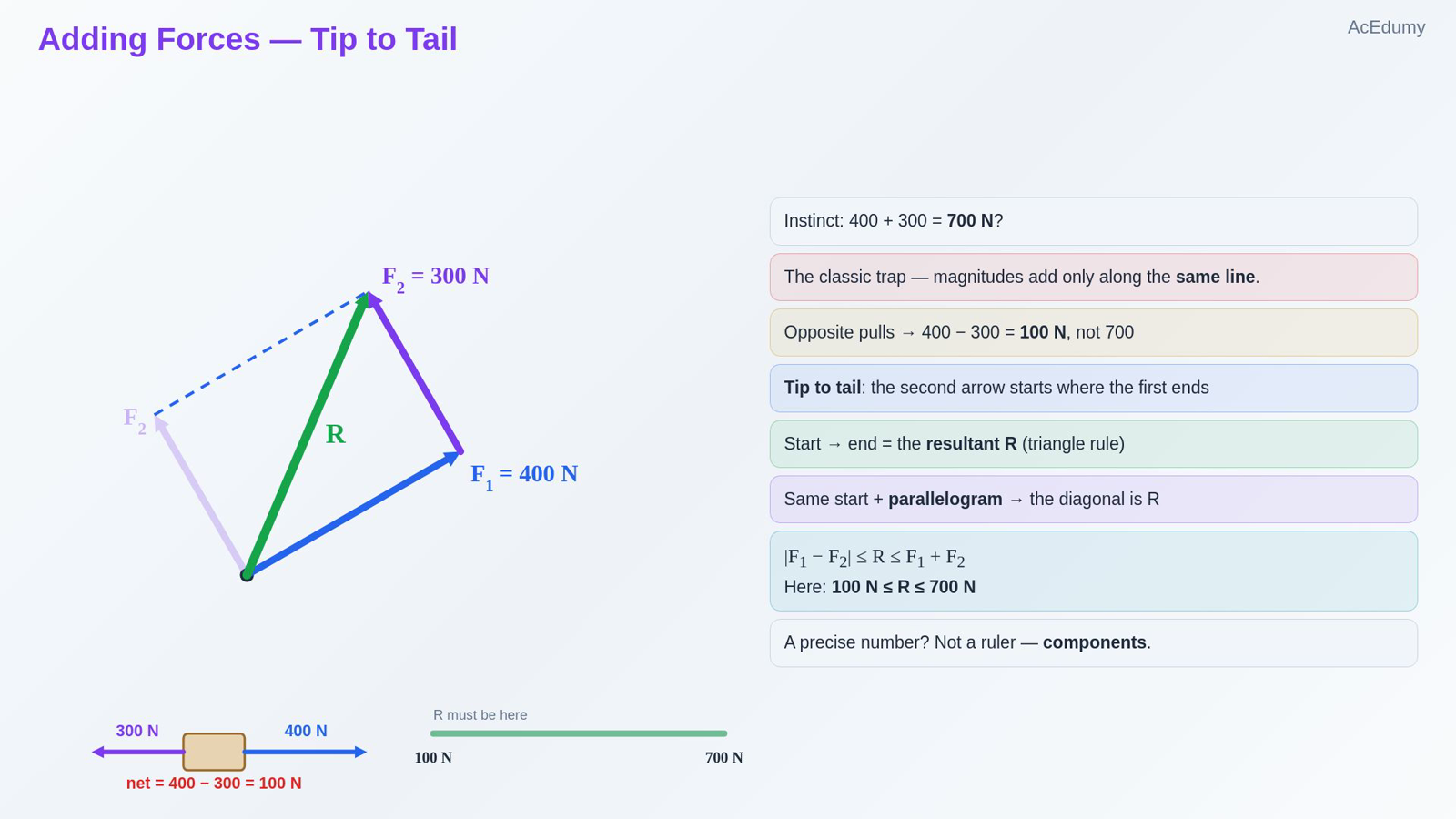
Final view of this section in the source lesson. The classic trap — magnitudes add only along the same line.Here:A precise number? Not a ruler — components.Narration transcript
How do we add two forces? The first instinct for most students is: 400 plus 300, 700 newtons. And that is the classic trap. Unless the forces act along the same line, you cannot simply add their magnitudes. Think about it: if the two ropes pulled in exactly opposite directions, the crate would barely move; the total would be 100, not 700. The right way is this: place the arrows tip to tail. The second arrow starts where the first one ends; the arrow from the very beginning to the very end is the resultant force. We call this the triangle rule. If instead you start both arrows from the same point and complete the parallelogram, the diagonal gives the same resultant. That is the parallelogram law. Keep one rule in mind: the resultant always lies somewhere between the sum and the difference of the two magnitudes. In our example, between 100 and 700. But how do we get a precise number out of this drawing? Not with a ruler, with calculation. And for that, we will learn to break a force into pieces.
4. Resolving a Force into Components
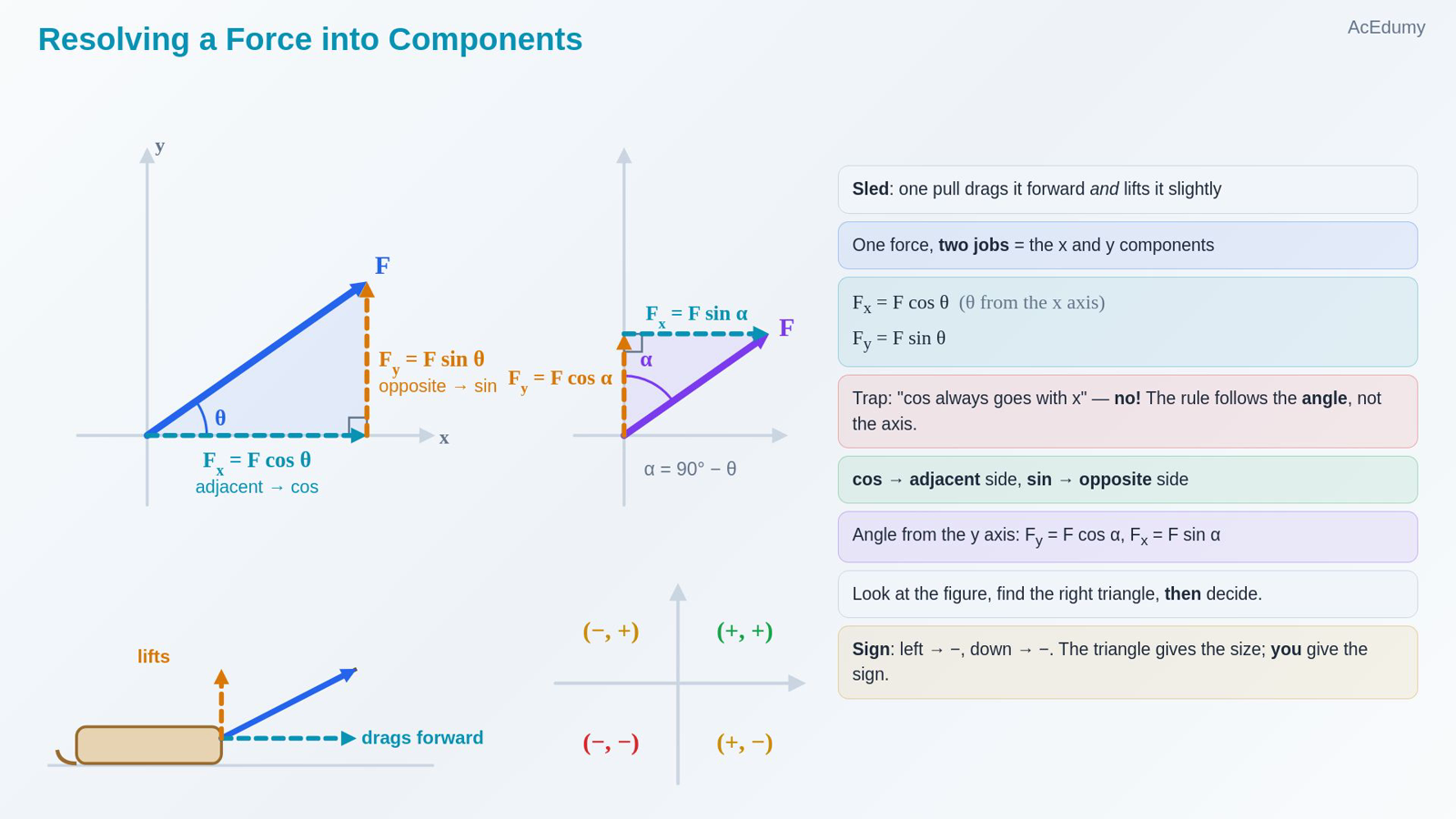
Final view of this section in the source lesson. Sled: one pull drags it forward and lifts it slightlyFₓ = F cos θ (θ from the x axis)Trap: "cos always goes with x" — no! The rule follows the angle, not the axis.Look at the figure, find the right triangle, then decide.Sign: left → −, down → −. The triangle gives the size; you give the sign.Narration transcript
Splitting a force along two perpendicular directions is called resolving it into components. Here is the intuition. If you pull a sled with a rope angled upward, part of your pull drags the sled forward, and part of it lifts the sled slightly off the ground. One force, doing two jobs. Those two jobs are the x and y components. The calculation: if a force F makes an angle theta with the x axis, the x component is F times cosine of theta, and the y component is F times sine of theta. Now the real trap: do not memorize 'cosine always goes with x'. The rule follows the angle, not the axis. Cosine goes with the side adjacent to the angle; sine goes with the side opposite to it. If the angle is measured from the y axis, then the y component uses cosine and the x component uses sine. Look at the figure, find the right triangle, then decide. And one more thing: the sign. If a component points to the left, it is negative; if it points down, it is negative. The right triangle only gives you the size. The sign is yours to put in.
5. Worked Example — Every Step
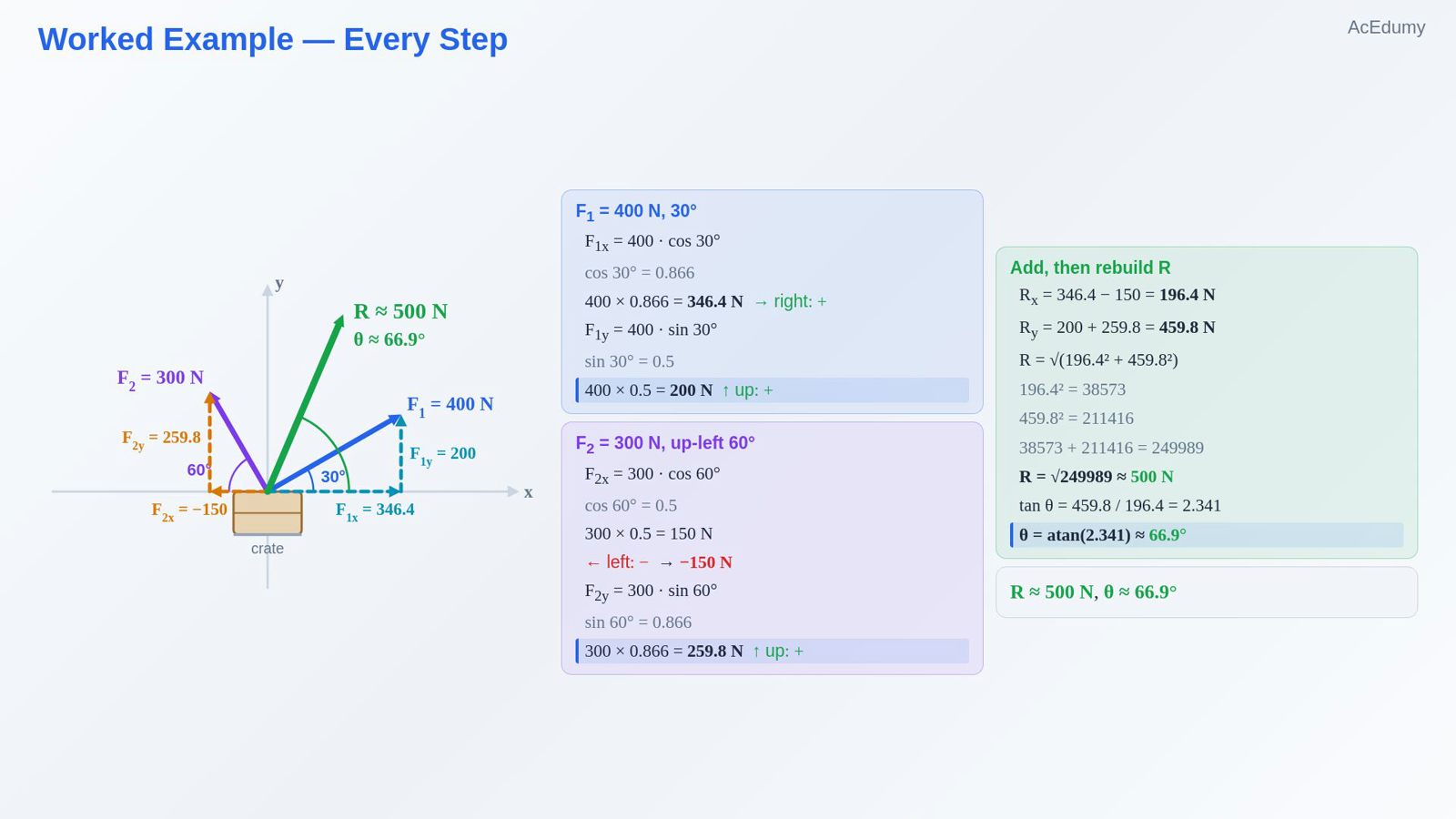
Final view of this section in the source lesson. 400 × 0.866 = 346.4 N → right: +400 × 0.5 = 200 N ↑ up: +← left: − → −150 N300 × 0.866 = 259.8 N ↑ up: +Narration transcript
Now let us solve our problem. The first force is 400 newtons at 30 degrees from the x axis. Its x component: 400 times cosine of 30 degrees. Cosine of 30 degrees is 0.866. 400 times 0.866 equals 346.4 newtons. It points to the right, so it is positive. Its y component: 400 times sine of 30 degrees. Sine of 30 degrees is 0.5. 400 times 0.5 equals 200 newtons. Upward, positive. The second force is 300 newtons, up and to the left, at 60 degrees to the horizontal. Its x component: 300 times cosine of 60 degrees. Cosine of 60 degrees is 0.5. 300 times 0.5 equals 150 newtons. But it points to the left, so it is minus 150. Its y component: 300 times sine of 60 degrees. Sine of 60 degrees is 0.866. 300 times 0.866 equals 259.8 newtons. Upward, positive. Now we add. The x parts: 346.4 minus 150 equals 196.4 newtons. The y parts: 200 plus 259.8 equals 459.8 newtons. The magnitude of the resultant comes from Pythagoras: the square root of 196.4 squared plus 459.8 squared. 196.4 squared is 38573. 459.8 squared is 211416. The sum is 249989. Its square root is approximately 500 newtons. For the direction: tangent of theta equals 459.8 divided by 196.4, which is 2.341. The arctangent of that is about 66.9 degrees. So the crate behaves as if it were pulled by a single force of 500 newtons, aimed 66.9 degrees above the horizontal.
6. Does It Make Sense? Three Checks
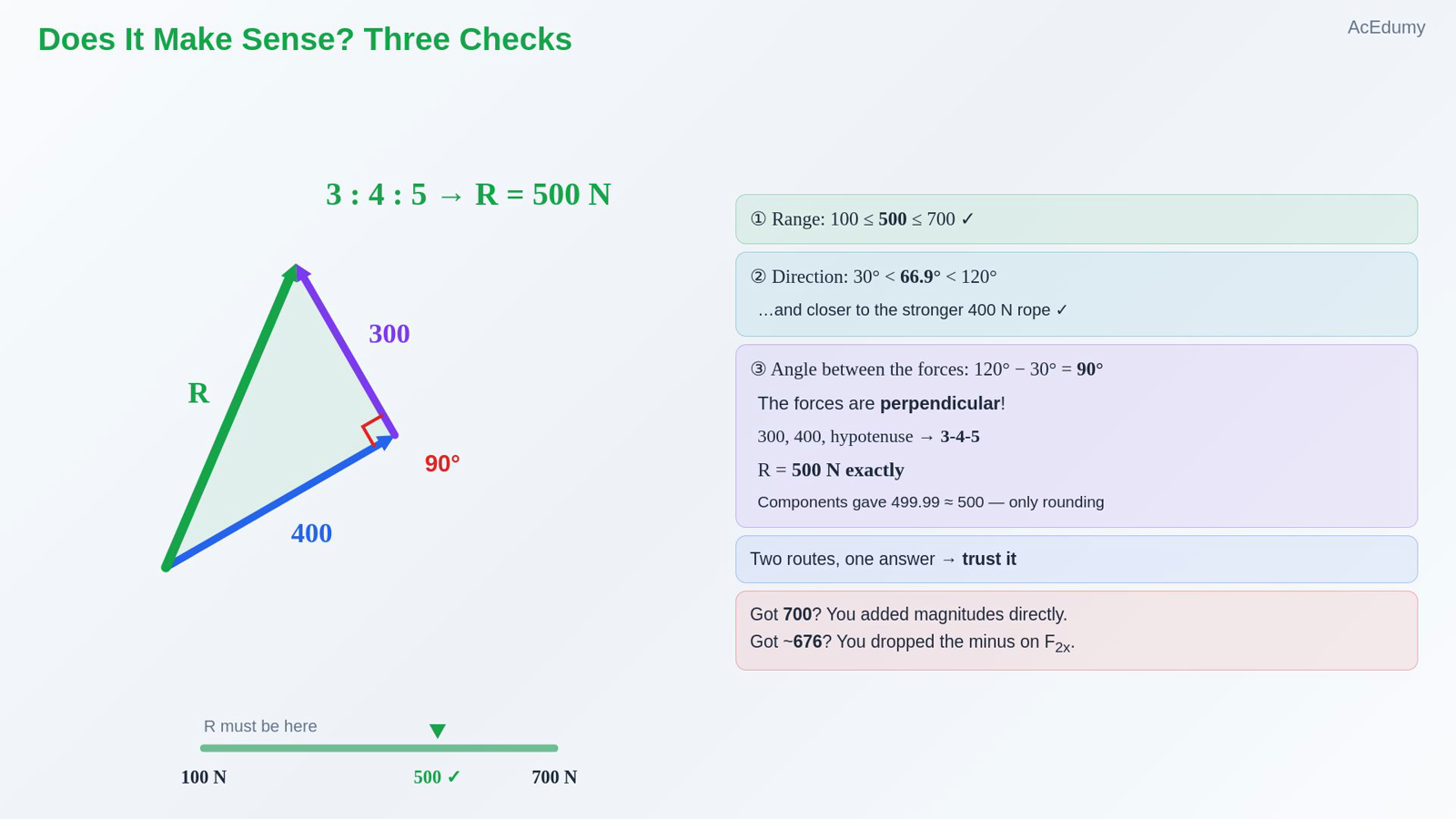
Final view of this section in the source lesson. ① Range:② Direction:…and closer to the stronger 400 N rope ✓③ Angle between the forces:The forces are perpendicular!R = 500 N exactlyTwo routes, one answer → trust itNarration transcript
Does the result make sense? Let us run three checks. One: is 500 between 100 and 700? Yes. Two: does the direction lie between the two ropes? The first rope is at 30 degrees, the second at 120 degrees; 66.9 sits between them, and closer to the stronger 400 newton rope. That makes sense. Three: here is a nice surprise. Look at the angle between the two forces: 120 minus 30 is 90 degrees. The forces are perpendicular! So we could have used the triangle rule directly: 300, 400, and the hypotenuse. A 3, 4, 5 triangle. 500 newtons, exactly. The component method also gave 500; the tiny difference is only rounding. When two different routes lead to the same answer, you can trust your solution. And the classic error warning: if you got 700, you added the magnitudes directly. If you got something like 676, you forgot the minus sign on the component that points left.
7. What We Gathered
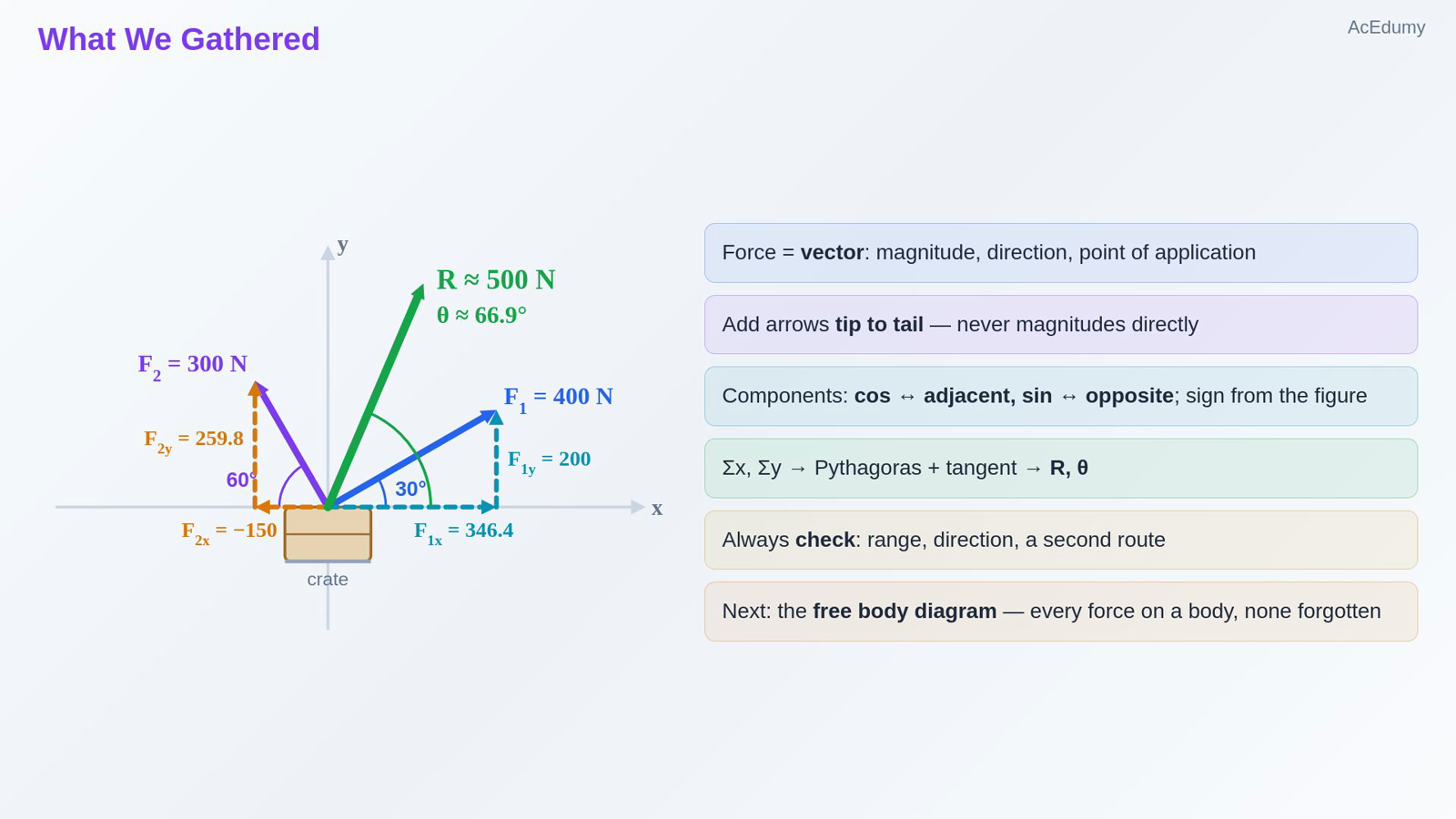
Final view of this section in the source lesson. Force = vector: magnitude, direction, point of applicationAdd arrows tip to tail — never magnitudes directlyComponents: cos ↔ adjacent, sin ↔ opposite; sign from the figureΣx, Σy → Pythagoras + tangent → R, θAlways check: range, direction, a second routeNext: the free body diagram — every force on a body, none forgottenNarration transcript
Let us gather what we have. A force is a vector: magnitude, direction, point of application. When adding two forces, never add the magnitudes directly; place the arrows tip to tail. For a precise answer, resolve into components: cosine with the adjacent side, sine with the opposite side, and you put in the sign by looking at the figure. Add the components along each axis, then rebuild the resultant with Pythagoras and the tangent. And always check at the end: the range, the direction, and if possible a second route. In the next lesson we will learn how to place these arrows on a real body: the free body diagram, the art of drawing every single force acting on a body without forgetting any. See you there.
Source video: Force and Its Components (9:54)