Statics · Statics
#02 Free Body Diagram
Isolate the body · every contact becomes a force
Question
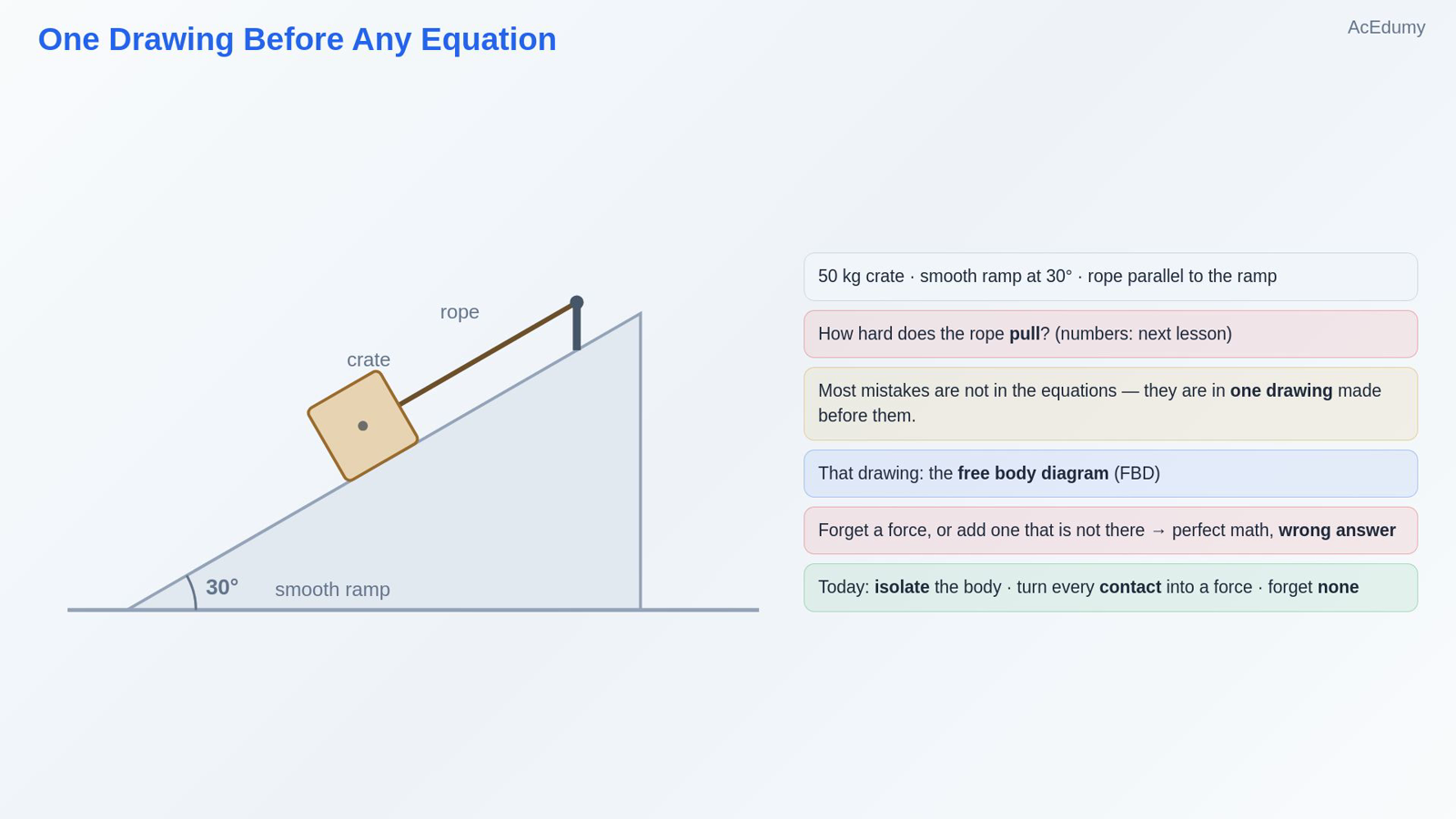
A crate of mass 50 kilograms rests on a smooth ramp inclined at 30 degrees, held by a rope parallel to the ramp. The question: how hard does the rope pull? We will solve that with numbers in the next lesson. But let me tell you a secret: in problems like this, most mistakes happen not in the equations, but in one single drawing made before any equation. That drawing is called the free body diagram. Forget one force, or add a force that is not there, and every bit of mathematics after it can be perfect and the answer will still be wrong. Today we learn to make that drawing correctly: isolate the body, turn every contact into a force, and forget none of them.
Written solution and narration transcript(shows the full solution)
Below are all the lines written in the notebook together with the full narration transcript.
1. One Drawing Before Any Equation
Final view of this section in the source lesson. 50 kg crate · smooth ramp at 30° · rope parallel to the rampMost mistakes are not in the equations — they are in one drawing made before them.That drawing: the free body diagram (FBD)Forget a force, or add one that is not there → perfect math, wrong answerToday: isolate the body · turn every contact into a force · forget noneNarration transcript
A crate of mass 50 kilograms rests on a smooth ramp inclined at 30 degrees, held by a rope parallel to the ramp. The question: how hard does the rope pull? We will solve that with numbers in the next lesson. But let me tell you a secret: in problems like this, most mistakes happen not in the equations, but in one single drawing made before any equation. That drawing is called the free body diagram. Forget one force, or add a force that is not there, and every bit of mathematics after it can be perfect and the answer will still be wrong. Today we learn to make that drawing correctly: isolate the body, turn every contact into a force, and forget none of them.
2. Cut the Body Loose
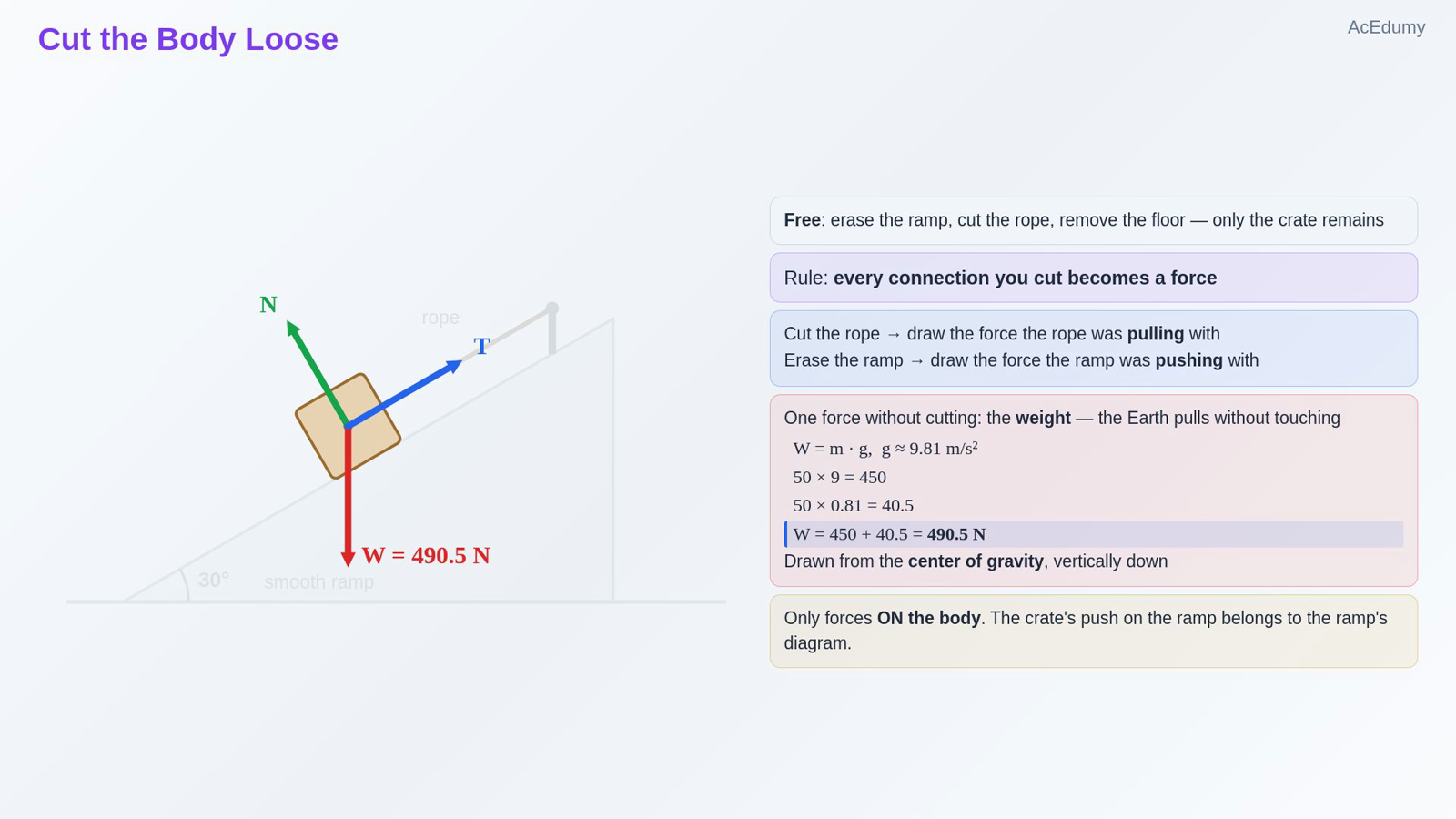
Final view of this section in the source lesson. Free: erase the ramp, cut the rope, remove the floor — only the crate remainsRule: every connection you cut becomes a forceCut the rope → draw the force the rope was pulling withErase the ramp → draw the force the ramp was pushing withOne force without cutting: the weight — the Earth pulls without touchingDrawn from the center of gravity, vertically downOnly forces ON the body. The crate's push on the ramp belongs to the ramp's diagram.Narration transcript
What does free body diagram mean? Free: cut the body loose from its surroundings. Erase the ramp, cut the rope, remove the floor; only the crate remains. But careful: everything you removed was exerting a force on the crate. That is the rule: every connection you cut becomes a force. Cut the rope, and in its place you draw the force the rope was pulling with. Erase the ramp, and in its place you draw the force the ramp was pushing with. And there is one force that comes without cutting anything: the weight. The Earth pulls the crate downward all the time; it does not touch it, but it pulls. Weight is mass times the acceleration of gravity: W equals m times g, with g about 9.81 meters per second squared. The crate has 50 kilograms: 50 times 9.81. Step by step: 50 times 9 equals 450; 50 times 0.81 equals 40.5; the total is 490.5 newtons. This force is drawn from the center of gravity, vertically downward. One more rule: only forces acting ON the body go into the diagram. The force the crate exerts on the ramp does not belong in the crate's diagram; it belongs to the ramp's diagram.
3. The Catalog of Contacts
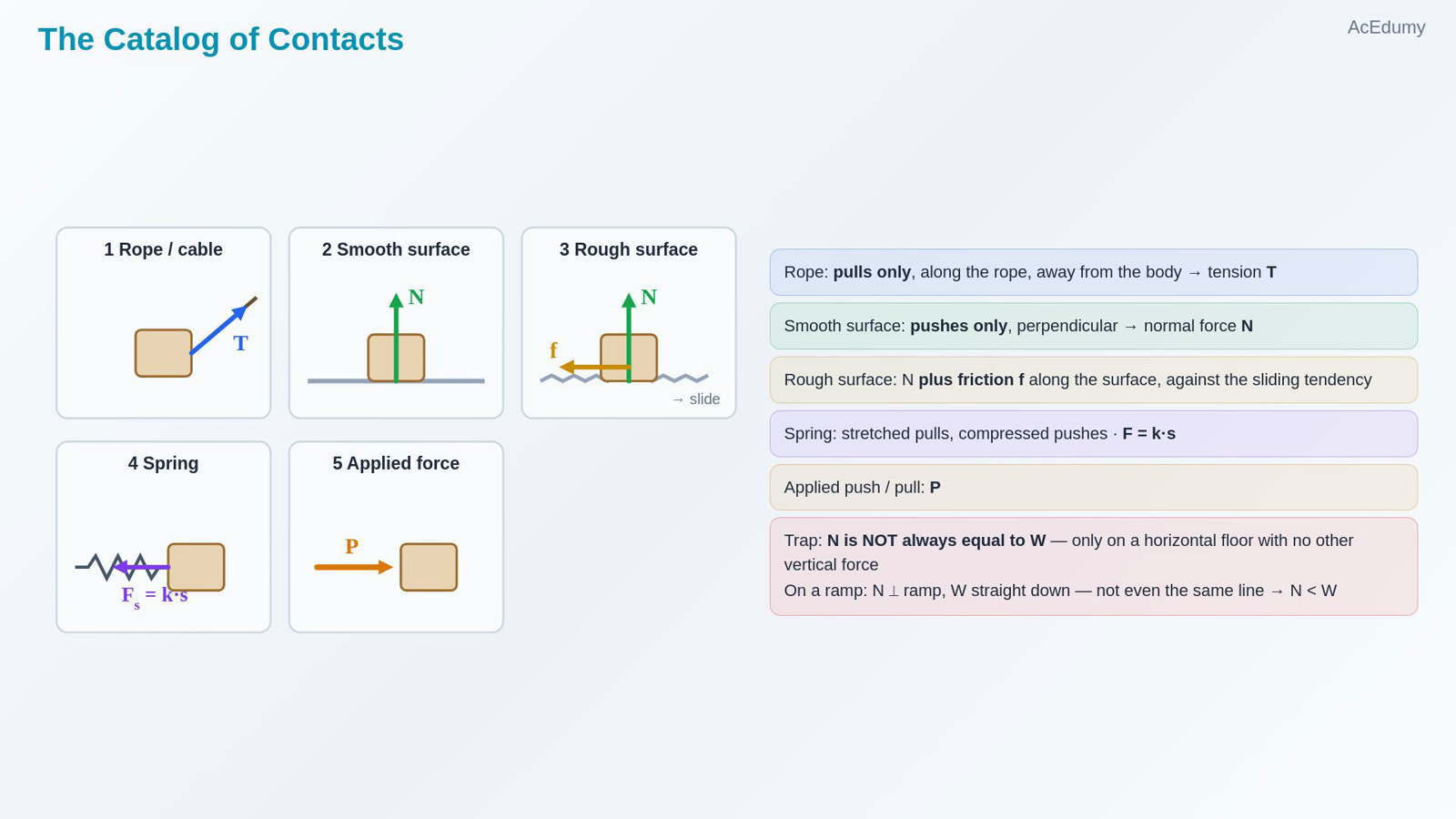
Final view of this section in the source lesson. Rope: pulls only, along the rope, away from the body → tension TSmooth surface: pushes only, perpendicular → normal force NRough surface: N plus friction f along the surface, against the sliding tendencySpring: stretched pulls, compressed pushes · F = k·sApplied push / pull: PTrap: N is NOT always equal to W — only on a horizontal floor with no other vertical forceOn a ramp: N ⟂ ramp, W straight down — not even the same line → N < WNarration transcript
Now let us build the catalog of contacts; each type of contact has a known force. One: a rope or cable. A rope can only pull, never push. The force is along the rope, pointing away from the body; we call it tension and write T. Two: a smooth surface. The surface can only push, and only perpendicular to itself. We call that the normal force, N; normal means perpendicular. Three: a rough surface. Besides the perpendicular push there is a friction force parallel to the surface; friction points against the direction the body tends to slide. Four: a spring. A stretched spring pulls the body toward itself, a compressed spring pushes; its size is the spring constant times the stretch: F equals k times s. Five: a directly applied push or pull; call it P. Now the most common trap: the normal force is not always equal to the weight. It equals the weight only on a horizontal floor with no other vertical forces. On an inclined ramp N is smaller than the weight, and one look at the directions tells you why: N is perpendicular to the ramp, the weight is straight down; they are not even along the same line.
4. The Four-Step Recipe
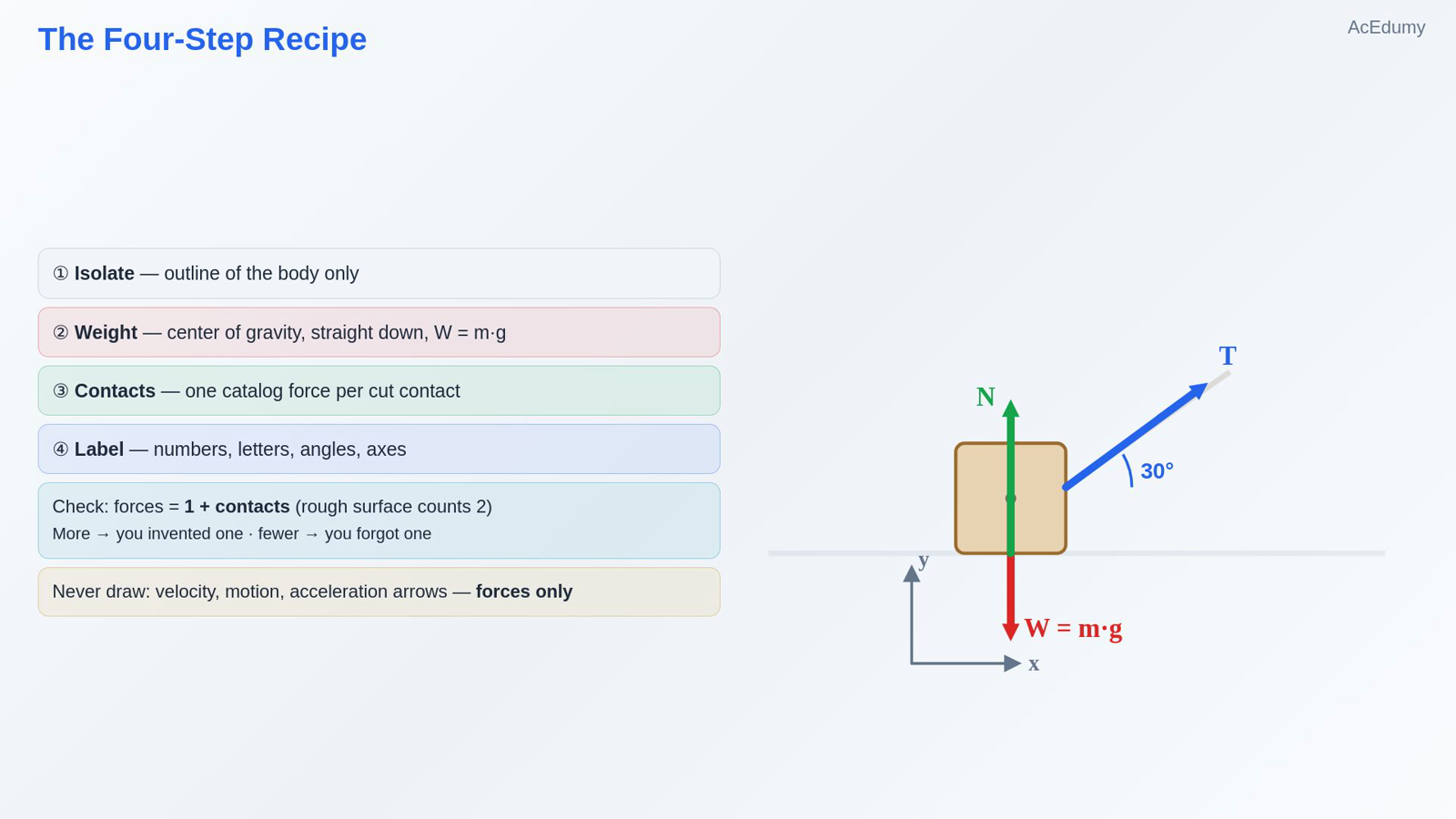
Final view of this section in the source lesson. ① Isolate — outline of the body only② Weight — center of gravity, straight down, W = m·g③ Contacts — one catalog force per cut contact④ Label — numbers, letters, angles, axesCheck: forces = 1 + contacts (rough surface counts 2)More → you invented one · fewer → you forgot oneNever draw: velocity, motion, acceleration arrows — forces onlyNarration transcript
A free body diagram has four steps, always in the same order. Step one: choose the body and isolate it. Draw only the outline of the body; no ramp, no rope, no wall. Step two: draw the weight; from the center of gravity, vertically down, W equals m g. Step three: go to every contact you cut and put its force from the catalog: tension for a rope, normal for a surface, friction if it is rough, spring force for a spring. Step four: label. Write known magnitudes as numbers and unknowns as letters; mark the angles; draw the x and y axes. Then a small check: the number of forces must equal one plus the number of contacts. One for the weight; one more for each contact, two for a rough surface. More than that and you invented one; fewer and you forgot one. And never draw these: a velocity arrow, a motion arrow, an acceleration arrow. A free body diagram contains forces only.
5. Worked Example — Crate on a Ramp
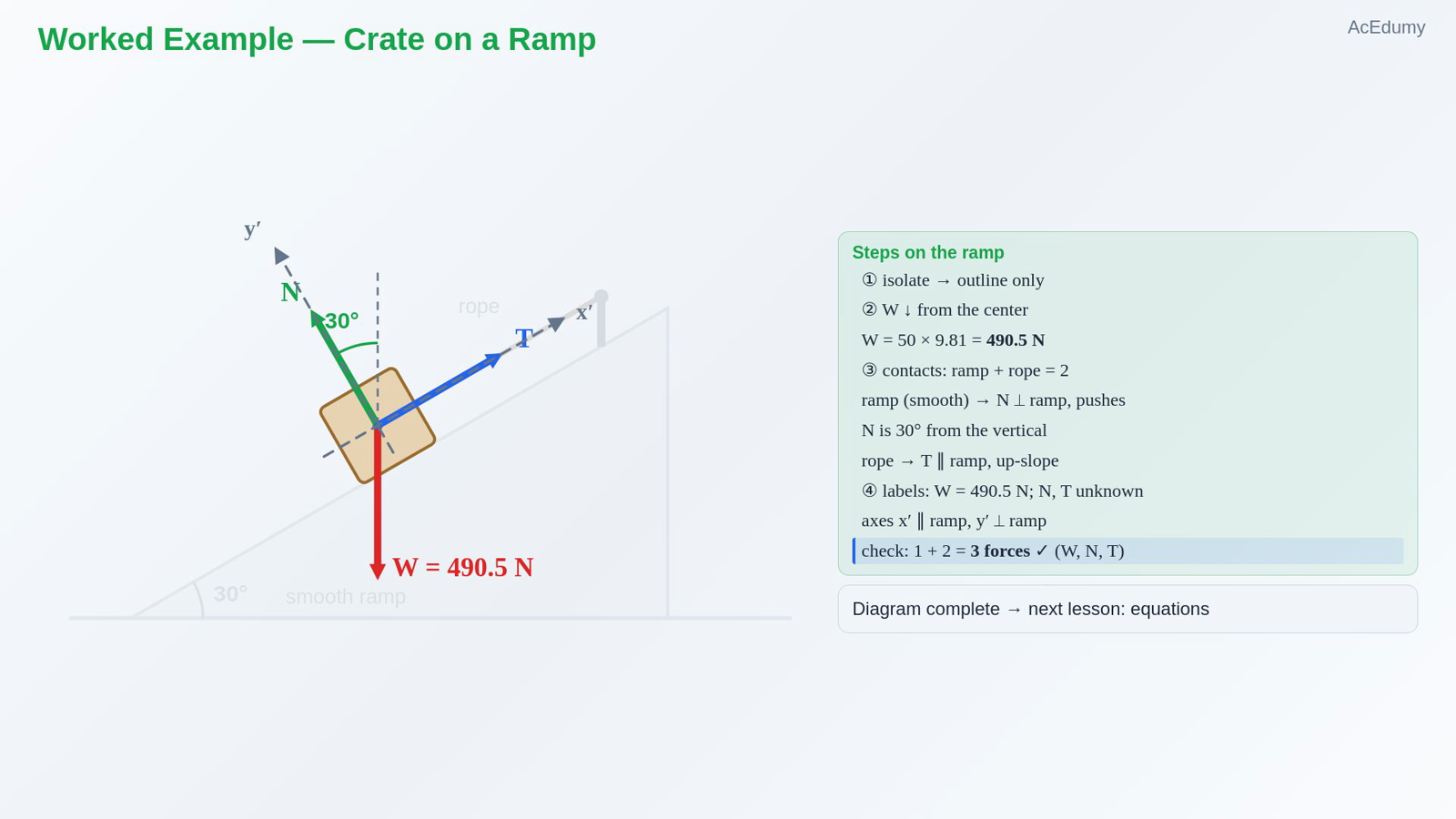
Final view of this section in the source lesson. ① isolate → outline only② W ↓ from the center③ contacts: ramp + rope = 2ramp (smooth) → N ⟂ ramp, pushesN is 30° from the verticalrope → T ∥ ramp, up-slope④ labels: W = 490.5 N; N, T unknownaxes x′ ∥ ramp, y′ ⟂ rampcheck: 1 + 2 = 3 forces ✓ (W, N, T)Diagram complete → next lesson: equationsNarration transcript
Now let us apply it to the crate on the ramp. Step one: isolate the crate; only the outline of the box remains. Step two: the weight. An arrow from the center of gravity, vertically down; its size is 490.5 newtons, which we computed a moment ago. Step three: the contacts. The crate has two contacts: the ramp surface and the rope. The ramp is smooth; the catalog says there is only a normal force. N is perpendicular to the ramp surface and pushes the crate, so it points away from the ramp. Because the ramp is inclined at 30 degrees, N makes 30 degrees with the vertical. Why? If the surface is rotated 30 degrees from the horizontal, the line perpendicular to it is rotated 30 degrees from the vertical. The rope: parallel to the ramp, pulling the crate up the slope. The tension T points up along the ramp. Step four: label. W equals 490.5 newtons; N and T are unknown, so they stay as letters. Angles: the ramp is 30 degrees from the horizontal, N is 30 degrees from the vertical. Axes: in problems like this, choosing the axes parallel and perpendicular to the ramp makes life much easier, because then N and T lie on the axes and only the weight needs to be resolved into components. Check: two contacts; the number of forces is one plus two, three. W, N, T. Done. The diagram is complete; in the next lesson we turn these three arrows into equations.
6. Two More Diagrams and Five Classic Mistakes
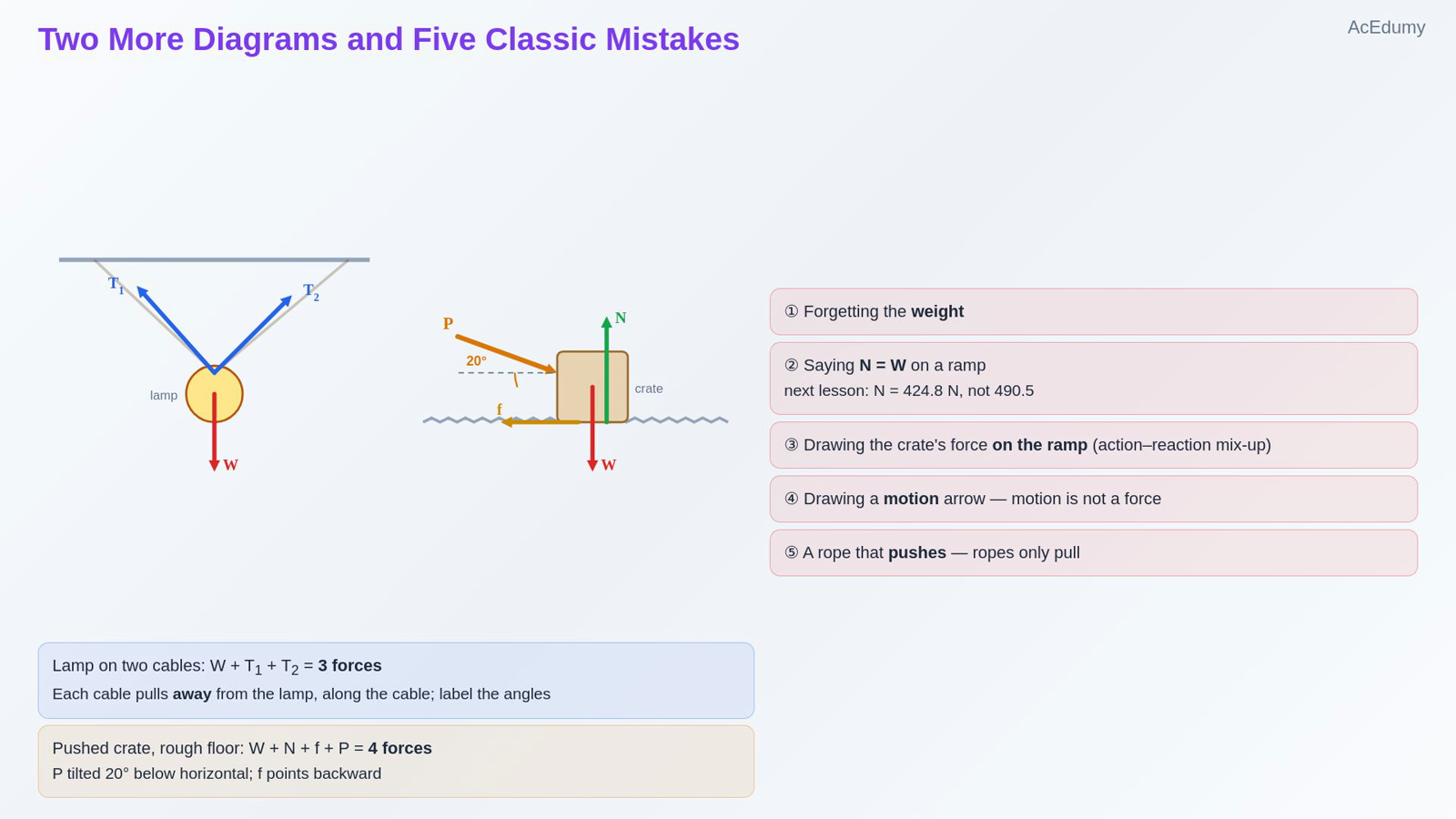
Final view of this section in the source lesson. Lamp on two cables: W + T₁ + T₂ = 3 forcesEach cable pulls away from the lamp, along the cable; label the anglesPushed crate, rough floor: W + N + f + P = 4 forcesP tilted 20° below horizontal; f points backward① Forgetting the weight② Saying N = W on a ramp③ Drawing the crate's force on the ramp (action–reaction mix-up)④ Drawing a motion arrow — motion is not a force⑤ A rope that pushes — ropes only pullNarration transcript
Two more examples, quickly. A lamp hangs from the ceiling by two cables. Choose the body: the lamp. Weight down. Contacts: two cables; each pulls away from the lamp along its own cable: T1 and T2. Three forces. The cables may be at different angles; do not forget to label the angles. Second example: on a rough floor you push a crate, pressing downward at 20 degrees below the horizontal. Choose the body: the crate. Weight down. Contacts: the floor and your hand. The floor is rough: normal force up, friction backward. Your hand: the push P, tilted 20 degrees. Four forces. The classic mistakes: One, forgetting the weight; the weight is always there. Two, saying N equals W on the ramp; next lesson we will see that for the crate on the ramp N comes out as 424.8 newtons, not 490.5. Three, putting the force the crate exerts on the ramp into the diagram; that force acts on the ramp, not on the crate. Four, drawing the direction of motion as an arrow; motion is not a force. Five, drawing a rope that pushes; a rope only pulls.
7. What We Gathered
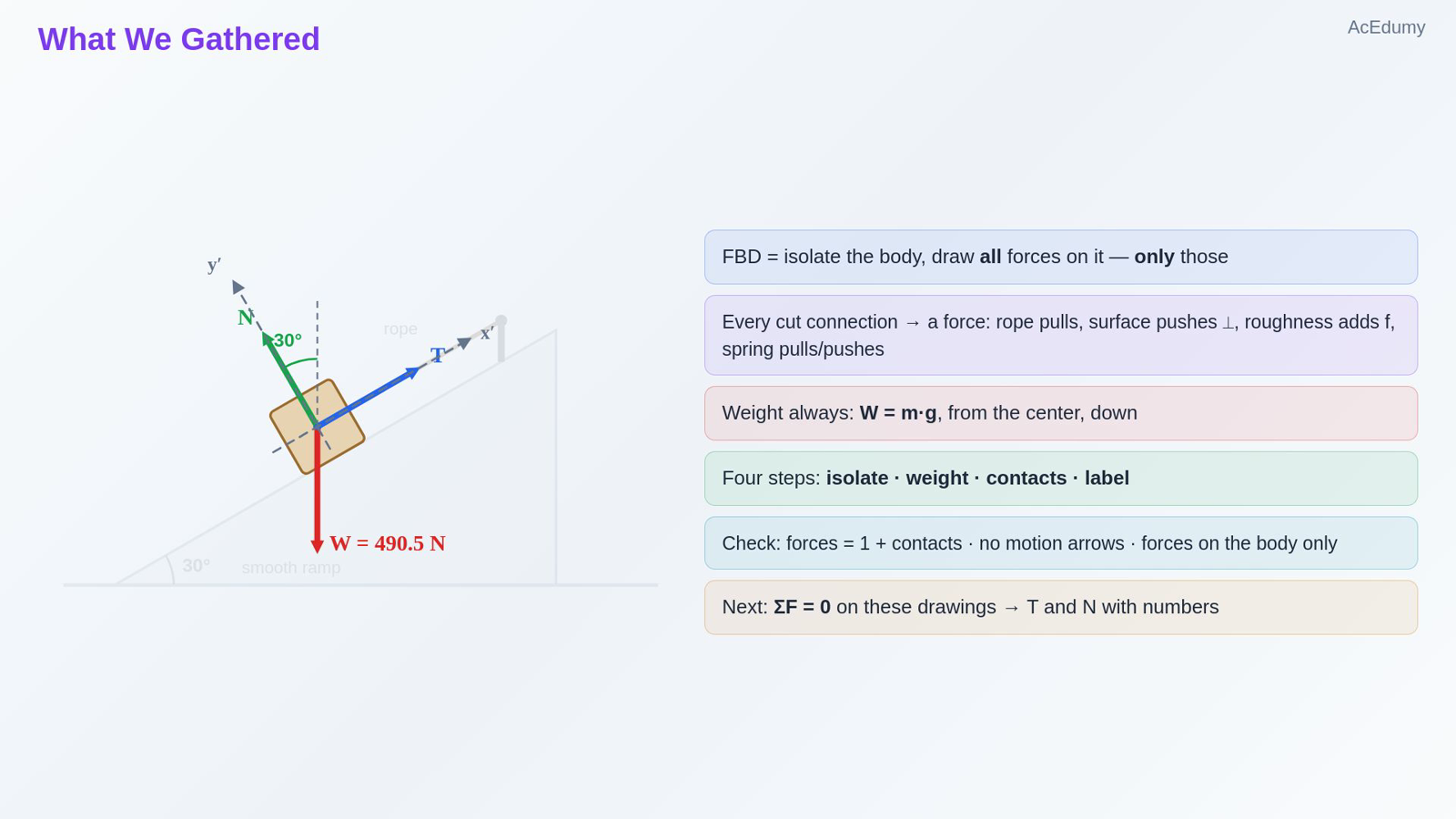
Final view of this section in the source lesson. FBD = isolate the body, draw all forces on it — only thoseEvery cut connection → a force: rope pulls, surface pushes ⟂, roughness adds f, spring pulls/pushesWeight always: W = m·g, from the center, downFour steps: isolate · weight · contacts · labelCheck: forces = 1 + contacts · no motion arrows · forces on the body onlyNext: ΣF = 0 on these drawings → T and N with numbersNarration transcript
Let us gather what we have. A free body diagram means isolating the body and drawing all the forces acting on it, and only those. Every connection you cut becomes a force: a rope pulls, a surface pushes perpendicularly, roughness adds friction, a spring pulls or pushes. The weight is always there: W equals m g, from the center downward. Four steps: isolate, weight, contacts, labels. Check: the number of forces is one plus the number of contacts; no motion arrows; only forces on the body. In the next lesson we add one sentence to these drawings: on a body at rest, the forces add up to zero. With that sentence we will find the rope tension and the normal force with numbers. See you there.
Source video: Free Body Diagram (9:05)