Statics · Statics
#03 Equilibrium of a Particle
ΣF = 0 · two equations · two worked problems
Question
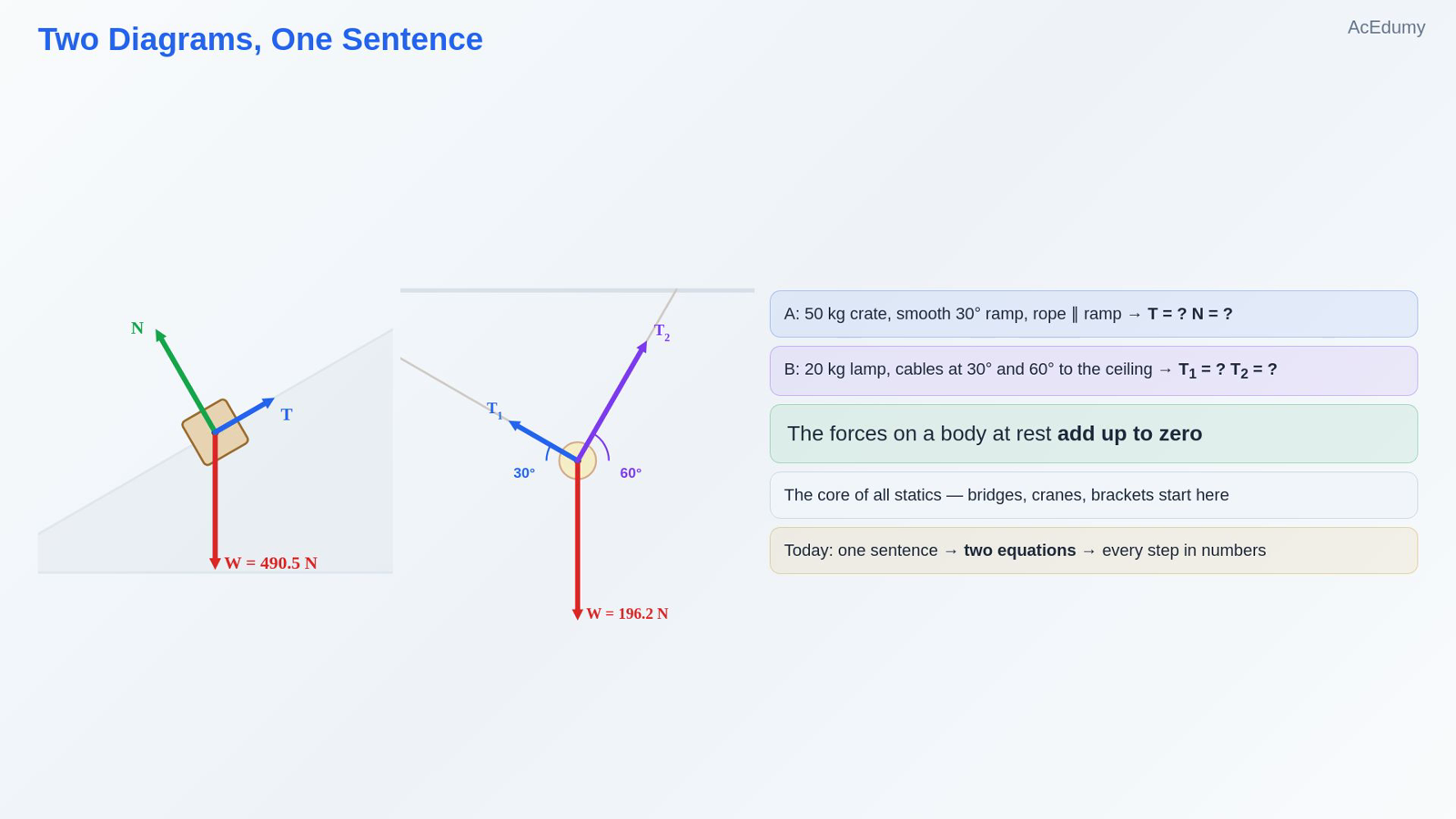
Last lesson we drew two free body diagrams and promised to turn both of them into numbers. First: a 50 kilogram crate on a smooth ramp inclined at 30 degrees, held by a rope parallel to the ramp; how many newtons are the rope tension and the normal force? Second: a 20 kilogram lamp hanging from the ceiling by two cables; the cables make 30 and 60 degrees with the ceiling. How hard does each cable pull? Today we solve both questions with a single sentence: the forces acting on a body at rest add up to zero. This sentence is the core of all of statics; from bridges to cranes, every calculation starts here. Today we turn it into two equations and show every step with numbers.
Written solution and narration transcript(shows the full solution)
Below are all the lines written in the notebook together with the full narration transcript.
1. Two Diagrams, One Sentence
Final view of this section in the source lesson. A: 50 kg crate, smooth 30° ramp, rope ∥ ramp → T = ? N = ?B: 20 kg lamp, cables at 30° and 60° to the ceiling → T₁ = ? T₂ = ?The core of all statics — bridges, cranes, brackets start hereToday: one sentence → two equations → every step in numbersNarration transcript
Last lesson we drew two free body diagrams and promised to turn both of them into numbers. First: a 50 kilogram crate on a smooth ramp inclined at 30 degrees, held by a rope parallel to the ramp; how many newtons are the rope tension and the normal force? Second: a 20 kilogram lamp hanging from the ceiling by two cables; the cables make 30 and 60 degrees with the ceiling. How hard does each cable pull? Today we solve both questions with a single sentence: the forces acting on a body at rest add up to zero. This sentence is the core of all of statics; from bridges to cranes, every calculation starts here. Today we turn it into two equations and show every step with numbers.
2. Why the Forces Add Up to Zero
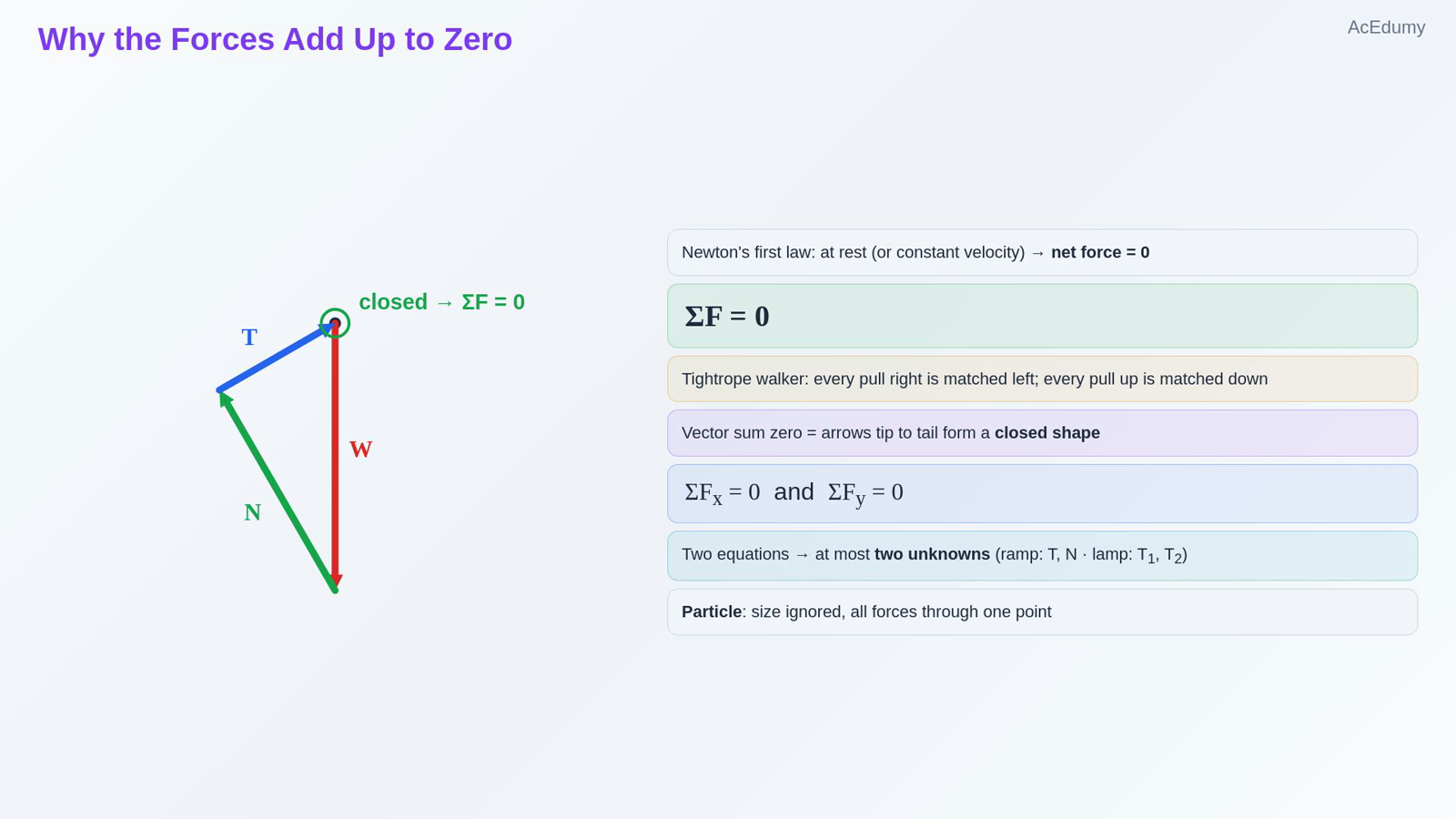
Final view of this section in the source lesson. Newton's first law: at rest (or constant velocity) → net force = 0Tightrope walker: every pull right is matched left; every pull up is matched downVector sum zero = arrows tip to tail form a closed shapeΣFₓ = 0 and ΣFy = 0Two equations → at most two unknowns (ramp: T, N · lamp: T₁, T₂)Particle: size ignored, all forces through one pointNarration transcript
Why do they add up to zero? Newton's first law: if a body is at rest, or moving at constant velocity, the net force on it is zero. In statics bodies are at rest; so the vector sum of all forces is zero: sigma F equals zero. Here is the intuition: think of a tightrope walker standing still. Whatever pulls to the right must be exactly matched by something pulling to the left; whatever pulls up must be exactly matched by something pulling down. Otherwise the body would start moving that way. A vector sum of zero means that when you place the arrows tip to tail, they form a closed shape; the tip of the last arrow lands on the tail of the first. You already know this from the tip-to-tail rule of the earlier lessons. For calculation we split the vector equation into two scalar equations: the sum of the x components is zero, and the sum of the y components is zero. Sigma F x equals zero, sigma F y equals zero. That gives us two equations; with two equations we can find at most two unknowns. On the ramp the unknowns are T and N: two, fine. For the lamp, T1 and T2: two again, fine. One more word: particle. We ignore the size of the body and assume all forces pass through a single point. For the crate and the lamp this assumption works very well.
3. The Five-Step Method
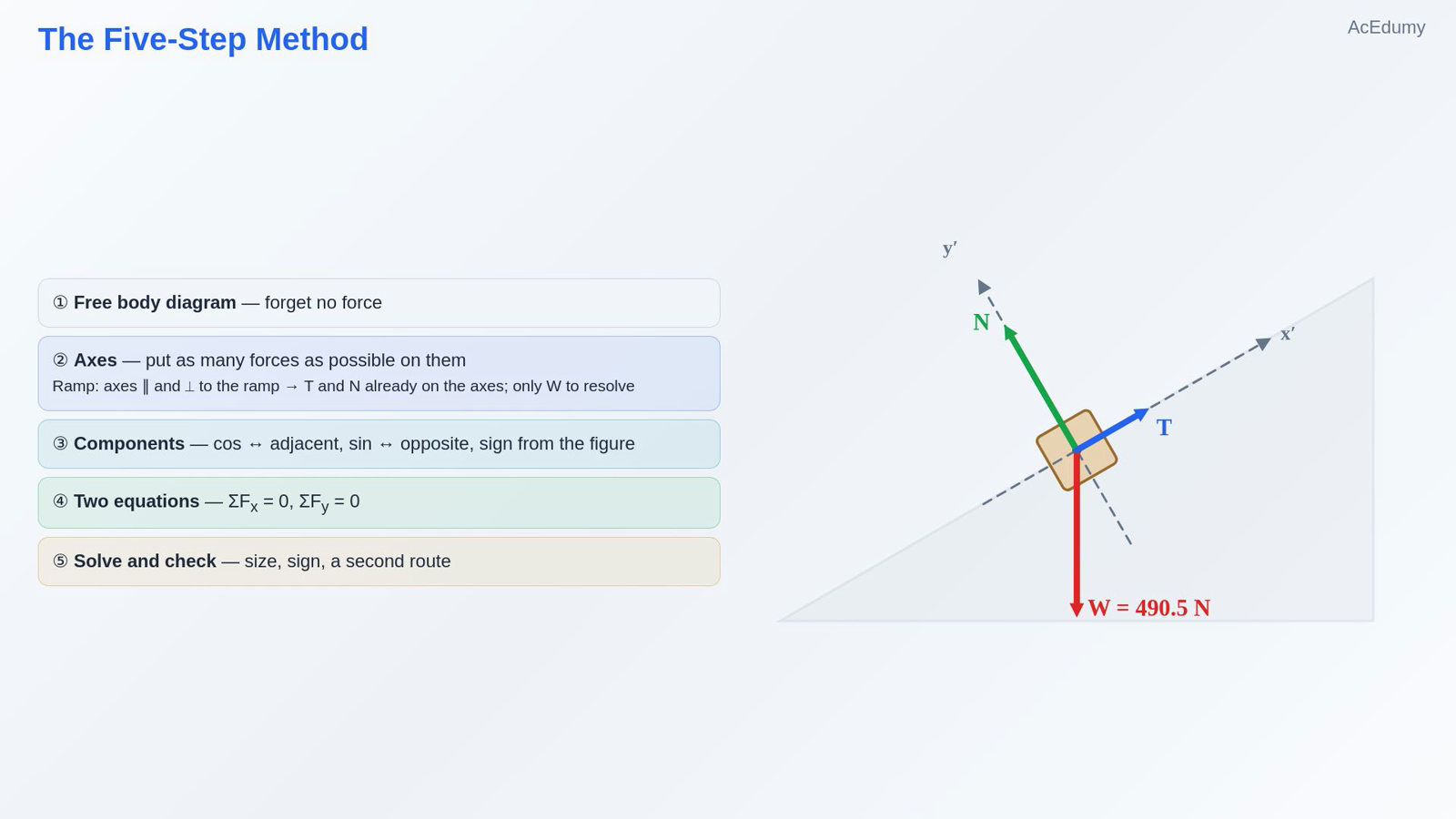
Final view of this section in the source lesson. ① Free body diagram — forget no force② Axes — put as many forces as possible on them③ Components — cos ↔ adjacent, sin ↔ opposite, sign from the figure④ Two equations — ΣFₓ = 0, ΣFy = 0⑤ Solve and check — size, sign, a second routeNarration transcript
The method has five steps. One: draw the free body diagram, exactly as in the last lesson, forgetting no force. Two: choose the axes. A small tip: choose the axes so that as many forces as possible lie along them. On the ramp, if you take the axes parallel and perpendicular to the ramp, T and N are already on the axes; you only resolve the weight. Three: resolve every force that is not on an axis into components; the rule from the first lesson: cosine with the adjacent side, sine with the opposite side, sign from the figure. Four: write the two equations. Add the x components and set them to zero; add the y components and set them to zero. Five: solve and check. Does the result make sense; is the size right; is the sign right; if possible, check by a second route. That is all. Now let us solve the two problems with these five steps.
4. Problem A — Crate on the Ramp
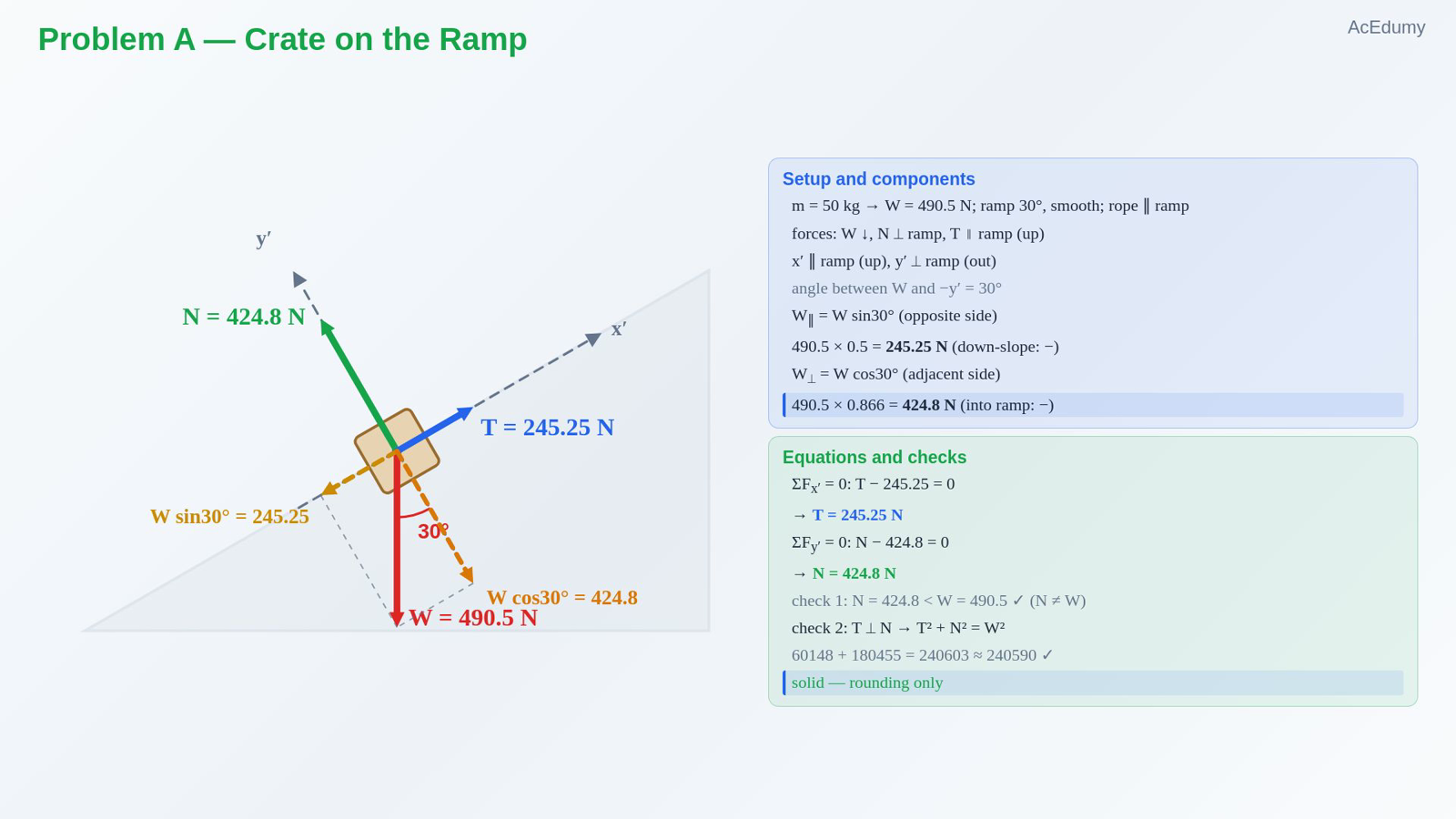
Final view of this section in the source lesson. m = 50 kg → W = 490.5 N; ramp 30°, smooth; rope ∥ rampforces: W ↓, N ⟂ ramp, T ∥ ramp (up)x′ ∥ ramp (up), y′ ⟂ ramp (out)angle between W and −y′ = 30°W∥ = W sin30° (opposite side)490.5 × 0.5 = 245.25 N (down-slope: −)W⟂ = W cos30° (adjacent side)490.5 × 0.866 = 424.8 N (into ramp: −)ΣF_{x′} = 0:ΣF_{y′} = 0:check 1:check 2:solid — rounding onlyNarration transcript
Problem A, the crate on the ramp. Given: mass 50 kilograms, weight 490.5 newtons; ramp at 30 degrees, smooth; rope parallel to the ramp. The diagram has three forces: W down, N perpendicular to the ramp, T up along the ramp. Axes: I take the x axis up along the ramp and the y axis perpendicular to the ramp, pointing out of it. T and N lie on the axes; only W needs resolving. Now pay attention: the ramp is inclined at 30 degrees, and the angle between the weight and the perpendicular to the ramp is also 30 degrees. The component of the weight parallel to the ramp is the opposite side: W times sine of 30 degrees. 490.5 times 0.5 equals 245.25 newtons; it points down the ramp, so it is negative. The component of the weight perpendicular to the ramp is the adjacent side: W times cosine of 30 degrees. 490.5 times 0.866 equals 424.8 newtons; it points into the ramp, so it is negative. The x equation: T minus 245.25 equals zero. So T equals 245.25 newtons. The y equation: N minus 424.8 equals zero. So N equals 424.8 newtons. Check one: N is 424.8, the weight is 490.5; the normal force came out smaller than the weight. Remember last lesson's warning: on a ramp N is not equal to W. Check two: T and N are perpendicular to each other, and together they carry the weight. So T squared plus N squared should equal W squared. 245.25 squared is 60148; 424.8 squared is 180455; the sum is 240603. 490.5 squared is 240590. The difference is only rounding. The solution is solid.
5. Problem B — Lamp on Two Cables
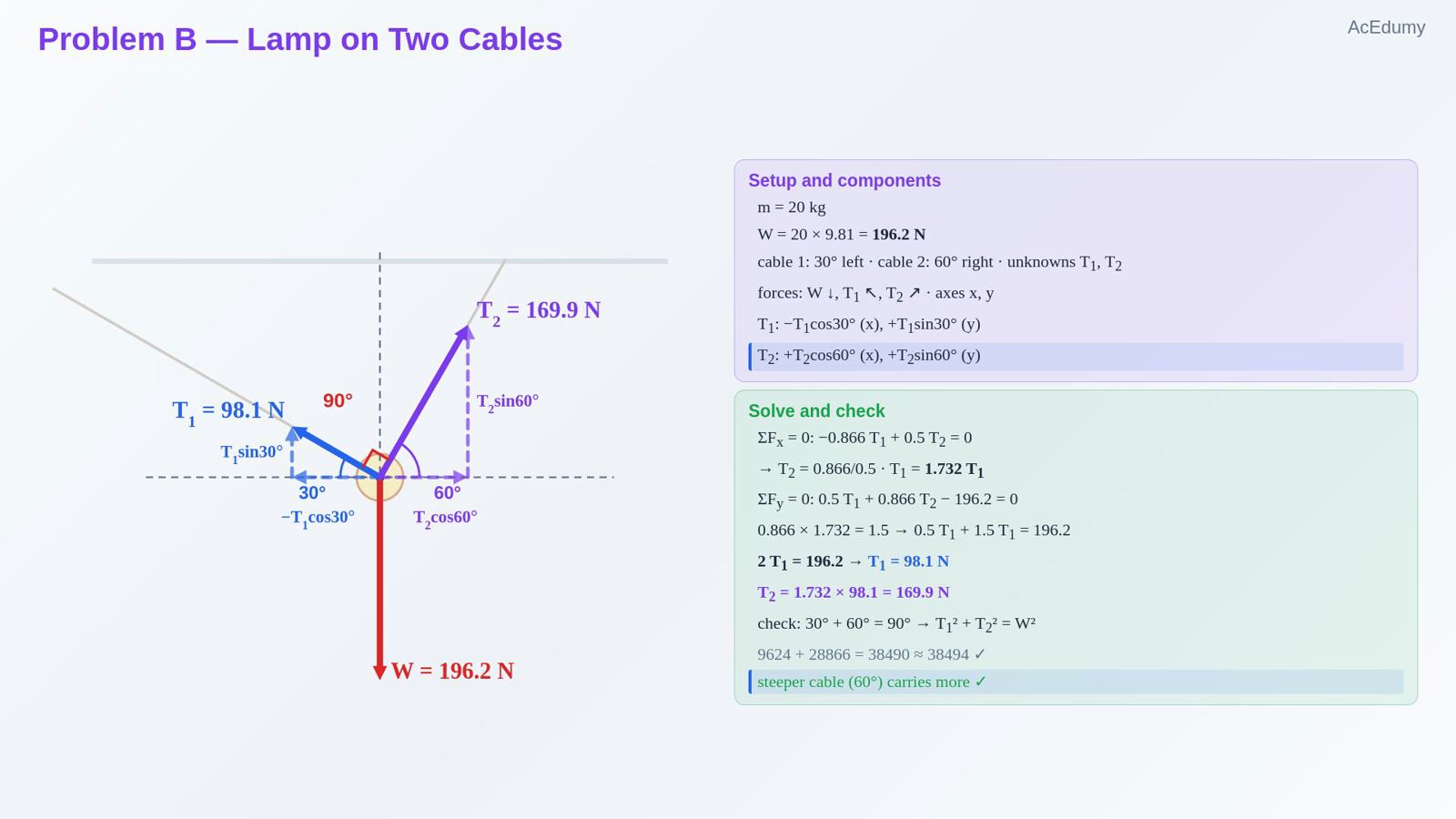
Final view of this section in the source lesson. m = 20 kgcable 1: 30° left · cable 2: 60° right · unknowns T₁, T₂forces: W ↓, T₁ ↖, T₂ ↗ · axes x, yT₁: −T₁cos30° (x), +T₁sin30° (y)T₂: +T₂cos60° (x), +T₂sin60° (y)ΣFₓ = 0:ΣF_{y} = 0:check:steeper cable (60°) carries more ✓Narration transcript
Problem B, the lamp on two cables. Given: mass 20 kilograms. Weight: 20 times 9.81 equals 196.2 newtons. Cable 1 goes to the left at 30 degrees to the ceiling; cable 2 goes to the right at 60 degrees to the ceiling. The unknowns are T1 and T2. The diagram has three forces: W down, T1 up-left along cable 1, T2 up-right along cable 2. Axes horizontal and vertical. Components: the horizontal component of T1 is T1 times cosine of 30, to the left, negative; its vertical component is T1 times sine of 30, up, positive. The horizontal component of T2 is T2 times cosine of 60, to the right, positive; its vertical component is T2 times sine of 60, up, positive. The x equation: minus T1 times 0.866 plus T2 times 0.5 equals zero. So T2 equals T1 times 0.866 divided by 0.5, that is T2 equals 1.732 times T1. The y equation: T1 times 0.5 plus T2 times 0.866 minus 196.2 equals zero. Substitute 1.732 T1 for T2: 1.732 times 0.866 equals 1.5. The equation becomes 0.5 T1 plus 1.5 T1 equals 196.2. So 2 T1 equals 196.2; T1 equals 98.1 newtons. T2 equals 1.732 times 98.1 equals 169.9 newtons. Check: 30 plus 60 is 90 degrees; the cables are perpendicular to each other. So T1 squared plus T2 squared should equal W squared. 98.1 squared is 9624; 169.9 squared is 28866; the sum is 38490. 196.2 squared is 38494. It holds. And the logic: the cable closer to vertical, the 60 degree one, carries the larger share of the load. Just as we expected.
6. Four Traps and One Habit
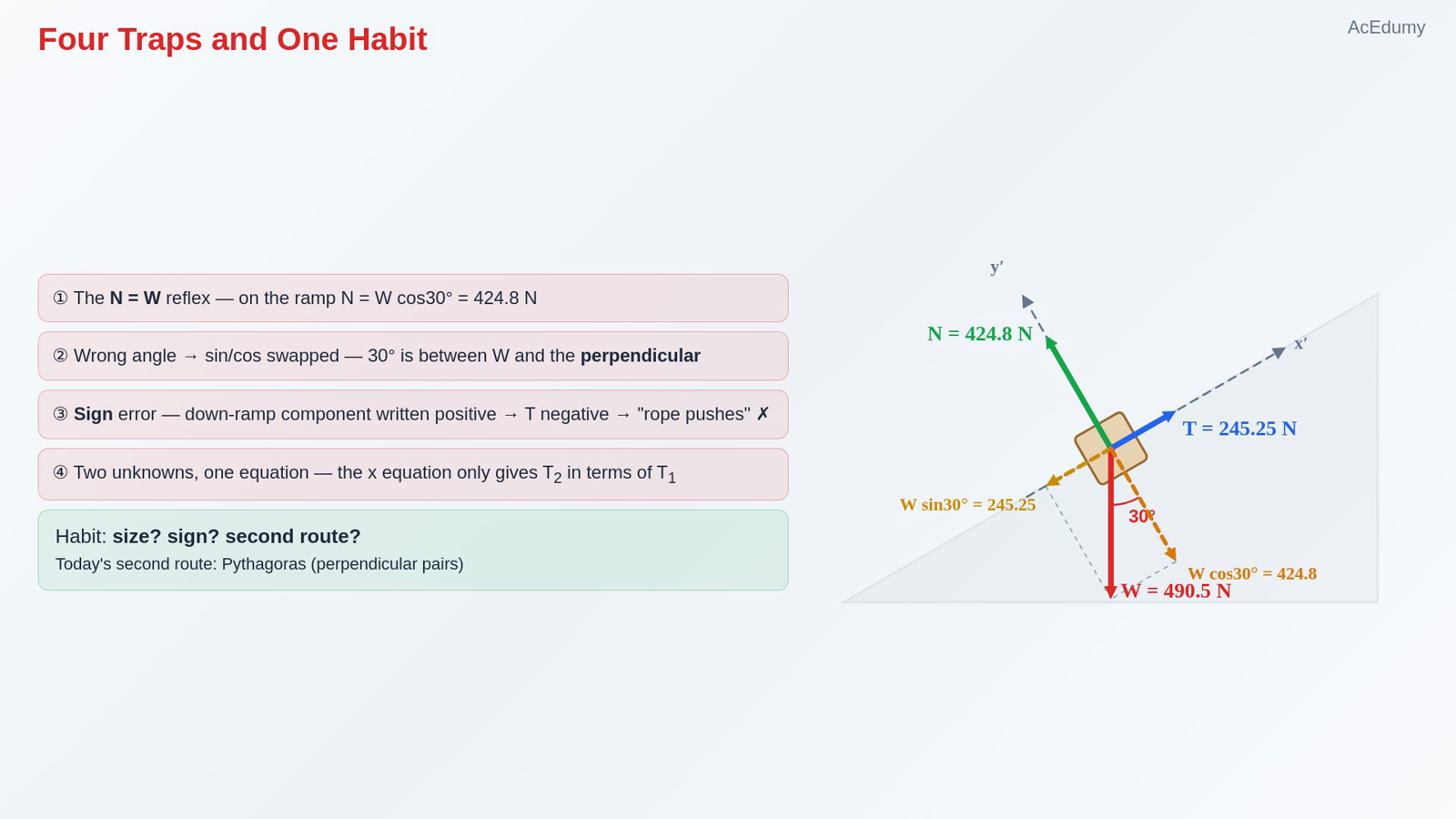
Final view of this section in the source lesson. ① The N = W reflex — on the ramp N = W cos30° = 424.8 N② Wrong angle → sin/cos swapped — 30° is between W and the perpendicular③ Sign error — down-ramp component written positive → T negative → "rope pushes" ✗④ Two unknowns, one equation — the x equation only gives T₂ in terms of T₁Habit: size? sign? second route?Today's second route: Pythagoras (perpendicular pairs)Narration transcript
Four classic traps. One: the N equals W reflex. On the ramp N equals W times cosine of 30, that is 424.8; write 490.5 and the whole solution drifts. Two: taking the angle from the wrong place and swapping sine and cosine. On the ramp the parallel component of the weight uses sine and the perpendicular one uses cosine, because 30 degrees is the angle between the weight and the perpendicular. If unsure, draw the right triangle and look at the sides. Three: a sign error. A component pointing left or down is negative; write the down-ramp component of the weight as positive and T comes out negative, which would mean the rope pushes. Ropes do not push. Four: trying to solve two unknowns with one equation. For the lamp the x equation alone does not give T1; it only gives T2 in terms of T1. Always write the second equation. And build a habit: at the end of every solution, three questions. Is the size reasonable? Is the sign reasonable? Is there a second route? Today the second route was Pythagoras in both problems; it is not always available, but when it is, use it.
7. What We Gathered
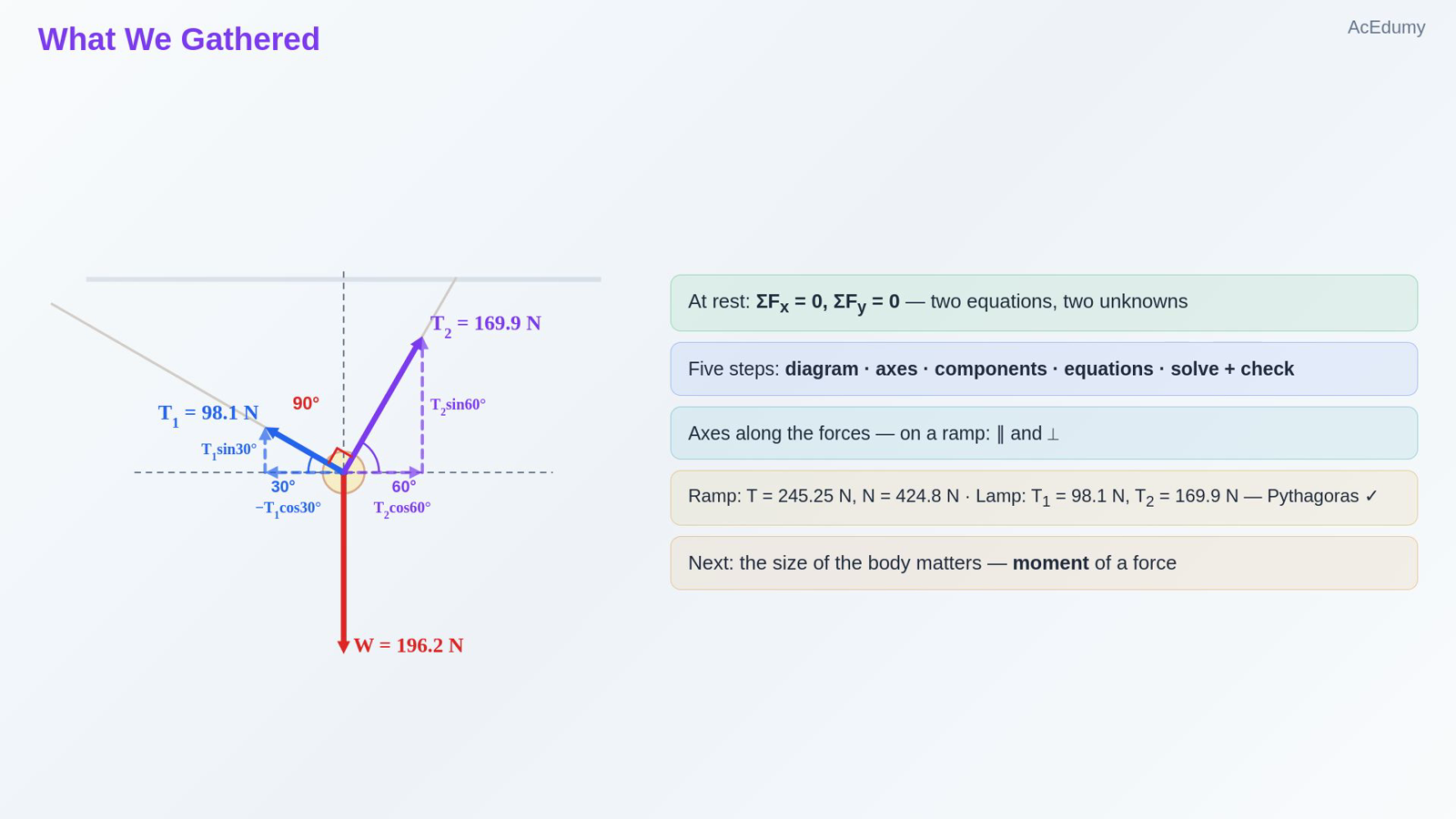
Final view of this section in the source lesson. At rest: ΣFₓ = 0, ΣFy = 0 — two equations, two unknownsFive steps: diagram · axes · components · equations · solve + checkAxes along the forces — on a ramp: ∥ and ⟂Ramp: T = 245.25 N, N = 424.8 N · Lamp: T₁ = 98.1 N, T₂ = 169.9 N — Pythagoras ✓Next: the size of the body matters — moment of a forceNarration transcript
Let us gather what we have. On a body at rest the forces add up to zero: sigma F x equals zero, sigma F y equals zero; two equations, at most two unknowns. Five steps: diagram, axes, components, two equations, solve and check. Choose the axes so that most forces lie along them; on a ramp, parallel and perpendicular. For the crate on the ramp we found T equals 245.25 newtons and N equals 424.8 newtons; for the lamp T1 equals 98.1 and T2 equals 169.9 newtons. Pythagoras confirmed both. In the next lesson the size of the body enters the picture: where a force is applied changes its turning effect. The concept of moment. See you there.
Source video: Equilibrium of a Particle (12:08)