Statics · Statics
#04 Moment of a Force
Turning effect · M = F·d · Varignon
Question
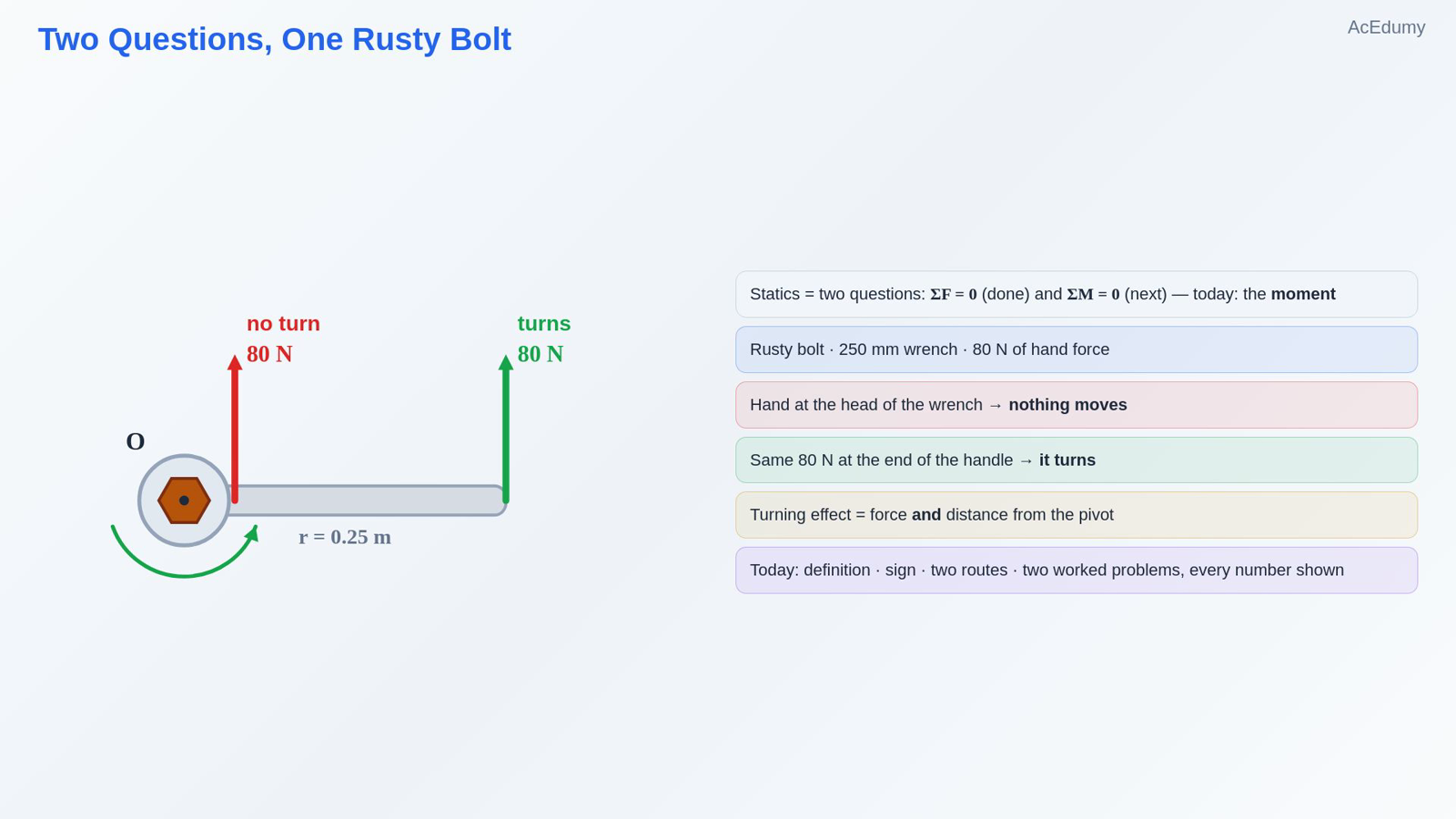
Statics really comes down to two questions. First: are the forces on a body in balance? We answered that last time with sigma F equals zero. Second: are the turning effects in balance? Today we build the key piece of that second question. Let's start with something real. A rusty bolt, and a 250 millimeter wrench in your hand. Put your hand right next to the bolt, at the head of the wrench, and push with 80 newtons: nothing moves. Now put the same 80 newtons at the very end of the handle: the bolt turns. Same force, completely different result. Why? Because the turning effect depends not only on the force, but also on how far from the pivot you apply it. That effect has a name: the moment of a force. Today we define the moment, learn its sign, compute it two different ways, and work two full problems showing every number.
Written solution and narration transcript(shows the full solution)
Below are all the lines written in the notebook together with the full narration transcript.
1. Two Questions, One Rusty Bolt
Final view of this section in the source lesson. Rusty bolt · 250 mm wrench · 80 N of hand forceHand at the head of the wrench → nothing movesSame 80 N at the end of the handle → it turnsTurning effect = force and distance from the pivotToday: definition · sign · two routes · two worked problems, every number shownNarration transcript
Statics really comes down to two questions. First: are the forces on a body in balance? We answered that last time with sigma F equals zero. Second: are the turning effects in balance? Today we build the key piece of that second question. Let's start with something real. A rusty bolt, and a 250 millimeter wrench in your hand. Put your hand right next to the bolt, at the head of the wrench, and push with 80 newtons: nothing moves. Now put the same 80 newtons at the very end of the handle: the bolt turns. Same force, completely different result. Why? Because the turning effect depends not only on the force, but also on how far from the pivot you apply it. That effect has a name: the moment of a force. Today we define the moment, learn its sign, compute it two different ways, and work two full problems showing every number.
2. What a Moment Is
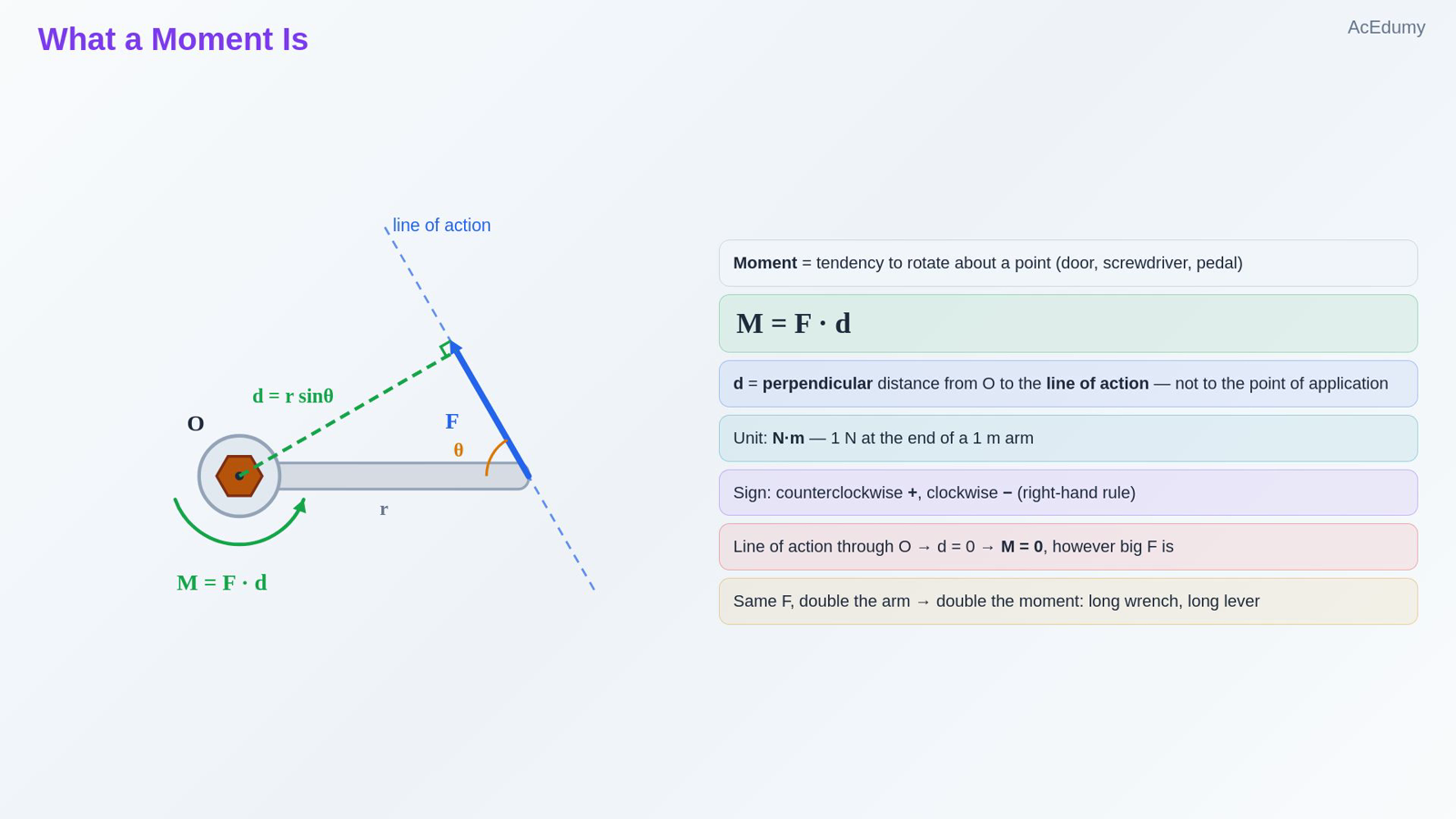
Final view of this section in the source lesson. Moment = tendency to rotate about a point (door, screwdriver, pedal)d = perpendicular distance from O to the line of action — not to the point of applicationUnit: N·m — 1 N at the end of a 1 m armSign: counterclockwise +, clockwise − (right-hand rule)Line of action through O → d = 0 → M = 0, however big F isSame F, double the arm → double the moment: long wrench, long leverNarration transcript
The tendency of a force to rotate a body about a point is called its moment. Pushing a door, turning a screwdriver, pressing a bike pedal: you use moments all day. The definition is simple: the moment about point O equals force times moment arm, M equals F times d. And d is the whole trick: it is the perpendicular distance from O to the line of action of the force. Not the distance to the point where the force is applied; the distance measured perpendicular to the line of action. The line of action is what you get when you extend the force arrow to infinity in both directions. The unit is newton times meter: newton meter. One newton meter means one newton at the end of a one meter arm. Now the sign. Rotation can go two ways. We take counterclockwise as positive and clockwise as negative; that is the right-hand rule written for a flat page. What if the line of action passes right through O? Then the perpendicular distance is zero, and the moment is zero; no matter how big the force, it cannot turn the body. That was your hand next to the bolt. One last piece of intuition: with the same 80 newtons, the easiest way to double the moment is to double the arm. Long wrenches, long levers, long door handles: that is why.
3. Two Routes, Same Number
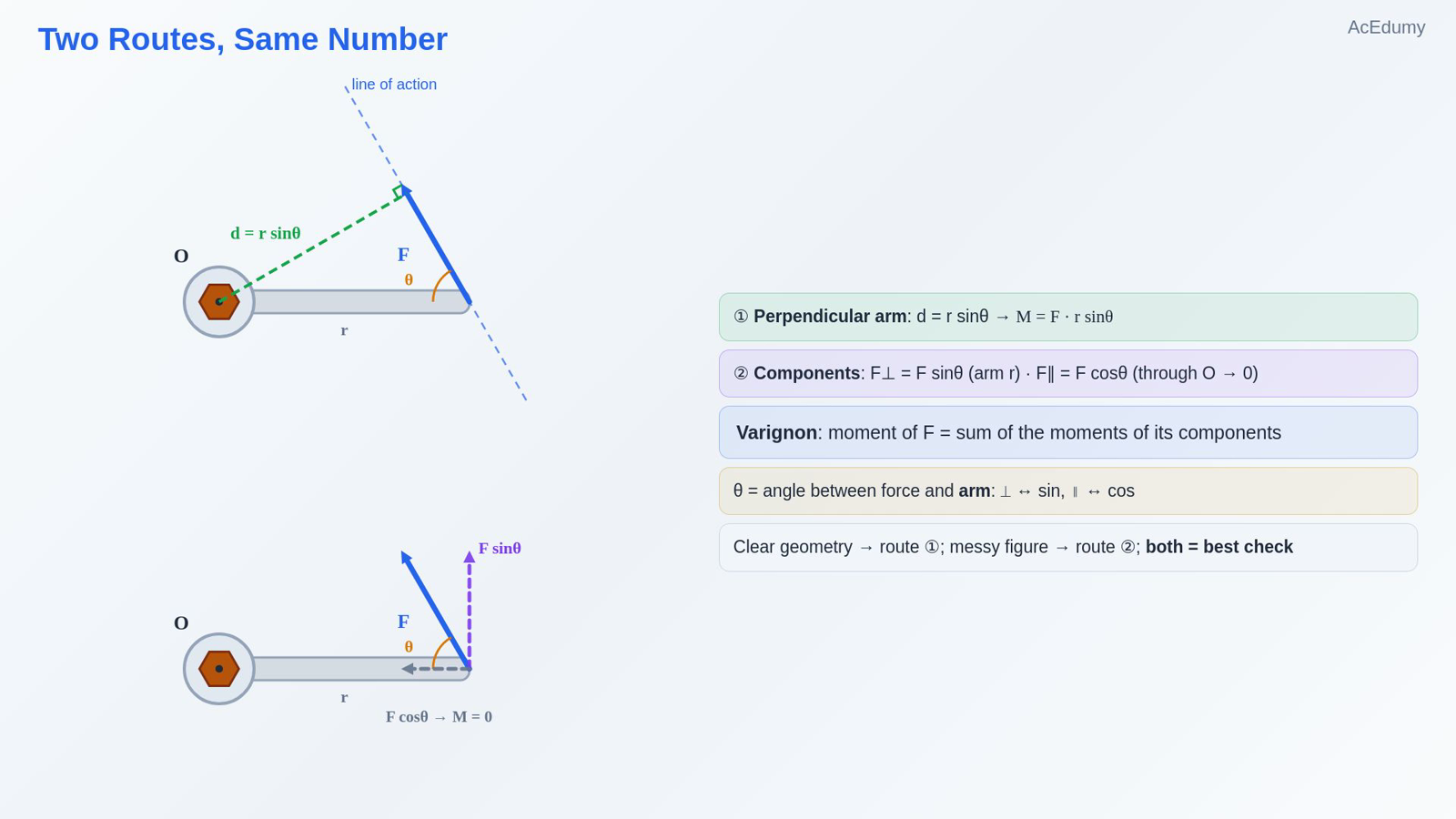
Final view of this section in the source lesson. ① Perpendicular arm:② Components: F⊥ = F sinθ (arm r) · F∥ = F cosθ (through O → 0)Varignon: moment of F = sum of the moments of its componentsθ = angle between force and arm: ⟂ ↔ sin, ∥ ↔ cosClear geometry → route ①; messy figure → route ②; both = best checkNarration transcript
There are two ways to compute a moment, and they always agree. Route one, the perpendicular arm: draw the line of action, drop a perpendicular from O onto it, measure that distance, multiply by the force. If the force acts at the end of an arm of length r and makes an angle theta with the arm, the perpendicular distance is r times sine theta, so the moment is F times r times sine theta. Route two, components: just like in the earlier lessons, split the force into two parts, one perpendicular to the arm and one along it. The perpendicular part is F sine theta; its arm is the full r; its moment is F sine theta times r. The part along the arm, F cosine theta, has its line of action through O, so it gives no moment at all: zero. Add them up: again F times r times sine theta. That is Varignon's principle: the moment of a force equals the sum of the moments of its components. Watch the angle rule: theta is the angle between the force and the arm. The component perpendicular to the arm goes with sine, the one along the arm with cosine; the same look at the angle rule from lesson one. Which route is better? If you can see the perpendicular distance straight from the geometry, use route one; if the picture is messy, components are safer. On an exam, doing both and getting the same number is the best check there is.
4. Problem A — The Wrench
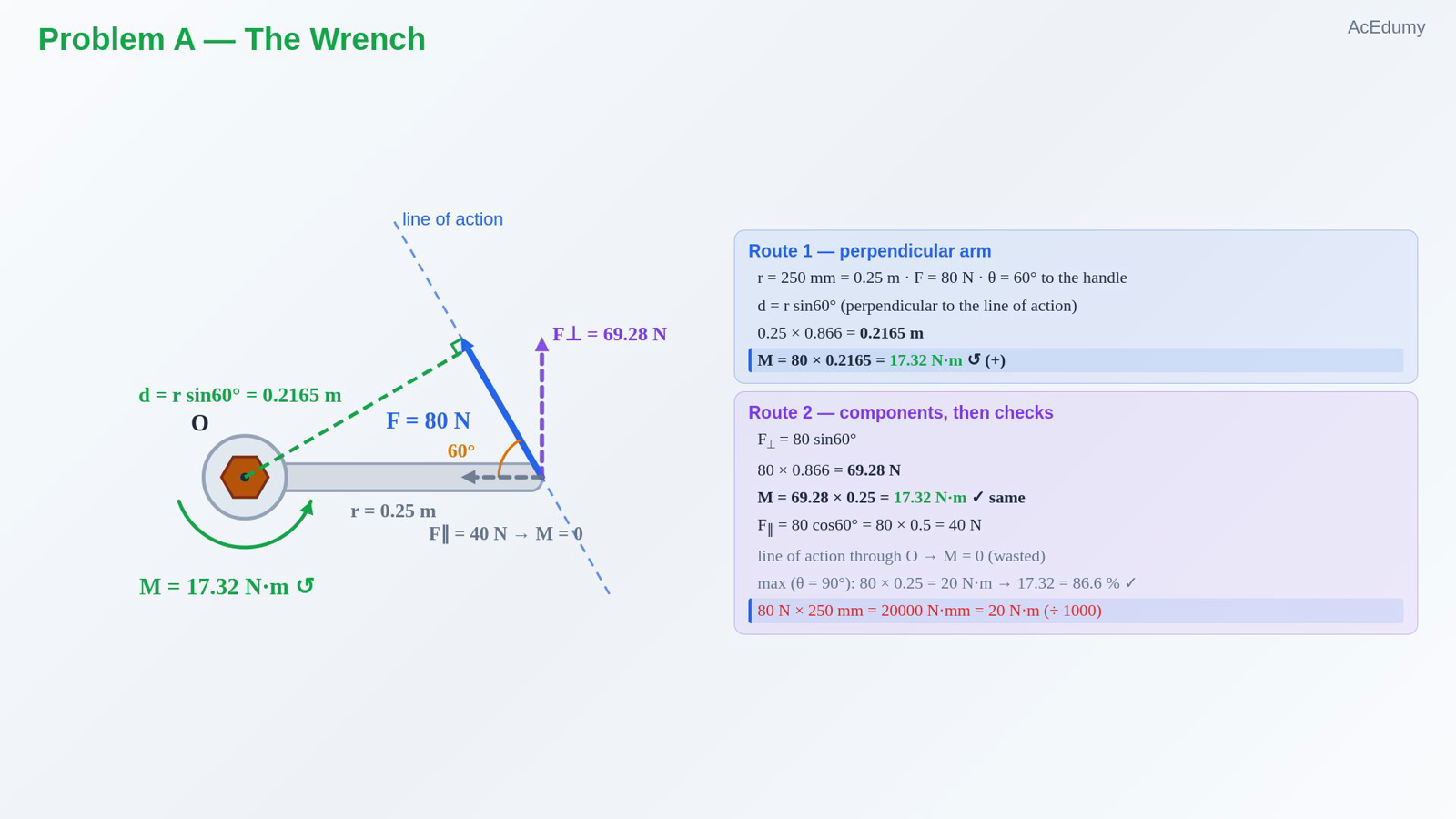
Final view of this section in the source lesson. r = 250 mm = 0.25 m · F = 80 N · θ = 60° to the handled = r sin60° (perpendicular to the line of action)M = 69.28 × 0.25 = 17.32 N·m ✓ sameline of action through O → M = 0 (wasted)max (θ = 90°):80 N × 250 mm = 20000 N·mm = 20 N·m (÷ 1000)Narration transcript
Problem A: the wrench. Arm length 250 millimeters, which is 0.25 meters. Hand force 80 newtons, but not quite perpendicular: the force makes 60 degrees with the handle. What is the moment about the center of the bolt? Route one first, the perpendicular arm. The perpendicular distance d equals r times sine 60 degrees. Sine 60 degrees is 0.866. 0.25 times 0.866 equals 0.2165 meters. The moment equals 80 times 0.2165, which is 17.32 newton meters. The force turns the wrench counterclockwise, so the sign is positive. Now route two, components. The component perpendicular to the handle: 80 times sine 60, that is 80 times 0.866, equals 69.28 newtons. Its arm is the full 0.25 meters: 69.28 times 0.25 equals 17.32 newton meters. Same number. The component along the handle: 80 times cosine 60, that is 80 times 0.5, equals 40 newtons. Those 40 newtons push the wrench toward the bolt; the line of action passes through the center; moment zero. Wasted force. Does it make sense? The biggest moment comes when the force is exactly perpendicular to the handle: 80 times 0.25 equals 20 newton meters. Our result is 17.32; less than 20, in fact 86.6 percent of it, exactly what sine 60 says. And one unit trap: 80 newtons times 250 millimeters gives 20000 newton millimeters, and it is tempting to read that as newton meters. Divide the millimeters by 1000: 20 newton meters. Always put the arm into the calculation in meters.
5. Problem B — The Hinged Beam
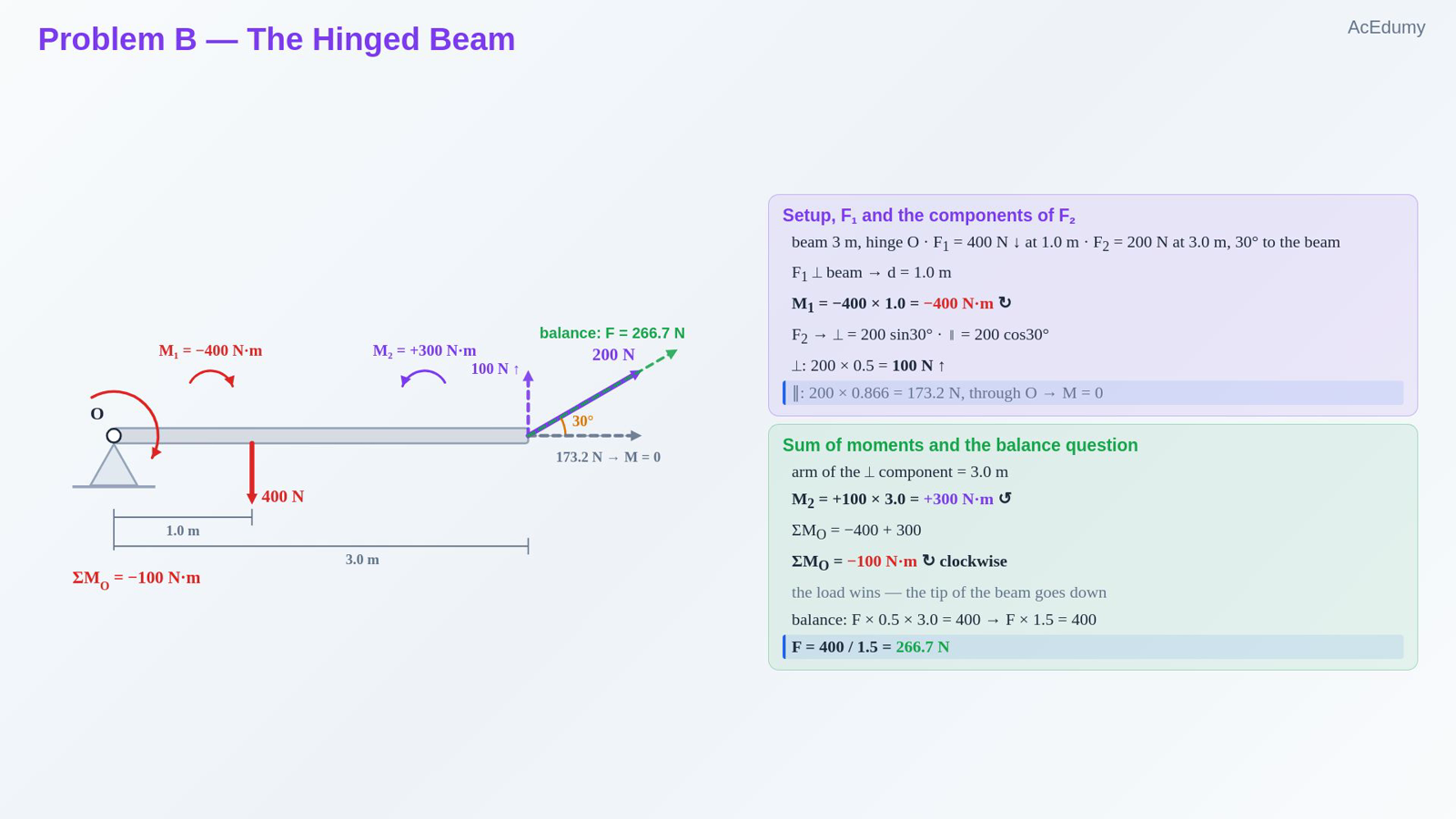
Final view of this section in the source lesson. beam 3 m, hinge O · F₁ = 400 N ↓ at 1.0 m · F₂ = 200 N at 3.0 m, 30° to the beamF₁ ⟂ beam → d = 1.0 m⟂:∥: 200 × 0.866 = 173.2 N, through O → M = 0arm of the ⟂ component = 3.0 mΣMO = −100 N·m ↻ clockwisethe load wins — the tip of the beam goes downbalance:Narration transcript
Problem B: a hinged beam. A light beam, 3 meters long, hinged at its left end, point O, so it is free to rotate there. Two forces act on it. First: 1 meter from the hinge, 400 newtons straight down, say a hanging load. Second: at the very end, 3 meters out, a rope pulls the beam up and to the right, at 30 degrees to the beam, with 200 newtons. Question: what is the total moment about the hinge, and which way does the beam want to turn? Take the forces one at a time. 400 newtons down, arm 1 meter; the force is perpendicular to the beam, so the perpendicular distance is simply 1 meter. Moment 400 times 1.0 equals 400 newton meters. Direction: a downward push on the right side turns the beam clockwise; minus 400. Now the 200 newtons. It makes 30 degrees with the beam; split it into components. The component perpendicular to the beam: 200 times sine 30, that is 200 times 0.5, equals 100 newtons, upward. The component along the beam: 200 times cosine 30, that is 200 times 0.866, equals 173.2 newtons; it acts along the axis of the beam, so its line of action passes through the hinge; moment zero. The perpendicular component has an arm of 3 meters: 100 times 3.0 equals 300 newton meters. Direction: an upward pull on the right side turns the beam counterclockwise; plus 300. Add them up: minus 400 plus 300 equals minus 100 newton meters. The result is negative: the beam wants to turn clockwise; the hanging load wins and the tip of the beam goes down. One more small question: how big would the rope force have to be to hold the beam in balance? Its moment must equal 400: F times 0.5 times 3.0 equals 400; F times 1.5 equals 400; F equals 400 divided by 1.5, which is 266.7 newtons. Does it make sense? The rope is three times farther out, but because of sine 30 only half of it counts; 200 newtons acts like 200 newtons at 1.5 meters, which is why we got 300. To balance you need 266.7 newtons, more than 200; the numbers are consistent.
6. Four Traps and One Habit
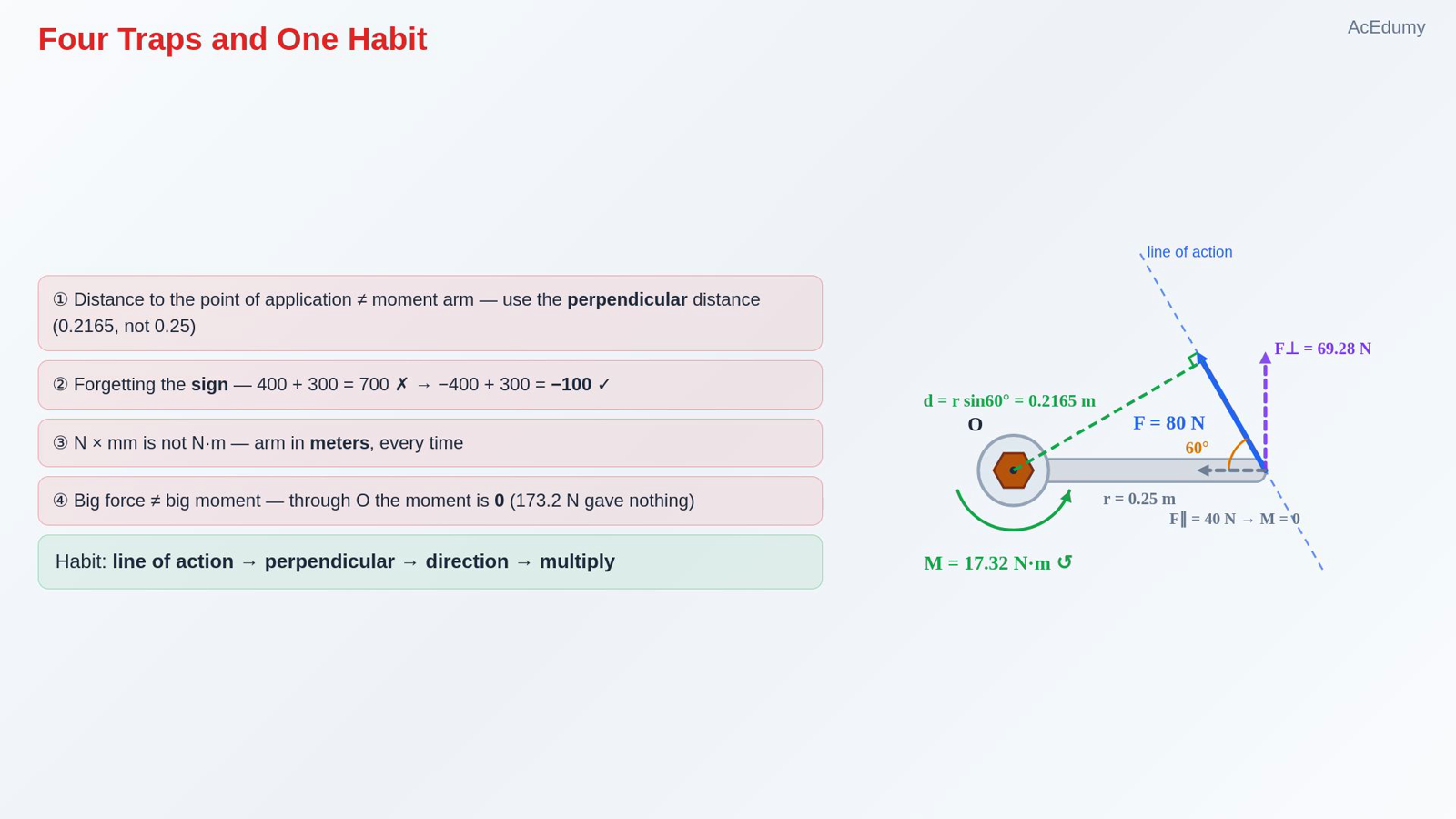
Final view of this section in the source lesson. ① Distance to the point of application ≠ moment arm — use the perpendicular distance (0.2165, not 0.25)② Forgetting the sign — 400 + 300 = 700 ✗ → −400 + 300 = −100 ✓③ N × mm is not N·m — arm in meters, every time④ Big force ≠ big moment — through O the moment is 0 (173.2 N gave nothing)Habit: line of action → perpendicular → direction → multiplyNarration transcript
Four classic traps and one habit. One: taking the wrong distance. The moment arm is not the distance from O to the point where the force is applied; it is the perpendicular distance to the line of action. On the wrench it is 0.2165 meters, not 0.25. Two: forgetting the sign. If you do not separate clockwise from counterclockwise when adding moments, you add 400 and 300 and get 700; but they work against each other, and the right answer is minus 100. Three: mixing units. Multiplying millimeters by newtons and calling it newton meters; put the arm in meters, every time. Four: thinking big force means big moment. A force whose line of action passes through O has zero moment; the 173.2 newton component on the beam is huge, yet it contributes nothing. The habit: for every moment, draw the line of action first, drop the perpendicular from O, say the direction out loud, then multiply.
7. What We Gathered
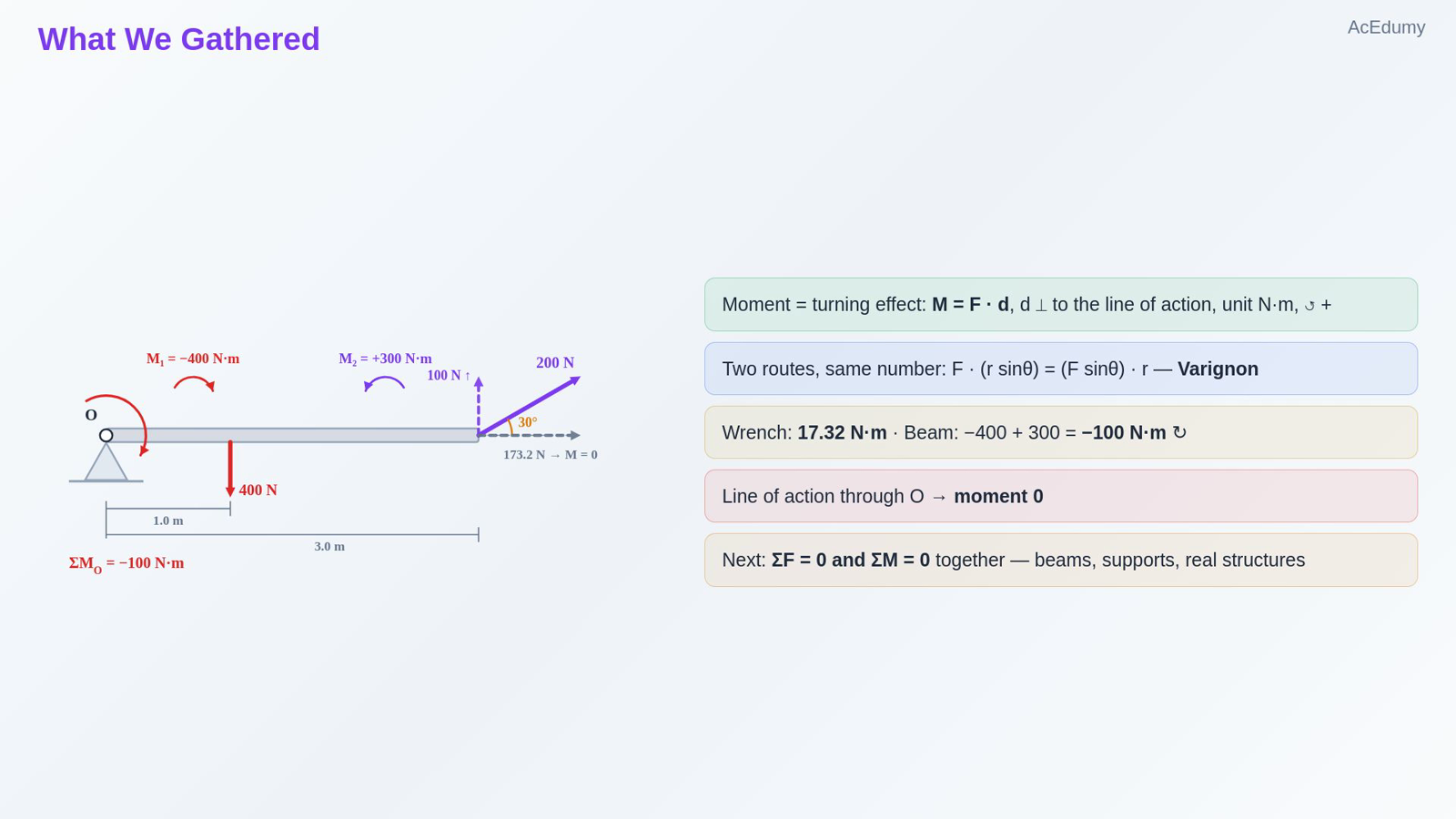
Final view of this section in the source lesson. Moment = turning effect: M = F · d, d ⟂ to the line of action, unit N·m, ↺ +Two routes, same number: F · (r sinθ) = (F sinθ) · r — VarignonWrench: 17.32 N·m · Beam: −400 + 300 = −100 N·m ↻Line of action through O → moment 0Next: ΣF = 0 and ΣM = 0 together — beams, supports, real structuresNarration transcript
Let's gather it up. The moment is the turning effect of a force about a point: M equals F times d, where d is the perpendicular distance to the line of action; the unit is the newton meter; counterclockwise is positive. Two routes give the same number: perpendicular arm times force, or the component perpendicular to the arm times the arm; Varignon's principle. On the wrench, 80 newtons, 0.25 meters and 60 degrees gave 17.32 newton meters; on the beam, minus 400 plus 300 equals minus 100 newton meters, clockwise. A force whose line of action passes through O has zero moment. Next lesson we put the two questions together: sigma F equals zero and sigma M equals zero; beams, supports, real structures. See you there.
Source video: Moment of a Force (12:26)