Statics · Statics
#05 Equilibrium of a Rigid Body
ΣF = 0 and ΣM = 0 · support reactions · two worked problems
Question
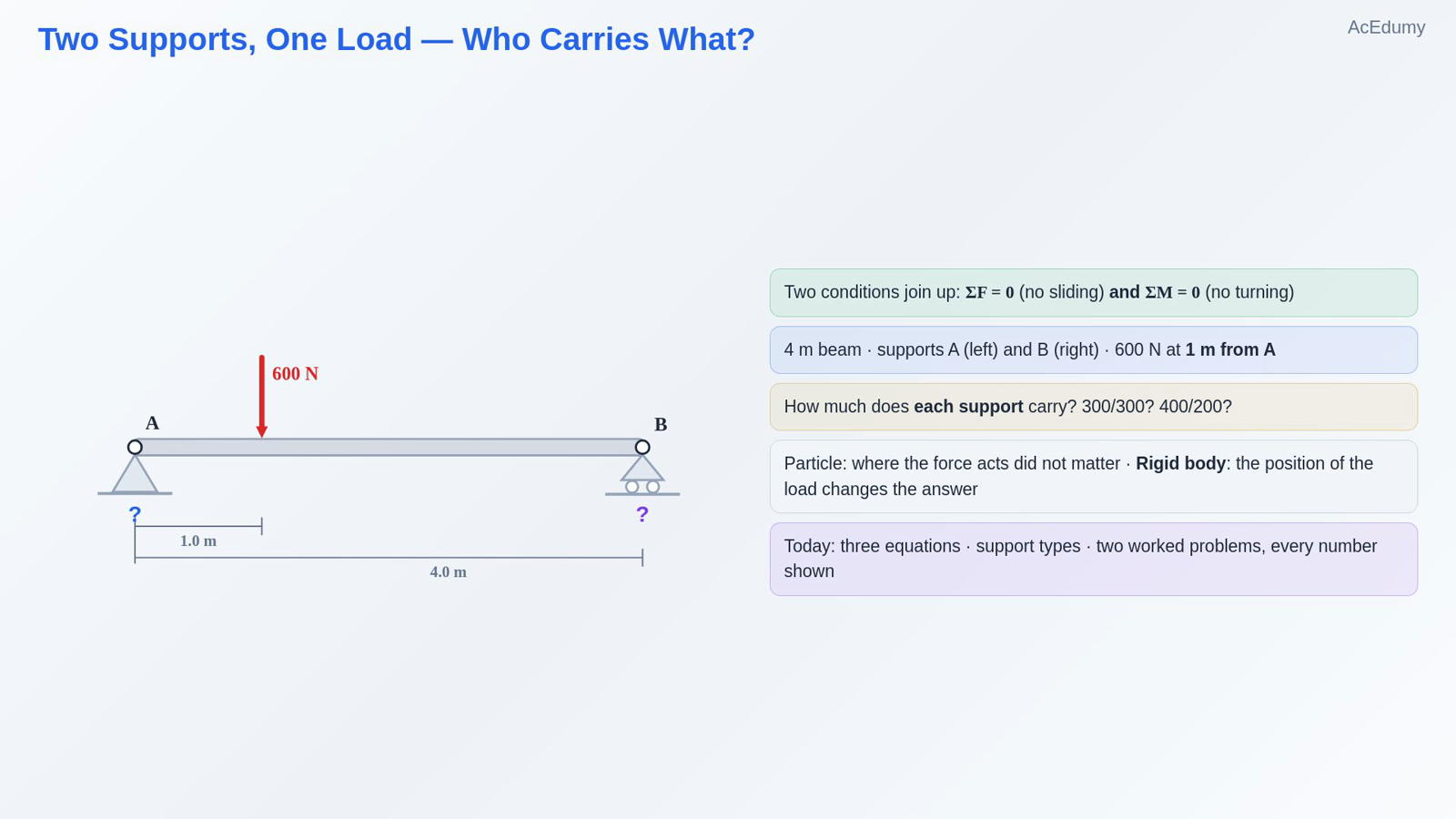
Last time we said statics asks two questions: are the forces in balance, and are the turning effects in balance. Today the two questions join up; a body at rest neither slides nor turns. Let's start with a real problem again. A light beam, 4 meters long, rests on two supports: A at the left end, B at the right end. A 600 newton load is placed on the beam, but not in the middle; 1 meter from support A. The question: how many newtons does each support carry? Your instinct says the left support carries more, and that is right; but how much? 300 and 300? 400 and 200? In the particle lessons it did not matter where a force was applied; everything met at one point. Now the body is a beam, and where the load sits changes the answer; we call this a rigid body. That is exactly why the moment equation enters the game. Today we learn to find support reactions with three equations, we meet the types of supports, and we work two full problems showing every number.
Written solution and narration transcript(shows the full solution)
Below are all the lines written in the notebook together with the full narration transcript.
1. Two Supports, One Load — Who Carries What?
Final view of this section in the source lesson. 4 m beam · supports A (left) and B (right) · 600 N at 1 m from AHow much does each support carry? 300/300? 400/200?Today: three equations · support types · two worked problems, every number shownNarration transcript
Last time we said statics asks two questions: are the forces in balance, and are the turning effects in balance. Today the two questions join up; a body at rest neither slides nor turns. Let's start with a real problem again. A light beam, 4 meters long, rests on two supports: A at the left end, B at the right end. A 600 newton load is placed on the beam, but not in the middle; 1 meter from support A. The question: how many newtons does each support carry? Your instinct says the left support carries more, and that is right; but how much? 300 and 300? 400 and 200? In the particle lessons it did not matter where a force was applied; everything met at one point. Now the body is a beam, and where the load sits changes the answer; we call this a rigid body. That is exactly why the moment equation enters the game. Today we learn to find support reactions with three equations, we meet the types of supports, and we work two full problems showing every number.
2. Three Equations, One Trick
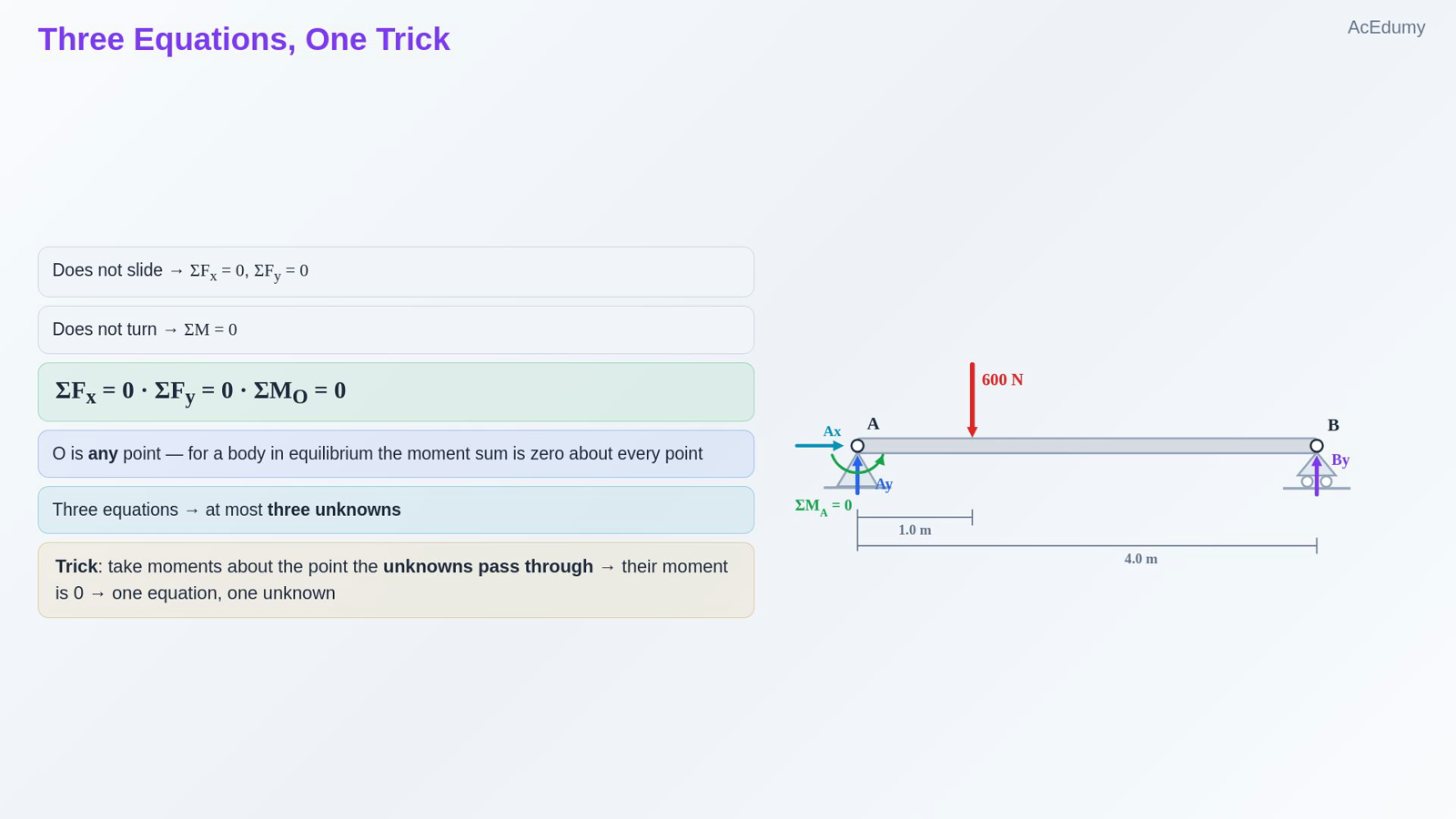
Final view of this section in the source lesson. Does not slide → ΣFₓ = 0, ΣFy = 0Does not turn → ΣM = 0O is any point — for a body in equilibrium the moment sum is zero about every pointThree equations → at most three unknownsTrick: take moments about the point the unknowns pass through → their moment is 0 → one equation, one unknownNarration transcript
For a rigid body at rest we can say two things. First: it does not slide; the forces add up to zero. We know that already: sigma F x equals zero and sigma F y equals zero. Second: it does not turn; the moments add up to zero. Sigma M equals zero. In the plane that makes three equations: sigma F x zero, sigma F y zero, sigma M zero. The beauty of the moment equation is this: whatever point you take the moments about, for a body in equilibrium the sum is zero. The choice of point is yours. Three equations means at most three unknowns. If a problem shows you four or more unknowns, statics alone is not enough; in today's problems we will have three or fewer. Now the most useful trick: take the moments about the point where the unknowns pass through. A force whose line of action passes through that point has zero moment, so it drops out of the equation. You are left with one equation and one unknown, and you solve it directly. This trick will finish both of today's problems in one stroke.
3. Supports and the Rigid-Body FBD
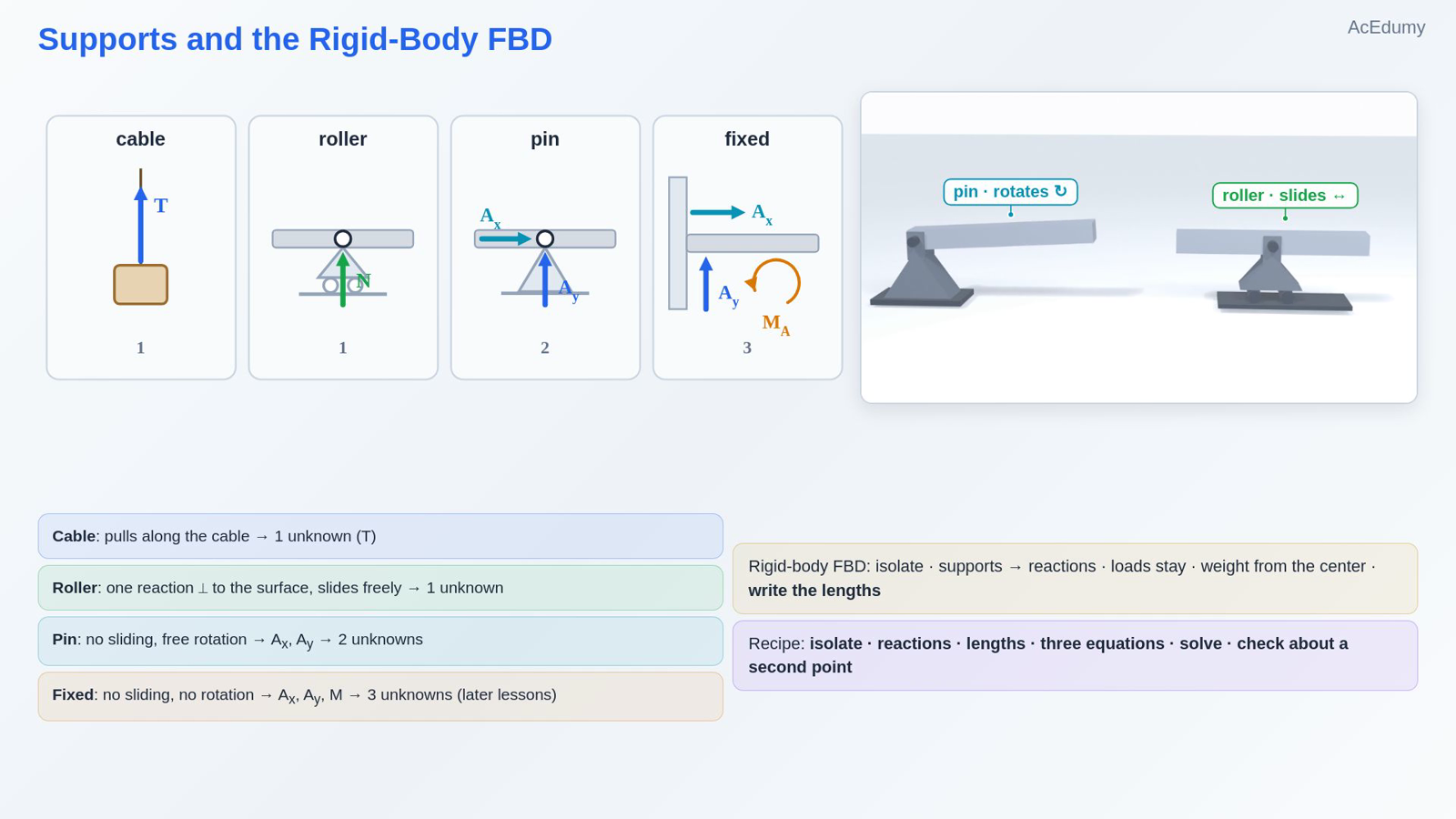
Final view of this section in the source lesson. Cable: pulls along the cable → 1 unknown (T)Roller: one reaction ⟂ to the surface, slides freely → 1 unknownPin: no sliding, free rotation → Aₓ, Ay → 2 unknownsFixed: no sliding, no rotation → Aₓ, Ay, M → 3 unknowns (later lessons)Rigid-body FBD: isolate · supports → reactions · loads stay · weight from the center · write the lengthsRecipe: isolate · reactions · lengths · three equations · solve · check about a second pointNarration transcript
To find support reactions we first need to know what each support does; a short catalogue. A rope or cable: it only pulls, along the cable; one unknown, the tension. A roller, or a movable support: it gives a single reaction perpendicular to the surface and slides freely sideways; one unknown. A pin, or a hinge: it cannot slide but it can rotate; it gives two reaction components, horizontal and vertical, A x and A y; two unknowns. A fixed support, like a beam built into a wall: it neither slides nor rotates; two force components plus a moment, three unknowns. Today we only meet it; we will use it in later lessons. The free body diagram of a rigid body follows the same recipe: isolate the body, replace every support by its reactions, keep the loads where they are, weight from the center if there is one, and always write the lengths; moments need distances. The recipe in short: isolate, turn supports into reactions, write the lengths, set up the three equations, solve, and check with a moment about a second point.
4. Problem A — Simply Supported Beam
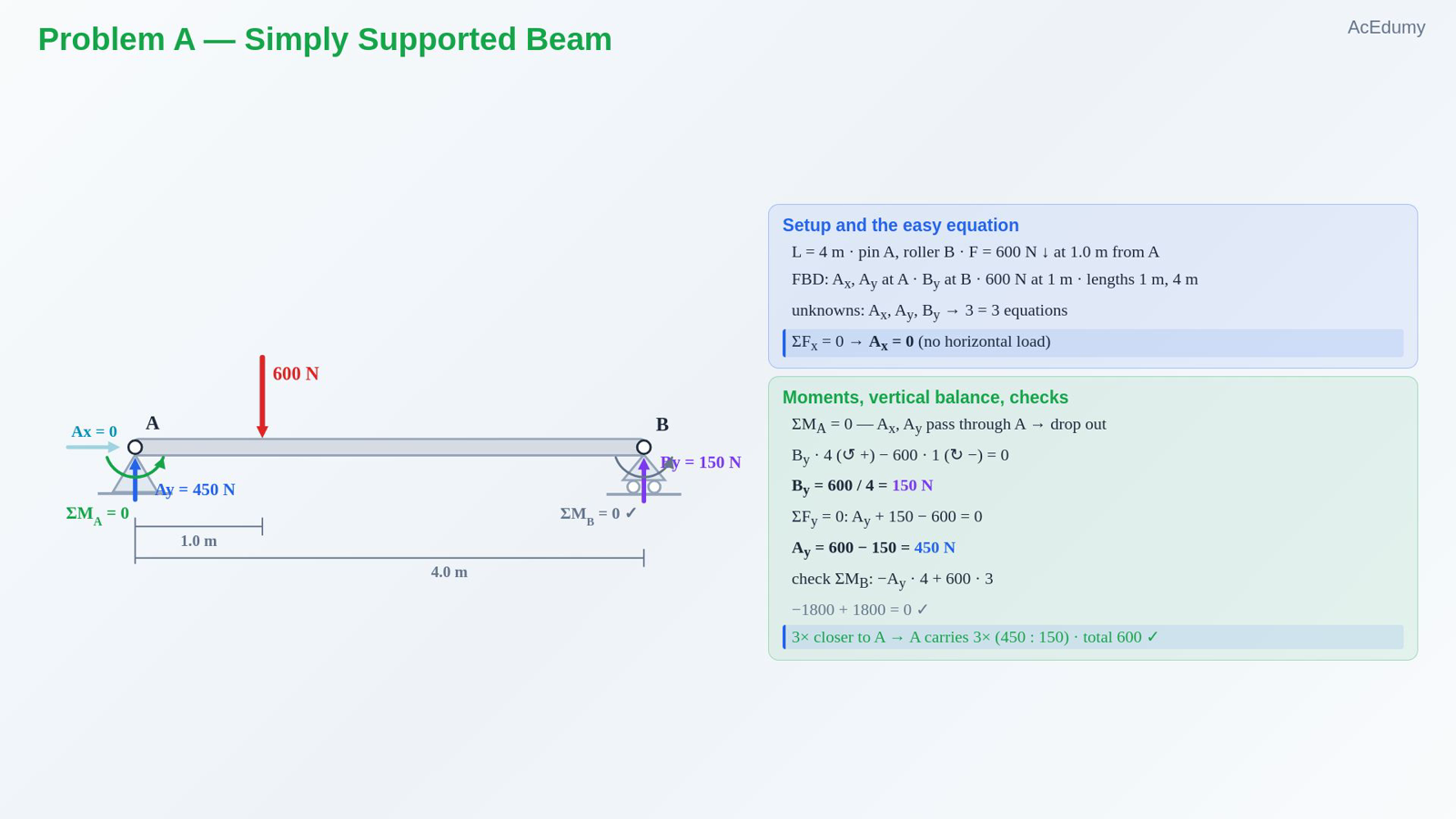
Final view of this section in the source lesson. L = 4 m · pin A, roller B · F = 600 N ↓ at 1.0 m from AFBD: Aₓ, Ay at A · By at B · 600 N at 1 m · lengths 1 m, 4 munknowns: Aₓ, Ay, By → 3 = 3 equationsΣFₓ = 0 → Aₓ = 0 (no horizontal load)ΣMA = 0 — Aₓ, Ay pass through A → drop outΣF_{y} = 0:check ΣMB: −Ay · 4 + 600 · 33× closer to A → A carries 3× (450 : 150) · total 600 ✓Narration transcript
Problem A: the beam from the opening. 4 meters, a pin at A, a roller at B, 600 newtons downward, 1 meter from A. Free body diagram: at A two reactions, horizontal and vertical, A x and A y; at B only a vertical reaction, B y; the 600 newton load at 1 meter; lengths 1 and 4 meters. Three unknowns: A x, A y, B y. Three equations too; exactly enough. The easy one first: there is no horizontal force, so sigma F x equals zero gives A x equals zero. The pin carries nothing horizontally. Now the trick: take moments about point A; A x and A y pass through it, both drop out. Sigma M A: B y times 4, counterclockwise, positive; minus 600 times 1, clockwise. Equals zero. So B y times 4 equals 600; B y equals 600 divided by 4, which is 150 newtons. Vertical balance: sigma F y: A y plus B y minus 600 equals zero. A y equals 600 minus 150, which is 450 newtons. Check: take moments about B this time. Minus A y times 4 plus 600 times 3: minus 450 times 4 equals minus 1800; 600 times 3 equals 1800; the sum is zero. It holds exactly. Does it make sense? The load is 1 meter from A and 3 meters from B; three times closer to A, so A carries three times as much: 450 to 150, three to one. And the total is 600, the whole load. The instinct was right, and now it has a number.
5. Problem B — Pin and Cable
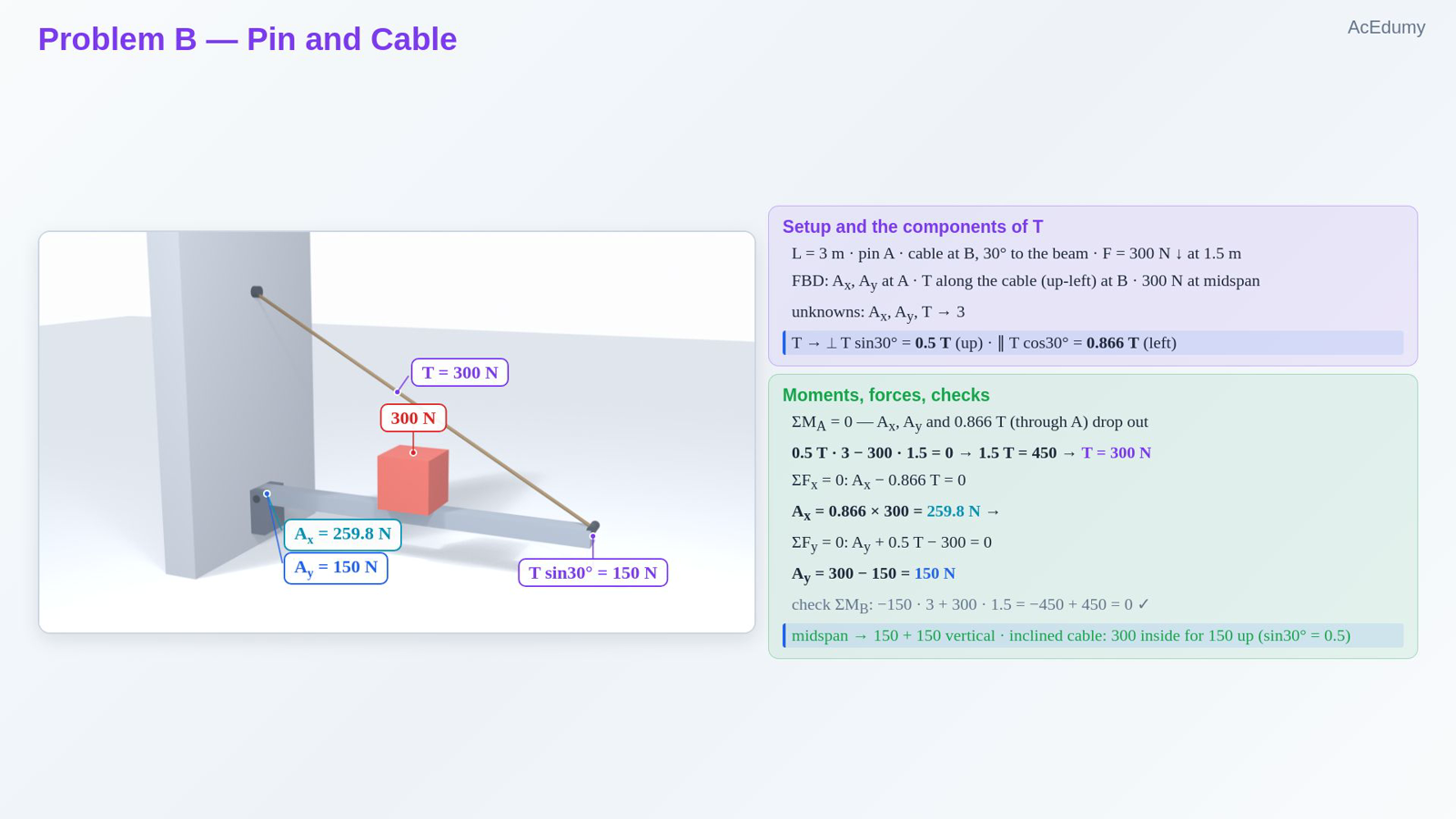
Final view of this section in the source lesson. L = 3 m · pin A · cable at B, 30° to the beam · F = 300 N ↓ at 1.5 mFBD: Aₓ, Ay at A · T along the cable (up-left) at B · 300 N at midspanunknowns: Aₓ, Ay, T → 3T → ⟂ T sin30° = 0.5 T (up) · ∥ T cos30° = 0.866 T (left)ΣMA = 0 — Aₓ, Ay and 0.866 T (through A) drop outΣFₓ = 0:ΣF_{y} = 0:check ΣM_{B}:midspan → 150 + 150 vertical · inclined cable: 300 inside for 150 up (sin30° = 0.5)Narration transcript
Problem B: this time one of the supports is a cable. A light beam, 3 meters long; its left end is pinned at A; its right end B is held by a cable that makes 30 degrees with the beam and runs up to a wall. A 300 newton load hangs at the middle of the beam, at 1.5 meters. What are the cable tension and the pin reactions? Free body diagram: at A, A x and A y; at B the tension T pulling along the cable, up and to the left; 300 newtons down in the middle. Again three unknowns: A x, A y and T. T is inclined; split it into components like last lesson. Perpendicular to the beam, upward: T times sine 30, that is 0.5 T. Along the beam, to the left: T times cosine 30, that is 0.866 T. Same trick: take moments about A. A x and A y drop out. The horizontal component of the cable acts along the beam axis, on a line through A, so its moment is zero too. Two moments remain. Sigma M A: 0.5 T times 3, positive; minus 300 times 1.5. Zero. 0.5 times 3 equals 1.5; 300 times 1.5 equals 450. So 1.5 T equals 450; T equals 450 divided by 1.5, which is 300 newtons. Horizontal balance: sigma F x: A x minus 0.866 T equals zero. A x equals 0.866 times 300, which is 259.8 newtons, to the right. The pin resists the cable's pull to the left. Vertical balance: sigma F y: A y plus 0.5 T minus 300 equals zero. A y equals 300 minus 150, which is 150 newtons. Check: moments about B: minus A y times 3 plus 300 times 1.5; minus 450 plus 450; zero. It holds. Does it make sense? The load is exactly in the middle, so the pin and the cable share the vertical load equally: 150 and 150. But the cable is inclined; to deliver 150 vertically it needs 300 inside it, because sine 30 is one half. An inclined cable works twice as hard as a vertical one; the number says so.
6. Four Traps and One Habit
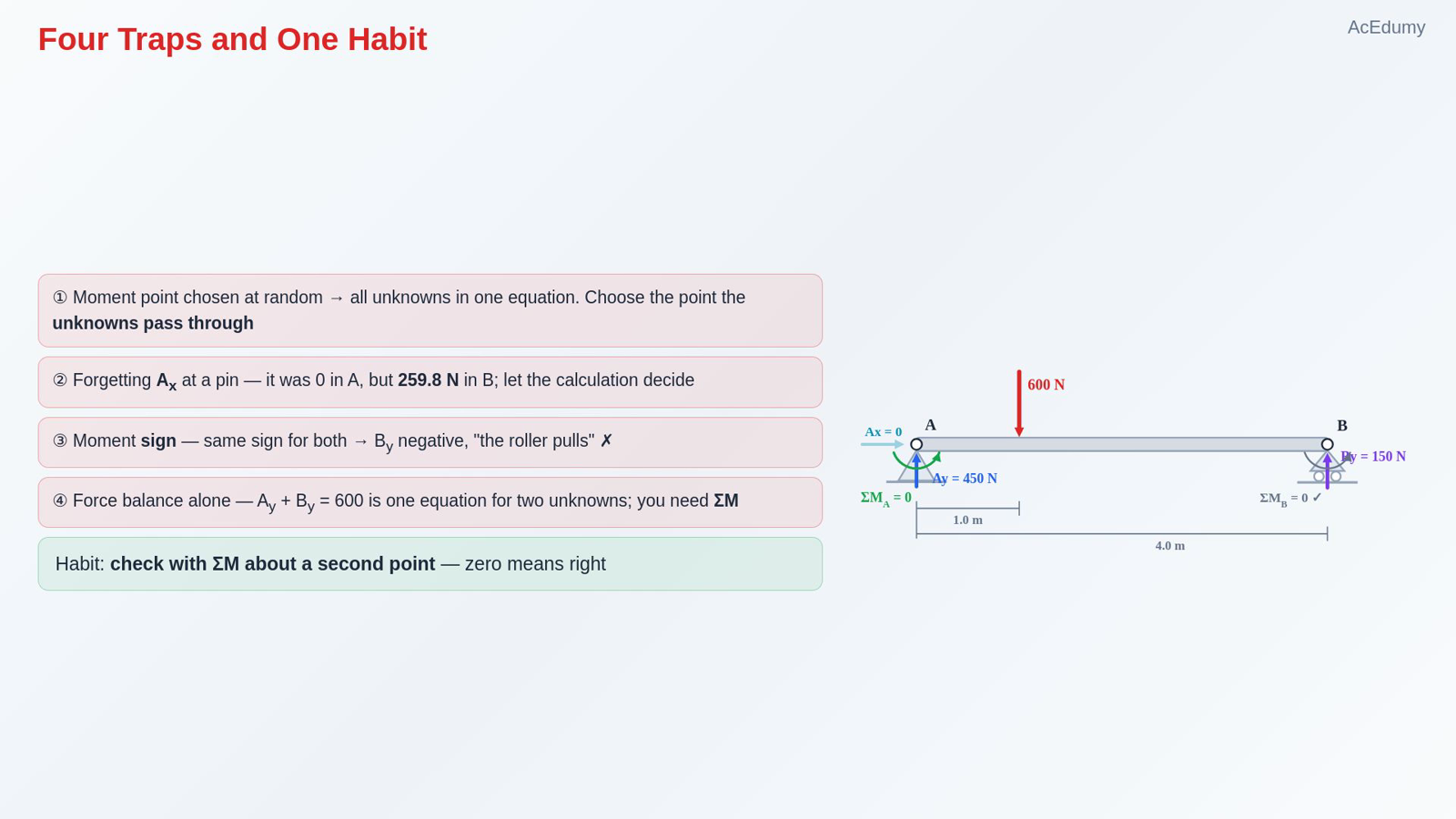
Final view of this section in the source lesson. ① Moment point chosen at random → all unknowns in one equation. Choose the point the unknowns pass through② Forgetting Aₓ at a pin — it was 0 in A, but 259.8 N in B; let the calculation decide③ Moment sign — same sign for both → By negative, "the roller pulls" ✗④ Force balance alone — Ay + By = 600 is one equation for two unknowns; you need ΣMHabit: check with ΣM about a second point — zero means rightNarration transcript
Four classic traps and one habit. One: choosing the moment point at random. Take it in the middle and all three unknowns enter the equation; the work drags on. Choose the point the unknowns pass through; about A, A x and A y vanished at once. Two: forgetting the horizontal reaction at a pin. A pin gives two components; in problem A, A x came out zero, but in problem B it was 259.8 newtons. If it is going to be zero, let the calculation say so; do not erase it in advance. Three: the sign of the moment. Counterclockwise positive, clockwise negative; add them with the same sign and B y comes out negative, as if the roller pulled the beam down; a roller cannot pull, it pushes. Four: trying to solve with force balance alone. A y plus B y equals 600 is one equation; it cannot give two unknowns; without the moment equation there are no support reactions. The habit: once you have the answer, take the moments about a second point. If it comes out zero, the calculation is right; if not, the mistake is in there somewhere.
7. What We Gathered
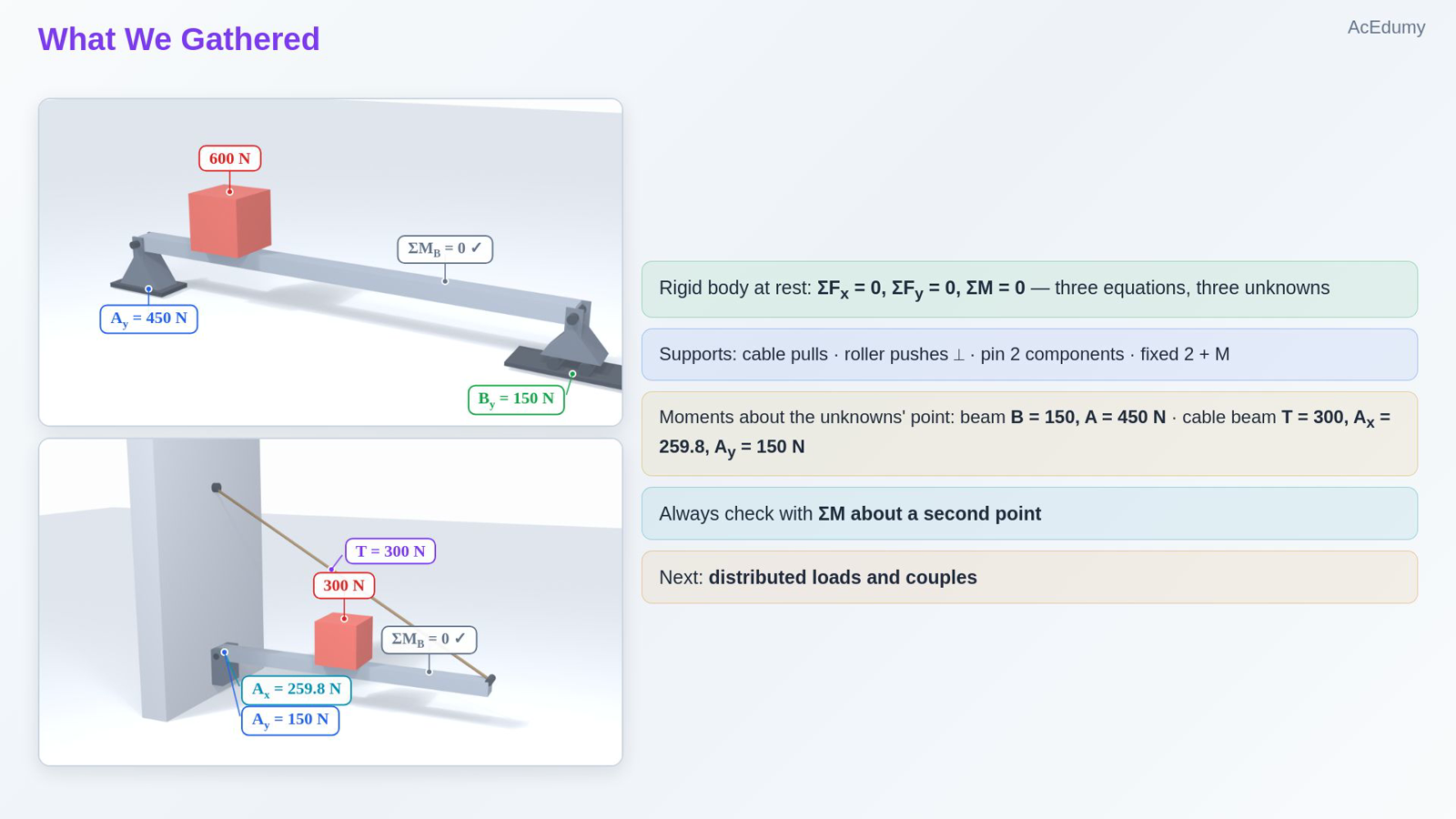
Final view of this section in the source lesson. Rigid body at rest: ΣFₓ = 0, ΣFy = 0, ΣM = 0 — three equations, three unknownsSupports: cable pulls · roller pushes ⟂ · pin 2 components · fixed 2 + MMoments about the unknowns' point: beam B = 150, A = 450 N · cable beam T = 300, Aₓ = 259.8, Ay = 150 NAlways check with ΣM about a second pointNext: distributed loads and couplesNarration transcript
Let's gather it up. A rigid body at rest neither slides nor turns: sigma F x zero, sigma F y zero, sigma M zero; three equations, at most three unknowns. Supports: a cable pulls, a roller pushes perpendicular to the surface, a pin gives two components, a fixed support gives two components plus a moment. Take the moments about the point the unknowns pass through: on the beam, B 150 and A 450 newtons; on the cable beam, T 300, A x 259.8, A y 150 newtons; and we checked both with a moment about a second point. The habit of checking every answer with a moment about a second point will save you in the exam and in the field. Next lesson the loads will not sit at a single point; they will be spread along the beam: distributed loads and couples. See you there.
Source video: Equilibrium of a Rigid Body (12:15)