Communication Basics · ATM Cell Mapping over STM-1 and Conditional AAL1 Efficiency
#32 establish the 9×270-byte STM-1 frame and 155.52-Mbit/s line rate, the one-column VC-4 POH and 9×260-byte C-4 client container, and 149.76-Mbit/s ATM-cell capacity; show why cells cross C-4 frame boundaries and per-frame floor/tail-waste accounting is wrong; use the 47-byte user field only for conditional AAL1 non-P, yielding a theoretical 132.806-Mbit/s upper bound and 85.395% line efficiency; gate actual goodput on cell mix, AAL, service, QoS, and protection
Correct STM-1/VC-4/C-4 anatomy, map ATM cells as a continuous C-4 stream, and calculate theoretical user rate only under an explicit AAL1 assumption.
Question
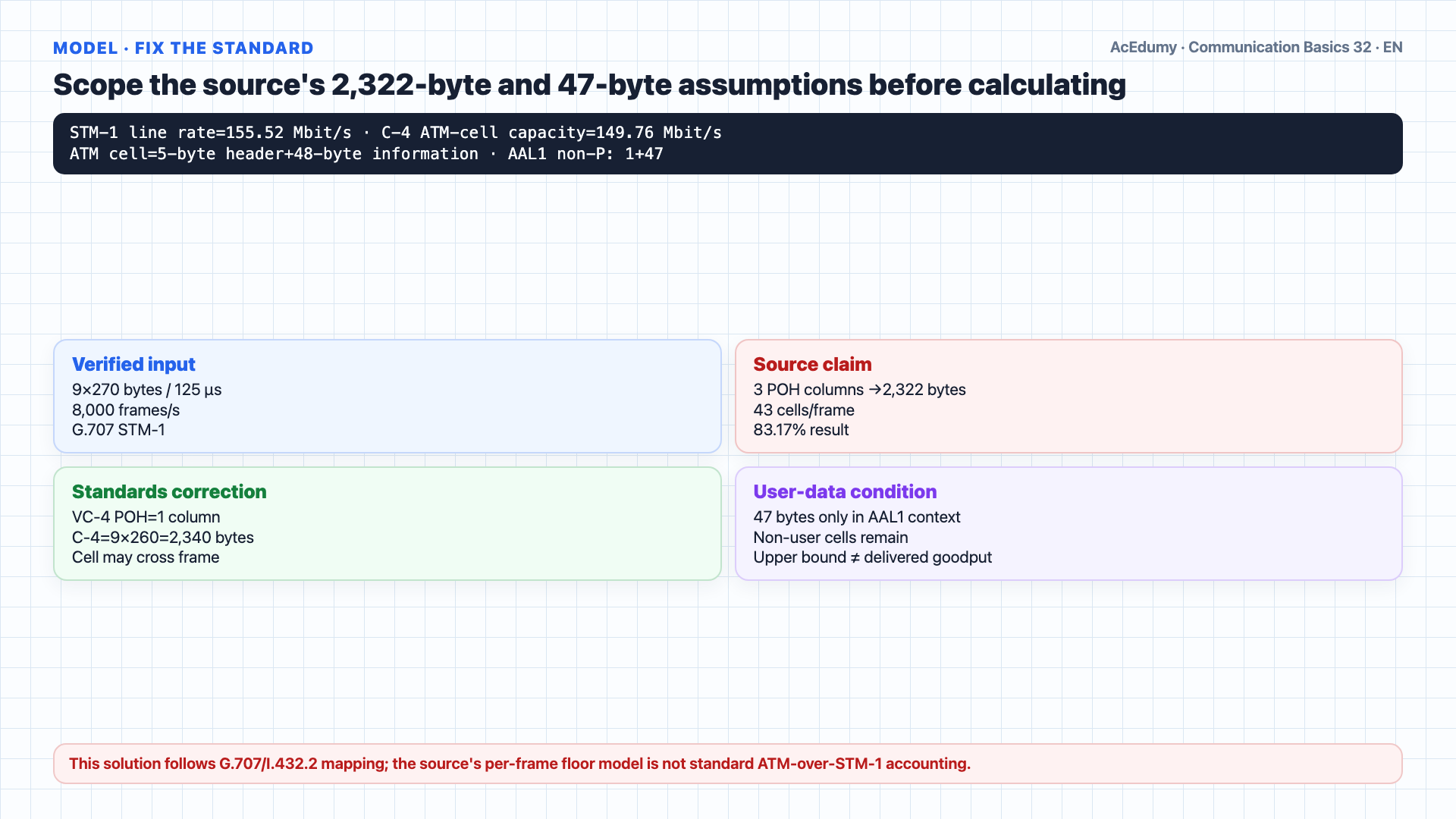
Separate STM-1 line rate, C-4 ATM-cell capacity, and application user data; retain the 9×270=2430-byte STM-1 frame, 8000 frames/s, and 155.52-Mbit/s line rate; identify the first 9 columns×9 rows as the transport-overhead area carrying RSOH, the AU-4 pointer, and MSOH, with a floating VC-4 in the remaining 261-column envelope; correct VC-4 POH from three columns to one column or 9 bytes, so the C-4 client container is 9×260=2340 bytes/frame and ATM-cell capacity is 149.76 Mbit/s; under G.707/I.432.2 ATM-cell octets align with C-4 octets and a cell may cross a C-4 frame boundary because 2340 is not an integer multiple of 53, so do not use floor(2322/53)=43 cells/frame or a recurring 43-byte unused tail; define the I.361 ATM cell as a 5-byte header plus a 48-byte information field; the split into a 1-byte AAL header plus 47 bytes of user data belongs only to the I.363.1 AAL1 non-P context, while alternatives such as AAL5 have different overhead; under the ideal assumption that every cell is an assigned user AAL1 non-P cell, calculate R_user,max=149.76×47/53=132.806 Mbit/s, eta_line,max=132.806/155.52≈85.395%, long-run average 16600.755 user bits/STM frame, and 22.714 Mbit/s total non-user line contribution; do not repeat 129.344 Mbit/s/83.17% as the standards-based outcome; gate actual delivered goodput on user/signalling/OAM/unassigned/idle cell shares, AAL/PDU padding/trailer/FEC, traffic/QoS, cell loss, protection/failure state, and measurement; do not call overhead waste/tax or claim a single-cause history for 53 bytes or a no-call-delay guarantee.
Written solution and narration transcript(shows the full solution)
Below are all the lines written in the notebook together with the full narration transcript.
1. Fix the problem model and standards-bounded user-data definition
The ATM cell stream may cross a C-4 frame boundary; the 47-byte user fraction is AAL1-specific and actual goodput depends on non-user cells, AAL, and service overhead. Welcome back.Today we separate STM-1 physical line rate, C-4 ATM-cell capacity, and application user data; overhead is functional, not automatically waste.We are looking at an STM one frame, the basic unit of synchronous digital hierarchy transmission.We are filling its payload area with ATM cells — the fifty three byte fixed cells used in early broadband networks.An ATM cell is a 5-byte header plus a 48-byte information field; the 1-byte SAR-PDU header plus 47 user bytes applies only to an explicit AAL1 non-P model.Four questions.Part a: because the ATM cell stream may cross a C-4 frame boundary, establish continuous mapping instead of an integer cells-per-frame count.Part b: compute long-run average user bits/frame only under an explicit all-user-cell AAL1 non-P upper-bound model.Part c: calculate the theoretical maximum user fraction of STM-1 line rate under that conditional model.Part d: calculate conditional upper-bound user rate and leave actual goodput behind AAL and cell-population gates.Narration transcript
Welcome back. Today we open up an S D H frame and ask a very practical question — how much of it actually carries user data, and how much is wasted on framing overhead. We are looking at an S T M one frame, the basic unit of synchronous digital hierarchy transmission. We are filling its payload area with A T M cells — the fifty three byte fixed cells used in early broadband networks. Each cell has five bytes of A T M header, one byte of adaptation overhead, and forty seven bytes of actual user data. Four questions. Part a: how many complete A T M cells fit inside one S T M one frame? Part b: how many bits of actual user data does that give us per frame? Part c: what percentage of the total S T M one capacity is genuine user data? Part d: at what data rate is the user information being transmitted, in megabits per second?
2. Correct STM-1, AU-4, VC-4, and C-4 frame anatomy
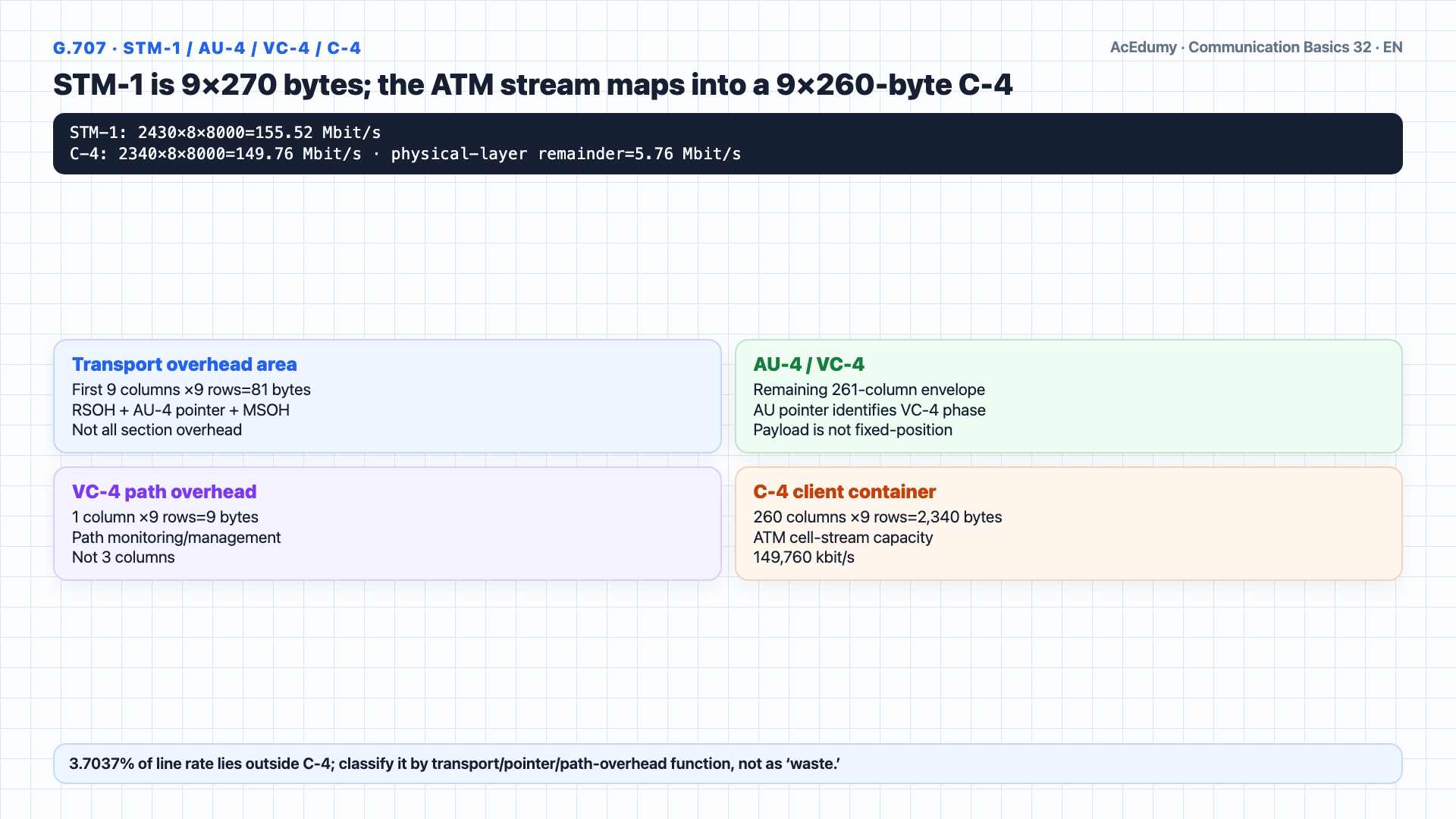
The ATM cell stream may cross a C-4 frame boundary; the 47-byte user fraction is AAL1-specific and actual goodput depends on non-user cells, AAL, and service overhead. First the frame.An STM one frame is a two-dimensional grid: nine rows by two hundred seventy columns of bytes.That is two thousand four hundred thirty bytes per frame, and at eight bits per byte, exactly nineteen thousand four hundred forty bits per frame.Now the layout.The first 9 columns×9 rows are a transport-overhead area carrying RSOH, the AU-4 pointer, and MSOH; not all 81 bytes are section overhead.Three rows are RSOH — regenerator section overhead.One row is the AU pointer.Five rows are MSOH — multiplexer section overhead.The 9×9=81-byte transport-overhead/pointer area carries framing, monitoring, pointer, and management functions.The remaining 261-column AU-4 envelope carries a floating VC-4; VC-4 POH is one column×9 rows, not three columns.The C-4 client container inside VC-4 is 261−1=260 columns across 9 rows.C-4 capacity is 260×9=2340 bytes/frame, or 149.76 Mbit/s at 8000 frames/s, for the ATM cell stream.STM one is transmitted at exactly eight thousand frames per second, so each frame lasts one over eight thousand seconds, or one hundred twenty five microseconds.That is the heartbeat of SDH.Narration transcript
First the frame. An S T M one frame is a two-dimensional grid: nine rows by two hundred seventy columns of bytes. That is two thousand four hundred thirty bytes per frame, and at eight bits per byte, exactly nineteen thousand four hundred forty bits per frame. Now the layout. The first nine columns of every row carry section overhead. Three rows are R S O H — regenerator section overhead. One row is the A U pointer. Five rows are M S O H — multiplexer section overhead. These nine columns of overhead times nine rows give us eighty one bytes of section overhead — framing, error monitoring, pointer adjustments, and management channels. The remaining two hundred sixty one columns are the payload area, but three of those columns are reserved for path overhead — the P O H — tracking the user signal as it walks across the network. Two hundred sixty one minus three equals two hundred fifty eight columns of usable space, across all nine rows. Two fifty eight times nine equals two thousand three hundred twenty two bytes — this is what we have to fill with our A T M cells. S T M one is transmitted at exactly eight thousand frames per second, so each frame lasts one over eight thousand seconds, or one hundred twenty five microseconds. That is the heartbeat of S D H.
3. Separate the ATM 5+48 cell from conditional AAL1 1+47
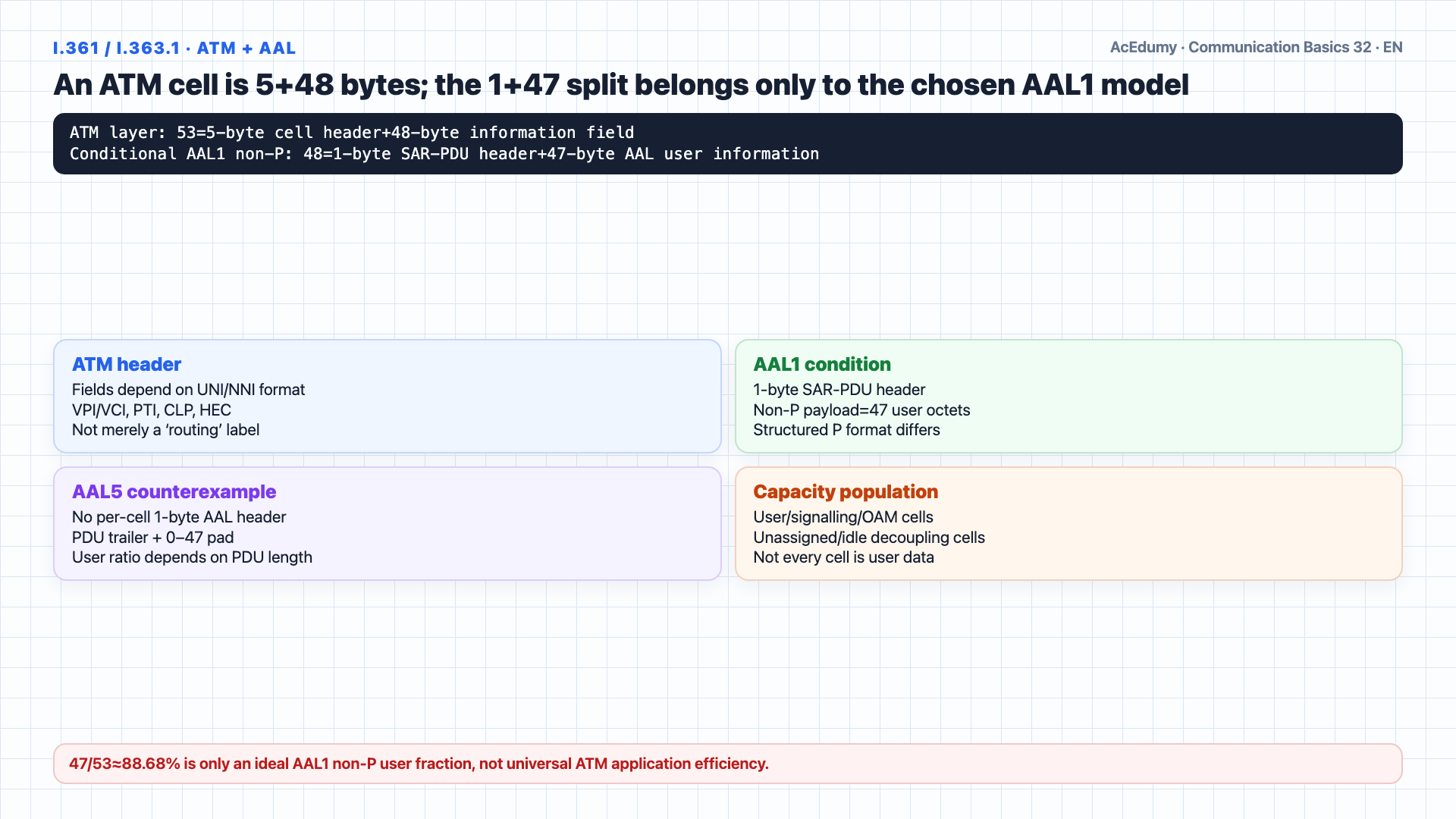
The ATM cell stream may cross a C-4 frame boundary; the 47-byte user fraction is AAL1-specific and actual goodput depends on non-user cells, AAL, and service overhead. Now the cell.ATM was an important standardized broadband-transport option in the 1990s, not the single choice for every deployment.ATM uses fixed 53-byte cells; a small serialization unit affects delay variation and multiplexing behavior, but do not reduce the 53-byte standardization history to one cause.The 5-byte ATM header carries format-dependent UNI/NNI fields including VPI/VCI, PTI, CLP, and HEC; UNI also includes GFC.Forty eight bytes are the ATM payload.Only in an AAL1 non-P SAR-PDU model does the 48-byte information field contain a 1-byte header plus 47 bytes of AAL-user information; AAL5 overhead differs.Under this explicit AAL1 non-P/all-user-cell model, at most 47 AAL-user bytes correspond to 53 transmitted bytes; this is not universal ATM payload efficiency.The conditional ideal AAL1 non-P fraction is 47/53≈88.68%; OAM/signalling/idle cells and higher-layer overhead are excluded.In that conditional cell ledger ATM+AAL1 overhead is 6/53≈11.32%; the fraction changes with AAL type and cell population.Now we will see how this combines with the frame overhead.Narration transcript
Now the cell. Asynchronous transfer mode, or A T M, was the technology of choice for broadband transport in the nineteen nineties. It uses fixed-size cells of fifty three bytes — chosen as a compromise between voice latency and data efficiency. Five bytes are the A T M header: routing, traffic class, error check. Forty eight bytes are the A T M payload. Of those forty eight, one byte is the adaptation layer header — A A L — leaving exactly forty seven bytes carrying actual end-user information. So per cell: fifty three bytes shipped, but only forty seven bytes of user data inside. The cell-level efficiency is forty seven over fifty three, about eighty eight point seven percent. Already an eleven percent overhead just at the cell level. Now we will see how this combines with the frame overhead.
4. Establish continuous C-4 mapping and frame-boundary crossing
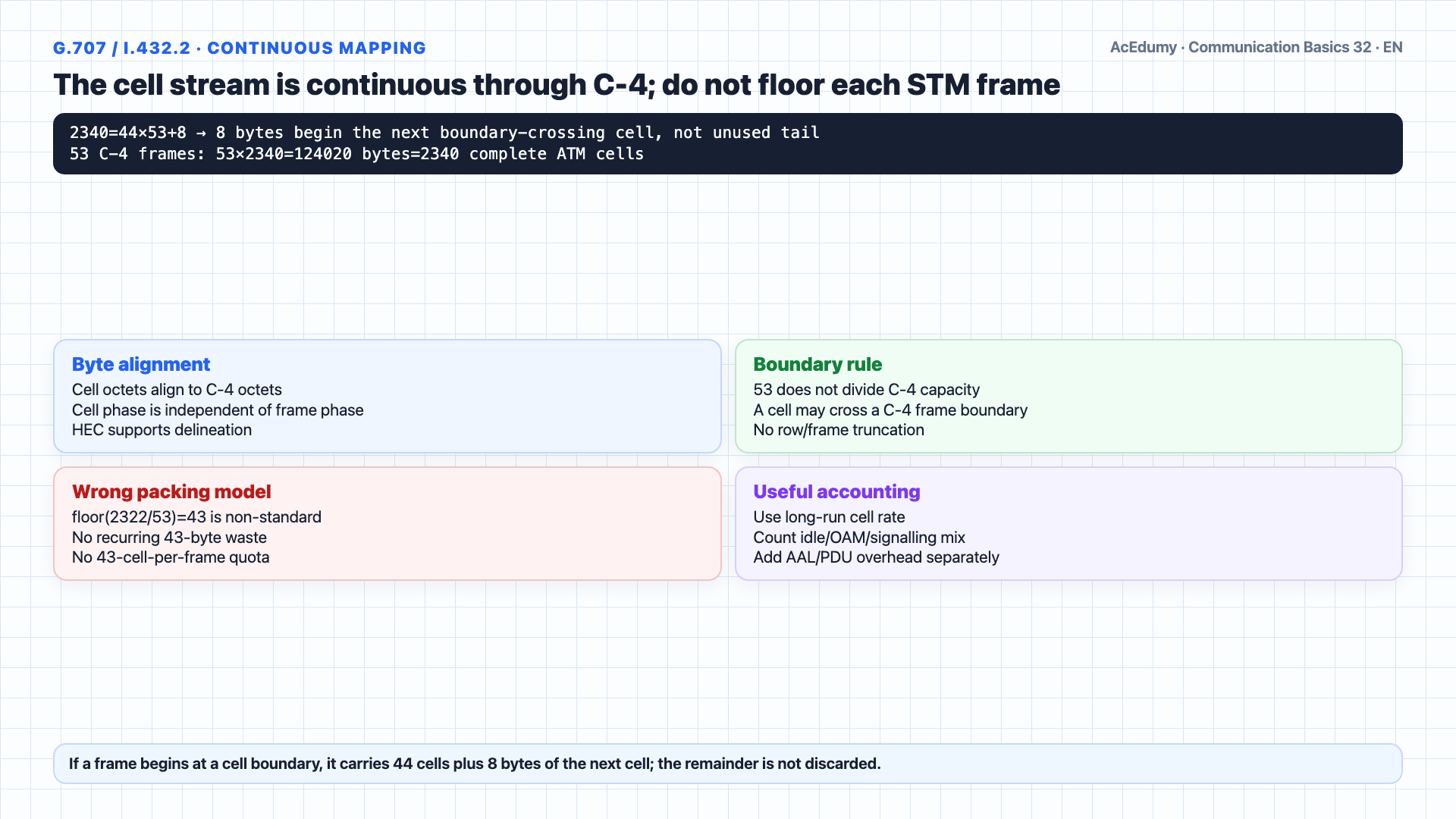
The ATM cell stream may cross a C-4 frame boundary; the 47-byte user fraction is AAL1-specific and actual goodput depends on non-user cells, AAL, and service overhead. Part a — how many cells fit in the payload?Standard ATM mapping provides 2340 C-4 bytes per frame.Each cell is fifty three bytes.2340=44×53+8; the 8 bytes may start the next boundary-crossing cell and are not unused tail.G.707/I.432.2 maps the ATM cell stream byte-aligned into C-4 and permits a cell to cross the C-4 frame boundary; there is no per-frame floor.There is no fixed 43-cell/frame quota; long-run cell rate is 149.76 Mbit/s ÷424 bit/cell≈353,207.55 cells/s.Across 53 C-4 frames, 53×2340=124020 bytes carry exactly 2340 complete ATM cells while boundary phase continues.There is no recurring 43-byte unused tail; standard mapping continues a cell across the C-4 frame boundary.Part b — actual user data per frame.Only an assumed AAL1 non-P user cell carries 47 bytes of AAL-user information; not every physical cell is a user cell.For a conditional AAL1 non-P user cell, 47×8=376 AAL-user bits is correct.With continuous mapping the theoretical average is 2340×8×47/53≈16600.755 AAL-user bits/STM frame, not 16168.Narration transcript
Part a — how many cells fit in the payload? We have two thousand three hundred twenty two bytes of payload area in one S T M one frame. Each cell is fifty three bytes. Two thousand three hundred twenty two divided by fifty three equals forty three point eight one — but cells are atomic, we cannot cut one in half. S D H allows cells to span two consecutive rows of the payload, so we just round down to the integer that fits. Forty three complete cells per frame. Total bytes occupied: forty three times fifty three equals two thousand two hundred seventy nine bytes. The remaining forty three bytes of the payload sit unused, waiting for the next frame to start a new cell. Part b — actual user data per frame. Each cell carries forty seven bytes of user data. Forty seven bytes times eight bits per byte equals three hundred seventy six user bits per cell. Forty three cells per frame times three hundred seventy six bits per cell — that is sixteen thousand one hundred sixty eight bits of actual user information per frame.
5. Calculate conditional AAL1 upper rate and line efficiency
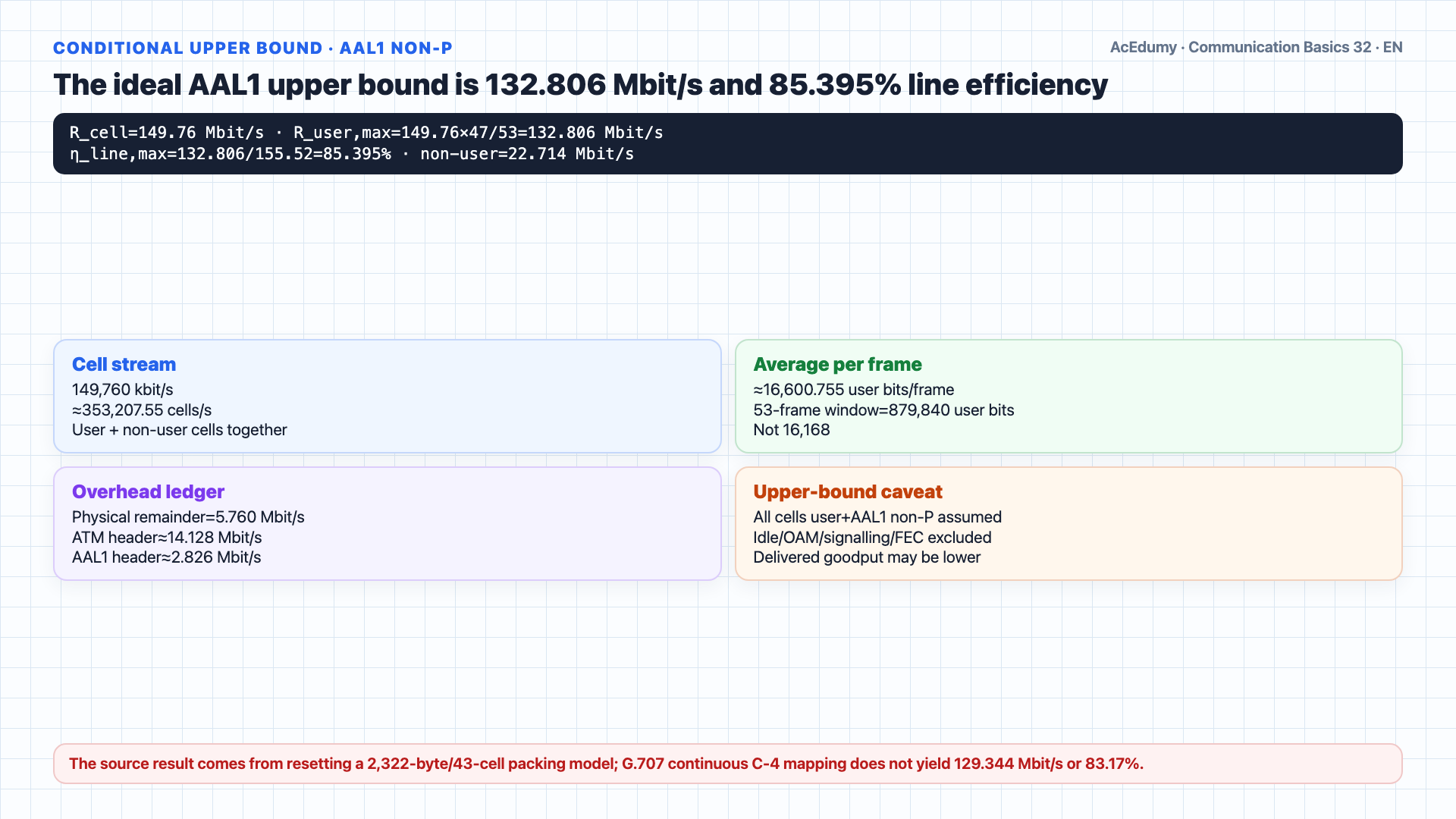
The ATM cell stream may cross a C-4 frame boundary; the 47-byte user fraction is AAL1-specific and actual goodput depends on non-user cells, AAL, and service overhead. Part c — efficiency.What fraction of the total STM one capacity is genuine user data?Conditional theoretical line efficiency is (149.76×47/53)/155.52≈85.395%; 83.17% comes from the incorrect per-frame reset model.The ideal all-user-cell AAL1 non-P upper bound is about 85.395% of line bytes; actual delivered fraction may be lower.The conditional ledger has about 14.605% non-user line contribution and no recurring unused tail; actual mix adds OAM/signalling/idle and service overhead.Part d — data rate.Each frame is transmitted in one hundred twenty five microseconds.Conditional long-run average user information is approximately 16600.755 bits per STM frame.Conditional upper-bound rate is 149.76×47/53≈132.806 Mbit/s; 129.344 Mbit/s is not the standard continuous-mapping result.Compare that to the line rate of STM one — one hundred fifty five point five two megabits per second.On a 155.52-Mbit/s line, the conditional AAL1 non-P upper bound is 132.806 Mbit/s; actual user rate depends on cell population and higher-layer efficiency.Remaining capacity serves physical transport, ATM/AAL headers, and actual OAM/signalling/idle cells; addressing, synchronization, and monitoring belong to different functions/layers.Narration transcript
Part c — efficiency. What fraction of the total S T M one capacity is genuine user data? Sixteen thousand one hundred sixty eight user bits divided by nineteen thousand four hundred forty total bits equals zero point eight three one seven, or about eighty three point one seven percent. Just over eighty three percent of every byte that crosses the link is user data. The other seventeen percent goes to framing overhead, headers, and the unused tail of the payload. Part d — data rate. Each frame is transmitted in one hundred twenty five microseconds. User data per frame is sixteen thousand one hundred sixty eight bits. Data rate equals sixteen thousand one hundred sixty eight bits divided by one hundred twenty five microseconds, which is one hundred twenty nine point three four four megabits per second. Compare that to the line rate of S T M one — one hundred fifty five point five two megabits per second. We push one fifty five megabits of bits down the wire, but only one twenty nine megabits is real user information. The rest is overhead, doing the work of keeping the network synchronized and addressable.
6. Gate actual goodput on overhead, cell mix, QoS, and protection
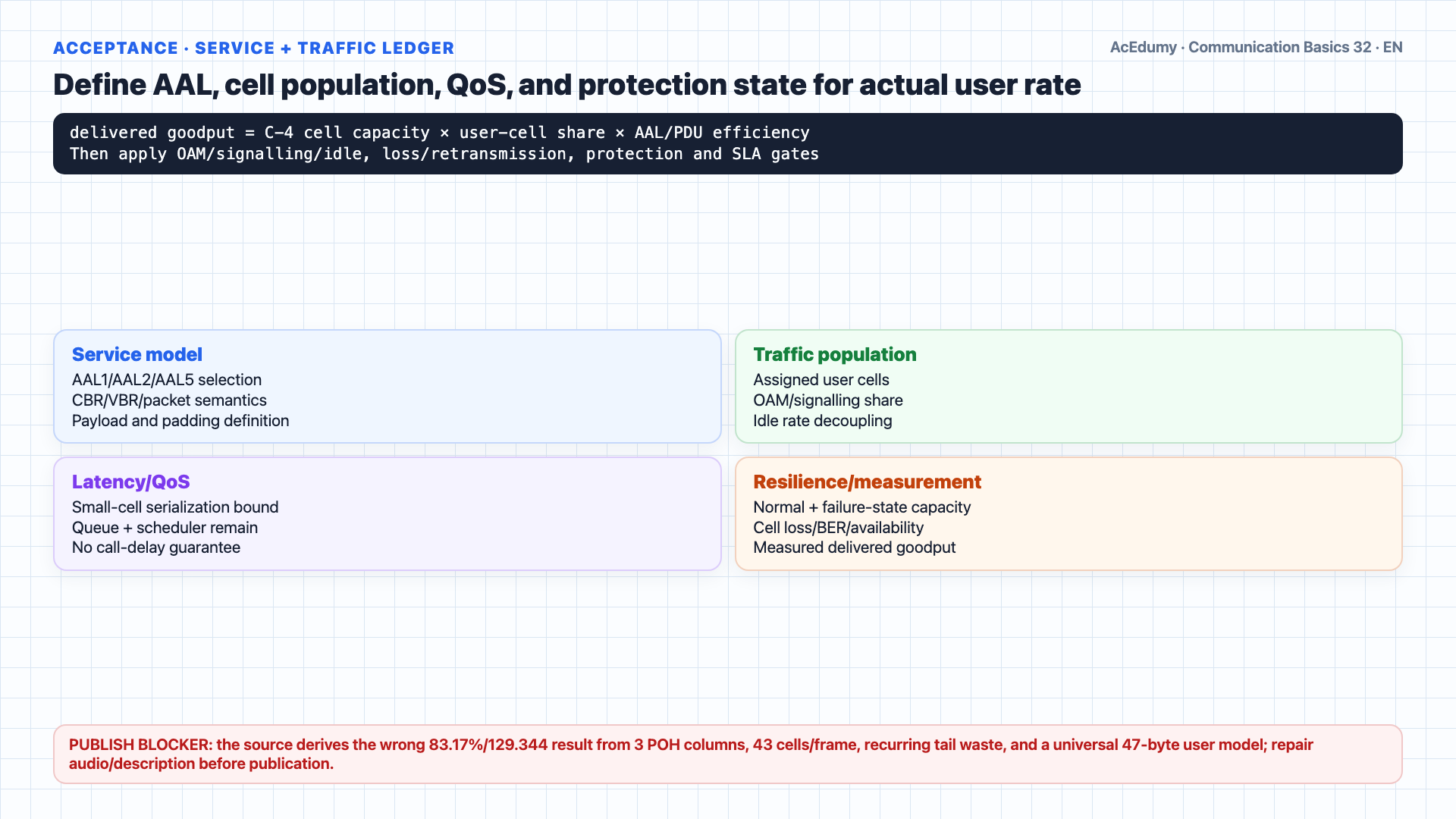
The ATM cell stream may cross a C-4 frame boundary; the 47-byte user fraction is AAL1-specific and actual goodput depends on non-user cells, AAL, and service overhead. Three takeaways from this exercise.One: overhead is an accounting category that carries framing, pointer, monitoring, management, delineation, and adaptation functions.Some layers add headers, trailers, padding, or control units; define user-visible goodput at a stated service boundary.The STM-1-to-C-4 difference is 3.7037% of line rate; ATM header is 5/53 of cell-stream bytes, AAL1 header adds 1/53, and there is no recurring frame-tail waste.In the ideal all-user-cell AAL1 non-P model the non-user line fraction is 14.605%; measure actual fraction from cell mix, AAL/PDU, and service overhead.Two: small fixed cells trade efficiency for predictability.Small fixed cells bound the maximum serialization unit at a given link rate; queues, schedulers, and offered load still create delay, so there is no no-call-delay guarantee.But that small size means a relatively large header-to-payload ratio.Audit later payload examples against their mapping, fragmentation/padding, and boundary-continuity rules; ATM cells themselves always remain fixed at 53 bytes.The STM-1 frame may stay fixed while delivered efficiency depends on client mapping, AAL/PDU format, traffic mix, and the overhead definition.Narration transcript
Three takeaways from this exercise. One: framing overhead is a tax. Every protocol layer adds bytes that the user does not see. S D H spends about three percent on the framing structure, A T M spends about eleven percent on cell headers, and the unused tail of the payload eats another percent or two. Add it all up and roughly seventeen percent of the bandwidth never reaches the user. Two: small fixed cells trade efficiency for predictability. A T M chose fifty three bytes because tiny cells keep voice latency low — any individual call cannot be held up by a giant data packet sharing the link. But that small size means a relatively large header-to-payload ratio. Three: in the next two videos we will run exactly this calculation with two different payload schemes — five hundred seventy six byte I P packets, where we will see efficiency collapse, and a mixed packet size that shows what happens when you mix cells of different sizes in the same frame. The S T M one frame stays the same; only the way we fill it changes — and the answer changes dramatically with the payload choice.
Source video: Communication Basics #32 Worked Example: STM-1 + ATM Cells — Frame Efficiency, 83.17% Real Data (7:56)