Communication Basics · Mixed-Unit Mapping over STM-1 and Conditional Efficiency
#34 distinguish a 53-byte ATM cell from a hypothetical 77-byte unit; continuously map their alternating 130-byte pair into the correct 2,340-byte C-4; derive 18+18 pair-aligned units with zero tail; under the stated 47+72 user model calculate 17,136 bits/frame, 137.088 Mbit/s, and 88.148% line-efficiency upper bounds; use gross-byte weights for mixture efficiency; gate actual goodput on mapping, AAL/PDU, traffic mix, OAM/idle, QoS, and protection
Separate the 53-byte ATM cell from a hypothetical 77-byte unit; continuously map the mixed stream into correct C-4 capacity and derive only an explicit conditional upper bound.
Question
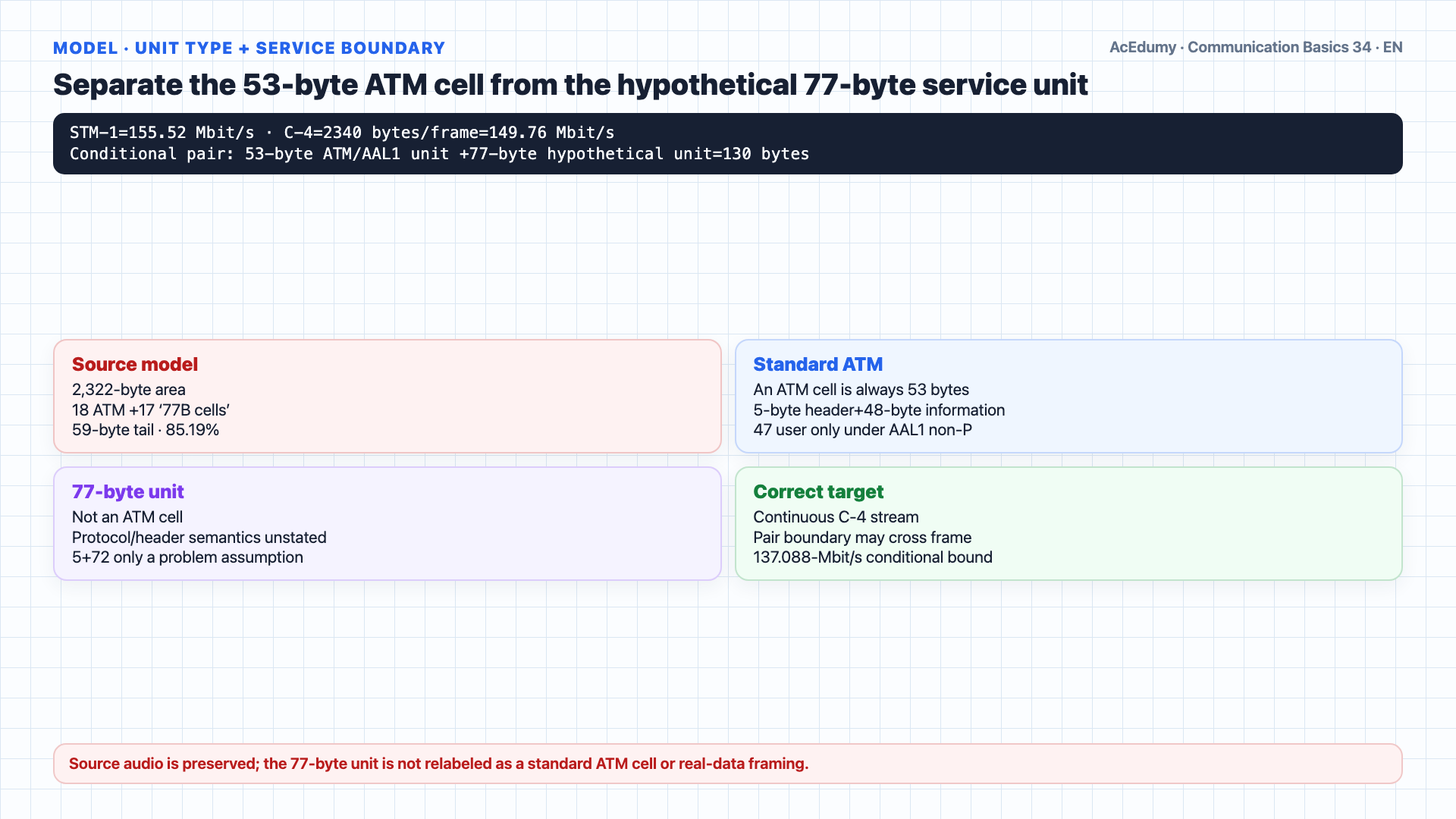
Distinguish the standard 53-byte ATM cell from the hypothetical 77-byte service unit; retain I.361's 5-byte ATM header+48-byte information field and use the 1+47 split only for I.363.1 AAL1 non-P user-cell conditions; state that the 77-byte unit is not an ATM cell, its 5+72 split is a stated arithmetic assumption rather than a standards-backed protocol, and a larger payload does not absorb adaptation; use G.707's 9×260=2340-byte/frame C-4 at 149.76 Mbit/s and reject the source's 2322-byte model; the stated one-for-one alternating pair is 53+77=130 gross bytes and 47+72=119 stated-user bytes; with continuous mapping, units/pairs may cross C-4 boundaries and no per-frame floor/tail squeeze applies; in the pair-aligned case calculate 2340/130=18 exactly, 18 ATM+18 hypothetical units, zero tail, and 2142 user bytes=17136 user bits/frame; conditional zero-extra-overhead user rate is149.76×119/130=137.088 Mbit/s and line efficiency is137.088/155.52=88.148%; do not repeat132.48 Mbit/s/85.19% as a standard result; weight mixture efficiencies by gross transmitted-byte shares, not user-byte shares; state corrected conditional comparison bounds D32≈132.806 Mbit/s/85.395% and D33=143.52 Mbit/s/92.284% with explicit assumptions; gate real link sizing on mapping protocol (ATM/PPP/GFP), Unit-B framing/delineation, AAL/PDU/padding/stuffing, assigned-user/OAM/signalling/idle population, non-one-for-one traffic mix, scheduling/queue/load, loss/retransmission, protection/failure state, and SLAs; avoid claims that voice automatically means ATM, every real network mixes this way, or unit size alone guarantees latency.
Written solution and narration transcript(shows the full solution)
Below are all the lines written in the notebook together with the full narration transcript.
1. Fix the problem model and mixed-unit service boundary
The 77-byte unit is not an ATM cell; pair-aligned C-4 carries 18+18 units, and 88.148% is only a stated zero-extra-overhead upper bound. Welcome back.The third and final video in our STM one filling trilogy.D32's 83.17% source result is not standard continuous mapping; its corrected conditional AAL1 non-P bound is 85.395%.D33's 90.87% source result also comes from a wrong per-frame reset; the conditional 24+552 zero-extra-overhead bound is 92.284%.Real networks may carry mixed services, but the transport and multiplexing method must be identified by standard or profile.This arithmetic toy model alternates a standard 53-byte ATM cell with a hypothetical 77-byte service unit in a continuous C-4 stream.An ATM cell is 5-byte header+48-byte information; 1+47 applies only to an AAL1 non-P user-cell condition, and voice does not automatically mean ATM.The 77-byte unit is not an ATM cell; 5 stated overhead+72 stated user is only the problem's hypothetical format.The stated mixing rule is one-for-one alternation; continuous mapping preserves pair/unit phase across frame boundaries and has no per-frame tail squeeze.Four questions, same shape as before.Part a: derive the long-run unit count for a continuous alternating-pair stream in the 2,340-byte C-4.Part b: derive long-run average user bits/frame under the stated 47+72 user assumptions.Part c: calculate the conditional pair model's STM-1 line-efficiency upper bound.Part d: find the conditional upper-bound rate, then gate actual goodput on mapping, service, and traffic.The conditional result lies between the stated corrected D32/D33 bounds; mixture efficiency is weighted by transmitted gross bytes.Narration transcript
Welcome back. The third and final video in our S T M one filling trilogy. In the first video we filled the payload with all A T M cells — eighty three point one seven percent efficiency. In the second we filled it with all five hundred seventy six byte I P packets — ninety point eight seven percent. But real networks rarely carry just one kind of traffic. Today we mix two cell sizes inside the same S T M one frame. Voice traffic uses fifty three byte A T M cells — five header, one A A L, forty seven user data. Data traffic uses seventy seven byte cells — five bytes of header, seventy two bytes of user data. The mixing rule we will use: alternate one of each, packing as many pairs as fit, then squeezing in any extras the tail allows. Four questions, same shape as before. Part a: how many of each cell fit in one S T M one frame? Part b: how many bits of actual user data does that give us per frame? Part c: what percentage of the total S T M one capacity is genuine user data? Part d: at what rate is the user information being delivered? Spoiler: the answer sits cleanly between A T M and I P — and we will see exactly why a mixed payload's efficiency is a weighted average of its parts.
2. Separate the 53-byte ATM cell from the hypothetical 77-byte unit
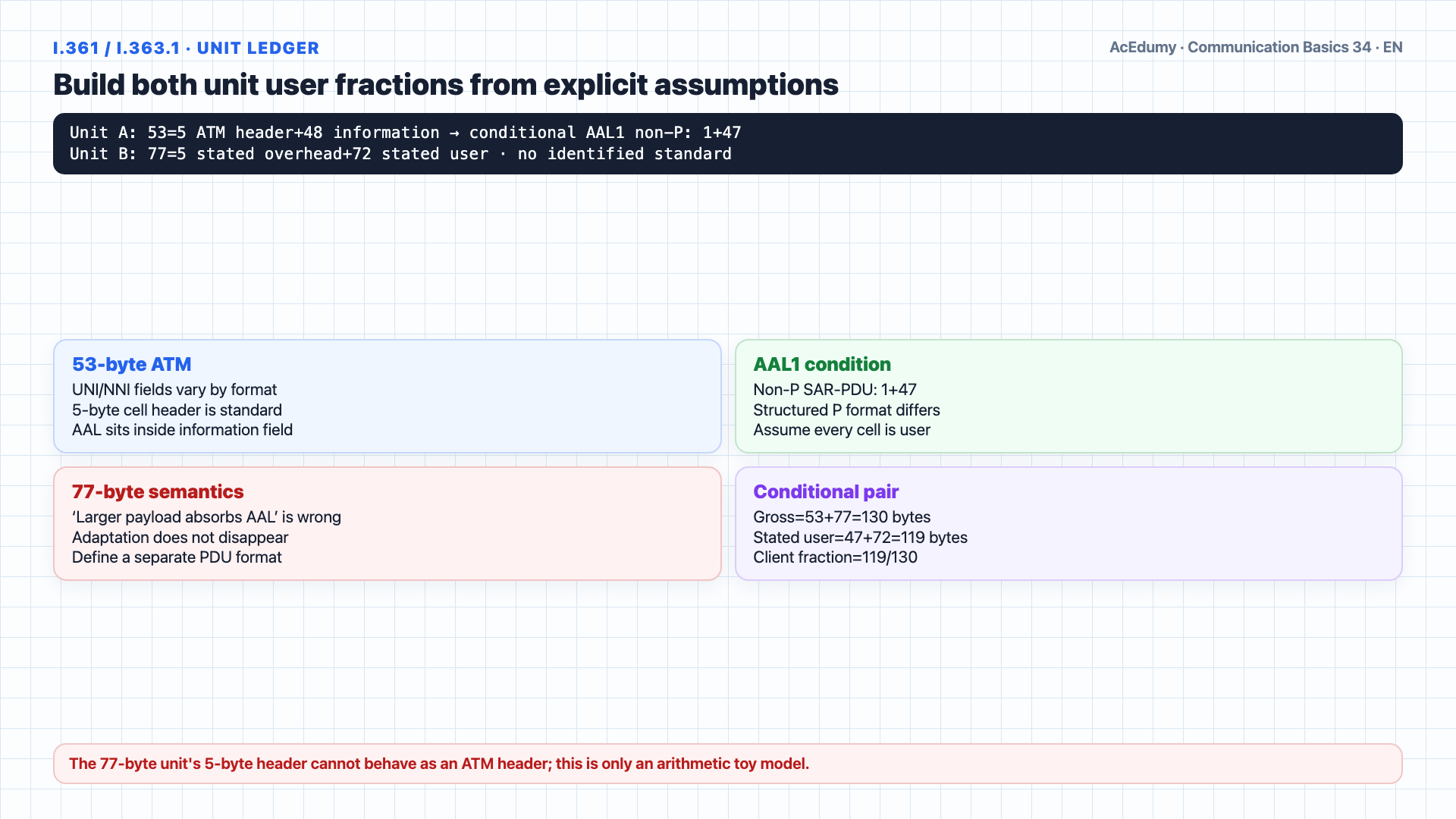
The 77-byte unit is not an ATM cell; pair-aligned C-4 carries 18+18 units, and 88.148% is only a stated zero-extra-overhead upper bound. First the two cell types side by side.Unit A is the standard 53-byte ATM cell.ATM header fields depend on UNI/NNI and include GFC/VPI/VCI/PTI/CLP/HEC; routing/error labels alone are incomplete.Only the AAL1 non-P SAR-PDU condition has a 1-byte header inside the 48-byte information field.Only the same AAL1 non-P user-cell condition yields 47 bytes of AAL-user information.The conditional AAL1 non-P user fraction is 47/53≈88.68%, not universal ATM application efficiency.Unit B is a hypothetical 77-byte service unit, not an ATM cell.Assume 5 bytes of stated Unit-B overhead; the source identifies no protocol field semantics.Assume 72 stated-user bytes for Unit B; a larger payload does not absorb adaptation, and real PDU/framing must be defined.The hypothetical Unit-B fraction is 72/77≈93.51%, valid only for the stated 5+72 ledger.The stated unit fractions differ by about 4.83 points; end-to-end services have not been compared.Why?The toy model spreads the same stated 5-byte overhead over 47 versus72 user bytes; real formats cannot assume identical headers.A larger PDU may amortize fixed overhead; actual efficiency also depends on MTU, stuffing, padding, loss, and retransmission.Unit size follows service/QoS, MTU, scheduler, and delay budgets; voice has no universal fixed-cell requirement.Traffic classes may be multiplexed; exact one-for-one unit alternation is not required by real networks.The question is how the math works when the payload is heterogeneous.Narration transcript
First the two cell types side by side. Cell type one — A T M, fifty three bytes total. Five bytes of header for routing and error checking. One byte of A A L adaptation overhead inside the payload. Forty seven bytes of actual user data. Cell-level efficiency: forty seven over fifty three, about eighty eight point seven percent. Cell type two — seventy seven byte cell. Five bytes of header. Seventy two bytes of user data — no separate A A L, the larger payload absorbs that role. Cell-level efficiency: seventy two over seventy seven, about ninety three point five percent. Per-cell, the seventy seven byte cell wins by about five points. Why? Same five byte header, but spread over a payload that is more than fifty percent larger. This is the same lesson from the I P video — bigger packets amortize the header. But in real networks, you cannot just pick the biggest size — voice needs small fixed cells for low latency. So you mix. The question is how the math works when the payload is heterogeneous.
3. Map the alternating pair stream continuously across C-4 boundaries
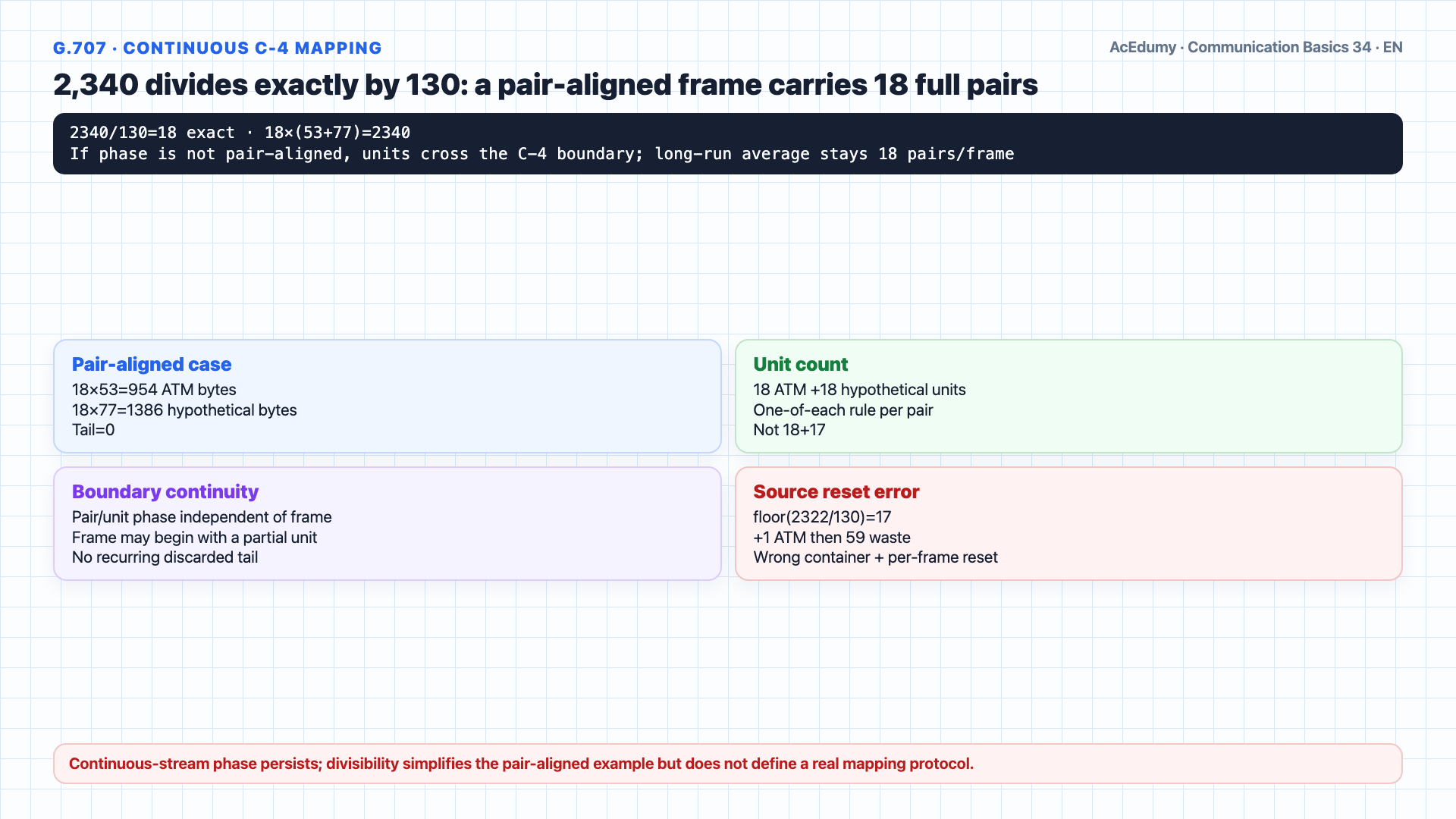
The 77-byte unit is not an ATM cell; pair-aligned C-4 carries 18+18 units, and 88.148% is only a stated zero-extra-overhead upper bound. The alternating pair.One ATM cell plus one seventy seven byte cell equals fifty three plus seventy seven, exactly one hundred thirty bytes per pair.The stated conditional pair carries 47+72=119 user bytes.The conditional client fraction is 119/130≈91.538%.The correct C-4 client container is 2,340 bytes/frame, and a continuous stream may cross the boundary.2,340/130=18 exactly.A pair-aligned C-4 frame carries 18 complete pairs; a general phase still averages18 in the long run.18 pairs×130=2,340 bytes exactly fill the pair-aligned C-4.The correct pair-aligned tail is 2,340−2,340=0.Continuous mapping has no per-frame squeeze stage.The 18th pair completes C-4; there is no recurring 112-byte remainder.An extra-cell test that breaks the pair rule is not standard mapping.Fifty three bytes — yes.The 77-byte unit is not an ATM cell; continuous phase may continue into the next frame.Fifty nine bytes left — no.A pair-aligned 2,340-byte C-4 carries 18 pairs with zero tail; no recurring 59-byte waste exists.Pair-aligned count is 18 ATM cells+18 hypothetical 77-byte units; at arbitrary phase this is a long-run average.18×53+18×77=954+1386=2,340 client bytes.Pair-aligned tail is zero; continuous mapping discards no recurring frame tail.Narration transcript
The alternating pair. One A T M cell plus one seventy seven byte cell equals fifty three plus seventy seven, exactly one hundred thirty bytes per pair. Each pair carries forty seven plus seventy two equals one hundred nineteen bytes of user data. Pair-level efficiency: one hundred nineteen over one hundred thirty, about ninety one point five percent. Now how many pairs fit in two thousand three hundred twenty two bytes of payload? Two thousand three hundred twenty two divided by one hundred thirty equals seventeen point eight six. Round down — seventeen complete pairs. Bytes occupied by seventeen pairs: seventeen times one hundred thirty equals two thousand two hundred ten bytes. Tail remaining: two thousand three hundred twenty two minus two thousand two hundred ten equals one hundred twelve bytes. Now — the squeeze. The pair is over, but we still have one hundred twelve bytes left. Can we fit another A T M cell? Fifty three bytes — yes. Can we then fit another seventy seven byte cell? Fifty nine bytes left — no. So we add one more A T M cell, leaving fifty nine bytes truly unused. Final count: eighteen A T M cells plus seventeen seventy seven byte cells per S T M one frame. Used bytes: eighteen times fifty three plus seventeen times seventy seven equals nine hundred fifty four plus one thousand three hundred nine equals two thousand two hundred sixty three bytes. Tail: fifty nine bytes wasted.
4. Calculate conditional mixed-unit user bits
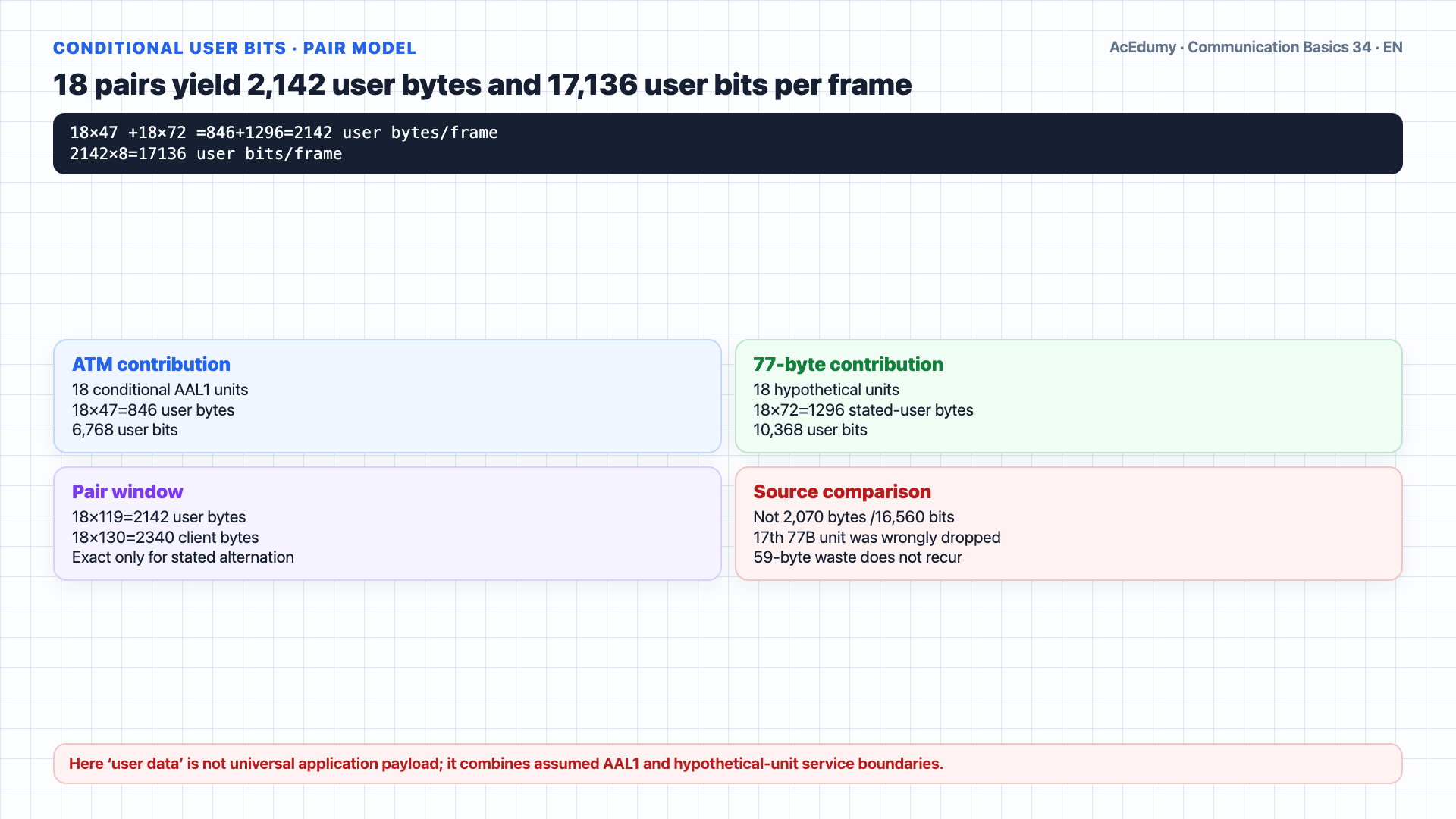
The 77-byte unit is not an ATM cell; pair-aligned C-4 carries 18+18 units, and 88.148% is only a stated zero-extra-overhead upper bound. Part b — user bits per frame.In the conditional model, 18 AAL1 non-P user cells each carry 47 AAL-user bytes.Eighteen times forty seven equals eight hundred forty six bytes of ATM user data.18 hypothetical 77-byte units each carry 72 stated-user bytes.18×72=1,296 stated-user bytes.Total conditional user data is 846+1296=2,142 bytes/frame.Conditional average is 2142×8=17,136 user bits per STM frame.Compare against our previous results.D32's corrected conditional long-run average is≈16,600.755 user bits/frame, not16,168.D33's corrected conditional average is17,940 user bits/frame, not17,664.The conditional mixed average is17,136 bits/frame and lies between the stated corrected bounds.Narration transcript
Part b — user bits per frame. Eighteen A T M cells each carry forty seven bytes of user data. Eighteen times forty seven equals eight hundred forty six bytes of A T M user data. Seventeen seventy seven byte cells each carry seventy two bytes of user data. Seventeen times seventy two equals one thousand two hundred twenty four bytes of large-cell user data. Total user data: eight hundred forty six plus one thousand two hundred twenty four equals two thousand seventy bytes per frame. Times eight bits per byte: sixteen thousand five hundred sixty user bits per frame. Compare against our previous results. Pure A T M gave us sixteen thousand one hundred sixty eight bits. Pure five seventy six byte I P gave us seventeen thousand six hundred sixty four bits. Mixed sits at sixteen thousand five hundred sixty — right between the two, as expected for a weighted blend.
5. Calculate conditional efficiency, rate, and gross-byte weighting
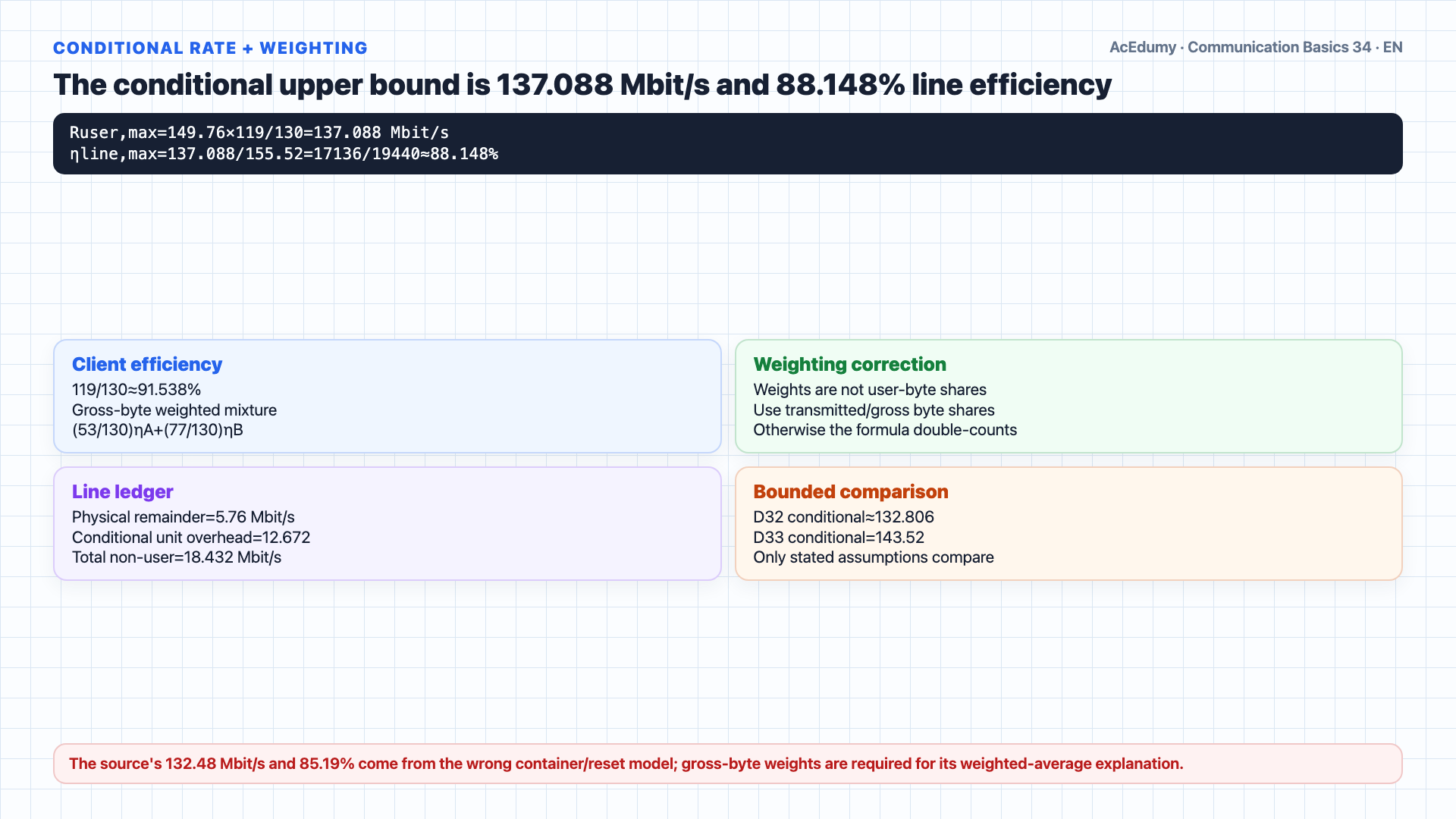
The 77-byte unit is not an ATM cell; pair-aligned C-4 carries 18+18 units, and 88.148% is only a stated zero-extra-overhead upper bound. Part c — efficiency.Conditional line efficiency is17136/19440≈88.148%.D32's corrected conditional AAL1 upper bound is85.395%.D33's corrected conditional 24+552 upper bound is92.284%.Conditional mixed efficiency is88.148%, about2.753 points above D32 and4.136 below D33.The exact position depends on the mix ratio: more ATM cells pulls efficiency down toward eighty three; more seventy seven byte cells pulls it up toward ninety four.Mixture efficiency uses gross transmitted-byte weights: (53/130)ηA+(77/130)ηB=119/130, not user-byte weights.Part d — data rate.The conditional mixed stream averages17,136 user bits per125 µs.The conditional upper-bound rate is17136/125 µs=137.088 Mbit/s.D32's corrected conditional bound is≈132.806 Mbit/s; mixed is≈4.282 Mbit/s higher.D33's corrected conditional bound is143.52 Mbit/s; mixed is6.432 Mbit/s lower.A mixture lies between constituent bounds only under a common service-boundary ledger; actual service overhead may differ.Operational benefit depends on traffic engineering; unit size alone cannot determine voice/data mapping, scheduler, or SLA.Narration transcript
Part c — efficiency. Sixteen thousand five hundred sixty user bits divided by nineteen thousand four hundred forty total bits equals zero point eight five one nine, or eighty five point one nine percent. A T M alone was eighty three point one seven. I P alone was ninety point eight seven. Mixed lands at eighty five point one nine — about two points above pure A T M, five points below pure I P. The exact position depends on the mix ratio: more A T M cells pulls efficiency down toward eighty three; more seventy seven byte cells pulls it up toward ninety four. This is the weighted-average law of mixed payloads — you get the linear combination of the per-cell efficiencies, weighted by the user bytes contributed by each. Part d — data rate. Sixteen thousand five hundred sixty bits in one hundred twenty five microseconds. Sixteen thousand five hundred sixty divided by one hundred twenty five microseconds equals one hundred thirty two point four eight megabits per second. Compared to A T M's one twenty nine point three four four, we gained about three megabits per second. Compared to I P's one forty one point three one two, we gave up about nine megabits. The price of mixing is paid in efficiency lost relative to the best single-cell choice. The benefit of mixing is paid out in operational flexibility — voice gets its low-latency small cells, data gets its higher-efficiency big cells, in the same frame.
6. Gate actual goodput on multiplexing, QoS, and protection
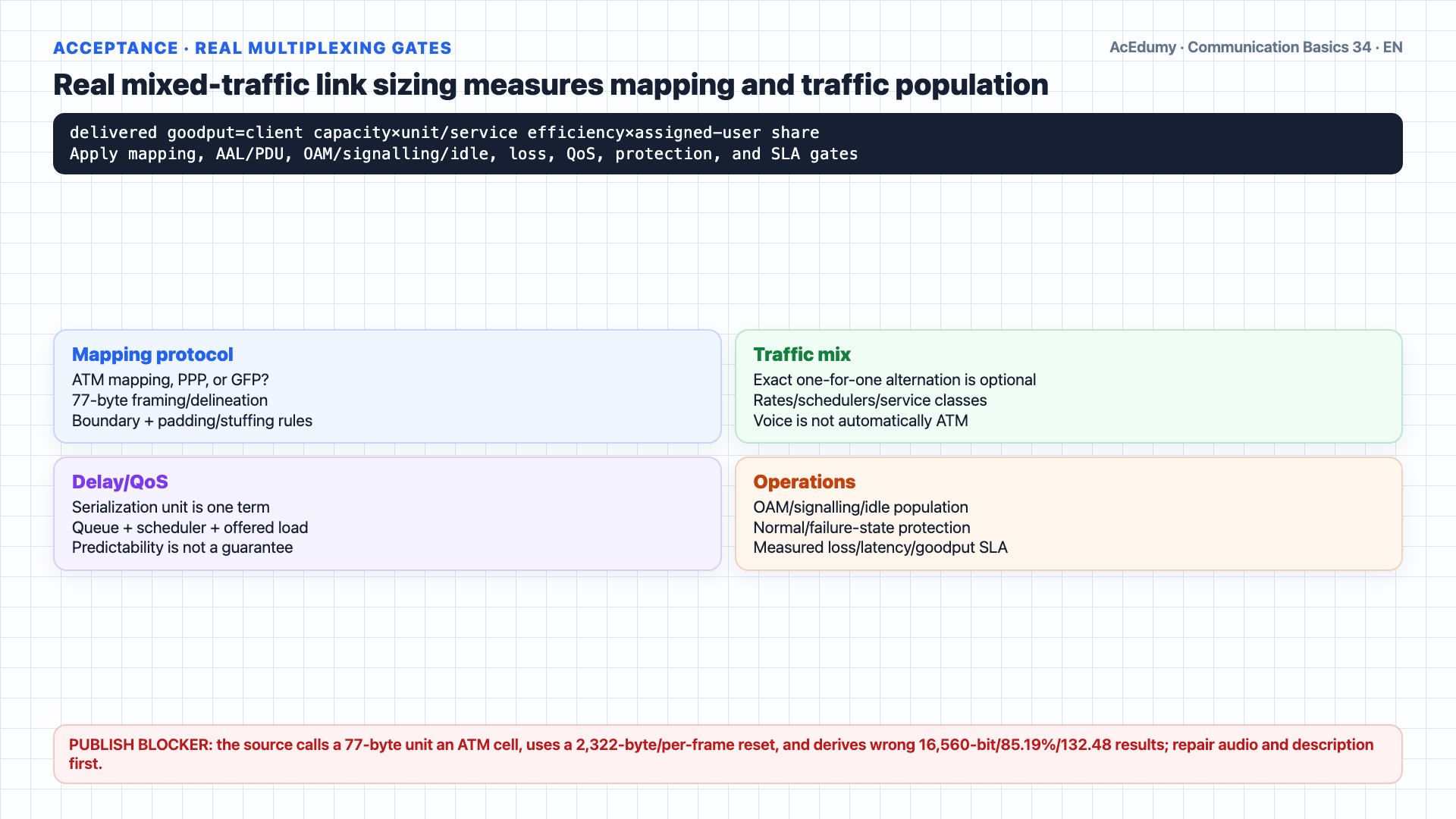
The 77-byte unit is not an ATM cell; pair-aligned C-4 carries 18+18 units, and 88.148% is only a stated zero-extra-overhead upper bound. Three takeaways from this trilogy.One: the STM one frame is fixed scaffolding.Nine rows by two hundred seventy columns, two thousand four hundred thirty bytes, two thousand three hundred twenty two bytes of payload, eight thousand frames per second, one hundred fifty five point five two megabits per second line rate.The STM-1 line frame is fixed while client mapping, traffic population, and application goodput may change.Efficiency depends on mapping, AAL/PDU overhead, idle/OAM/signalling, loss, and service boundary as well as unit mix.Small fixed cells bound serialization granularity; queues, schedulers, and load still create delay.Variable packets may amortize fixed overhead; actual timing/efficiency depends on MTU, scheduling, loss, and retransmission.Under a common ledger, mixture efficiency lies between bounds using gross-byte weights, not user-byte weights.This alternating 53/77 toy model is not how every real transport network must operate.Metro transport service mix and mapping are deployment-specific; traffic may occupy separate VCs/paths or use different adaptation and framing.Link sizing also requires a traffic matrix, utilization target, QoS, protection, loss/latency SLA, and failure-state analysis.And with that, our trilogy of STM one frame filling examples closes.Same frame, three different fillings, three different answers — and a single principle behind all of them.Narration transcript
Three takeaways from this trilogy. One: the S T M one frame is fixed scaffolding. Nine rows by two hundred seventy columns, two thousand four hundred thirty bytes, two thousand three hundred twenty two bytes of payload, eight thousand frames per second, one hundred fifty five point five two megabits per second line rate. Those numbers do not change. Two: efficiency is determined entirely by what you fill the payload with. Small fixed cells like A T M trade efficiency for predictable latency. Big variable packets like I P win efficiency at the cost of bursty timing. Mixed payloads land somewhere in between, scaled by the user-byte weights of each cell type. Three: this is how every real transport network operates. An S D H link on a metro carrier does not run pure A T M or pure I P or pure anything — it carries voice, video, data, signaling, all packetized at different sizes, all sharing the same frame. The math we just walked through is exactly the math the network engineer runs to size a link. And with that, our trilogy of S T M one frame filling examples closes. Same frame, three different fillings, three different answers — and a single principle behind all of them.
Source video: Communication Basics #34 Worked Example: STM-1 + Mixed 53/77-byte Payload — 85.19% Real Data (9:29)