Circuit Theory 1 · Supermesh Analysis
#17 Supermesh #17 — boundary and shared current-source examples
Uses a boundary current source directly, then combines a source constraint with supermesh KVL for a shared current source.
Question
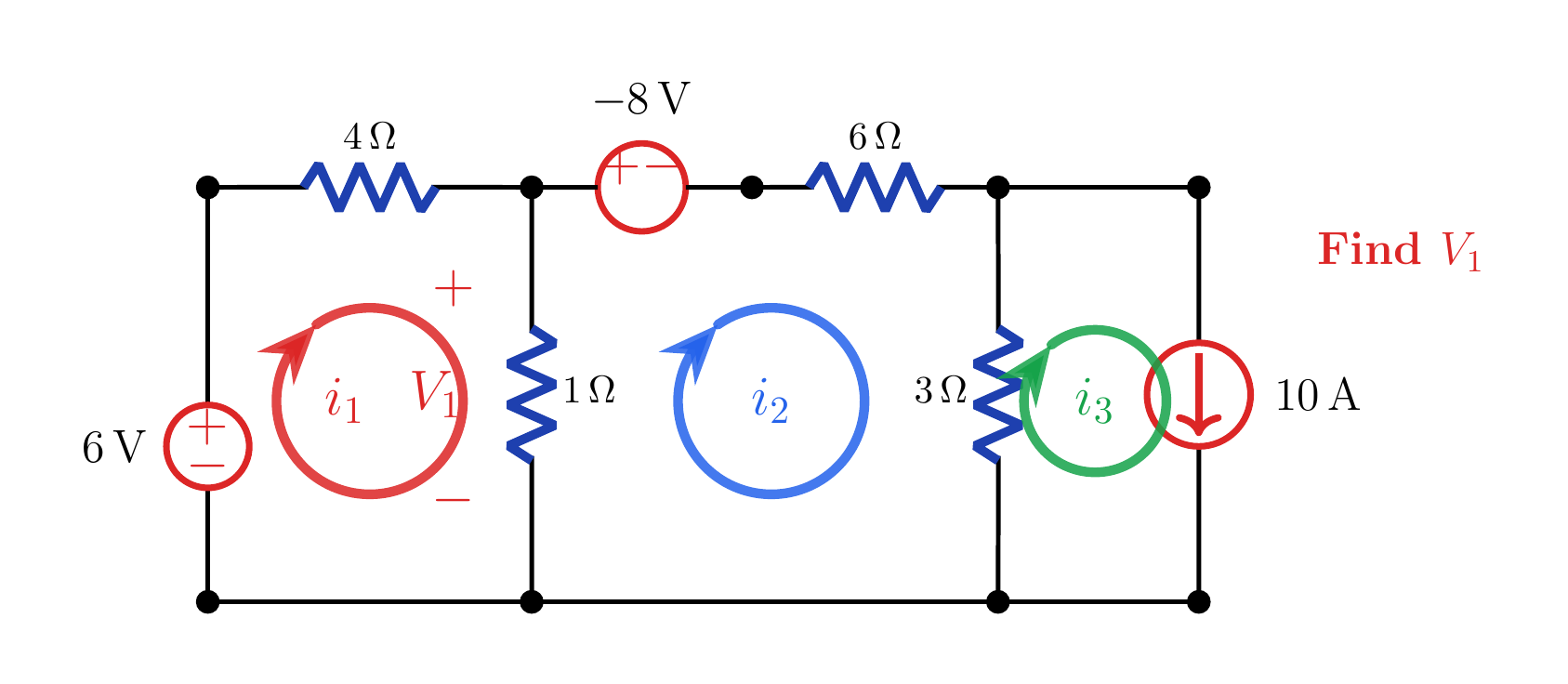
Use current-source constraints and supermesh analysis to find V_1 in the first circuit and mesh currents i_1, i_2 and i_3 in the second circuit.
Written solution and narration transcript(shows the full solution)
Below are all the lines written in the notebook together with the full narration transcript.
1. Current-source rules
The boundary source fixes i_3=10 A; V_1 is referenced positive at the top of the shared 1 Ω resistor. Boundary current source ⇒ directly sets a mesh currentSource between two meshes ⇒ current constraintMissing equation ⇒ supermesh KVL around the shared branchNarration transcript
Now we move from ordinary mesh-current equations to supermesh cases. The trigger is a current source. If a current source is on the outer boundary, it can directly set one mesh current. If a current source lies between two meshes, we avoid writing a voltage across that source. Instead, we write a constraint equation from the source current, and a Kirchhoff's Voltage Law, K V L, equation around the combined supermesh.
2. Example 1 circuit
The boundary source fixes i_3=10 A; V_1 is referenced positive at the top of the shared 1 Ω resistor. Find: V1Narration transcript
In the first example, the right-side current source is on the outside boundary of mesh three. Because the arrow is downward, and the mesh current i three is also downward through that branch, we immediately get i three equals 10 amperes. The requested quantity is V one across the 1 ohm resistor, with plus at the top and minus at the bottom. So after solving i one and i two, V one will be 1 ohm times i one minus i two.
3. Solve Example 1
The boundary source fixes i_3=10 A; V_1 is referenced positive at the top of the shared 1 Ω resistor. Narration transcript
For loop one, the 6 volt source is a rise, then the 4 ohm resistor and the shared 1 ohm resistor are drops. This gives 6 minus 4 i one minus the quantity i one minus i two equals zero, or 5 i one minus i two equals 6. For loop two, the 6 ohm resistor, the shared 3 ohm resistor, and the shared 1 ohm resistor are included, together with the negative 8 volt source. After substituting i three equals 10 amperes, the second equation becomes i one minus 10 i two equals negative 38. Solving the two equations gives i one equals 2 amperes and i two equals 4 amperes. Therefore V one equals 1 times 2 minus 4, which is negative 2 volts.
4. Example 2 circuit
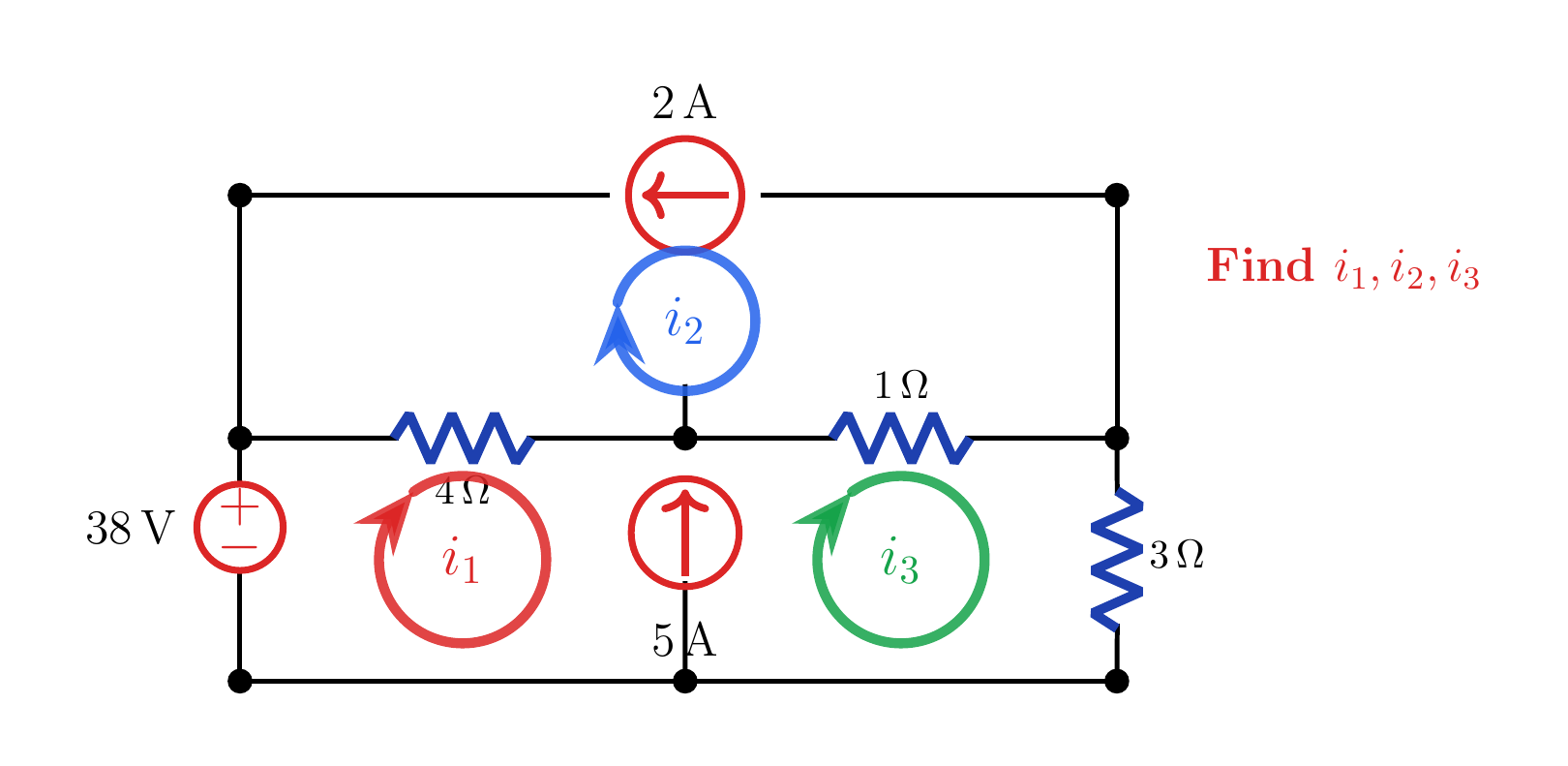
The sources give i_2=−2 A and i_3−i_1=5 A; the two lower meshes form a supermesh. Supermesh: loops 1 and 3Narration transcript
In the second example, the top current source is on the boundary of the upper mesh. The source arrow points left, while the clockwise mesh current i two goes to the right through that top branch. So i two equals negative 2 amperes. The 5 ampere source sits between the two lower meshes, so it creates the constraint i three minus i one equals 5 amperes. Now we write one supermesh K V L equation around the outside of loops one and three.
5. Solve Example 2
The sources give i_2=−2 A and i_3−i_1=5 A; the two lower meshes form a supermesh. Narration transcript
The supermesh travels around the 38 volt source, the 4 ohm resistor, the 1 ohm resistor, and the 3 ohm resistor. The equation is 38 minus 4 times the quantity i one minus i two, minus 1 times the quantity i three minus i two, minus 3 i three equals zero. Using i two equals negative 2, this simplifies to i one plus i three equals 7. Together with the source constraint i three minus i one equals 5, we add the two equations and get 2 i three equals 12. So i three equals 6 amperes, i one equals 1 ampere, and i two equals negative 2 amperes.
6. Method summary
The sources give i_2=−2 A and i_3−i_1=5 A; the two lower meshes form a supermesh. Boundary source ⇒ direct mesh currentShared source ⇒ constraint + supermesh KVLNegative current ⇒ physical direction opposes the referenceNarration transcript
These two examples show the two most common current-source patterns in mesh analysis. A boundary current source directly fixes a mesh current. A current source between two meshes creates a supermesh: one constraint equation from the source, and one K V L equation around the combined outside loop. The sign is not decoration. It comes from comparing the source arrow with the chosen mesh-current direction.
Source video: Circuit Theory #17 | Supermesh Analysis Examples - Current Source Constraints (3:47)