Circuit Theory 1 · Supermesh Analysis
#18 Supermesh #18 — Example 3: three mesh currents
Combines the shared current-source constraint with lower-supermesh and top-loop KVL equations.
Question
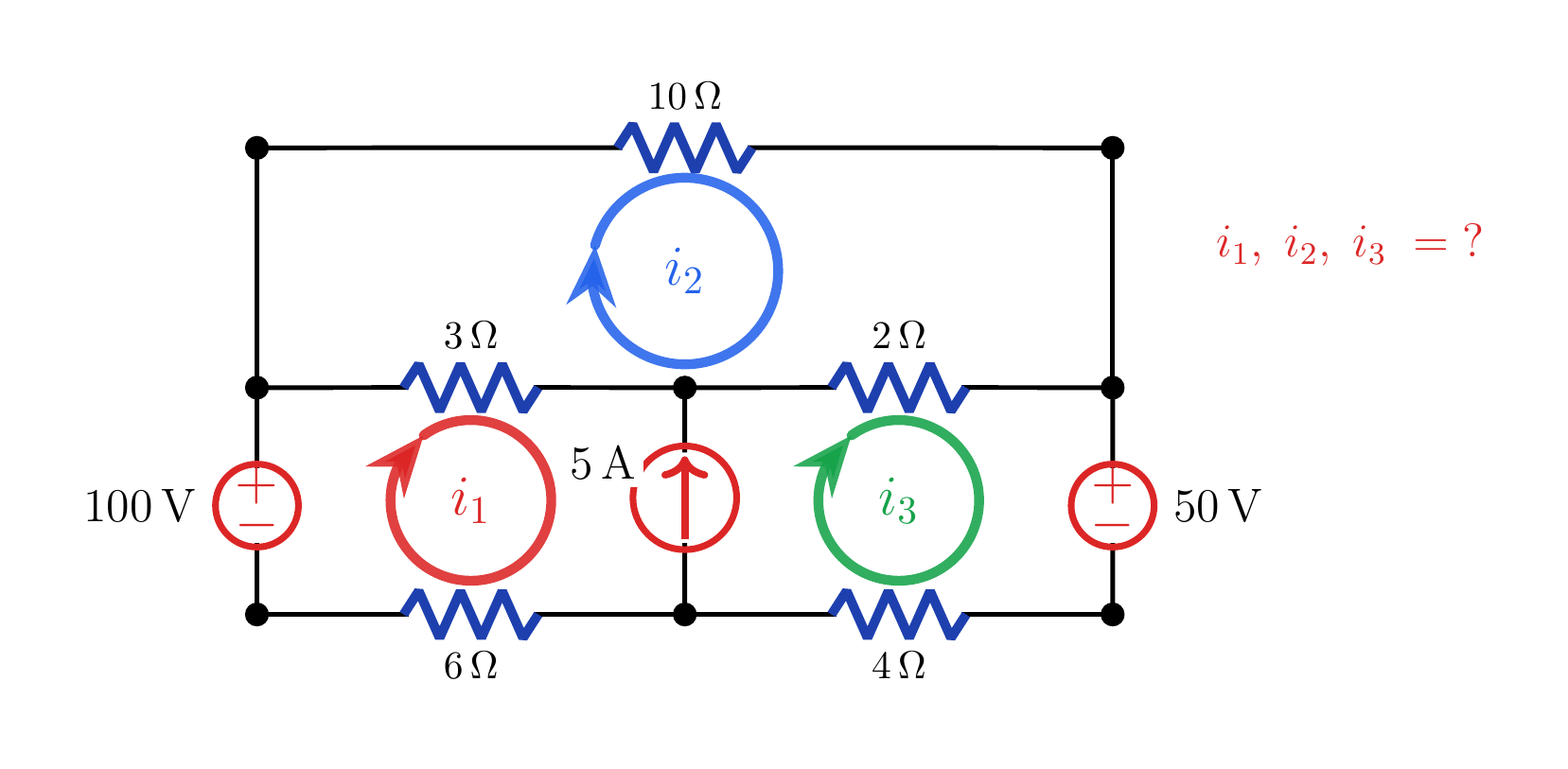
Use the current-source constraint and supermesh analysis to find mesh currents i_1, i_2 and i_3 in the three-mesh circuit.
Written solution and narration transcript(shows the full solution)
Below are all the lines written in the notebook together with the full narration transcript.
1. Supermesh recap
Clockwise mesh currents i_1, i_2 and i_3 are shown; the middle source gives the constraint i_3−i_1=5 A. Three mesh currents, one shared current sourceWrite the source constraint firstThen lower-supermesh KVL + top-loop KVLNarration transcript
In the previous lesson, we used current-source constraints in mesh analysis. Now we finish that idea with one compact example that has three mesh currents. The middle 5 ampere current source sits between the lower-left and lower-right meshes, so it creates a supermesh constraint. Then we still need two voltage equations: one around the lower supermesh, and one around the top loop.
2. Example 3 circuit
Clockwise mesh currents i_1, i_2 and i_3 are shown; the middle source gives the constraint i_3−i_1=5 A. i1, i2, i3: clockwiseMiddle source: 5 A ↑Arrow agrees with i3 and opposes i1Narration transcript
The circuit has a 100 volt source on the left, a 50 volt source on the right, and a 5 ampere source in the middle branch. All three mesh currents are chosen clockwise: i one in the lower-left window, i two in the top window, and i three in the lower-right window. Because the middle source arrow points upward, it agrees with i three and opposes i one on that shared branch. Therefore the source constraint is i three minus i one equals 5 amperes.
3. Build and solve the equations
Clockwise mesh currents i_1, i_2 and i_3 are shown; the middle source gives the constraint i_3−i_1=5 A. Lower supermesh: bypass the current-source branchTop loop: 10 Ω, 2 Ω and 3 ΩCheck:Narration transcript
First write the lower supermesh equation, skipping the current-source branch. Starting through the 100 volt source as a rise gives 100 minus 3 times the quantity i one minus i two, minus 2 times the quantity i three minus i two, minus 50, minus 4 i three, minus 6 i one equals zero. This simplifies to 9 i one minus 5 i two plus 6 i three equals 50. For the top loop, only the 10 ohm, 2 ohm, and 3 ohm resistors appear. The equation is negative 10 i two, minus 2 times the quantity i two minus i three, minus 3 times the quantity i two minus i one equals zero. So the third equation is 3 i one minus 15 i two plus 2 i three equals zero. Solving these three equations gives i one equals 7 over 4 amperes, i two equals 5 over 4 amperes, and i three equals 27 over 4 amperes. The check is simple: i three minus i one is 27 over 4 minus 7 over 4, which equals 5 amperes.
4. Method summary
Clockwise mesh currents i_1, i_2 and i_3 are shown; the middle source gives the constraint i_3−i_1=5 A. Shared current source ⇒ current constraintKVL ⇒ supermesh path that does not cross the sourceNarration transcript
This example is a good pattern to remember. A current source between two meshes gives a current constraint, not a voltage drop. The K V L equation must go around a path that does not cross that current source. After that, ordinary loop equations can still be used for the remaining meshes. For this circuit, those three equations lead to i one equals 1.75 amperes, i two equals 1.25 amperes, and i three equals 6.75 amperes.
Source video: Circuit Theory #18 | Supermesh Analysis Example 3 - Three Mesh Currents (3:01)