Circuit Theory 1 · Circuit Analysis Fundamentals
#12 The supernode method — example 1
Solves a 10 V source between two unknown nodes using a supernode and verifies V₁=30 V and V₂=20 V by KCL.
Question
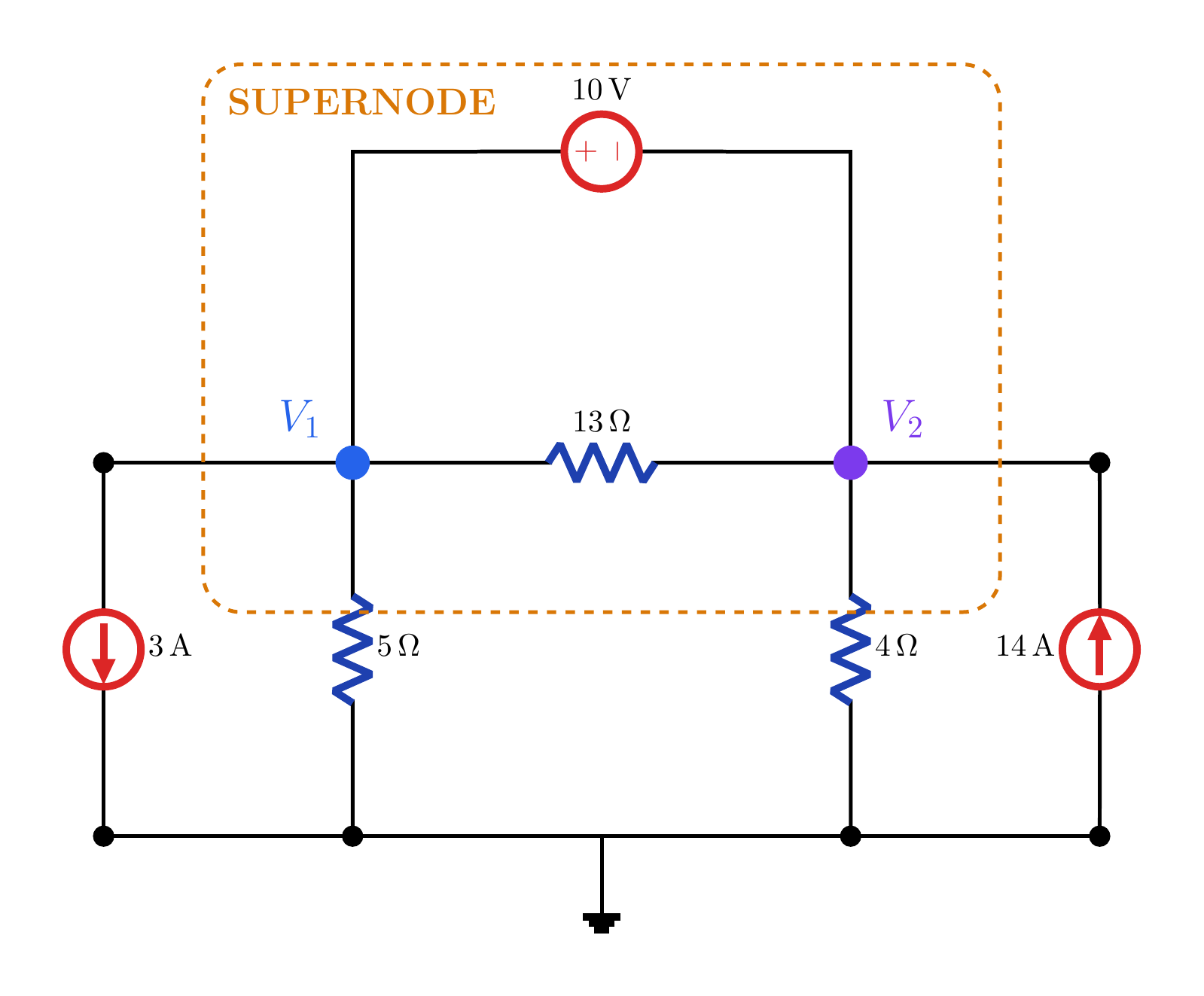
Find node voltages V_1 and V_2 using the supernode method. Write the supernode KCL equation and the voltage-source polarity constraint separately.
Written solution and narration transcript(shows the full solution)
Below are all the lines written in the notebook together with the full narration transcript.
1. Why is a supernode needed?
The dashed orange boundary encloses V₁, V₂, the 10 V source and 13 Ω; the source positive terminal is on the V₁ side. Voltage source between two unknown nodesEnclose both nodes and the source in one boundaryKCL + voltage constraint ⇒ two equationsNarration transcript
In the last video, we saw a voltage source with one terminal at ground. That was easy — the other node's voltage was simply known. But what happens when a voltage source connects two non-reference nodes — nodes whose voltages are both unknown? We cannot write a separate KCL equation at either node, because we do not know the current flowing through the voltage source. The solution is the supernode. We draw a boundary that encloses both nodes and the voltage source between them. Then we write KCL for this entire region as if it were a single big node. Any current that crosses the boundary counts; any current that stays inside — like the current through a resistor connecting the two nodes — does not appear in the equation. Finally, the voltage source gives us a constraint equation: the difference between the two node voltages equals the source voltage. So we always get two equations: one from KCL, one from the constraint. Let's see this in action.
2. Read the circuit and boundary
The dashed orange boundary encloses V₁, V₂, the 10 V source and 13 Ω; the source positive terminal is on the V₁ side. Supernode: V1, V2, 10 V and 13 ΩBoundary branches: 5 Ω, 4 Ω, 3 A and 14 AInternal 13 Ω does not appear in KCLNarration transcript
Here is the circuit. Nodes V one and V two sit on a horizontal rail in the middle. A ten-volt source connects V one to V two from above, with its positive terminal on the V one side. A thirteen-ohm resistor also connects V one to V two, directly between them. Below the rail, a five-ohm resistor goes from V one down to ground, and a four-ohm resistor goes from V two down to ground. On the left, a three-ampere source pulls current downward from V one to ground. On the right, a fourteen-ampere source pushes current upward from ground into V two. The ten-volt source sits between two unknown nodes — this is exactly the supernode situation. We draw a dashed boundary around V one, V two, the ten-volt source, and the thirteen-ohm resistor. Notice: the thirteen-ohm resistor is inside the boundary, so its current will not appear in KCL. Our task: find V one and V two.
3. Supernode KCL equation
The dashed orange boundary encloses V₁, V₂, the 10 V source and 13 Ω; the source positive terminal is on the V₁ side. Multiply by 20:Narration transcript
Let's write KCL for the supernode. We count every current crossing the boundary. The five-ohm resistor carries V one over five, leaving the supernode downward. The four-ohm resistor carries V two over four, also leaving downward. The three-ampere source: its arrow points down from V one. Current leaves the supernode — so we add positive three. The fourteen-ampere source: its arrow points up into V two. Current enters the supernode — so we subtract fourteen. Setting the sum to zero: V one over five, plus V two over four, plus three, minus fourteen, equals zero. To clear denominators, multiply everything by twenty. We get four V one, plus five V two, plus sixty, minus two hundred eighty, equals zero. Simplifying: four V one plus five V two equals two hundred twenty. That is our first equation.
4. Voltage constraint
The dashed orange boundary encloses V₁, V₂, the 10 V source and 13 Ω; the source positive terminal is on the V₁ side. Positive terminal of the 10 V source is at V1Narration transcript
Now the constraint from the voltage source. The ten-volt source has its positive terminal at V one and its negative terminal at V two. So V one is ten volts higher than V two. In equation form: V one minus V two equals ten. That is our second equation. Two equations, two unknowns — we can solve.
5. Find and verify V₁ and V₂
The dashed orange boundary encloses V₁, V₂, the 10 V source and 13 Ω; the source positive terminal is on the V₁ side. Narration transcript
From the constraint: V one equals V two plus ten. Substitute into the KCL equation: four times V two plus ten, plus five V two, equals two hundred twenty. Expanding: four V two plus forty plus five V two equals two hundred twenty. Nine V two equals one hundred eighty. V two equals twenty volts. Then V one equals twenty plus ten, which is thirty volts. Let's verify. V one over five is six amperes leaving. V two over four is five amperes leaving. The three-amp source takes three out. The fourteen-amp source brings fourteen in. Total leaving: six plus five plus three equals fourteen. Total entering: fourteen. They match. Correct.
6. Three supernode rules
The dashed orange boundary encloses V₁, V₂, the 10 V source and 13 Ω; the source positive terminal is on the V₁ side. 1) Enclose the source and both nodes2) Apply KCL to boundary currents3) Add the source-polarity constraintNarration transcript
Three rules to remember about the supernode. First: when a voltage source connects two non-reference nodes, enclose both nodes and the source in one boundary. Second: write KCL for the boundary — internal elements like the thirteen-ohm resistor do not appear. Third: the voltage source provides a constraint equation — the node voltage difference equals the source voltage. In the next video, we will practice with more supernode examples.
Source video: Circuit Theory #12 | The Supernode Method — Voltage Source Between Two Nodes (5:23)