Circuit Theory 1 · Superposition with a Dependent Source
#21 Superposition #21 — find V_x with a dependent source
Keeps the V_x/3 dependent source active while finding and adding the three signed voltage contributions.
Question
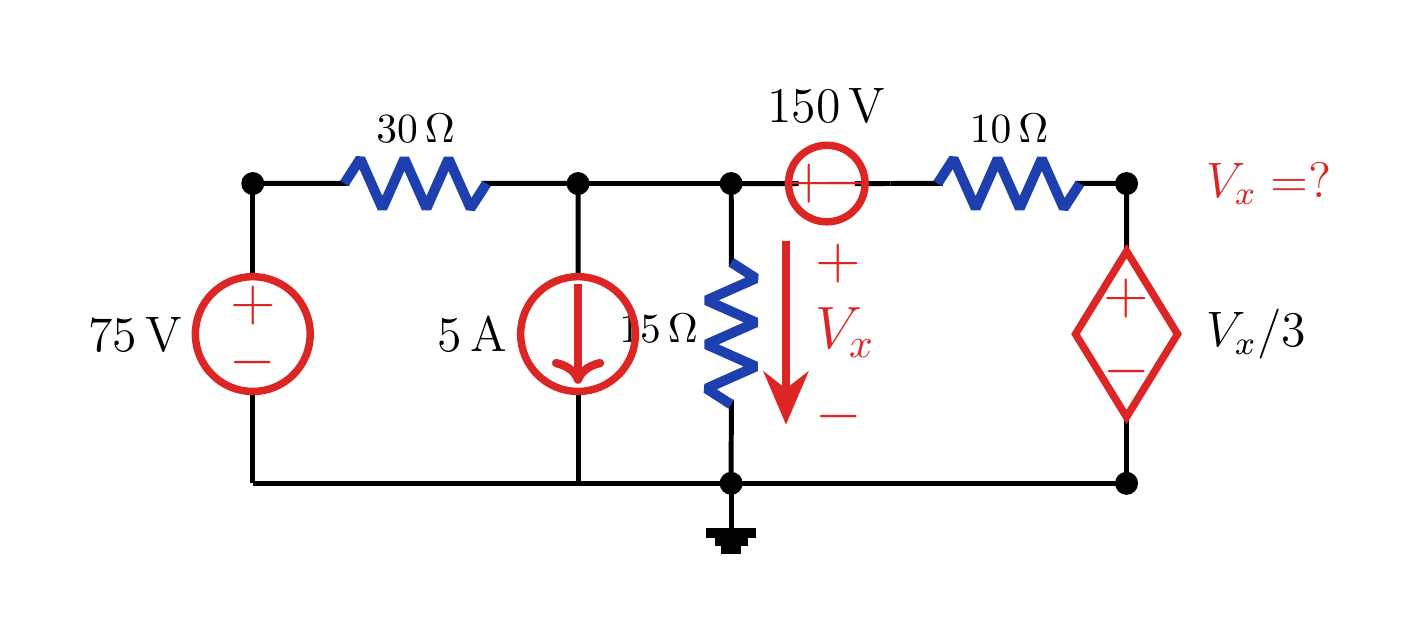
Use superposition to find the voltage V_x across the 15 Ω resistor. The dependent voltage source has the value V_x/3.
Written solution and narration transcript(shows the full solution)
Below are all the lines written in the notebook together with the full narration transcript.
1. Dependent-source rule
The red polarity arrow marks the target voltage V_x across the 15 Ω resistor. Critical superposition ruleDeactivate independent sources onlyThe dependent source stays activeTarget: Vx across 15 ΩDependent source: Vx/3Narration transcript
In this example, superposition still works, but there is one rule that cannot be skipped. We turn off only independent sources. A dependent source stays active in every subcircuit, because its value is controlled by the circuit variable we are solving for. Here the target is V x, the voltage across the 15 ohm resistor, and the dependent voltage source is equal to V x divided by 3.
2. Read the circuit
The red polarity arrow marks the target voltage V_x across the 15 Ω resistor. Three independent sources75 V, 5 A and 150 VIn each subcircuit: dependent source = Vxn/3Narration transcript
The original circuit has three independent sources: a 75 volt source on the left, a 5 amp current source in the middle, and a 150 volt source on the top branch. We will find V x as the signed sum of three contributions. So V x equals V x one plus V x two plus V x three. For each contribution, the dependent source remains in the circuit, but its value becomes that contribution divided by 3.
3. 75 V contribution
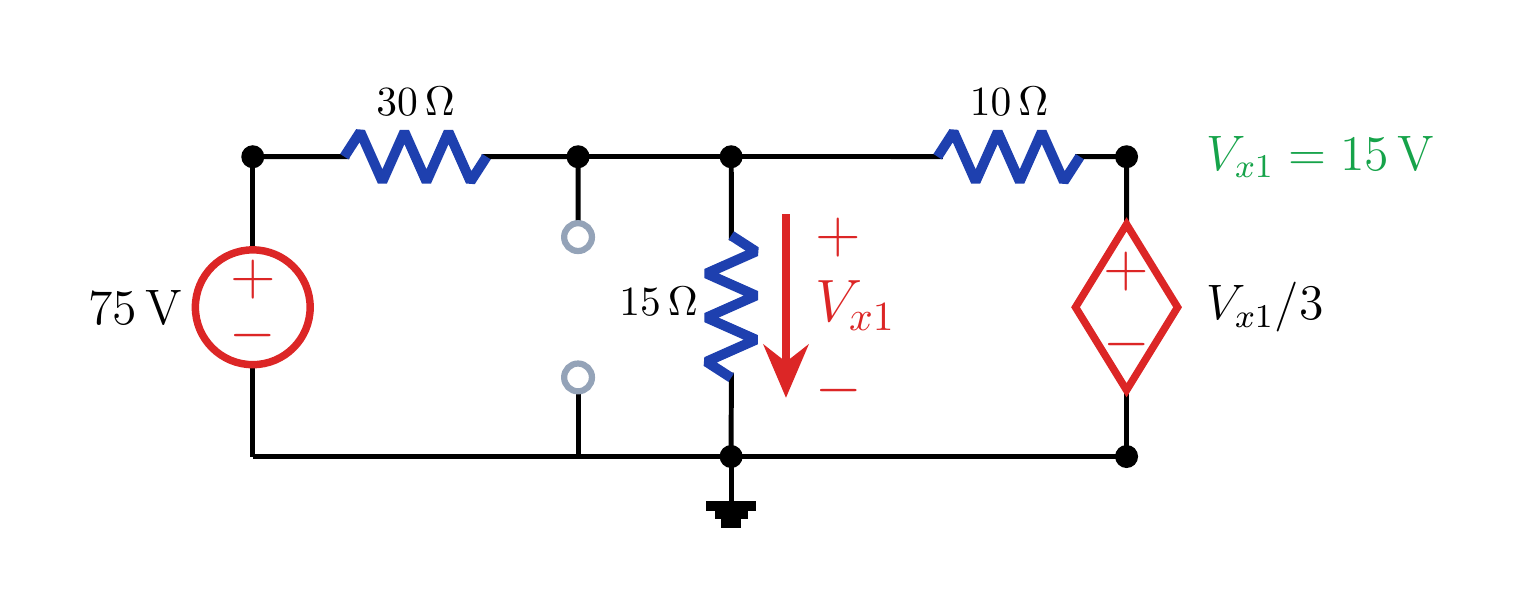
The 5 A source is open and the 150 V source is shorted; the dependent source remains active as V_{x1}/3. Only 75 V is active5 A ⇒ open; 150 V ⇒ shortKCL: (Vx1−75)/30Narration transcript
First keep only the 75 volt source active. The 5 amp current source becomes an open circuit, and the 150 volt source becomes a short circuit. Now write Kirchhoff's Current Law at the V x one node. The current through 30 ohms is V x one minus 75, divided by 30. The current through 10 ohms is V x one minus V x one divided by 3, all divided by 10. The current through 15 ohms is V x one divided by 15. Adding these currents gives zero, and simplifying gives V x one equals 15 volts.
4. 5 A contribution
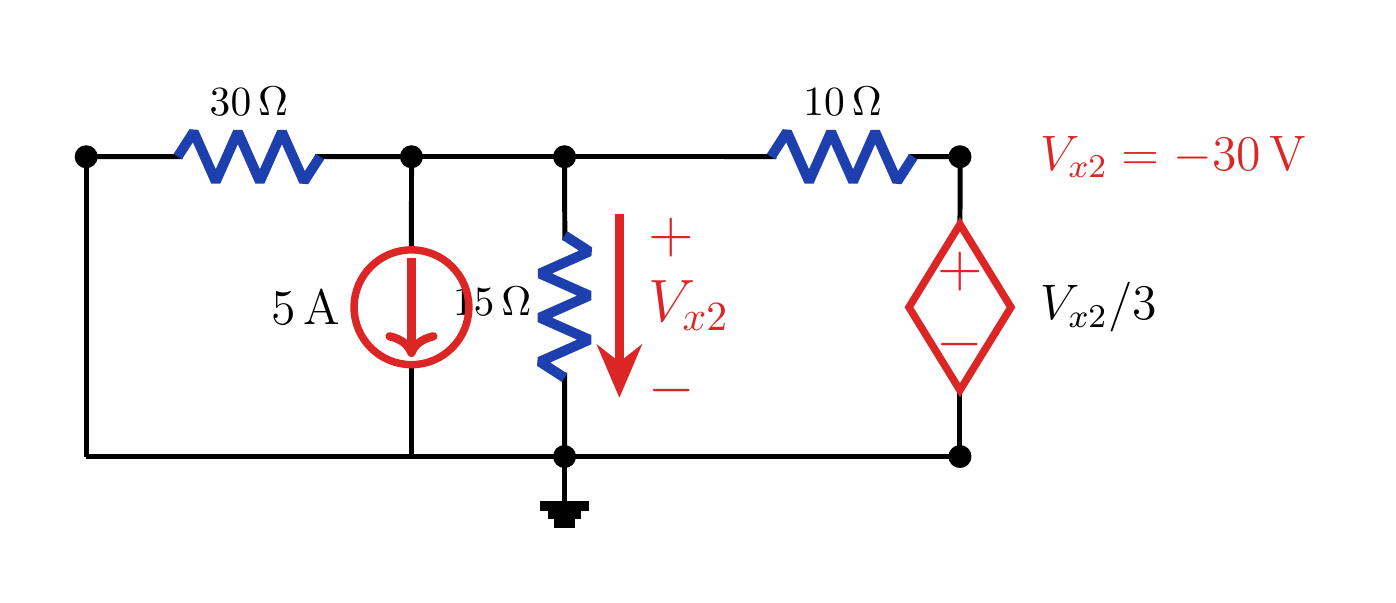
Both independent voltage sources are shorted; the dependent source remains active as V_{x2}/3. Only 5 A is active75 V and 150 V ⇒ short circuitsKCL: Vx2/30+Vx2/15The sign is opposite to the reference polarityNarration transcript
Second keep only the 5 amp source active. The 75 volt source and the 150 volt source are both replaced by short circuits. The current source arrow points downward, so in the node equation it is a 5 amp current leaving the node. The three branch currents are V x two divided by 30, V x two divided by 15, and V x two minus V x two divided by 3, all divided by 10. Together with the 5 amp source, the equation gives V x two equals negative 30 volts. The negative sign means this source drives the 15 ohm voltage opposite to the chosen V x polarity.
5. 150 V contribution
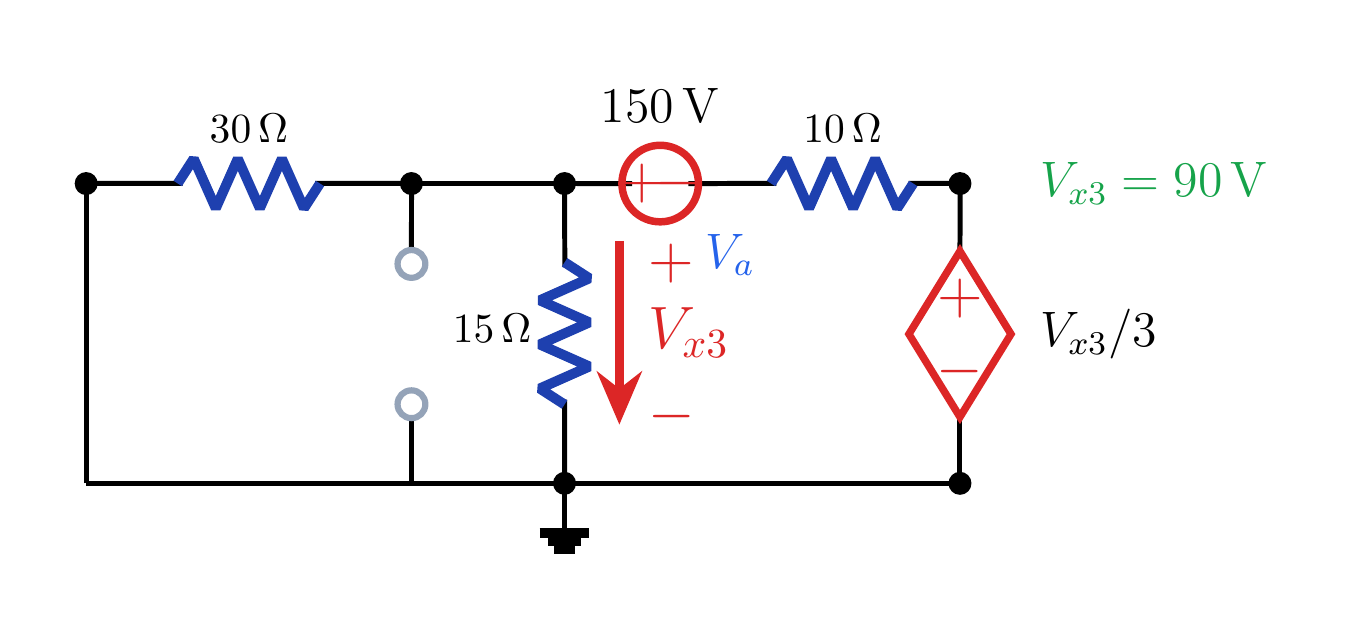
The 75 V source is shorted and the 5 A source is open; the dependent source remains active as V_{x3}/3. Only 150 V is active75 V ⇒ short; 5 A ⇒ openSupernode:Vx3/30+Vx3/15Narration transcript
Third keep only the 150 volt source active. The 75 volt source becomes a short circuit, and the 5 amp current source becomes an open circuit. Because the 150 volt source sits between two non-reference nodes, use a supernode. Let the node to the right of the 150 volt source be V a. The source constraint is V x three minus V a equals 150. The supernode current equation is V x three over 30, plus V x three over 15, plus V a minus V x three over 3, divided by 10, equals zero. Solving the two equations gives V x three equals 90 volts.
6. Add contributions
The red polarity arrow marks the target voltage V_x across the 15 Ω resistor. Add the signed contributionsAnswer:Never deactivate the dependent sourceNarration transcript
Now add the three signed contributions. V x is 15 volts plus negative 30 volts plus 90 volts. Therefore V x equals 75 volts. The important takeaway is the handling of the dependent source. Independent sources are deactivated one at a time, but the dependent source stays active and follows the contribution variable in each subcircuit.
Source video: Circuit Theory #21 | Superposition with a Dependent Source - Find Vx (3:43)