Circuit Theory 1 · Superposition Method
#20 Superposition #20 — three-source current through 12 kΩ
Keeps each independent source active in turn and adds the three signed contributions to the 12 kΩ branch current.
Question
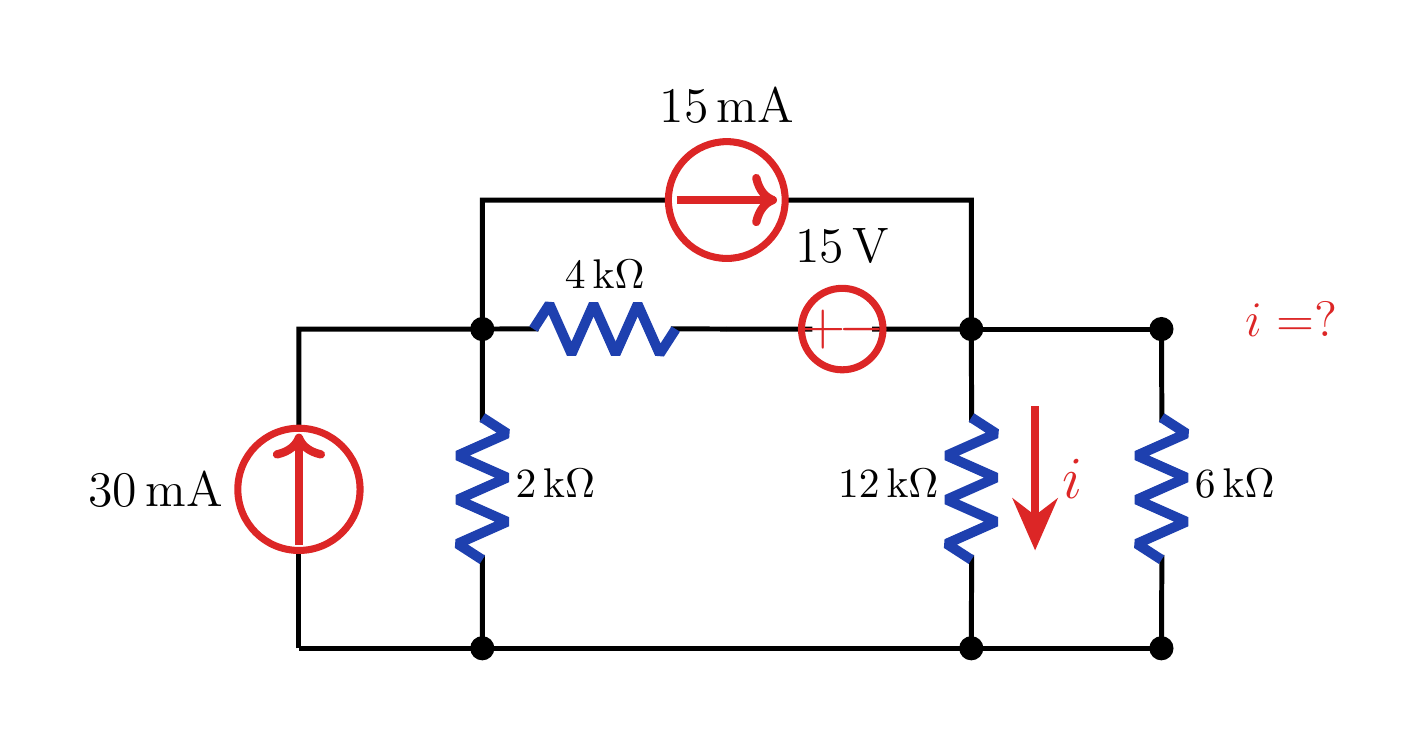
Use superposition to find the downward reference current i through the 12 kΩ resistor in the linear circuit.
Written solution and narration transcript(shows the full solution)
Below are all the lines written in the notebook together with the full narration transcript.
1. Superposition rule
The red arrow marks the downward reference current i through the 12 kΩ resistor. Superposition: linear circuits onlyKeep one independent source activeVoltage source ⇒ short circuitCurrent source ⇒ open circuitDependent sources stay activeNarration transcript
Superposition works only for linear circuits. The idea is simple: keep one independent source active, deactivate all the other independent sources, find that source's contribution, and then add the contributions. When we deactivate an ideal voltage source, we replace it by a short circuit. When we deactivate an ideal current source, we replace it by an open circuit. Dependent sources, if present, are not turned off, but this example has only independent sources.
2. Read the circuit
The red arrow marks the downward reference current i through the 12 kΩ resistor. Find: downward i through 12 kΩSources: 30 mA, 15 mA and 15 VNarration transcript
In the worked example, we need the downward current i through the 12 kilo ohm resistor. There are three independent sources: a 30 milliamp current source on the left, a 15 milliamp current source on the top branch, and a 15 volt voltage source in series with the 4 kilo ohm resistor. So we will write i equals i one plus i two plus i three, where each term is the contribution of one active source.
3. 30 mA contribution
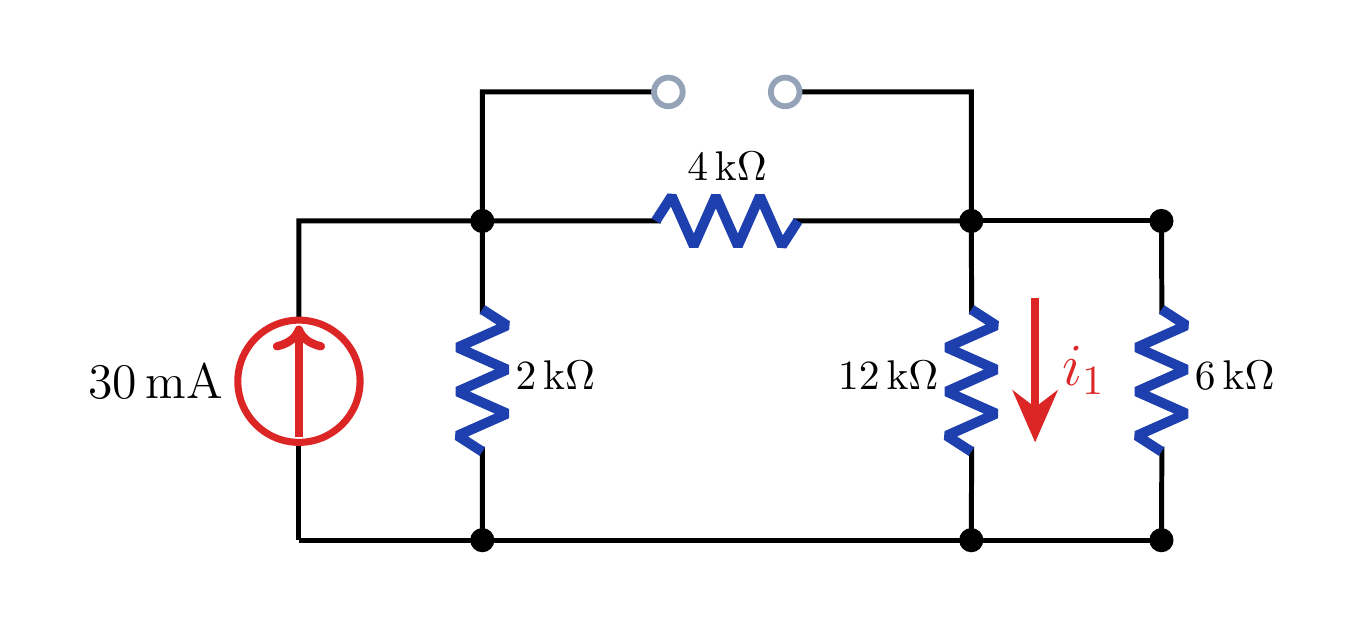
The 15 mA source is open and the 15 V source is shorted; the target contribution is i_1. Only the 30 mA source is activeCurrent division ⇒ 6 mA in the 8 kΩ path6 mA divides again across 12 kΩ || 6 kΩi1=2 mA ↓Narration transcript
First keep only the 30 milliamp source active. The 15 milliamp source becomes an open circuit, and the 15 volt source becomes a short circuit. The right-side 12 kilo ohm and 6 kilo ohm resistors are in parallel, so their equivalent is 4 kilo ohms. That is in series with the 4 kilo ohm resistor, making an 8 kilo ohm path. This 8 kilo ohm path is in parallel with the 2 kilo ohm resistor. By current division, the current in the 8 kilo ohm path is 6 milliamps. Then that current divides between 12 kilo ohms and 6 kilo ohms, giving i one equals 2 milliamps downward.
4. 15 mA contribution
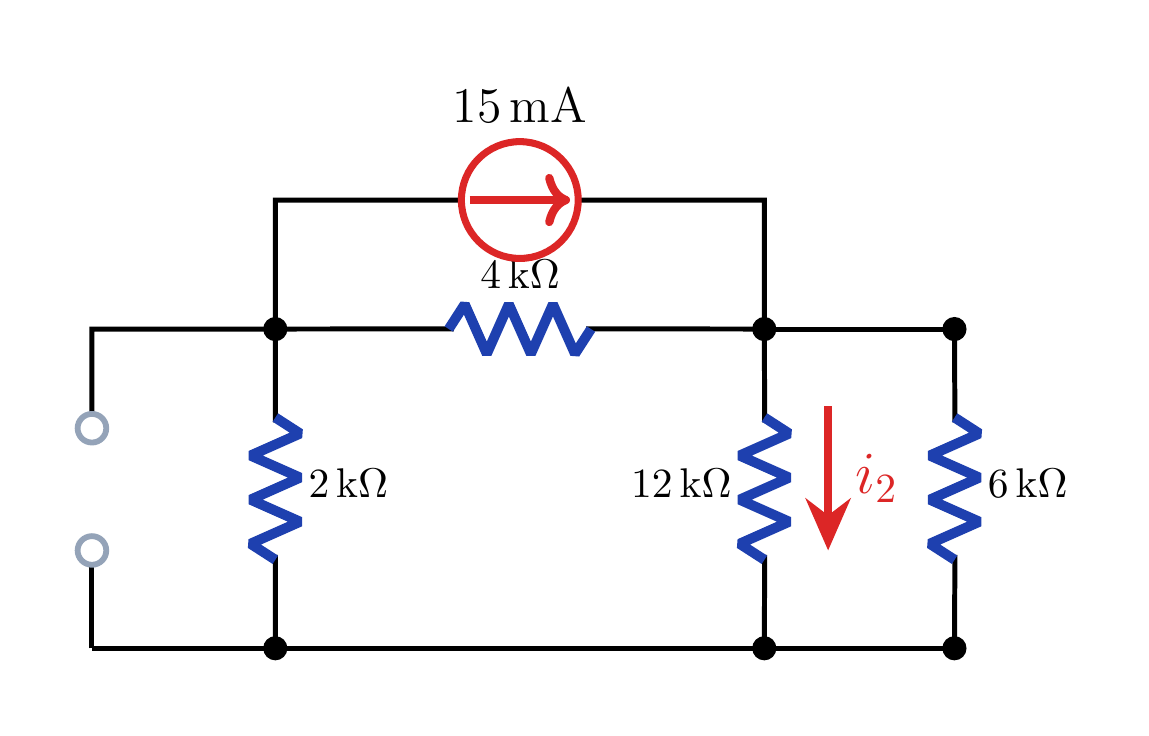
The 30 mA source is open and the 15 V source is shorted; the target contribution is i_2. Only the 15 mA source is activeLower path:Direct 4 kΩ branch || 6 kΩ lower pathCurrent division ⇒ 6 mA in the lower pathi2=2 mA ↓Narration transcript
Second keep only the 15 milliamp source active. The left 30 milliamp source is opened, and the 15 volt source is shorted. Between the two top nodes, the direct 4 kilo ohm branch is in parallel with the lower path made of 2 kilo ohms plus the parallel combination of 12 kilo ohms and 6 kilo ohms. That lower path is 6 kilo ohms. Current division sends 6 milliamps into the lower path, and the 12 kilo ohm branch receives 2 milliamps. So the second contribution is i two equals 2 milliamps downward.
5. 15 V contribution
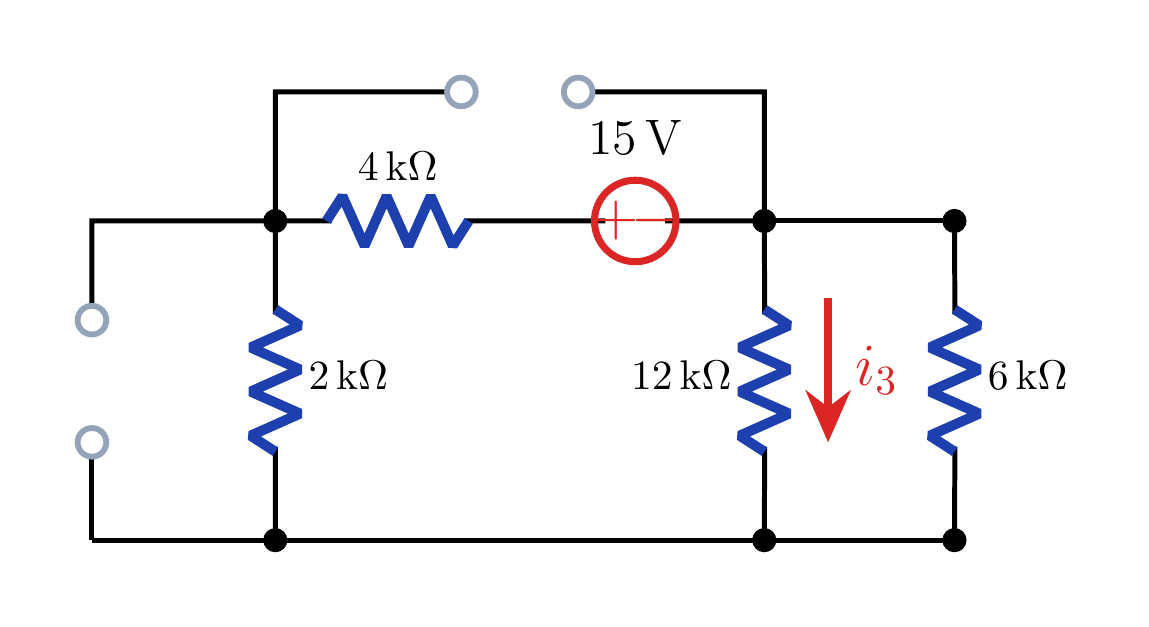
Both current sources are open; the target contribution is i_3. Only the 15 V source is activeRloop=4+2+(12||6)=10 kΩIloop=15/10=1.5 mAThe 12 kΩ current opposes the referencei3=−0.5 mANarration transcript
Third keep only the 15 volt source active. Both current sources are opened. The 12 kilo ohm and 6 kilo ohm resistors are again equivalent to 4 kilo ohms, so the loop resistance is 4 kilo ohms plus 2 kilo ohms plus 4 kilo ohms, or 10 kilo ohms. The loop current is 15 volts divided by 10 kilo ohms, which is 1.5 milliamps. That current makes the 12 kilo ohm branch current point upward, opposite to our reference direction. Therefore i three equals negative 0.5 milliamps.
6. Add the contributions
The red arrow marks the downward reference current i through the 12 kΩ resistor. i=2+2−0.5=3.5 mAAnswer: i=3.5 mA ↓A negative contribution is not an errorNarration transcript
Now add the three contributions with signs. The total current is 2 milliamps plus 2 milliamps minus 0.5 milliamps. Therefore the requested current is 3.5 milliamps downward. The important habit is to keep the reference direction fixed from the beginning. A negative contribution is not a mistake; it simply means that source pushes current opposite to the chosen reference.
Source video: Circuit Theory #20 | Superposition Method - Current in a 12 kOhm Resistor (3:38)