Communication Basics · The New Public Network
#02 Backbone and access digitalization, next-generation network targets, application requirements, backbone scaling, and SI prefixes
Analyze public-network transformation without mistaking legacy ratios for current facts; build network targets and capacity scenarios from measurable assumptions.
Question
Separate the backbone and local-access layers of the public network. Define measurable capacity, latency, interoperability, QoS, security, and programmability targets. Interpret petabit and exabit scenarios using user count, concurrency, codec, year, and source assumptions, and apply SI prefixes with correct symbols.
Written solution and narration transcript(shows the full solution)
Below are all the lines written in the notebook together with the full narration transcript.
1. Separate backbone and local-access digitalization
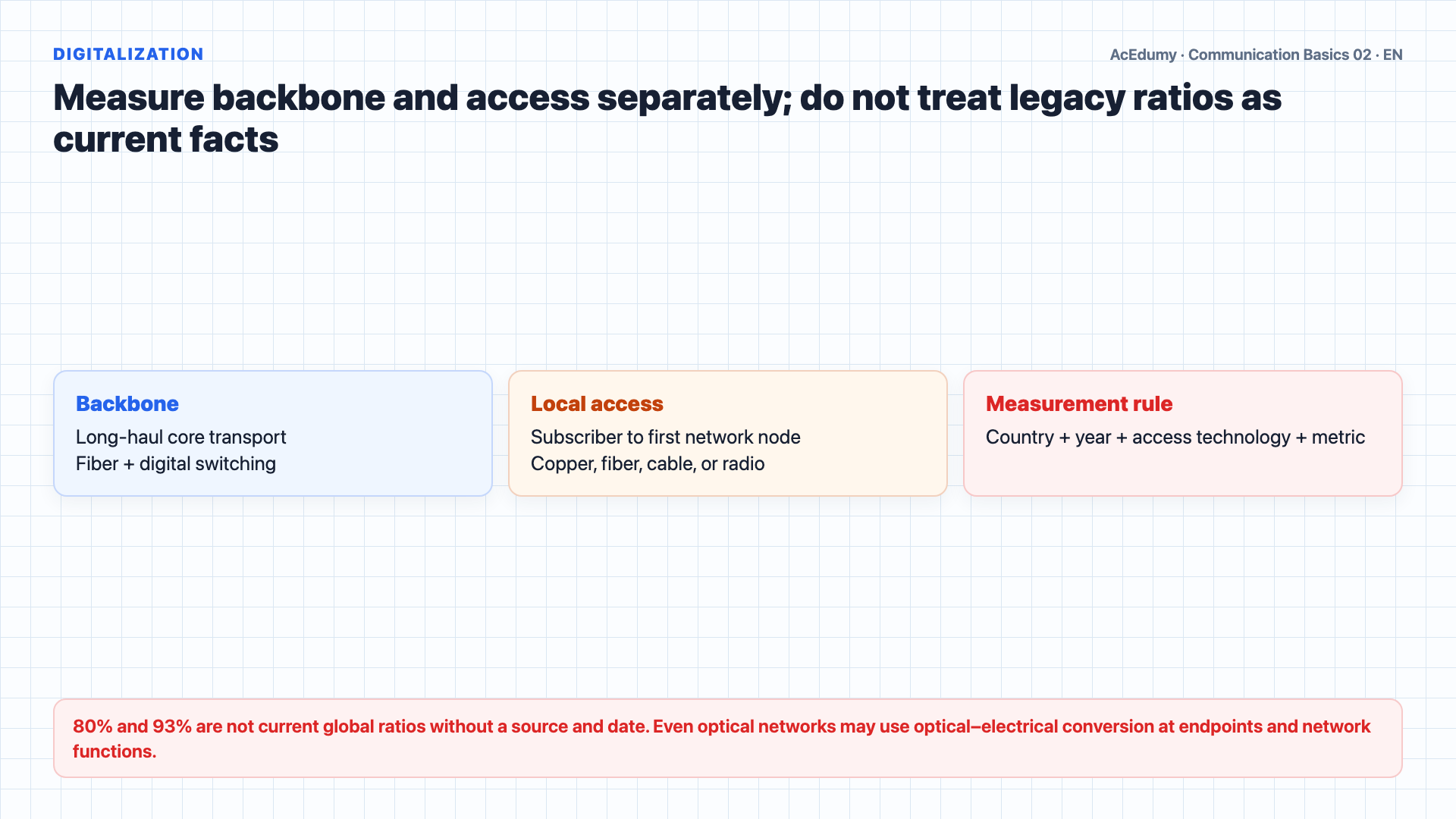
Public-network capacity is meaningful only when layer, application, users, concurrency, technology, and time scope are stated together. The public telephone network is undergoing a massive transformation.The source's approximate 80% backbone figure cannot be treated as a current global ratio without a source and date; backbone and access require separate metrics.The source's approximate 93% analog local-loop figure is historical and unscoped; a current value must identify country, year, and access technology.Modernizing local access is important for capacity and coverage, but internet and application growth cannot be reduced to broadband availability at every home and office.Optical transport can reduce conversion stages, yet endpoints and many routing, processing, and access functions may still use optical–electrical conversion.Narration transcript
The public telephone network is undergoing a massive transformation. Around 80 percent of the world's backbone networks have already been digitized. However, the local loop, the last mile connection between the subscriber and the network, remains about 93 percent analog. Digitizing this last mile is one of the biggest challenges in modern telecommunications, because without broadband access to every home and office, the internet and advanced applications simply cannot grow. Today's networks are electronic, but the future points toward end-to-end optical or photonic networking, where light carries data from source to destination without ever converting back to electrical signals.
2. Build measurable next-generation network targets
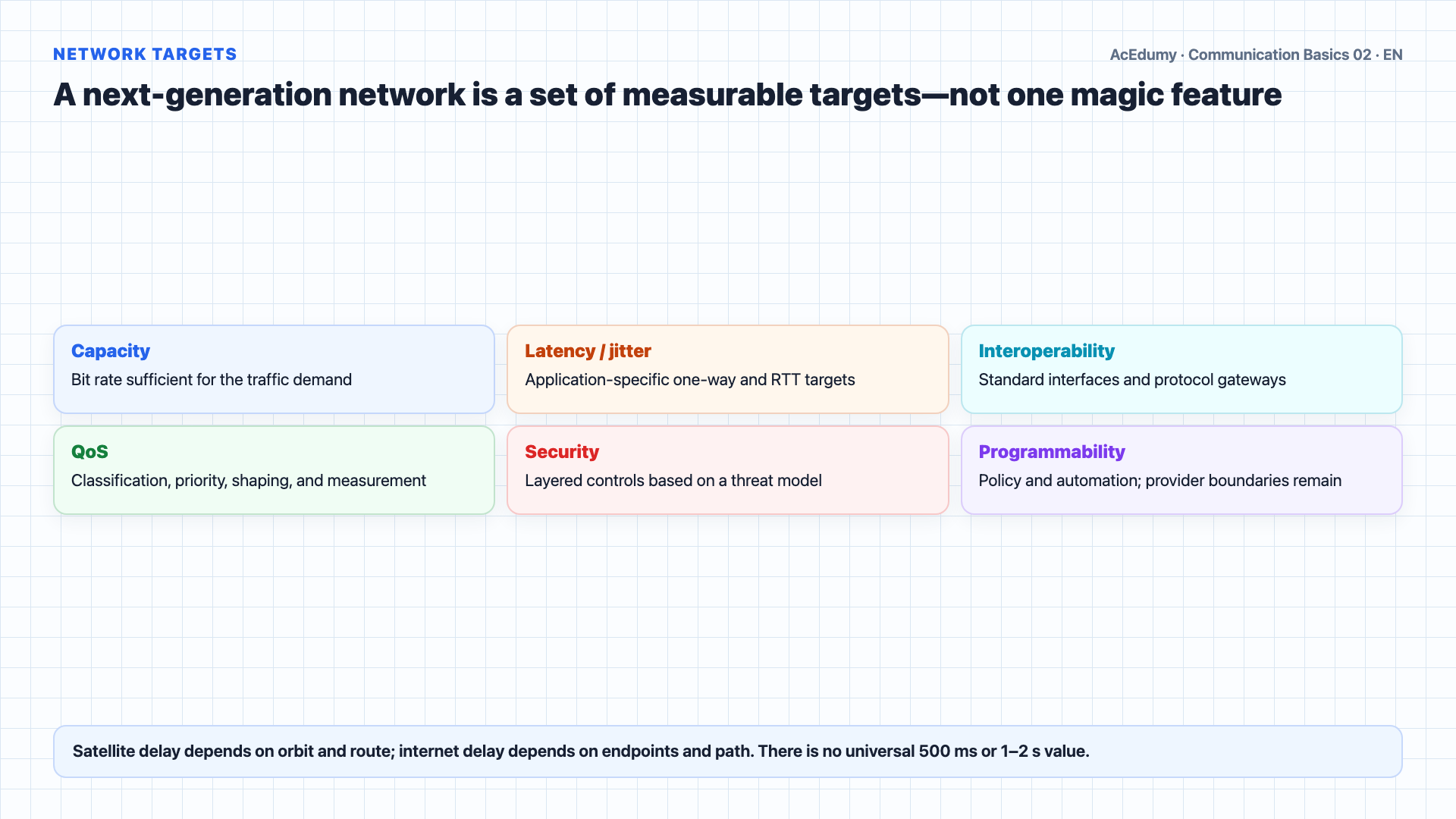
Public-network capacity is meaningful only when layer, application, users, concurrency, technology, and time scope are stated together. The new public network must be intelligent and programmable.Interoperability aims to broaden access, but service availability remains constrained by provider, regulation, identity, device, and geography.This requires six key characteristics.First, very high bandwidth infrastructure to support data-hungry applications.Second, multichannel capability, meaning one physical medium carries multiple channels of different traffic simultaneously.Third, low latency.Satellite RTT depends on orbit and routing, while internet delay depends on endpoints, path, and load; 500 ms or 1–2 s is not a universal typical value.The new network must minimize this.Fourth, interoperability relies on standard interfaces, encapsulation, and gateways; one interface cannot be assumed to handle every format and protocol natively.Fifth, QoS mechanisms manage bandwidth, latency, and loss targets; end-to-end guarantees require resource and SLA support across every domain.Sixth, security combines identity, authorization, integrity, confidentiality, monitoring, and encryption at the layers required by the threat model.Narration transcript
The new public network must be intelligent and programmable. From anywhere in the world, any service or feature should be accessible, regardless of which network provider or platform you are connected to. This requires six key characteristics. First, very high bandwidth infrastructure to support data-hungry applications. Second, multichannel capability, meaning one physical medium carries multiple channels of different traffic simultaneously. Third, low latency. Satellite links can have round-trip delays of 500 milliseconds, and today's internet often has one to two seconds of delay. The new network must minimize this. Fourth, the network must be protocol agnostic, able to handle any data format or protocol through a single interface. Fifth, Quality of Service guarantees, ensuring that bandwidth, latency, and loss requirements are met for each type of traffic. And sixth, built-in encryption and security to protect data at every layer.
3. Classify application requirements by QoS dimension
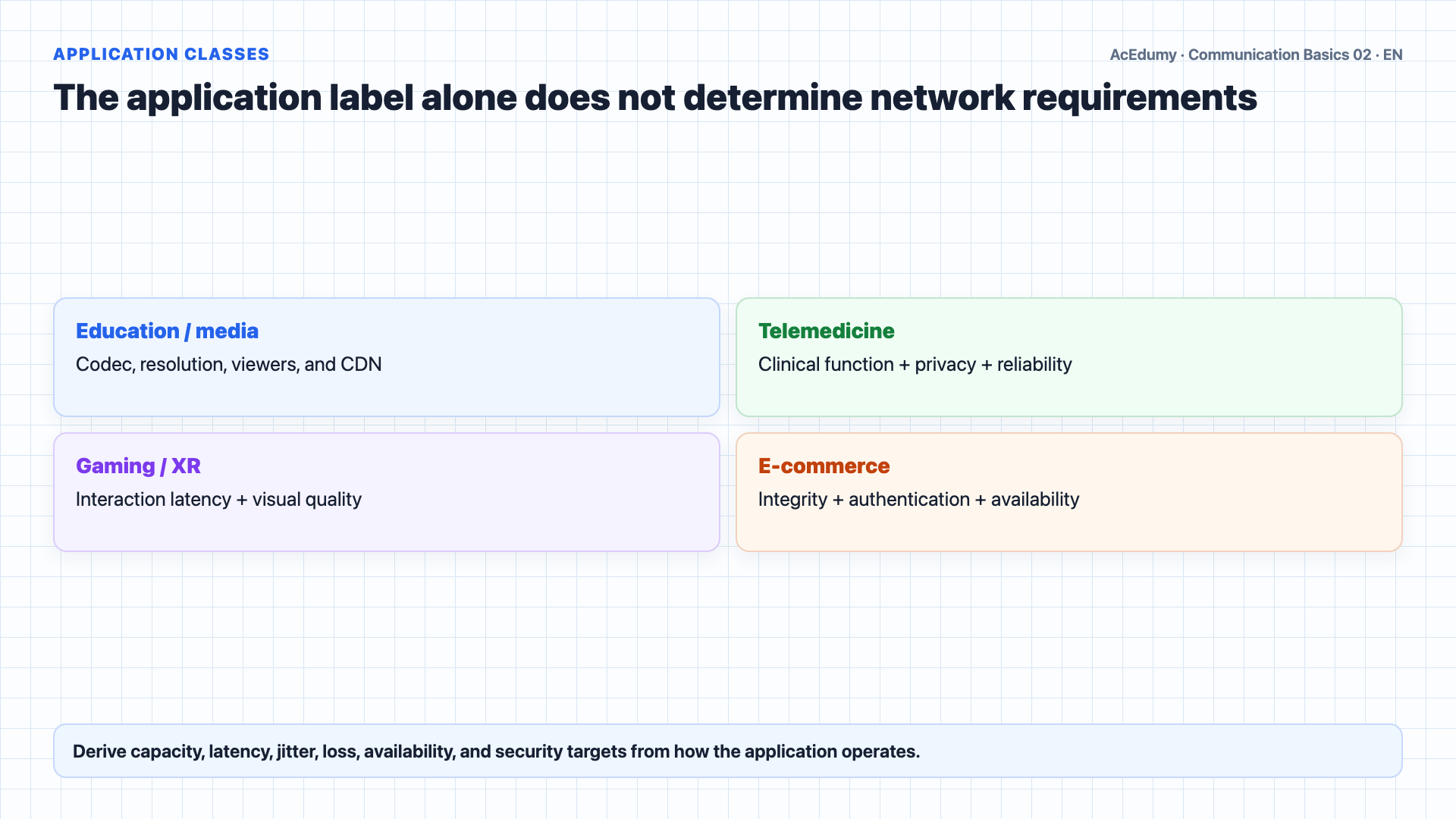
Public-network capacity is meaningful only when layer, application, users, concurrency, technology, and time scope are stated together. As networks evolve, entirely new categories of applications become feasible.Streaming media, online education platforms, and telemedicine consultations all depend on reliable, high-speed connectivity.Interactive multimedia, digital television, and three-D gaming push bandwidth demands further.Virtual reality applications, such as holographic telepresence, represent the most extreme requirements.And e-commerce and mobile commerce continue to grow, requiring networks that are both fast and secure.Narration transcript
As networks evolve, entirely new categories of applications become feasible. Streaming media, online education platforms, and telemedicine consultations all depend on reliable, high-speed connectivity. Interactive multimedia, digital television, and three-D gaming push bandwidth demands further. Virtual reality applications, such as holographic telepresence, represent the most extreme requirements. And e-commerce and mobile commerce continue to grow, requiring networks that are both fast and secure.
4. Scale backbone capacity with explicit assumptions
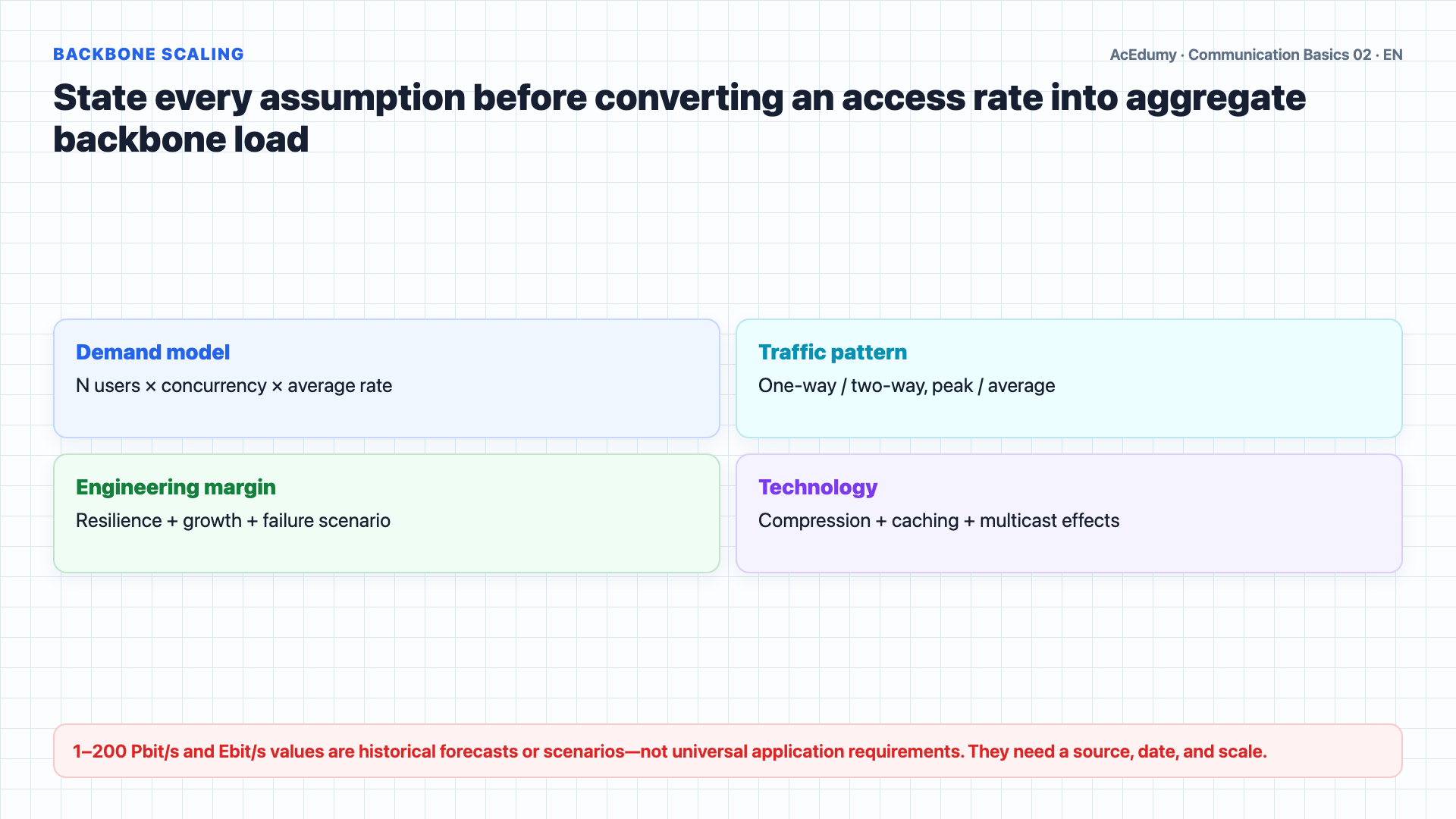
Public-network capacity is meaningful only when layer, application, users, concurrency, technology, and time scope are stated together. Let us look at the backbone bandwidth these advanced applications would require.The 1–70 Pbit/s value is not a universal VR or telepresence requirement without a source, date, representation, compression, user count, and network scope.A 50–200 Pbit/s machine-communications value must be treated as a scenario with device count, message size, reporting frequency, and aggregation scope.A 50–200 Pbit/s high-volume-computing value is not a general requirement without dataset, workflow, site count, and completion-time assumptions.Inferring Ebit/s aggregate traffic from 100 Gbit/s access requires subscriber count, concurrency, and average utilization; it is a capacity scenario.That is 10 to the 18th bits per second, a truly staggering number.Narration transcript
Let us look at the backbone bandwidth these advanced applications would require. Online virtual reality, including life-size three-D holography and telepresence, would need 1 to 70 petabits per second on the backbone. Machine communications for smart utilities, web agents, and robots would require 50 to 200 petabits per second. High-volume computing tasks like three-D computer-aided design and weather forecasting would also demand 50 to 200 petabits per second. And once residential broadband reaches 100 gigabits per second, the aggregate traffic would be on the order of exabits per second. That is 10 to the 18th bits per second, a truly staggering number.
5. Distinguish SI prefixes and bit/byte units
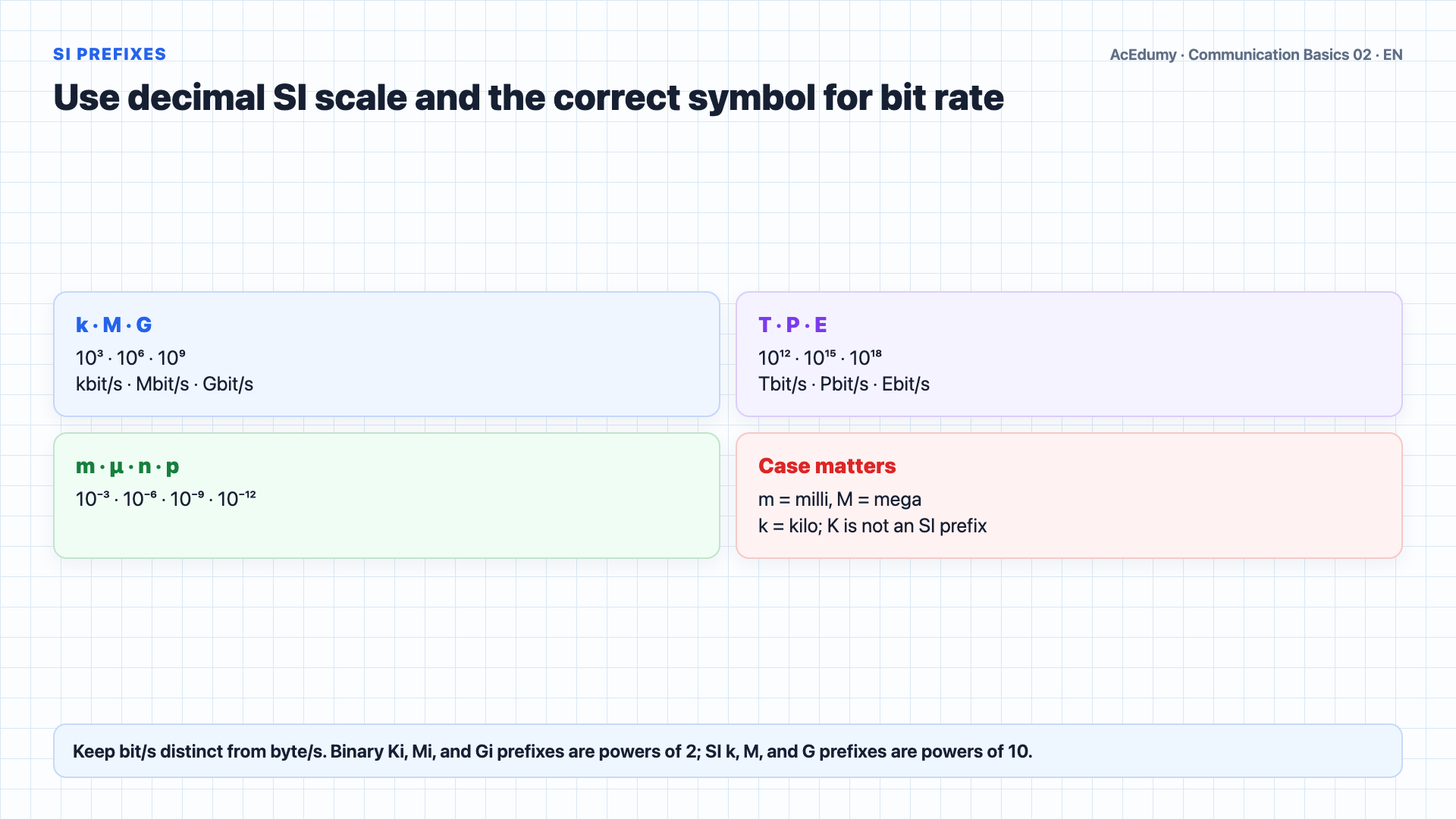
Public-network capacity is meaningful only when layer, application, users, concurrency, technology, and time scope are stated together. To make sense of these enormous numbers, engineers use SI prefixes.Starting from the most common: kilo means one thousand, or 10 to the 3rd.Mega means one million, 10 to the 6th.Giga means one billion, 10 to the 9th.Tera means one trillion, 10 to the 12th.Peta means one quadrillion, 10 to the 15th.And exa means one quintillion, 10 to the 18th.Going smaller: milli is one thousandth, micro is one millionth, nano is one billionth, and pico is one trillionth.You will encounter these prefixes constantly throughout this course, from kilobits per second for voice calls to petabits per second for backbone networks.Narration transcript
To make sense of these enormous numbers, engineers use SI prefixes. Starting from the most common: kilo means one thousand, or 10 to the 3rd. Mega means one million, 10 to the 6th. Giga means one billion, 10 to the 9th. Tera means one trillion, 10 to the 12th. Peta means one quadrillion, 10 to the 15th. And exa means one quintillion, 10 to the 18th. Going smaller: milli is one thousandth, micro is one millionth, nano is one billionth, and pico is one trillionth. You will encounter these prefixes constantly throughout this course, from kilobits per second for voice calls to petabits per second for backbone networks.
6. Summarize layers, targets, scenarios, and units
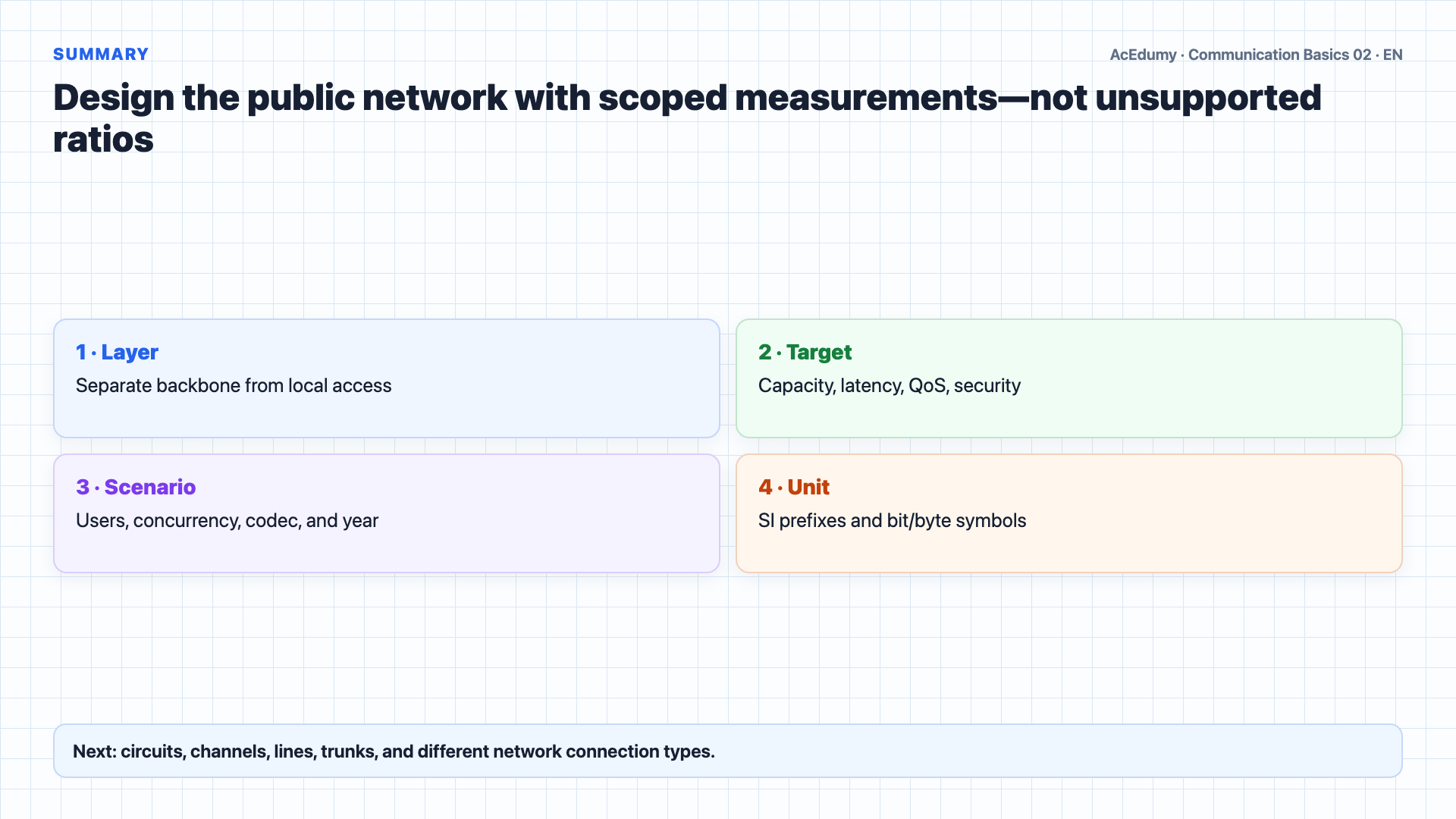
Public-network capacity is meaningful only when layer, application, users, concurrency, technology, and time scope are stated together. Let us review.The public network is evolving from analog to fully digital, but the last mile remains the bottleneck.A next-generation network design combines capacity, multi-traffic support, application-appropriate latency, interoperability, QoS mechanisms, and threat-model-driven security.Petabit and exabit scales are possible backbone scenarios only when source, date, users, compression, concurrency, and utilization assumptions are explicit.In the next lesson, we will look at the basic building blocks of any telecom network: circuits, channels, lines, trunks, and the different types of network connections.Narration transcript
Let us review. The public network is evolving from analog to fully digital, but the last mile remains the bottleneck. The new public network needs six key features: high bandwidth, multichannel support, low latency, protocol agnosticism, quality of service guarantees, and built-in security. Advanced applications like holographic telepresence could require petabits per second on backbone networks, and aggregate residential traffic could reach exabit scale. In the next lesson, we will look at the basic building blocks of any telecom network: circuits, channels, lines, trunks, and the different types of network connections.
Source video: Communication Basics #02 The New Public Network (4:39)